Millennial Doc Savage – Part 5

The DC Comics updating of Doc Savage to the present day ran for two special team-up stories and then 18 solo issues beginning in 2010, was wildly inconsistent — with remarkable highs and lows — and after the comic was cancelled, the rights to present the character in comics form shifted to another company. That publisher was Dynamite Entertainment, and they also planned to update Doc to the 21st century.

Of course there was no continuity between the story presentations of each company, so things with Dynamite went essentially back to square one. DC had utilized a reboot technique to transplant Doc into the time frame of 2010, but Dynamite took a different approach, beginning in the 1930’s and then moving forward through the decades. Doc’s survival across that arc of time was explained by his use of “silphium”, a plant introduced in the original pulp novel Fear Cay, which could be refined and ingested to produce human longevity.

In the Dynamite story, written by Chris Roberson, Doc experiments with the longevity drug on himself (and also uses it in a life-and-death emergency on his cousin Pat)…but on no one else. By the time he feels the drug is safe and begins preparations to share it with the world, a terrorist group destroys the installation that held the entire stockpile of silphium. So Doc will not age (and Pat, having received the drug only once, will only age slowly)…but everyone else ages and dies normally throughout the course of the story.

The story device to provide Doc with “immortality” felt a bit awkward, but at least it utilized plot elements from canonical pulp stories (though as Jeff Deischer points out in his comment below, not with complete accuracy…the life-extending qualities of silphium were debunked in the original novel). In any event, it allowed Doc’s whole pulp history to be utilized.

Beyond the technique used to carry Doc forward in time, the stories themselves attempted a coherent retelling of events between the 1930’s and 2014. This was carried out with a varying degree of success.

The Dynamite project certainly did correct one great flaw from DC’s attempted updating — creative continuity. The DC comic changed writers and artists almost constantly throughout its run, and the discontinuity was glaring. Dynamite used the same creative team throughout its series: author Chris Roberson, artist Bilquis Evely, and cover artist Alex Ross.

While that certainly made things more coherent, it provided problems of its own. The covers by Ross were brilliant…visually stunning to a degree that rivaled the great Bantam paperback cover artist James Bama. Evely, by contrast, provided somewhat pedestrian visuals. Her artwork across the arc of stories was competent, detailed (at one point I was amazed to see Evely depict the art deco designs of the elevator doors of the Empire State building…and they were absolutely correct. She clearly did her research) and consistent, but almost entirely lacked the dynamic power of Ross’ cover paintings. So after the thrill of the exterior package, the interiors were a distinct step down.

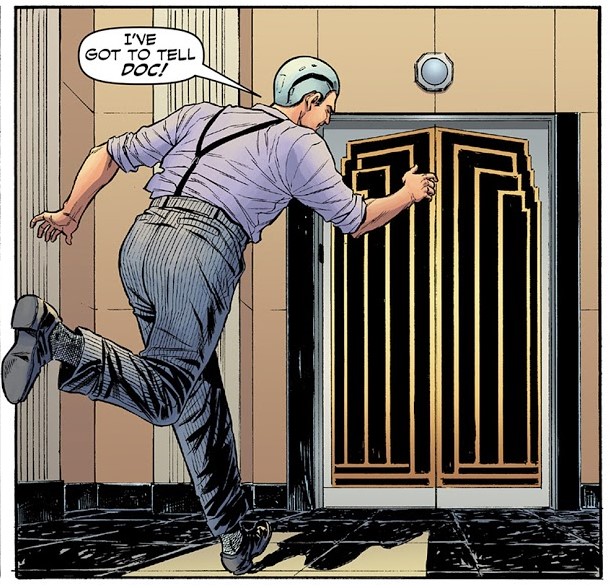
Empire state Building Elevator

Long Tom and an ESB elevator – art by Bilquis Evely

Roberson’s writing style exacerbated the effect. Though displaying a thorough and wide-ranging grasp of Doc Savage history, his sense of drama proved to be tepid, and characterization almost non-existent. Each story felt like a dry recounting of events…almost like a documentary. Doc’s aides were essentially ciphers, appearing for the purpose of advancing plot but little more. Doc’s original “Amazing Five” were depicted so shallowly they seemed to barely be there at all. Pat fared a little better, if only because she will go all the way through the 20th century in the story. The other aides age and die and are replaced by new characters…and in his zeal to repopulate the stories, the new characters are numerous, and unfortunately, equally wooden.

Issues 1-5 covered the decades from the Thirties to the turn of the century, and so I won’t explore the stories in depth here. With #6, the timeline crosses the year 2000, arriving in the Millennium.

But before exploring Roberson and Evely’s vision of Doc in the 21st century, here are the covers of the first five issues, all by Alex Ross.

To be continued…
Millennial Doc Savage – Part 4

In the first three parts of this article, I explored DC Comics’ 2010 effort to update the iconic pulp character Doc Savage into the 21st Century. Over the course of DC’s “First Wave” project, Doc appeared in a team-up alongside a new take on Batman, a mashup with an array of revived and re-imagined 20th century characters, and a very weak launch to a series of his own that was openly cartoonish and juvenile.

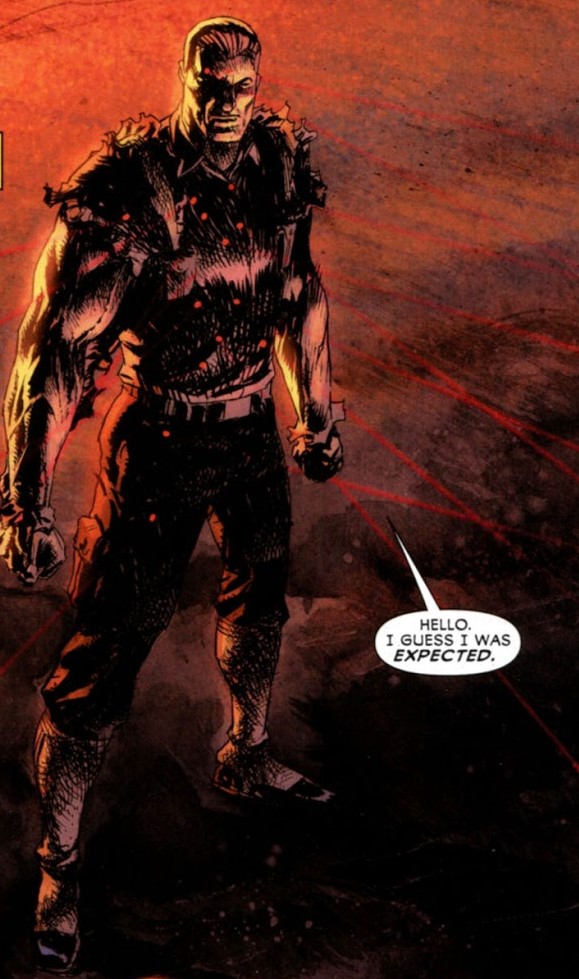
Then with issue #6 of the Doc Savage comic, the series did another abrupt about-face. It was much more in line with the concept originally proposed for Doc in the First Wave, in a bold attempt at more mature storytelling. It was strange, had some remarkable moments, and encompassed just one six-issue story arc.

It was, depending on your perspective, either one of the best or one of the worst attempts to meld the foundational concepts of the character to the tone of the modern world.

The earliest First Wave issues had given intriguing flashes of a harder-edged, more emotionally nuanced Doc Savage, but those glimpses had been swamped by a tidal wave of revived characters all jostling for space in the same storyline. The first five issues of Doc’s solo comic, with their childish tone, seemed to abandon a mature Doc Savage completely. But original First Wave author Brian Azzarello returned, and the artistic side of the series took a dramatic upward leap, with the arrival of Nic Klein (Klein would ultimately go on to draw some big comics headliners, including Captain America, Thor, and Deadpool).

Klein brought a grim dynamism to the character, with unique and powerful visuals. But it was the character of Doc Savage himself that underwent the biggest transformation.

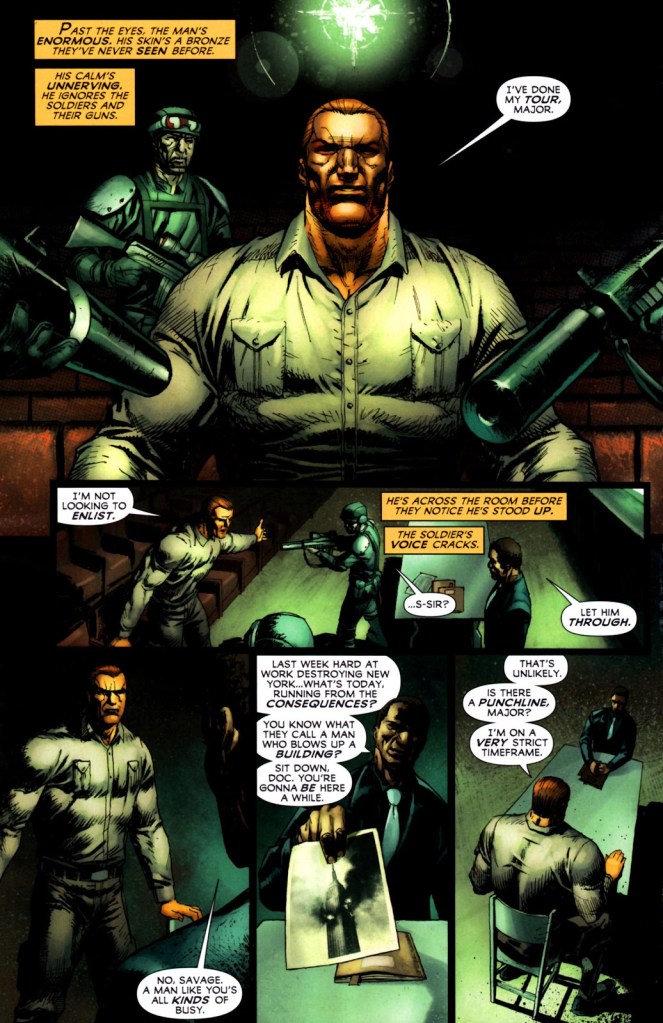
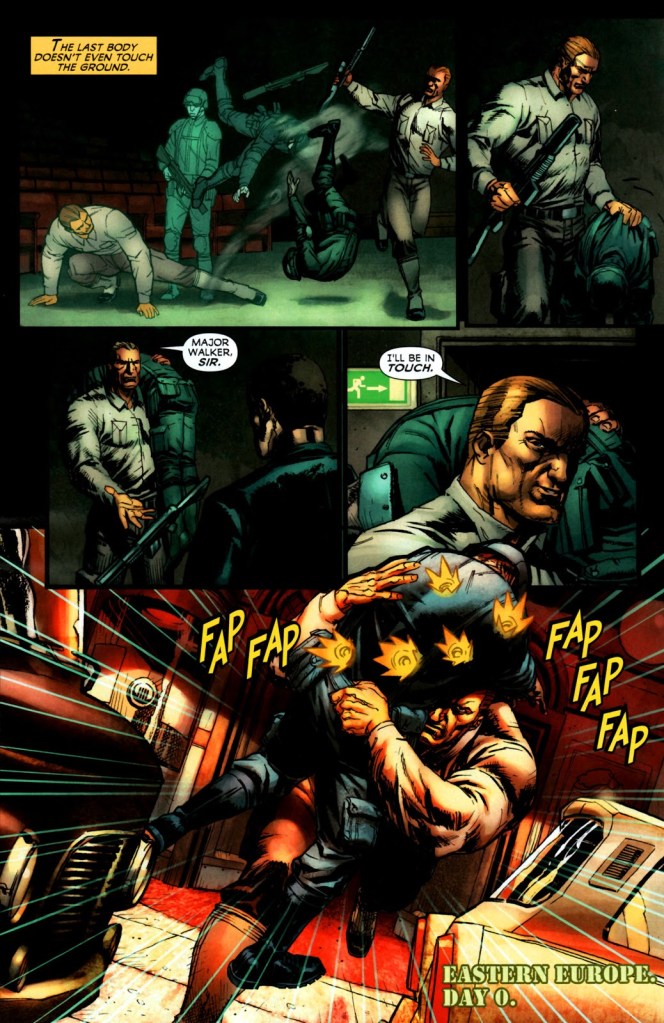
The original pulp Doc Savage, during World War II, was kept out of direct battlefield conflict by the government, who wanted him to be utilized in the war effort as a kind of troubleshooter extraordinaire. But in Doc Savage #6, Clark Savage is suddenly shown to be a veteran of the Gulf War.

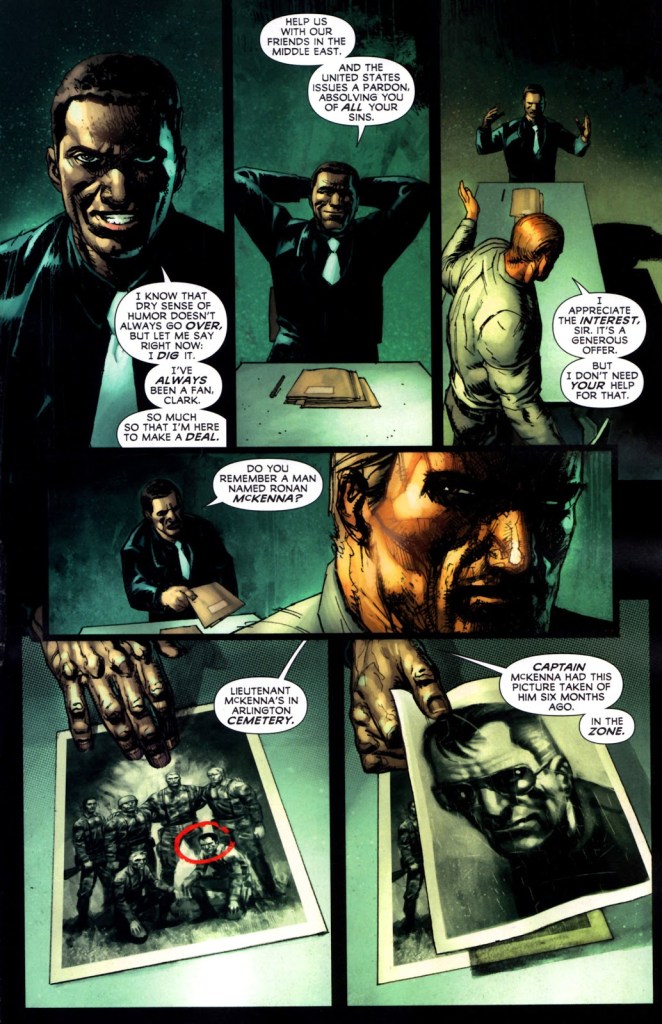
He makes reference to having “done my tour” (presumably his tour of military duty) but is not referred to by any rank, so his exact status is a bit vague. In any case the military wants him back, to handle a bizarre threat involving Weapons of Mass Destruction. He is recruited in a very blunt manner indeed:

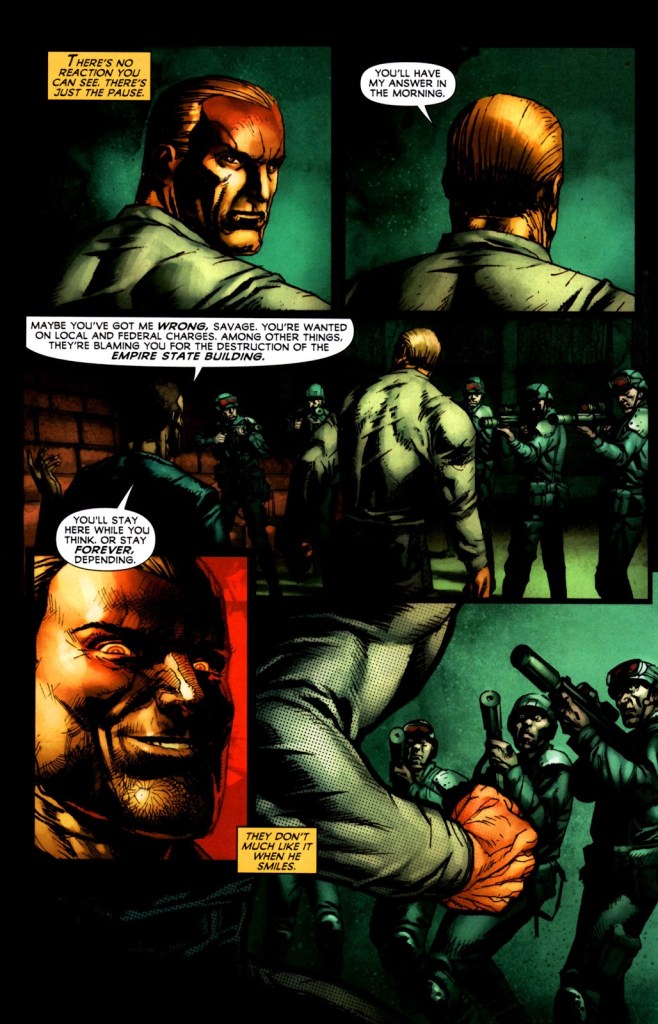
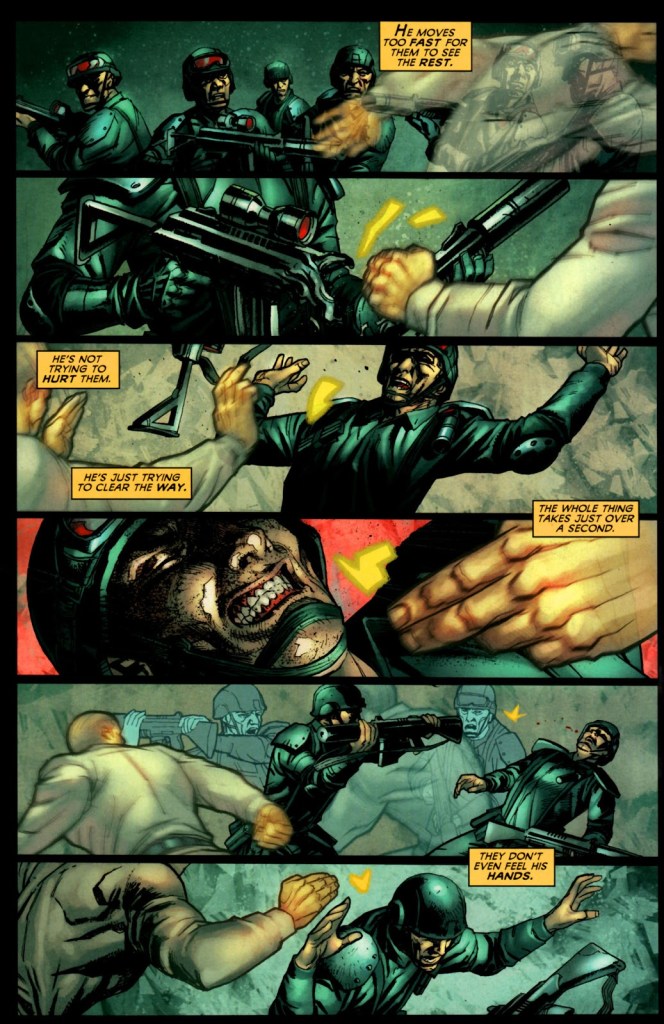
This gritty storytelling approach was quite unlike any Doc Savage seen before. Good thing or bad thing? That is debatable. But at least DC finally committed to presenting the harder-edged characterization they had visualized from the beginning.

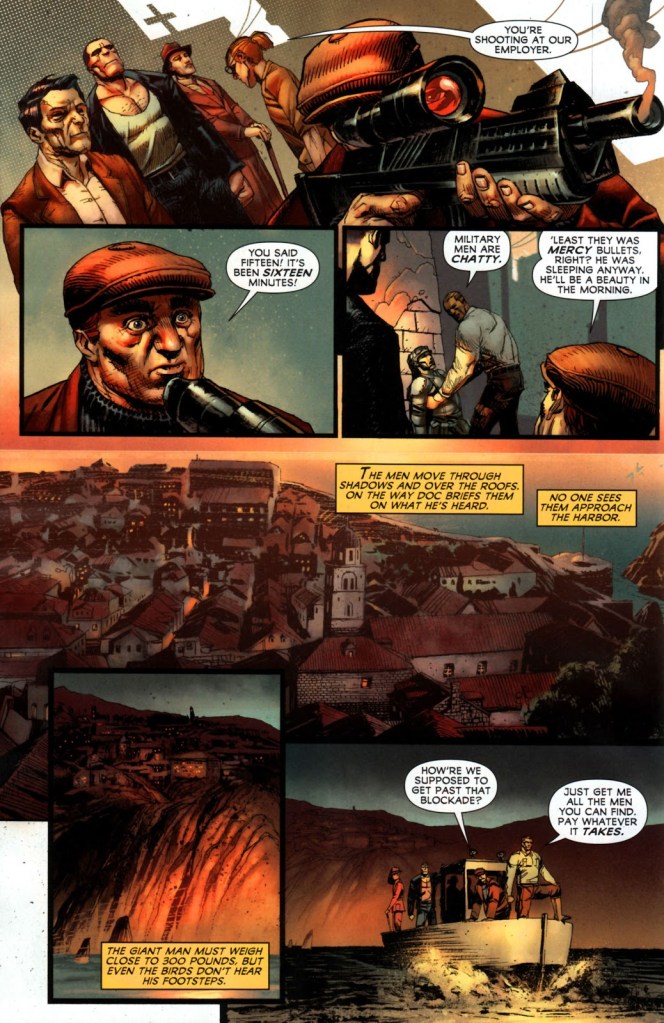
The story that followed had spectacular ups and downs. It was marred by inconsistency, as for some inexplicable reason, the six issue story arc bounced between the distinctive style shown above, and a much more traditional comic-book presentation of flashbacks and backstory. Azzarello teamed with a second writer, Ivan Brandon, with the two men co-plotting and Brandon providing the finished script. The backstory scenes, though serving the purpose of giving more detail to characters and motivations, were nevertheless a discordant departure from the main story. One entire issue, #10, was a flashback, done entirely by Brandon and artist Phil Winslade, whose more simplistic art was completely at odds with Klein’s visual pyrotechnics.

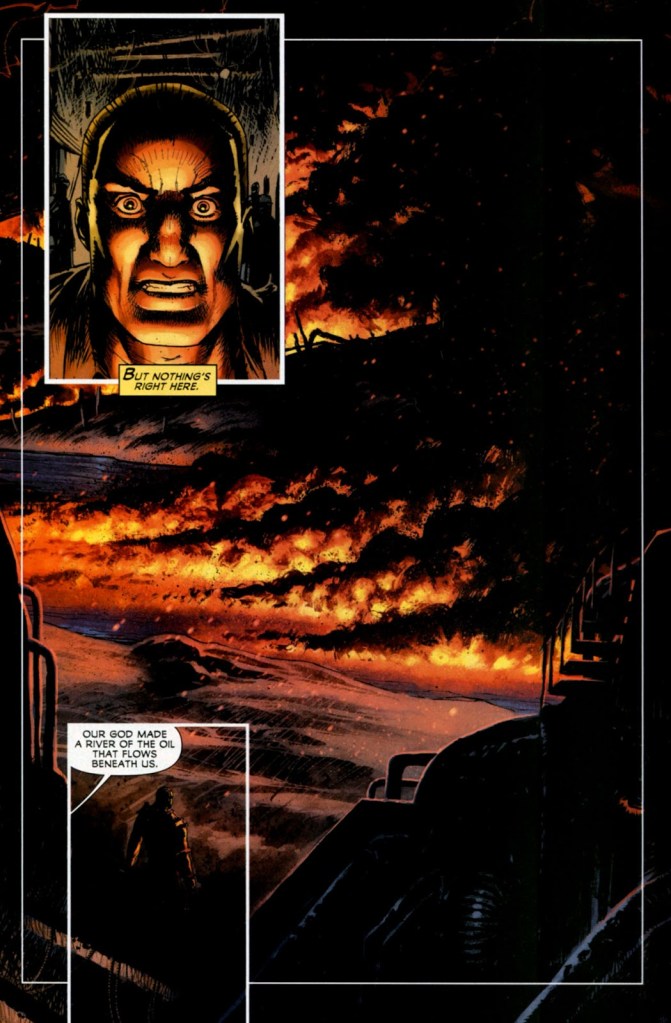
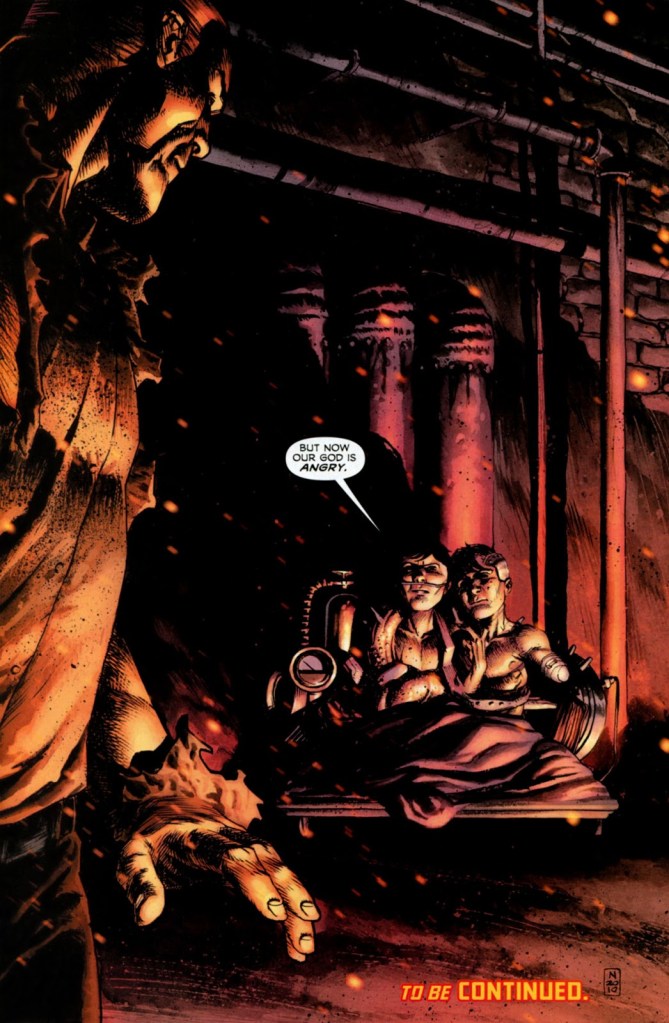
The main story was set in a Middle East location known as “The Zone”, which is cut off from the rest of the world by burning rivers of oil, constant darkness, and thick smoke. To portray this, Klein (who also colored his own artwork) used a palette of heavy black shot through with red and orange.

The story at times takes on compelling force (unfortunately blunted by the jarring backstory art/writing shift), but at other times seems to lose its direction entirely, veering into interludes that while striking, can be hard to follow or even to understand.

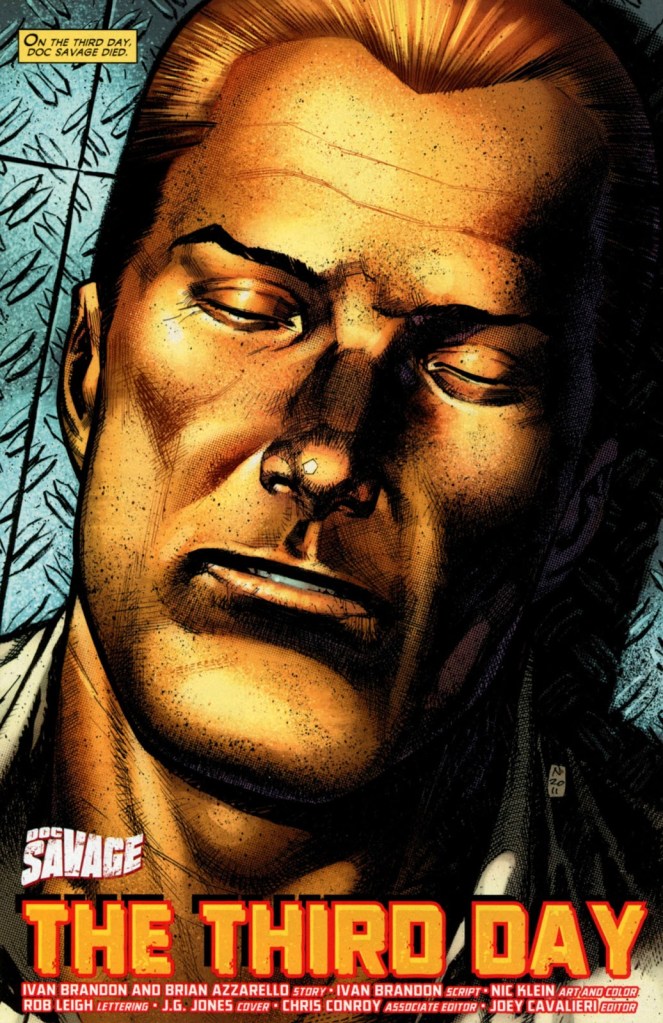
Fascinating, violent interactions with the people living in The Zone are interspersed with bizarre digressions, and ultimately a scene where Doc fights the villain, loses, and dies.

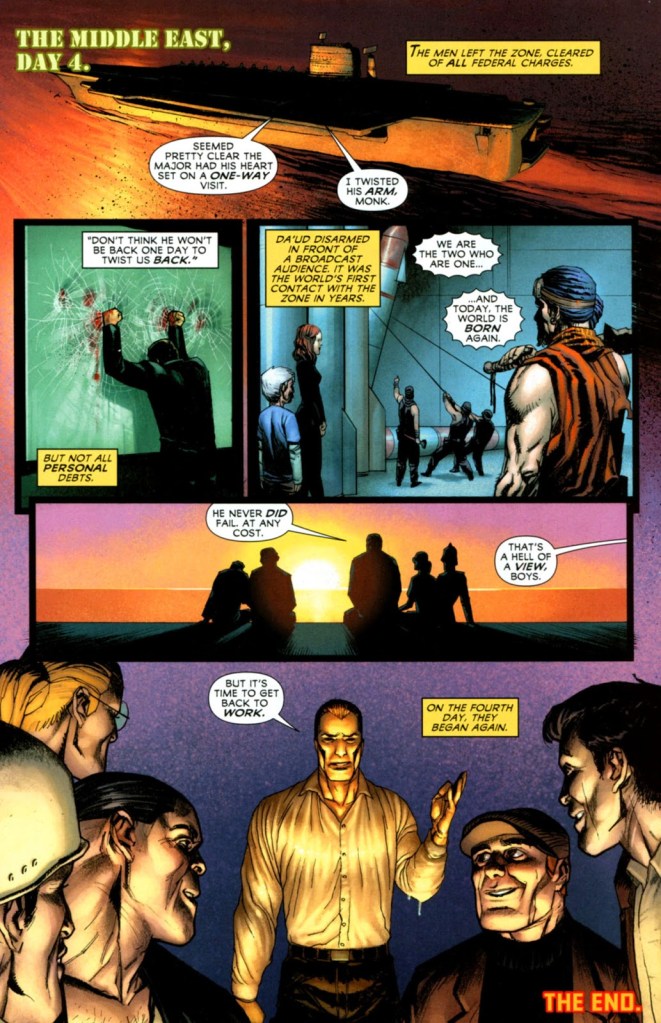
This development had a unique (if odd) intensity to it, as it was again presented with a harsh semi-realistic tone. But the writers wriggled out of it with an outrageous use of deus ex machina, with Doc resuscitated by a gadget implanted inside of his body long, long before…activated just in time for him to manually disable a missile in flight (also an abandonment of any shred of realism). Something of a mess…though when it was all said and done, the story concluded on an upbeat, and fairly promising note.

For all of its inconsistencies (the two-writer, two-artist approach…the lack of a coherent vision), it was a pretty wild and interesting ride. In fan circles during the presentation of the story, it was decisively hated by old-school Doc fans, with younger fans divided. But this style would never even be attempted again. The next issue, Azzarello and Klein both departed, and the whole direction of the series reversed itself again. It collapsed back into an uncoordinated and amateurish effort to recapture the old pulp style, loaded with cliches like mummies, dinosaurs, a Russian mad scientist, a super-soldier, a primitive tribe, and an attempt to resurrect a figure from history (in this case, Genghis Khan). Readers of the final issues of DC’s Doc Savage comic would have been far better served to read novels from the original Doc pulp canon, as nothing even faintly original would appear in the comic. The series died an ignominious death, with the final issue, #18, not even released in print, but only electronically.

And that was the end for Doc Savage in the DC Comics First Wave.

But it would not be long before the adaptation rights for the character would shift to a new publisher, and once again, an attempt would be made to update Doc Savage into the present day.

Next: Dynamite Entertainment’s “The Man of Bronze”.

Millennial Doc Savage – Part 3

One of the most challenging of literary ambitions is to carry an immensely successful, culturally iconic character from the early decades of the 20th century into an innovative and relevant re-imagining in the 21st. In Part 1 and Part 2 of this article, I looked at DC Comics’ 2010 effort to do exactly that with the character of Doc Savage. DC had launched a project called the “First Wave”, which essentially rebooted a number of notable 20th century characters into the present day. The first installments of the project, a Doc Savage/Batman team-up and a Doc/Batman/Spirit/Blackhawks/Avenger/Rima the Jungle Girl mashup, were not completely consistent in their vision, but did show elements of style and flashes of sophisticated storytelling. Production values were high, signaling what seemed a company commitment to quality for the project.

The next step after the introductory team-up stories, was to launch individual titles for the various characters. Since the greatest weakness of the first stories had been the inevitable discordance of mixing so many diverse characters in a single storyline, the individual titles, cleared of that impediment, were where I had hope for this concept to soar. Particularly with Doc Savage.

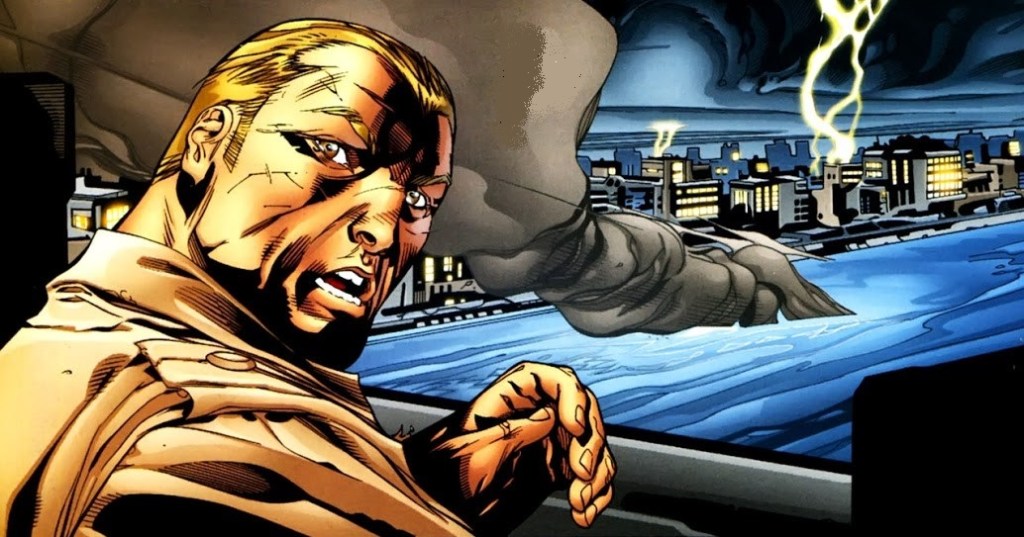
Instead of a more focused continuation of sophisticated 21st century art and story techniques, Doc Savage #1 came out of the gates as an epic fail. This look of stunned shock by Doc at the sight of a crash-and-burn in the initial multi-part storyline pretty much sums up my own reaction.

What happened? A very great deal went wrong. The comics medium is unique in that it has two distinct layers: writing and art. If both elements are brilliant, the stories produced can be stunning. If one of the two is strong, it can at least partly redeem a weaker effort from the other. But if both are weak…well, all hope is lost.

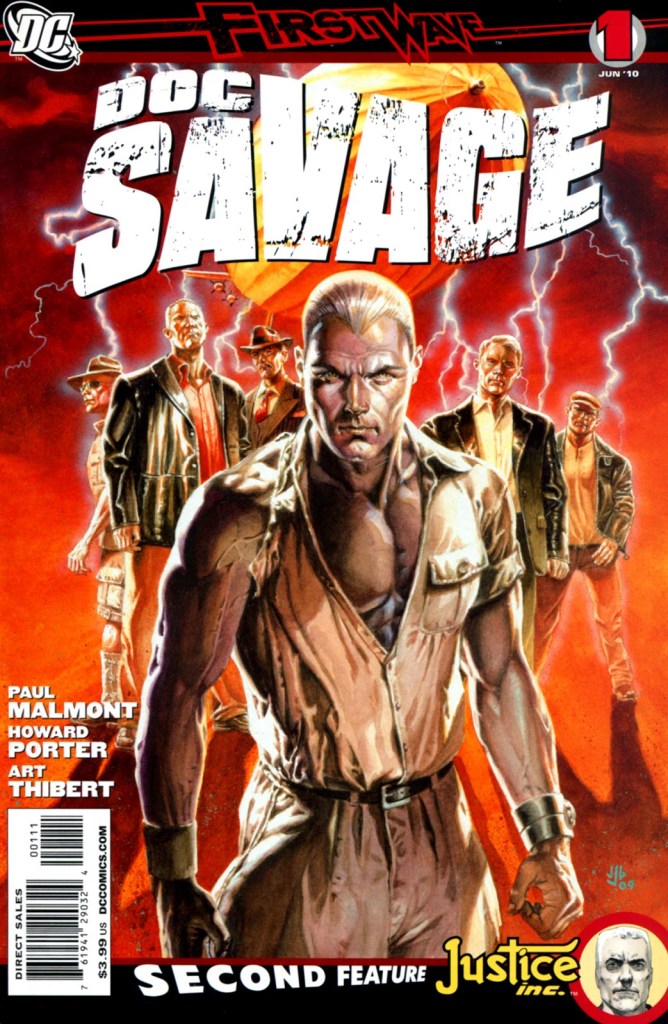
The cover image of Doc Savage #1, at least, had striking qualities. Done by J.G. Jones, it was a clear evocation of the James Bama style from the Bantam paperback series. Even that seemed to be a choice to look back rather than look forward, but it was still a dynamic image.

However, the opening page of the story itself brought an immediate crashing halt to the idea that an innovative, sophisticated tale was about to unfold.

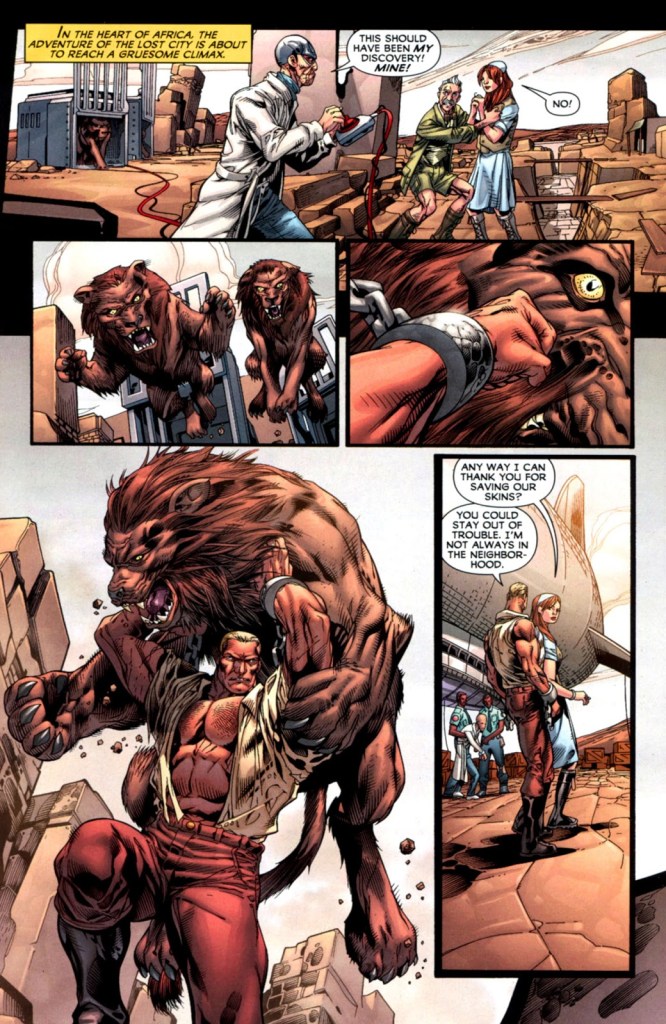
A nameless mad scientist releases lions on innocent bystanders…Doc Savage, his anatomy grotesquely exaggerated, is shown doing some lion-fighting, and the dialogue is entirely empty one-liners. Reading it, for a few seconds I thought Page 2 might show the modern Doc watching a cartoon of himself, perhaps chuckling a little at its crudity. But no…that was really the tone of the whole story to follow.

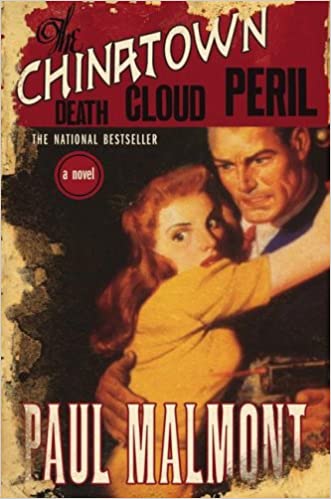
Brian Azzarelllo had been the author of the two previous First Wave stories, but here the authorship shifted to Paul Malmont. There was certainly reason for enthusiasm in the choice…Malmont had written a bestselling novel called The Chinatown Death Cloud Peril, which starred, of all protagonists, Doc Savage pulp author Lester Dent and Shadow author Walter Gibson in a pulp-style adventure.

In retrospect there were a few red flags coming out of the novel…despite its clever premise, the writing had an adolescent tone…but nevertheless it was entertaining and certainly displayed Malmont’s love of the pulps and knowledge of their history. In interviews he showed great enthusiasm at the prospect of writing an actual Doc Savage tale.

That it should emerge as flat and uninspiring as it did felt almost inexplicable. For the four issues written by Malmont, all of the more sophisticated style that had been teased by Azzarello was jettisoned. The story was a retread of concepts done better elsewhere (the “Lord of Lightning” theme had been done by Doug Moench 35 years earlier in the first issue of Marvel’s superior black and white magazine), the characterization was wooden, not just for Doc but for all the characters. They were given to a succession of empty one-liners just like that disastrous first page, and instead of taut plotting, the story was a succession of explosions and vapid action scenes. The Empire State Building has its top sheared off (in somewhat questionable taste within a decade of the World Trade Center terrorist attacks), the Hidalgo Trading Company is reduced to rubble…when the plot bogged down, it became predictable that something would explode in order to prop up the action. Though it was an alternative “real world”, Malmont seemed to lose track at times of common sense — after the Empire State takes its pounding, Doc comments to Renny that the engineer had built the structure well for it to have survived at all — seemingly forgetting that the building had been erected 80 years previously, which would have made Renny over 100 years old in a reboot setting of 2010.

The art, by Howard Porter, remained distinctly cartoonish throughout. Even with the expected exaggerations of comic book storytelling, Porter had difficulty drawing the human body, and his grasp of facial expression was limited. It felt as if all the ambition of the First Wave launch had been summarily abandoned.

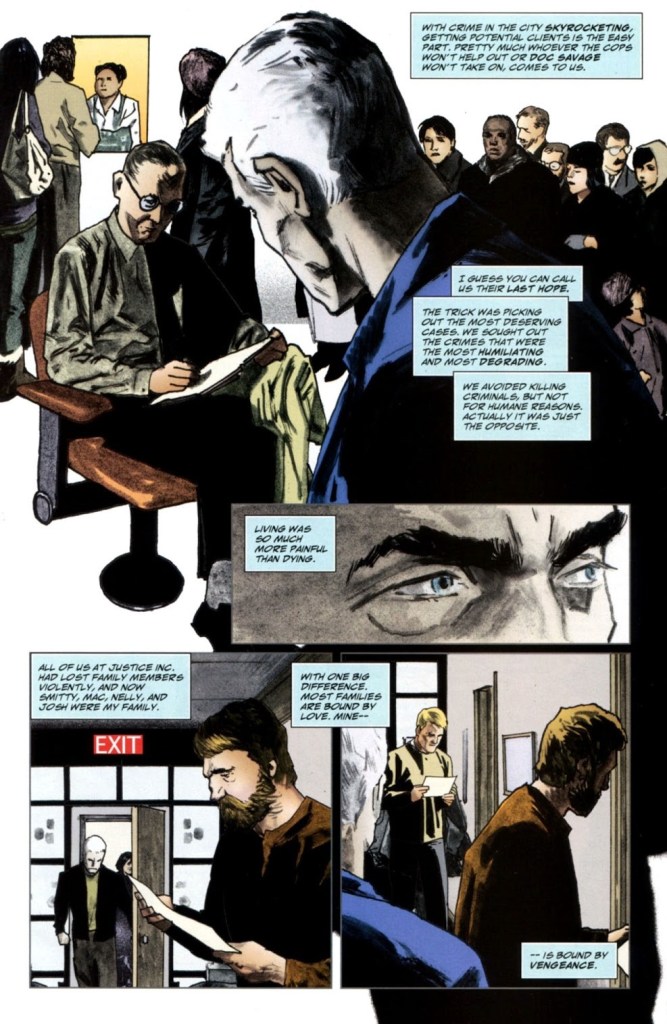
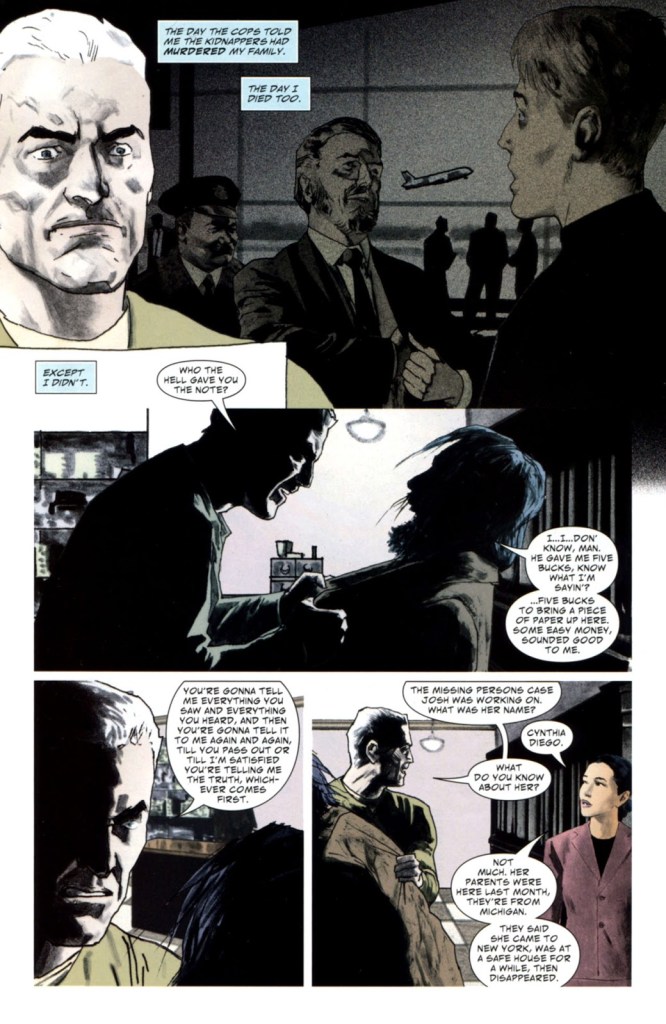
Complicating matters further, each issue had a backup story featuring one of the other great pulp heroes of the Thirties, The Avenger. The tone of those stories was the polar opposite of the Doc Savage feature: in TV terms, if the Doc story felt like a Saturday morning cartoon, the Avenger story, with a dark artistic palette, realistic dialogue and unrelenting hardnosed approach, had the feel of a particularly gritty HBO crime drama.

That choice of tone and style can be debated (and has been, hotly — the Avenger serial was enthusiastically lauded and profoundly hated by a variety of fans), but at least it was bold, and true to the premise of storytelling aimed at a more sophisticated audience. Appearing as it did along with the juvenile Doc feature, the two could not have been more ill-suited to be shown in the same book, even as separate stories.

This approach would continue for the next five issues, at which point there was a major change in the Doc feature. Brian Azzarello would return, and the art would have a major upgrade…kindling hope again that something of substance could come of Doc Savage set in the 21st century.

to be continued…

Talos Fan Fiction Contest #15 – The Abduction

Note from Doc Talos author/contest judge R. Paul Sardanas: Steve Donoso is a prominent figure in the pulp community, editor/founder of the new pulp journal,
The Shadowed Circle, the first ongoing publication about Walter Gibson’s iconic character in over two decades. Their Facebook page is:

facebook.com/Burbank1931

Steve combines two classics in his story The Abduction: the world of Doc Savage (through the pastiche of Doc Talos), and the brilliant 1960’s TV series The Prisoner. What would happen if one of Doc’s men were kidnapped and taken to the Village? Time to find out…

Comment from author Steve Donoso: The Abduction came out of my wanting to write a story that combined two of my favorite series: Doc and Patrick McGoohan’s television series, The Prisoner. Within the story there are very brief nods to:
Danger Man (titled Secret Agent in the U.S.), the espionage television series that McGoohan starred in prior to The Prisoner.
Unearthed, the third story in William Preston’s series homage to Doc and Pulp Heroes.
– And another nod that I won’t mention because it would be a story spoiler
Many things were not completely spelled out in
The Prisoner, some only hinted at, and I have tried to bring that sense of mysterious unknowing into this story as well. Why exactly was Tom abducted? Was it for information, an invention he was working on, his connection with Doc? What did his captors really want? These characters did not impart the answers to me, so I can’t really say for sure. The interpretation(s) are up to the reader. I have only ever written one other piece of fiction, which coincidentally involved the Street & Smith Doc series, and I enjoyed writing this second one. Thanks for reading it!

Steven Donoso is the author of  Returning The Gift: Dialogues On Being At Peace Within Ourselves and the World, with Eckhart Tolle, et al., now in Paperback www.amazon.com/dp/0989902730 and e-book, as well as Unknown Skies: Leslie Kean and the Case for Rational UFO Investigations http://www.amazon.com/dp/B00U6I9GGU

Additional note: If you are interested in submitting fiction to the Summer 2021 contest (first prize is a Bantam Doc Savage paperback Czar of Fear first edition, signed by James Bama, and all contestants will appear in a special souvenir paperback collection of the stories) you can read the contest guidelines HERE.

Millennial Doc Savage – Part 2

A character created in the 1930’s, and adeptly designed to tap into the dreams, hopes, and fantasies of the Depression-era world, Doc Savage was one of the most popular figures in adventure fiction, and arguably fiction as a whole at that time. Over and over, more modern authors, artists and publishers have tried to carry the unique quality of his character and adventures forward into the present day. It’s been attempted in decade after decade…most often in comic book adaptations of Doc Savage. In Part 1 of this article I began a look at one of the more ambitious attempts to update Doc: DC Comics’ “First Wave”.

The concept of the First Wave was to take various classic 20th century characters, bypass any effort of story-structure that would directly link them to their original chronologies, and simply reboot them into the 21st century. The “reboot” itself is a recurring 21st century phenomenon; it is common in books, comics and films now to restart an iconic franchise. With equal frequency as producers, creators, or public taste changes, that reboot is abandoned and re-rebooted. It’s an approach with distinct pros and cons. Effectively, it disconnects readers or viewers from any sense of long continuity with a favorite character, which allows each new creative team a broad, fresh canvas for their own vision. But it is very different from the entertainment zeitgeist of the 20th century, where long continuities actually linked iconic characters to fans across generations. Something potentially powerful is gained, but something very rich is also lost.

After the joint story with DC’s Batman in the opening story of the First Wave comics, a six-issue storyline with Doc and Batman followed, this time adding another character with immense popularity from the 20th century, The Spirit. The signature creation of comics innovator Will Eisner, The Spirit was a series that also ran for decades, cultivating a devoted readership.

The writer continuing this project was Brian Azzarello, this time teamed with artist Rags Morales. The production values of the series were high, signaling (at least at the beginning) a commitment to a quality product.

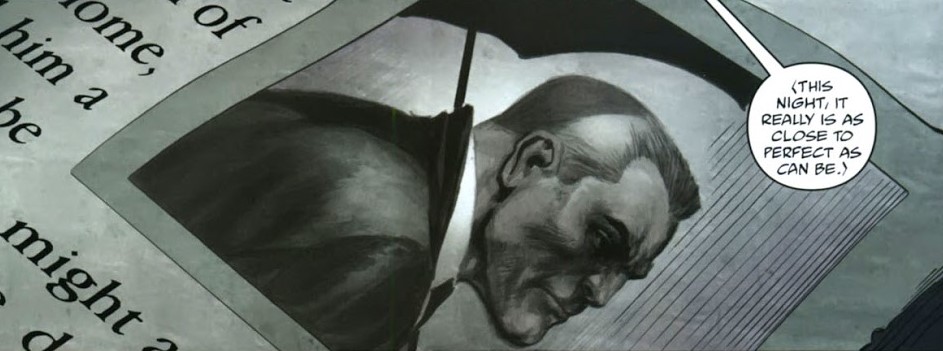
About midway through the first issue, I was struck by a single panel…a newspaper photo of Doc Savage at his father’s grave.

In a way it summed up my initial impressions of this Doc Savage of the new Millennium. The powerful, chiseled features are there…he is instantly recognizable, but with a quality of introspection unusual for the character.

Many Doc Savage fans, strongly connected to the pleasure they experienced reading the exuberant adventures of the 1930’s pulps, have no interest in this kind of depiction of Doc. And that is understandable — those reading experiences were exciting and inspirational. I myself return to them over and over to re-live those qualities that so defined them: wonder, agency in a world that often felt oppressive, adventure and freedom. Those stories will always carry a glow of immense personal joy for me.

But there are qualities of the Doc Savage character that make him — potentially — equally alluring to readers in our present world. Qualities of rich intelligence and insight, humility, idealism and practicality…a sense of vision tempered by reason and thought. If Doc is to be rebooted into the 21st century, there is great appeal for me in seeing qualities like that explored.

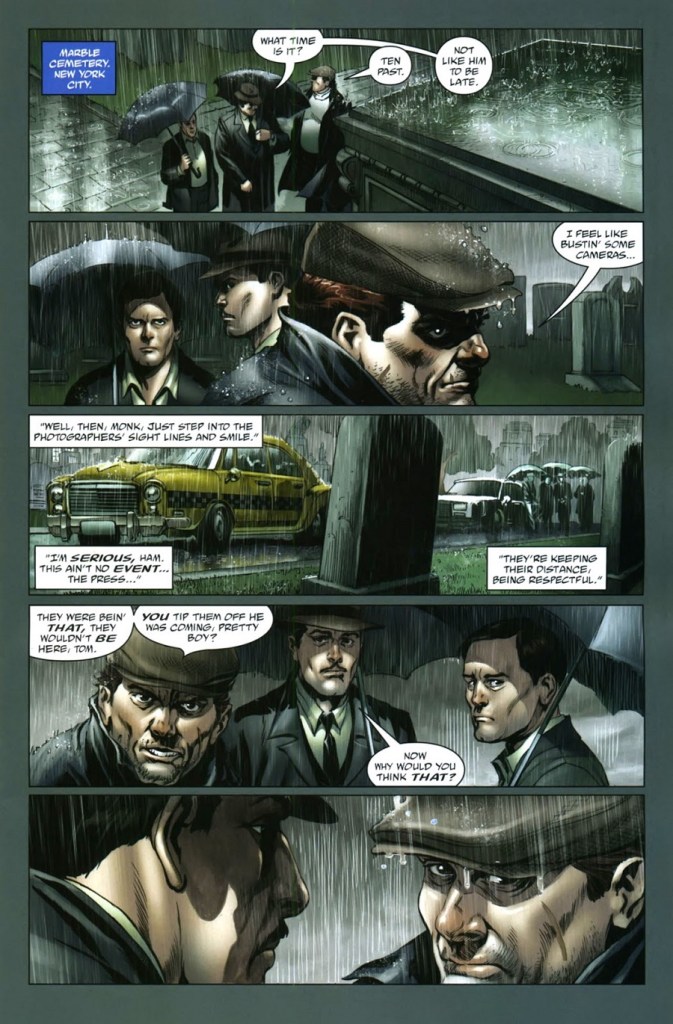
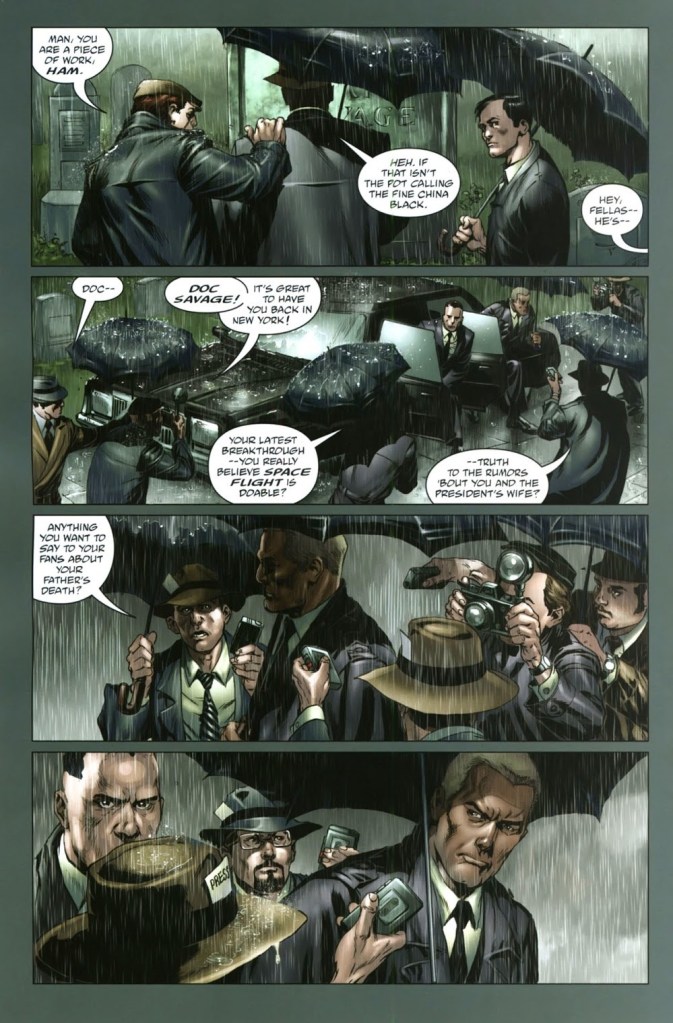
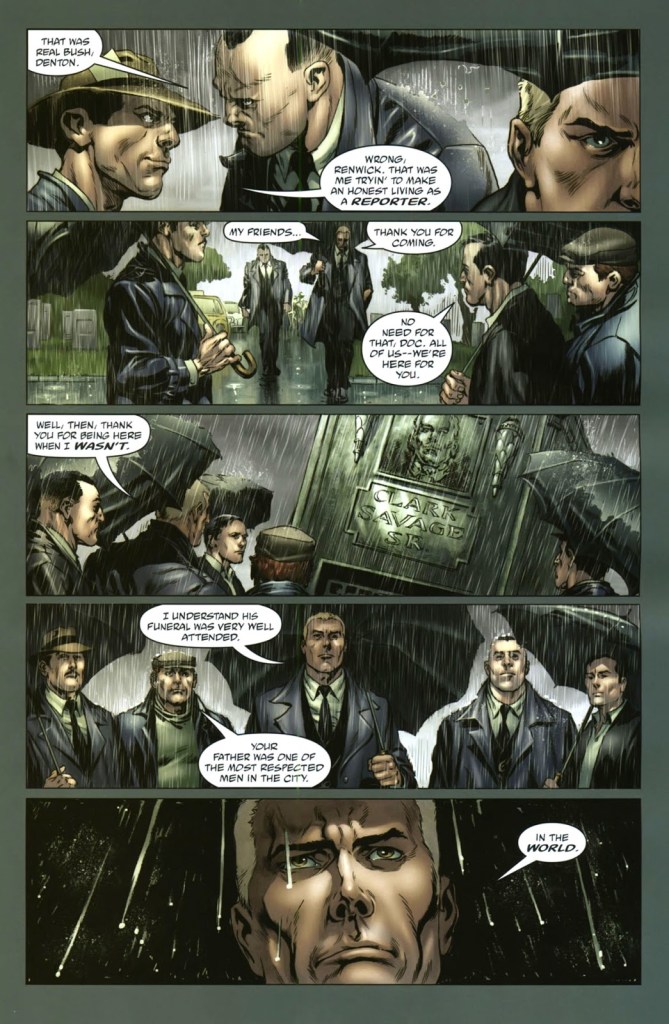
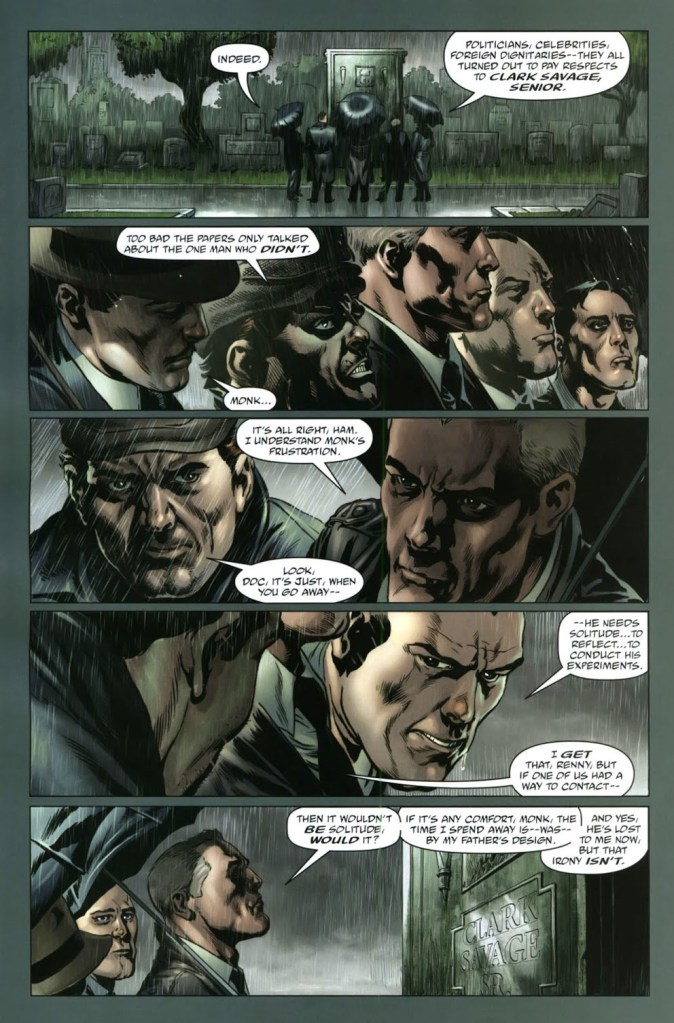
Here is the actual scene at the gravesite of Doc’s father. It is somber, but there is hope in it as well, and at his heart, the character of Doc Savage can come to embody hope. He’s accompanied by Monk, Ham, Long Tom and Renny (Johnny is elsewhere in the story at this point).

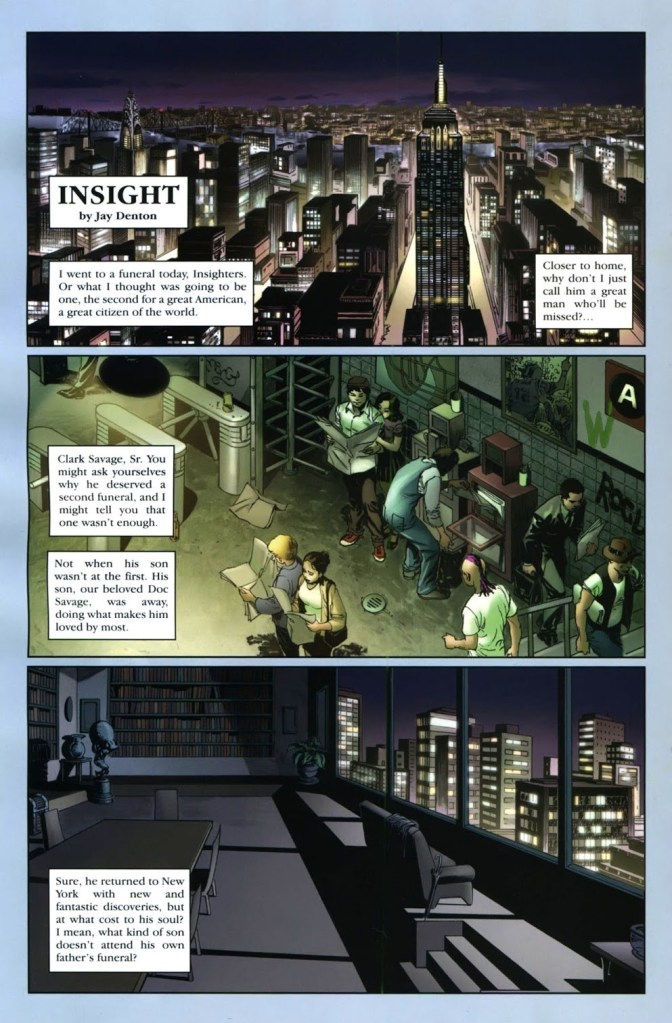
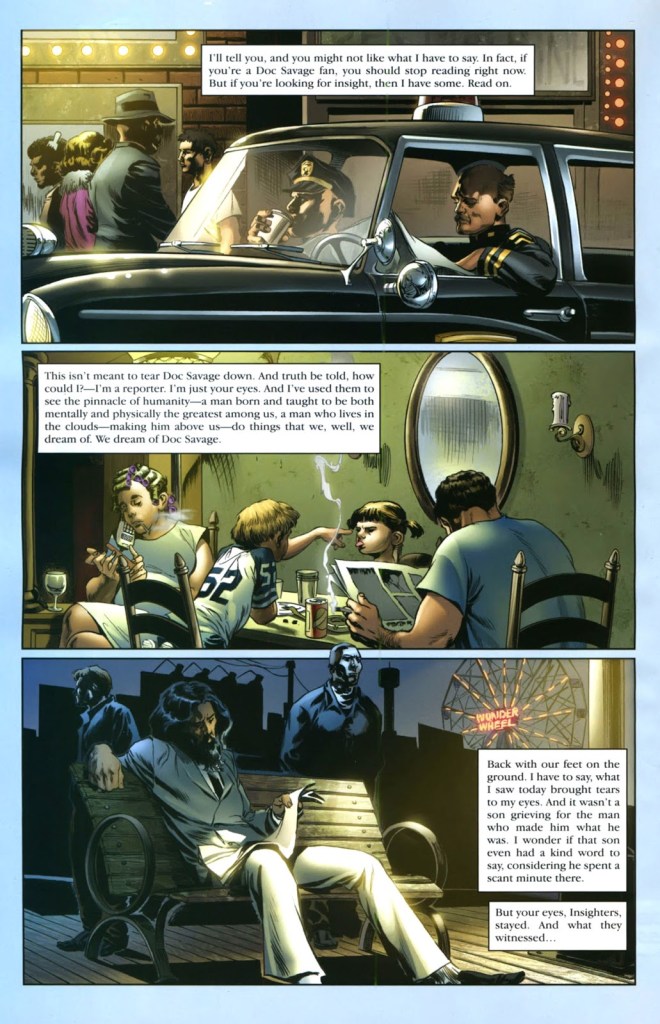
After this scene, there is an unusual interlude, where a reporter muses about Doc Savage, his influence on society, and his legacy.

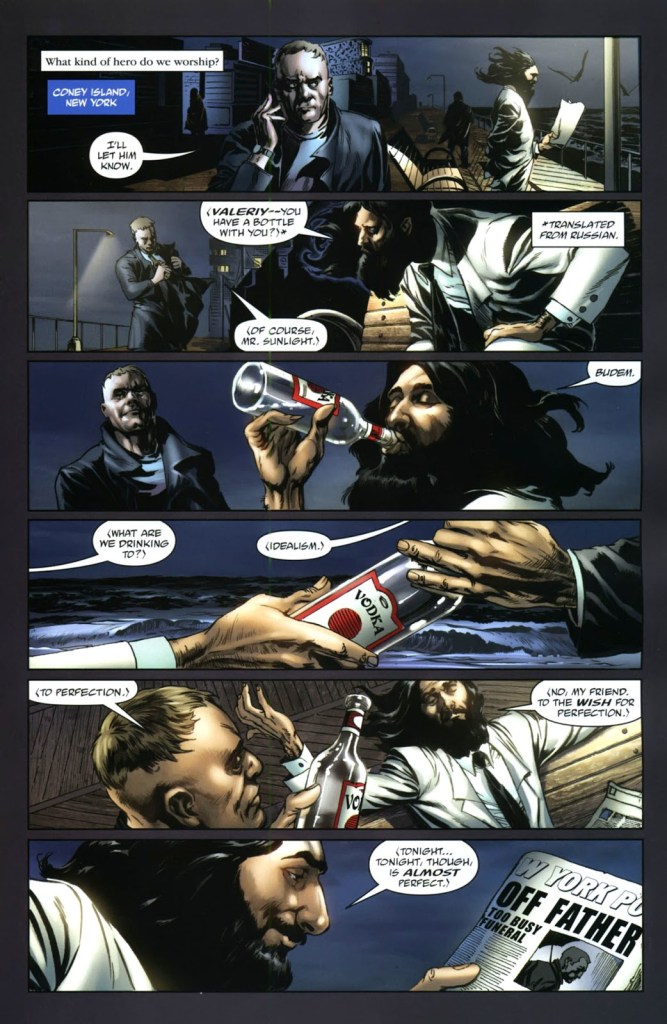
The scene segues into the introduction within the story of its antagonist, John Sunlight. Sunlight, in the years to follow, would become immensely overused by comics authors. Prior to this appearance, in comics from the 80’s and 90’s, he had also been utilized as Doc’s antithesis. But this was one of his most intriguing appearances…dangerous in a way that was hard to quantify…philosophical, with a control belied by his wild physicality.

These glimpses of a sophisticated storytelling style for Millennial readers were just that however…glimpses. The story would rather quickly become swamped by its character-mashup premise. An almost bewildering array of other 20th century icons would be mixed in, not only the two other headliners, Batman and The Spirit. My assumption is the editorial goal for the six issues of “First Wave” was to showcase as many of these characters as possible, and so they were crammed in: the Avenger, the Blackhawks, even Rima the Jungle Girl (DC had done a comics adaptation of W.H. Hudson’s 1904 novel Green Mansions: A Romance of the Tropical Jungle in the 1970’s).

So the opportunity to see a full story in the style of the pages presented above did not materialize. The story that did follow was in its way entertaining, with more standard comics fare of fights, rescues, robots, a techno-city, and a hodgepodge of scenes designed to spotlight the cornucopia of characters intended to populate the First Wave world.

A mature and cohesive new approach to Doc Savage (as well as all the other characters) was lost in the riot. Though at the time I first read these issues, I hoped it might just be deferred to the future — an individual First Wave Doc Savage comic was planned, and did in fact appear.

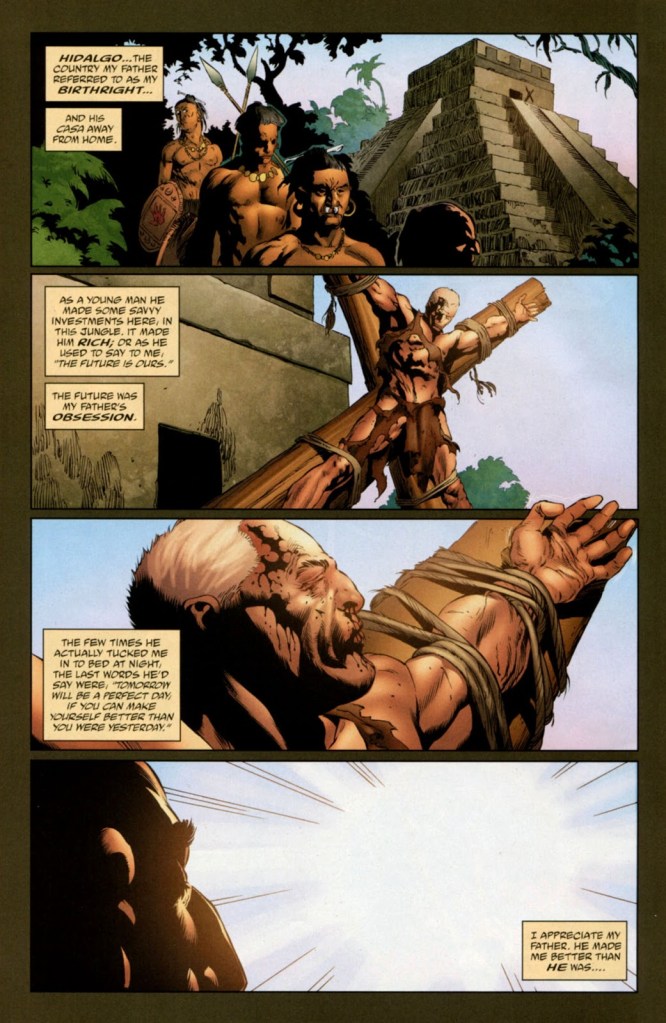
Many Doc Savage purists (and in some respects I am one of them, as I love the original pulp stories) respond to stories that do not simply revisit the spirit of those glorious early tales with either ennui or outrage. And there is no doubt those stories and characters possess a special magic that is a joy to experience. But in addition to that pleasure, I was fascinated by the idea of a Doc Savage boldly aimed at a sophisticated readership, which could offer scenes like this one, where Doc (having returned to Hidalgo only to encounter violence and imprisonment), still shows his deep idealism in silent musings…

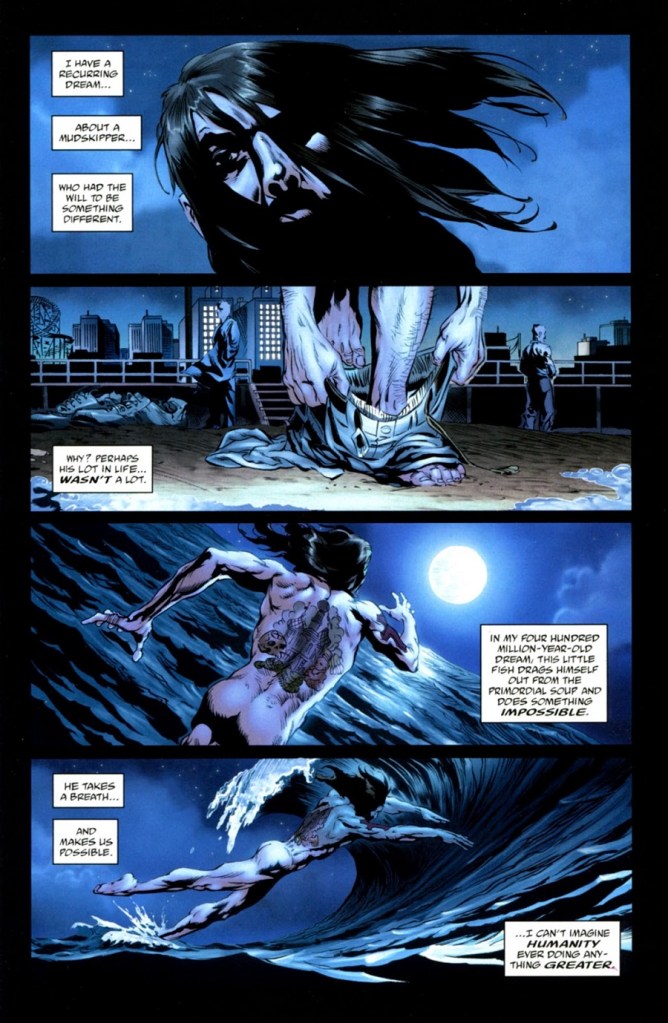
Or this scene in which John Sunlight does some musing of his own on the nature of greatness (while of all things, indulging in an impromptu nude swim at a public nighttime beach…)

He considers the kind of will it takes to do something truly different…to in fact embrace the ambition to strive for the impossible.

This story didn’t quite get there, but it offered a tantalizing taste of what that grand impossibility might look like.

to be continued…

Millennial Doc Savage – Part 1

The classic pulp character Doc Savage will always be powerfully connected to the era in which he was created…the 1930’s. He was in many ways a consummate man of that time, countering the dark days of the Great Depression with stories of high adventure blended to a practical idealism for society and technology.

Since the original pulp run came to an end in 1949, there have been various updates to the “present day”. Most persistently this has been done in comic book adaptations of the character, with some intriguing results…but most often the updates simply have not taken hold. Marvel Comics attempted to bring Doc Savage forward to the 1970’s for just a single issue before changing course and returning him to the ’30’s…a decade-plus later, DC Comics made a more determined effort to update him to the late 80’s, but they too ultimately rolled the character back into the Depression era.

The updates have taken about an even split of those that used plot devices to slow or arrest his aging, and those that simply ignored his past literary history and rebooted him in the present. Since the Millennium turned, each method has been used again by companies obtaining the rights to do Doc Savage comics. DC Comics (again) in 2010, and Dynamite in 2013. Both were ambitious…and their success (or lack thereof) can certainly be hotly debated.

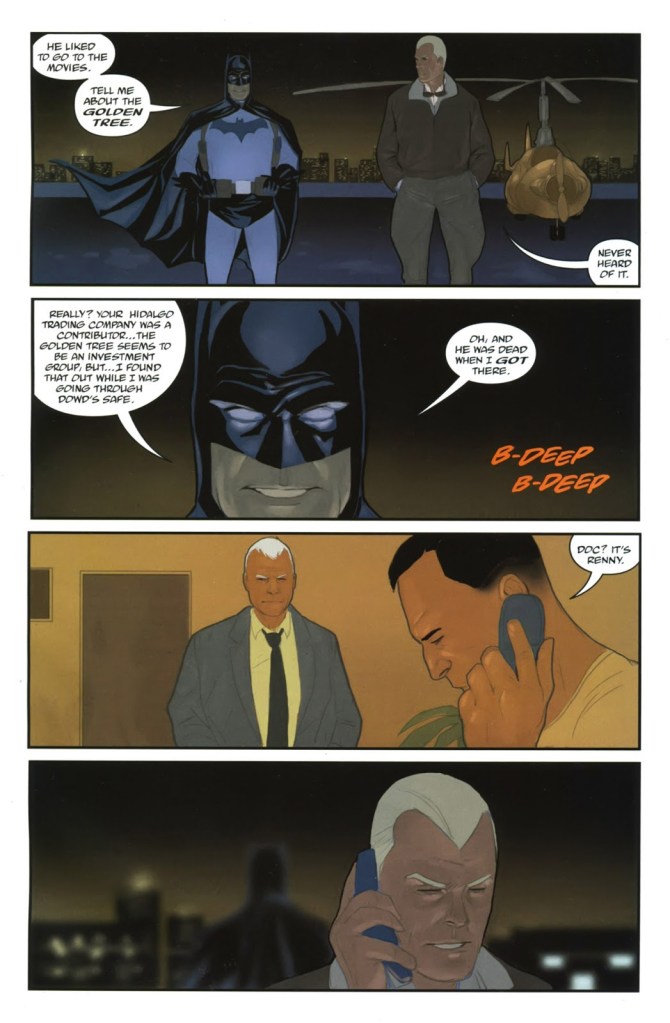
In 2010, DC Comics launched a project called the “First Wave”, in which some classic heroes, including their own, were portrayed in alternate histories. One of those was Doc Savage, who was teamed at first with an alternative Batman and then shortly afterward with Will Eisner’s signature character The Spirit, and the “jungle girl” character, Rima, from W.H. Hudson’s classic novel Green Mansions, which DC had done as a comics series in the 1970’s.

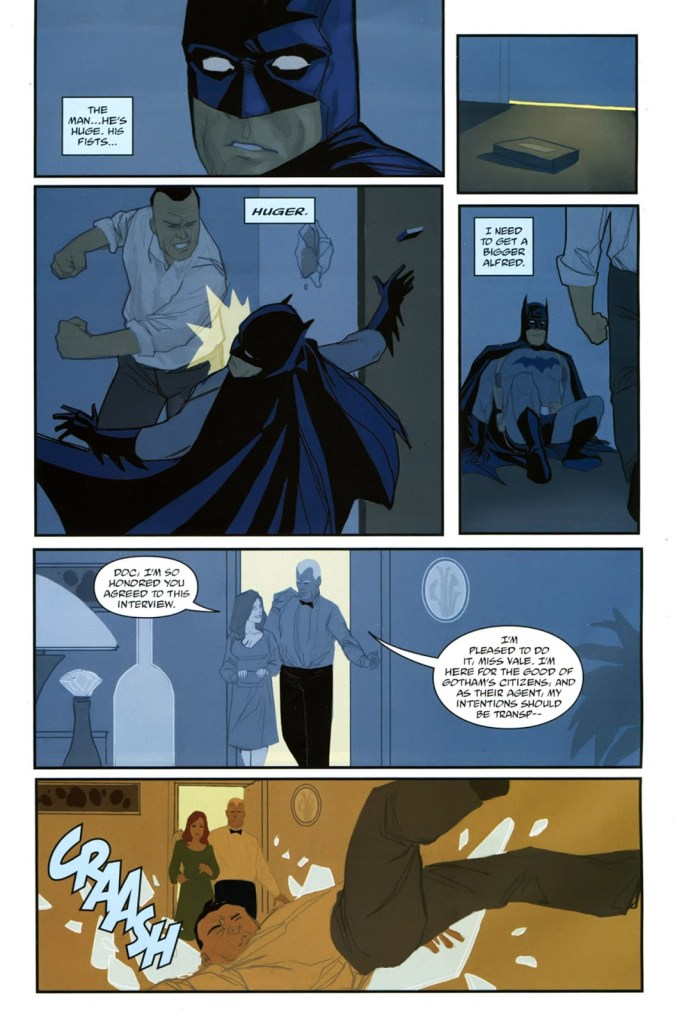
The Batman/Doc Savage comic kicked off DC’s First Wave, done by the creative team of Brian Azzarello and Phil Noto.

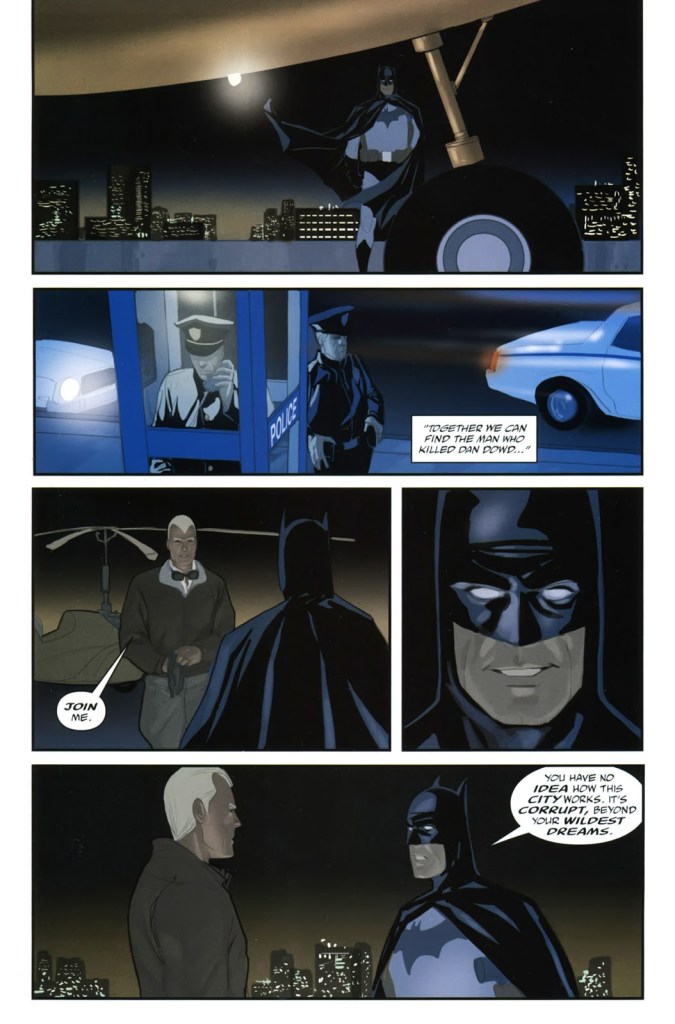
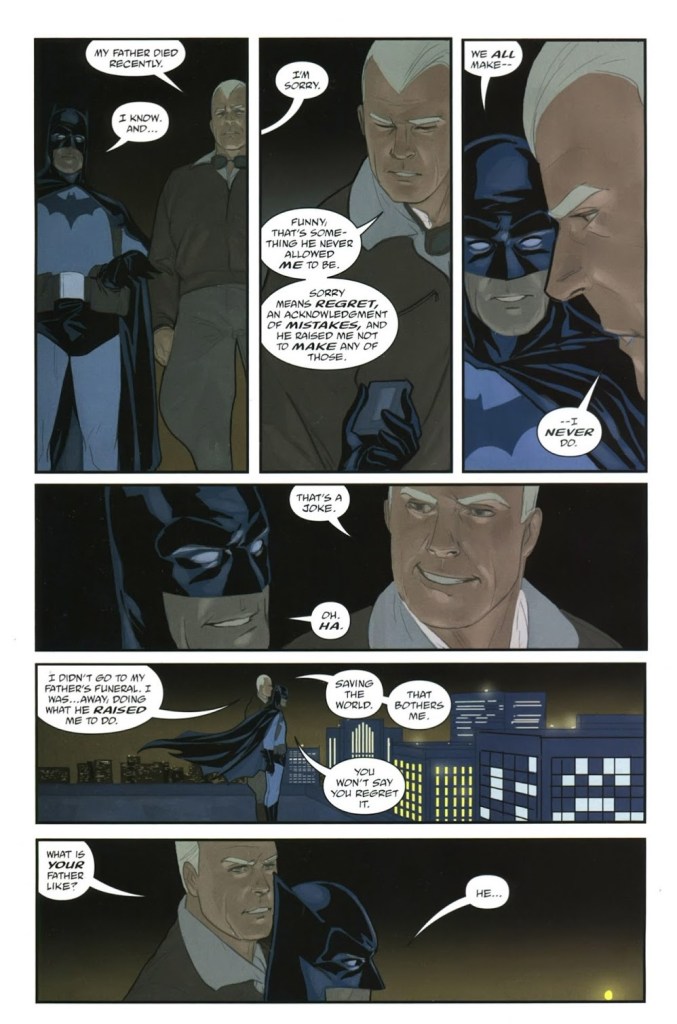
It was set in a somewhat ambiguous alternate present-day, which also included anachronisms like dirigibles and autogyros. Batman is portrayed as more devil-may-care than his frequently-grim mainstream personality, and Doc, shown below ruminating on the death of his father, is more introspective than the 1930’s version of Clark Savage, Jr.

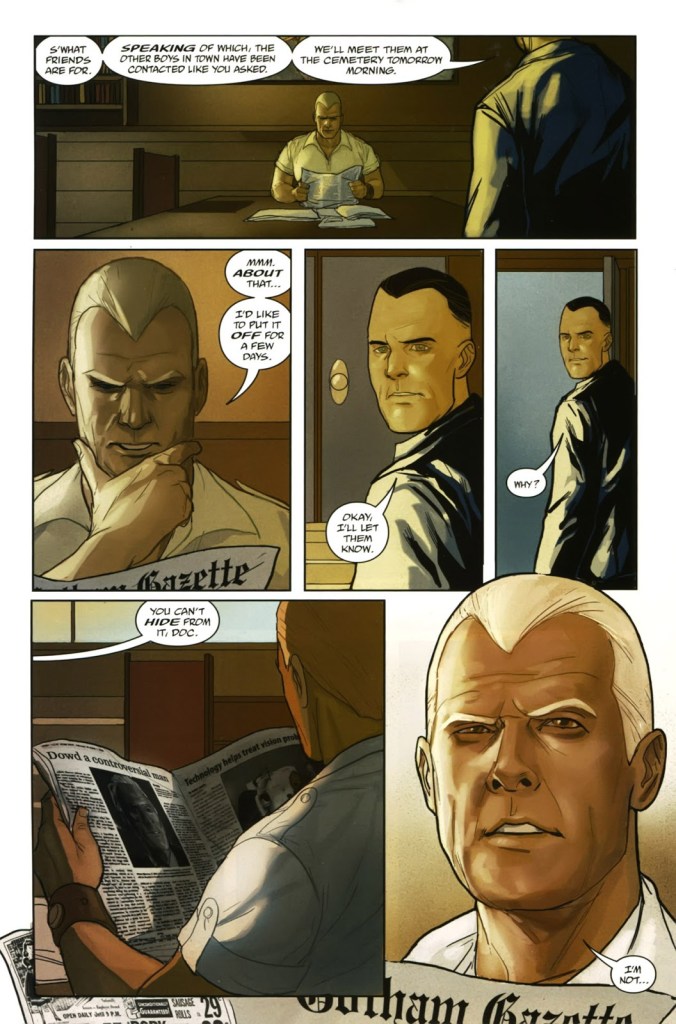
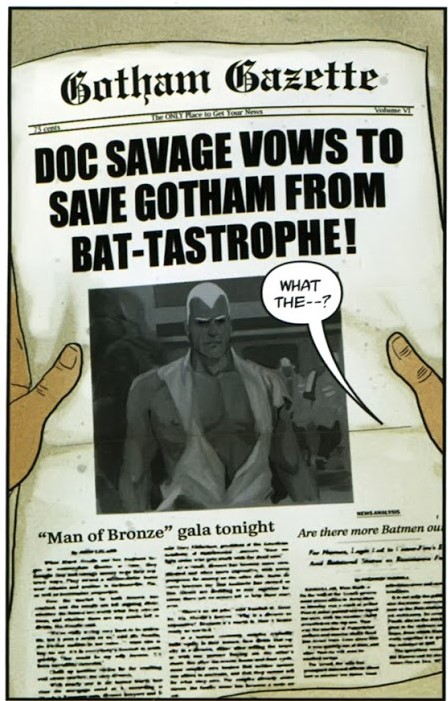
Doc, who usually strove to avoid publicity in the early pulps, has a higher public profile, and soon is touted by the Gotham City newspaper as taking on the problem of the more-rogue Batman.

There is some clever play on the tropes of the pulps, with a scene showing a dirigible preparing to dock atop a Gotham City building (as the Empire State Building mooring mast was originally intended to do, before the concept was determined to be unsafe). For those still unsure of the present-day setting at this point, no doubt is left by the presence of a TV in the lower panels of the page below.

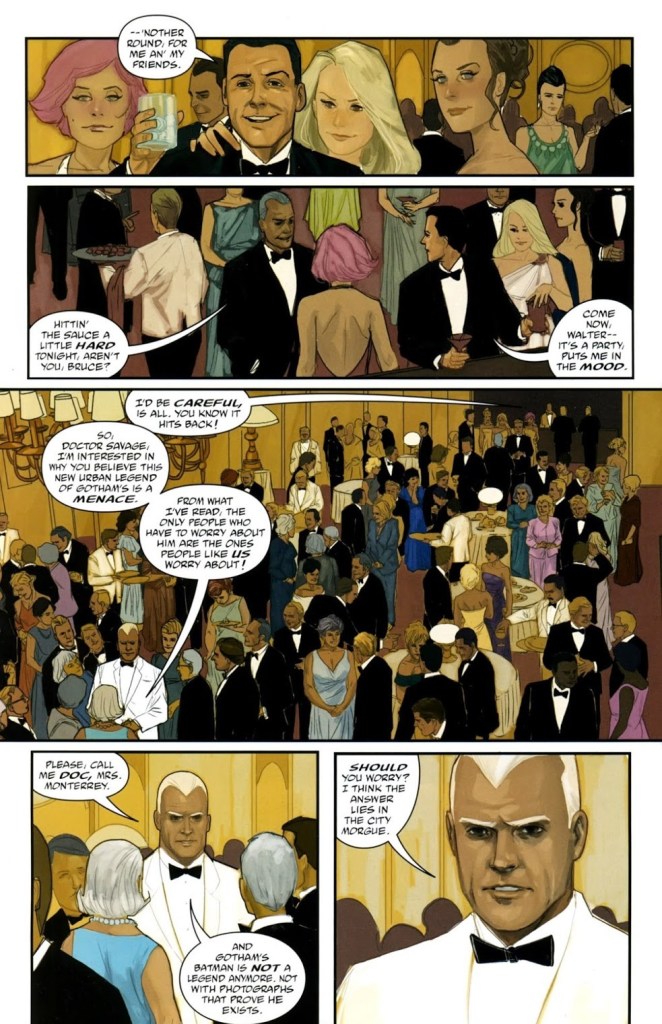
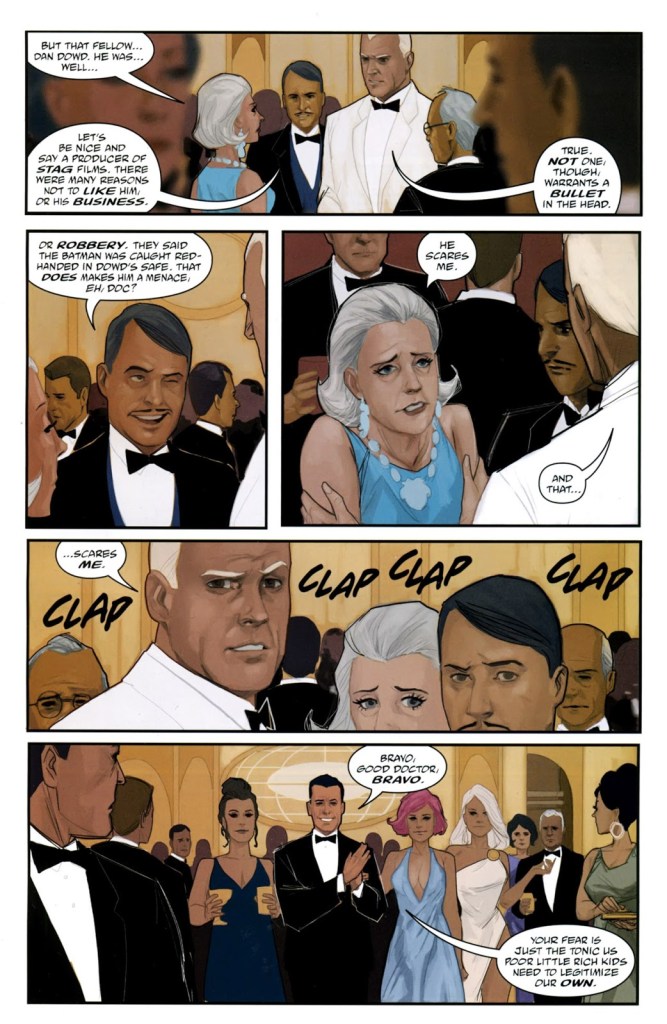
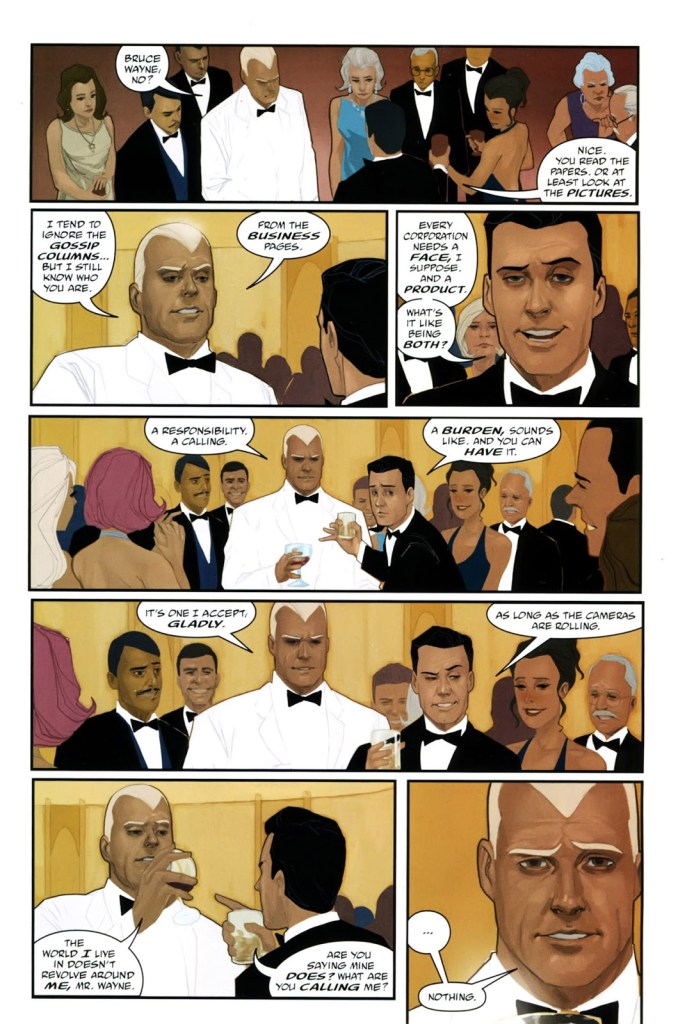
At the Gala itself, Doc once again presents himself in a higher profile (quite resplendent in a tux).

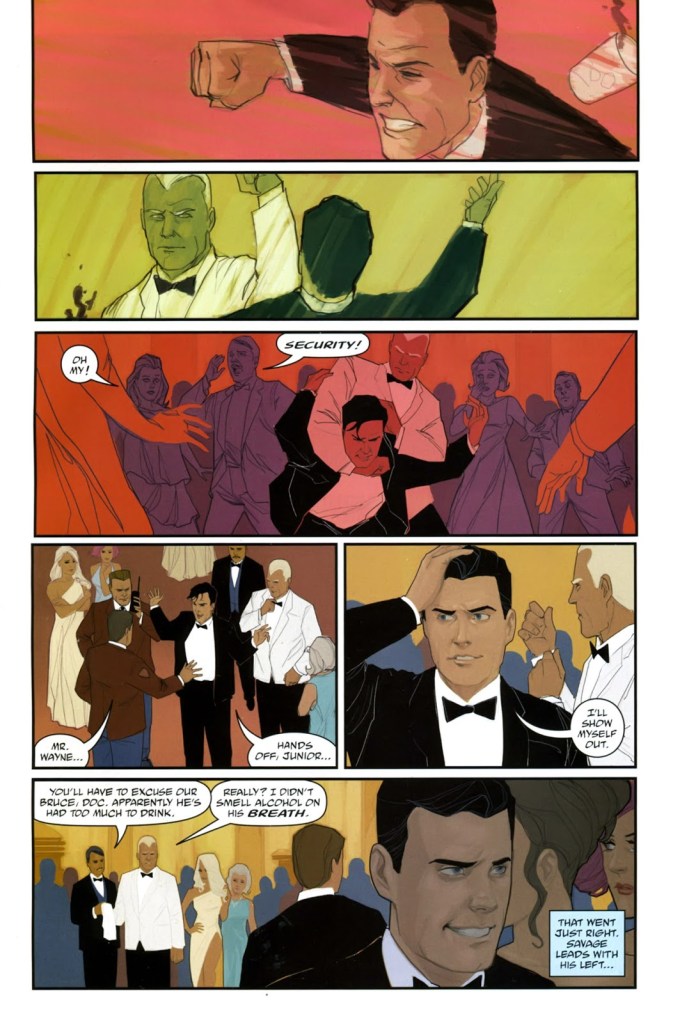
Bruce Wayne, also attending the Gala, baits Doc into an intriguing conversation that contrasts their styles, and ends with Wayne (pretending to be drunk), testing Doc’s strength and reflexes by throwing an abortive punch. Doc, however, is not quite taken in by the drunken act. The scene, though brief, is an instrumental one, giving the reader a clear look at these new characterizations for Doc Savage and Batman.

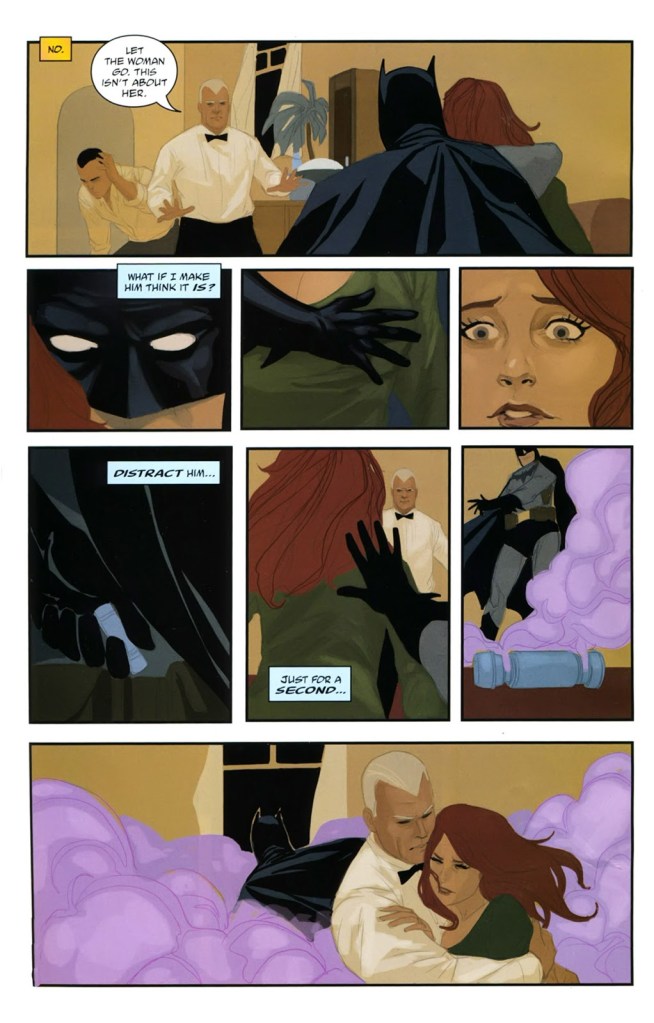
Those characterizations are reinforced in the scene that follows…as Batman, Wayne breaks into Doc’s room, only to run into Renny, who gives him a bruising fight before going down. Doc arrives with Vicki Vale accompanying him for an interview, and Batman escapes by the very un-Batman-like act of threatening, then groping her as a “distraction”…a scene which might well have gotten the author into hot water in 2021.

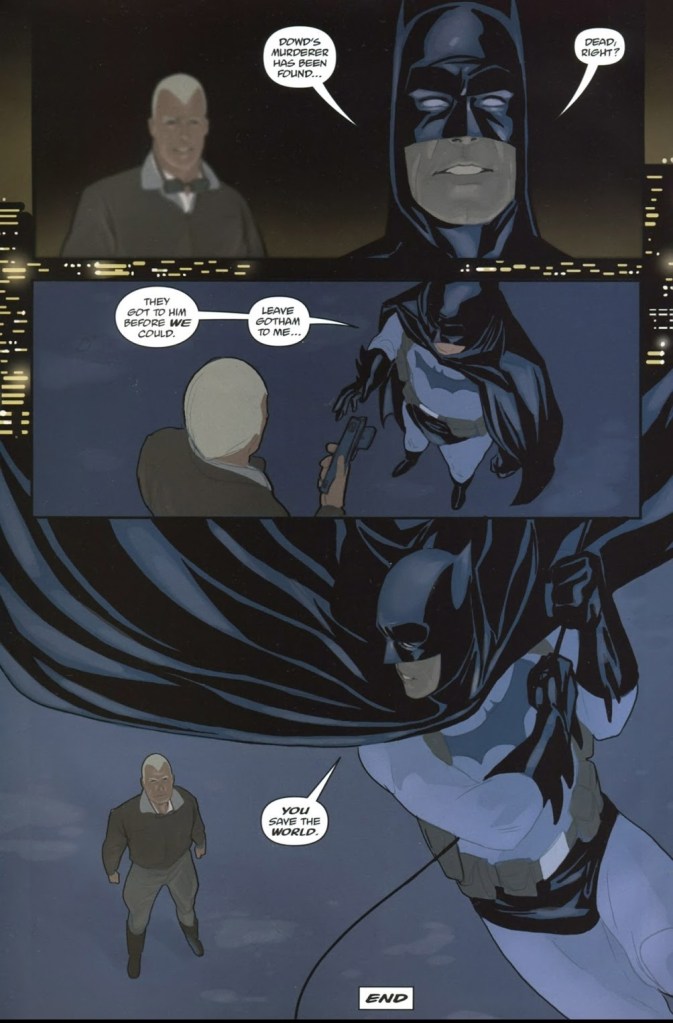
There follows another fight scene between Doc and Batman, then Doc looks into the mysterious death that has gotten Batman branded a killer, and determines he is innocent. In the final scene of the story, the two talk…with some interesting insights into each character.

Quirky but stylish, it was an interesting effort, with more depth than the usual “team-up” story. The concept of an “alternate present” which allowed established characters to be updated instantly into the 21st century, was a fresh take on trying to vault Doc Savage forward from the 1930’s. It set the stage for more of the “First Wave” experiment, which was soon to follow.

to be continued…

Talos Fan Fiction Contest Entry #14 – The Shy Man

Note from Doc Talos author/contest judge R. Paul Sardanas: Leslie is an old comrade of mine from my days writing erotic thrillers — it was interesting to see that given total freedom of content here, she chose to dial down the intense erotic content of that genre of fiction. Instead, she has approached the topic of intimacy with a sophisticated, and even gentle story, which captures the spirit of adult fiction quite beautifully.

Comment from author Leslie Payton: Blending sex and adventure is really fun…sex really should feel like an adventure, as well as a joy and a fulfillment. I’ve written about the end of virginity before…usually the other way around, with a woman experiencing that day in each of our adult lives that changes us so profoundly, forever. But part of the theme of this story, where the woman is the one with experience, is that the core of virgin feeling in all of us never really goes away…sometimes a partner will unexpectedly take us back to a renewed closeness with that younger self, when we were perhaps more vulnerable than at any other time in our lives.

Additional note: If you are interested in submitting fiction to the Summer 2021 contest (first prize is a Bantam Doc Savage paperback Czar of Fear first edition, signed by James Bama, and all contestants will appear in a special souvenir paperback collection of the stories) you can read the contest guidelines HERE.

The on-again, off-again love affair between Jim Steranko and Doc Savage

Sometimes an artist will embrace a character with so much enthusiasm and brilliance that the two become forever linked. It seemed, at various points across the past fifty years, that such a bonding might happen between the dynamic, innovative creator Jim Steranko, and the iconic character Doc Savage. But it never really happened. Steranko, an author/artist auter, never wrote or drew an actual Doc Savage story. Nevertheless, the flirtations were often spectacular.

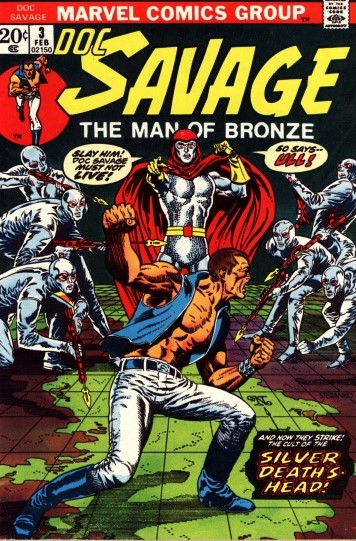
Steranko (shown above in a self-portrait from 1970), first crossed paths with Doc Savage in 1972, on the cover of Issue #2 of Marvel’s comic book revival of the great pulp character.

For a then 14-year old fan like myself, it was quite a lightning bolt to see this on the comics spin rack. For an instant, I indulged in the feverish fantasy of the whole story within also being done by Steranko. But it was not to be. He was doing a fair amount of cover art for Marvel at the time, but no interiors. Still, the thrill would be repeated the very next issue, with a second cover.

For a little while, that was it. No more Steranko covers were forthcoming in the series, which only ran for eight issues.

1972 saw Doc and Steranko again, however. He launched his media magazine Comixscene later that year, and chose to spotlight Doc Savage for the very first issue. The cover was a reprint of the Doc Savage #2 image, but the image here on a computer page does it little justice — Comixscene was a tabloid-sized publication, and the cover in print was big, and totally stunning. Likewise the image of Doc and his five aides below, which was the centerspread of the magazine. It was huge, and breathtaking. In addition, the spread had portraits of Doc by Gene Colan, Marie Severin, Dan Adkins and Mike Ploog. But the Steranko dominated the collage of images.

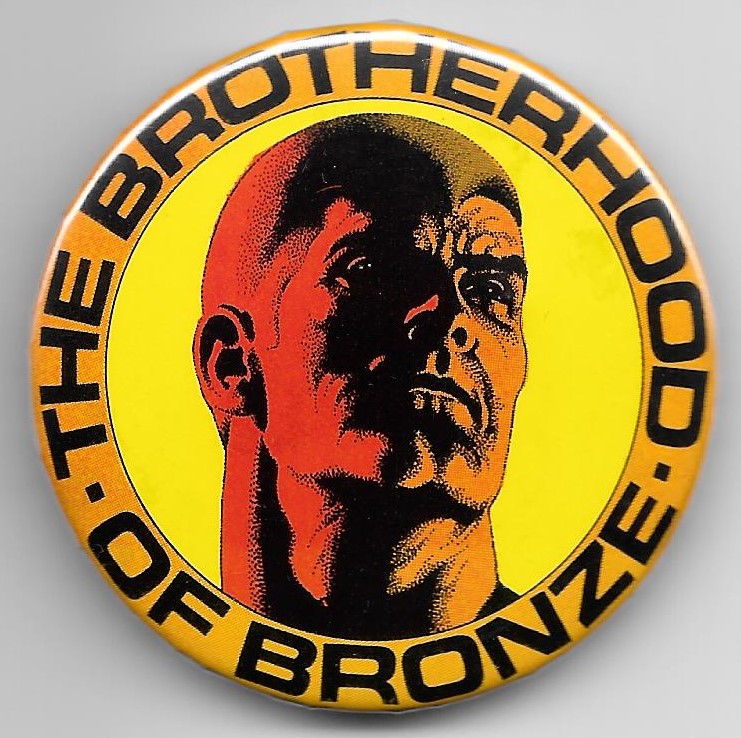
That was it for Steranko art in that issue…the rest of the visuals included some classic Paul Orban portraits of Doc and his aides, as well as some pulp cover reproductions. However, when the Doc Savage: The Man of Bronze film was released in 1975, there was a brief media flurry (until the movie tanked, and most of the interest in Doc as a multimedia character went away), which included Steranko creating the Doc Savage Brotherhood of Bronze club. I promptly joined the club, and the member package was filled with great items, including a bronze-tinted card with a Steranko Doc portrait, a pin, and a shipping envelope with some gorgeous art on it.

There would be no more Doc Savage connections for a long time, until Steranko did a cover for Argosy magazine in 1990, illustrating a Philip Wylie story reprinted there.

The image, though not for a Doc Savage story, clearly evokes the original first pulp cover by Walter Baumhofer, right down to the central figure holding a little Mayan artifact.

Steranko got a lot of mileage from that painting, called City of Bronze, as he used it as part of a trading card project and also a poster (which was marketed, not as a Wylie character, but Doc Savage). The trading card also had an interesting bit of accompanying text by Steranko: Philip Wylie’s novel The Savage Gentleman has been called the story that inspired the creation of Doc Savage. When Argosy Magazine reprinted it in 1990, I envisioned the protagonist holding a gold Aztec figurine, silhouetted against a bronze, deco city. He had a deep, almost metallic tan and hair like bronze shavings. I took a very different approach from Walt Baumhofer and Jim Bama, putting the hero in a tux! Your guess: Doc Savage, or not?

And then, there were the tributes. When Dynamite Comics did their version of Doc, they engaged Alex Ross for the covers, and two of them were direct homages to Steranko’s iconic Nick Fury, Agent of SHIELD covers.

Jim Steranko, SHIELD cover

Alex Ross, Doc Savage The Man of Bronze cover
Jim Steranko, SHIELD cover
Alex Ross, Doc Savage cover

Will there be more? Time will tell. Jim Steranko is alive and well at age 82, and one can only dream about the possibility that he could bring his brush to The Man of Bronze yet again.

Paperback release for Talos “Esoterica”

For those who have experienced any or all of the 6-volume Talos Chronicle (and lived to tell the tale), a companion volume of short stories, vignettes, art and photos is being released on August 1 for those with continuing interest in Doc.

Esoterica is an eclectic array of stories, photos and full-color artwork that enhance the core narrative of the Talos Chronicle. Most have been available only in electronic formats and hardcover heirloom editions (and some have never appeared at all), but will now be available in paperback.

Included is a unique scrapbook of experiences from the 1939 New York World’s Fair, as well as a series of tales set during World War II, in which a big-fisted engineer helps dismantle the World’s Fair, a portentous meeting takes place in a Switzerland bookstore, an electrical wizard’s love story in Japan comes to an end, a forbidden film is shown in Berlin, James Talos Jr. serves in the army at Guadalcanal, Rickie Talos leaves the Women’s Air Corps, and Doc Talos discusses the war’s aftermath with an old enemy.

Rickie Talos is spotlighted in two stories: she goes on a unique date to a 1930’s Harlem nightclub…and decades later, screen tests for a role in a Doc Savage movie that was never made. Also included is a long pictorial featuring Sienna Day, the actress who portrayed Rickie in independent film.

There is a farewell to a beloved big-worded archeologist and geologist, and an interview with an actress who is also the primary force in a powerful Gnostic cult.

A special visual presentation of Bellerophon’s Anatomy creates a symbiosis between powerful abstract design and classical anatomical drawings, exploring unique spiritual/physical code in the body of Doc Talos.

Finally a sketchbook of stunning in-progress Talos art by Iason Ragnar Bellerophon, which displays the intense depth of creativity that went into the crafting of these tales.

Esoterica will appear in the Talos Bookstore at the beginning of next month, but if you are interested in more info or samples, please feel free to write to Mal at admin@gromagonpress.com at any time.

Talos Fan Fiction Contest Entry #13 – Forged in Bronze

Note from Doc Talos author/contest judge R. Paul Sardanas: Scott Cranford brings us another look at a younger James Talos, with a look at the crucible within which the most enduring metal can be forged, both inside and outside.

Comment from author Scott Cranford: I’ve been a Doc Savage fan since I was twelve years old and over the years I’ve often wondered about Doc’s life when he was young. The Doc Savage novels don’t really tell us much about Doc’s personal life, especially about his early life. I thought I would try my hand at providing a brief glimpse into the vast unknown world of Doc’s upbringing.

Additional note: If you are interested in submitting fiction to the Summer 2021 contest (first prize is a Bantam Doc Savage paperback Czar of Fear first edition, signed by James Bama, and all contestants will appear in a special souvenir paperback collection of the stories) you can read the contest guidelines HERE.