The Council of Evil discusses Harold Bloom’s “The Flight to Lucifer”

What follows is a review/discussion by three diverse authors…all enthusiastic creators and readers of pulp adventure. The three of us met in 2021 and immediately enjoyed one another’s company and writings to the degree that we joined in the tradition of author circles like the 1930’s Kalem Club (a literary group whose last names all began with K, L or M, and included H.P. Lovecraft) and the Inklings, the Oxford circle made up of J.R.R. Tolkien, C.S. Lewis and Charles Williams.  A brief introduction: Atom Mudman Bezecny is both an author and publisher, and created the Hero Saga, which has brought to life unique pastiches of classic — and some wonderfully obscure — pulp characters. R. Paul Sardanas is the co-creator (with artist Iason Ragnar Bellerophon) of the Doc Savage adult pastiche Talos Chronicle, and André Vathier is a French Canadian author who has written stories in both the Hero and Talos “universes”. Together we comprise the Conseil du Mal (or Council of Evil)…dedicated to wicked literary pleasures of all kinds!
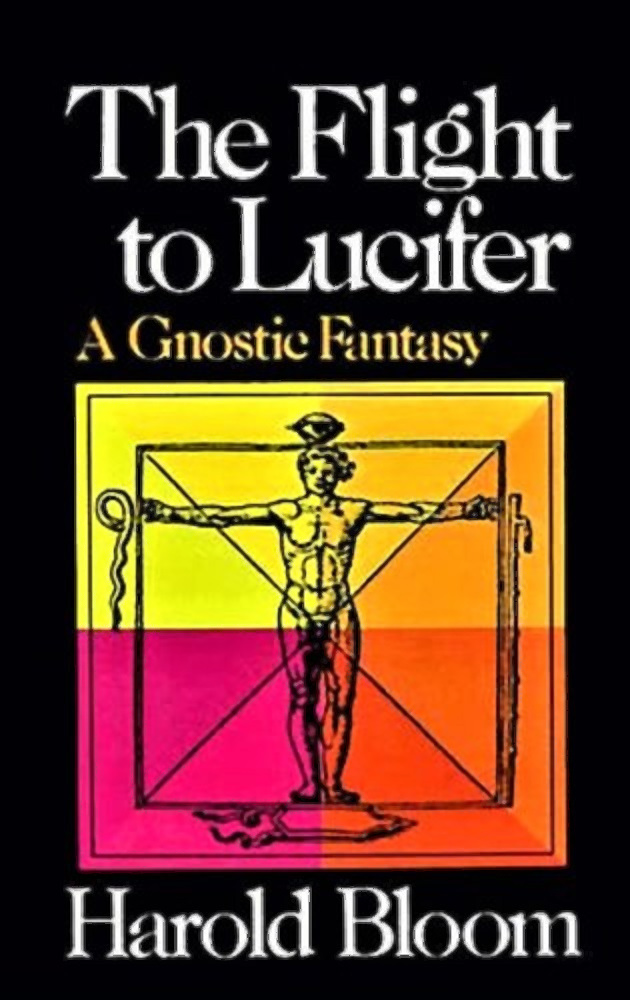
Cover to the hardcover edition of The Flight to Lucifer

SARDANAS: Hi Atom, Hi André, good to have the Conseil du Mal assembled again to discuss another book that’s been influential to modern pulp writing. We’re going to talk today about Harold Bloom’s The Flight to Lucifer, an intriguing choice for a modern pulp conversation, as it was first published in 1979, with an unusual literary provenance behind it, and perhaps equally unexpected influences on pulp writing ahead of it. Bloom has made his formidable reputation as a literary critic, most famously producing many books discussing the works of William Shakespeare. But one of his own favorite books was a bizarre pulp-visionary 1920 novel by David Lindsay, called A Voyage to Arcturus. Here’s a description of the book and some of the luminaries it inspired:

A Voyage to Arcturus is a novel by the Scottish writer David Lindsay, first published in 1920. An interstellar voyage is the framework for a narrative of a journey through fantastic landscapes. The story is set at Tormance, an imaginary planet orbiting Arcturus, which in the novel (but not in reality) is a double star system, consisting of the stars Branchspell and Alppain. The lands through which the characters travel represent philosophical systems or states of mind as the main character, Maskull, searches for the meaning of life. The book combines fantasy, philosophy, and science fiction in an exploration of the nature of good and evil and their relationship with existence. Described by critic, novelist, and philosopher Colin Wilson as the “greatest novel of the twentieth century”, it was a central influence on C.S. Lewis’ Space Trilogy, and through him on J.R.R. Tolkien, who said he read the book “with avidity”. Clive Barker called it “a masterpiece” and “an extraordinary work … quite magnificent”.The book sold poorly during Lindsay’s lifetime, but was republished in 1946 and many times thereafter. It has been translated into at least ten languages. Critics such as the novelist Michael Moorcock noted that the book is unusual, but that it has been highly influential with its qualities of “commitment to the Absolute” and “God-questioning genius”.
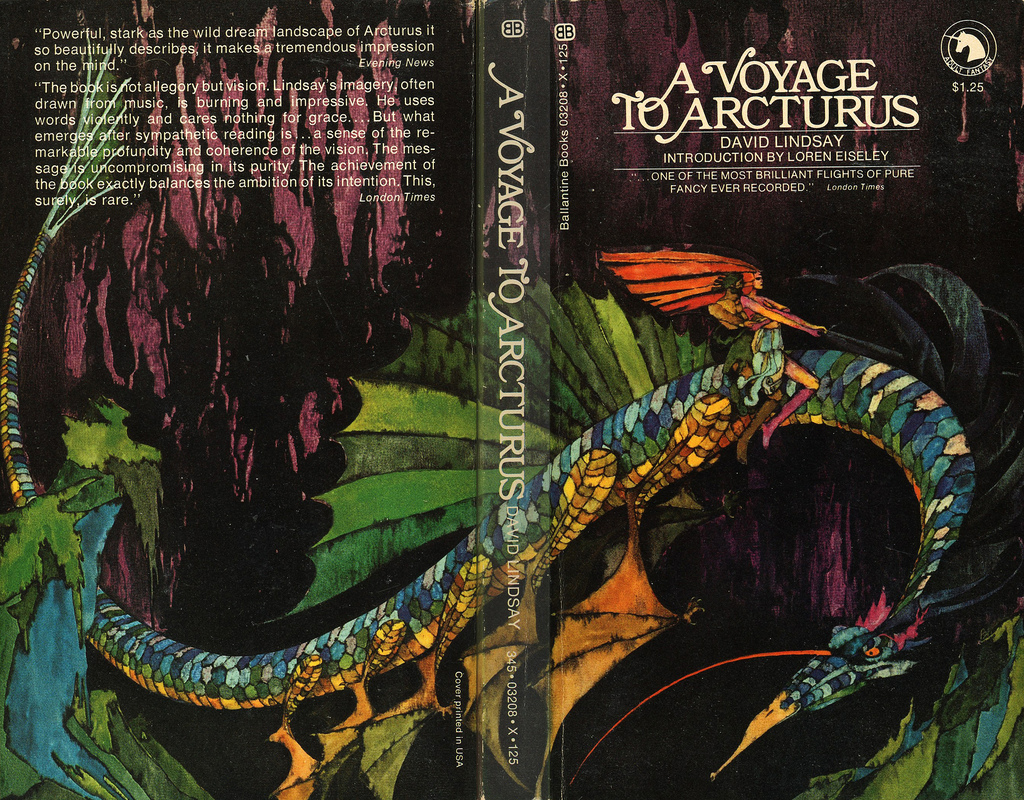
Paperback wraparound cover for A Voyage to Arcturus

A very incongruous collection of admirers…some from the literary ivory tower, others from the horror and adventure-fantasy genres. And the book itself is written in a style that is often blunt and unconstrained, practically the opposite of a “high literary” narrative. It reads, in fact, like a pulp novel. Bloom’s admiration for the book led him to write the only novel of his long career, The Flight to Lucifer, which re-imagines A Voyage to Arcturus in terms of Gnostic belief. Bloom somewhat notoriously hated his own creation – once saying that he wished he could buy back every copy printed and burn them all (the fate, ironically, of many an old pulp magazine and comic book in the hands of parents who considered them “trash”). The Flight to Lucifer also did not sell well, and was savaged by many critics…most commonly objecting to its dry scriptural tone, mixed with bursts of violence and dark eroticism more commonly to be found in pulp lit. In fact some of its scenes are strongly reminiscent of Philip José Farmer’s pulp-pornographic novel A Feast Unknown. Four decades later, The Flight to Lucifer would also provide a layer of inspiration to myself and artist/co-creator Iason Ragnar Bellerophon in our creation of the Doc Savage pastiche Doc Talos, and the six-volume Talos Chronicle. In A Voyage to Arcturus, and in some ways even more strongly in The Flight to Lucifer, is a fascinating blueprint for both the elevation of pulp fiction – or equally true, the infusion of visceral elements from those same “bloody pulps” into the dry and scholarly realm of literary fiction. A trip upward toward the ivory tower, while at the same time improbably tearing down that tower and hauling its pretensions (kicking and screaming) down into the mass readership of the pulp world.

BEZECNY: That’s a pretty apt description, as both Lindsay and Bloom’s books involve characters ascending physical towers which are actually more like dimensional bridges, warping them across infinity to the respective titular planets. Both stories are, fundamentally, about the passage from the material world into a spiritual world of gnosis, and this early sequence literalizes that. It really is interesting to me, the balance that Bloom strikes between pulpy and literary aspirations. On one hand, his book is an intellectual academian recontextualization of an earlier fantasy story. On the other, the book has a curious obviousness to it if one has already read Voyage to Arcturus. Bloom is very much telling the same story as Lindsay, down to the same sequence of events, but in a way that makes Lindsay’s incidental Gnosticism much more clear. It’s a smart criticism because it takes a strong knowledge of religious and mythic themes to come up with such a direct correspondence. But in changing the names of Lindsay’s places and characters into Gnostic variants, Bloom is crafting a surprisingly simple narrative, and in some ways he is stripping some of the magic out of Arcturus in a way that feels almost materialistic. And yet the revelations about Lindsay’s work which Bloom draws are almost Gnostic in their transformative nature. He creates the sort of paradox which my weird spiritual beliefs associate with the godly. This is essentially the same as rewriting the Narnia books to replace Aslan’s name with Jesus, but the simple fact that David Lindsay didn’t intend for his book to serve as a Gnostic vision makes this case a very different animal (pun intended?). The issue with good pastiche is that it wouldn’t exist without its predecessor. At the same time, criticism is, in an ideal sense anyway, about progress. It’s about investigating the old to inspire the new. Good criticism opens up new views of old stories that make them shine brighter (or stranger) in new light. And sometimes that fresh illumination comes from a crossing of the supposed barriers separating “highbrow” from “lowbrow.” Like A Feast Unknown, this book melds those two barriers together to shine light on both attributes at once. It can’t be contained by conventional criticism and yet in that sense it is in some ways participating in the ultimate form of criticism. 

VATHIER: See I think I made a mistake by not reading A Voyage to Arcturus by David Lindsay first. I decided to jump right in. It is sort of becoming a tradition whenever I talk to both of you. I missed the subtleties of the book. Because I have not read the previous, work it pastiches. We should start a drinking game. Take a shot whenever André tells you he has not read a work or is unfamiliar with an English-language author. I must admit, I found it to be a frustrating read at first. I was not enjoying it. Parts of the book reference previous works or concepts that i felt I should get but I did not. Therefore, after a while I decided to start over and just “feel” the book instead of understanding it through the lens of a pastiche or academic highbrow. Reading it that way was more enjoyable. Bloom’s style is interesting. He’s an academic. I thought it would be Umberto Eco type book.Where he flexes his academic knowledge. However, the small chapters in The Flight to Lucifer are perfectly made to convey emotions. That is what I like about it. Like A Feast Unknown this book is emotionally intense. It’s raw in a way that very few authors dare to go. After I was done with it, I decided to read some of the Goodreads reviews. It’s either “This book is great” or ‘’This book is the worst book I ever read in my entire life”. There very little in between. I feel a lot of the critics miss the forest for the trees.   This is unrelated but the Wikipedia states the following. “The book received negative responses, and was compared, including by Bloom himself, to the film Star Wars (1977)” Star Wars? Personally, I do not see it.
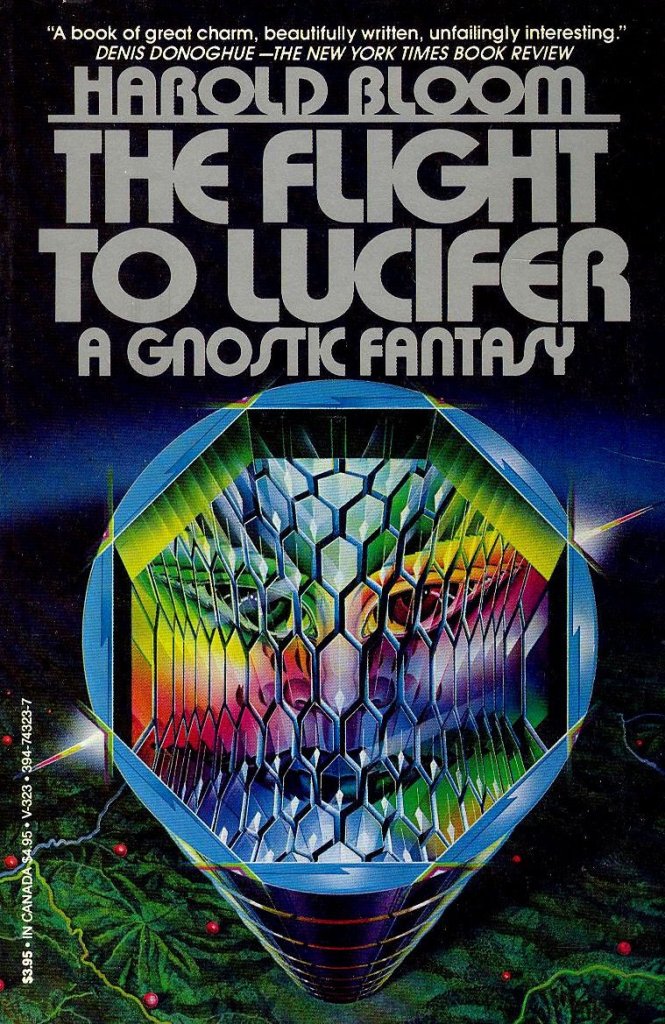
Paperback cover for The Flight to Lucifer


SARDANAS: In a way André, the fact that you read The Flight to Lucifer without first reading Lindsay’s book gave you a unique perspective — sometimes the experience of pastiche-first, original-second can be very illuminating. Particularly since Bloom’s style is distinctly academic, and Lindsay’s is almost anti-academic.  Interesting point Atom, that Bloom, as a lifelong literary critic, actually achieved a unique form of criticism through his only novel as well. As you know I’m fascinated by both the dichotomy and potential symbiosis in “highbrow” and “lowbrow” literature, and while Bloom himself (by disowning his own book) disliked the result, he did indeed take Lindsay’s often amateur-like writing (Lindsay did things like make up words instead of finding sophisticated ways to describe unique elements of the story…in addition to a sometimes crude and simplistic style) and shape it with a much more disciplined hand.  Interesting too that we all feel an analogue to aspects of Farmer’s raw, intense A Feast Unknown in The Flight to Lucifer. I agree with you André, Bloom took the narrative at times to places many authors are too timid (or too limited) to explore…as did Farmer.  How all this relates to modern pulp writing comes into play in intriguing ways. In the modern pulp-author community, I see a lot of frustration among authors who feel “no one is listening”. Low sales, lack of widespread fame…of course those can be discouraging, but I feel that sometimes those frustrations will lead to modern pulp authors abandoning faith in their own most innovative and challenging concepts. If the criteria for achievement is sales and fame, both Lindsay and Bloom as novelists were resounding failures. Lindsay, discouraged after Arcturus’ poor showing commercially, shifted gears and attempted to tailor his next works to commercial tastes, resulting in books that have been utterly forgotten. Bloom returned to his critical writings (for which he has wide readership and acclaim)…but Lucifer arguably continues to inspire as much as any of those works over forty years after its publication.  Both books have achieved what might be thought of as “underground” followings. People are passionate about them (as you say André, often either strongly loving or hating) which I actually consider a hallmark of important books. Perhaps at least part of the lesson to today’s writers being faith that a willingness to go out on a limb to present a powerful personal vision may not make you a cartload of money, but may inspire passion in readers a half or full century after you write those works. Pulp readers have a strong affinity — and deep loyalty — toward characters and authors that strike a deep chord of emotion, often defying commercial convention while they are doing it. 

BEZECNY: If it’s any comfort, André, I tend to read pastiches way before I read the originals. I’ve read far more Doc Savage pastiches than I have original novels. I think these two books have a dualism that lets you indulge them in either order.  I agree with you that Lucifer doesn’t quite work as a pure sequence of events; it’s more like prose poetry, and viewed through that lens it’s very effective. Alas, no one really likes prose poetry, probably because they’ve only read bad examples, when in fact there are many, many good examples out there. Critics, in an effort to sell to increasingly narrow algorithms, have to display more and more intensely polarized opinions, which means that books like this are never very popular. Capitalism and art just don’t mix. I think that’s partly why the Star Wars comparison came up–even in the 80s, there was a push to always compare lesser known stories to better known ones, because marketing. There was a time not too long ago when every single new sci-fi book that came out was said to be “just like Stranger Things” when it had nothing in common with that show. I think it’s hard because the same environment and social system which has led to this lack of mainstream critical nuance is also that which is starving most of the world’s population. The disparity between wages and costs of living is growing worse without anyone in power seemingly interested in halting it. No one wants to work a job that kills them on an emotional level, and so making a living wage in the creative arts involves serving the creative wishes of corporations. This isn’t to say that every author who’s made it is a sellout–far from it. But there are creators whose visions are inherently going to be held back from success because they run contrary to the acceptable conservative status quo. And it’s very easy to see that many people view the exercise of imagination or the creation of “high art” as a symbol of privilege. But I don’t think any of that reduces the necessity of the sort of creativity that authors like Lindsay and Bloom put forward. I think that it’s important to challenge boundaries and meld mutual exclusitivies even if those experiments aren’t always successful. As a lover of trash movies, I know that there’s always someone out there who will find value in a work which most condemn as useless. 

VATHIER: Atom You talk about your love of trash movies. Youtuber Kyle Kallgren said the following in one of his videos. I think it applies really well to the book too.  Even a badly worded statement can inspire. Even a poorly made gesture can move “ It’s sad that Harold Bloom never tried fiction ever again. He of all people should know that practice makes perfect. Commercial failure does not mean failure. Consequently, I have noticed it to Paul. That frustration among pulp author is about “no one is listening low sales, lack of widespread fame”. I do not share that frustration. On the other hand, I do not have that need for that widespread fame. I mean knowing that both of you read and enjoyed my short stories filled me with Joy. I share your opinion. If authors cannot make a living from writing then they totally should write a book or produce a piece of art that is personal or just follow their own vision regardless if it will be commercially successful. Atom you mention that capitalism and art do not mix. I agree I have seen authors; content creators online try to quantify or create “objective” parameter for judging and creating art. I dislike the fact that people online feel the need to justify what they like or what they find inspiring.  What happened to liking something just because you do? Paul  if it were not for you, I would never have picked up Flight to Lucifer. For one before you brought it up I had never heard of the book (I think Bloom himself is the cause of it .Allegedly paying the editor a large sum of money so it never gets a second printing or editions). I am curious to know where you first heard of it and when you first read it. Reading Flight to Lucifer after reading your Talos Chronicle stories. I could see it’s a source of inspiration for you.

SARDANAS: An interesting sidelight to the “trash film” side of the conversation – there is a terrific trash movie of A Voyage to Arcturus which was made in 1970 by student actors and filmmakers…done on a shoestring budget with almost no special effects, it is a fantastic example of a film being made on heart and inspiration alone. Extremely difficult to find, I snapped up a copy when it was briefly available on DVD, and was alternately appalled and enthralled by its crudity of technique melded to an intense dedication to filming “the book that is impossible to film”. No underground film fan should fail to see it sometime in their life.


Film images from the 1970 underground/student film of A Voyage to Arcturus

Regarding art and capitalism, they are indeed uneasy bedfellows at best, bitter adversaries at worst. When you add in the social disdain frequently aimed at “trash lit” – pulp storytelling being a notable wicked stepchild of the literary world – things get even more intense…and interesting. This is certainly one reason why I find The Flight to Lucifer such a compelling milestone. As you’ve described, Atom, it often reads like a prose poem, but loaded with an almost insane mix of elements that are hallmarks of pulp excess. For modern pulp authors, I think one distinct trap they can fall into is failing what I call the “Cardboard/Cartoon” test. Much pulp fiction of the 20th century was rooted in shallow, bloodthirsty plots, or driven by gimmicky sensationalism. Great fun, but given the sheer quantity of the stuff, it can feel stale when recycled over and over. I’m the last person to look down on mindless fun (mindlessness can be a Gnostic experience in and of itself), but in heroic pulp fiction, it is all too easy to fall into the comfort zone of reading and writing stories of hollow men and women. Everyone of course has their own personal touchstones for what makes pulp fiction enjoyable and inspiring. But I have used two books for decades as a test for whether or not I have (unconsciously or not) fallen down a hole where I am no longer striving hard enough. Those books are Farmer’s A Feast Unknown and Bloom’s The Flight to Lucifer. Both books succeed and fail in some (actually in many) ways, but they show a courage in opposing the paradigm of cardboard characters in cartoon situations that is relentless. As both a reader and writer, I want to aspire toward that kind of courage. André to answer your question, I actually didn’t discover The Flight to Lucifer in what might be the expected manner – following the path from Arcturus (which I read in the 1970’s) to its pastiche, Lucifer. My mother was a Shakespeare and Blake scholar (my own name is a direct lift from a character in Macbeth), and by 1979 I was also heavily into both authors. This, of course, was Bloom’s wheelhouse…I was (and still am) endlessly fascinated by books like Bloom’s Blake’s Apocalypse: A Study in Poetic Argument, which I also read in the 1970’s. When I learned that Bloom’s first novel was going to appear in 1979, I acquired it immediately. Only on starting to read did I realize that this was a book with deep, deep roots in Lindsay’s Arcturus. I’ve always had one foot in the academic world and the other in the pulp world…and the synthesis of those in Lucifer practically had me hypnotized. When the time came, much later, to begin work on my own pastiche Talos Chronicle, I went back to those two mentor books, Feast and Lucifer, as core aspects of inspiration. Discovering that my creative partner for the Chronicle, Iason Bellerophon, equally treasured both books, was an incredible bit of serendipity.

BEZECNY: You can’t tell, dear readers, but I temporarily froze time in the middle of this conversation so that I could watch the Voyage to Arcturus film. It was an enlightening experience! Definitely a mixture of the exciting and the disappointing, as you said, R. It started off with a brilliant energy and then just sort of lost focus, presumably as deadlines and budgets ran out. But it did still capture a sliver of Lindsay’s novel. The dreamy cheapness of it was an adequate reflection of the almost incomprehensible pseudo-psychedelic atmosphere of that book. I wonder if Bloom ever saw the movie, either before or after he wrote Lucifer. I imagine that he and the filmmakers felt similarly about their respective products, but it’s a testament to the raw imagination of Lindsay’s work that it’s a hard thing to try to do twice. André, I love that quote by Kyle…it really defines my life and my perspective on things.  Incidentally, I highly recommend pairing the Arcturus film with another student film from the ’70s, Moonchild from 1974, which managed to score both Victor Buono and John Carradine, two of my favorite actors. That movie, too, is overflowing with occult symbolism (including, as the title implies, Crowleyan themes) and was, I’m sure, an influence on the Eagles song “Hotel California.” We’ve talked now a little bit about the literary alchemy that Bloom’s practices, but I figure since this is kind of an obscure novel, and a complex one, it might be fun to dig a bit more into the plot. There are a lot of Gnostic names here, and modern readers can decipher much of the symbolism behind these names with the power of Wikipedia. But others, like Nekbael, are more elusive, and require some perusal of authentic Gnostic texts–those which survive, anyway. I’m curious what the two of you thought of the plot of this–and while I know you’ve both explored Gnosticism in your other writings, I’m curious to know how you reacted to this book’s spiritual themes on a personal level. 

VATHIER: I will need to watch both movies now. Describing the plot can be difficult. The book does not have a traditional structure. Characters can fast-travel from one place to another in an instant. Multiple events happen concurrently. Some individuals that the characters meet along the way disappear without any explanation never to return. The plot summary from the Wikipedia article does not do the book justice. We follow Thomas Perscors with his friend Seth Valentinus an amnesiac who can remember a great deal and nothing at all and Olam a yellow-eyed being.  Olam takes both men to the planet of Lucifer, Seth wants his memory back and Thomas Perscors’ purpose and quest are ambiguous for most of the story. You asked how I reacted to the spiritual theme on an emotional level. See while reading it. I quickly realized that I was not as well verse as I thought I was when it came the Gnosticism.  Wikipedia did help but it only offered some superficial understanding. I will read this book more than once. I feel bad because I wish I could give more insight but to tell you the truth I did not fully understand the book. It frustrates me deeply because talking to you both of you obviously understood it. While I was left confused. This might because of my ignorance. (My knowledge of what Gnosticism is growing.) The fact that English is not my first language. However, I think the biggest reason above all else as to why I found this book to be a challenging read is this. I have not read A Voyage to Arcturus before reading this one. A lot of reviews call Flight to Lucifer a spiritual sequel or a re imagining of A Voyage to Arcturus and I am starting to believe them. I want to “get it” the same both of you “Get it”. However, I do not and it makes me frustrated, that led to slight anger.  So seeing Thomas Perscors being angry in the book felt somewhat cathartic in a weird way because like him I was on an alien world that I did not fully understand.Speaking of Perscors. He reminds me a lot of a video game protagonist. I personally do not play video games but my partner and his friends do. Right now, they are playing a video game called Elden Ring. From what I can understand from watching them play, the game is set in a hostile fantasy world (Not unlike Lucifer) where your goal is complete quests while killing everything that stands between you and the quest. It’s kill or be killed. At one point, I asked my friends if a peaceful option was even possible. Like could they win the game by not killing a single character?  They told me no. the mechanics would not allow it. To complete the quest you need to slash, hit, punch, kick, bite your way until the end. For those of you who know about the game I know there is a lot more to it than that but in that way Thomas was that video game protagonist. He listens to someone then moves forward killing or trying to kill anyone who stands in his path. Listen to someone else that makes the story go forward then he fights the person who crosses him, which segues into the next scene. In the book he’s a representation of Adam Kadmon (The primal man). Like a video game protagonist from a violent game both are an unstoppable force. I want to reiterate this is not a bad book. Confusing maybe. Nevertheless, its raw essence is very inspiring. It stays with you. It’s one of those pieces of art that relies a lot on what you bring to it. 

SARDANAS: André, don’t feel troubled that your experience of the book was confusing. Part of that is due to not having experienced A Voyage to Arcturus, but that book is also mightily confusing. I have read both books multiple times for decades, and certainly make no claims to fully understanding them even now. And in a way, that is the point of a story that is at its heart a spiritual journey — in fact, multiple journeys. Like abstract art, I don’t believe its intent is for a full intellectual understanding. Instead, that kind of artistry can lead to feelings from a visceral place that no words can fully articulate. The story (sometimes literally) boosts a reader up to a platform where strange vistas can be viewed, but the viewing and the feelings provoked by that act are enough; to attempt prosaic explanations would drain those vistas of their majesty.  Quite right Atom, we have explored a lot of oblique paths in talking about this story, but heaven forbid we should actually talk about the plot! André, you are also quite right, it is not a plot that can be easily summarized. In essence, a small group of individuals (Perscors, Valentinus, Olam) wander the planet Lucifer — mostly apart from one another — pursuing goals that are in no way clear. Perscors, though an intelligent and perceptive man, also embodies the Primal Man of Gnosticism, and frequently behaves in a distinctly primal manner. He flings himself into situations both sexual and violent. Valentinus is more deeply philosophical, but suffers from amnesia. His journey is one of slow and fragmentary remembrance of powerful beliefs that once made him a spiritual leader. Olam is a being from a higher existence (an Aeon in Gnostic language), and he is looking to reclaim a tower he once raised on Lucifer. He is coarse, blunt and powerful…but represents a form of unshakable honesty in a world filled with deceit and illusion. Each character runs a gamut of catastrophes, strange encounters with bizarre beings, and along the way there are numerous revelations that are tantalizingly opaque.  By any measure, a strange story. But it is bold (as was Lindsay’s Arcturus) in its effort to create a visionary experience for the mind and soul.  My personal responses — over decades now — are often ones of feeling that these characters are illustrating very important aspects of life, including my own life. That can feel exciting, frustrating…even frightening. It’s inviting readers to look at potentially very difficult aspects of being alive and human.  Creatively, I have certainly found it inspiring. As mentioned previously, many aspects of the story provided pathways into human mysteries that I wished very much to explore…and did so (taking my own tangent on Bloom’s presentation of the Gnostic pantheon) in the Talos Chronicle

BEZECNY: I also wanted to assure you, André, that this book is a hard read even among those of us for whom English is our first language. Like I said, it’s very much like prose poetry, and the feeling it evokes is in many ways more important than the story–but that’s not to say that those feelings are easy to conceptualize. The story itself is frustrating at times, because of how cryptic it can be and because oftentimes the characters act more in accordance to vague, unspoken mythic tropes rather than an ordinary sort of reason. In many ways this makes most if not all interpretations of the text valid. That’s part of why I enjoyed the book so much–but I am, as I’ve probably indicated many times here and elsewhere, fond of experimentalism for its own sake. There’s a lot of interesting intersections surrounding your video game interpretation. I do think it’s interesting how death and conquest are such important parts of games. It recalls Ronald Reagan’s statement that video games would create better jet pilots–there’s a certain militarism in giving kids stories which involve so much killing. A lot of popular, celebrated games are much smarter than this, but it is odd that young boys are expected to kill fictional characters as part of their upbringing. I feel inclined to target boys in this instance–sorry, gentlemen–because I have to admit that the conception of the Primal Man in Lucifer is often very patriarchal in his depiction. There is an emphasis on his Primal nature being tied to sex and murder, when in truth humanity’s Primal instincts are more complex than that. Our ancient ancestors learned to cuddle, to heal the sick, to feed each other, give gifts, etc. as part of their dawning sentience, and these too are part of our Primal ancestry. It’s been centuries of male-led anthropology that has convinced us that sex and death were the only instincts that mattered. We are compelled by so many different feelings that we take for granted. The video games that rise to the top, I feel, are the ones which incorporate these multiplicities into their experience, and don’t submit to status quo concessions. Much like any other medium. But I realize also that, while the Gnostics may have envisioned the Primal Man as our ancient ancestors, the concept of the Primal Man is one based on archetypes. In a sense, the Primal Man is a sort of cosmic everyman, a Platonic ideal of a spiritual traveler. In this, Perscors is much like the sort of allegorical protagonist found in books like The Pilgrim’s Progress. This in some ways makes Perscors’ violent tendencies more troubling. This is part of why “the West”‘s dependence on the imaginations of millennia-dead Europeans is an issue. The ancient stories, the myths of old, are very violent and very patriarchal. In replicating that vibe, modern writers have succeeded in evoking literary power, but we really do need to question it more on a general basis. It may sound like I’m turning on the book, but I personally enjoy any fictional experience that is about the pursuit of enlightenment. As an atheist I don’t really believe in enlightenment on a cosmic level, but I do believe that the deliberate pursuit of wisdom is a noble goal. I tend to lean into the Gnostic/Buddhist interpretation of the process, which is that the material world often causes one to deviate from truly enlightening paths. At this point the natural human obsession with enlightenment is such that it seems the world is covered with cults, all of them eager to sell their own solution to existential issues. But then, the world has always been that way, as I tend to believe the line between cults and mainstream religion is pretty thin. I believe that a true Gnostic or a true Buddhist would understand that even Gnosticism and Buddhism can’t give them all the answers. Truth must come from a study of many disciplines, with a willingness to accept that one’s preconceived notions could always be proven wrong.  In a sense, books like this will always be imperfect because the path to learning is a continuous one. There is no end to knowledge, and the only thing we mortals can hope for is to be better than we were before.

VATHIER: Atom is right. I don’t want you, the reader, to think that we disliked the book. Far from it. It’s true that it made me frustrated but I feel that’s why it succeeded . It made for a more active read. Under normal circumstances I would say go buy it but you can’t since it’s out of print. You can always find a second-hand copy but they can be very expensive. I wish Bloom had not salted the earth with his singular fiction book. It’s one of those books that would have benefited from a critical reappraisal. 

Harold Bloom

SARDANAS: Just as the book is challenging to read, our discussion about it is equally challenging to sum up. Appropriate, in a way. It led each of us on interesting tangents – from the spiritual and cultural to the commercial…not a bad legacy for a work of fiction. As it applies to pulp literature, it’s one of very few books with the audacity to ram the academic world and the pulplit world together, and in doing so producing an intense experience. To the authors in our pulp circle who despair about their works being appreciated, I hope you can take heart. Here is a book that the author himself would have liked to suppress, even wipe out of literary memory, and yet all these years later – after crashing and burning in bookstores – it is still being read…still inspiring new efforts to expand the realms of scholarly thought and pulp thrills. If you put your vision out there, amazing things can happen.

Omnipresent Sunlight: Doc Savage’s archenemy – Part 17

In the previous installment, David Avallone, author of the last (to date) John Sunlight tale, joined me to talk about his inspirations and process for the story, The Ring of Fire. David will return again, giving us more background on the third issue of this four-issue tale, published by Dynamite Entertainment in 2017.

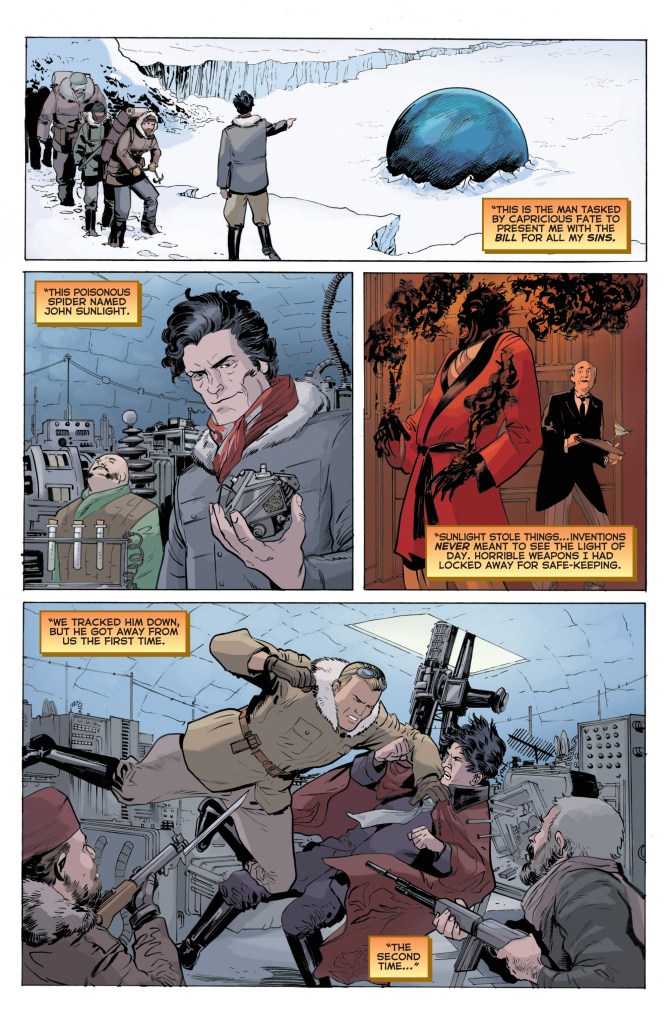
The first two episodes of the story achieved a great deal…they presented a richly-researched period setting, captured characterizations for Doc, Pat, and the five aides that rang true to their original pulp incarnations, and issue #2 ended with the unveiling of the tale’s antagonist, none other than John Sunlight.

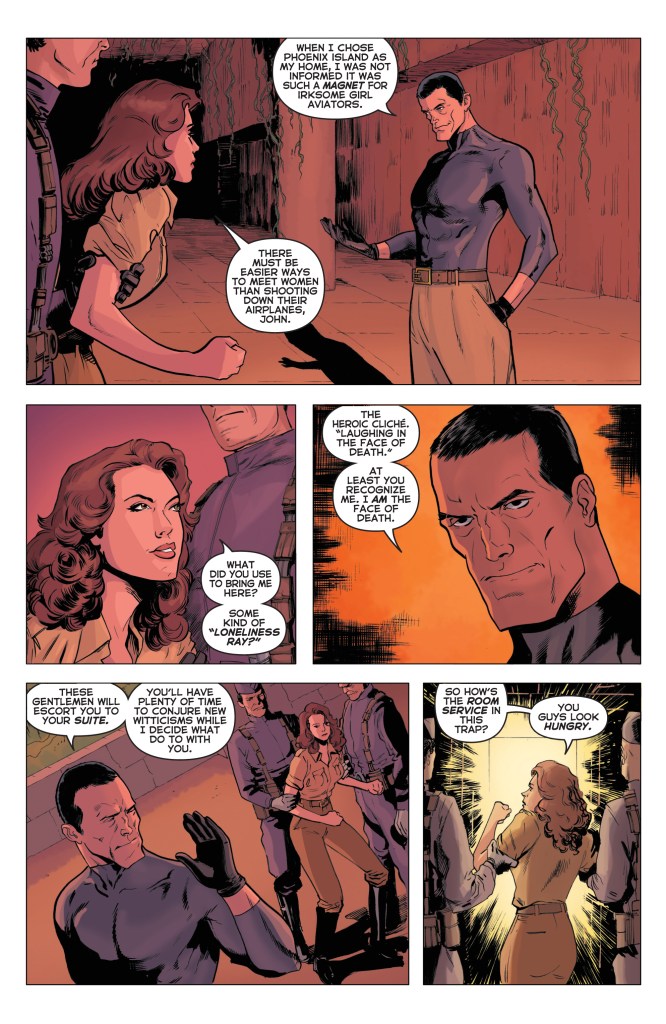
Sunlight, from his secret base — Phoenix Island, in the Pacific — had downed Pat Savage’s plane and taken her prisoner. As the third chapter opens, Pat and Sunlight briefly confront one another…again, their personalities captured to perfection. Pat is impudently defiant, Sunlight calm and self-assured.

Pat, taken away to a cell, finds her friend Amelia Earhart there. Earhart (whose disappearance over the Pacific is of course the stuff of legend), had also fallen prey to Sunlight’s motor-stopping weapon.

Speaking of John Sunlight and weapons, Avallone and artist David Acosta then treat us with a revisiting of Sunlight’s original pulp appearance, in the classic Doc Savage novel Fortress of Solitude. Skillfully done, it makes me daydream of how great it would be to see this author/artist team do a full adaptation of that novel.

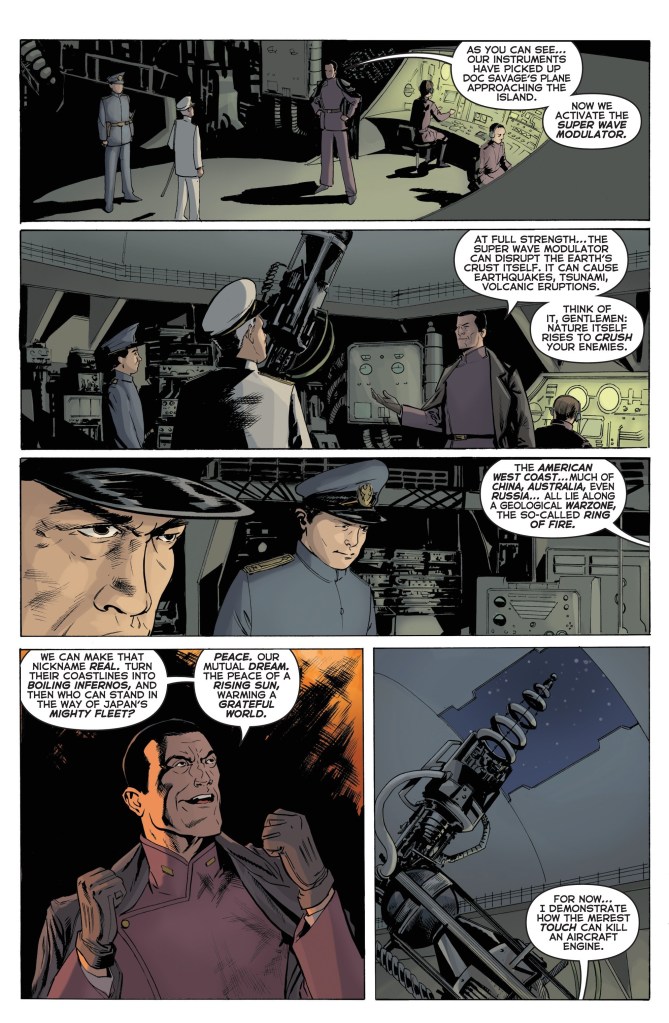
Sunlight’s second pulp appearance, in the novel The Devil Genghis, is briefly described but not shown, as The Ring of Fire shifts back to its main storyline. Sunlight is attempting to forge an alliance with the Japanese empire…whose military representative is arriving to discuss Sunlight’s claims to be able to use his weapon to damage the earth’s crust, raising volcanoes, starting earthquakes…particularly effective along the planet’s fault lines.

Sunlight presents himself with both dignity and menace. The understated tone of these scenes is very effective, grounding them in an atmosphere that feels real, rather than loaded with comic-book hyperbole.

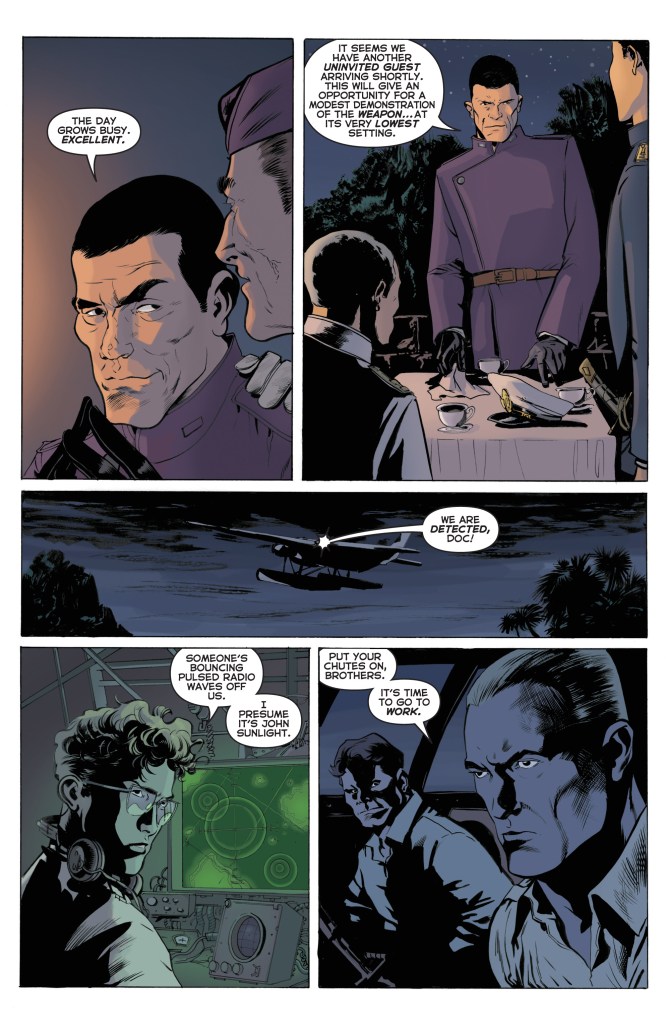
Meanwhile, Pat and Amelia have escaped their cell, and (true to form for Pat) are raising some havoc as they attempt to reach one of the planes at Sunlight’s compound. Sunlight, having tea with the Japanese officers, does not seem particularly concerned.

Doc Savage himself is now approaching the island, which Sunlight has clearly anticipated. He takes his guests to view a demonstration of the technology which he uses to capture planes.

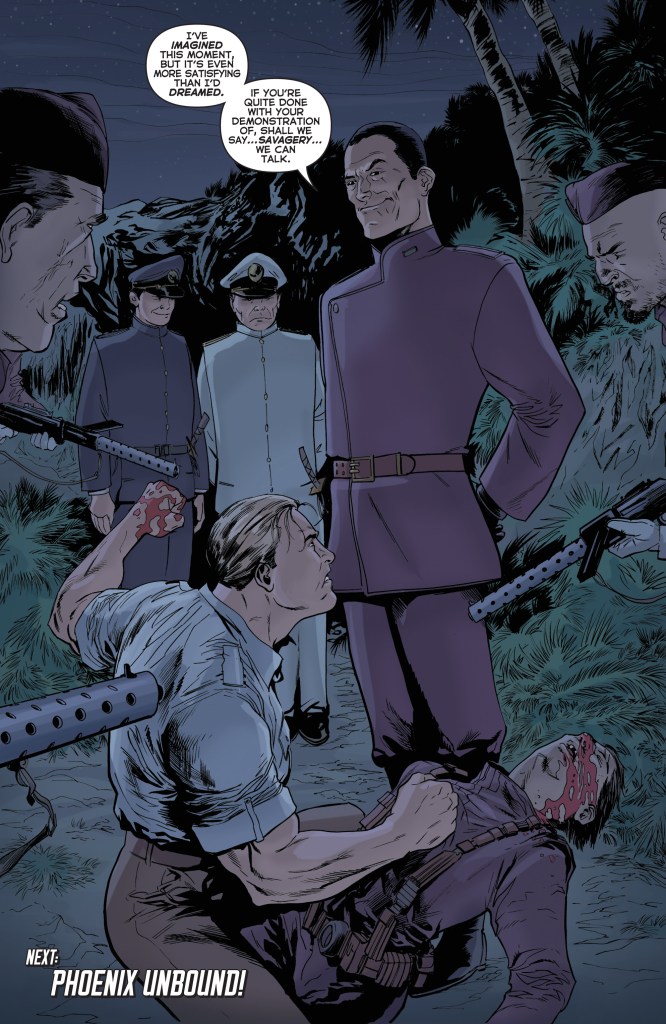
The action heats up, with Doc and the aides avoiding being helplessly disabled, and they too begin to wreak some havoc on Sunlight’s installation. In the midst of the conflict, Sunlight and his minions succeed in getting the drop on Doc, giving us the cliffhanger to this penultimate chapter of the story.

Here once again is David Avallone, with his thoughts on this third chapter of The Ring of Fire:

David Avallone

Amelia at last! Her friends called her Millie. Amelia’s about a decade older than Patricia Savage. Amelia spent the late twenties and early thirties giving a lot of lectures to college students, and went to a lot of events with the best and brightest young women in the country. Also… she formed an organization of women aviators called The Ninety Nines. I’m quite sure that Pat would have been a Ninety-Nine.


Doc tells the origin story of John Sunlight, for those who haven’t read Lester Dent’s FORTRESS OF SOLITUDE or THE DEVIL GENGHIS recently. (Go read them. They’re awesome.) Lester Dent never named the Siberian Penal Colony where John Sunlight was exiled. Because I’m obsessive about such things, I looked at Google Maps for Siberia and narrowed the possible locations down to Krestovaya.

In this Chapter, Doc finally makes his “sound.” In the original pulps, when Doc is deep in thought, he unconsciously emits a strange trilling sound. His men are used to it, but I’m sure Admiral Leahy has never heard anything like it. I didn’t want to use it gratuitously, just for fan service… but this is the moment where Doc really connects all the dots and figures out his course of action. In the art for this issue, Dave Acosta references both INDIANA JONES AND THE LAST CRUSADE and THE SIMPSONS. But here we are… three issues in, and Doc’s shirt STILL hasn’t been ripped. One issue left, Doc.

To be continued…and both The Ring of Fire and Omnipresent Sunlight concluded!

Omnipresent Sunlight: Doc Savage’s archenemy – Part 16

In the last installment, I began with a look at the first issue of Dynamite Entertainment’s 2017 Doc Savage limited series, The Ring of Fire. The author was David Avallone, the artist Dave Acosta.

Since then, David Avallone himself has graciously offered to let me share his thoughts on the series here. What follows is the first part of an Afterword he created for the collected graphic novel version of the story. This will be new to those who have only read the comics — and in addition, sheds some light on his thoughts concerning the topic of these articles: the presence (and continuing mystique) of John Sunlight as an adversary to the Man of Bronze.

Here is David Avallone:

I thought you might be interested in a little background on the making of the book you hold in your hands (or are reading on your iPad.) When Dynamite Executive Editor Joseph Rybandt kindly asked if I would be interested in doing a Doc Savage miniseries, I jumped at the chance. I love Doc, and had only done a “what-if” style Doc one-shot. I was excited to do a classic 1930s “Supersaga” in the Lester Dent tradition. Joe didn’t even have to ask if I wanted my Twilight Zone: The Shadow artist back for this one… Dave Acosta and I were both looking to work together again, after having such a terrific time on that series.


To come up with a pitch (or three) I thumbed through some 1930s history and looked for things that might have caught the attention of Doc Savage and his crew. A few events jumped out at me, one of which was the disappearance of Amelia Earhart. Doc’s Cousin Patricia, a character I’ve always adored, was an aviatrix herself, and surely would have crossed paths with Amelia. I decided they became inseparably close, and that Pat was still haunted, a year later, by her girlfriend’s disappearance, and maybe something else… something more mysterious. I submitted this pitch with two others, and when Joe let me pick which one I wanted to do the most, chose the one with Amelia Earhart. She was irresistible.

To prepare for the series, Dave Acosta and I spent some time on the designs of the characters. As usual, we started a Pinterest board for visual reference. We decided on the incredibly important and controversial question of Doc’s hair: a Bama-like skullcap but one that was clearly made of real hair, which could be disturbed, and not the bizarre helmet-thing from the otherwise excellent 1970s paperback covers. We also came up with a “cast list” for the whole book, with the actors (mostly from the period) serving not as caricatures but as templates for “type”. Perhaps eagle-eyed fans can figure out who was inspired by who. Or you can cheat and look up our Pinterest board for the series… Doc Savage: Ring of Photo References.

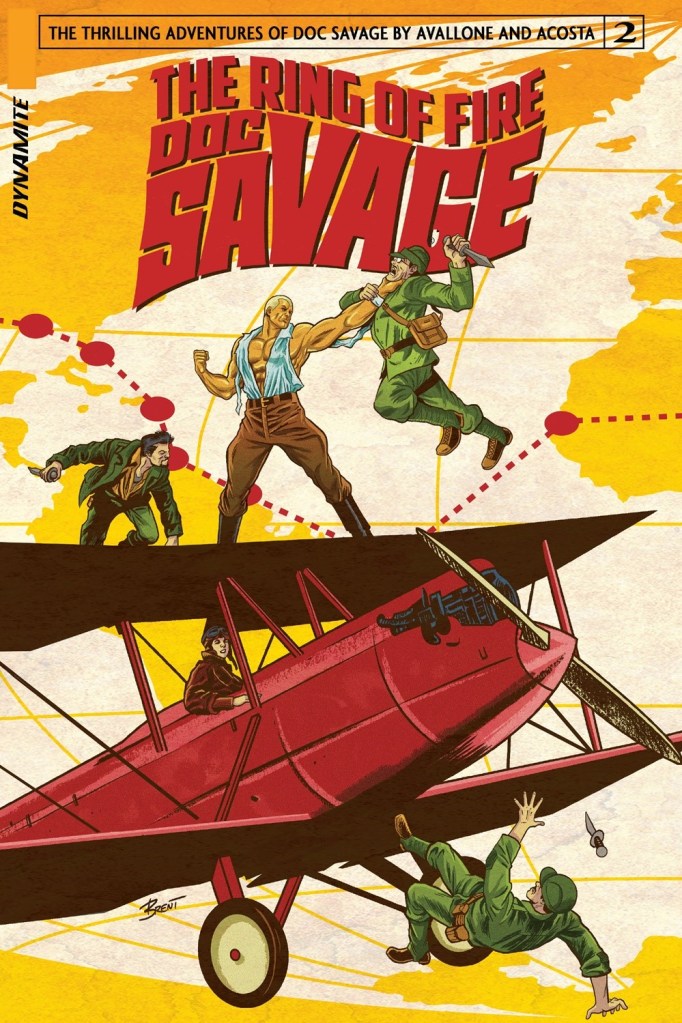
All of Anthony Marques’ covers bursts with power and energy. Brent Schoonover’s interconnecting covers show the path of Amelia Earhart’s ill-fated round-the-world flight… a lovely touch which I didn’t notice until I read something Brent wrote about it. I also didn’t notice (until putting them side-by-side) that beyond the obvious use of the Bantam books font, even the formatting (the rectangle with our names and the number) mimics the great paperbacks from the 1960s/70s.

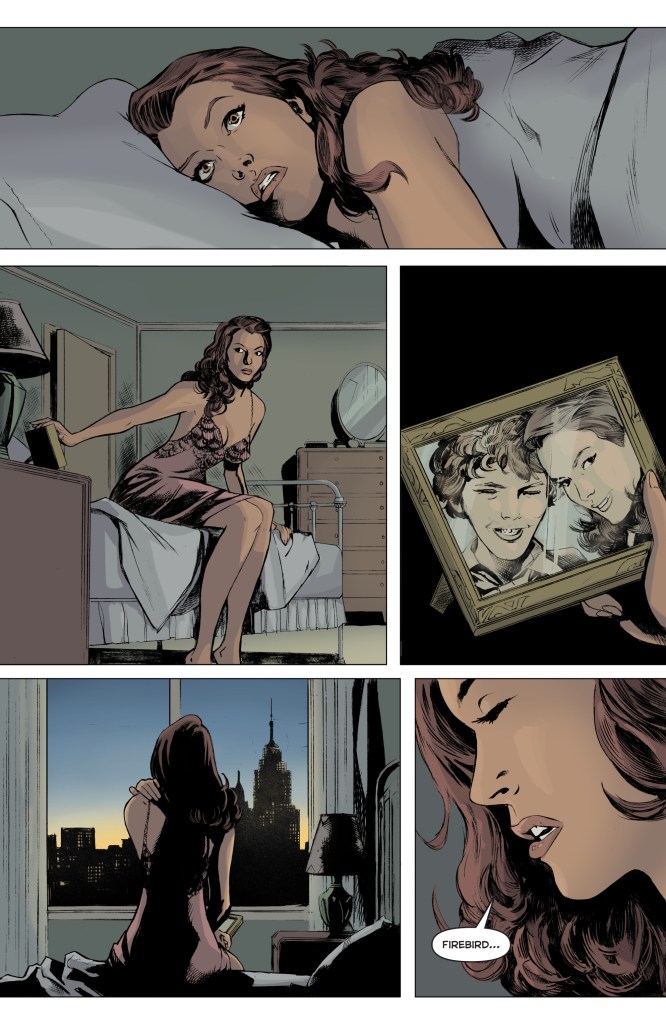
Chapter One: maybe it’s a pretentious tic left over from too much Fellini, but I like opening a story with a mysterious dream sequence. We discussed a bit whether or not the audience would “get it.” I felt we should give the reader the benefit of the doubt. I thought the “silence” of the scene… and Doc’s horrible “death” would be enough to make the nightmare plain enough. From the very first page I loved how the book looked: the talents of Dave Acosta and colorist Morgan Hickman are very much apparent here, and on every page that followed.


I love doing the research for these period-set comics, and for what it’s worth… there really was a U.S.S. Augusta, it really did carry Admiral Harry Yarnell, and there was a naval base on the Palmyra Atoll. Calling it Palmyra Island was my very weak geology “joke”. It was an island before the Ring of Fire blew it in half and turned it into an atoll. I chose the Augusta because it shares a name with my beloved wife, but reading up on it I discovered it was a very significant ship in history. My favorite history teacher is honored here with the non-historical-figure Captain Calimano. Thanks, Mr. C.

Speaking of historical figures, Chapter One also has a cameo appearance by comic book hero President Franklin Delano Roosevelt, delighted to be using an early Doc Savage version of Facetime. I loved writing FDR: it’s fun stuff when you have a character who – famously – really knew how to speak and express himself in interesting and charming ways. His buddy is the Secretary of the Navy, Admiral Bill Leahy. I figured Bill would be in on a call like this. This is a good place to draw your attention to the lettering of Taylor Esposito, who handled a lot of challenging stuff in the series with great imagination and talent.

Chapter One then introduces the Fabulous Five. To be honest, I feel that the Five can be a challenge, and it’s a challenge Dave and I were very much interested in taking on. How to make them all clearly defined, visually and as characters? We worked on this a lot, and I hope it shows.

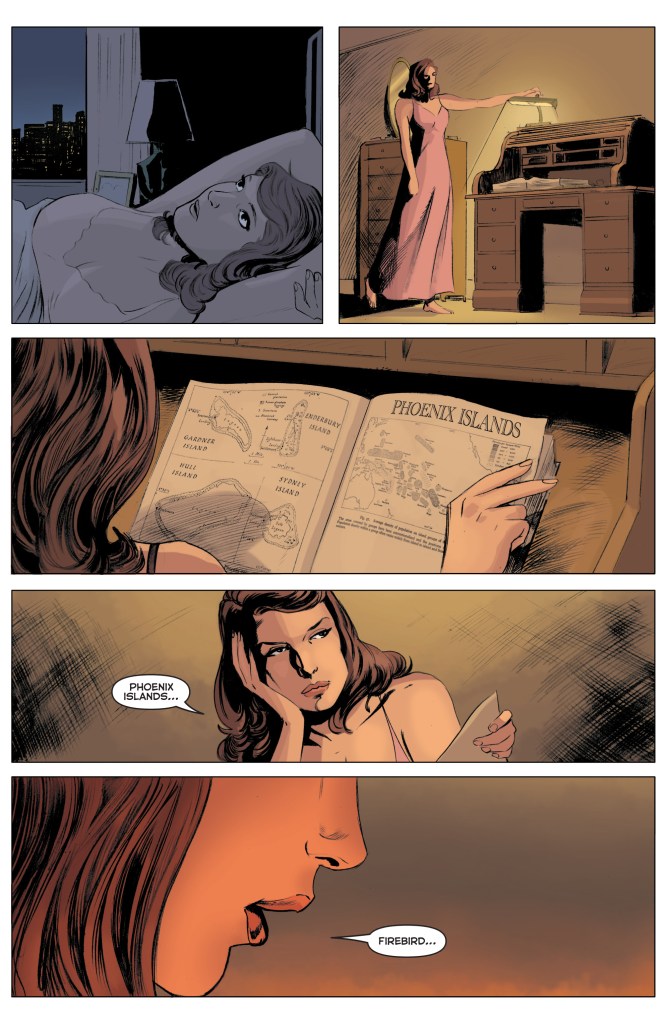
Chapter One ends with a curious thing about research, and the subconscious. When I started writing, I wasn’t sure what “clue” would lead Pat to know where to look for her friend. In the real world, Amelia vanished not terribly far from an island group called (in 1938) the Phoenix Islands. At the time I wrote Amelia’s transformation to the Firebird I was not consciously aware of that fact, or thinking about it. When I got to this scene I suddenly realized I had already planted the clue in the first sequence. My mind played a trick on me identical to the one it played on Pat Savage: I assume “Phoenix Island” was lodged somewhere in my brain from doing the research, and the dream sequence – just like in the story – was trying to give me the answer.

Chapter Two gets its title from a Bogart movie from the period. Ironically, in the Bogart movie he never quite makes it to the Pacific.


As the US Navy guys watch Doc Savage fall from the sky, I couldn’t help myself from gently tweaking the famous superhero who owes a lot of his foundations to Doc. Doc’s diving suit here can be found on the cover of the October 1937 issue of Doc Savage magazine. Old film nerds might also recognize the design of Doc Savage’s gas grenades. In 1933, Doc supplied them to a filmmaker named Carl Denham, who was concerned that he might need to knock something enormous unconscious.


The issue ends with the reveal of our villain, foretold in story and song and Previews solicits: John Sunlight. I know that some fans are like “c’mon, man, John Sunlight? Again?” In prepping this series I went back and reread the Sunlight pulps and really wanted to write the character. I also felt like Kenneth Robeson/Lester Dent still left something there unfinished. Dave and I both picked the same “photo model” independently, and I love the way his design came out.

To be continued…

Omnipresent Sunlight: Doc Savage’s archenemy – Part 15

The most recent appearance of John Sunlight in a mainstream venue was in the 2017 Dynamite Entertainment comic book limited series Doc Savage: The Ring of Fire. The author of this story is David Avallone, and the interior art is by Dave Acosta. This is also the last time (to date) that a Doc Savage authorized comic book story has been done by any company. I’m glad to say that if it is a finale (at least for now), it’s a good one.

Dynamite tried a lot of different approaches during its time working with the Doc Savage characters and mythos as a whole…some of which were ambitious and interesting, others more pedestrian, and one (the previous appearance of Sunlight) to my mind, a disaster. But The Ring of Fire went back to Doc’s period roots, and pulled it off with considerable skill and poise — and an obvious love of all things Doc.

John Sunlight does not appear until halfway through the story, and in most of the reviews in this series, I jumped straight to the moment where he steps onstage. But bear with me for a bit, as I feel this story is worthy of setting that stage properly.

There are numerous elements to this story, all of which are handled deftly — great credit goes to author Avallone, who entered a minefield that many other authors have attempted, but few have navigated with success. Among the challenges: presenting an authentic 1930’s period atmosphere, including historical personages in the narrative without them appearing for the sake of novelty alone, and balancing an exciting storyline with genuine emotional strength to the characterizations.

All of this is done well in The Ring of Fire. It begins with a dream sequence featuring Doc and his cousin Pat, in which a traumatic episode of fiery death unfolds before Pat’s dreaming eyes.

Included in the dream sequence are Doc’s death, and the appearance of what is to us a legendary historical figure: Amelia Earhart.

Pat awakens, and goes to Doc to talk about her dream. Practical as ever, he is skeptical that it is more than simply a subconscious expression of Pat’s emotions — it’s explained that Pat and Amelia were actually very close friends (a logical connection, given Pat’s own prowess as an aviatrix).

One creative choice evident in the pages above, is Avallone and Acosta are depicting the characters as dressing normally for the 1930’s, without a hint of superhero costuming. This is something the comics over and over were hesitant to do, but it was a huge breath of fresh air to see in this story — linking it visually to the pulp era and style. The characters all speak realistically as well — another excellent decision, as it avoids the pitfalls of camp or comic book speechmaking tropes.

The story progresses with a call from President Roosevelt, using a prototype videophone — also adeptly presented, with a realistic feel for the 1930’s setting.

Next on the scene are Doc’s five aides, as they prepare to investigate the mystery. Doc also agrees to hunt for the missing Amelia Earhart, with Pat’s gratitude presented in a warm scene that shows how deeply the cousins both respect and care for one another.

Pat, of course, is never to be counted out of an adventure — she muses about her own feelings about Amelia and the dangers facing Doc and the others, and decides to head into the thick of the mystery herself…and the stage is set for what will be a memorable reappearance of John Sunlight.

to be continued…

“Operation Xanadu” Book Release

Gromagon Press is pleased and proud to announce the release in paperback of Atom Mudman Bezecny’s novella Operation Xanadu.

Atom is no stranger to Forbidden Pulp…she is the author of the Doc Talos story Silver Legacy, as well as a member of the Conseil du Mal modern pulp review/discussion team.

Her Operation Xanadu novella is a scathing, funny, insightful and intense exploration of hedonism (and its price)…

“In Xanadu did Kubla Khan a stately pleasure dome decree…”

“What?”

“Nothing.”

Far more than nothing, the opening words of Operation Xanadu herald an apocalypse. And not just any apocalypse, but one ushered in by The Greatest Party of All Time. A group of high school friends from a quiet suburban neighborhood are ready to celebrate with plenty of sex, drugs and music…but their hedonistic dreams devolve into something that more closely resembles the end of the world.

Atom Mudman Bezecny’s searing vision of unrestrained pleasure and its consequences will leave you staggering…and amid the flames, questioning the sanity of society’s values and priorities.

Or maybe just dead. But what a way to go.

Here is Atom’s Foreword to Operation Xanadu:

I was never really a party girl.

Oh, there were times when I labored under the pretense that I was. I am and always have been an excitement-junkie, and a pleasure-junkie, but I’ve been recently informed that this is true of most humans. I suppose that makes sense. Most of us like to go to the movies, after all, or read books, or take drugs; whatever brings us in touch with a world more pleasurable and more dramatic than our own, and whatever kills the pain and tedium of a life under capitalism. Those of us who do try to live a life of adventure in “real life,” regardless of what that means in the moment, often learn that, as a famous Vulcan once sagely observed, “’having’ is not so pleasing a thing after all as ‘wanting.’” The element of risk grows more dangerous and less pleasurable the harder one chases a thrill.

But it is the nature of humans to court death, to court the threat of the law, and above all, to court that which is forbidden, for the sake of conquering those fearsome things. That is the psychological root of teen party culture.

I didn’t have to be a party girl to learn that. Excitement and rebellion take different forms for every teen. Some do go to parties, but others read horrible books or drive their cars really fast or steal things on weekends, or go to rallies that their conservative parents wouldn’t approve of. In my own rebellion, I’ve always felt like a sense of purpose is important; back in my teen years that always made me seem like something of a judgmental asshole. Since high school, I’ve learned to actually let people have fun. When people do stand up for the oppressed, I still always appreciate their sense of purpose—I’ve just gained an understanding that there is no resistance without an enjoyable life. There is no ground gained when we, the rebels, deny ourselves the humanity we’re fighting for.
Still, I’m far from free from oppressive beliefs, just like the rest of humanity. The traumatic nature of high school has made it hard for me to shake the popularity mentality. And yet there’s little wonder that this mentality persists into adulthood—high school is in many ways a model in miniature of capitalist society, in that intersectional privileges result in a de facto hierarchical caste system. One which affects people even when they try to ignore it. At times, life can be a popularity contest, if popularity is gained from being whiter, straighter, cis-er, richer, and more abled than everyone else. You get invited to more “parties” based on the nature of historically-rooted oppressive power systems. Nevertheless, it is worth pointing out that I was neurotic in high school, as I am today, and I had a tendency to take things too personally. That is a side-effect of trauma, but I still made my choices, independent of my own marginalization in life. Consequently I may have absorbed more belief in that popularity hierarchy than my progressive beliefs should let me allow. Or perhaps that absorption is simply a product of my own privilege.

What I’m trying to say through all of this is that when I watch trashy teen thrillers or party movies, there’s a tiny part of me that still wishes I could be one of the cool kids, even though I know that those cool kids were and are, more often than not, spoiled pieces of shit.

What I didn’t know as a teenager that I do know now is that these sorts of movies were always for the purpose of vicarious living. None of the sexed-up, drugged-out circumstances they depict are any more real or realistic than the ironic fate-prisons of film noir. At the very least, they capture reality in a way that is distorted by the filmmakers’ adult cynicism. But a lot of these movies do succeed in capturing the vibe of high school—the pettiness, the desperation, the confusion of nascent and collapsing emotional states. The love of eternal friendship frosted with the dangling knowledge that friendship is not eternal. What a miserable time! Why do we watch these movies? Why are we nostalgic for our teen years when they were so awkward and, oftentimes, so sad?

I guess because we like to gawk.

Project X was made for gawking. Made in 2012, this movie is a time capsule of millennial embarrassment. It is the story of a group of teens who decide to host the party of the century, which soon gets out of hand. There’s not much of a premise beyond that. The movie is rather notoriously stupid, being just a festival of drinking and sex talk, and that’s precisely why I watched it. I wanted to see what passed for “cool” entertainment at the tail end of my own teen years.

Project X is fundamentally an example of missed potential. It’s a movie that comes so close to criticizing the crude bigotry of its “protagonists” that its failure to do so crowds out any of its thematic value. It’s a movie that chooses to take the easy route of portraying hard drug use, bullying, slurs, and cheating on your partner as things that are ultimately consequence-free, as long as you’re young and white enough. Sure, it milks these things for conflict, but the entire thing is so lacking in plot structure that nothing comes to any sort of meaning, and not in the way the filmmakers probably intended.

But, there was still potential. And so as a writer, I got to thinking.

I’ve always been interested in the idea of pleasure, despite my non-status as a party girl. I’ve read a lot of the “horrible books” I mentioned above (and below), a great many of which deal with the nature of pleasure as a philosophy unto itself. I think that the study of pleasure is interesting on both a literary and psychological level, as it digs into the deepest layers of what makes us human. For this book, I decided to blend together what I’ve learned to create a retelling of Project X that not only tapped into my sociopolitical concerns, but also my own sense of the nature of pleasure—including the pleasure of off-the-rails storytelling. I hope you enjoy the resulting tale.

I do recommend watching Project X prior to reading Operation Xanadu, as I followed the movie pretty much beat-for-beat up to a certain point. I wrote this as what I’ll refer to here as a a “parallel work,” much in the same way that the 2022 Netflix series The Woman in the House Across the Street from the Girl in the Window is a parallel work to the 2021 film The Woman in the Window. As is my unquenchable habit, I’ve included a few nods to various other pieces of fiction along the way, including other teen movies.

From the moment I finished this project, I had R. Paul Sardanas’ Gromagon Press in mind for publishing it. I knew that a story centering on the exploration of hedonism and debauchery was exactly in line with what that esteemed house specializes in. Gromagon is the publisher of Mr. Sardanas’ excellent Doc Talos series, which was not a small influence on this book. One of the figures of this story who I drew from preexisting literature helps make this connection more appropriate; like Doc Talos, this character was the product of a social experiment conducted on him from birth, intended to shape him into a superhuman being. As Doc Talos is in many ways a dark reflection of the pulp hero Doc Savage (or is it the other way around?), having a figure who is a shadow-version of the Bronze God of Technopolis seemed fitting. My thanks to Gromagon for publishing this book; I am truly honored to join the ranks of awesome creators who have helped make it one of the coolest indie presses in the world.

I extend those thanks to you as well, dear reader, and I hope that the serving of hedonism I place before you more than sates your appetite. “Till the break of dawn, yo!”

Exclusive by direct order from Gromagon Press, Operation Xanadu is available in paperback and PDF download. To order, please send an email to admin@gromagonpress.com, and our administrative staff will respond with PayPal information for you to purchase this book.

Operation Xanadu by Atom Mudman Bezecny

6 x 9 Paperback, 90 pages

$14 plus $5 shipping and handling

PDF download is available for $8.00, and you will be provided with a download link upon purchase.

“Till the break of dawn, yo!”

Omnipresent Sunlight: Doc Savage’s archenemy – Part 14

In the previous installment, I took a look at the concept and introductory issues of Dynamite Entertainment’s 2014 Justice Inc. limited series, which featured John Sunlight as one of two antagonists (the other being Dr. Mocquino, The Voodoo Master, an opponent of The Shadow).

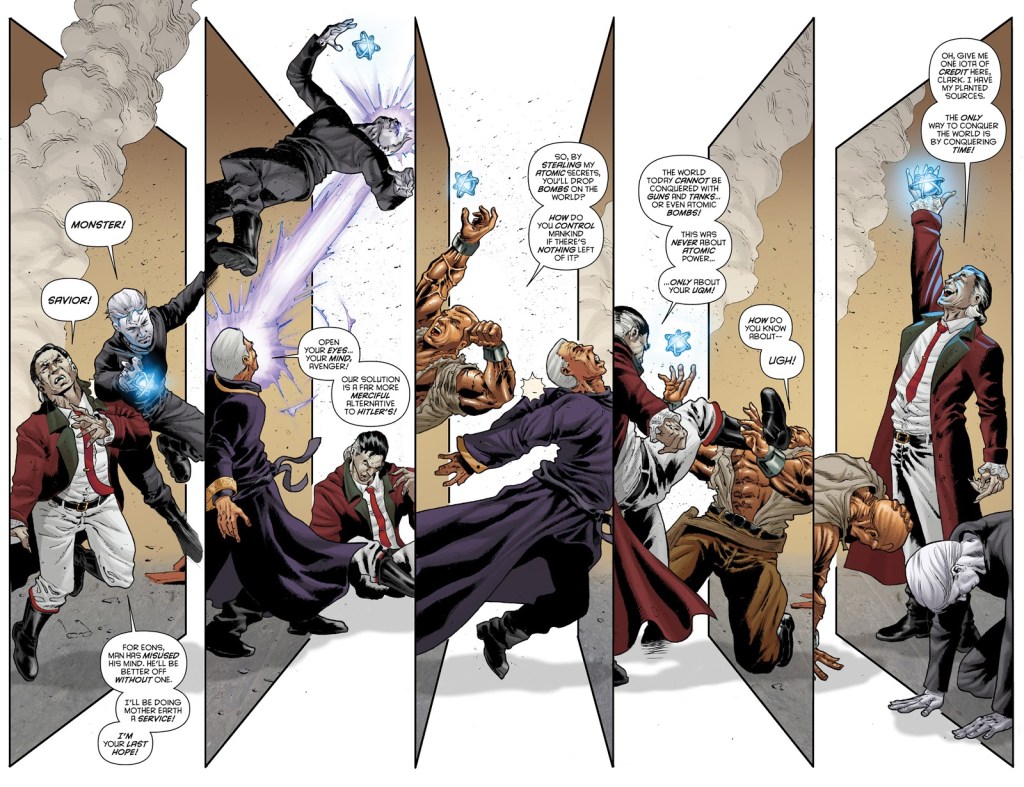
Sunlight did not appear until issue #3, crashing down from above with a small army of ninjas. However, by the time of that scene the tone of the story had been set. Written by film producer/sometime comics-writer/comics scholar Michael Uslan, it was an uneasy graft of pulp and comics tropes. A team-up story, featuring Doc Savage, The Shadow and The Avenger, it displayed knowledge of their pulp histories, but a very off-kilter portrayal of all three…and not in a good way. They basically became cartoon characters…shallow, given to labored exposition, hollow action sequences, and speechmaking. All three classic characters fared badly, but Doc Savage arguably the worst, with his speech pattern and mannerisms altered through the use of often-clumsy (and even cringeworthy) slang and adolescent behavior.

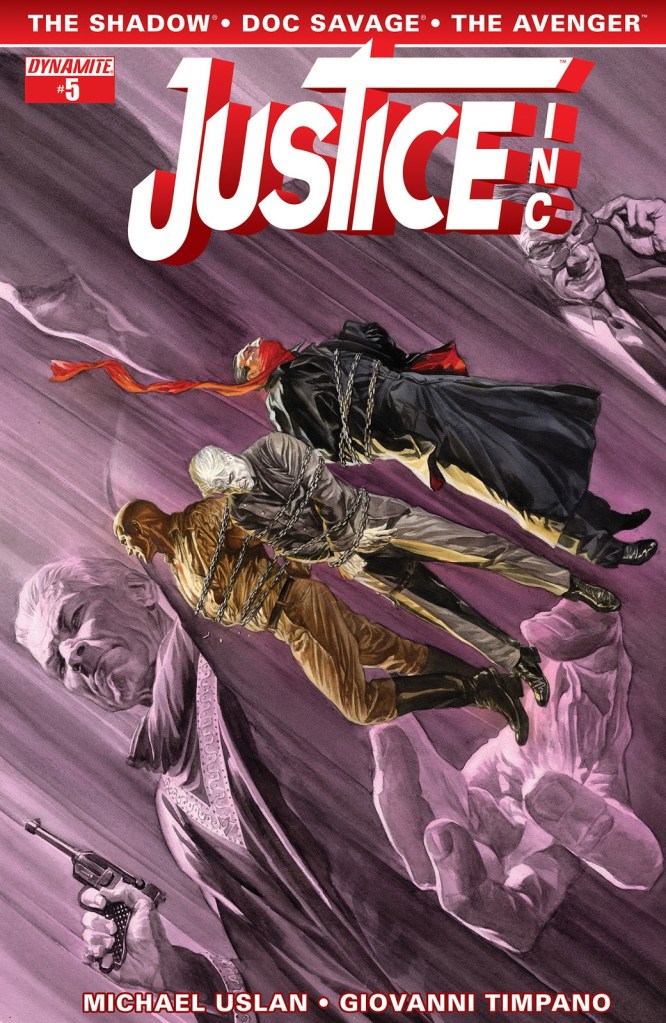
The series teased better things with its covers — very dynamic compositions by artist Alex Ross (the image below is of issue #5, the only one that displays Sunlight, in the upper right corner) but the drop-off in the story content itself was precipitous.

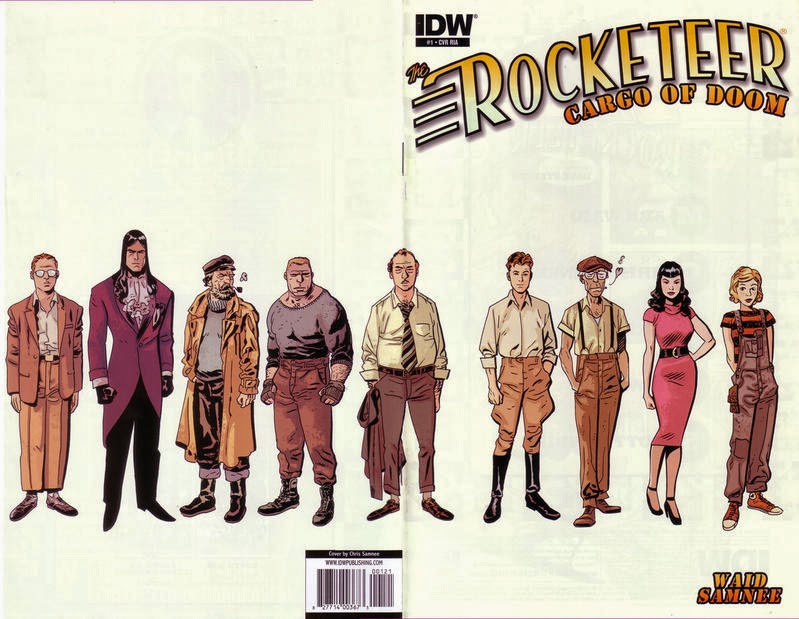
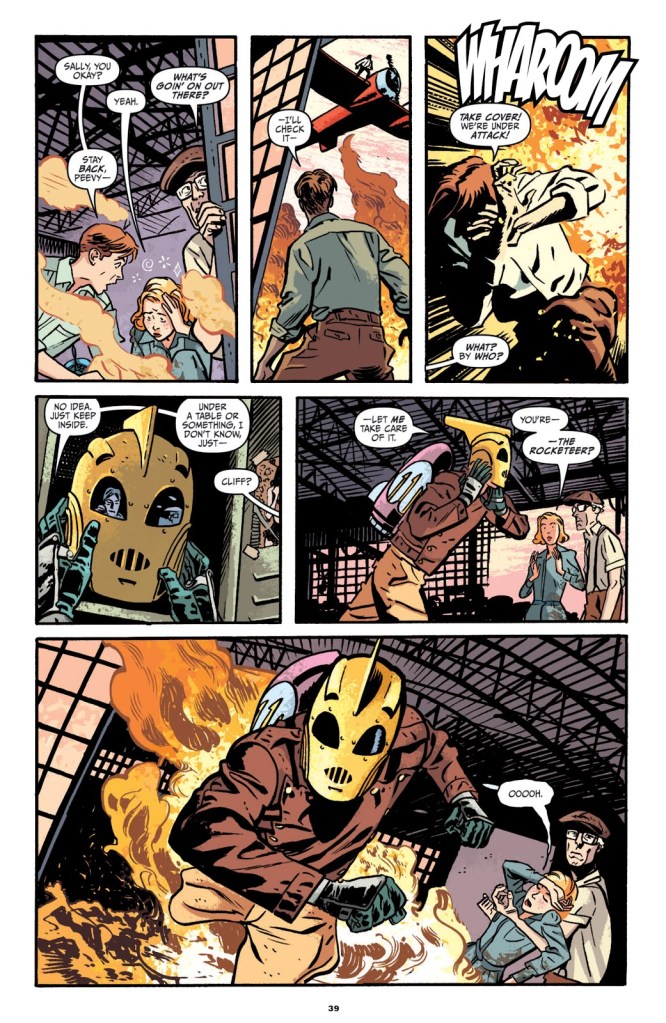
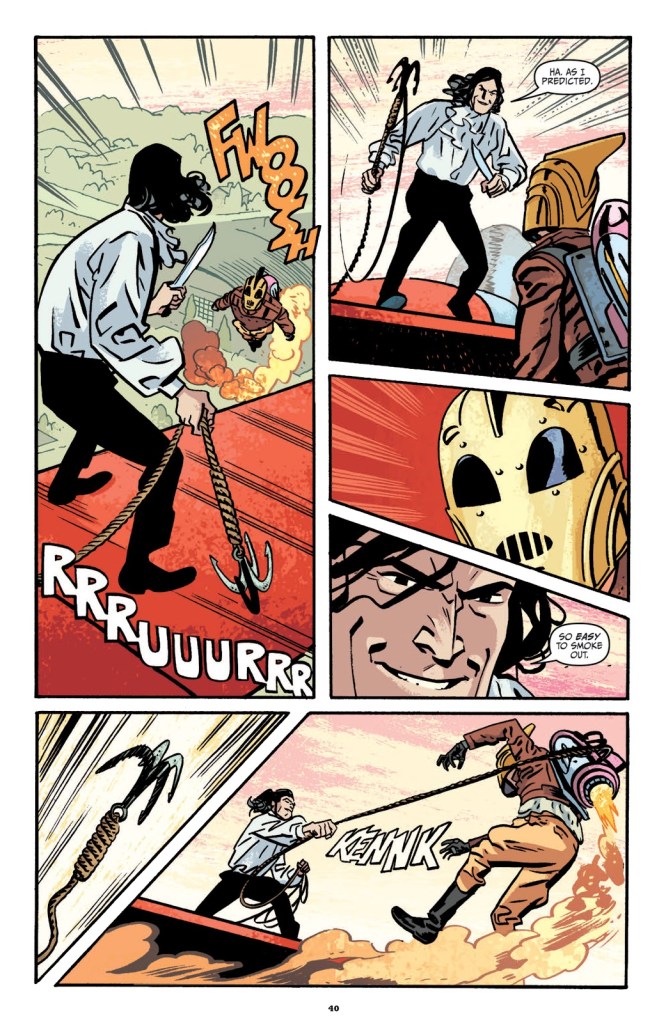
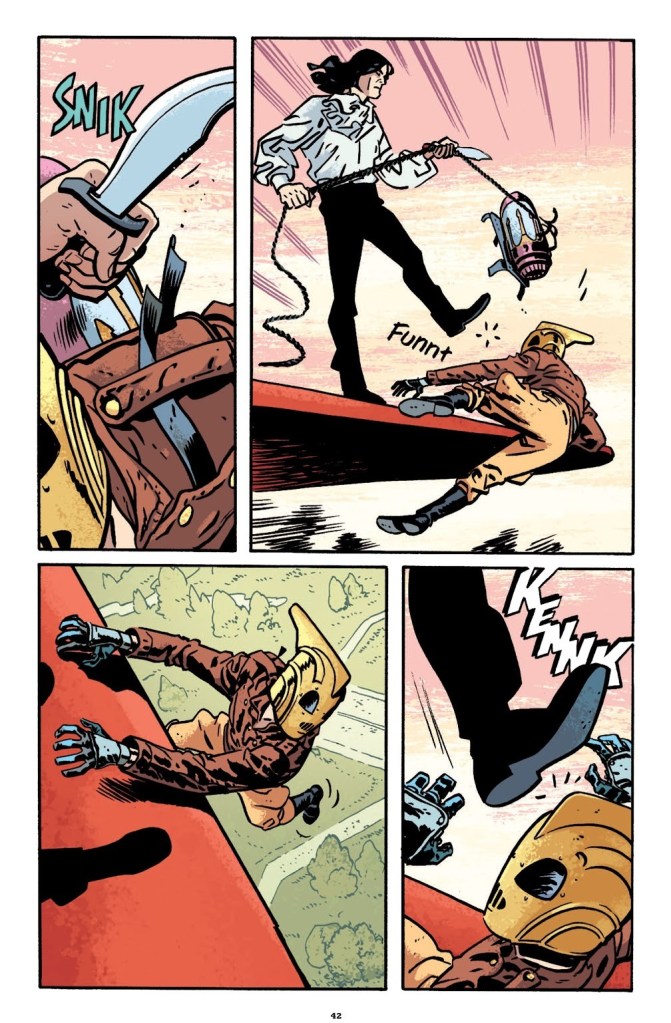
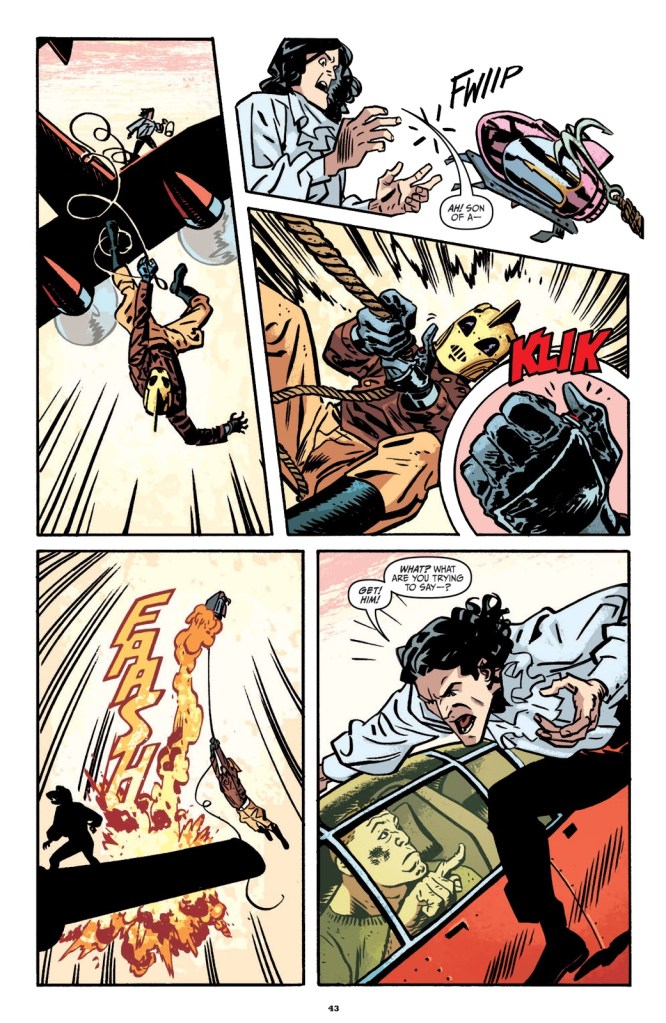
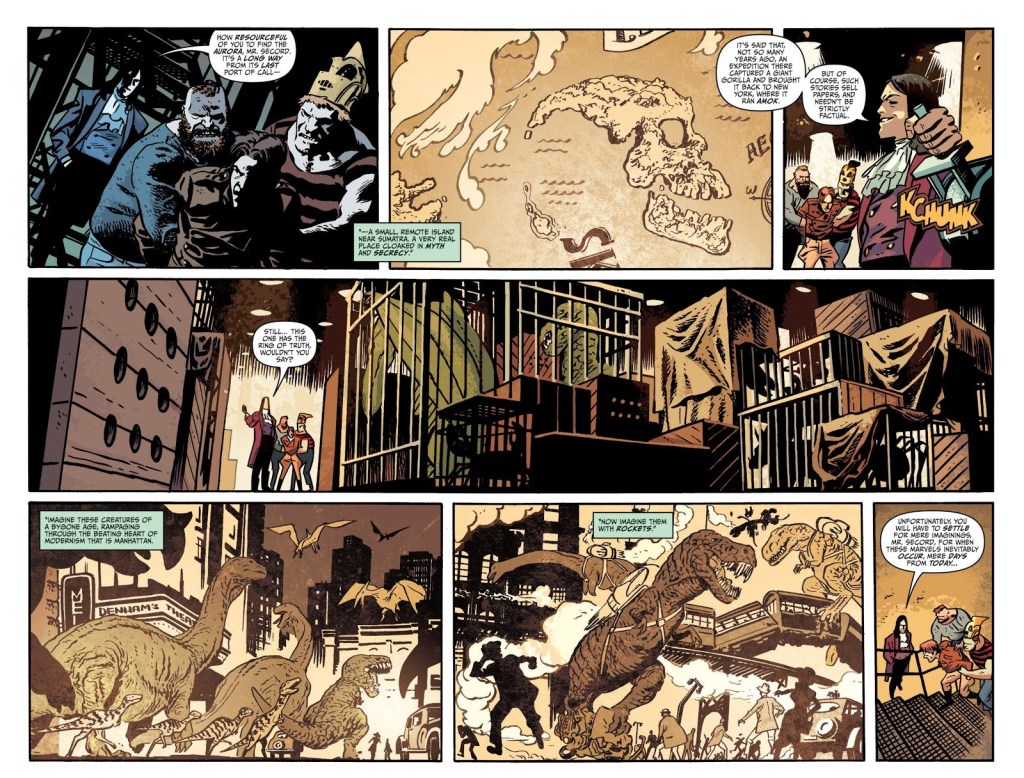
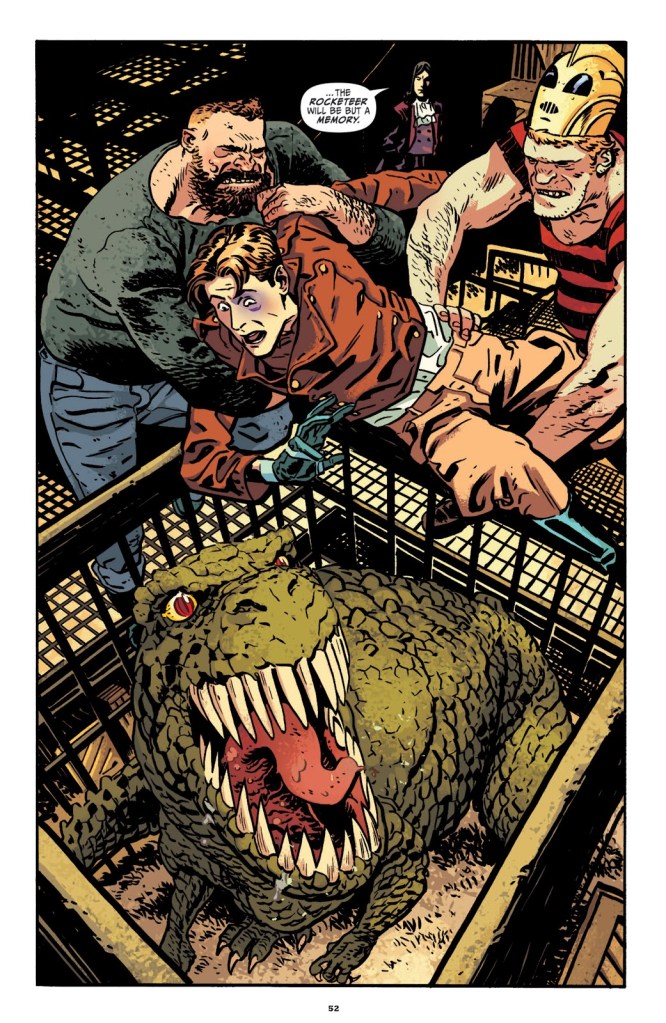
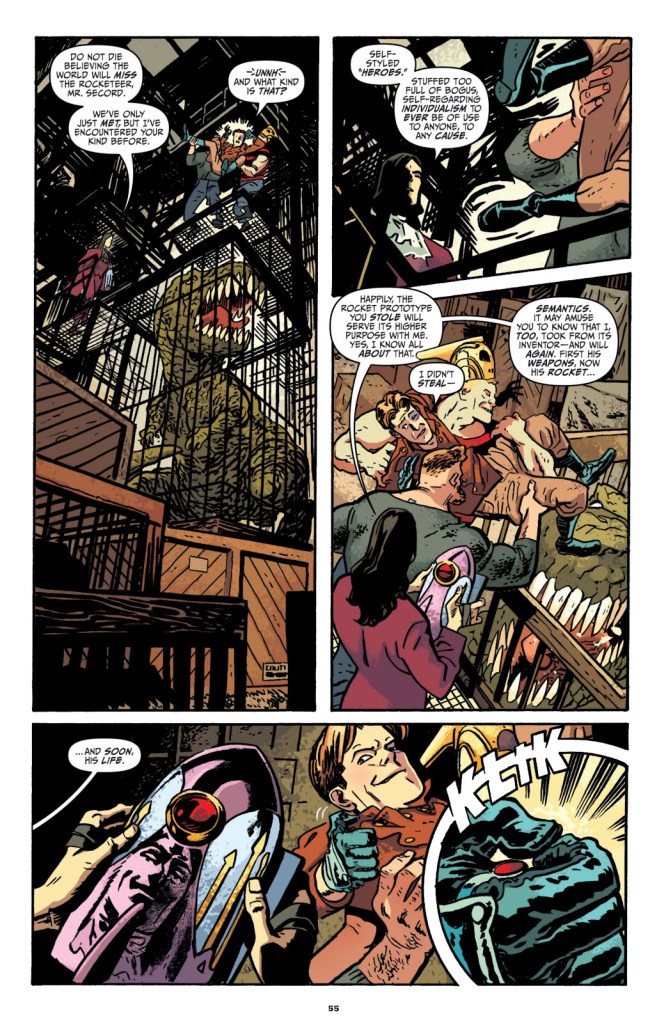
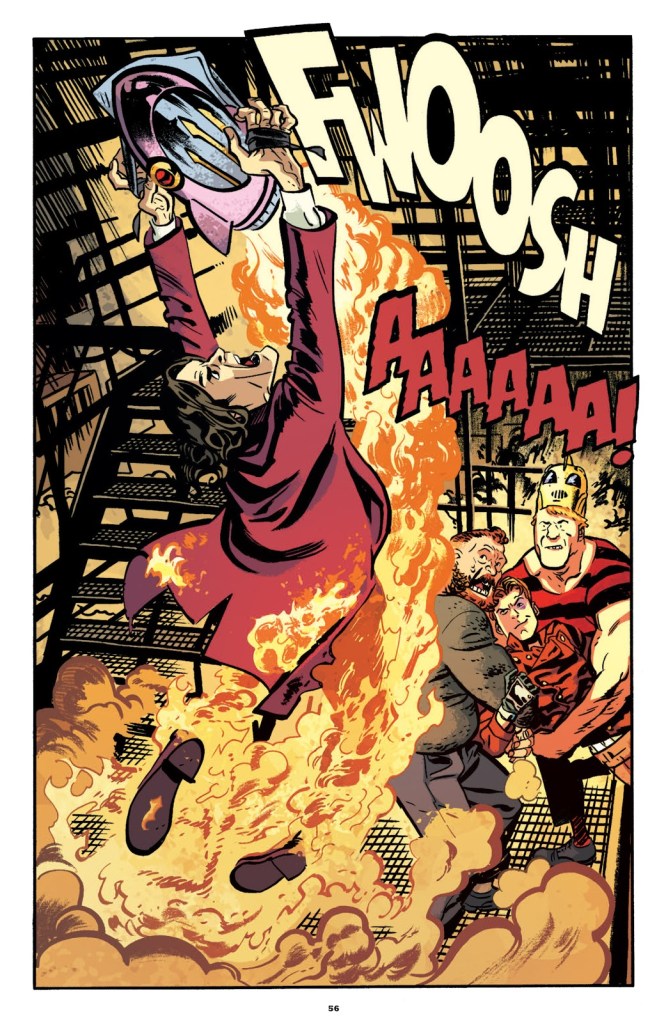
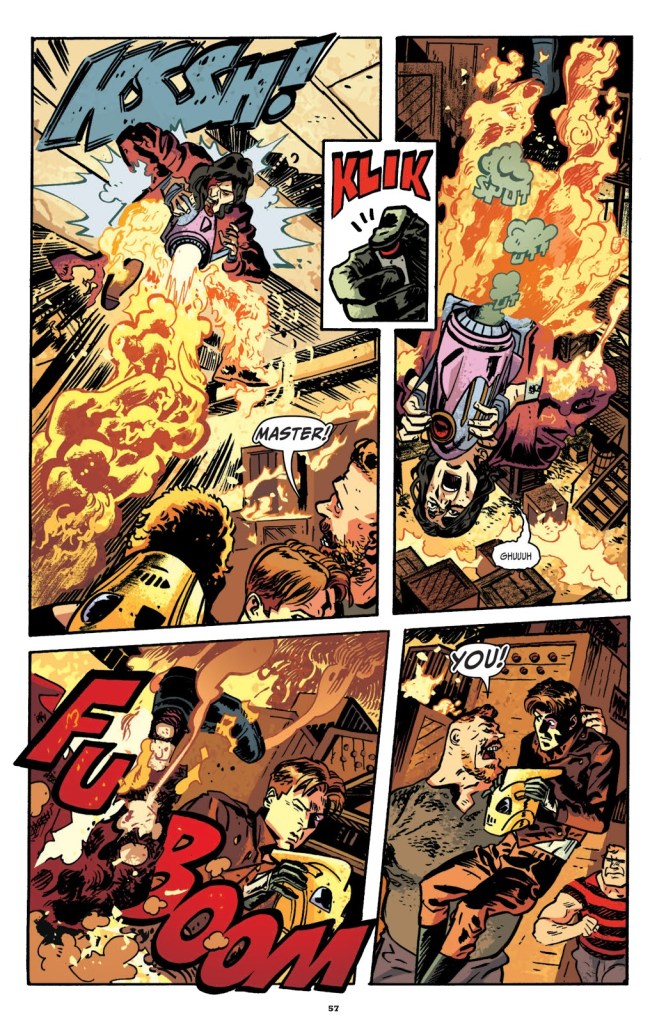
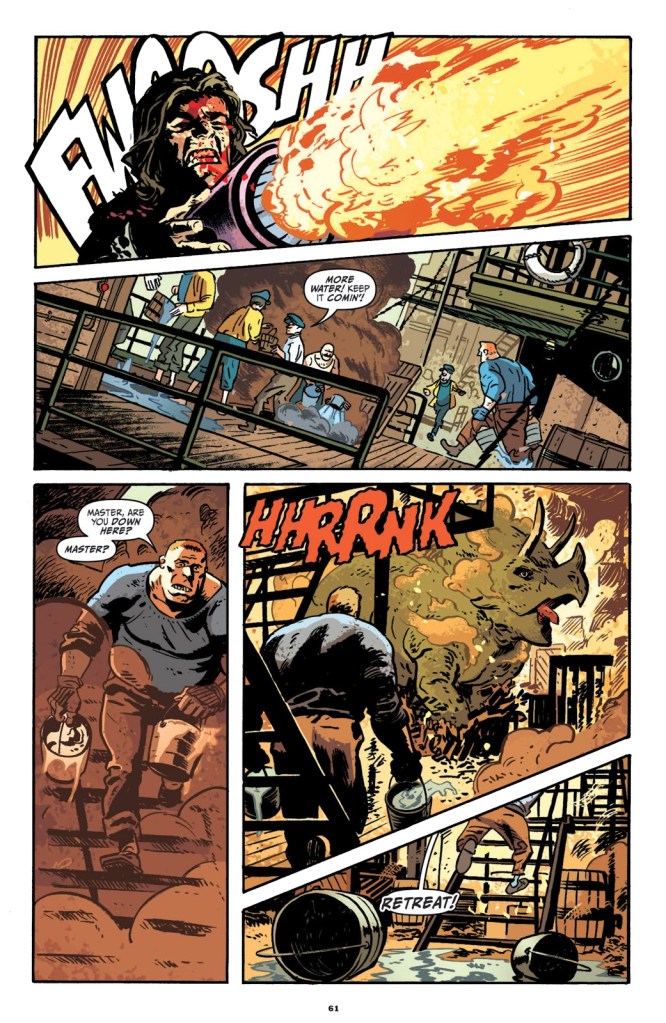
The visual design for Sunlight actually cribs some stylistic details from the Rocketeer story he had appeared in a couple of years before — primarily a Victorian-style shirt and frilled cuffs — and piles on other costume-like elements. Tinted sunglasses, a duster coat, high boots, a somewhat-straggling red necktie. No effort is made to follow Sunlight’s penchant in the pulps and other comics renditions for wearing monocolors.

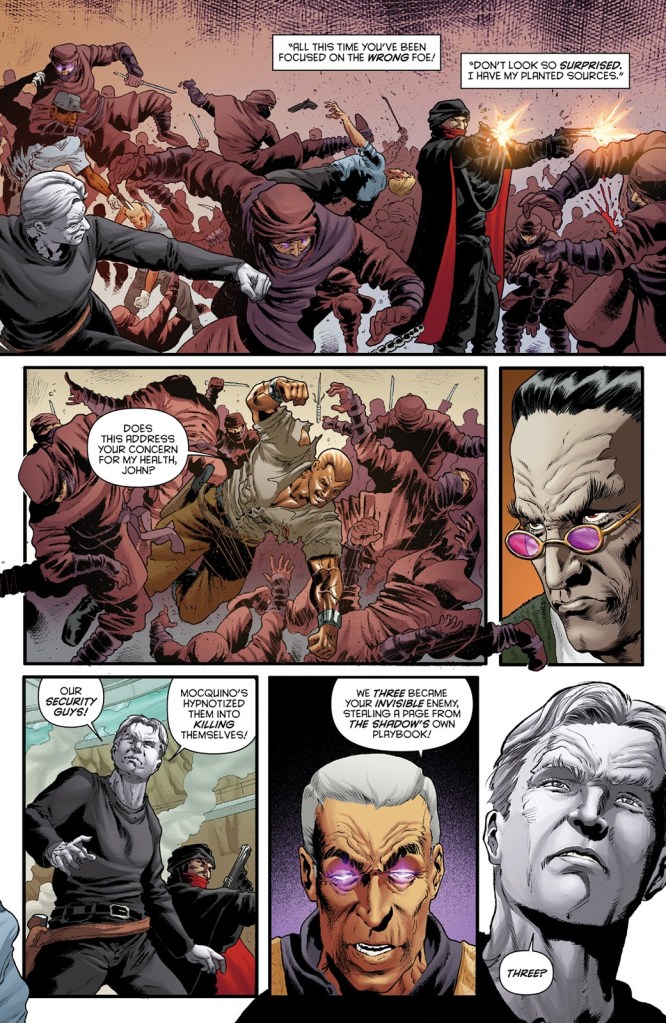
The following sequence (which takes place right after Sunlight’s entrance at the end of issue #3) is emblematic of his presence going forward — basically he stands around looking generically evil and saying malevolent things.

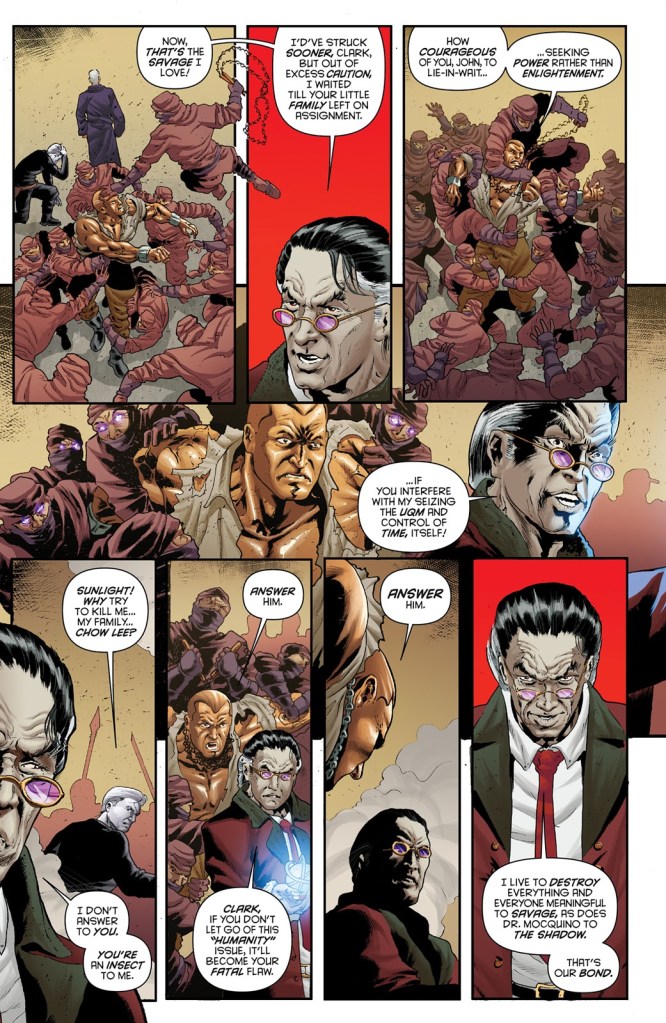
The plot of the story involves an artifact that gives its possessor control over the entirety of time — a rather silly SF premise that would have been wildly out of place in any of the pulps dedicated to these characters. It’s the little blue glowing object featured in the panels below.

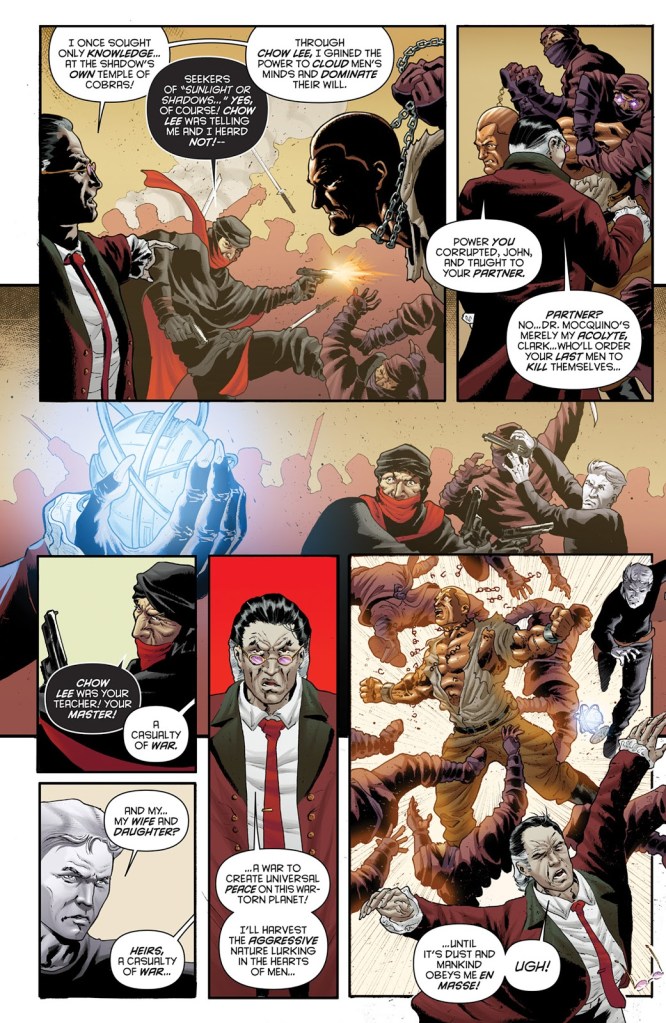
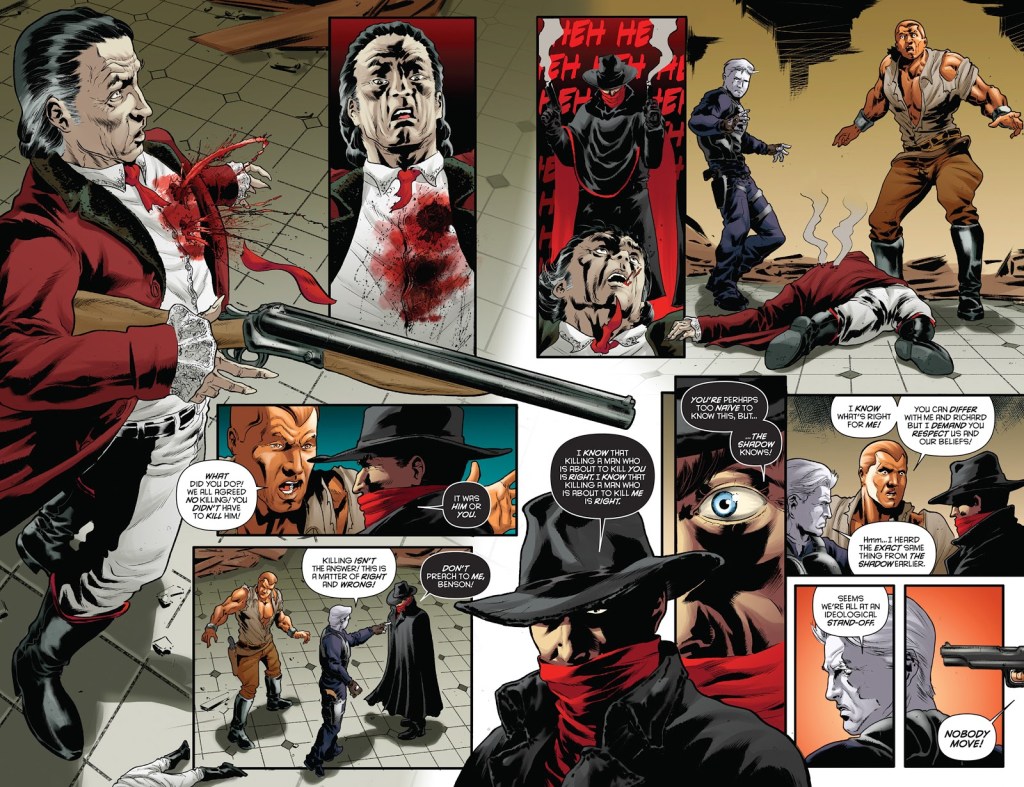
Many scenes similar to this over-posed sequence take place in the series, but I won’t belabor the point by showing them all. A final discordance to this story is the presence of bloody violence alongside the distinctly juvenile plot elements, and Sunlight meets his end in one of those. After more speeches in the midst of an action sequence, Sunlight takes aim with a shotgun, only to be shot in the back by The Shadow.

All in all, this was perhaps John Sunlight’s least memorable appearance — an ill-conceived tale that is probably mercifully forgotten.

There would be just one more appearance of the John Sunlight character in a mainstream venue — from Dynamite Entertainment again, but in a much better story, going full circle back to the pulp era.

to be continued…

Omnipresent Sunlight: Doc Savage’s archenemy – Part 13

The next appearance of John Sunlight was in 2014, in a comic book limited series from Dynamite Entertainment. Dynamite had acquired not only the right to do Doc Savage stories, but also the other two pillars of Depression-era heroic pulp fiction: The Shadow and The Avenger. Dynamite’s not-too-surprising decision on the use of those characters was to mash them together into a single story.

A number of things went wrong with this right out of the gate. DC Comics had of course gone the mashup route as well with its First Wave event, and had similar difficulties creating a coherent story with characters never meant to appear together. But First Wave tried an ambitious, more mature storytelling style (at least at first), which allowed for more latitude in portraying these pulp characters, as it was attempting to re-define pulp storytelling as a revitalized genre in the 21st century.

Dynamite’s series, titled Justice, Inc. (after The Avenger’s organization), had no such lofty ambitions. It is in fact a little hard to understand the goal of the series at all, unless it was simply to test the audience interest in these classic characters. Chosen for the writing of the series was Michael Uslan, which seemed to make a little sense on one hand, but on the other no sense at all. Uslan was best known for his role of producer on the Batman film franchises, and he was also a teacher of comic book writing (an interesting vocation). He had written some comics himself, but in total, really very few. One of those had been an issue of The Shadow by DC Comics in the 1970’s — done when that series was in its final decline — which guest-starred The Avenger. Perhaps the fact that he had worked, albeit briefly, with two of the classic pulp characters in the past was a tipping point to his heading up this new project.

Uslan showed familiarity with all of the characters in Dynamite’s Justice Inc., but missed pretty widely on his own characterization of all three. Doc, for instance, was given a distinctly adolescent speech pattern, and basically did very little but spout action-story cliches. The Shadow came off as annoyingly officious and given to B-movie speechifying, and The Avenger had a wisecracking manner.

One thing that was well done about the series was the cover art: done by Alex Ross, it offered some spectacular visuals, including the cover of issue #3, the part of the story where John Sunlight first appears. It is a three-way portrait of each hero along with original pulp supporting cast, and is beautifully rendered.

The interior artwork, by Giovanni Timpano, is unfortunately much less skillful. It had a somewhat generic comic-book feel…the characters and scenes had a cardboard-cutout vibe to them, which was another aspect of the series’ adolescent style. Even that was discordant, as the series also included bursts of bloody violence much more suited to a more adult, R-rated narrative.

Given all that, it was not altogether surprising that by the time John Sunlight does appear, right at the end of issue #3 (the antagonist to that point had been solely a Shadow villain, the Voodoo Master)…he too appears as an over-stylized cardboard-evil character. For the first time in his long history, Sunlight had the gaudy trappings of a traditional comic-book villain.

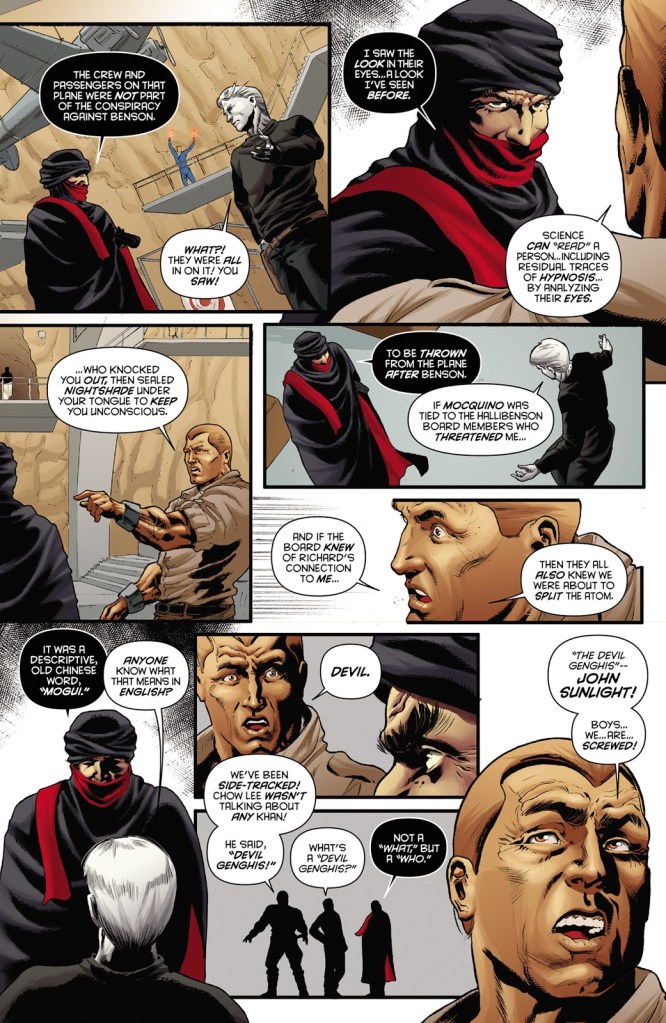
He appears at the head of an attacking force of ninja-like marauders, moments after Doc, The Shadow, and The Avenger have figured out that he had been an unseen presence in their troubles throughout the story to date. He crashes in from above, after a bizarrely uncharacteristic pronouncement by Doc of “Boys…we…are…screwed!”

Next: the Justice Inc. mashup story continues…

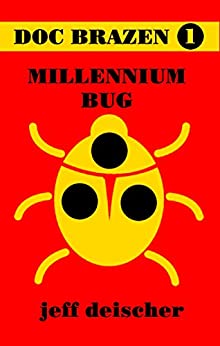
Three authors discuss the world of modern pulp: Jeff Deischer’s Doc Brazen “Acid Test”

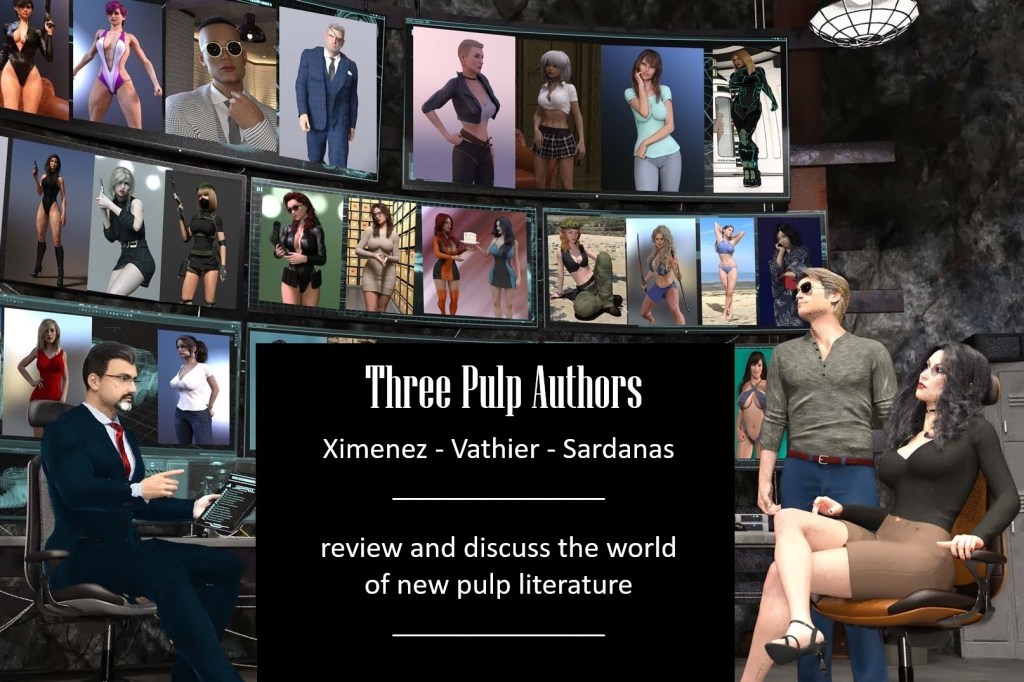
Three Pulp Authors review and discuss Jeff Deischer’s “Acid Test” and the Doc Brazen series

A brief intro of our authors:

R. Paul Sardanas is the author of over 30 books of both mainstream/classical and pulp fiction, including the pulp-epic Talos Chronicle; Grace Ximenez hosted a noir/story/roleplay/film site for almost a decade, and headlined three pulp-peril short-story collections called The Grace X Anthologies; André Vathier is the co-author of the Doc Talos Mythos book We Are Connected by Invisible Links, and has written stories for Atom Mudman Bezecny’s Hero Saga.

SARDANAS:

Hi Grace, hi André. So we’re here to discuss author Jeff Deischer’s novel Acid Test, as well as the ongoing Doc Brazen series of novels.

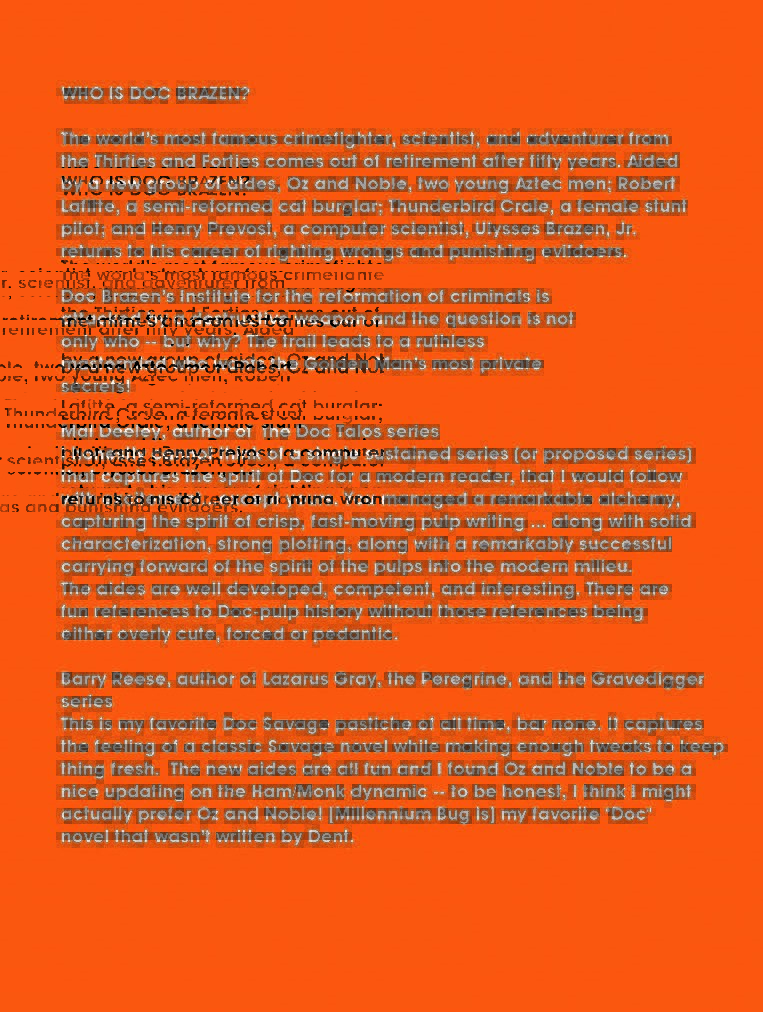
For those not familiar with these books, there are three books in the series currently available, with the ultimate run of Doc Brazen novels projected to be twenty-four total books. So, a series with a lot of ambition. It is a pastiche of the 1930s/1940s pulp icon Doc Savage, but with a unique premise: instead of squeezing more period stories into the 1933-1949 span of time that encompassed the original pulp magazine run, the Doc Savage character, here named Ulysses Brazen, had retired in 1949, but returns, plausibly aged, near the turn of the millennium, for a new series of adventures. He has a new group of aides, and brings the spirit of the original pulp stories into a modern setting.

We’re going to specifically review Doc Brazen #4, Acid Test…but along the way will talk about the series concept as a whole. As I mentioned, there are three books available currently in the series, Brazen #1, #3 and #4 (Number Two will be released out of sequence). These three books can all be read independently, but are in fact a trilogy when the trio of tales are taken as a whole. Deischer is a noted Doc Savage scholar, having written the 2012 book The Adventures of the Man of Bronze: A Definitive Chronology, and he brings that detailed knowledge of the original characters and stories to his Doc Brazen pastiche.

Before I jump into Acid Test specifically, I found the concept of the Brazen stories overall to be very appealing. In this era of reboots of classic characters that seem to “start over” every few years in order to try and inject fresh commercial interest into beloved characters, the Brazen series can be looked at as a continuation of the original pulp saga. The way it is written, if the names and locations were changed to match the original pulps, it would feel exactly as if the original pulp run was being continued into the modern era. Deischer’s writing style hearkens strongly to that of Lester Dent (the original Doc Savage author), which also contributes to that feeling of continuity.

VATHIER:

I agree I like the setting. For me the 90s to Y2K period (1991 – Pre-9/11) is seen through rose coloured lenses. I was five years old when Y2K was in the news cycle. I do not remember most of it since I was too busy watching Spongebob Squarepants. I know it is naïve but I see this period as sort of halcyon days (most likely because I was a child and saw the world as a child does). Looking at TV shows, movies, books from that era, they have a different feel. I cannot pin point it exactly. This changed after 9/11. My point that I want to make is when people do a reboot of a popular pulp hero or they try to put it in a modern setting it’s often set during the Cold War (1947 to 1991) or post 9/11 war on terror era. Very few set it in the 1991 – 2000 Era.  

Jeff Deischer really captured that era. Cellphones are a thing but they are not omnipresent like they are now. Same with personal computers. I think it is the last time an analogue hero with gadgets can thrive. I wonder if future stories will deal with the post 9/11 era or just end before 2001.  Maybe he will explore the missing years of 1949 – 1999…who knows?

Also Jeff’s fast paced action is very reminiscent of Laurence Donovan’s writing. Doc Brazen being a  nonagenarian is a good idea. You do not have to spend time telling a new origin story. The 1933 to 1949 era is still intact. As you said, Doc Brazen can be a continuation of those stories.  I have not read the other stories yet. Nevertheless, like you said before, each story can stand on its own like the original magazine stories. Anyone can pick it up and start reading.  

XIMENEZ:

The Doc Savage books are a source of very great pleasure to me. I got into them in kind of a backwards way, encountering Doc first in the Marvel Comics magazine of the 70’s (I’ve been a big comics fan for decades), and enjoying those so much I went looking for more. Of course I found the mother lode of Bantam paperbacks. For a long time, given that there are so many novels in the original pulp run, I really didn’t feel anything more was needed…anytime I felt like indulging in a “Doc fix”, I would just pick up one of the Bantams, and it seemed like they would never run out.

But as I read and read and read, I did start to feel a little melancholy in the knowledge that 1949 would mark the end. I began to feel like Doc and his crew were literary “family”, and there’s actually a special pleasure to be had in being a part of it as something that is ongoing, rather than completed a decade before I was born. When the Will Murray Wild Adventures came along I enjoyed those…it was fun to see Doc in a format of much longer novels (many of their themes mined from Lester Dent’s unpublished novels and notes). But those too were set in the era of the original pulps, and so to me they had the feeling more of “previously lost adventures”, rather than new ones.

So when I learned about the concept behind Doc Brazen, I was definitely intrigued.

The first hurdle in winning me over was the fact that Doc was now in his nineties, and no gimmick was being employed to make him young all over again. Doc’s physicality was one of his most enduring features from the pulps…how would that translate into an older man? Honestly I didn’t find the suspension of disbelief too difficult. Doc was of course the ultimate physical paragon, and there were precedents even in the real world to bring into the mental equation…remember Jack LaLanne? The “godfather of modern fitness”, he astounded the world (at least certainly astounded me), by doing things like towing 70 rowboats, one with several guests aboard, from the Queen’s Way Bridge in the Long Beach Harbor to the Queen Mary…a distance of one mile. The amount of rowboats was significant, as this was when LaLanne himself was 70 years old. When he died (of complications from pneumonia) at age 96, his family said he had been doing his usual workout routine the day before.

So I could buy Doc Brazen, one step in physical perfection even above LaLanne, being distinctly vigorous in his nineties.

And there were so many interesting things that I wondered about! The original five aides (older than Doc, if you recall) had passed away, but there were very interesting connections to be found and mysteries to be uncovered about the fifty year gap of time in which Doc had been retired.

All of this (and more) had me diving into the Doc Brazen stories with great anticipation.

SARDANAS:

Among those interesting connections are certainly Doc’s group of new aides. Here is how they are described on the introductory page of Acid Test:

Ozomatli, “Oz”, ape-like Aztec warrior possessing tremendous strength and not much self-control;

Tlazotitlapiltzin, better known as “Noble”, Ozomatli’s strong silent-type cousin who acts as his conscience;

Robert Lafitte, “le Chat”, a French cat burglar who is not quite reformed;

Norma Crale, granddaughter of a famous aviatrix and pilot extraordinaire using the stage name “Thunderbird”;

Henry Prevost, Gulf War vet and computer whiz.

Five of them…reminiscent of the “Amazing Five” of the pulp years, but they are quite different from Doc’s original aides. The only one resembling a member of the old team is Oz, who is Monk-like in many ways (which can be attributed to his parenthood…who would have guessed that Andrew Blodgett Mayfair might end up husband to an Aztec lady!) The substitution of Aztecs for the Mayans of Doc Savage history is nicely integrated into the Brazen storytelling tapestry, and well researched by Deischer. The country of Hidalgo from the pulps is renamed Coronado, and it is to there that Doc Brazen retired in 1949.

Oz and Noble are the standout stars of the new group of aides – though don’t jump to the conclusion that the resemblance of Oz to Monk means that Noble is like Ham. Noble is a distinct personality of his own (with some history that I won’t spoil for the readers), and his rapport with his cousin Oz is nothing like the perpetual quarrel/banter of Monk and Ham. And even Oz, with his slang repartee and love of a good fight, is not a carbon copy of Monk…his charm includes a mix of youthful impulsiveness and a blend of respect for Doc balanced against wayward outbursts that get him both in and out of trouble.

The other three new aides are also completely unique, and each is very capable, which is very refreshing. As the years rolled by in the original pulp magazine, it often seemed that the Amazing Five were present just to be captured and rescued by Doc…Lafitte, Crale and Prevost are all spotlighted at times in the Brazen novels, often making decisions and taking actions that rely on their own instincts and experience.

VATHIER:

It’s true they all get to shine. 

XIMENEZ:

I enjoyed the new aides…nice to have a woman as a permanent team member, and Thunderbird Crale is tough and has a lot of spirit. I liked the interplay between the two Aztec cousins, Oz and Noble, very much. There is some humor in it (Oz is quite the character) but it’s not played for comedy relief, which I was very glad to see. The perpetual quarrel between Monk and Ham in the original pulps was fun, but it was way overdone at times, which just got wearying. As you say André, each of the aides gets to shine at various points in the story. Doc Brazen himself is very appealingly portrayed – his hair is white now, and he does not have the heavy musculature of his youth – and his personality is very calm, thoughtful and restrained. Toward the end of the pulp stories he had begun to display anger, frustration, fear and nervousness…but here he really does seem more mature, more balanced. It’s an adept portrayal of the hero as an older man.

SARDANAS:

Getting into Acid Test itself, it opens in a way that echoes many a Doc Savage novel: with a sudden, shocking disaster. A man going on his Christmas vacation is traveling on the Concorde, when the plane suddenly shakes apart and disintegrates in mid-air. The man, not so coincidentally, also had connections to Doc Brazen.

The scene shifts to another familiar setting: Doc’s headquarters (never clearly stated to be the Empire State Building in the pulps, though that was the assumption that original Doc author Lester Dent clearly wanted his readers to make). It’s referred to in the Brazen adventures as the Century Building. Again, longtime Doc readers will recall that a special room some floors below the headquarters office was sometimes utilized to screen people coming to see Doc, and often manned by Monk and Ham. In this case Oz and Noble, the two Aztec cousins, are doing the screening. There’s even a fun nod to the past where Oz tricks his cousin into losing a coin toss, with a special coin “inherited from his father”. Monk frequently used the trick coin to similarly bamboozle Ham. Though as we’ve noted, the cousins don’t engage in the running quarrel that Doc’s original aides clung to for decades. Oz and Noble are far more cordial to one another (despite the impish behavior by Oz).

The person seeking to speak with Doc Brazen is a drab little man who has experienced a strange encounter with what seems to have been an unknown kind of aircraft…and after consulting with one another, the two aides agree to take him to see Doc.

Deischer’s writing is clear and crisp right out of the gate, and the story moves quickly…again, very reminiscent of the fast-moving pulps. The familiar touches ground the story nicely with a sense of connection to Doc stories of the past; readers of the original novels should almost immediately feel right at home.

VATHIER:

Honestly Paul . I could not have said it better. The book reads like a missing Doc Adventure of old. I know he published his own Doc Chronology. I assume he must have read the original 181 novels over and over again. That’s why Acid Test reads like an old pulp. 

XIMENEZ:

That really puts a finger right on one of the key reasons I enjoyed Acid Test so much. It felt intrinsically like a continuation of the pulp saga. Which if course it is…but that’s an easy label that I think is actually very difficult to achieve. To capture the style – and soul, if you will – of the Doc pulps at their best, while staying true to the continuity of the canon and bringing that off in modern pastiche…well, that’s a helluva challenge. And another aspect of it is wisely pruning out those aspects of Doc Savage pulp writing that haven’t aged well. You mentioned Laurence Donovan, André…I actually get more of a Dent vibe from Jeff’s style, but he does both Dent and Donovan one better by keeping the story elements under firm control. Doc writers in the pulps were often wild (and admittedly great fun), but honestly sometimes went off the rails with red herrings, unresolved plot elements, two-dimensional characterization, and occasional silliness. Yes, that was all part of the crazy phenomenon of pulp charm. But a story set in modern times wouldn’t feel quite so fun with all of that dragging at its heels. So how do you retain the unique glow of pulp adventure while cleaning up the flaws of style from ninety years ago? For me, Acid Test pulled off that little miracle.

SARDANAS:

I think that is true of all the Brazen books. Grace, you also mentioned liking Thunderbird Crale, and the presence of strong woman characters is enhanced in Acid Test by the presence of another member of the Aztec side of the Doc Brazen family, Puksi’ik’al. For the duration of this story she takes part in the action along with the other aides. Here is her first appearance in the book:

One of the agency secretaries interrupted the feud. “Mr. Noble, Mr. Banks, you have a visitor,” she told the pair of Aztecs.

The cousins exchanged looks, for neither had many acquaintances in the city, then followed the secretary back to the reception area. They found a ravishing bronze-skinned dark-haired woman waiting for them. Oz broke into a wide grin at the sight of the young Aztec woman. “It’s good to see you again, Puksi’ik’al.”

He came forward and hugged the beauty.

The woman named Puksi’ik’al returned the smile and said, “It’s good to see you again, Ozomatli,” using the ape-like Aztec’s true name.

“They call me Oz.”

“Then call me ‘Puck’,” said the Aztec beauty with a mischievous smile. Glancing over Oz’s shoulder, she told Noble, “Hello, brother.”

At the appearance of the beautiful young woman, the faintest hint of a frown had played upon Noble’s fine features. He disapproved of his elder sister, because while he was the faithful and obedient son, she was the family wild child.

Puck brings a lot of adventurous charm to the story.

VATHIER:

This comment contains a spoiler – if you wish to read it, please click here to visit the Forbidden Pulp Spoiler Vault

XIMENEZ:

I really like your thoughts on the development of the story’s antagonist, Andre. I agree it’s done in a very unique way, that encourages thought about the nature of “right action” that to me is always at the philosophical core of a Doc story. For those who like a good surprise as part of their reading experience, I recommend reading Acid Test first and then returning to read the comment with details about that mysterious antagonist. But don’t forget to come back! Because it brought a perspective to the characterization that’s really interesting.

The story has plenty of action to delight the pulp reader too. A wildly destructive disintegrator ray…a fight on and around a submarine. Jeff’s fight scenes are really well choreographed. Sometimes in the pulps a melee veers a bit out of the writer’s control — in some original Doc Savage novels I actually had to read some action sequences twice to work out who is doing what to whom — but the action in Acid Test carries that hallmark of clarity that Jeff displays throughout the story. For me, this really enhanced the thrill.

SARDANAS:

For me final impressions of Acid Test are linked to my feeling about the whole Doc Brazen series. As we’ve mentioned, the book can be read on its own (as was true for all of the pulp Doc Savage novels), but with this third book in the series the feeling of it being a larger literary event — one that will be bringing years of great reading — is taking shape. Since Deischer is planning no less than 24 Doc Brazen books, that is a canon all its own, and to me it feels like the most natural extension of Doc storytelling that I’ve yet encountered. So just as I looked forward constantly to the next book as Bantam reprinted the original Docs over a span of many years, I feel that same enthusiasm rekindled, with these novels building into an epic narrative of modern pulp adventure.

VATHIER:

It’s true we have not seen pulp adventures released on a regular basis since the Bantam reprints.

See you next time when Infernal Machine comes out.

XIMENEZ:

I’m definitely hooked…I’ll be getting the two other Doc Brazen books that are available now, and will be looking forward with excitement to every new release in the series. I hope the word really gets out about these books. They are such a great combination of old-school pulp adventure brought forward with 21st century sophistication in the writing. The Man of Bronze has become The Golden Man…count me in on the adventures to come!

_____________________________________________________

Check out Jeff Deischer’s Doc Brazen books:

Click here to see Millennium Bug on Amazon

Click here to see Net Prophet on Amazon

Click here to see Acid Test on Amazon

Omnipresent Sunlight: Doc Savage’s archenemy – Part 12

When we left off, we were about halfway through IDW’s 2012 Rocketeer story, Cargo of Doom. Series creator Dave Stevens had, in his original stories about this character, included fond “guest appearances” of Doc, Monk and Ham, though they were not officially named, as Rocketeer comics were not authorized to openly use those names. After Stevens’ passing, the creators taking up the reins of his series continued the tradition, as writer Mark Waid and artist Chris Samnee included none other than John Sunlight in their Cargo of Doom story…unnamed, but also unmistakable.

Here is the cast of that tale…and over on the left, towering somewhat over all the characters, is the villainous Sunlight.

Of note among the characters, second from the right, is not a Doc Savage character, but a very engaging pastiche of another memorable personage, sex symbol Bettie Page.

So far in the story, Sunlight had engineered an expedition to Skull Island (which adventure-film aficionados will recognize as the home of King Kong, along with a menagerie of prehistoric creatures). The titular “cargo of doom” refers to what he has brought back to civilization from that expedition.

However, Sunlight is distracted upon discovering that Cliff Secord, the Rocketeer, is in possession of a singular piece of Doc Savage-designed equipment: the rocket pack from which the Rocketeer takes his name. Sunlight, of course, has stolen instruments of Doc’s technology before, and he cannot resist adding the rocket pack to that list.

So after quelling a violent altercation with the mysterious creatures he has brought from Skull Island, as well as arguing openly with an ally in his intended crimes, he sets off to appropriate the rocket pack from Secord. Never hesitant regarding the unleashing of mayhem, Sunlight attacks.

What ensues is an intense aerial struggle between Sunlight and Secord, which sways back and forth as to who has the upper hand.

Though things didn’t quite go Sunlight’s way, it is not long before he has the upper hand again, as Secord trails him to his cargo ship, but is promptly captured. Sunlight describes his (entertainingly nutty) idea to put rocket packs onto dinosaurs (which are the mysterious Skull Island cargo) in order to shake things up in the world at large…after which he prepares to drop Secord into the jaws of one of the captive saurians.

Things then go all wrong for Sunlight. Using a remote control, Secord activates the rocket pack while Sunlight is holding it, with catastrophic results for the criminal mastermind.

Things blow up right and left, the dinosaurs break loose, and chaos reigns.

In short order, it’s all over for Sunlight. Intriguingly, realizing he is fatally wounded, he instructs his men to save the ship’s crew. One of his flunkies later says that the order was because Sunlight would always choose to dominate rather than kill (a trait of the original pulp Sunlight)…but that doesn’t quite jibe with Sunlight’s realization that at point he was already one step from the grave. Hard to dominate when you’re going to be dead in a few seconds. Sunlight, despite his extremes of violence, had a streak of idealism in him too, and it’s interesting to conjecture that his last act in this tale was to try and protect his underlings.

In any case, the final panel of the climactic scene shows probably the most conclusive death of Sunlight in any of his many stories.

And that is the end of John Sunlight in this wild and woolly pastiche.

Of course, it was pastiche, and “official” tales featuring Doc’s archenemy were far from over.

Next…John Sunlight, pseudo-pulp comic book supervillain.

New release of the Doc Talos Mythos novella “We Are Connected by Invisible Links”

Doc Talos Mythos books expand on the events and characters from the six core novels of the Talos Chronicle, from new, exciting creative talents. Authorized additions to the Talos canon (and sometimes co-written or illustrated by series creators Sardanas and Bellerophon), they add a unique depth and new perspectives to the Doc Talos story.

We Are Connected by Invisible Links by André Vathier (in collaboration with R. Paul Sardanas), illustrations by Iason Ragnar Bellerophon (accompanied by archival photographs selected by RPS)

A tale from the late 19th, early 20th century takes Thomas Davies, possible bastard grandson of the Gnostic Archon Demiurge, from London to Gabon in West Africa. As a member of the French Foreign Legion, Thomas encounters the apelike Folk, the almost-legendary Fon warrior women, and survives the slaughter of his legionnaire comrades to come face to face with powerful, primal mysteries.

82 page novella, with Foreword by Vathier and Afterword by Sardanas, illustrated with dozens of full color paintings by Bellerophon, as well as archival photographs.

Paperback: $16.00 PDF Download: $7.00

to order this book, contact taloschronicle@gmail.com

View the entire series of Doc Talos books in our Bookstore.