In Part 1 of this article, I discussed some of the factors that built up the legend of this unique story. In a way, a perfect storm of literary weight had grown around it by the time it was discussed by Philip José Farmer in his 1973 book Doc Savage: His Apocalyptic Life. Literary weight which had no relationship to the ambition of the writer or publisher when creating and presenting it.
Not knowing that the 16-year run of tremendously successful pulp magazines would end with that Summer of 1949 issue, Lester Dent had written a story that upon examination, was a bit bizarre, but by no means extraordinary. In fact, as the Doc Savage researcher Jeff Deischer — author of The Adventures of the Man of Bronze: A Definitive Chronology — pointed out to me (quite correctly), it recycles elements from at least three older novels, Land of Always-Night, The Evil Gnome and The Vanisher. This was not uncommon in the later years of the series. The target audience for the Doc Savage magazine — though it had gone up slightly in the final years — was younger to mid-teen boys, with a new wave of readers expected to replace those boys as they grew older. It was a reasonable expectation that plot and story elements used five or ten years previously would be perceived as wholly new by the subsequent reader generation. So the plot recycling was a useful tool in preparing stories quickly, and utilized not only by Dent, but by many writers in the field.
Likewise, the somewhat apocalyptic concept of the adventurer Doc Savage fighting his final battle in Hell itself, though emotionally appealing in retrospect, was not bold new ground…in fact it was formulaic to the series to have mythic or mystical themes introduced in the form of villains and menaces, which were later debunked as clever criminal schemes.
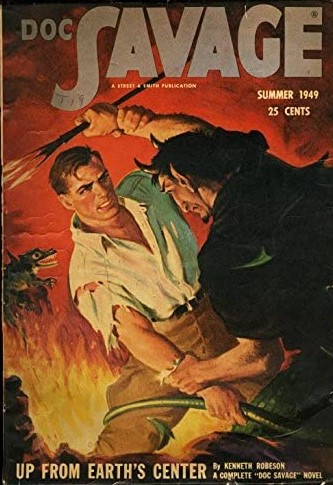
The presence of Satan on the cover, grappling with Doc, was symbolic only. He does not wrestle with Satan in the story itself. Also, as the narrative progressed, Dent would make periodic reference to the underworld of the damned as “Tophet”…an odd choice, as it is a Middle English word much less familiar than “Hell”. To a younger reader (not versed in 14th Century Biblical vernacular), it probably sounded more like one of the many lost civilizations Doc encountered in his literary history. But then the name Hell is also used freely in the narrative. The result was certainly an odd set of confusing signals to that reader. Intentional, to build an atmosphere of portent and mystery? Or just quirky storytelling in a pulp tale written quickly under deadline?
The title of the story, from the Rubaiyat of Omar Khayyam (a poetic work from ancient Persia), adds more obscure cultural layering. Here is the full stanza the title words appear in:
Up from Earth’s Centre through the Seventh Gate rose, and on the Throne of Saturn sate; And many a Knot unravel’d by the Road; But not the Master-knot of Human Fate.
That stanza was printed fully in the pulp…also fascinating, but certainly obscure to most pulp readers. So why all this mix of cultural/literary references? It’s a question without an answer, but Dent was well read and enjoyed dropping erudite references into his works…perhaps with no more intent than to give the appearance of a little more gravitas to pulp writings that were, even by his own reckoning, often considered to be “junk”.
So, on to the story itself. Here is how Chapter 1 begins:
The hours became days, and the days grew into weeks, and the weeks followed one another into a dull and terrible haze of time in which nothing really changed. Gilmore had scooped a shallow pit in the eroding chalk at the edge of a cliff, roofed it with a crude thatched trapdoor which he could close against the black things of night, and he spent the majority of his time there.
For a time, during Indian summer, one day was like another. It was then that Gilmore lost his shirt. He took off the shirt and arranged it carefully and, he thought, safely on the sandy beach, while he waded into the sea to stand motionless in hopes of clubbing an unwary fish for food. A huge and dour gray seagull, a typically thievish knave of a seagull, carried the shirt away. It was a sports shirt, and its gaudy plastic buttons fascinated the gull.
It was a small thing. The thin shirt was practically worthless as a protective garment. But Gilmore took it hard. He ran wildly after the seagull, and the bird flapped out to sea, packing the shirt in its beak with gull-like greed. Gilmore, unable to swim, ran, screaming, up and down the beach, and when he was exhausted, he fell on his face and sobbed.
During the ensuing few days of Indian summer, Gilmore tried to teach himself to swim. He was unsuccessful, probably because he had no real heart left to put into it. It was pointless, anyway. A man could not swim the Atlantic. The warm days ended. Winter came. The pools of rainwater in the potholes in the island stone began to have thin crusts of ice, and the rocks became bone-colored with coatings of frost.
Gilmore made hardly a move to thwart the certainty of freezing to death. It was too much of a certainty for him to compete against. It was inevitable. His pants now were frayed into shorts, and he stuffed them with dry seaweed, and tied seaweed about himself with other seaweed for binding until he resembled an ambulatory pile of the smelly stuff. Actually, it did no good, and it soon became definitely established in his mind that he would freeze to death. He began to wait for death almost as one would await a friend.
Certainly a harrowing picture of a castaway, bordering on the feel of a lost soul — an impression enhanced by interior illustrator Paul Orban’s depiction of the unfortunate Gilmore.
Gilmore is rescued, but does not welcome those rescuers…instead he indicates he believes he’s been pursued by devils from Hell, and considers the men who found him to be enemies. Here is the rescue scene:
Gilmore was sitting on a stone, contemplating eternity, when a pleasant voice hailed him. “Hello, there,” the voice said. “Are you the proprietor of thisheavenly spot?”
A glaze settled over Gilmore’s sore eyes, and for a long time he did not turn around. In fact, he did not turn until he had conducted quite an odd conversation, in a small choking voice.
“So you finally got to me,” Gilmore said. His voice had the hopelessness of a soul lost in interstellar space. “Yeah. It took a little time to climb the cliff.” The voice contained some pleasant surprise. “I didn’t think you had seen us. You didn’t give any sign. We were rather puzzled.” Gilmore shuddered and said, “I don’t always see you, do I?”
“Huh?”
“Us?” Gilmore continued, selecting carefully from the words the pleasant voice had said. “Us? We? Is there more than one of you now?”
“There are eighteen of us,” the voice said. “Say, what’s the matter with you, fellow?”
“So you went back for more experienced help!” Gilmore went on. “Eighteen of you!” croaked Gilmore. “Good God! They must have depleted the staff!”
“What staff?”
“The executive personnel in hell!” said Gilmore bitterly.
“Who are you kidding?” the amiably friendly voice inquired.
If nothing else, an environment of distinct disorientation (not only for the characters, but the reader) had been introduced. And that would only grow as things went on…extending to the psychology of Doc Savage himself, which will prove to be one of the most unsettling (and interesting) aspects of the story.
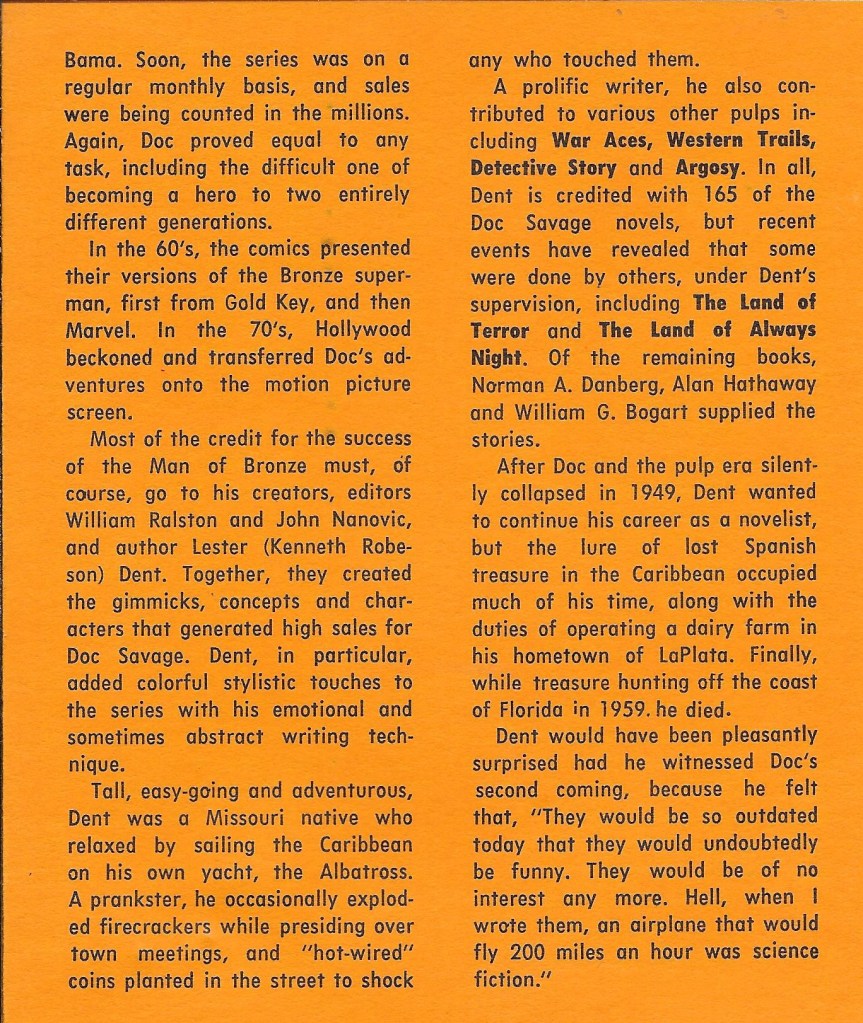
As the last issue in the pulp run of Doc Savage magazine, its publication heralding the end of the hero pulps in 1949, the story Up From Earth’s Center has achieved something of mythic status. On the surface, its themes are worthy of that status — after 16 years of epic storytelling, the inference was that Doc Savage would take his fight against evil to Hell itself. The cover literally depicts Doc grappling with Satan.
Doc Savage Magazine, Summer 1949, cover art by George Rozen
And yet beyond these surface indicators, the very concept is extraordinarily out of place for the Doc Savage series. The formula for Doc’s adventures had often been one that featured apparently supernatural or mystical menaces, which were invariably shown to be false fronts for phenomena or devices relying solely on scientific explanation. Granted, some of the science was pretty far out there, but Satan and Hell, in their literal incarnation, were never on the horizon.
Would the same formula prove true for Up From Earth’s Center? Perhaps, and perhaps not. Even after multiple readings, that ambiguity remains, which makes this last story one of the most unique in the entire Doc Savage canon, completely aside from being the final story.
Today, Up From Earth’s Center can be acquired and read relatively easily. It has been in print three times: the original pulp magazine, a reprint in Doc Savage Omnibus #13 from the early 1990’s, and most recently, in the Sanctum run of pulp reprints. It is available in electronic formats ranging from epub to pdf. But there was a time within memory of many Doc Savage readers (including myself), when there was only one way to read the story: by reading the original pulp itself.
Not so easy…and that added to the myth. The very concept of being able to read the story required a quest to find that pulp magazine from 1949.
I learned about the story in the 1970’s, when I read about it in Philip José Farmer’s “biography”, Doc Savage: His Apocalyptic Life. In Chapter 18, “Some of the Great Villains and their World-Threatening Gadgets”, Farmer concludes the chapter with a rather lengthy description of Up From Earth’s Center.
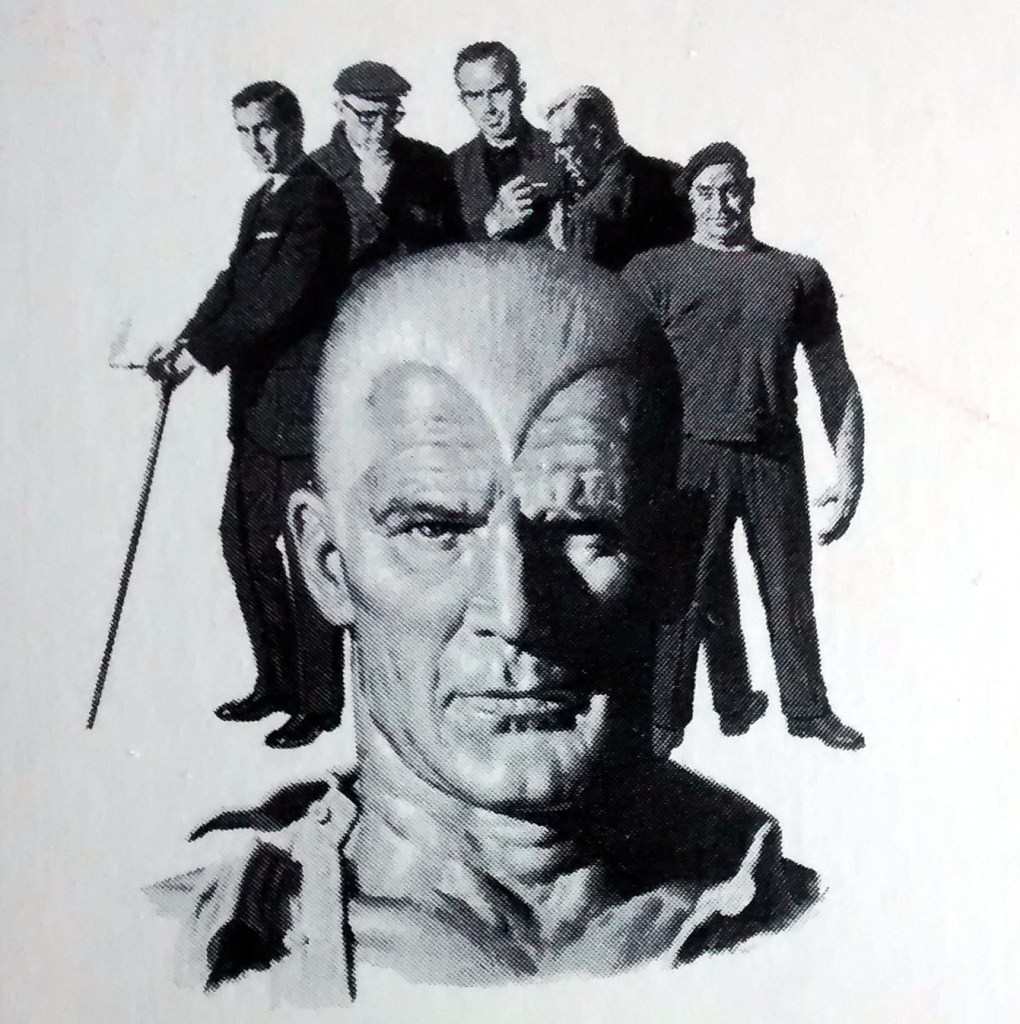
In an interesting cover design, the Playboy Press edition of Doc Savage: His Apocalyptic Life shows distincly hellish elements surrounding the figure of Doc.
It begins thusly:
Whatever the reasons, though there were some fabulous devices used by wicked men during World War II and after, the villains seem pale compared to those who went before them. Except for a few, Doc’s enemies lacked true apocalyptic stature.
But in the last recorded supersaga, Up From Earth’s Center, Doc may have run into somebody, or something, even he could not win out against. he did escape from his antagonists, but the implications are that they had powers which did not depend on gadgets and which no gadgets could successfully combat in the long run.
Up From Earth’s Center is a very strange tale.
With that, Farmer set the stage for several pages of description and discussion of the story. But again bear in mind, at the time Doc Savage: His Apocalyptic Life was published, there was — except for the small (and enviable) circle of people who either owned or could borrow that pulp — no way to read the full story Farmer was describing. Somewhat akin to a modern book mentioning an archaic manuscript that held the deepest secrets of life, but the only known copy had been in the Library of Alexandria.
To a reader of Doc Savage in the era of the 1970’s to the 1990’s, this of course grew the mythic status of Up From Earth’s Center to even greater size: it was, unquestionably, a Holy Grail.
But to return to the original question posited at the beginning of this article, was the story itself worthy of such stature? That remained to be seen.
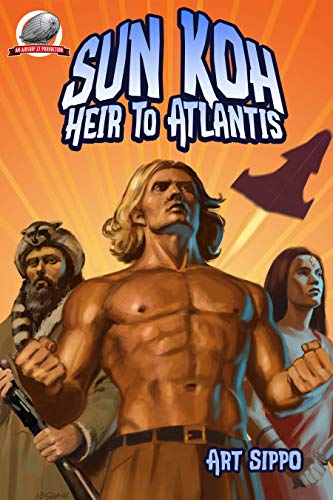
Featured on the blog today is an article by Dr. Arthur Sippo, discussing the story behind the 1969 publication The Doc Savage Journal. It’s a fascinating look at a little-known chapter in Doc Savage history. Many thanks to Art for sharing it here on the Forbidden Pulp Blog, and special thanks to Jeff Deischer, for both suggesting its appearance here, and acting as a liaison with Dr. Sippo.
This article also appeared in The Big Book of Bronze Vol, 2, 2009. A link to Art Sippo’s latest project is at the bottom of the article.
The Doc Savage Journal: The Untold Story
By Arthur C. Sippo MD, MPH
The year was 1969. The tumultuous 1960s were on the wane.
The year 1968 had been a hard for the United States. Five years earlier, President John F. Kennedy had assassinated. The police action in Vietnam had escalated into a full blown war with a massive American military buildup. The Tet Offensive in January came as a total surprise and proved that the military situation in Vietnam was neither predictable nor under American control. In that same year, Martin Luther King and Robert Kennedy were also assassinated. In the Presidential election, the American people demonstrated their dissatisfaction with the state of the nation by ending 8 years of Democrats in the White House and electing Richard Nixon with his promise of a ‘secret plan to end the war.’ The only real highpoint was the Apollo 8 mission over Christmastime which was the first manned flight ever to leave the confines of Earth and go into orbit around another world. The actual Moon landing was expected for midsummer 1969. At least America seemed to be winning the space race.
Something else happened in the 1960s which for many of us was an enduring highpoint that helped get us through those turbulent times. In 1964, Bantam Books began to republish the adventures of Doc Savage, one of the most popular of the Pulp magazine characters of the 1930s and 1940s. Stories of Cold War spying and intrigue were quite popular at that time and the James Bond movies with their combination of action, stylish violence, exotic locales, colorful villains, technological gadgets and a virtually indomitable hero were the biggest draws at the box office. The Doc Savage stories had pioneered all of these ideas in the days after the Depression and in fact had been the source of ideas for much of the adventure characters in pulps, comics, novels and films that came after them. It made sense that such a character would appeal to a modern audience.
Bantam marketed the Doc Savage paperback books with a photorealistic cover style developed by Jim Bama which instantly became iconic for the character even though it did not conform to any specific image either in the stories or the Pulp covers and art work from the original magazines. Those covers and the strength of the writing of Lester Dent and his associates catapulted Doc Savage into major publishing phenomenon.
Shortly after the initial success of Doc Savage, there were other pulp character reprints and we saw the creation of a new pulpish ‘men’s adventure ’ genre of paperbacks to compete in the same market. None of these did as well as Doc Savage and it was only the Doc Savage pulp series that eventually had its whole run reprinted.
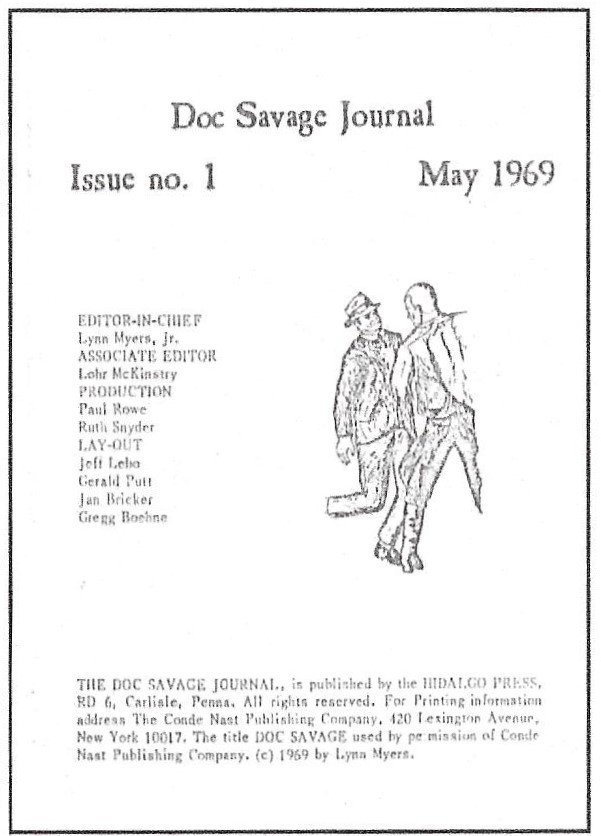
In May 1969, Doc Savage was still a hot property. Only 36 of the novels had been published by then with Resurrection Day being the most recent reprint. In that month, a high school student from Carlisle, Pennsylvania named Lynn Myer published the first (and only) issue of a fanzine called The Doc Savage Journal (DSJ). This was a unique magazine in that Lynn had received the blessing of the Condé Nast Publishing Company (which owned the rights to the Doc Savage character) to publish new stories using their characters.
The story published in this issue was entitled Trail of Doomsday and was written by another high school student named Lohr McKinstry. Lohr was a fan of the pulp genre of literature even back then and he had an interest in writing.
The permission given to these young men to write a new Doc Savage story predated that which was given to Will Murray in the 1990s by at least 25 years. Technically, Trail of Doomsday was not a pastiche but a fully authorized story that has the right to be included in any Doc Savage publication list.
Both Lynn and Lohr are still with us and are very active in the modern pulp revival. I was able to reach them by e-mail to get some information about how their fanzine and its story came to be published. I had sent Lyn Myers a few questions that I wanted to ask him and he sent back a detailed response that is so well written I am reprinting it just as I received it.
The following section is from the e-mail Lynn sent me:
Here are the answers you’ve been looking for. Sorry it took so long, I had to have cataract surgery which has now been done.
1) When did you start planning the DSJ? In 1968 I went to a comic book convention in New York City. They had two canvases displayed which were original oil paintings of the Bantam covers. Neither was by James Bama (the most famous of the Doc cover artists). One was the cover of Land of Always Night, the other I forget. In the dealer room I talked with publishers of several fan magazines. One of them had reprinted The Human Torch in an offset booklet. I asked how he got permission from Marvel Comics to do the reprint. He said he got a letter from Stan Lee (the editor) saying it was okay. That put a thought in my mind: How about Doc? I started working out what I had to do to publish my own fanzine. The address for Condé Nast was printed inside on the copyright page of the early Bantam printings.
2) How long did it take you to get permission from Condé Nast to use the Doc Savage name? Was it difficult? I got permission from Paul Bonner, Jr. at Condé Nast in April of 1968. I told him I wanted to publish a new Doc in a fanzine and I got permission to do new stories only. No reprints. I also got permission to continue publishing as long as it was fanzine. The permission letter took a couple of months. They did not want to see the final product. I got asked this a lot over the years (including Doc historian Will Murray). I had enough youthful bravado to ask, and never thought it was much of a big deal. They would have said no, but didn’t. I guess I was lucky. I remember once asking permission from Samuel French to make an 8mm amateur movie based on the plot of the Broadway musical It’s a Bird, It’s a Plane, It’s Superman. They told me very firmly no, sent back postage money back for my sample copy of the book for the play, and told me not to contact them again. Go figure.
3) How old were you when you published the DSJ? I was eighteen on the publication date in May of 1969. I was going to use the most common methods of fanzines of that era; a Ditto machine which used a carbon stencil and was good for about 3 dozen copies. However, there were several drawbacks. A Ditto machine produced a deep purple image and you could only print on one side of the paper. Also, the pages had that god-awful smell of the duplicating fluid. The second option was a mimeograph machine that took a waxed stencil and could reproduce hundreds of double sided copies. However, you needed a good electric typewriter to cut the stencil. IBM Selectrics were available at my high school where I was taking the business course, but I wasn’t much of a finish typist and your stencils had to be really good to get a polished product. I began hanging out at a local printer who had a print shop in his basement. I told him I wanted to learn the offset printing business, and he agreed. This was during the Vietnam era when young people were supposed to be radicals that were trying to undermine the country. I had to develop a trust with the printer. After a couple of weeks, I proved I learned something from him and he agreed to print my magazine if I did all the work myself. The cost would be 100 dollars. I took the bait.
Waiting for the permission letter set the project back a few months, but since I was an apprentice and did scut jobs at the printing shop for free, there was no hurry, I would wait. During those years I also had an after school job working as a stock boy at a greetings card store where I made $1.50 an hour. That paid for the Doc Savage Journal.
Poet Walt Whitman did a similar apprentice at a Philadelphia printer: he would give them free labor in exchange he would set his own type for Leaves of Grass. What does Leaves of Grass and the Doc Savage Journal have in common? They both lost money.
4) Why was there never a volume 2? There was no second issue because: My number in the Viet Nam draft lottery was 46, and I wanted to continue my education, so I went to a broadcasting school in Houston, Texas (I was born in raised outside of Carlisle, Pennsylvania). So I packed up my stuff and went to school for six months and didn’t return for several years. The school had a placement program so I worked at various radio and television jobs for the next couple of years—all in Texas. I had two stories in the hopper. One was submitted by Robert Weinberg (today a noted pulp historian) it was entitled Killers of Kali. Lohr has a copy of it, I had a very bad photocopy of it and I don’t remember much about it anymore. By the way, the first story was supposed to be Ghosts of Doom by me. My story was about a late eighteen century whaler where the Captain ventured took far out in the Atlantic looking for a mysterious large whale and got hung up in stalled icebergs. The crew froze to death and the ship (The Doom) remained stuck for almost a century, finally freed during a World War II thaw. The captain and his crew are reanimated and under cover of dense fog, the captain dispatches a ship to go to shore and to shanghai men for the crew, not knowing they have taken members of the Doc Savage crew. With a full crew, the Doom goes back to whaling and sets it sights on a Nazi submarine that is having mechanical problems. The story concerns Doc coming to rescue his men and the whaler captain (who is both blind and crazy) trying to throttle the sub that the half blind totally mad captain thinks is a giant whale. (Note: I starting writing his before I had permission from Condé Nast, so it really wasn’t about Doc Savage but my own knockoff character called Captain Nemesis. He was like Doc, but had fewer sidekicks, was Australian, and looked like Errol Flynn.
However, I was too young and inexperienced to make the story flesh out.
5) Did you approach Lohr about doing this story or did he approach you? When I finally got permission from Condé Nast I was too damned busy trying to get the money for the publishing. Lohr, who is a couple of years younger than me, was already a pulp collector and volunteered for the job. I think it took him three weeks to write the story. If you read it, you’ll realize that he used characters from later Doc stories that Bantam had not gotten around to yet. When the Doc Savage Journal was published there were only about 30 Bantam Doc adventures that had been printed. Anyhow, Lohr lived in Bloomsburg, PA and he was only a phone call away. He also had some writing experience and I liked his story, and he was the co-editor. He was a good choice. Also, because Lohr and I share the same initials, people thought I wrote the story. I did not. I didn’t have anything to do with it except for publishing it. However, it was my idea to do an updated Doc based on the trouble I was having researching Ghosts of Doom set during World War II.
Questions you didn’t ask on this email:
How did you come up with the name of your fanzine? I used to read a monster magazine entitled Castle of Frankenstein. In the back pages you could order their first magazine called The Journal of Frankenstein. I liked journal best, but I had thought of other titles as well: monthly, news, times, etc.
Why did you publish your first issue in May, 1969. There were only a few methods of setting the type back in those days. I got a quote from a man who had an advertising business. He had a photo type machine that would have made a nice product. But he wanted eight dollars a finished page. I didn’t have that kind of money, so I went to Dickinson College where they published their student newspaper (The Dickinsonian) on a Varityper. A Varityper is a giant typewriter that took a type bar (you just snapped in another type bar for other fonts and for italics), carbon film, and you typed your manuscript in column format and then typed it again and it would justify the type. The typesetting cost me $40 dollars and was done by the editor of the college newspaper who thought 40 dollars was a lot of money. There was also a second reason for publishing it in May. I would have copies to sell at the second comic book convention I went to in the summer of 1969. I brought 100 copies and I almost sold out. The other methods were an ad in the Rocket’s Blast Comic Collector and locally. I sold more locally than any other way: I sold 100 copies at the store where I bought my Bantam Docs. The magazine sold for 45 cents a copy (but at the comic book convention they were a dollar). I let the merchants and dealers have it for half price.
How did I meet other Doc fans? The first time I ever saw a Bantam Doc Savage was in the hands of a student that rode the school bus with me. He was about three years younger than me. I did what other people did back in those days: I made fun of him and called the character Doctor Savage. When I discovered Doc for myself in 1965, I tried to make amends to this student, and after I read a few of the adventures myself, we became friends. This student got my first copy of the Doc Savage Journal. In later life he became an attorney. I bumped into him about thirty years ago and he told me that he hadn’t read a Bantam Doc in years. In high school there was a dedicated core of Doc fans, so we used to pass them around. I have a whole run of the Bantam editions and about three partial runs. I never did give up on him. When Will Murray came out with his editions I eagerly read those as well. I didn’t think much of Escape to Loki by Philip Jose Farmer, good story but kind of tough to read. Now as I get closer to 60 I’d like to believe that a bronze shadow watches over me.
Where did I buy my Bantam editions of Doc Savage? When I was a teenager we had two fairly good retailers. One was a magazine shop that had spindle racks for paperbacks, the other was a candy store. I was a frequent customer of both. I remember reading paperback reprints of the Shadow, the Spider, Captain Future, and the Phantom Detective as well. I saved them all. There were no chain book stores in those days. I kept up my Doc collection hoping my son would be interested, he wasn’t. He found Harry Potter, but he and I watch the Doc Savage movie when in came out on VHS. He liked it, but he was 10 years old at the time. I personally hated the movie. My son eventually found Harry Potter, which he liked. I’d like to think that Doc Savage was Harry Potter of my generation.
Is there anything left of the original printing of the Doc Savage Journal? No. In 40 years I’ve lived in two states and have moved a dozen times. Nothing remains with the exception of Lohr’s original manuscript (which I am holding for ransom). The layout pages and the artwork are all gone, some of it was destroyed in an attic fire at my old homestead, the unfolded interior printed pages were salvaged kept in boxes in a barn, and they have been ravished by insects and bird excrement. I have about two dozen copies of a facsimile edition that was printed up by Office Max and maybe five copies of the original printing. All of the artwork is gone as well. I did some of the interior illustrations myself and they are long gone. The letter from Condé Nast survived several of the plagues, But I haven’t seen it for twenty years.
Where are they now? 40 years is a long time. The printer that did the Doc Savage Journal died about five years ago. He was close to 80. My business teacher from high school has to be either dead or nearing 100 by now. The editor of the student newspaper that did the typesetting would be social security age by now. The other student who helped me ink the interior illustrations became a Baptist preacher. Both of the merchants where I used to buy my Bantam Docs have died and neither business exists any longer. We eventually got an independent book store and a chain bookstore, but they are also gone. They stayed in business long enough to for me to complete my Doc collection. I’ve worked in radio most of my adult life and am still on the air in my hometown of Carlisle. Lohr McKinstry is a writer and editor for a string of weekly newspapers in upstate New York (I pointed out to him that he probably lives close to where Doc used to have his college for reformed criminals). I continue to keep a hand in the publishing industry. I have been a researcher for author Max Allan Collins for the last twenty five years. My articles on hard-boiled writers of the past have been in many magazines, and I am agent for several authors and have coeditor three books that collect the early work of the late Mickey Spillane. I also have two collections of books coming out on Paul Cain (a writer from the glory days of Black Mask magazine) and another by a hard-boiled writer that was published only in sleaze paperbacks. I still keep in touch with Lohr McKinstry.
P.S. Doc’s birthday has been guesstimated to be November 12. My birthday is November 11. Go figure.
Doc Savage Journal trivia: The cover of the Doc Savage Journal features a somewhat revised version of the cover of the Doc Savage pulp magazine featuring the story “Repel”. This was a mistake. Lohr had given me that original Doc pulp so I could see what the original magazine had looked like. The printer, without my permission, ran it off because he didn’t want to clean the press and he had some leftover card stock. It had already been decided that my magazine would have a red cover. He had been running blue on that press, so he dabbed some red on the roller and I remember the first batch had a purple look to them. I used it because it was done for free. The cover I was going to use was done by a local artist and featured Doc punching out a bad guy. I had furnished a copy of the Gold Key Doc Savage comic for her to get inspired by. Her cover would have made the exterior match the interior —- the James Bama version of Doc with the exaggerated widow’s peak that went clear down to his nose hairs.
I also corresponded with Lohr McKinstry and he provided me with the following information about “Trail of Doomsday”:
Sure. I wrote it in 1969, shortly before Lynn printed it. He knew I’d written articles for a lot of fanzines, along with some short stories in the Texas-based Huh magazine, and we were big Doc fans then.
I think I was inspired by Peter Heath’s Mind Brothers trilogy that Lancer Books printed in the late ‘60s. I was reading REH, Dent, Gibson, Page and all the others at the time as well.
I found it interesting that Lohr had gotten inspiration from The Mind Brother’s Trilogy. I had read them in the late 1960s. The three novels were The Mind Brothers (1967), Assassins from Tomorrow (1967), and Men Who Die Twice (1968). The main characters were young mathematical whiz Jason Starr, genius and folk-singer Mark Brown, and Adam Cyber a virtual superman from 50,000 years in the future who has come back to the 1960s to prevent certain events from happening that would ultimately destroy his world. They had unlimited cash, unlimited libidos, plenty of high-tech toys, and powerful villains to match. One of the events that figured largely in Adam Cyber’s concern was the assassination of John Kennedy. If one were to try and update Doc Savage and bring him into the world of the 1960s, this series would indeed be a good model for it (except for the libido stuff). It also helps explain some of the plot elements of Trail of Doomsday.
{SPOILERS FOLLOW}
It was only natural that Lohr would try to transpose Doc Savage into the present day of 1969. It would have been far too hard for a teenage writer to place Doc in his real setting in the 1930s. Besides, a modern story would appeal to modern readers.
To bring Doc and his men into the present day, Lohr had them placed in suspended animation inside a cave by an unknown party who used high-tech machinery to preserve them. Doc and his men had disappeared in 1950 and no trace had been found of them until then. They were found and revived and the machinery self-destructs. There is a talking computer in this scene which was a real novelty in 1969. This all could represent future technology that has been sent into the past to preserve Doc and his men so that they might deal with some upcoming disaster. The source of the high tech gear is never revealed in Trail of Doomsday. Lohr obviously was planning to deal with this in a sequel.
Doc manages to salvage a mysterious egg-shaped object which he is unable to analyze. It is eventually dumped in the Atlantic Ocean for safety’s sake. This is reminiscent of the disposal of the infamous ‘Shining Trapezohedron’ described by H. P. Lovecraft in The Haunter of the Dark and by Robert Bloch in his sequel to that story The Shadow from the Steeple. I suspect that Lohr may have been inspired at this point by these stories.
Doc is rescued by the US Military who want to hire him, but he elects to remain on his own. Meanwhile, he effortlessly reclaimed his skyscraper headquarters and seemed to have access to funds and vehicles despite his having been missing for almost 20 years.
The writing to this point is amateurish and could have used some polishing.
Then the real adventure part of the story begins in which a ‘client’ shows up, the villains go after Doc, and the McGuffin of the story is revealed. This is the best part and I do not want to spoil it any further. Several new ideas are introduced which are interesting and which hold promise for further sequels. There is even a future plot line in which Pat Savage would figure prominently.
This part of the story moves rapidly and is very exciting. It left me wanting to read more stories based on this one. Alas, none have been written… yet.
For a variety of reasons I am not sure that this story could be introduced into the current continuity of established Doc Savage Chronologies such as those by Rick Lai, Jeff Deischer, and Win Eckert.
{End of Spoilers}
At this time I have made an inquiry at Condé Nast for permission to reprint Trail of Doomsday in The Big Book of Bronze series. At this point I have not heard from them, but I understand they are making inquiries concerning The Big Book of Bronze and I am hopeful that we will receive permission to republish this historic story sometime in the near future.
To check out Art Sippo’s latest project, please click on the link below:
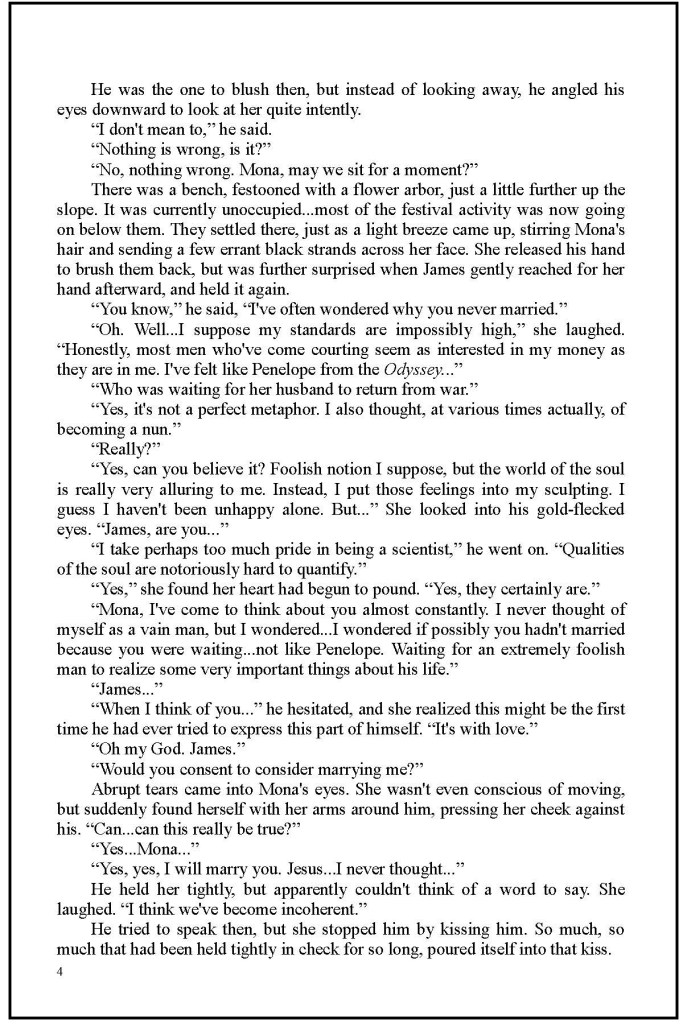
Note from Doc Talos author/contest judge R. Paul Sardanas: When I invited short story author Marissa Sarno to take part in the contest, she expressed two wishes: one, to write something that would potentially fit with existing Doc Talos canon, and — after reading the Princess Monja posts here on the Forbidden Pulp blog — to feature Mona, the Talos pastiche of the Mayan princess. So I sent Marissa a timeline of the events in Mona’s life so she could weave her tale into it without any conflicts, and cheered her on to go for it. The resulting story, “Daughter of the King” floored me with its touching sweetness, and wonderful characterizations of both Doc and Mona. Marissa…job well done.
Comment from author Marissa Sarno: I was always the girl who ignored plot. It didn’t matter if I was reading a thriller, a classic, a science fiction opus or an adventure yarn. I wanted to know about the characters, to read digressions into their lives, to have the author give me moments where I feel like I knew them as if they were real people. So though I was fascinated by the gloriously complex dynamics of the Talos Saga, I really just wanted to write a nice moment for those noble-but-unhappy lovers, Doc and Mona. A moment when love feels magical. Because everybody, everywhere, even fictional characters, should have at least one moment like that in their lives.
Additional note: If you are interested in submitting fiction to the Summer 2021 contest (first prize is a Bantam Doc Savage paperback Czar of Fear first edition, signed by James Bama, and all contestants will appear in a special souvenir paperback collection of the stories) you can read the contest guidelines HERE.
Late in 1975 I was seventeen years old, living in a beach town in Delaware. I’d gotten early acceptance to college, and was already pursuing my writing career, doing short science fiction and fantasy stories (I have an impressive collection of rejections from some of the legendary editors in the field). At college my major was in the humanities: literature, art and philosophy. It’s likely I was not representative of the target audience for the Doc Savage series…but along with classical books, writing and sex (some things never change, as I would ultimately combine all three in the Doc Talos pastiche stories), Doc was one of my obsessions.
Here is the evidence:
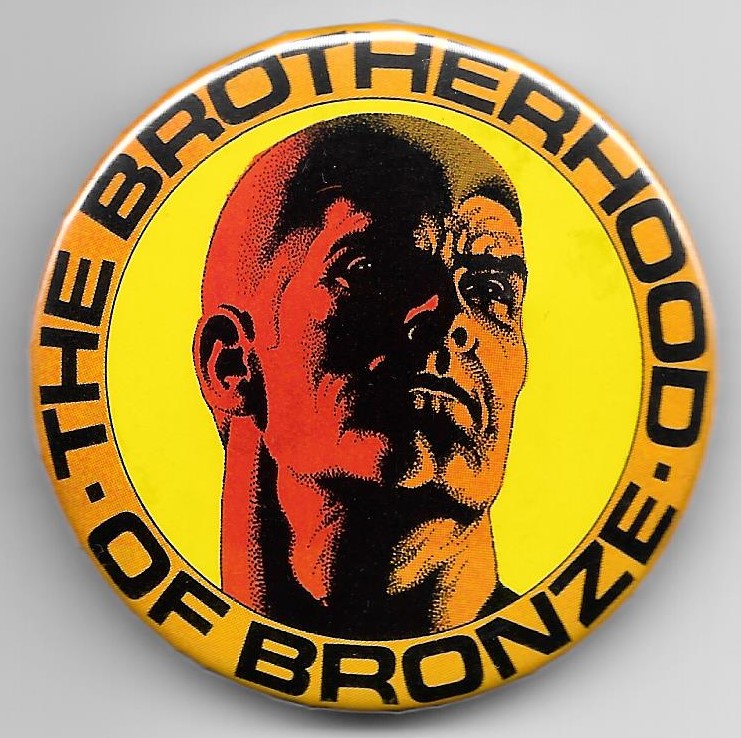
That signature under the Doc Savage oath and next to the intriguing calligraphy for Clark Savage Jr, is me. Code number 837, Brotherhood of Bronze.
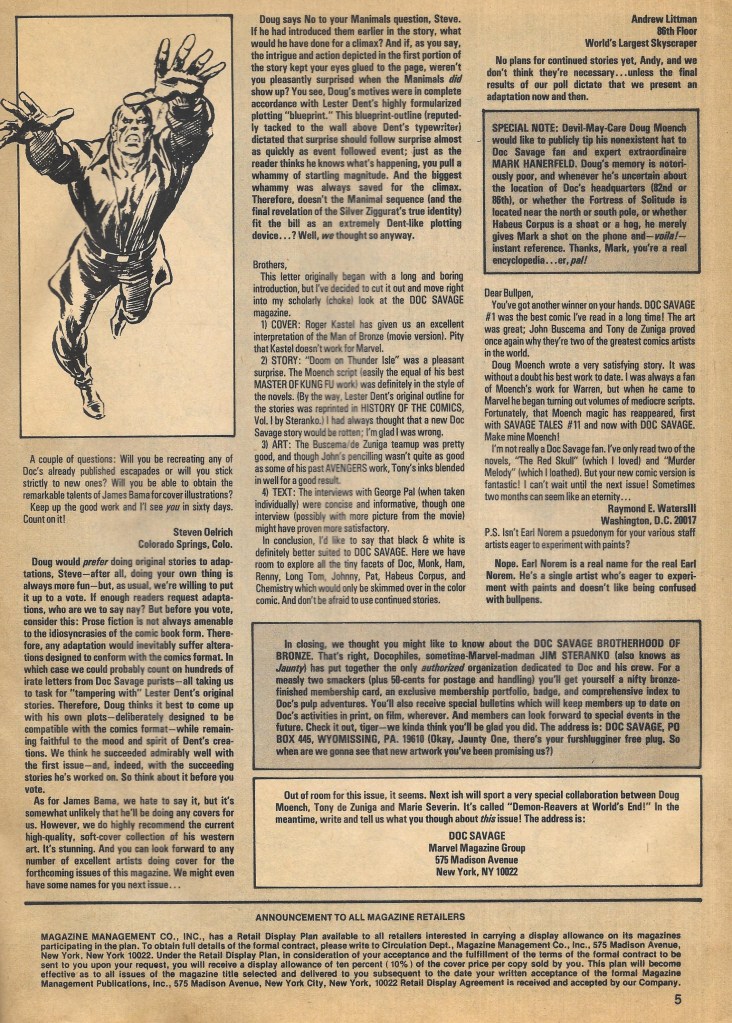
Back in late ’75, Artist, writer, publisher and auter Jim Steranko had started a club for Doc Savage fans (there was one for The Shadow as well, called the Shadow Secret Society, but I only joined the Brotherhood).I learned about it while reading the letters page of Marvel’s Doc SavageMagazine #3. Near the bottom of the letter column, was this little announcement, which got me quite excited.
It’s a little small to read, so here is the announcement itself, enlarged.
For two bucks, plus 50 cents postage, sent along to Wyomissing, PA, membership in the “Brotherhood of Bronze” could be had. Needless to say, I did not hesitate. I went down to the post office, got a money order for the $2.50, and sent it off.
A few weeks later, in January of 1976, this came in the mail.
As you can see from the address, I was living in a town called Bethany Beach. Much later, I learned what an amazing coincidence that was — the poet May Swenson, who wrote Evolution (the poem from which Philip José Farmer got the title for A Feast Unknown) was also living in Bethany Beach at the same time. If only I had known at the time! But she passed away shortly afterward, and I never got to meet her.
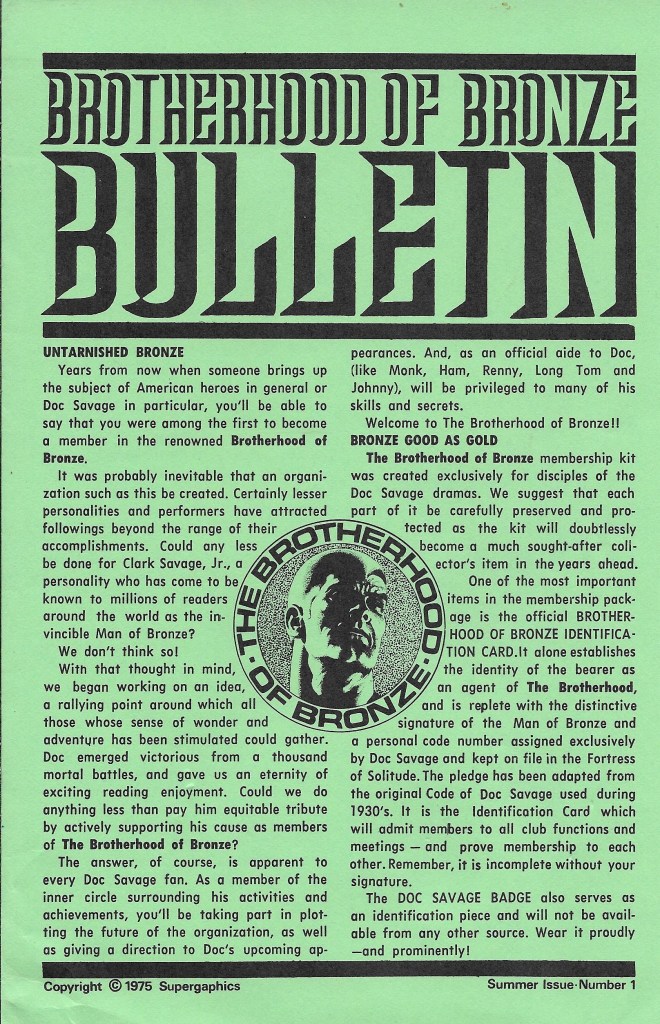
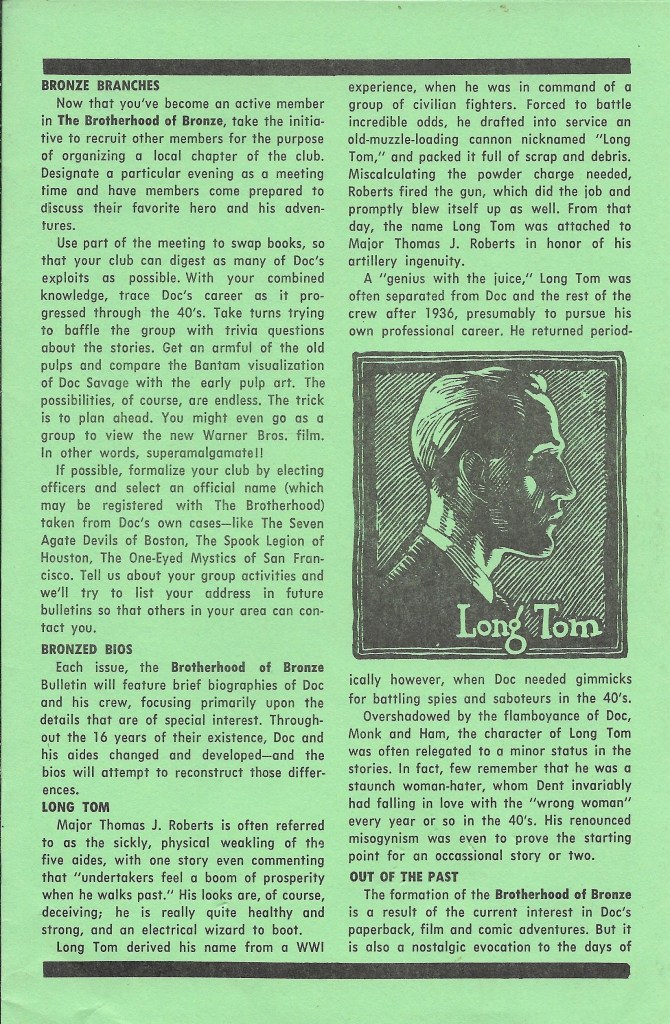
In any case, the envelope with the great Steranko art yielded a bounty of treasure. In addition to the bronze membership card, there was a newsletter with all sorts of interesting Doc announcements.
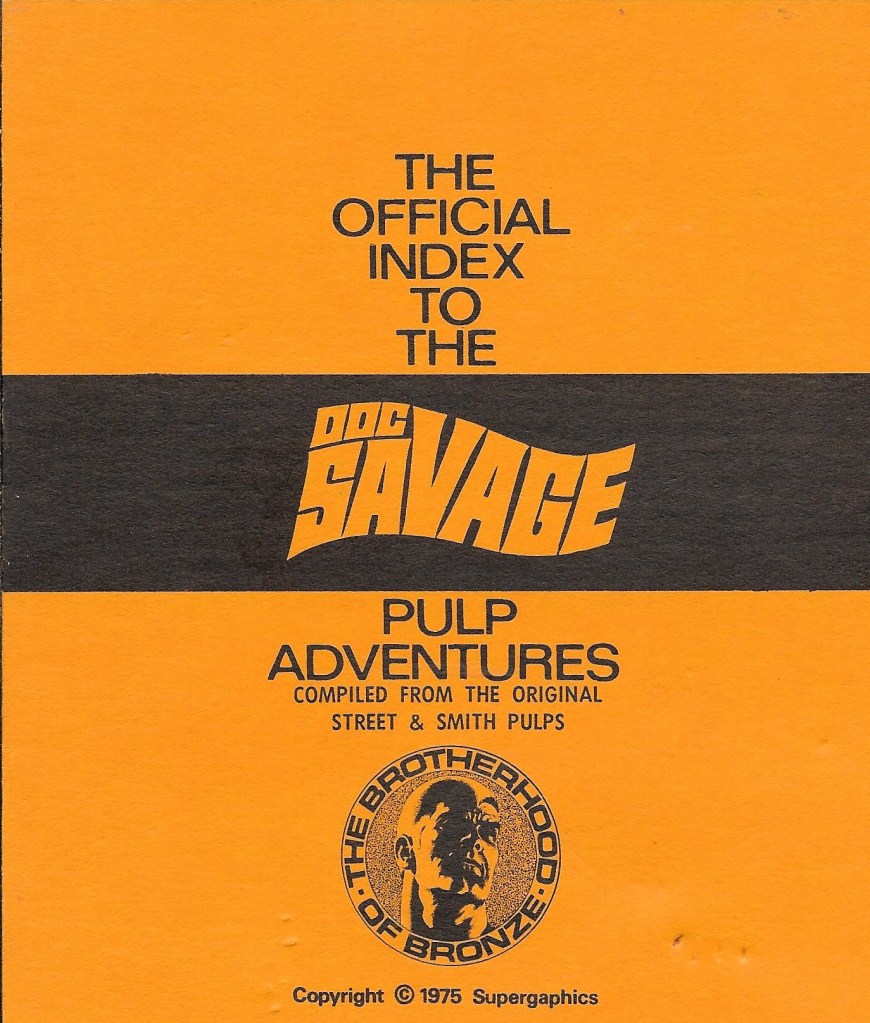
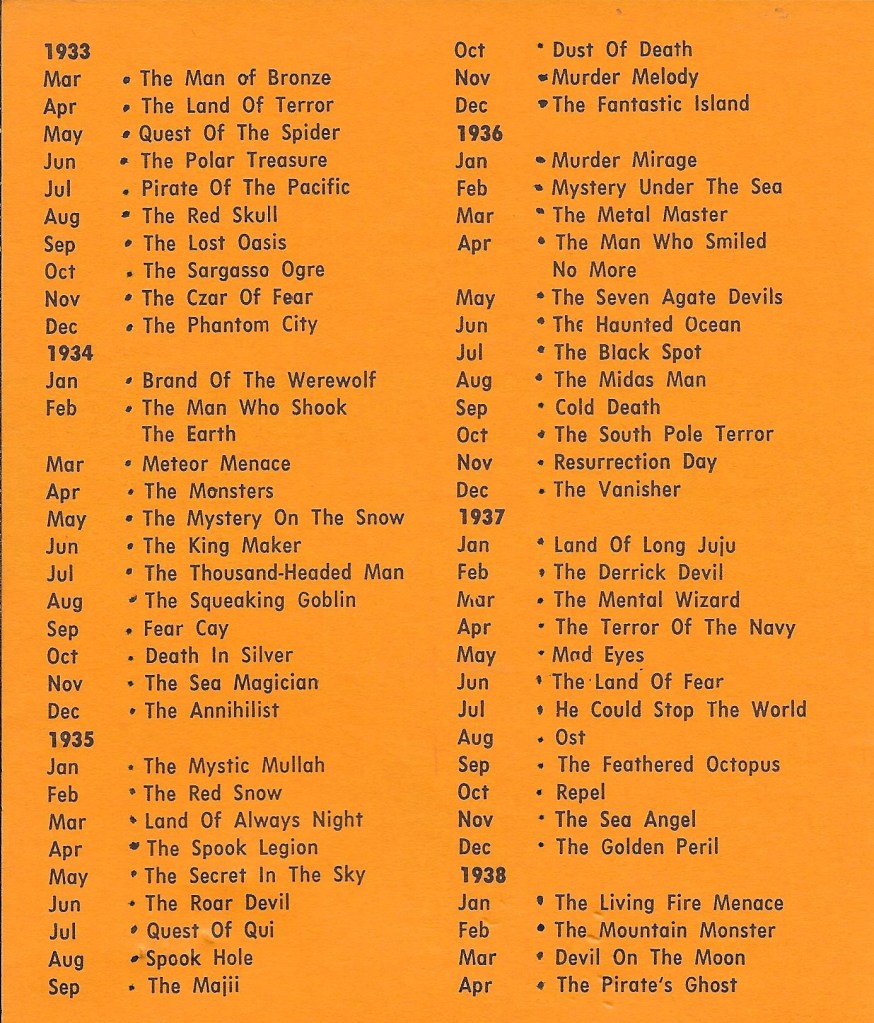
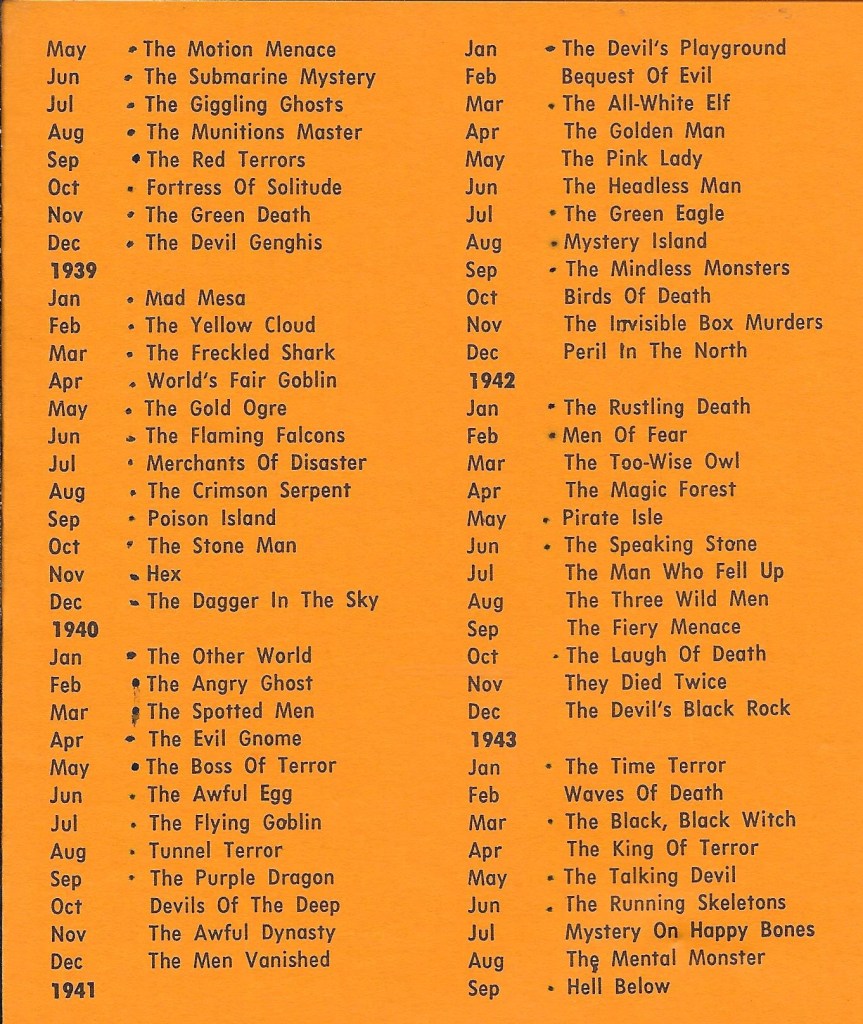
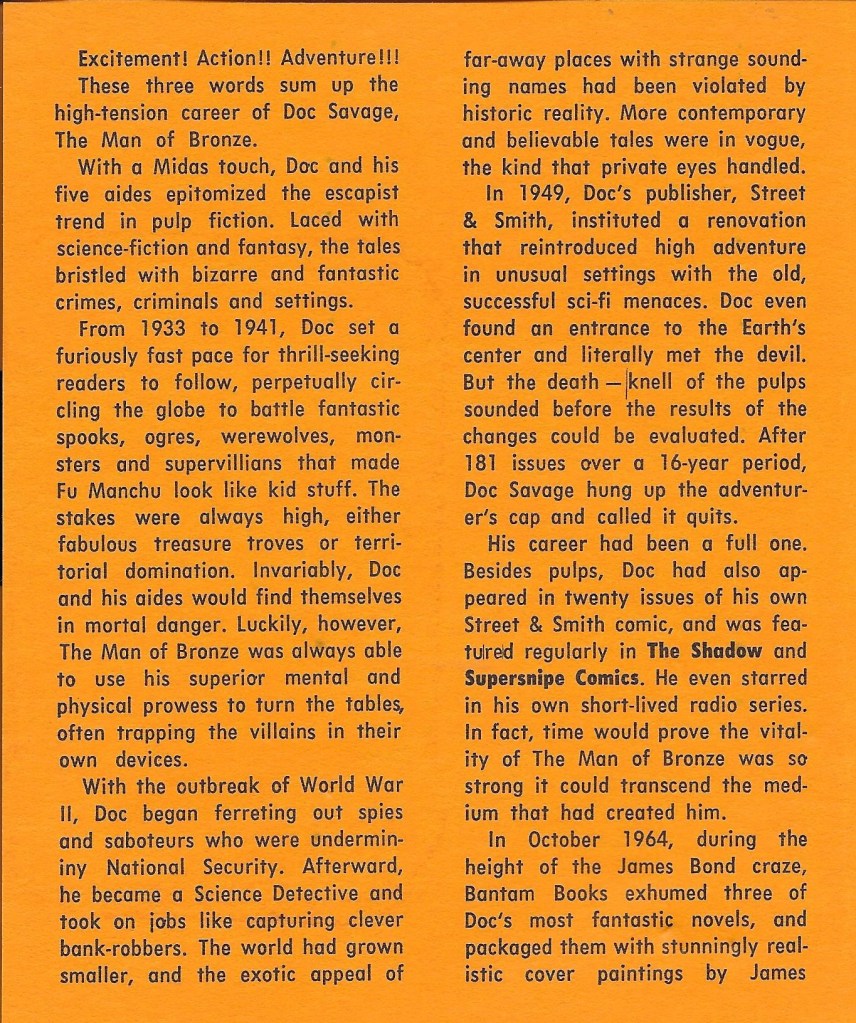
Further, there was a handy pamphlet-style checklist of all the then-known Doc Savage novels (In Hell Madonna/The Red Spider had yet to be discovered in `1975). I diligently placed a dot next to each title I acquired for my collection (as you can see by the many dots, I used the checklist as my go-to reference for many, many years).
The last item in my Brotherhood package was this nifty pin:
I envisioned wearing it at Brotherhood gatherings which would surely be organized soon.
But alas, the Doc Savage movie bombed, the Marvel magazine went on for only eight issues in total, and the Bantam paperbacks, though they continued until the whole pulp run was completed, slowed down and sometimes came close to being discontinued. The Brotherhood of Bronze faded away.
Only now, after 45 years, have I begun to find fellow Brothers from that time (brought together through the various online groups and gatherings of Doc fans). Maybe it’s time to start carrying my membership card in my wallet again…and maybe I will finally get a chance to wear that pin.
When the five aides of Doc Savage were introduced in the 1933 novel The Man of Bronze, they were featured more or less equally, but it did not take long for a favorite to emerge from among them. The apish chemist Andrew Blodgett “Monk” Mayfair, usually in tandem with his friend and intellectual sparring partner Ham, became spotlighted in almost every novel throughout the Street & Smith run of pulps.
Monk’s character went through an evolution over time. All of the aides were competent and depicted in ways that allowed them to display their areas of expertise. As the series progressed they tended to slip into caricature, being defined instead by signature quirks of personality. Their competence as adventurers slipped somewhat as well, as they were given to being captured, kidnapped, blundering into near-deathtraps, and requiring rescue from Doc. Monk and Ham, with their perpetual quarrel, became something of a device for comedy relief. Later in the series, in the 1940’s, their dialogue and behavior became more realistic, less cartoonish.
However, no matter the tone of the stories, it was rare for any of the aides to appear solo in more than periodic chapters in the novels. But Monk did have a few occasions of standing alone. He appeared by himself on the cover of the pulp magazine once, in 1940. A uniquely thoughtful pose, working with his chemical apparatus.
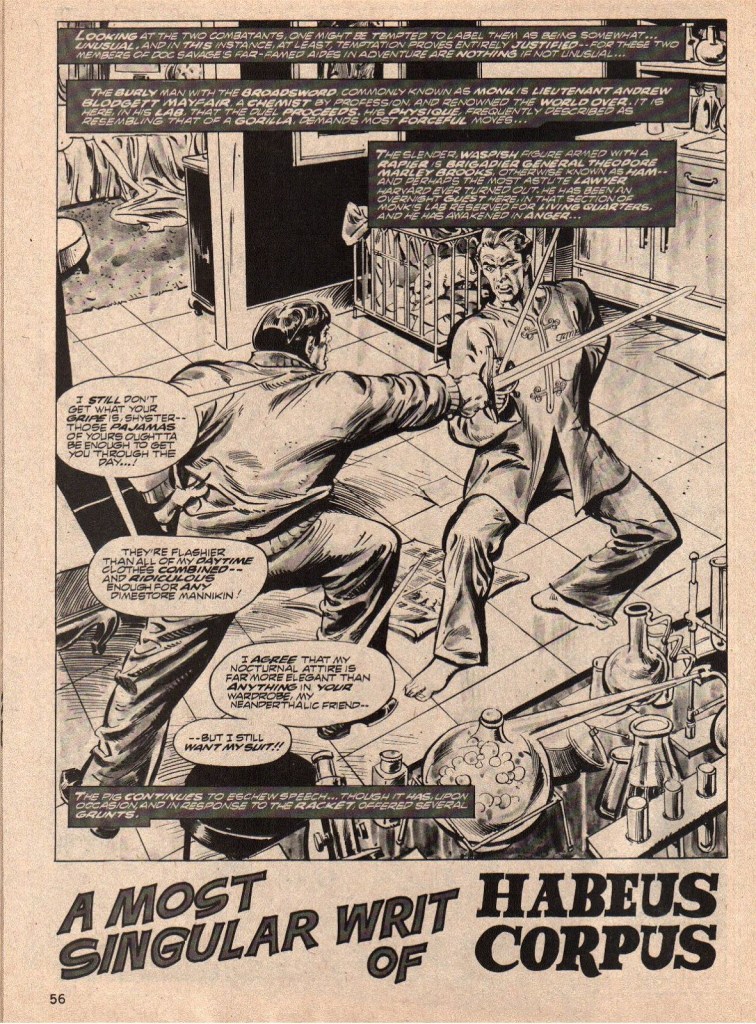
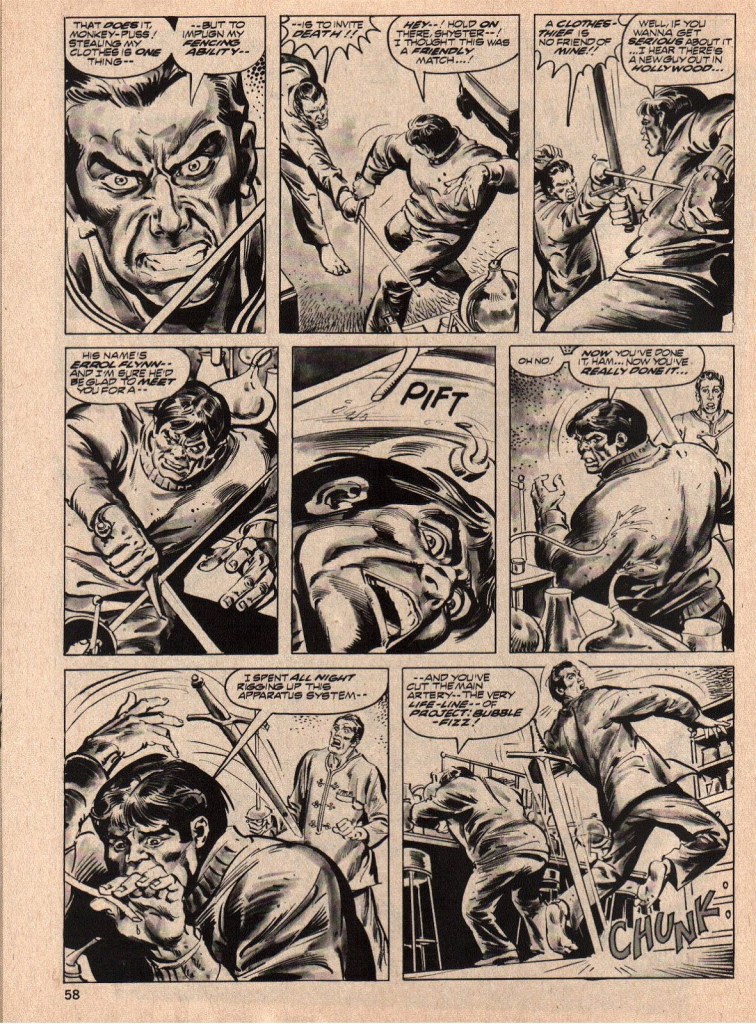
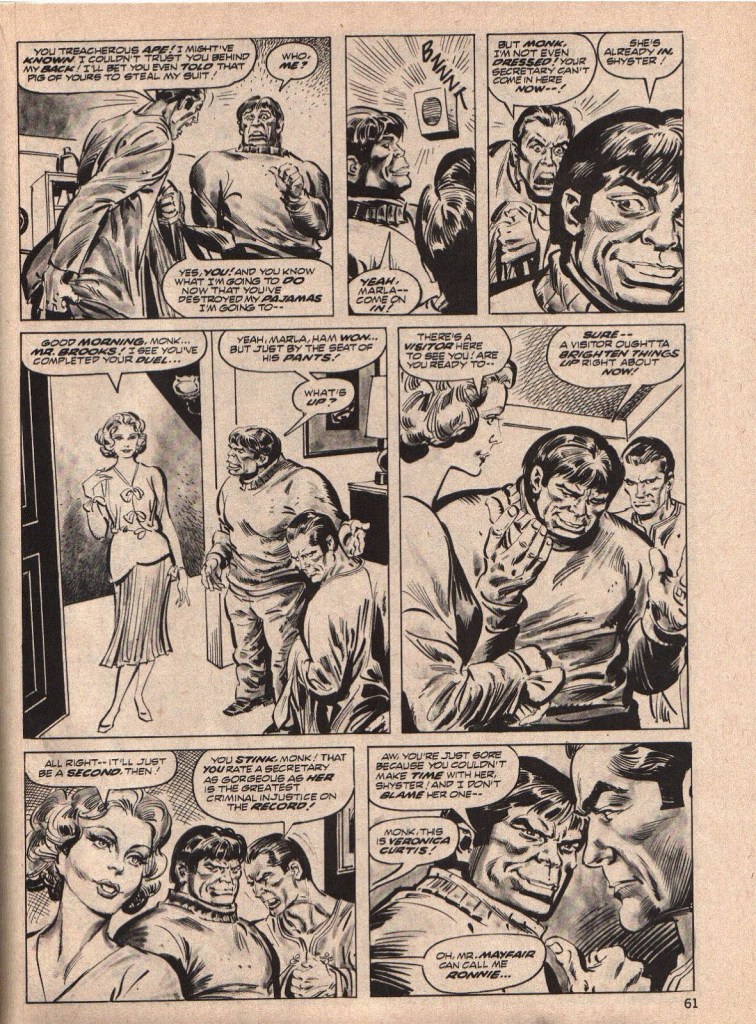
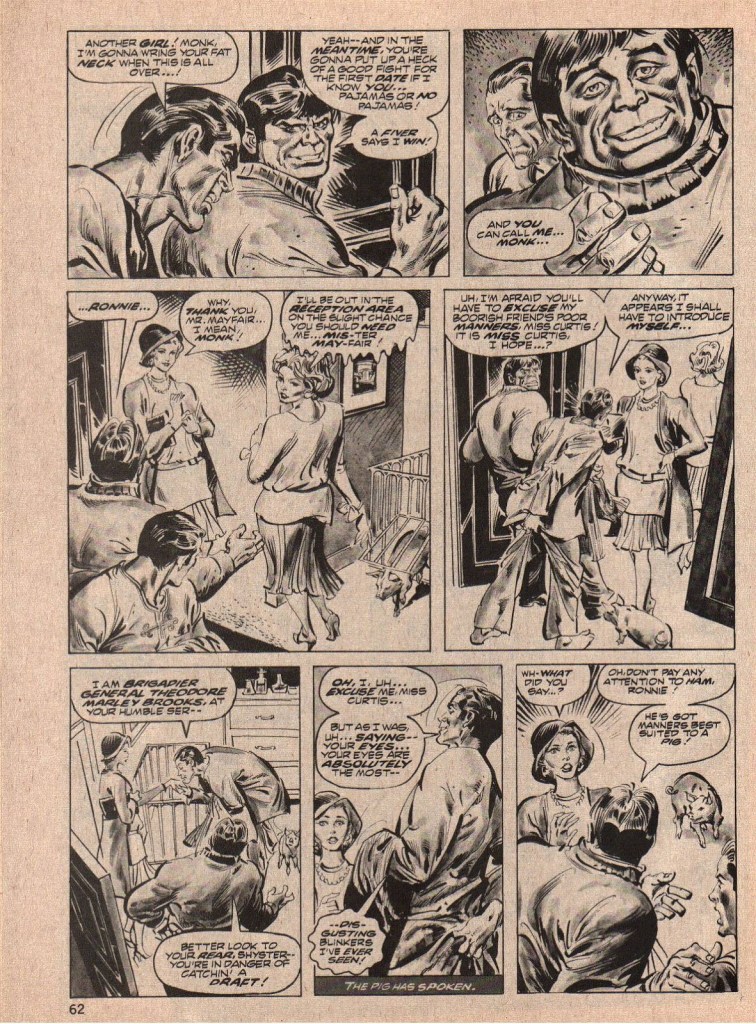
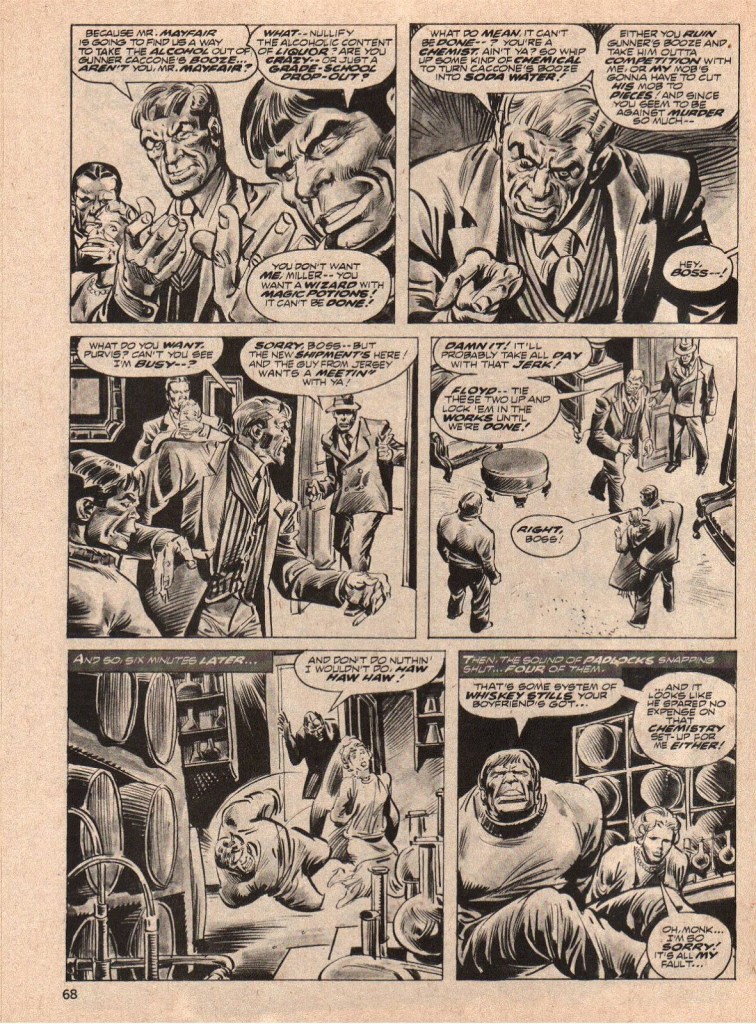
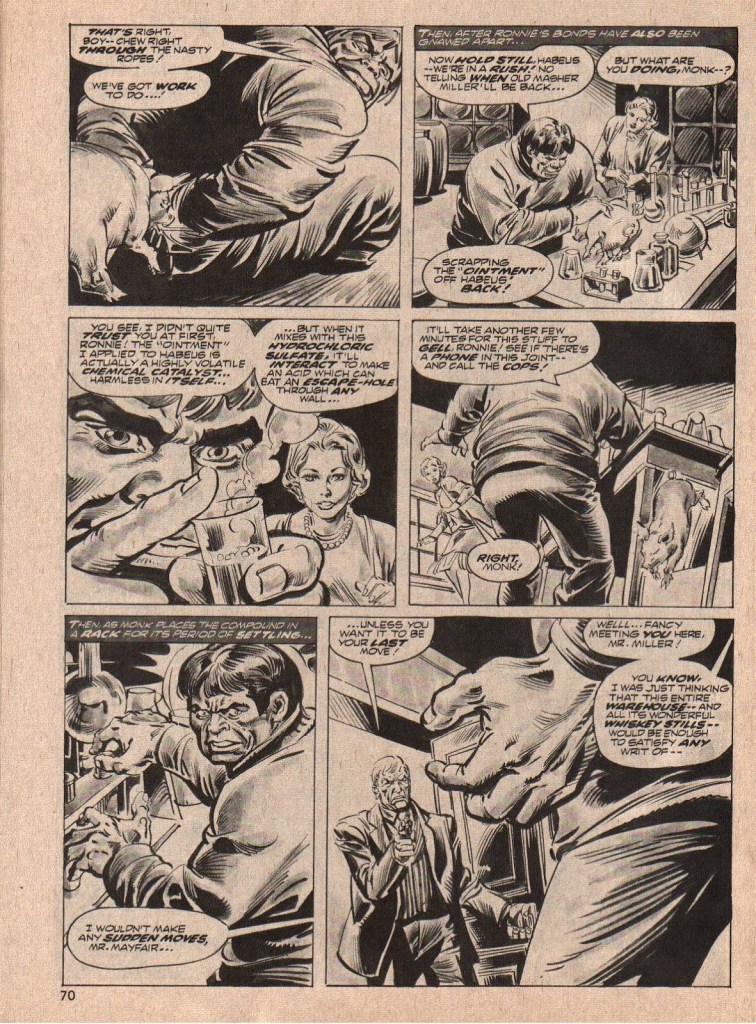
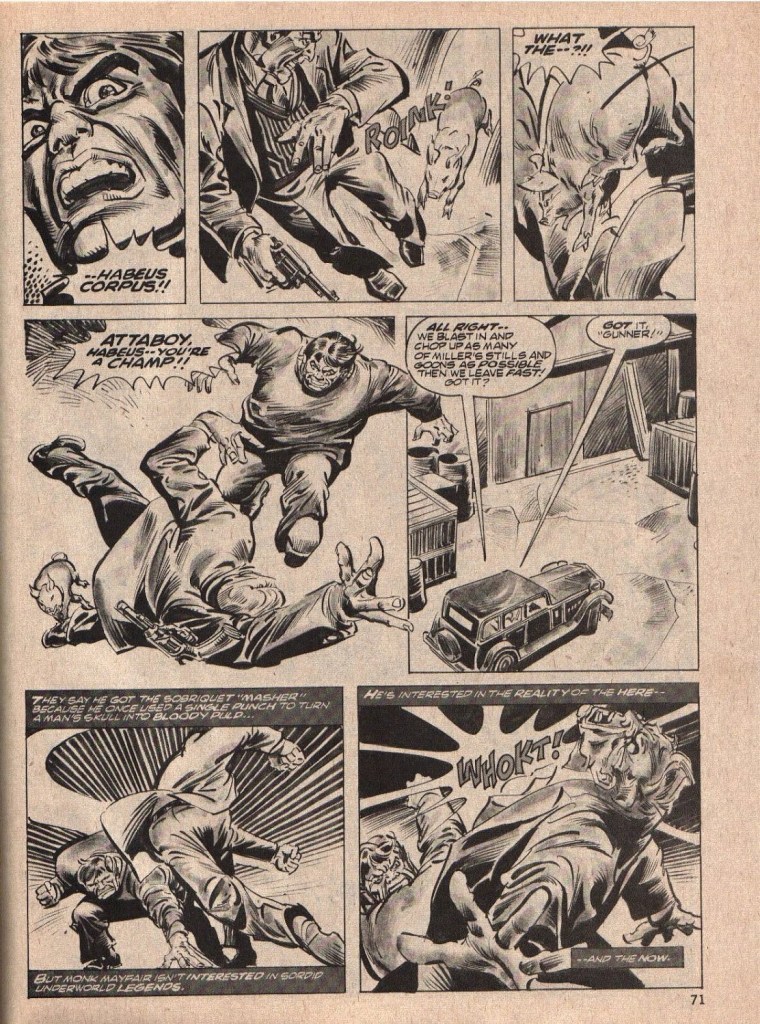
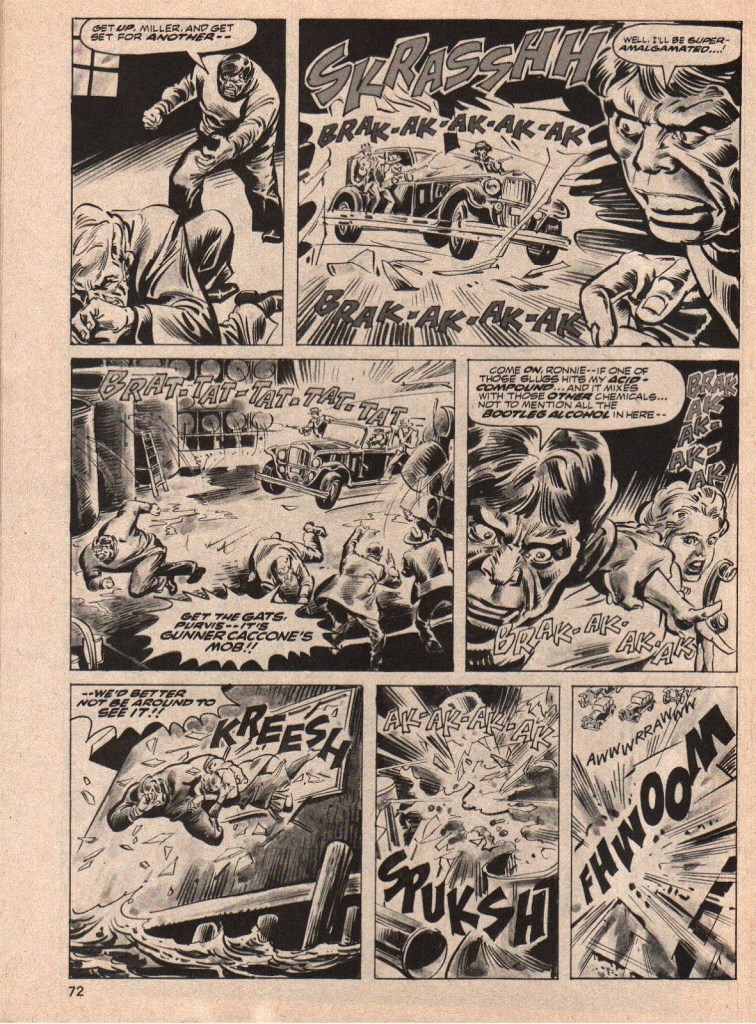
And in the January 1976 issue of Marvel Comics’ Doc Savage black and white magazine, they tried an intriguing experiment. Monk was left out of the main story (The Inferno Scheme, featured here in an earlier blog post) and instead appeared in a solo adventure later in the magazine. Marvel had planned to feature each of the aides in similar tales, but the magazine was discontinued after issue #8, and only the Monk story saw the light of day in that format.
But it’s interesting (and fun)…a blend of Monk’s special idiosyncrasies, his rough humor, his charm, as well as his intelligence and superlative skills as a chemist. A memorable fellow indeed, Mr. Mayfair.
Note from Doc Talos author/contest judge R. Paul Sardanas: Dick Lawrence’s meeting between James Talos and author Truman Capote — an interlude discussing subtleties of crime and emotion, is one of the more unique takes I’ve seen on the concept of Doc’s “crime college”. No answers are forthcoming at the end of the short tale, but many vastly important questions are likely to linger in the reader’s mind.
Comment from author Richard Lawrence: The out-of-the-blue reference to Doc Savage in the book In Cold Blood seemed to beg for a response from Doc himself. More firmly rooted in the real world than his pulp counterpart, I would expect Doc Talos to apply his humanitarian beliefs more through a kind of stubborn faith in his fellow human beings and an earnest willingness to work hard for society’s improvement, even though there is no “crime gland” to cut out, nor any college that can so profoundly prevent people from hurting others. There is always hope to be found when caring people try their best.
Additional note: If you are interested in submitting fiction to the Summer 2021 contest (first prize is a Bantam Doc Savage paperback Czar of Fear first edition, signed by James Bama) you can read the contest guidelines HERE.
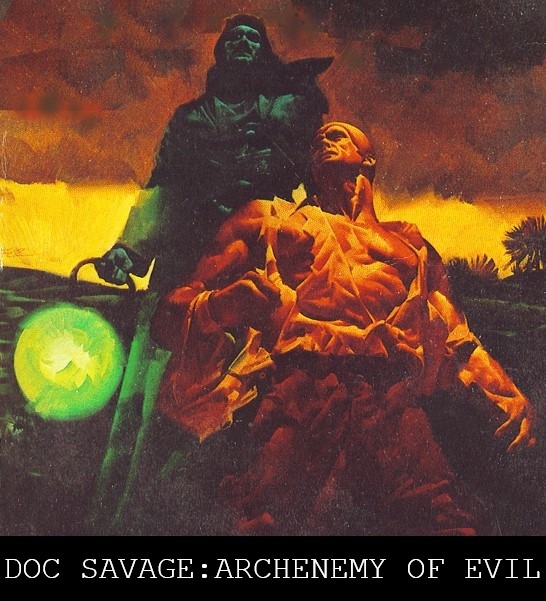
After the critical and box office debacle of the 1975 movie Doc Savage: The Man of Bronze, what had been intended as a series of films came to an abrupt end. But in the final credits of that film, a second movie was announced, Doc Savage: Archenemy of Evil.
That movie was never made, but the first steps toward its creation had been taken when the plug was pulled on the hoped-for franchise. Several possibilities for a story were in development, among them one by author Philip José Farmer, based on the Laurence Donovan novel Murder Mirage.
Farmer did not get so far as to create a shooting script, but he did do a screen treatment, which is a shortened version of scenes and dialogue for a proposed film. Though some of the captions edge in the direction of humor and caricature, it did scale back the disastrous camp approach considerably, and was a relatively faithful adaptation of the original novel.
The timing of the story is altered a bit — at the end of The Man of Bronze film, the teaser for the next installment takes place around Christmastime, and that is carried forward into the film treatment. So the bizarre summer snowstorm that is featured in the original novel is a more timely winter storm.
Original title illustration for Murder Mirage – art by Paul Orban
The scene where a fleeing woman is assaulted by Bedouins in the heart of New York, which results in her being blasted into nothing but a ghastly shadow, is retained in the script. An interesting Farmer-esque character note is the change of name from Lady Fotheran in the novel, to Lady Clayton in the proposed film.
Some of the descriptions of the villains are a bit gimmicky — Farmer uses references to actors from the film Casablanca, such as Sidney Greenstreet, Claude Rains and Peter Lorre, in his depiction of figures in the “Archenemy” film. The Arab characters also suffer from stereotyping — which was of course common in the 1930’s when Murder Mirage was originally written — and had the second film been made with that tone, those stereotypes might have led to objection from audiences as the decades passed.
The film would have included Pat Savage, who uses the exploding shoe gadget from the novel at one point in an attempt to escape the bad guys. She is also dressed in a nightgown from beginning to end in the film treatment, as she is kidnapped in it and never has an opportunity to change.
The film also retained a female villain, relatively rare for Doc stories.
As I mentioned, it edges toward camp at times (for instance in one scene various bad guys get knocked down, and the instructions for a sound overlay are for a clip of bowling tenpins falling to be played over the action), but overall it was nowhere near as overtly campy as the first movie.
Had The Man of Bronze not failed so drastically, bringing the movie series to an screeching halt, this film might have gone far toward repairing the damage and putting the film adventures of Doc Savage on more solid ground. At the end of the film treatment there is a teaser for another installment in the franchise, Death in Silver, which would have been a great story to bring to the big screen. The novel The Mental Wizard was also floated as a possible sequel, called Doc Savage in Klantic Country.
Rumors have abounded that at least some scenes from the second film were done simultaneously with the shooting of The Man of Bronze, but that was put to rest pretty definitively by Ron Ely (who played Doc) — in subsequent interviews, he has flatly stated that no such additional filming was ever done.
So to this day, despite quite a few attempts to bring Doc Savage back to the movies, we are still waiting.
Painting by Fred Pfeiffer for the Bantam reprint paperback of “Murder Mirage”. Makes a great potential movie poster!
James Bama’s series of paintings for the Bantam Doc Savage paperbacks has become iconic, and has certainly been discussed in articles and interviews far more comprehensive than this one will be. But as a fan of Bama, I have enjoyed learning more about his process, and particularly his use of models.
In an interview for the Men’s Adventure Magazine website, Bama noted that he always took his own photos, and over the years they totaled an astonishing 55,000 images.
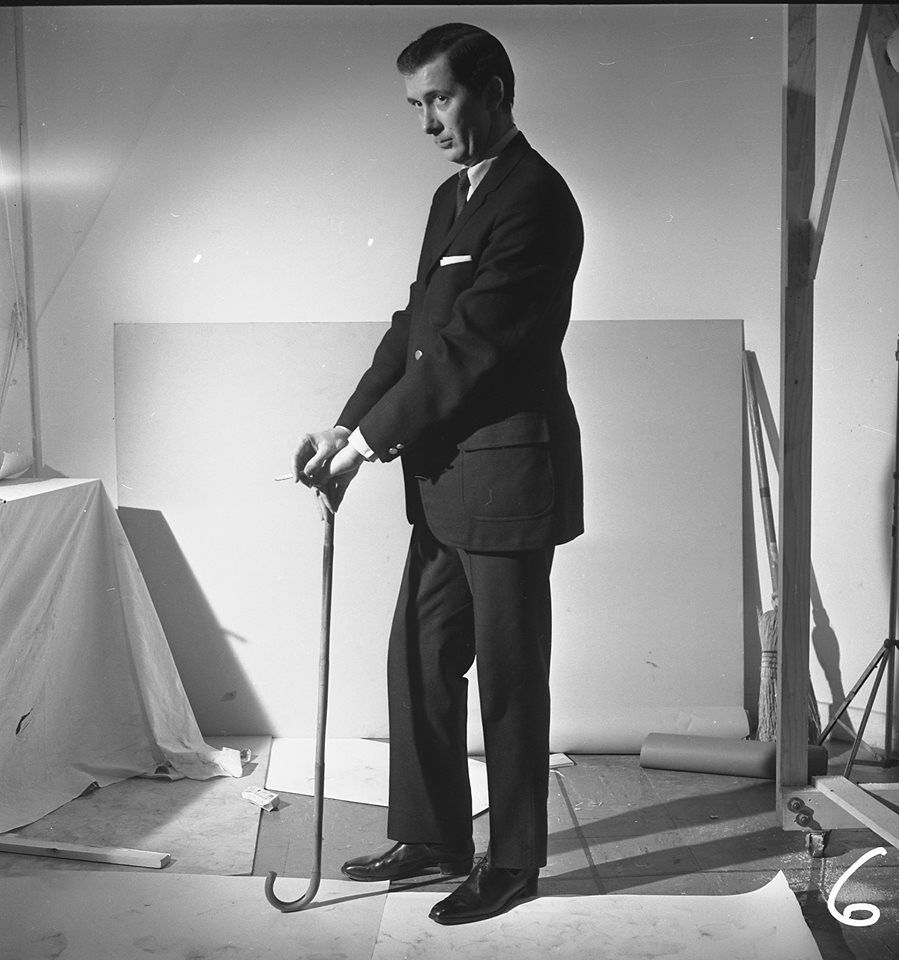
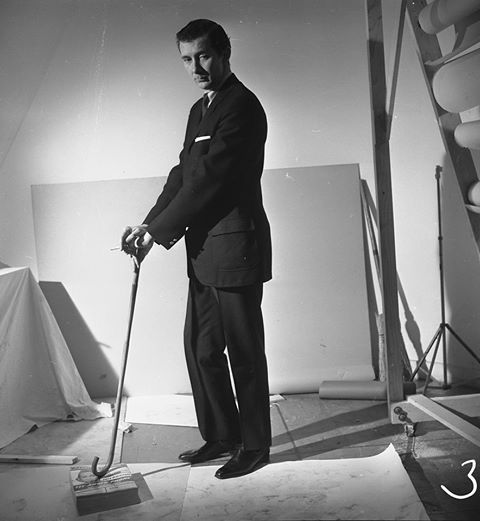
The model for Doc Savage was Steve Holland, one of the most popular male models for cover and interior artwork in books and magazines for decades. But Bama used a great many different models, including those who posed for the now-legendary arrangement of Doc and his aides that appeared on the back of the Bantam paperbacks.
Spencer Perlstein as Monk
Additional Monk pose
Dick Phall as Ham
Additional Ham pose
Pose for Johnny
Steve Holland pose for Doc
Doc and his aides
Bama did a wide array of other cover paintings beyond his Doc Savage work, one of the most famous being his cover for The Harrad Experiment. The male figure is Holland, and though at one time the woman was noted as model Andrea Dromm, Bama in his interview corrected that — the model in fact being his wife, Lynne Bama.
Bama even used himself as a model, appearing on the cover of The Men Who Smiled No More.
In the interview, Bama related a funny story about the famous Doc Savage ripped shirt. Here is the tale:
Bama: I created that ripped shirt he wore as Doc Savage. I remember when I was a teenager my uncle was a cab driver and when my mother died I moved in with my two aunts and my uncle. He used to buy pulp magazines and he gave me his Doc Savages. I still remember the first Doc Savage pulp cover I saw. He had a ripped shirt and was in the jungle, and that’s how I conceived the shirt for my version of the character. So, I ripped up a shirt and gave it Steve Holland to wear and it worked great. And, we kept using it for years. Then, when I moved to Wyoming in 1968 I left the shirt with Steve, along with the pants and the boots we used for Doc. Well, after I moved, his daughter was cleaning the house, his apartment, and she thought the shirt was a dust rag and she threw it out. For a while after I moved to Wyoming, I was still doing Doc Savage covers, So, Steve had to create another one, which wasn’t quite like the one I made. Anyway, that’s the story of his ripped shirt.
Bama, age 95, lives on his ranch in Wyoming, but apparently no longer paints, due to a degenerative eye condition. For those wanting to learn more about James Bama’s life and work, there is a wonderful book (which features all of the Doc covers among many other creations), called James Bama, American Realist.
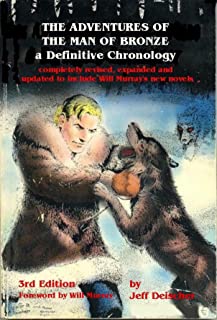
Joining me today is Jeff Deischer, author of The Adventures of the Man of Bronze: A Definitive Chronology, and creator of the Doc Savage pastiche character, Doc Brazen. As Jeff notes in the article to follow, Doc Savage has inspired a great many pastiches, but to my mind, there are few that capture the magic of the original pulps, much less succeed in applying more modern writing techniques to update an iconic character to the present.
Doc Brazen achieves this with style.
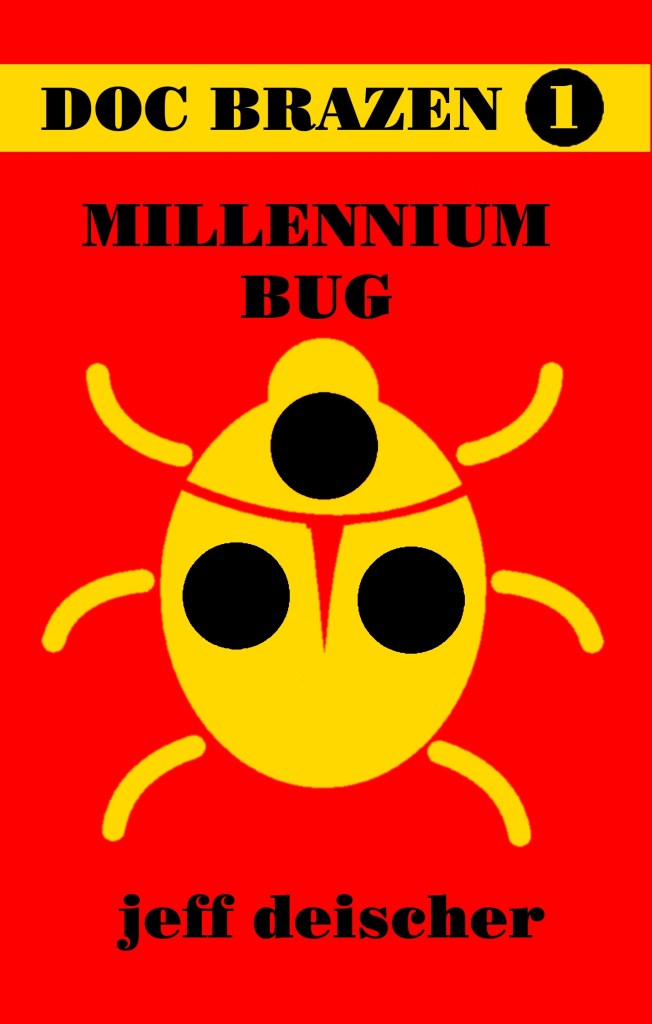
Reading the first novel of Brazen’s adventures, I was struck by Jeff’s clear love for the Doc Savage canon of pulps (a love evidenced also by the rich texture and depth of his Chronology), and a unique ability to apply his own vision to the mythos. Millennium Bug, or Doc Brazen #1, receives my highest recommendation — and links to further explore and purchase the book, as well as The Adventures of the Man of Bronze, are at the bottom of this post, following Jeff’s article.
And now, please enjoy, as Jeff Deischer talks about his creation.
WHAT’S IN A NAME?
By Jeff Deischer
It’s probably safe to say that those of you who recognize my name do so because of my book about the Doc Savage series, The Adventures of the Man of Bronze: a Definitive Chronology. We’re here to talk about my Doc Savage pastiche, Doc Brazen, but let me begin by telling you that TAotMoB is “a” definitive chronology, and not “the” definitive chronology because others have written their own that are just as valid as mine – using their own rules. Using my rules, which were established by Philip Jose Farmer, the first to write a Doc Savage chronology, I consider mine to be definitive. Rick Lai’s is equally valid, under his own set of rules. He often uses the geopolitical backdrop of stories to place them, ignoring Farmer’s it-has-to-occur-before-it-can-be-published maxim, which is a legitimate take on any series, in my opinion. Will Murray simply places the stories at about the time they were written, largely ignoring any other evidence.
With that out of the way, we can proceed to how Millennium Bug, the first Doc Brazen novel, came about. I’ve been a more or less lifelong fan of the Man of Bronze, having discovered him when I was 11 in 1972-73. As a teenaged would-be writer, I had numerous story ideas for Doc – none of which were the plot to Millennium Bug.
The idea for Millennium Bug started in 2003. It was intended as an online serial, and involved the character under another name with a different plot, but with the same mystery villain. The idea was to bring Doc Savage into the twenty-first century. I didn’t get very far, and abandoned the story for reasons lost to the mists of time.
Over the years, a number of people have urged me to write a Doc Savage pastiche. I’ve written two fan fiction Man of Bronze novels, shared with friends and close fans. I’ve resisted turning them into pastiches because everyone’s doing it. There are more pastiche/fan fiction characters with the appellation “Doc” than any other! I didn’t want to do what everyone else was doing. So, setting aside the question of quality, how would mine be any different?
It wasn’t until 2018 that I recalled my original millennium Doc Savage pastiche idea – and realized that this would make mine different.
My other concern, just as big as the first, was, can a true pulp adventure really work in the present? Technology is so different now, more immediate. You could stick characters on a train for days back in the golden age of pulp, isolated. Can’t happen now. People use planes for long distance travel. Characters could be trapped without any hope of rescue – not nowadays, with cell phones and GPS. So this presented its own unique challenge.
So I’d resisted any attempt to write a pulp in modern times. But I thought if I were going to try it, it should be with a project that I was in love with – so Doc Brazen it was. Doc Savage is the character I know best and love the most. And coming up with the “Doc Brazen” name in 2018 sealed the deal for me. So obvious – yet never used.
As an adult writer, I had a new crop of story ideas for Doc by 2018, one of which became the plot for Millennium Bug. The premise that a criminal mastermind could find a way to reverse what Doc does to criminals to make them reform and become citizens in good standing would be the perfect thing to get an aged Doc Brazen to come out of retirement. Maybe the only thing.
This was a separate plot from my original new millennium idea, which involved the internet, but it was a logical way to bring the ultimate enemy to Doc. I hesitate to say more because I don’t want to spoil any surprises. I will say that some readers guessed his or her identity, which of course is the way good stories should be – as long as they don’t do so too early. They didn’t. But the clues are there, from the very first chapter. The mystery is not so much who he or she is, but who he or she really is! As you know, a multitude of Doc Savage villains pretended to be someone else, and the trick was to figure out who they really were. It’s fine to know the Blue Carbuncle is out to destroy River City, but unless you figure out his secret identity, it might be hard to stop him.
You might say that there was really only one opponent who was worthy of facing Doc, or at least getting him to come out of retirement, and I took up the challenge of using this super criminal. Others have done so, and in my opinion, failed. That’s the ultimate reason I decided to use him or her – to do it right. And if I never got the opportunity to pen an authentic tale of Doc Savage, I’d have done the next best thing, a novel of the ultimate pulp hero (despite his new name) pitted against the ultimate evil – and done it in a way no one else had done it. It was therefore natural to pair the separate concepts of the secret mastermind’s return to the plot of a criminal undoing Doc’s work. The two characters are literally moral opposites. The two plots or parts fit well together thematically. They also worked well together plot wise, which is just as important. Ideas aren’t worth much if the execution (plot) fails.
So Millennium Bug is a frenetic chase from beginning to end, told in authentic Thirties pulp style. It is a multi-layered mystery as well, so I can’t say too much about any of the clues or revelations in it. All I can tell you is, pay close attention to what the bad guys do, and if you are a Doc Savage fan, you will be able to deduce the identity of the criminal mastermind – though perhaps not the cover identity he or she is using in Millennium Bug. As I stated, this is a very layered mystery. I expect – and hope – readers will guess wrong at least once as to the cover identity of the super criminal.
Lester Dent produced a famous 4-part outline that was published as part of an article to help novice writers sell a short story. Jim Steranko, in his History of Comics, incorrectly stated that he used it to write his Doc Savage adventures. This isn’t true, Dent created the outline for short stories of about 6000-10000 words. I used it for my third novel, The Stone Death, a Doc Savage adventure based on a premise by Harold Davis, one of Dent’s ghost writers. It appeared on the internet beginning in 1999 (now long since removed), and let me tell you, making it fit 40,000 words was a struggle! So in 2010, I revised it to write my second Doc Savage fan fiction novel, Doomsday (its origin would take an entire article itself!), adding two new sections (based on Dent’s sections), and I found that it worked quite well for a novel-length story. I also found it easier because I’d grown a lot as a writer in the decade since I wrote The Stone Death. I now use the six-part outline for all golden age pulp novels I write, including Millennium Bug. It really helps with pacing, and it spurs my creativity to “fill in the blanks” in the outline.
In my opinion, Doc Brazen could not function (as a character) without aides, so I rounded up a new bunch. He did not need any experts as Doc Savage’s aides had been (mostly, I think, to give them something to do). The Man of Bronze didn’t really need the help, in my opinion …. So the original three aides were a Mayan warrior, a cat burglar who was immune to the decriminalization process, and a computer expert – the one field about which neither Doc knew anything about. Each represented a facet of Doc’s life – his heritage, his life’s work, and a new science (he was a master of all the old ones). I based their initial personalities on three archetypes I’ve used in a number of books in a number of genres, tweaking them in each case to fit the milieu. They’ve been criminals, fighting monks, superheroes, space cowboys, sword and sorcery adventurers, and golden age pulp adventurers, always partners who, despite their differences, had each other’s backs, no matter how contentious their relationships might get.
In 2018, when I looked through my old notes – I’d read something a couple of months earlier that reminded me of the old millennium idea, causing me to review the original concept – I realized that these three wouldn’t really get along in any substantial or interesting way, and a lot of what I loved about the Doc Savage series was Monk and Ham. So I decided to make Oz (short for “monkey” in Nahuatl, the primary dialect of the Aztecs) the child of the Monk Mayfair-pastiche Buddy Banks, and give him a straight man – a straight-laced and straightforward man.
So the personalities of the three original aides changed drastically from their original conception.
Oz is very much like Monk – impetuous and powerful. Rather than trying to duplicate the bickering of the original pair, I decided to make Noble (a nickname derived from his Aztec name) a true straight man – he would be Oz’s best friend and conscience, as well as his cousin. This personality led to his name, which I’d struggled to create. Noble’s father is not revealed (and if you figure it out, don’t tell anyone and spoil their guessing game), but Noble and Oz are both young Aztec men who lived in Coronado alongside Doc Brazen and his wife in the small Central American nation where Doc retired to in 1949. Oz’s mother and Noble’s mother are related, being cousins. A couple of readers have told me they figured out who Noble’s parents are. That’s fine with me. It means I did a good job with the clues. I also pulled off the greatest literary sleight of hand in this book that I’ve ever written with regards to Noble’s parentage. I don’t know if I’ll ever reveal it in the series, officially, and I probably won’t tell you who isn’t Noble’s father.
The cat burglar was retained in the form of Robert Lafitte (Lafitte was a famous pirate and in French, the final “T” is not pronounced, so his personal name could be (incorrectly) sounded out as “robber”; there are numerous such Easter eggs in the novel. For example, Ann Sinai is an anagram of Anais Ninn, the French author and diarist (the French locale is a clue to the mastermind’s identity), Prevost is the name of an early computer thinker, and Coronado was Lester Dent’s first choice for the name of the Central American nation that was published as Hidalgo in the Doc Savage series. I learned this, among many fascinating tidbits, when I went to the Dent archive in 1998 at the University of Missouri-Columbia). I previously told you that the personalities of the three original aides changed drastically: Originally, Lafitte was going to have the Oz personality – saying and doing whatever he wanted, and Oz was going to be the serious character – who I split off into Noble. He had another name, “Puck”, short for Puksi’ik’al, Nahuatl for “heart”, and be Buddy Banks’ grandson, related to Doc through marriage.
Henry Prevost is the computer expert, working at the famous Brazen Institute, located on Storm Island where Ulysses Brazen was born near the beginning of the twentieth century. Prevost is a desk jockey who craves excitement he’s never experienced. It was important that each aide be distinct, in personality (motive) as well as profession. His background is tied to the original Doc Savage canon, and will be revealed extensively in the series at some point. I thought it was important that each new aide have a built-in connection to Doc, as all of Doc Savage’s aides had to him.
Prevost’s motivation is contrasted by the presence of Norma “Thunderbird” Crale, a stunt flyer – a daredevil like the 1920s barnstormers. Her grandmother was involved in one of Doc Brazen’s adventures during the 1930s at the South Pole. I thought it was important that there be a female in the group, since there is no Pat Savage analog present – Lucrezia “Lucy” Brazen, Doc Brazen’s cousin, disappeared in the Amazon in the early 1960s. A mystery I’ll address at some point in the series. The impetus for Thunderbird Crale specifically came from an idea I’d had to write the 1930s pulp adventures of her grandmother – in the vein of the adventures of Irene Adler from Sherlock Holmes’ being written at the time.
I do have a number of sequels in mind. It’s a matter of writing them. I have numerous series in numerous genres in progress, and I’m focusing on superheroes right now, with eight distinct universes and over half my bibliography consisting of superhero books. But some day, I’d like to return to Doc Brazen, and reveal what happened to all of his original aides, among other things. One, the last surviving member of the original group, will make a cameo appearance in one of the upcoming novels. Other possible volumes: Dead Wrong (deceased killers who come back to life), Net Prophet (the original internet premise), Acid Test (the return of a criminal), Infernal Machine (sequel to two 1930s adventures), Black Balled (featuring the cameo by one of Doc Brazen’s original aides), World Piece (an international peace movement), Element of Surprise (an unknown substance related to a 1930s adventure), Golden Opportunity (a South American mystery), Train of Thought (psychic research), Master Mind (Doc Brazen’s Institute secrets are revealed to the public by a criminal), Wild West (an adventure set in Wyoming, revealing the background of Henry Prevost). I also have about a dozen more ideas that are less developed. These listed ones are stories I could plot and write.
Lastly, I like the H. Swenson “mod” or “pop art” look of Doc Savage’s “science detective” phase, though not particularly for a Doc Savage book, having grown up on the ultra-realistic James Bama covers. So I went for that look designing the cover to Millennium Bug.
Oh, and there really is a reason this is set in 1999, and not 2019, other than the double entendre title.
Millennium Bug, Doc Brazen #1, available from Amazon here.
The Adventures of the Man of Bronze: A Definitive Chronology, available from Amazon here.
































 Doc Talos