What’s in a name? – by Jeff Deischer

Joining me today is Jeff Deischer, author of The Adventures of the Man of Bronze: A Definitive Chronology, and creator of the Doc Savage pastiche character, Doc Brazen. As Jeff notes in the article to follow, Doc Savage has inspired a great many pastiches, but to my mind, there are few that capture the magic of the original pulps, much less succeed in applying more modern writing techniques to update an iconic character to the present.

Doc Brazen achieves this with style.

Reading the first novel of Brazen’s adventures, I was struck by Jeff’s clear love for the Doc Savage canon of pulps (a love evidenced also by the rich texture and depth of his Chronology), and a unique ability to apply his own vision to the mythos. Millennium Bug, or Doc Brazen #1, receives my highest recommendation — and links to further explore and purchase the book, as well as The Adventures of the Man of Bronze, are at the bottom of this post, following Jeff’s article.

And now, please enjoy, as Jeff Deischer talks about his creation.
WHAT’S IN A NAME?

By Jeff Deischer

It’s probably safe to say that those of you who recognize my name do so because of my book about the Doc Savage series, The Adventures of the Man of Bronze: a Definitive Chronology. We’re here to talk about my Doc Savage pastiche, Doc Brazen, but let me begin by telling you that TAotMoB is “a” definitive chronology, and not “the” definitive chronology because others have written their own that are just as valid as mine – using their own rules. Using my rules, which were established by Philip Jose Farmer, the first to write a Doc Savage chronology, I consider mine to be definitive. Rick Lai’s is equally valid, under his own set of rules. He often uses the geopolitical backdrop of stories to place them, ignoring Farmer’s it-has-to-occur-before-it-can-be-published maxim, which is a legitimate take on any series, in my opinion. Will Murray simply places the stories at about the time they were written, largely ignoring any other evidence.

With that out of the way, we can proceed to how Millennium Bug, the first Doc Brazen novel, came about. I’ve been a more or less lifelong fan of the Man of Bronze, having discovered him when I was 11 in 1972-73. As a teenaged would-be writer, I had numerous story ideas for Doc – none of which were the plot to Millennium Bug.

The idea for Millennium Bug started in 2003. It was intended as an online serial, and involved the character under another name with a different plot, but with the same mystery villain. The idea was to bring Doc Savage into the twenty-first century. I didn’t get very far, and abandoned the story for reasons lost to the mists of time.

Over the years, a number of people have urged me to write a Doc Savage pastiche. I’ve written two fan fiction Man of Bronze novels, shared with friends and close fans. I’ve resisted turning them into pastiches because everyone’s doing it. There are more pastiche/fan fiction characters with the appellation “Doc” than any other! I didn’t want to do what everyone else was doing. So, setting aside the question of quality, how would mine be any different?

It wasn’t until 2018 that I recalled my original millennium Doc Savage pastiche idea – and realized that this would make mine different.

My other concern, just as big as the first, was, can a true pulp adventure really work in the present? Technology is so different now, more immediate. You could stick characters on a train for days back in the golden age of pulp, isolated. Can’t happen now. People use planes for long distance travel. Characters could be trapped without any hope of rescue – not nowadays, with cell phones and GPS. So this presented its own unique challenge.

So I’d resisted any attempt to write a pulp in modern times. But I thought if I were going to try it, it should be with a project that I was in love with – so Doc Brazen it was. Doc Savage is the character I know best and love the most. And coming up with the “Doc Brazen” name in 2018 sealed the deal for me. So obvious – yet never used.

As an adult writer, I had a new crop of story ideas for Doc by 2018, one of which became the plot for Millennium Bug. The premise that a criminal mastermind could find a way to reverse what Doc does to criminals to make them reform and become citizens in good standing would be the perfect thing to get an aged Doc Brazen to come out of retirement. Maybe the only thing.

This was a separate plot from my original new millennium idea, which involved the internet, but it was a logical way to bring the ultimate enemy to Doc. I hesitate to say more because I don’t want to spoil any surprises. I will say that some readers guessed his or her identity, which of course is the way good stories should be – as long as they don’t do so too early. They didn’t. But the clues are there, from the very first chapter. The mystery is not so much who he or she is, but who he or she really is! As you know, a multitude of Doc Savage villains pretended to be someone else, and the trick was to figure out who they really were. It’s fine to know the Blue Carbuncle is out to destroy River City, but unless you figure out his secret identity, it might be hard to stop him.

You might say that there was really only one opponent who was worthy of facing Doc, or at least getting him to come out of retirement, and I took up the challenge of using this super criminal. Others have done so, and in my opinion, failed. That’s the ultimate reason I decided to use him or her – to do it right. And if I never got the opportunity to pen an authentic tale of Doc Savage, I’d have done the next best thing, a novel of the ultimate pulp hero (despite his new name) pitted against the ultimate evil – and done it in a way no one else had done it. It was therefore natural to pair the separate concepts of the secret mastermind’s return to the plot of a criminal undoing Doc’s work. The two characters are literally moral opposites. The two plots or parts fit well together thematically. They also worked well together plot wise, which is just as important. Ideas aren’t worth much if the execution (plot) fails.

So Millennium Bug is a frenetic chase from beginning to end, told in authentic Thirties pulp style. It is a multi-layered mystery as well, so I can’t say too much about any of the clues or revelations in it. All I can tell you is, pay close attention to what the bad guys do, and if you are a Doc Savage fan, you will be able to deduce the identity of the criminal mastermind – though perhaps not the cover identity he or she is using in Millennium Bug. As I stated, this is a very layered mystery. I expect – and hope – readers will guess wrong at least once as to the cover identity of the super criminal.

Lester Dent produced a famous 4-part outline that was published as part of an article to help novice writers sell a short story. Jim Steranko, in his History of Comics, incorrectly stated that he used it to write his Doc Savage adventures. This isn’t true, Dent created the outline for short stories of about 6000-10000 words. I used it for my third novel, The Stone Death, a Doc Savage adventure based on a premise by Harold Davis, one of Dent’s ghost writers. It appeared on the internet beginning in 1999 (now long since removed), and let me tell you, making it fit 40,000 words was a struggle! So in 2010, I revised it to write my second Doc Savage fan fiction novel, Doomsday (its origin would take an entire article itself!), adding two new sections (based on Dent’s sections), and I found that it worked quite well for a novel-length story. I also found it easier because I’d grown a lot as a writer in the decade since I wrote The Stone Death. I now use the six-part outline for all golden age pulp novels I write, including Millennium Bug. It really helps with pacing, and it spurs my creativity to “fill in the blanks” in the outline.

In my opinion, Doc Brazen could not function (as a character) without aides, so I rounded up a new bunch. He did not need any experts as Doc Savage’s aides had been (mostly, I think, to give them something to do). The Man of Bronze didn’t really need the help, in my opinion …. So the original three aides were a Mayan warrior, a cat burglar who was immune to the decriminalization process, and a computer expert – the one field about which neither Doc knew anything about. Each represented a facet of Doc’s life – his heritage, his life’s work, and a new science (he was a master of all the old ones). I based their initial personalities on three archetypes I’ve used in a number of books in a number of genres, tweaking them in each case to fit the milieu. They’ve been criminals, fighting monks, superheroes, space cowboys, sword and sorcery adventurers, and golden age pulp adventurers, always partners who, despite their differences, had each other’s backs, no matter how contentious their relationships might get.

In 2018, when I looked through my old notes – I’d read something a couple of months earlier that reminded me of the old millennium idea, causing me to review the original concept – I realized that these three wouldn’t really get along in any substantial or interesting way, and a lot of what I loved about the Doc Savage series was Monk and Ham. So I decided to make Oz (short for “monkey” in Nahuatl, the primary dialect of the Aztecs) the child of the Monk Mayfair-pastiche Buddy Banks, and give him a straight man – a straight-laced and straightforward man.

So the personalities of the three original aides changed drastically from their original conception.

Oz is very much like Monk – impetuous and powerful. Rather than trying to duplicate the bickering of the original pair, I decided to make Noble (a nickname derived from his Aztec name) a true straight man – he would be Oz’s best friend and conscience, as well as his cousin. This personality led to his name, which I’d struggled to create. Noble’s father is not revealed (and if you figure it out, don’t tell anyone and spoil their guessing game), but Noble and Oz are both young Aztec men who lived in Coronado alongside Doc Brazen and his wife in the small Central American nation where Doc retired to in 1949. Oz’s mother and Noble’s mother are related, being cousins. A couple of readers have told me they figured out who Noble’s parents are. That’s fine with me. It means I did a good job with the clues. I also pulled off the greatest literary sleight of hand in this book that I’ve ever written with regards to Noble’s parentage. I don’t know if I’ll ever reveal it in the series, officially, and I probably won’t tell you who isn’t Noble’s father.

The cat burglar was retained in the form of Robert Lafitte (Lafitte was a famous pirate and in French, the final “T” is not pronounced, so his personal name could be (incorrectly) sounded out as “robber”; there are numerous such Easter eggs in the novel. For example, Ann Sinai is an anagram of Anais Ninn, the French author and diarist (the French locale is a clue to the mastermind’s identity), Prevost is the name of an early computer thinker, and Coronado was Lester Dent’s first choice for the name of the Central American nation that was published as Hidalgo in the Doc Savage series. I learned this, among many fascinating tidbits, when I went to the Dent archive in 1998 at the University of Missouri-Columbia). I previously told you that the personalities of the three original aides changed drastically: Originally, Lafitte was going to have the Oz personality – saying and doing whatever he wanted, and Oz was going to be the serious character – who I split off into Noble. He had another name, “Puck”, short for Puksi’ik’al, Nahuatl for “heart”, and be Buddy Banks’ grandson, related to Doc through marriage.

Henry Prevost is the computer expert, working at the famous Brazen Institute, located on Storm Island where Ulysses Brazen was born near the beginning of the twentieth century. Prevost is a desk jockey who craves excitement he’s never experienced. It was important that each aide be distinct, in personality (motive) as well as profession. His background is tied to the original Doc Savage canon, and will be revealed extensively in the series at some point. I thought it was important that each new aide have a built-in connection to Doc, as all of Doc Savage’s aides had to him.

Prevost’s motivation is contrasted by the presence of Norma “Thunderbird” Crale, a stunt flyer – a daredevil like the 1920s barnstormers. Her grandmother was involved in one of Doc Brazen’s adventures during the 1930s at the South Pole. I thought it was important that there be a female in the group, since there is no Pat Savage analog present – Lucrezia “Lucy” Brazen, Doc Brazen’s cousin, disappeared in the Amazon in the early 1960s. A mystery I’ll address at some point in the series. The impetus for Thunderbird Crale specifically came from an idea I’d had to write the 1930s pulp adventures of her grandmother – in the vein of the adventures of Irene Adler from Sherlock Holmes’ being written at the time.

I do have a number of sequels in mind. It’s a matter of writing them. I have numerous series in numerous genres in progress, and I’m focusing on superheroes right now, with eight distinct universes and over half my bibliography consisting of superhero books. But some day, I’d like to return to Doc Brazen, and reveal what happened to all of his original aides, among other things. One, the last surviving member of the original group, will make a cameo appearance in one of the upcoming novels. Other possible volumes: Dead Wrong (deceased killers who come back to life), Net Prophet (the original internet premise), Acid Test (the return of a criminal), Infernal Machine (sequel to two 1930s adventures), Black Balled (featuring the cameo by one of Doc Brazen’s original aides), World Piece (an international peace movement), Element of Surprise (an unknown substance related to a 1930s adventure), Golden Opportunity (a South American mystery), Train of Thought (psychic research), Master Mind (Doc Brazen’s Institute secrets are revealed to the public by a criminal), Wild West (an adventure set in Wyoming, revealing the background of Henry Prevost). I also have about a dozen more ideas that are less developed. These listed ones are stories I could plot and write.

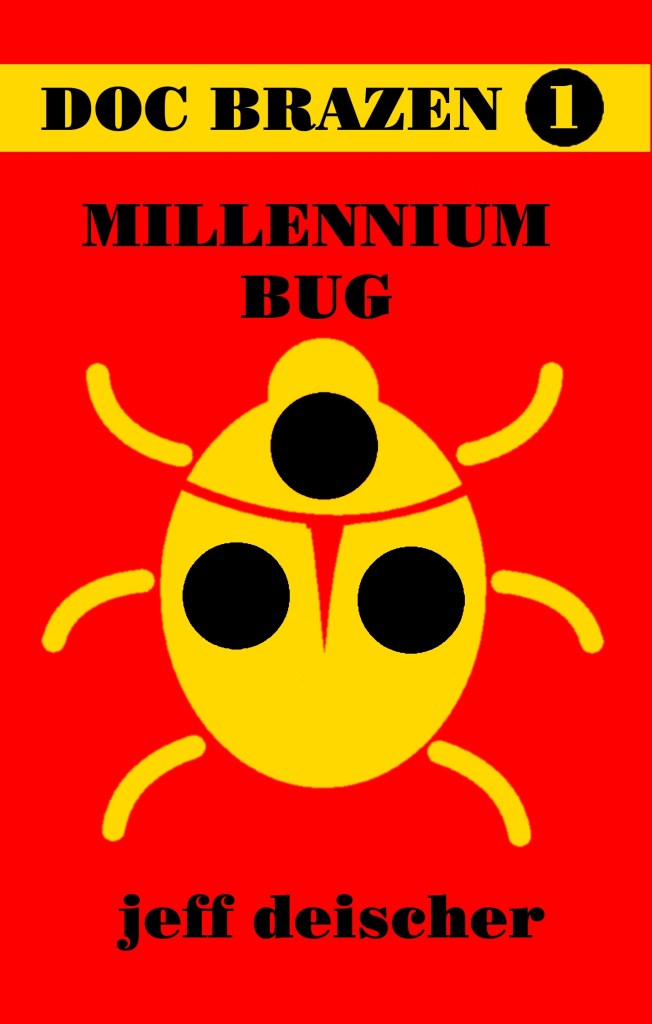
Lastly, I like the H. Swenson “mod” or “pop art” look of Doc Savage’s “science detective” phase, though not particularly for a Doc Savage book, having grown up on the ultra-realistic James Bama covers. So I went for that look designing the cover to Millennium Bug.

Oh, and there really is a reason this is set in 1999, and not 2019, other than the double entendre title.

Millennium Bug, Doc Brazen #1, available from Amazon here.
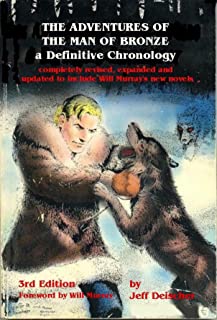
The Adventures of the Man of Bronze: A Definitive Chronology, available from Amazon here.
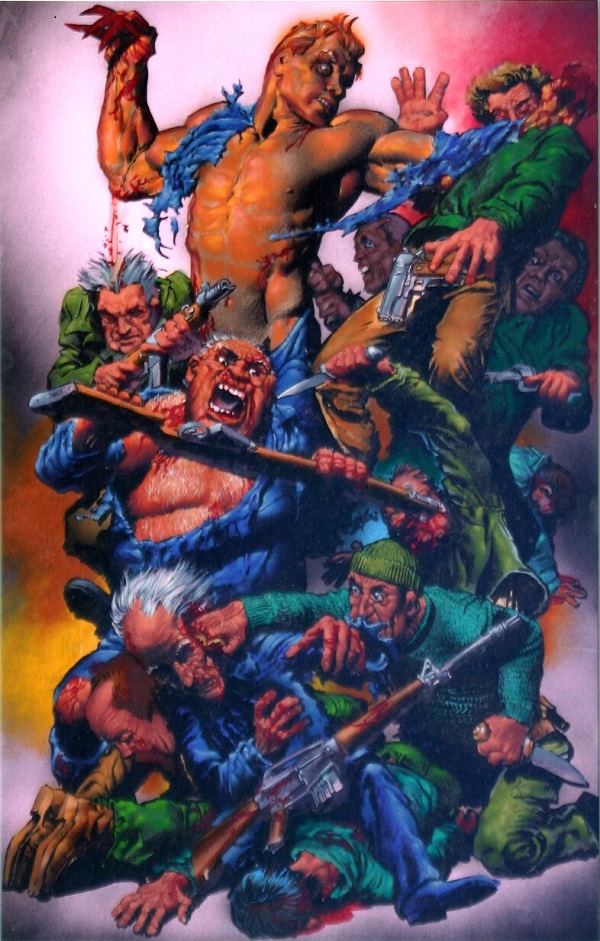
Splintered Mirror: Doc Savage and Doc Caliban – Part 2 of 2

At the end of this article’s first segment, I suggested that the core of what the character Doc Caliban offered was a literary opportunity: to explore, using techniques of adult storytelling, a whole range of compelling human drives…from ethics and morality right down through atavistic behaviors of sexual hunger and need, and their link to human violence. I closed the article with a question:

Using Doc Caliban as a mirror with which to explore those themes, was that opportunity fulfilled?

My feeling, unfortunately, is no. It was not. All of the elements to do so had been put into place, including iconic characters of primal cultural power (pastiches of Doc Savage and Tarzan), and a format — explicit adult storytelling — that opened the door to an extremely visceral experience. That door was opened and left beguilingly ajar at the end of A Feast Unknown, but then, bit by bit, nudged back shut.

Richard Corben’s portrayal of the primal, violent Doc Caliban

Here is where the issue of whether Doc Caliban was merely a parody or a character of depth in his own right becomes germane. As a figure of satire — an honorable man laid low by a form of sexual madness — his purpose for existing was essentially over at the end of Feast. None of the tantalizing depths in the question of how a reasoning — even noble — man could experience such a collapse of his beliefs are broached. Instead a deus ex machina was employed as a means to back away from those compelling themes. The state of insanity was induced by an external force (the Nine’s immortality elixir)…a resolution which makes for an easy escape from the depths of the Pandora’s Box that had been opened.

For a single potent satire — and Feast is unquestionably a powerful story — that adds up to “mission accomplished”. Though for me it left a sense of the unfinished in my mind as a reader…I very much wanted to see Caliban explored with a similar depth to that afforded Grandrith in the story. The themes were so compelling, and an “adult Doc Savage” was a remarkable potential means for looking deeper into that mirror of not only Doc, but ourselves.

And the story did not end with the final scenes of A Feast Unknown, which included this last look at a Caliban physically broken by his brutal final conflict with Grandrith, but intriguingly, on the brink of opening a new chapter as a person. Here is that passage (the I of the narration is Grandrith):

…I tried to walk into Doc’s room, but the pain between my legs discouraged this. I allowed Clio to wheel me in beside his bed. He was lying there with a stiff plastic collar around his neck. Clio had done a professional job in doctoring his broken neck. He was flat on his back and staring up at the ceiling. Tears formed pools with a deep golden-green bottom in his eye sockets, and tears ran down his cheeks. Trish was crying also, but at the same time she was smiling.

“He hasn’t wept since he was a little child,” she said. “Not even when his mother died or his father died, did he weep. He must have an ocean down there, and I thought it would never come. Oh, I’m so happy.”

If he did not stop crying, she would not be so happy. He could be suffering a complete breakdown, or he could be on the road to a healthiness he never had.

I said, “Doctor Caliban, why are you crying?”

He did not answer. I waited a while and then repeated my question. After another long period of silence, he said, in a choked voice, “I am crying for Porky and Jocko and the other wonderful friends I had. I am crying for many people, for Trish especially, because she loves me and I gave her almost nothing back. And I am crying most of all, and I cannot help it, for me.”

This, more than all the rampant sex and violence of the narrative, is the kind of glimpse and beginning insight into a character that embodies adult writing.

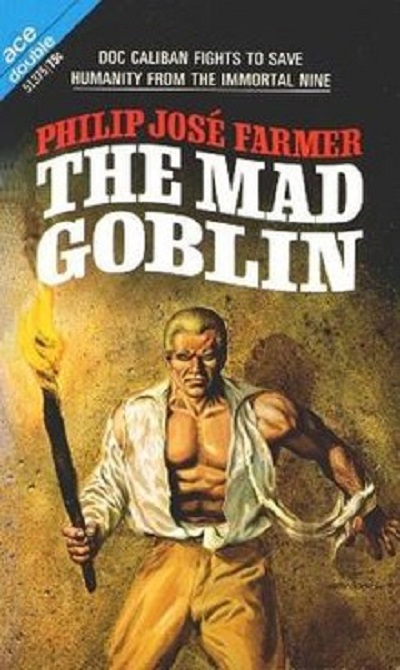
However, it was to remain only a glimpse. The book that followed did not even attempt such an ambitious alchemy of intense pulp storytelling wedded to powerful human drives and psychology. The double book The Mad Goblin/Lord of the Trees was an often clever and complex adventure thriller, but no more.

In his half of the book, the character of Doc Caliban had the potential opportunity to lay bare his own depths in the aftermath of the “insanity” that had turned him into a cruel, even an arguably evil man. But this is distinctly avoided. Farmer even employs the extraordinary device of an author’s note before the storyline of The Mad Goblin commences:

A Note from Philip José Farmer:

Although the editors of Ace Books insist on publishing this book as a novel under my by-line, it is really the work of James Caliban, M.D. Doc Caliban wrote this story in the third person singular, even though it is autobiographical. He feels that this approach enables him to be more objective. My opinion is that the use of the first person singular would make him feel very uncomfortable. Doc Caliban does not like to get personal, at least, he doesn’t like to do so with most people. Even the largest mountain throws a shadow.

Quite the disclaimer, and the narrative of the story remains true to it. Caliban, for all intents and purposes, is a non-character in his own book, going through a great deal of action, but little more.

Farmer’s further plans for the character were equally vague. In the 1980’s he teased the premise for the book The Monster on Hold, essentially a continuation of the final Doc Savage pulp novel Up From Earth’s Center, done as something of a Lovecraftian mashup. The sample chapter he published appeared to have little of the tone from even The Mad Goblin/Lord of the Trees, and none at all of the series fountainhead, A Feast Unknown. (As noted in Part 1 of this article, the story has since been completed by Win Scott Eckert, and will appear later this year — which will be a review for another time.)

But I have little expectation that any core theme of Doc Caliban’s depths as a character will be attempted. At least I will certainly be surprised if the story assays to go there.

So as an adult mirror through which we, as readers, could look at some very intense, and certainly fascinating human issues, Caliban appears destined to be unfulfilled…the mirror of his deeper self splintered into fragments of genre play and wandering literary direction.

Splintered Mirror: Doc Savage and Doc Caliban – Part 1 of 2

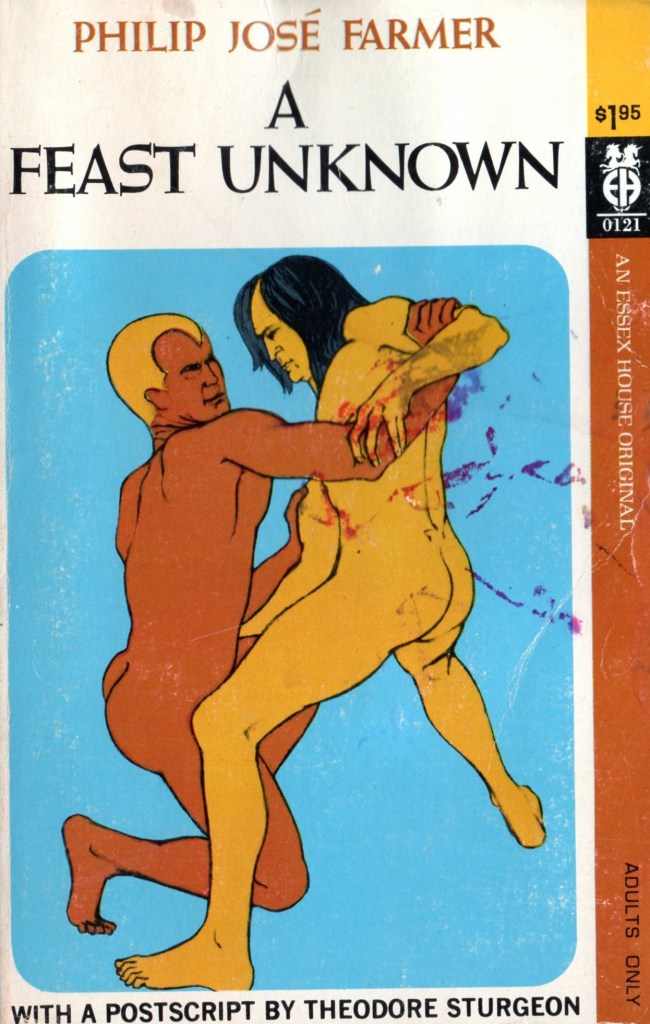
Much has certainly been written about the literary and publishing decisions that resulted in the creation of Philip José Farmer’s character Doc Caliban. The character, who first appeared in 1969’s A Feast Unknown, has certainly endured. For a character that for all intents and purposes has appeared in two books (if you consider the double book Mad Goblin/Lord of the Trees, which have a mirror-narrative, to actually be a single story from two points of view) in over fifty years, Caliban retains reader interest to this day, with a new story (The Monster on Hold, written by Win Scott Eckert from Farmer’s notes and fragments), due to appear this year.

When the topic of Doc Savage pastiches is discussed, there are a great many of them, but unquestionably first on most lists would be Caliban. But is he just a pastiche/parody, or a unique character in his own right?

Arguments could be made either way. Caliban would certainly not exist without Doc Savage, and his physical characteristics are identical to the pulp Man of Bronze. But his character is elusive.

Doc by Iason Ragnar Bellerophon

The novel A Feast Unknown is written as a first person memoir of Lord Grandrith, Farmer’s Tarzan pastiche. Thus Caliban is seen only through Grandrith’s eyes. In their first encounter, Caliban throws a grenade at Grandrith simply for the purposes of testing his speed and strength (the grenade, unknown to Grandrith, is a dummy). Not too strange in a violent action story, but Caliban’s manner as he does so is wildly out of character if he is representing Doc Savage. It is mocking, sarcastic, and punctuated by dismissive laughter. Afterward, this is Grandrith’s description of his impression of the man:

Usually, I don’t think in the human categories of good and evil. Those who would kill me are enemies. Just that and nothing more. I kill them without having to justify the deed by classifying them as evil.
But seeing this very handsome man, I experienced a feeling of genuine evil, of the anti-good. The hairs rose on the back of my neck as if a demon of the native African religion had pulled them up with his cold hands of wind.

It was a feeling I did not like.
My own experience, reading that for the first time, was that I didn’t like it either. But as I continued to read, that antipathy toward the Caliban character transformed into a distinct fascination. The extremes of the story are explained as the narrative progresses…both men having been driven into a unique violent/erotic psychosis by a life-extending elixir they use. And Caliban is further driven out on a behavioral edge through his belief that Grandrith has murdered his lover, Trish Wilde. However, Grandrith, throughout the story’s narration, has not become a completely dark version of himself. His thoughts are often reasoned and measured…as one would expect a mirror of Doc Savage’s to be.
The “evil doc” paradigm is shown relentlessly throughout the story (until the end, when it begins to soften). Caliban has his reasons and they are compelling ones, but he is nonetheless relentlessly cruel. Why? The psychology of his warped behavior is not adequately explained, given that Grandrith, under the same conditions, has not turned “evil”.

The novel is explicit in its depictions of sex and violence — the explicit erotic content being a requirement of its publisher, Essex House — and that opens the door for Farmer to drop psychological clues. Grandrith could by no measure be considered a repressed personality. He is what he is and doesn’t question his natural behaviors, even when they are outwardly destructive. His primitive childhood in the company of apes has pretty much erased any capacity for self-judgment.

Caliban, on the other hand, is an extrapolation of the qualities of Doc Savage, whose upbringing was distinctly repressed. Raised and trained exclusively by male tutors, with no mother present and an authoritarian father, the early Doc Savage had learned to hide virtually all of his emotional responses. Caliban is described the same way, and the reticence and repression is heightened by some extreme details concerning intimacy in his life.

Physically he is a paragon, except for his genitals, which are disproportionately (even for a very large man) huge. For a shy man, one who has crafted every other aspect of his physicality into a state near to symmetrical perfection, and who was also painfully shy around women, this must have produced extreme feelings of physical shame, awkwardness, and even self-loathing. In addition, a youthful experience is described in which he encountered a brutal gang moll, Big-Eyes Llewellyn — he is captured, rendered helpless, and sexually humiliated by the woman. He ultimately kills her in a fit of visceral, uncontrolled violence.

India Summer and Nick Jacobs in an independent-film recreation of A Feast Unknown’s Big-Eyes Llewellyn and Doc Caliban

This act sends Caliban into a personal crisis, prompting him to withdraw from the world, and re-emerge with an even greater dedication and ferocity to his “fight against evil”.

Presumably, this includes the “evil” he feels is inside of himself — of a man capable of such shocking violence.

This (and other incidents and details mentioned in the course of Farmer’s narrative) could predispose him to surrender to what he might perceive as his “evil self” in the aftermath of the supposed murder of his cousin and lover Trish, with whom he had achieved a somewhat uneasy but nonetheless loving and passionate intimate relationship.

This is where the explicit nature of the novel opens up unique psychological territory for an “action hero”, much more so than what would be present in a shallow, sexualized parody. Most of us can understand the feeling of being driven a bit crazy by the drives of desire and sexual hunger in our lives. Not to the extent of a Doc Caliban of course, but that is a subtle point within the presentation of an X-rated Doc: writ large in parallel to the extremes of experience with heroic adventure narratives, the topic of drives buried within human sexuality can be explored in unique depth.

And this is where Doc Caliban can show us aspects of the human condition unique from those of the more adolescently-portayed pulp Doc Savage. A remarkable literary opportunity…but was it fulfilled?

To be continued…

Magnificent Anger: Princess Monja in the Doc Savage comics – Part 4 of 4

In the first three parts of this look at the character of Princess Monja in her comics incarnations, we saw her as beautiful, courageous and dutiful in Rare Orchid (her Marvel Comics appearance)…strong and doomed in Courage and Tragedy (her DC comics story)…and modernized but cold in Paris and Pistols (in her Dynamite Entertainment persona).

But perhaps her most intense comics incarnation of all came in the Millennium Comics revival of Doc Savage in the 1990’s, in a story called The Monarch of Armageddon.

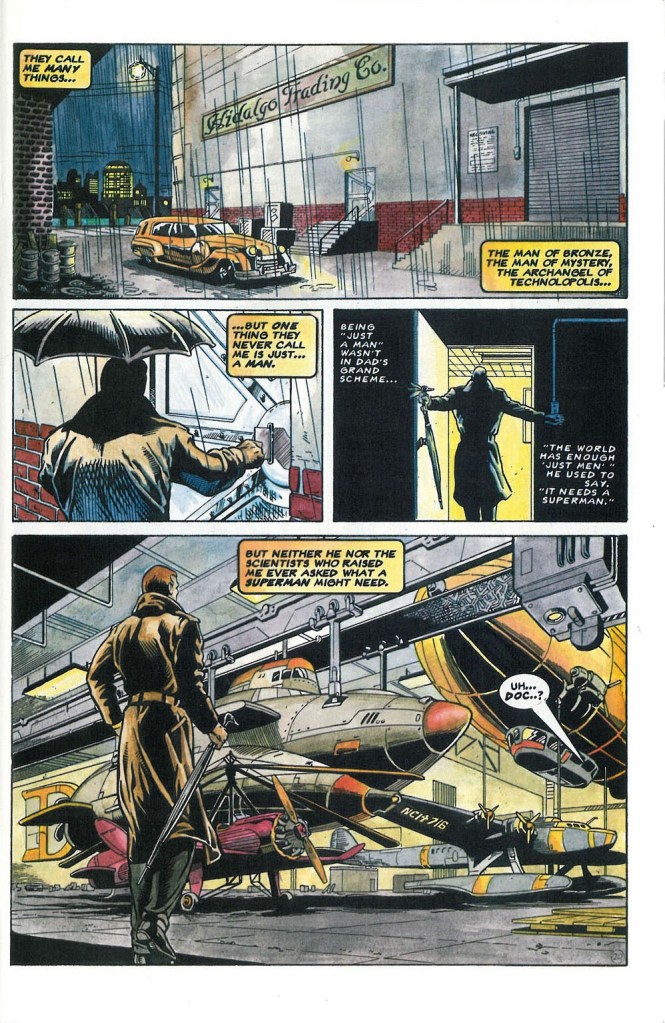
That story, written by Mark Ellis and drawn by Darryl Banks, worked to create a balance between an appreciation of the long pulp history of Doc Savage and a more in-depth exploration of the Savage mythos. The story had very ambitious scope, incorporating a host of key elements from Doc Savage canon in a new story that was intellectually complex and emotionally engaging.

One of those elements was Monja, who was depicted in a way completely consistent with her pulp history, and yet in a light never seen before.

While preparing this article, I reached out to Mark Ellis himself, to ask if he might share his thoughts on the Millennium presentation of Monja. He graciously agreed to do so, and so is here to share those thoughts. Here is Mark, describing his creative process in characterizing Monja.

When I sat down to craft the “Monarch of Armageddon” storyline for Millennium Publications, I determined to go in different directions than either DC or Marvel had with Doc Savage and his milieu.

I didn’t want to do a straightforward story along the lines of Marvel’s black-and-white magazines, nor did I feel comfortable creating elements out of whole cloth as DC had done.

I went back to the original stories and found plenty of potential ideas that had never been explored.

The first was my characterization of Doc himself, focusing more on his repressed emotional nature, very much on display in the first year’s worth of pulp novels and touched upon in later stories, such as “The Devil Genghis”.

That led me to think about the character of Princess Monja, a beautiful  noblewoman who acted as Doc’s de facto lady-in-waiting in the Valley of the Vanished.

After a few years, particularly following the events of “The Golden Peril”, it struck me that she would get tired of that thankless role and quite possibly become embittered…she’s stuck there in the hind-end of nowhere while Doc is running around the world using Mayan gold to finance his life-style. I postulated that she spent a lot of time fuming.

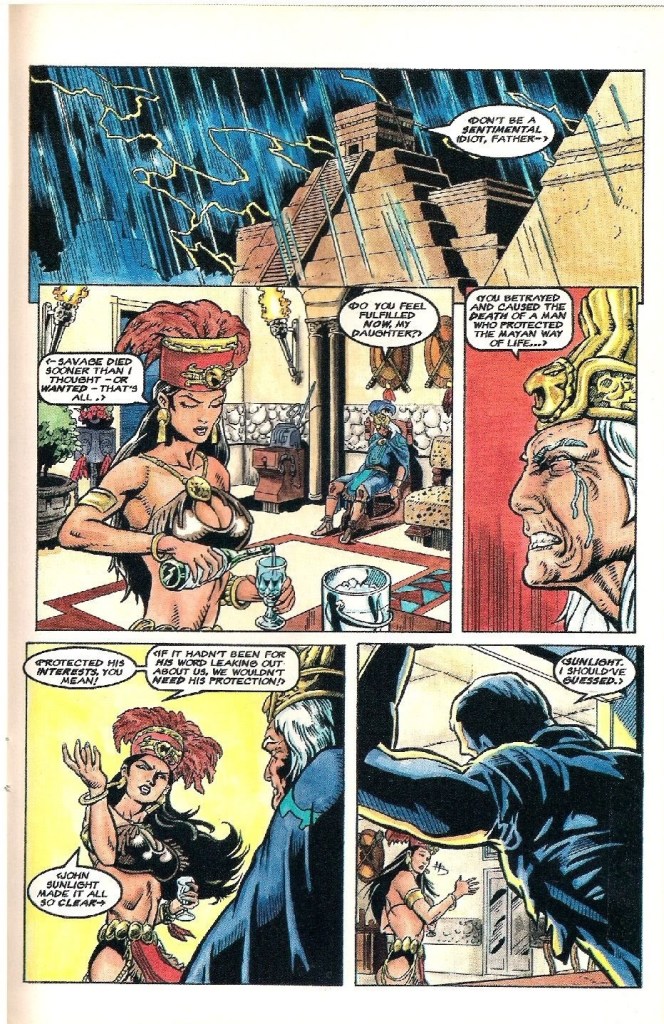
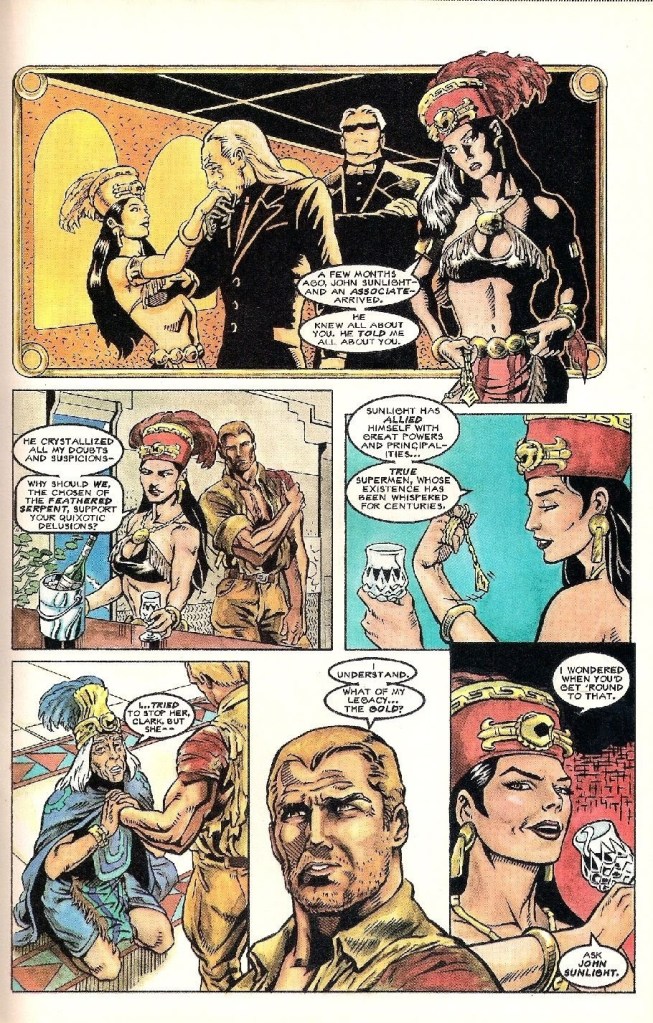
When John Sunlight found his way into the Valley and used his smarm, snake-oil and hypnotic abilities to charm her, Monja was already primed to be turned against Doc.

Mark’s addition of psychological realism to Monja’s character led to some very memorable scenes. They begin with Doc needing to step away from the constant struggle and near-death stresses of the lifestyle he has been living. Significantly, he chooses to sojourn for a bit in the Valley of the Vanished. His aides, knowing his awkwardness around social situations but astutely perceiving that his main motivation in going was to see Monja, see him off.

Doc proceeds to the Valley, but does not receive the reception he had expected.

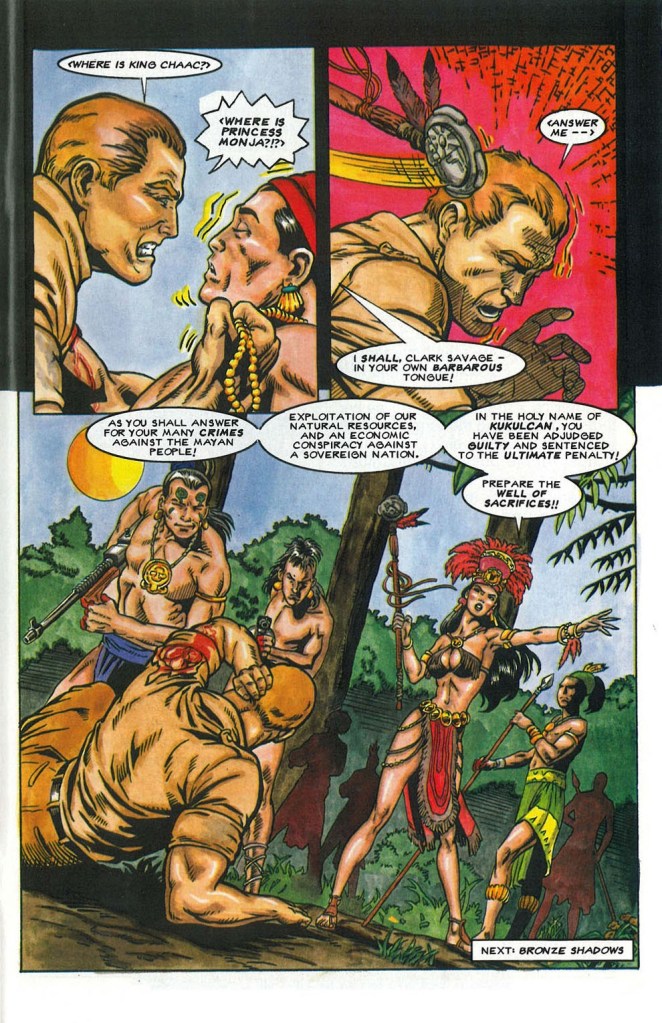
He is promptly attacked, and after getting the upper hand against the Mayans who have ambushed him…it is revealed that the person orchestrating that assault is actually Monja. It is a memorable last panel to the first issue of the four issue series, with a breathtaking (and intensely angry) Monja standing over a fallen Doc.

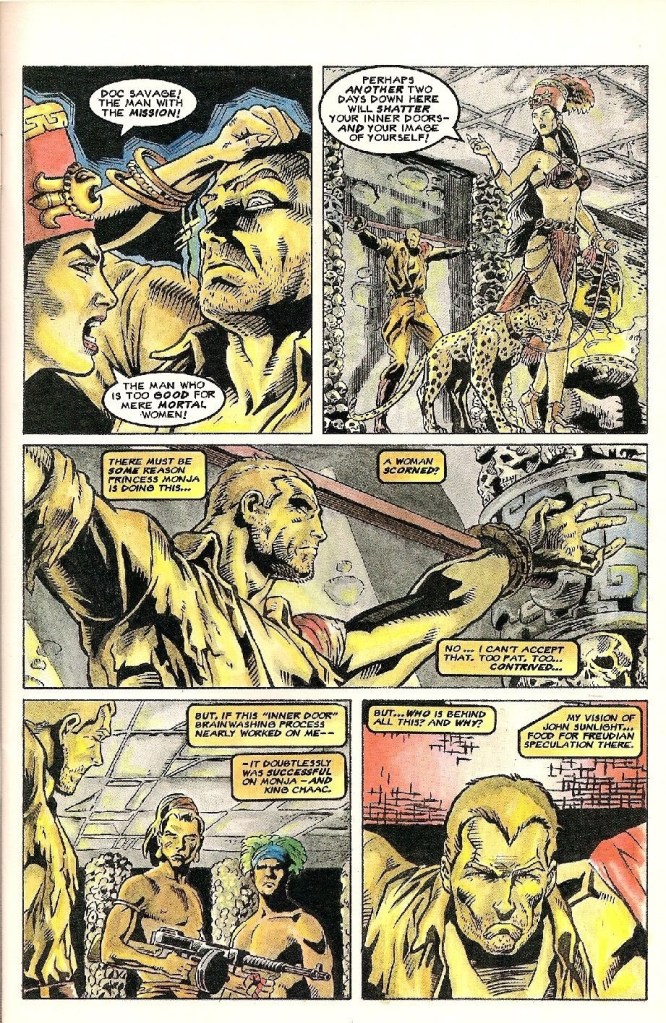
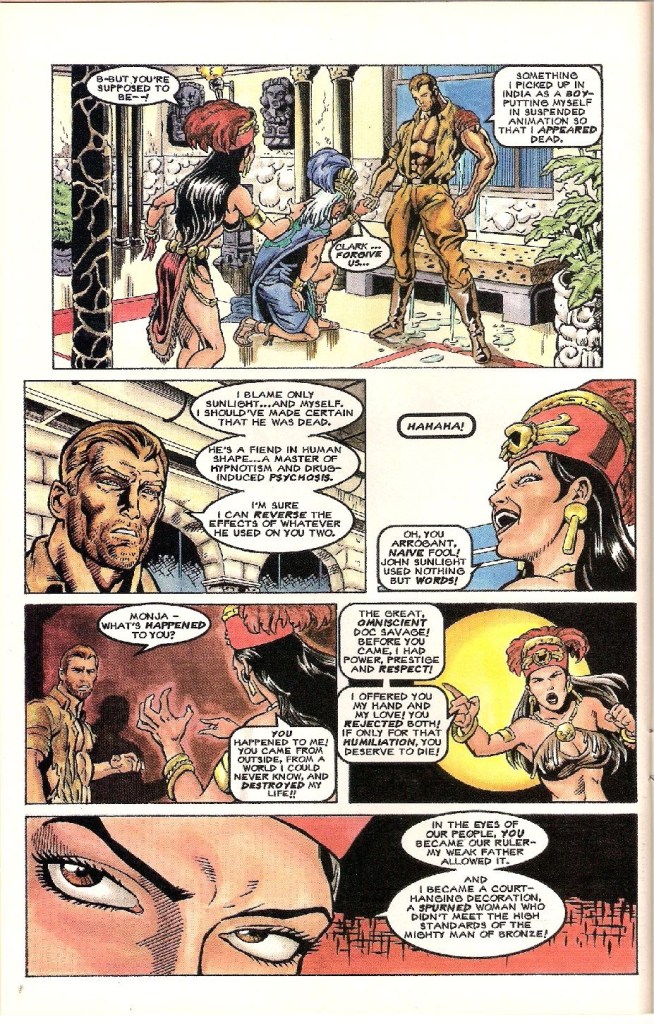
Doc is imprisoned and fed hallucinogenics, which expose many of his fears and traumas. He comes back to consciousness to discover Monja is bitter and vengeful. Their confrontation is emotionally wrenching.

Shortly afterward, Doc appears to die from the mental and physical torture he has undergone. And Monja, though outwardly hard and dismissive, is visibly, deeply upset as she departs.

A little later, we see Monja and her father, Chaac. She has restored her hard demeanor, but is shaken for a moment upon discovering Doc is still alive…then her anger clamps down again. Doc, learning that John Sunlight had preceded him to the Valley of the Vanished, believes Monja has been hypnotized. Author Mark Ellis, to his credit, does not take this easy narrative route, and instead deepens the psychological complexity of her rage.

They part, and Doc displays some rage of his own, but to the reader who has been paying attention, his own anger is not just at John Sunlight, but fueled by his own errors in his inability to deal with a strong and complex woman that he cares for.

The story continues, shifting away from the Valley of the Vanished, and it is a complex, well-crafted tale, with really superb portrayals of Doc’s canonical circle, including the five aides and Pat.

At the end though, it is clear where Doc’s thoughts are. He realizes his own behavior has been unfair and even dismissive toward Monja, and (good hearted guy that he really is), determines to set it right.

Here again, is Mark Ellis:


At the end of the “Monarch” storyline, I suggested that Doc would be returning to Hidalgo to try and make peace with Monja. Whether he did or not is an open question. My guess is…he did.

I wish that we had seen that story, that conversation and perhaps reconciliation between an inherently noble (but flawed and intimately awkward) man, and a truly magnificent woman.

My heartfelt thanks to Mark Ellis for joining me in the Forbidden Pulp blog! Mark’s career as an author continues to this day…please explore his many creations!

Read about Mark Ellis

Golden Age Doc Savage Comics – Part 3

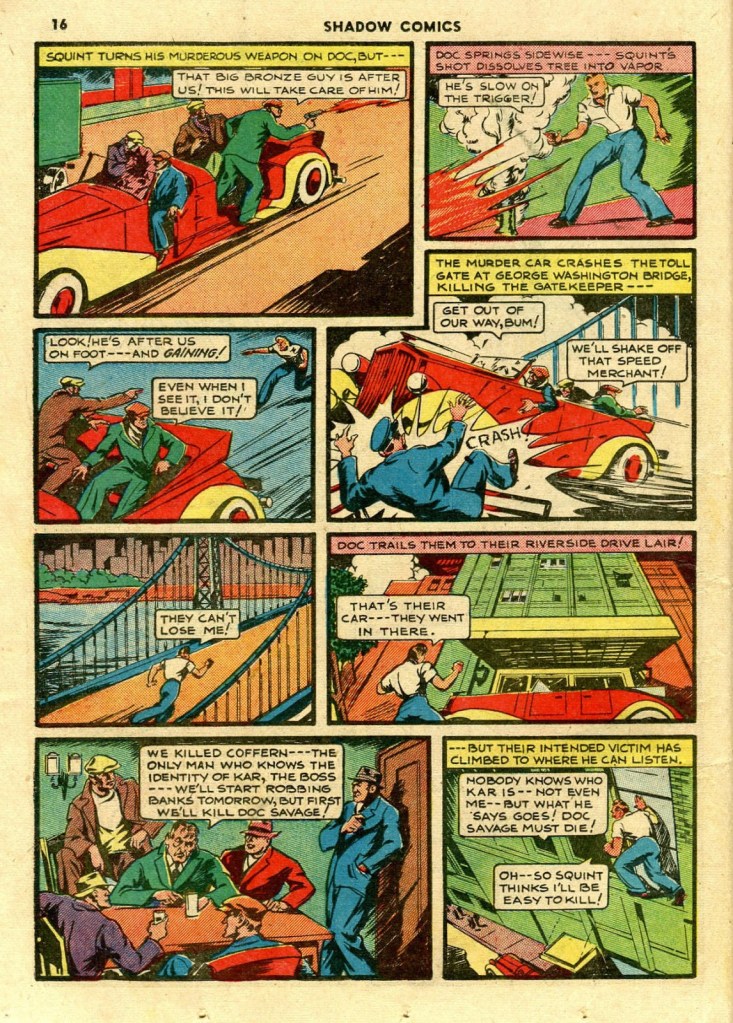
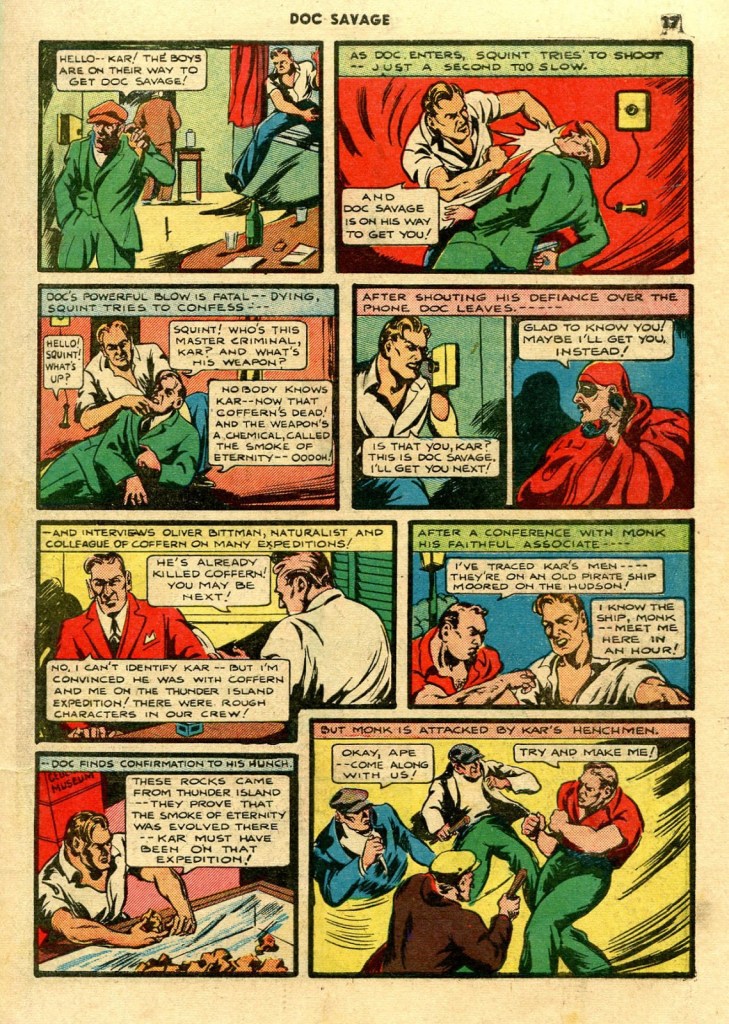
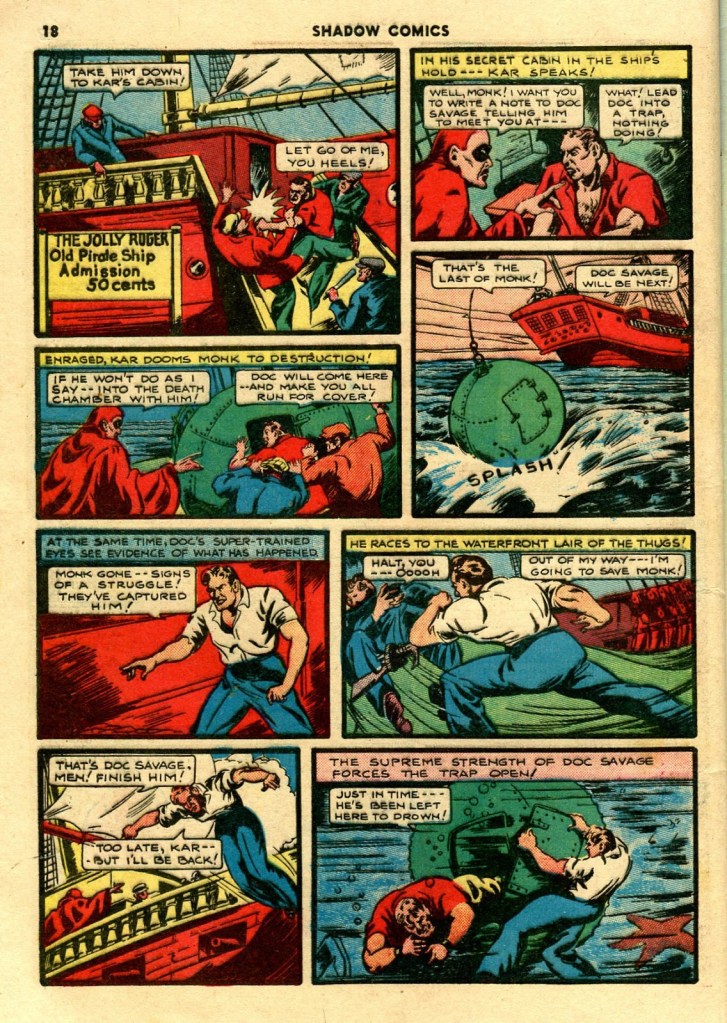
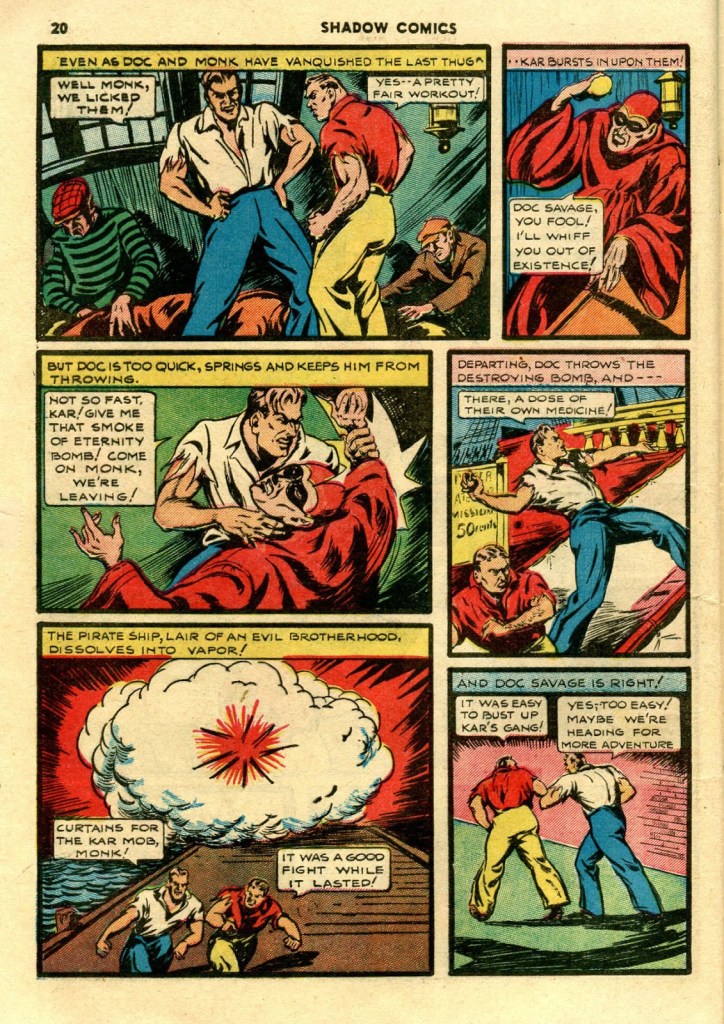
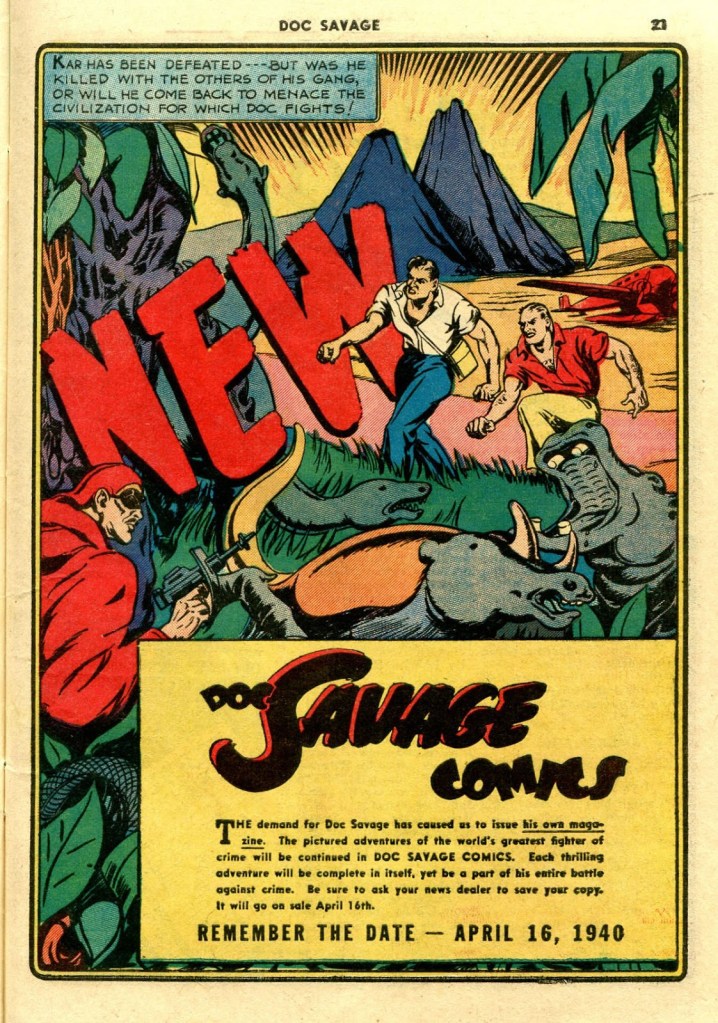
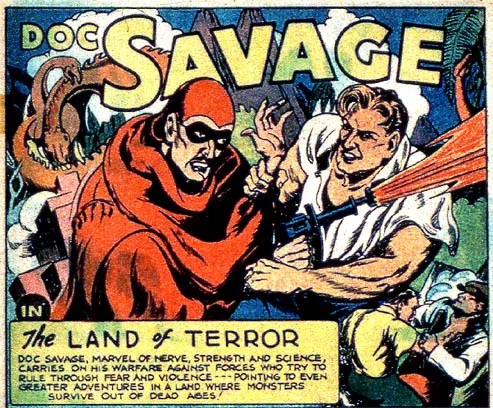
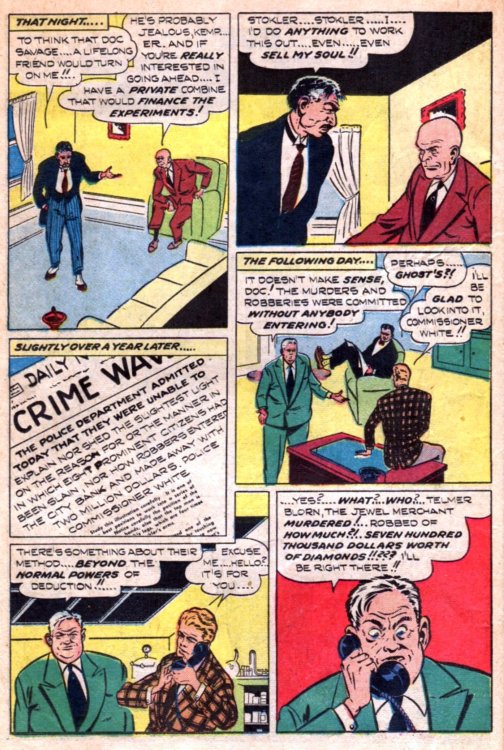
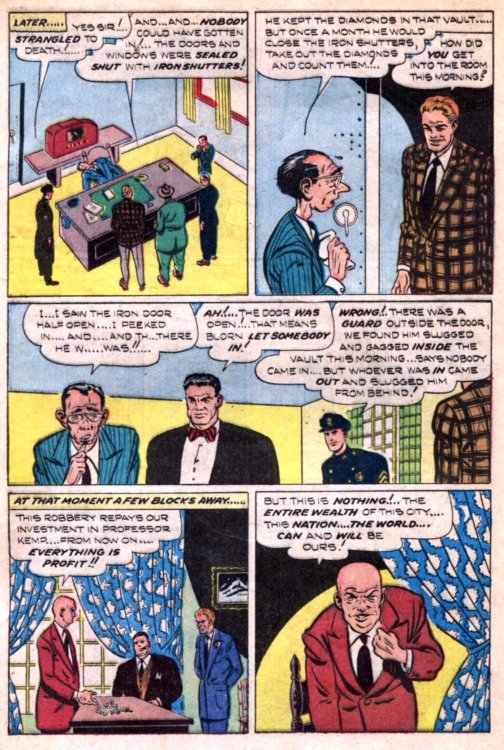
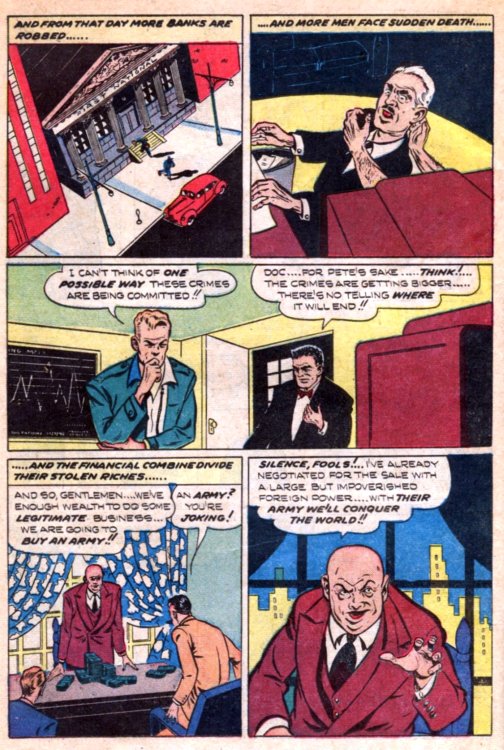
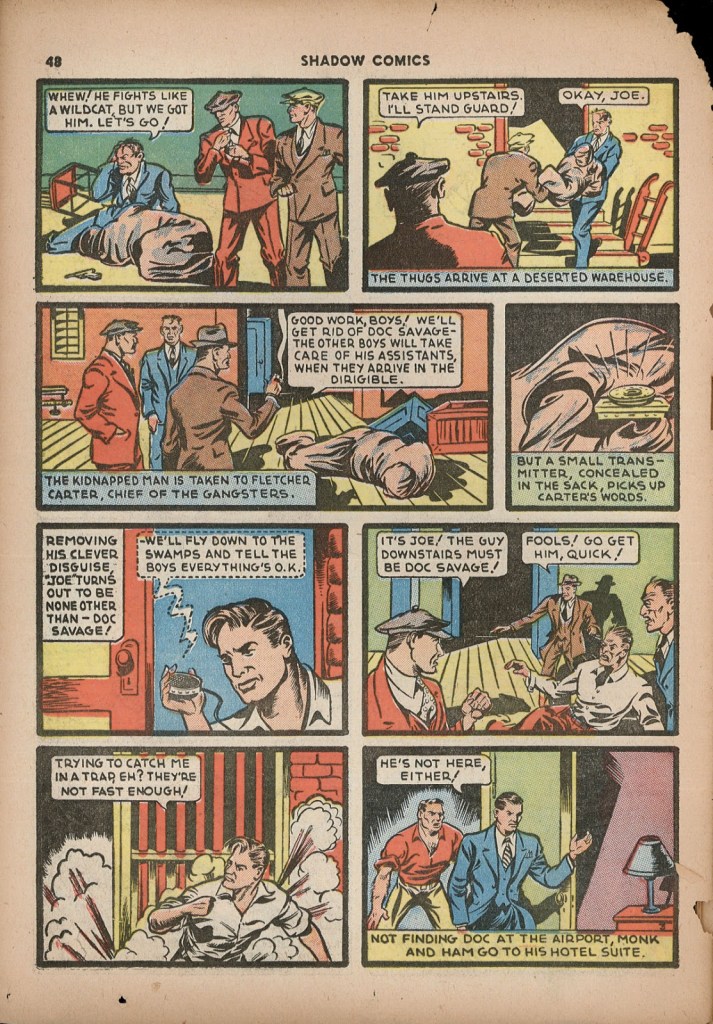
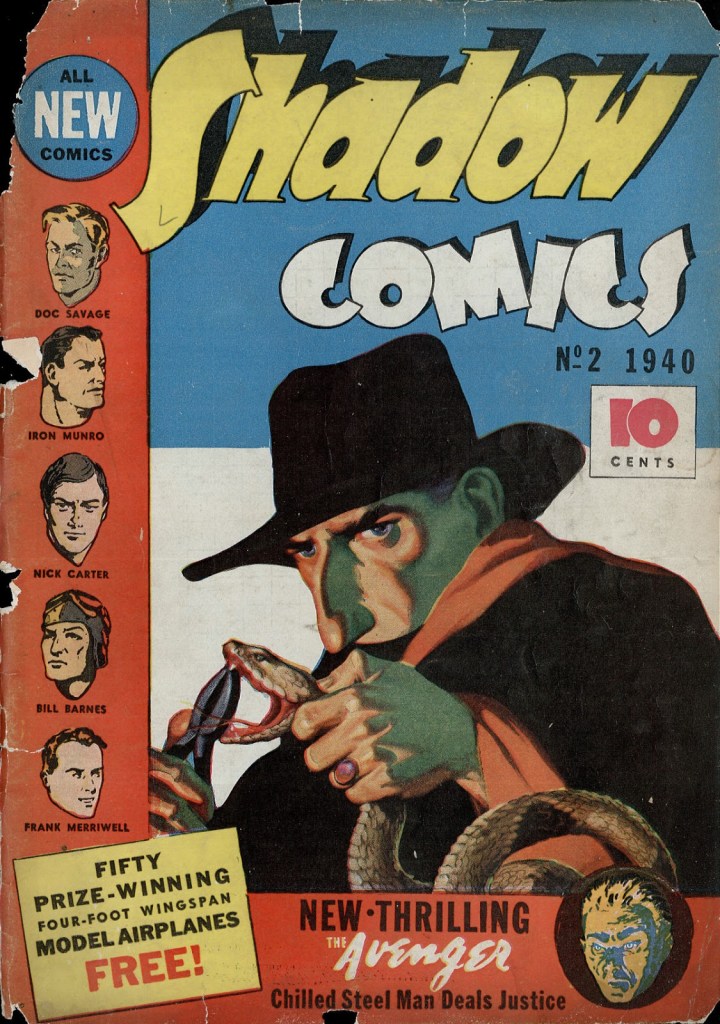
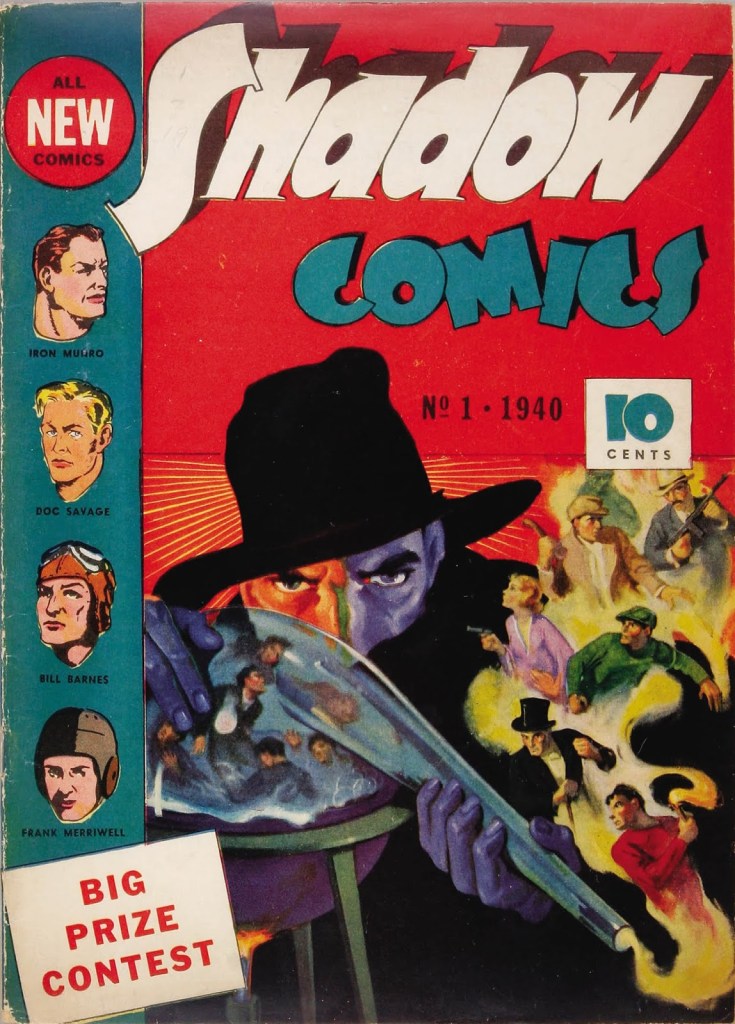
The first two appearances of Doc Savage in the comics — as a backup feature in Street & Smith’s Shadow Comics in 1940 — were short in page count and questionable in quality, but they were only the beginning. By the time Shadow Comics #3 appeared, Street & Smith was moving forward to spin Doc out into his own title. A house ad appeared in Shadow Comics #2 announcing that the first issue of the new Doc Savage Comics would feature an adaptation of The Land of Terror.

That adaptation would actually begin in Shadow Comics. Issue #3 featured a six-page beginning for the story, which would then be continued in Doc’s own title. Here are those six pages:

Following the story was a new house ad for the upcoming Doc Savage Comics.

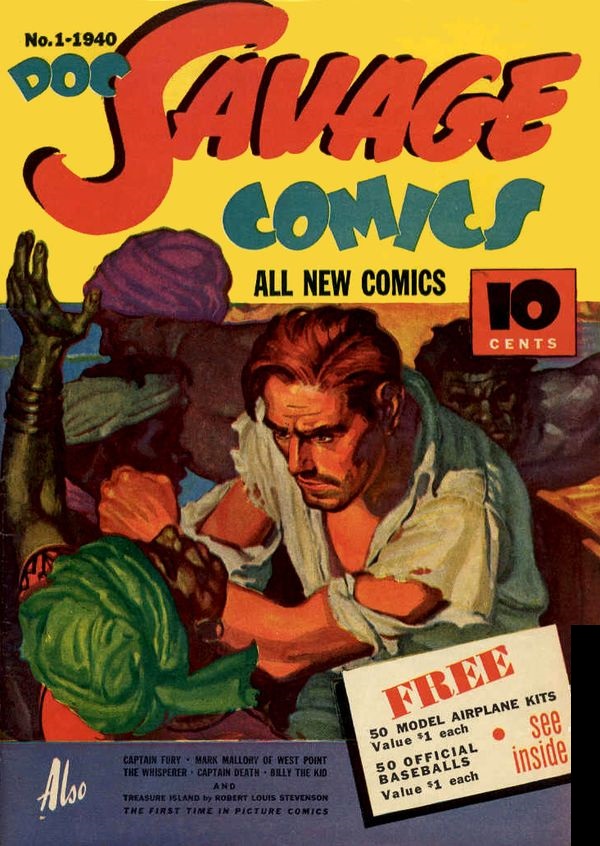
And Doc Savage Comics did indeed debut in 1940, using the same formula as the successful Shadow Comics of reprinting a pulp cover painting on the cover (interestingly, not the cover for the Land of Terror story).

Art by Harry Kiefer

The lineup of stories for the first issues of Doc Savage Comics was “The Land of Terror” (No. 1-2), “The Polar Treasure” (No. 3), “Terror in the Navy” (No. 4). After that the pulp adaptations were abandoned, and Doc’s character was radically changed to make him into a “superhero” (he began to wear a hood and use a “mystic ruby”…none of which bore any resemblance to the pulp Doc).

Art by Jack Binder

Only Monk and Ham appeared in these stories, never the other three aides. And they were quite unrecognizable to the pulp fan (Monk bald!)

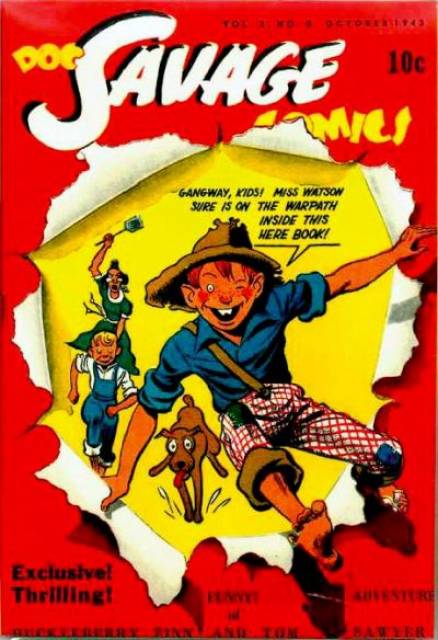
By the last issue, #20, things had gone pretty far downhill. Doc had disappeared from the cover of his own magazine, supplanted by of all things, Huckleberry Finn (the Doc story was relegated to the end of the book).

The series was cancelled…a rather ignominious end. However, Doc returned to being a backup feature in Shadow Comics (which would have a long run, right to the end of the pulp era, in 1949).

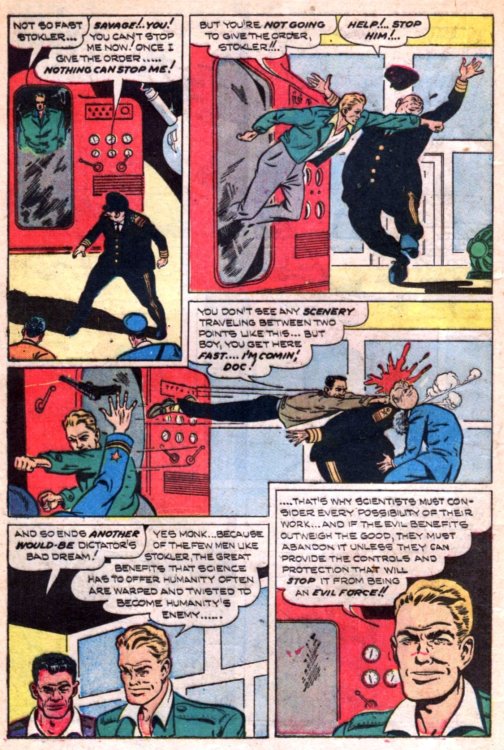
Here’s an example of the late 40’s comics Doc (hood and mystic ruby gone). This story appeared in Shadow Comics #91, 1948. Art and story were from the Bob Powell studio.

The Doc of these final Golden Age stories was more of the “science detective” he became in the pulps of that era.

Doc’s last Golden Age comics appearance came in the final issue of Shadow Comics (#101, 1949), and in a final bit of weirdness, the motifs of the story go back to the very beginning…jungles, Mayan-style pyramids, and Doc in jodhpurs.

All in all, Doc Savage’s journey through the Golden Age of comics was strange indeed. The stories, from pulp-novel adaptations, to a superhero digression, to the scaled-back adventure themes of the later 1940’s, make for a wild ride indeed.

Golden Age Doc Savage Comics – Part 2

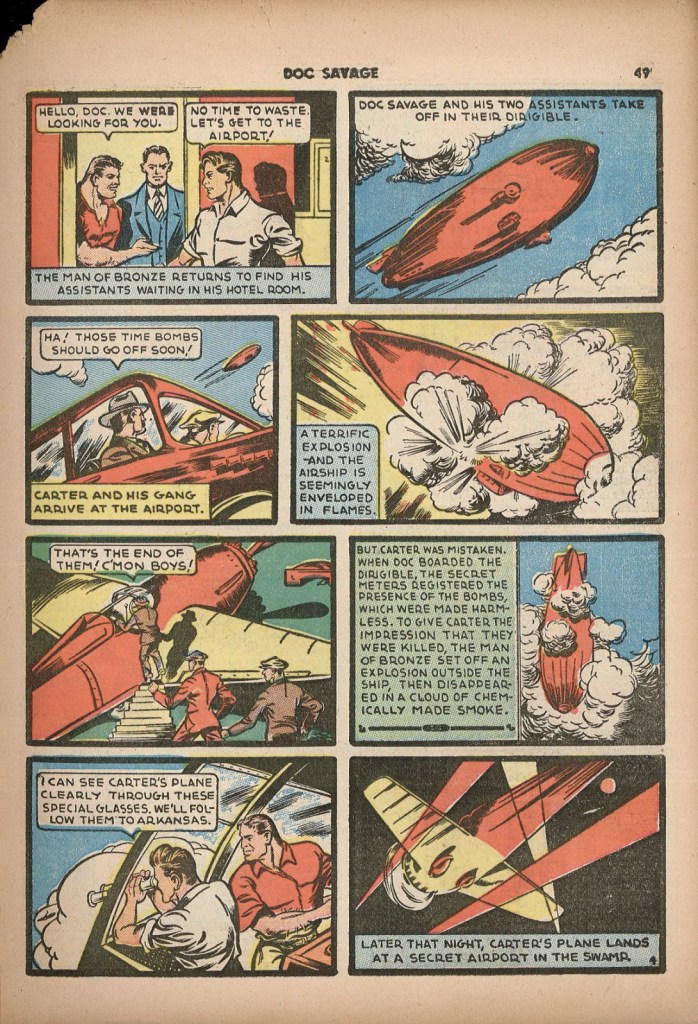
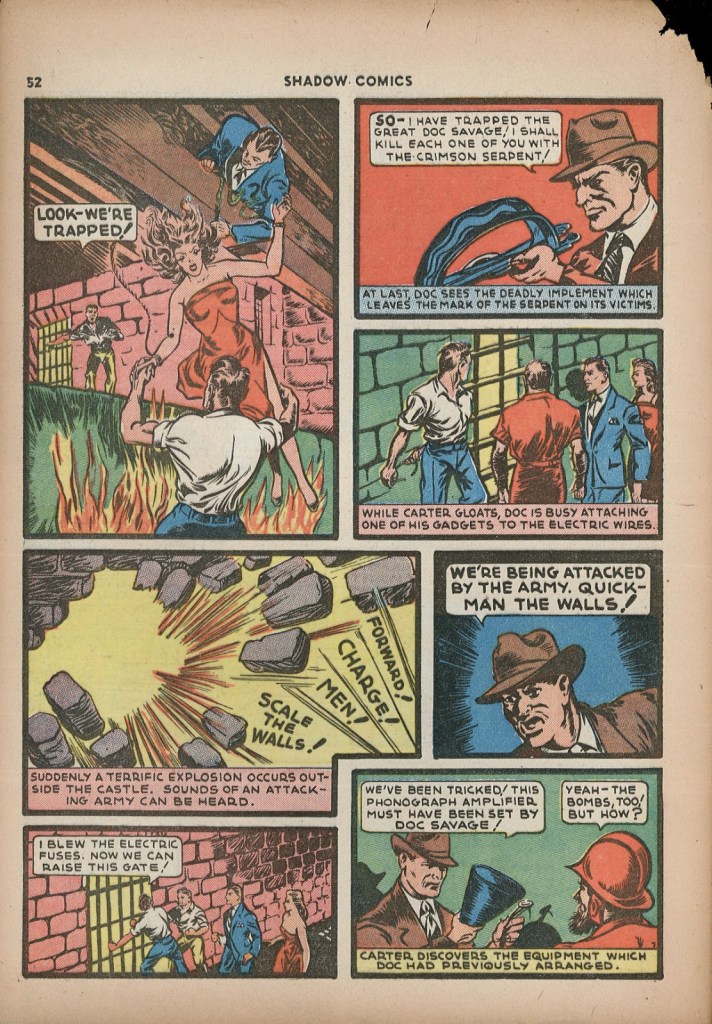
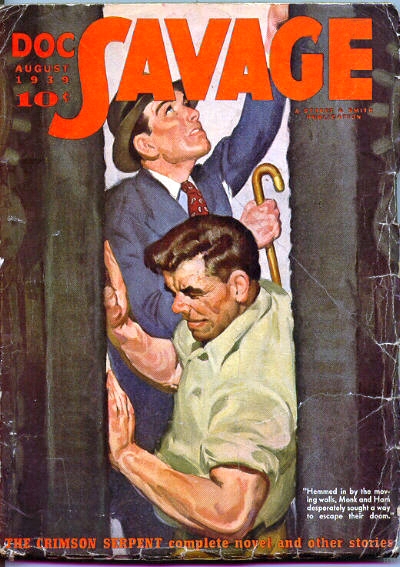
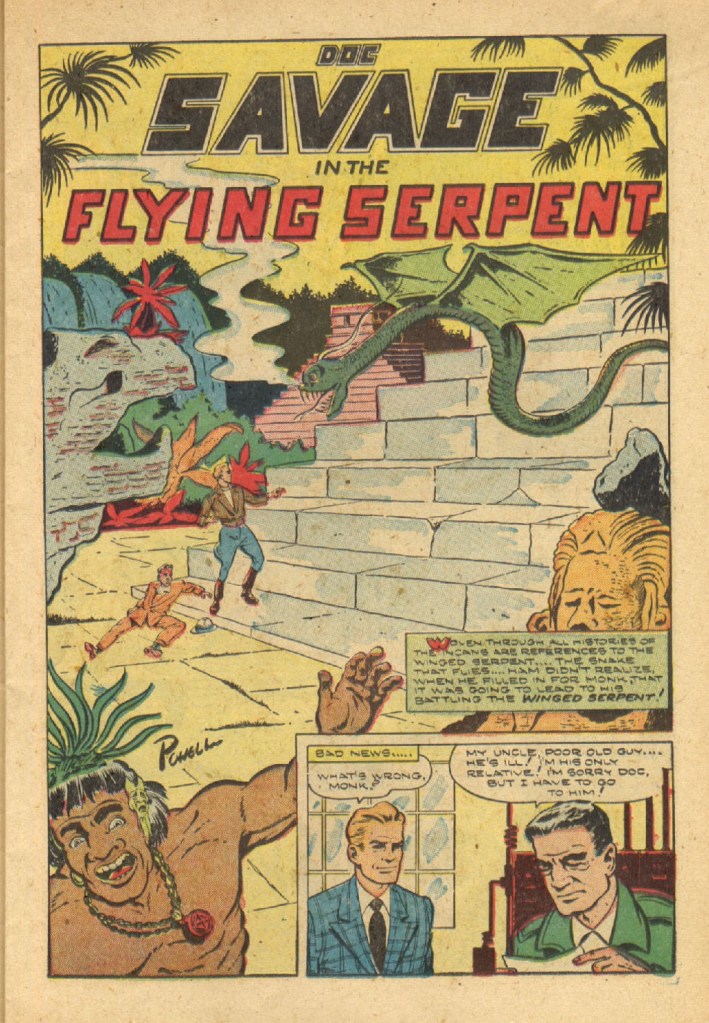
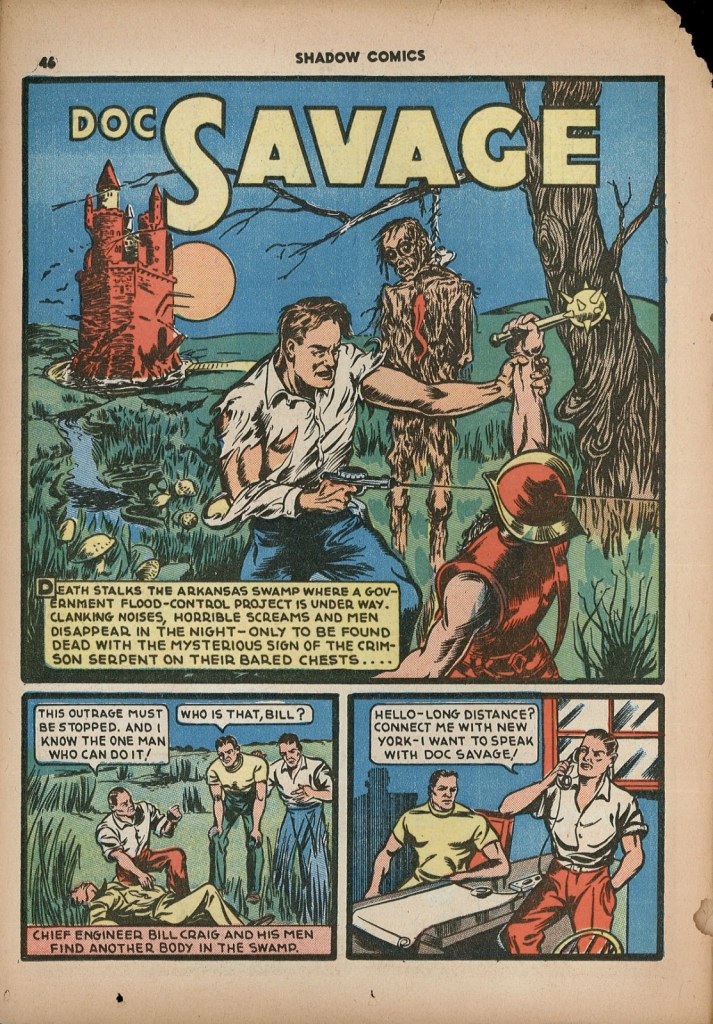
The first Doc Savage comic story, presented in Shadow Comics #1, had a very thrown-together feel to it, but by the second issue (also published in 1940), the storytelling had become more ambitious. The artwork, though still primitive, had more detail, and the story was actually an adaptation of what was then a recent novel from the Doc Savage pulp, The Crimson Serpent, from August 1939.

The Crimson Serpent was a Harold Davis-written Doc Savage — Davis had a tendency toward bloody action with elements of horror, which may have appealed to the Street & Smith comics division, as horror-style comics were extremely popular (this was well before the “Seduction of the Innocent” clampdown on comics that led to the establishment of the Comics Code).

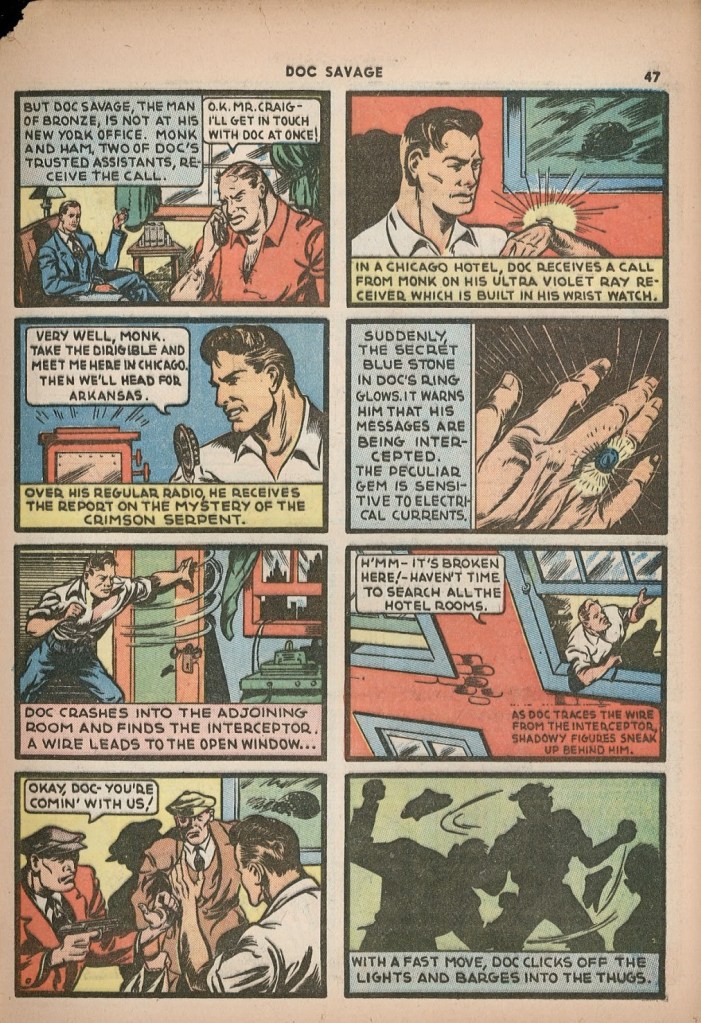
The cast was expanded to include more than Doc and Monk — Ham is also present in this comics adventure. Also classic elements from the Doc Savage pulp, like the New York headquarters and a dirigible flight, gave the story more of pulp-Doc feel. Though Doc is portrayed on the title panel as shooting a villain through the head, which was more Shadow-like than the more humanitarian Doc of the 1939 pulp magazine. Here is the story in its entirety:

For an eight-page adaptation of a full-length novel, it necessarily skimmed quickly through Davis’ plot, but it actually displayed some skill and care with the pacing and action, and was a distinct improvement over the first Doc comic.

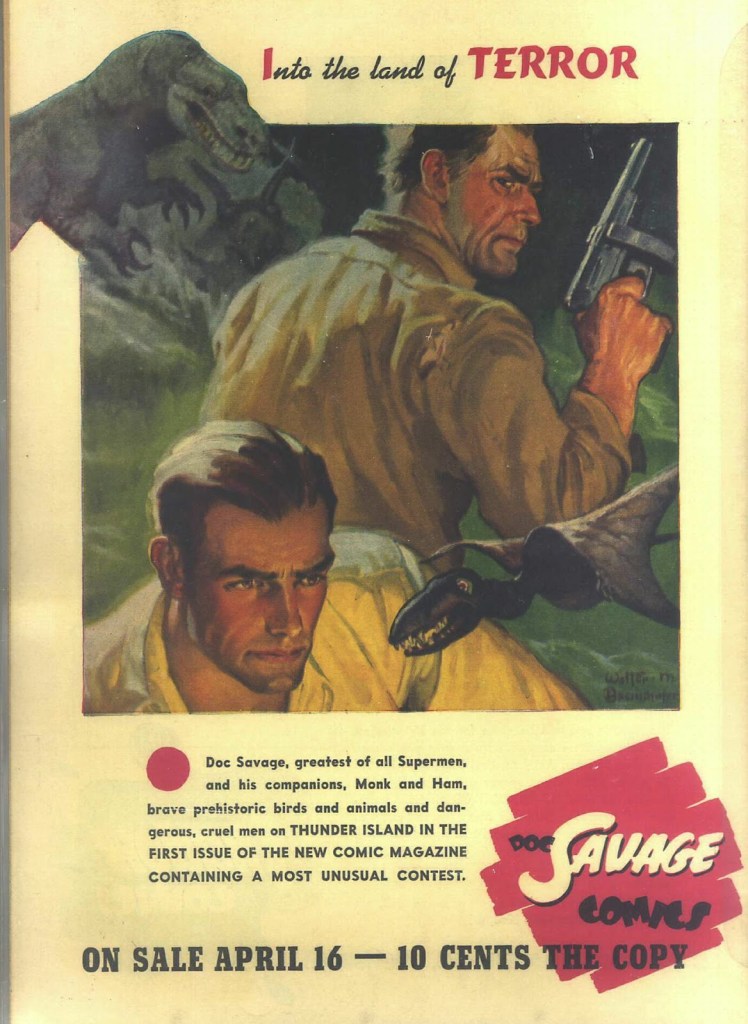
Street & Smith must have been encouraged by the response to Doc’s presence in Shadow Comics, as later in the issue this ad for Doc to spin off into his own comics title appeared:

The ad copy touts the presence of Monk and Ham as well, despite the Baumhofer cover of the original Land of Terror novel featuring Renny.

Here is the original cover of the Shadow Comics #2 (Doc has moved up on the marquee to the top of the column, supplanting Iron Munro) , as well as the cover of the original Crimson Serpent pulp. Interesting that Monk’s hair color on the pulp cover is also incorrect, brown instead of “rusty shingle nails” red.

Golden Age Doc Savage comics – Part 1

With the various Doc Savage comics incarnations since the revival of Doc by Gold Key to tie in with a proposed film in the ’60’s, it’s easy to forget that the Doc from the Golden Age of comics was not limited to the bizarre mystical Doc with the red ruby gem. There were also many comics stories based on the pulp Doc, that actually ran concurrently with the pulp magazine.

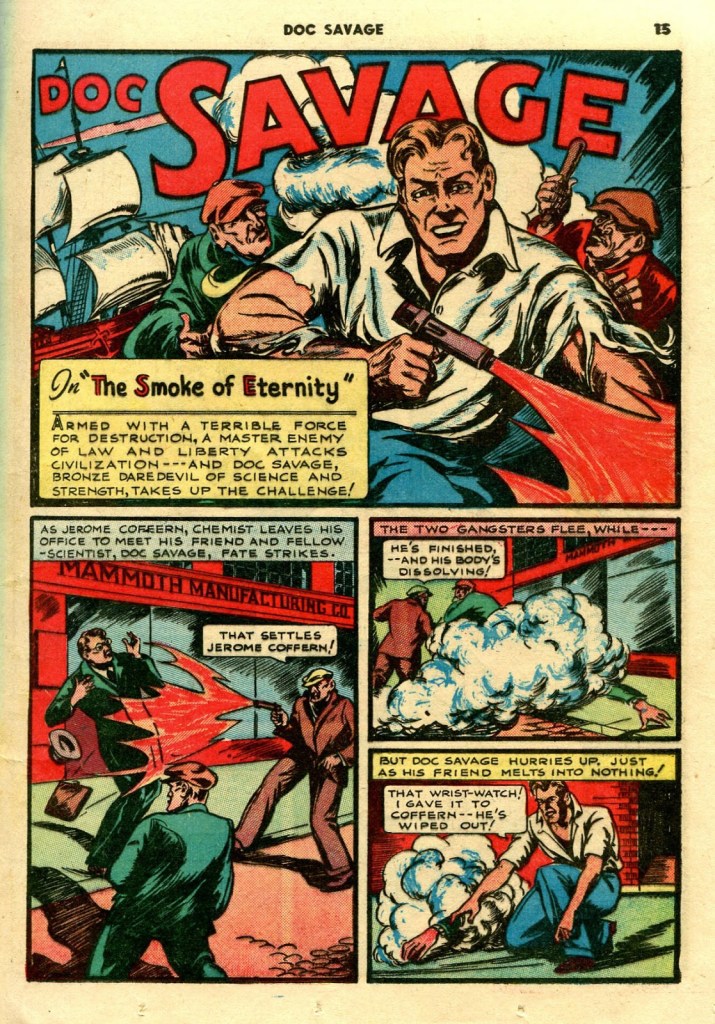
They were strange little things…usually quite short, loaded with stereotypes of the time in adventure fiction (brutish natives, helpless female captives, etc), and drawn in a sloppy early-comics style that often looked like it had been composed on a staff artist’s lunch hour.

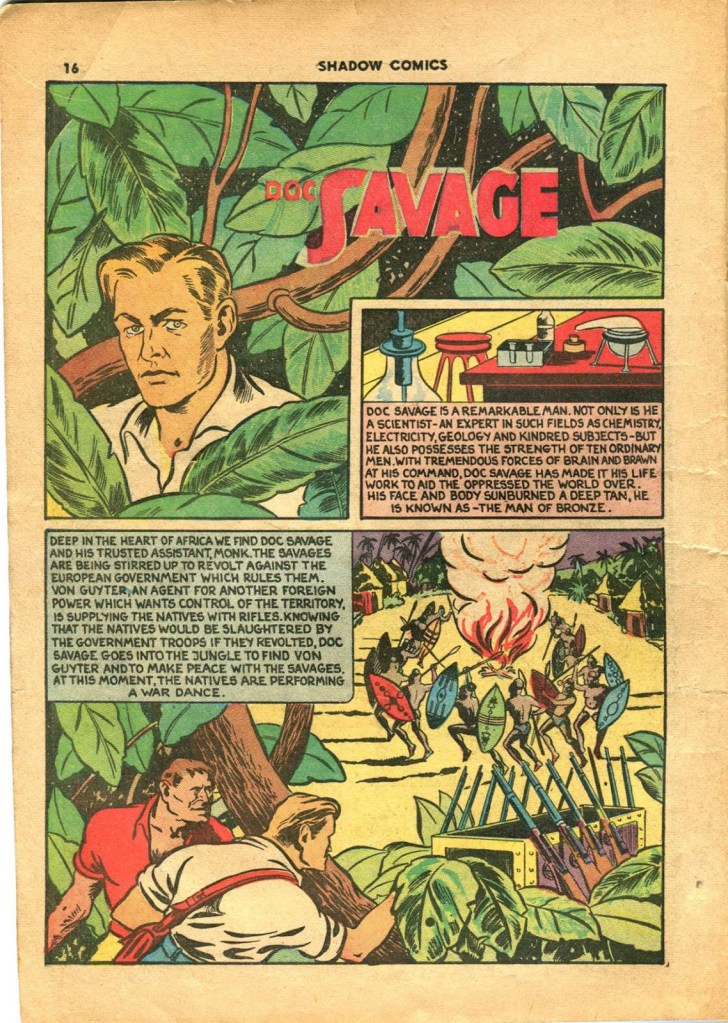
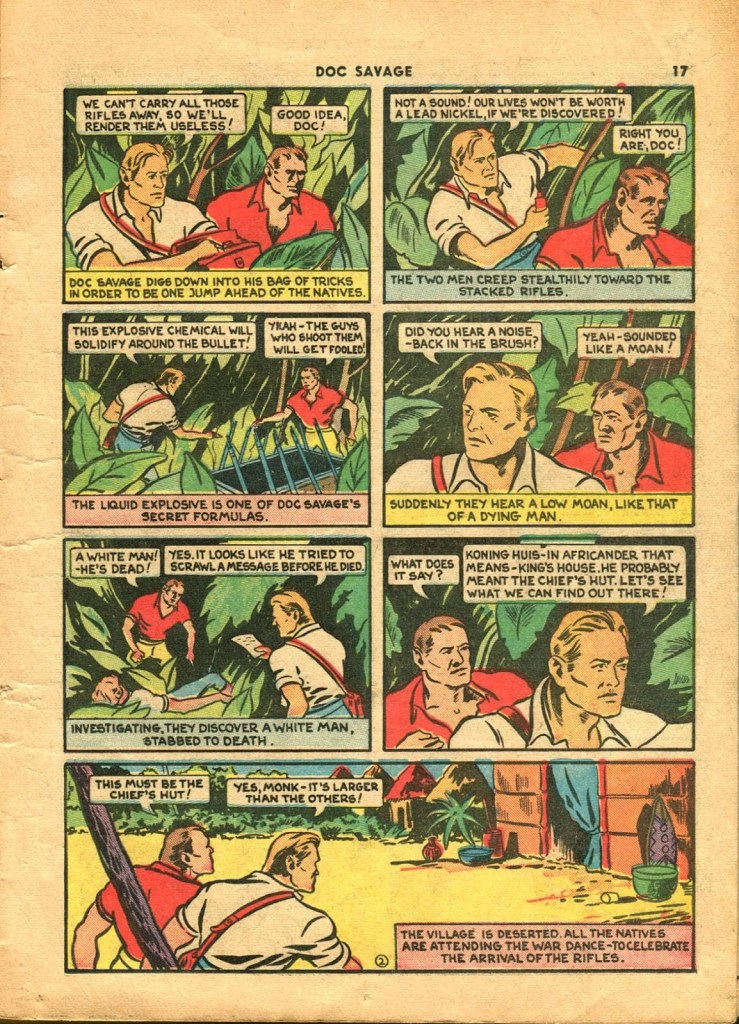
But they were fun in a distinct politically-incorrect, forbidden pleasure sort of way. Here is the first of them, from Shadow Comics #1, in 1940.

Monk’s hair color is wrong, but who can nitpick an adventure that features a flaming belt buckle gimmick, the straight-faced exchange between Doc and Monk about the mysterious message (Doc: “Then how did he scrawl this message if he was dead?” Monk: “Something’s funny about that!”) and a parting from the heroine (after Doc arranges to get her back to civilization — and gets her a job, to boot) that consists of “Thanks for everything, Doc Savage — and goodbye!”

Here is the cover of the issue, obviously featuring The Shadow…with Doc in the third marquee position under “Iron Munro”!

Talos Fan Fiction Contest Entry #9 – The Professor

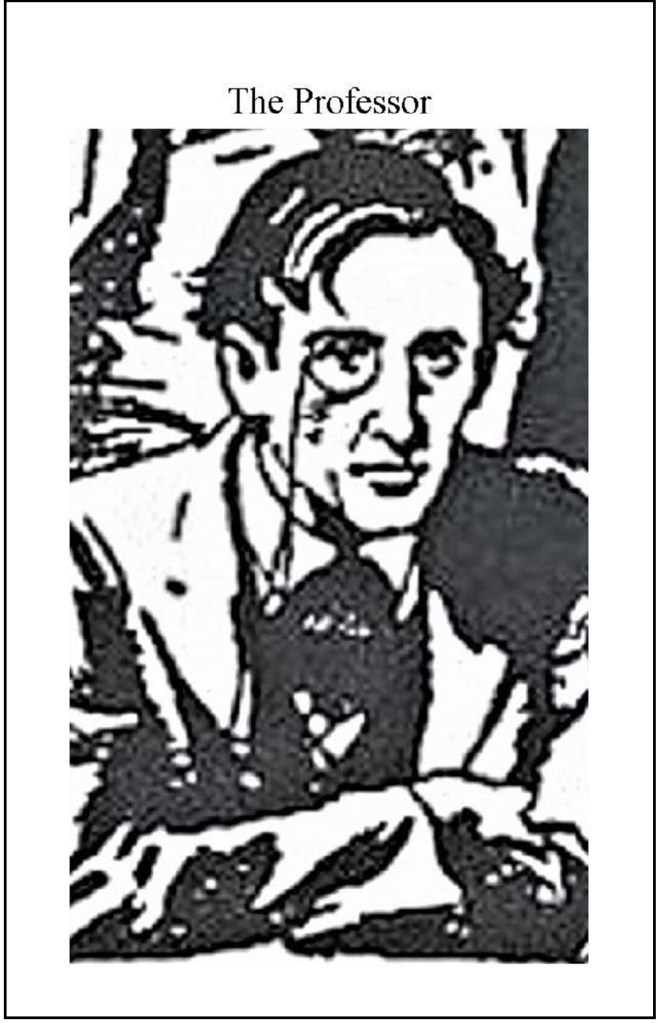
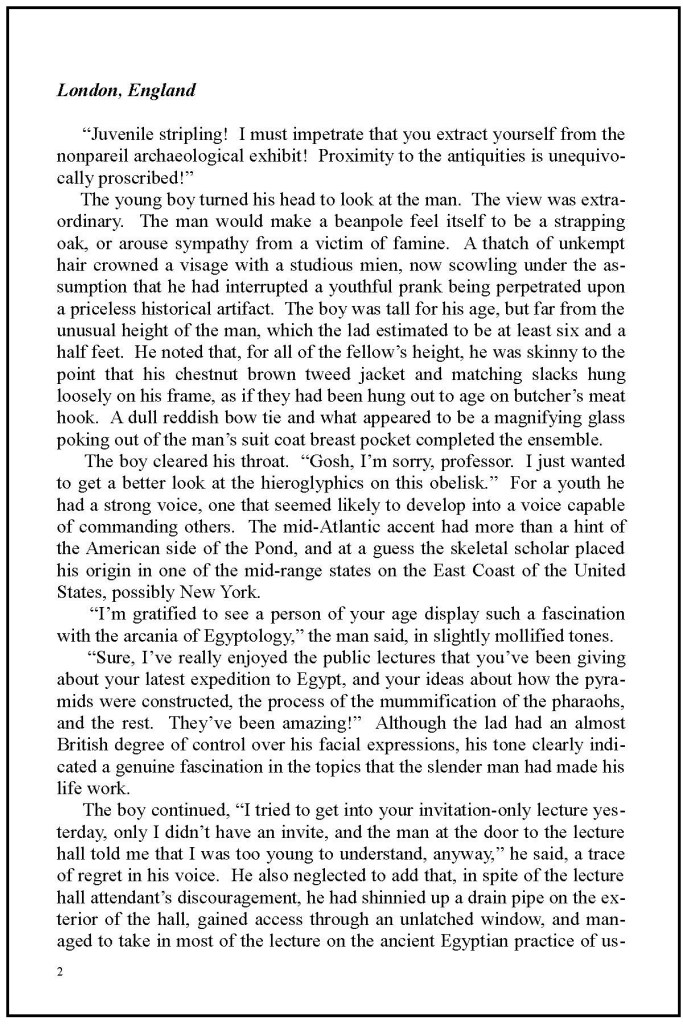
Note from Doc Talos author/contest judge R. Paul Sardanas: Daryl Morrissey, creator of the huge Refractions in Bronze project, displays his virtuosity in the world of a renowned 20th century adventurer, as well as his fascination for the untold stories from the youth of the man who would come to be known as Doc. In this tale, we are given the delightful experience of the first meeting between a particularly bright young man and an erudite professor with a voracious penchant for (to use uncharacteristically small descriptives)…big words.

Comment from author Daryl Morrissey: When, after a hiatus of some thirty years, I returned to Doc Savagedom, I was delighted to find that there was a core fan-base that was keeping the flame alive, and the Code in their hearts – and even adding to the Savage legend with fanzines and fan fiction, pastiches and Facebook groups.  And I wondered if, after all this time, there was a place for me to do my own small part to add to the magic.  Nearly every Doc Savage novel has a brief reference to Doc’s unusual upbringing, his intense multidisciplinary studies with world experts – and I tried to imagine what that must have been like, for both the mentors and young Clark Savage. Doc’s past is a mansion with scores of closed doors, and in the pulp stories we are never really allowed more than a glimpse of the foyer.  This is my attempt to crack the door into at least one of those hidden rooms.

Additional note: If you are interested in submitting fiction to the Summer 2021 contest (first prize is a Bantam Doc Savage paperback Czar of Fear first edition, signed by James Bama) you can read the contest guidelines HERE.

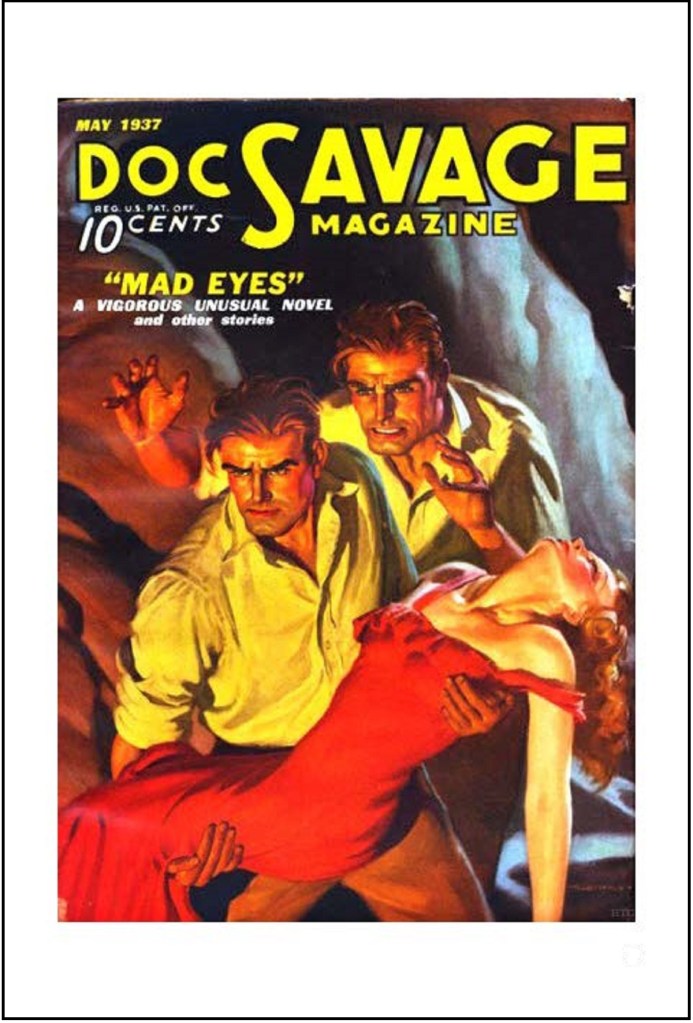
Talos Fan Fiction Contest Entry #8: Mad Eyes Donovan and the Wolf in Ape’s Clothing

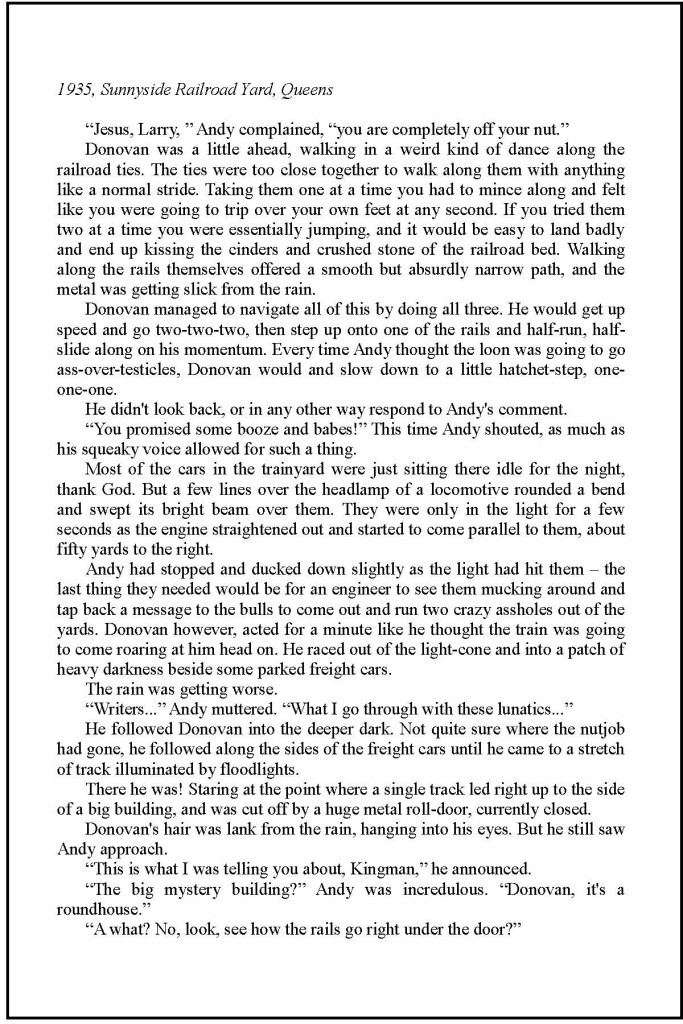
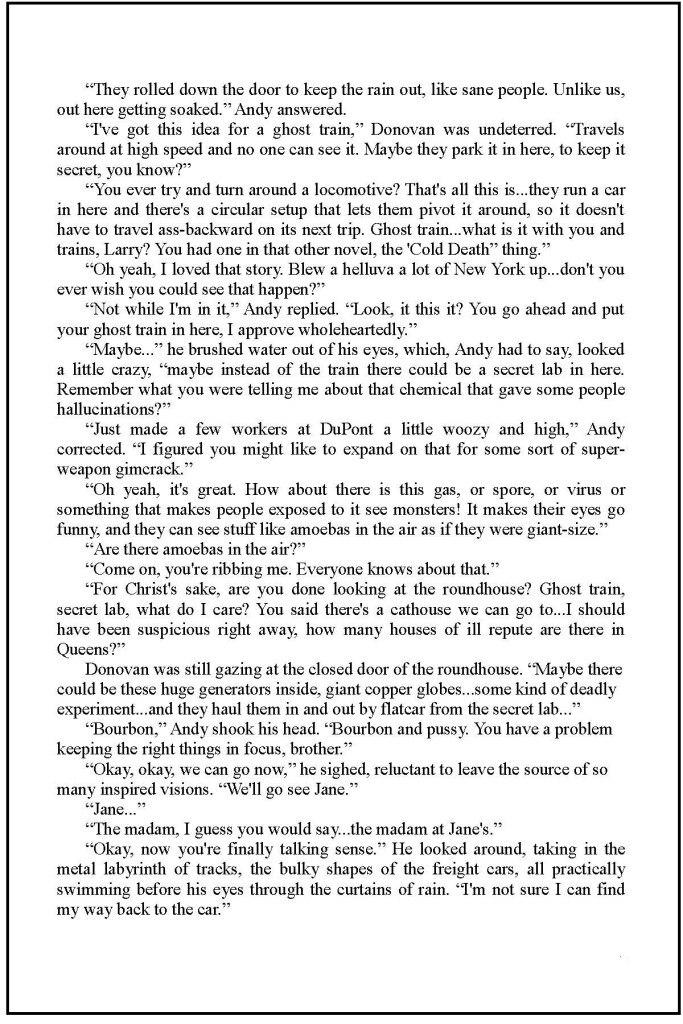
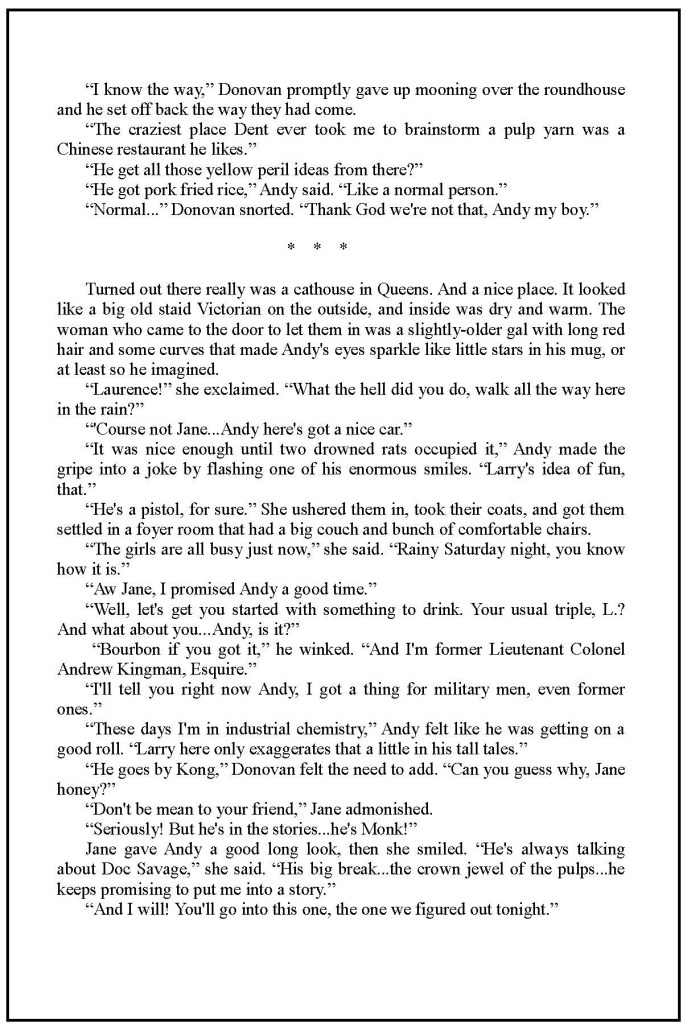
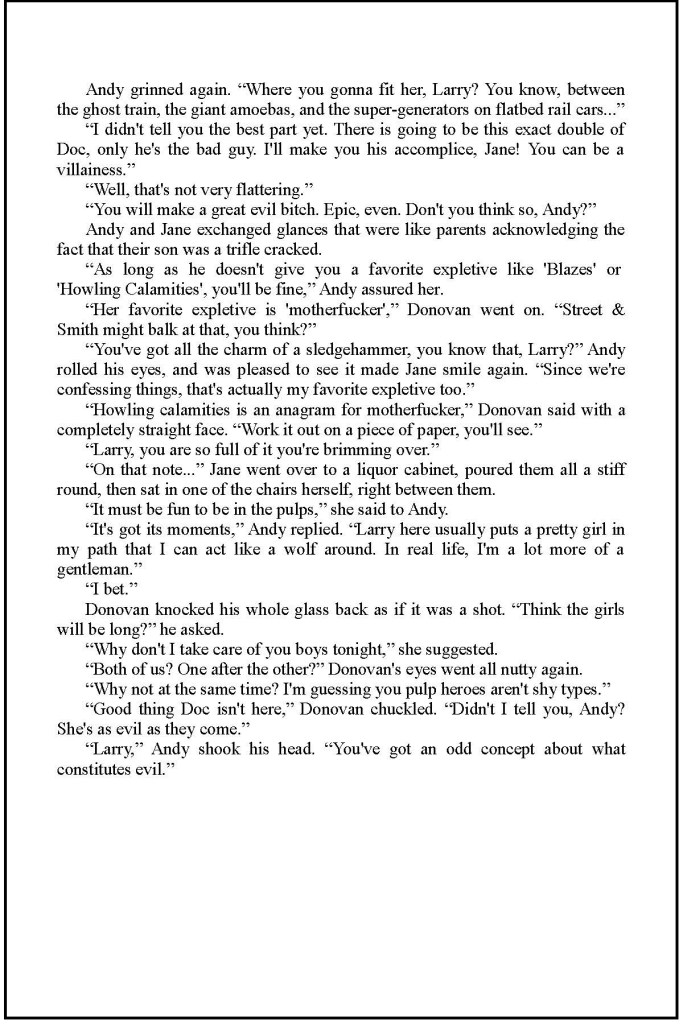
Note from Doc Talos author/contest judge R. Paul Sardanas: This tale by Brooklyn Wright, featuring the wildest of the Kenneth Robesons and a certain apelike chemist brainstorming a Doc Savage yarn one night in 1935, made me smile from its beginnings in a Queens trainyard to its ending in the company of a madam who is destined to become a pulp villainess. That’s one helluva night.

Comment from author Brooklyn Wright: For all the reverence I apply to the name of Lester Dent, Laurence Donovan was my favorite of the Kenneth Robesons. His novels were so insanely off the wall, I never knew what he would pull next. Sometimes they were terrific from cover to cover, sometimes they crashed and burned. But he really was something. Philip José Farmer, in his book Doc Savage: His Apocalyptic Life, suggested that Monk might have fed quite a few stories to the Doc authors over the years…so why not to Donovan? Another inspiration for this story is the 1985 Scorsese dark comedy film After Hours.

Additional note: If you are interested in submitting fiction to the Summer 2021 contest (first prize is a Bantam Doc Savage paperback Czar of Fear first edition, signed by James Bama) you can read the contest guidelines HERE.

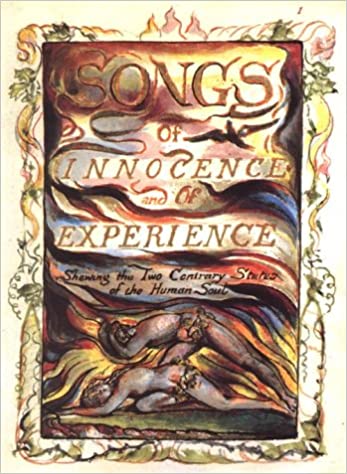
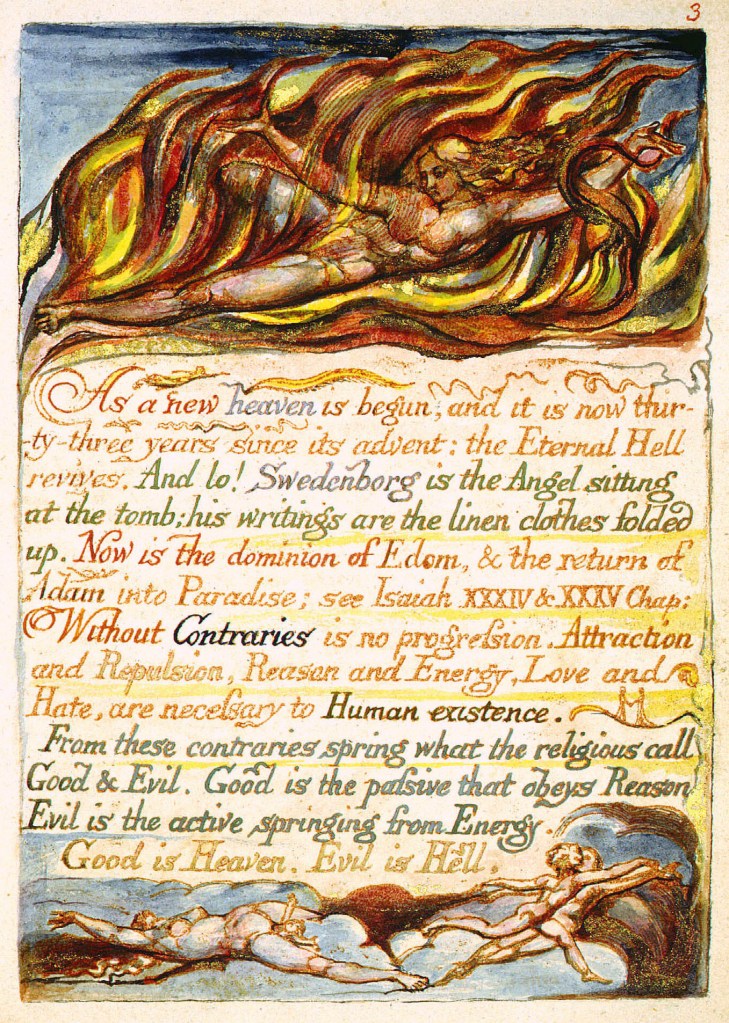
Returning to the roots of the graphic novel: Doc Talos and the illuminated Books of William Blake

In our May 8 Forbidden Pulp blog, we explored the process of creating a new kind of novel/graphic novel hybrid. Instead of the sequential panel art format of most graphic novels, the Talos Saga was created using a fusion of traditional narrative book-style text formatting, and fully painted art. While strikingly different from the visual novel structures of today, it goes back to classical roots.

William Blake 1757-1827, using processes mastered through his work as a printer, also fused text and art to create his illuminated manuscripts, which were visionary, prophetic works filled with their own unique cosmology and philosophies, but also deeply moving evocations of human aspiration and dreams.

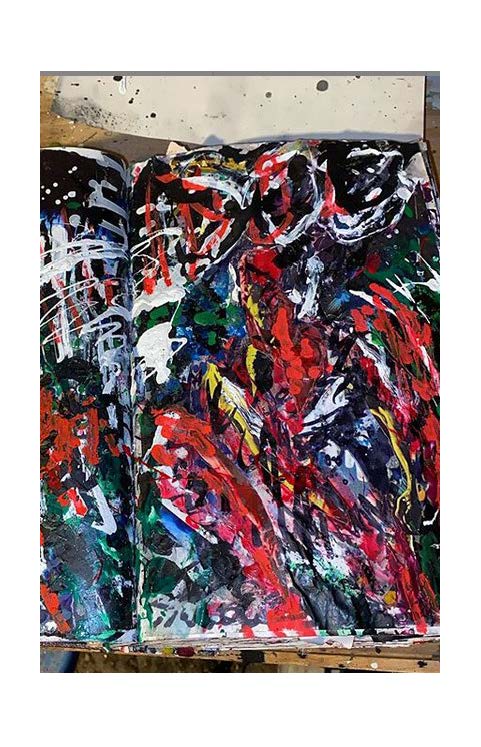
Carrying forward those techniques from the 18th/19th century to the 21st, artist Iason Ragnar Bellerophon and I strove to create illuminated manuscripts again, this time with the goal of blending modern pulp fiction to powerful painted art.

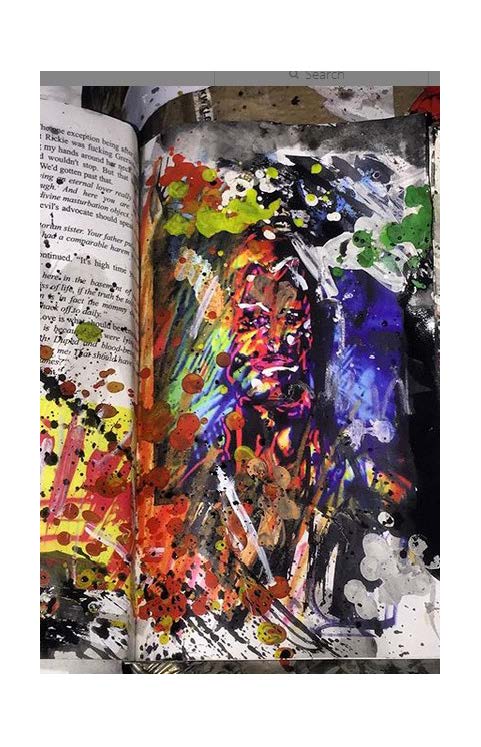
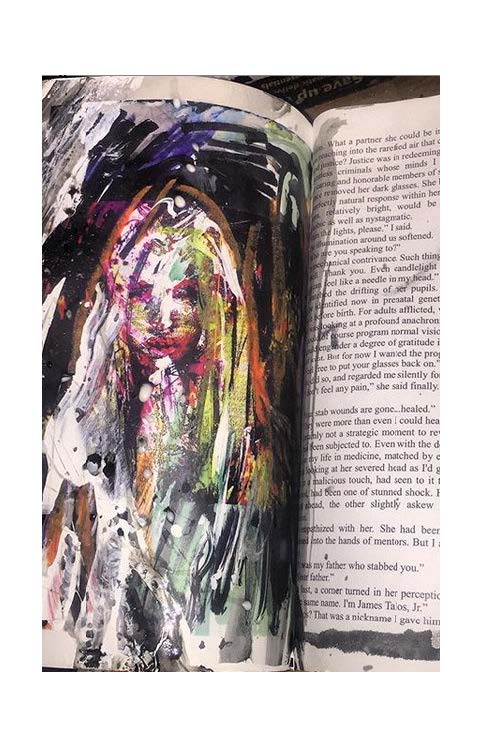
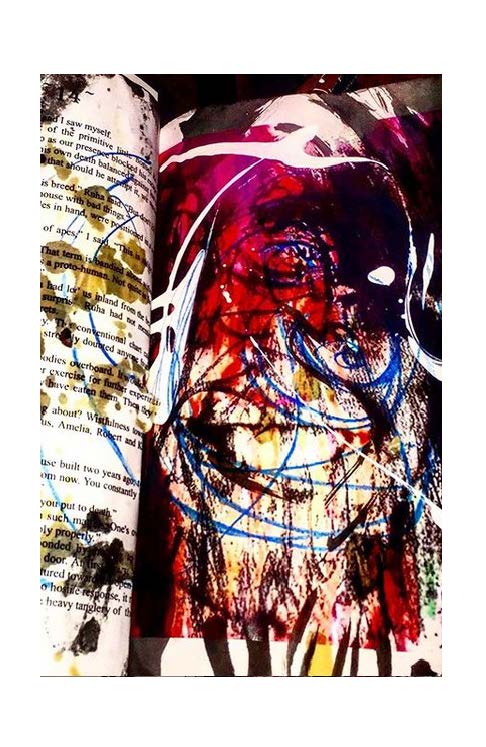
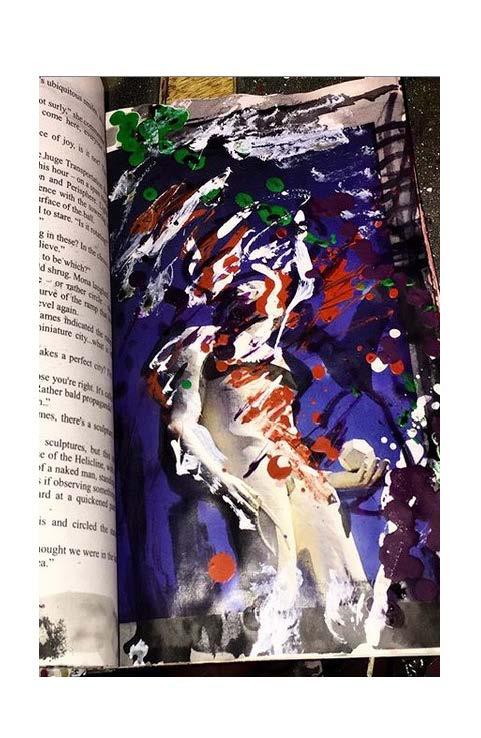
Here is a selection of images from the Talos books as they were being created…a powerful testament to the aspiration of visionary entertainment.