Previously available only in electronic formats and in premium hardcover heirloom editions, the clear-text versions of the six-volume Talos Chronicle will be available in paperback on August 1st.
The Doc Talos books are a unique joining of art and prose, with each side of that creative equation inspiring the other. The books contain hundreds of fully painted artworks by Iason Ragnar Bellerophon, along with the complete novels by R. Paul Sardanas. To capture that magic in the books themselves, two versions were created: the Art Editions (available now in our Bookstore), which have expanded, full-bleed artwork and paint designs that extend even over the text — and the Clear Text Editions, which have all artwork included, but cropped and all text uncovered for easy reading. Here are samples of how each version looks:
Clear Text Edition sample page
Art Edition sample page
Gromagon Press and Tetragrammatron Press are proud that both editions will now be available in paperback. Here are the covers for the new set of Clear Text print books!
Volume 1 of 6 — Abyss Clear Text Paperback Edition
Volume 2 of 6 — Alleys Clear Text Paperback Edition
Volume 3 of 6 — Towers Clear Text Paperback Edition
Volume 4 of 6 — Savages Clear Text Paperback Edition
Volume 5 of 6 — Passages Clear Text Paperback Edition
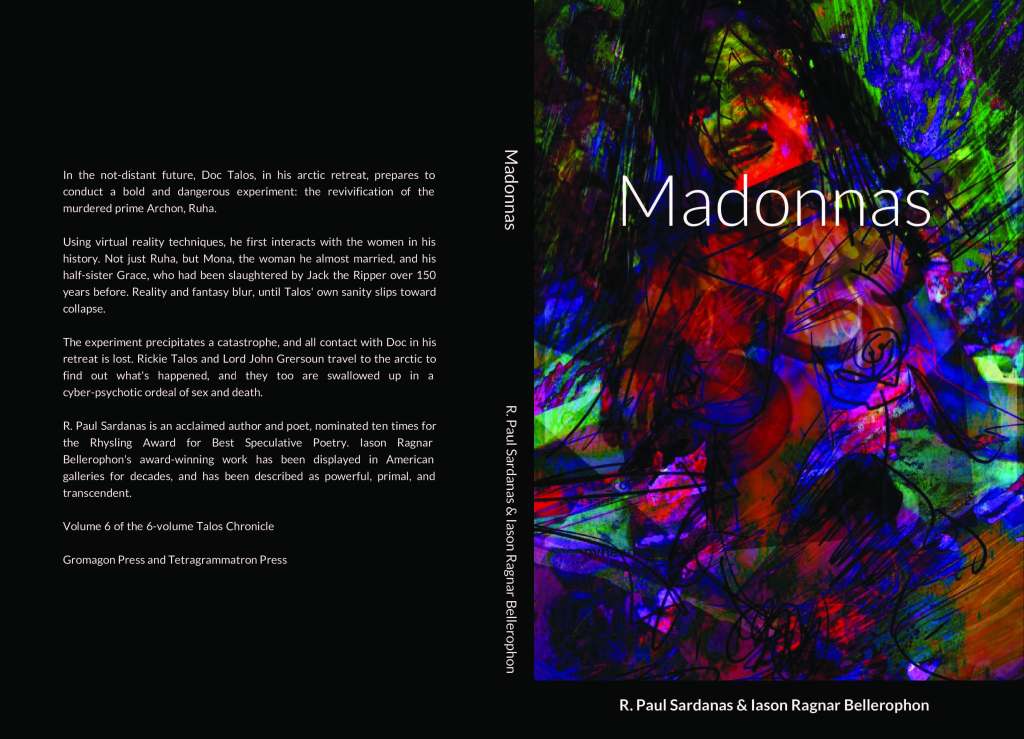
Volume 6 of 6 — Madonnas Clear Text Paperback Edition
If you are interested in free sample chapters from the books, or would like pricing, advance order, or complete-set discount information, please feel free to drop a line to taloschronicle@gmail.com
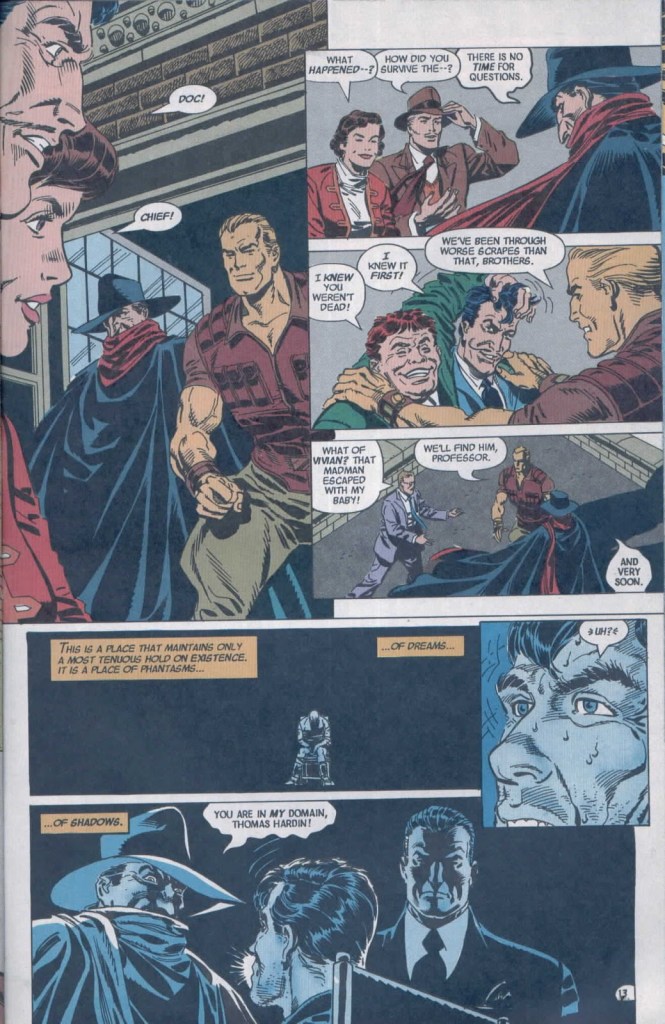
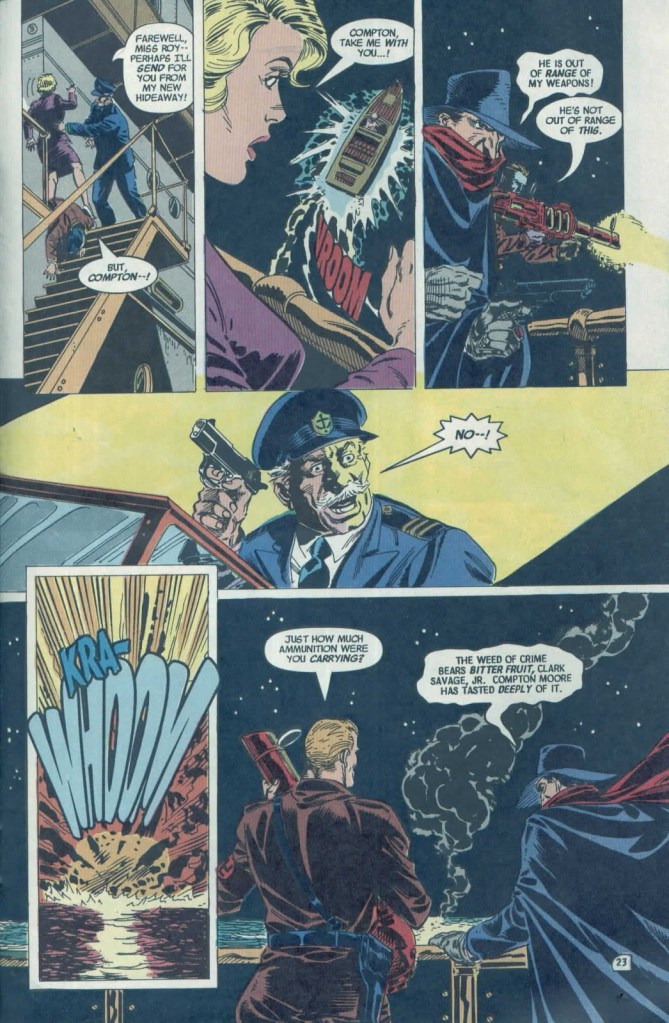
With the fourth chapter of DC Comics’ 1990 story The Conflagration Man, the unique storytelling conjunction of the two great pulp crimefighters came to its conclusion. As it had done with each preceding chapter, it shifted from one ongoing series to the other, this time moving from Chapter 3 in The Shadow Strikes, to Chapter 4 in Doc Savage.
The writers also shifted their roles again, with Doc Savage author Mike Barr once again taking over the scripting, and The Shadow Strikes author Gerard Jones acting as co-plotter. The regular artists for both comics, Rod Whigham and Eduardo Barreto, continued to share the pencils and finishes.
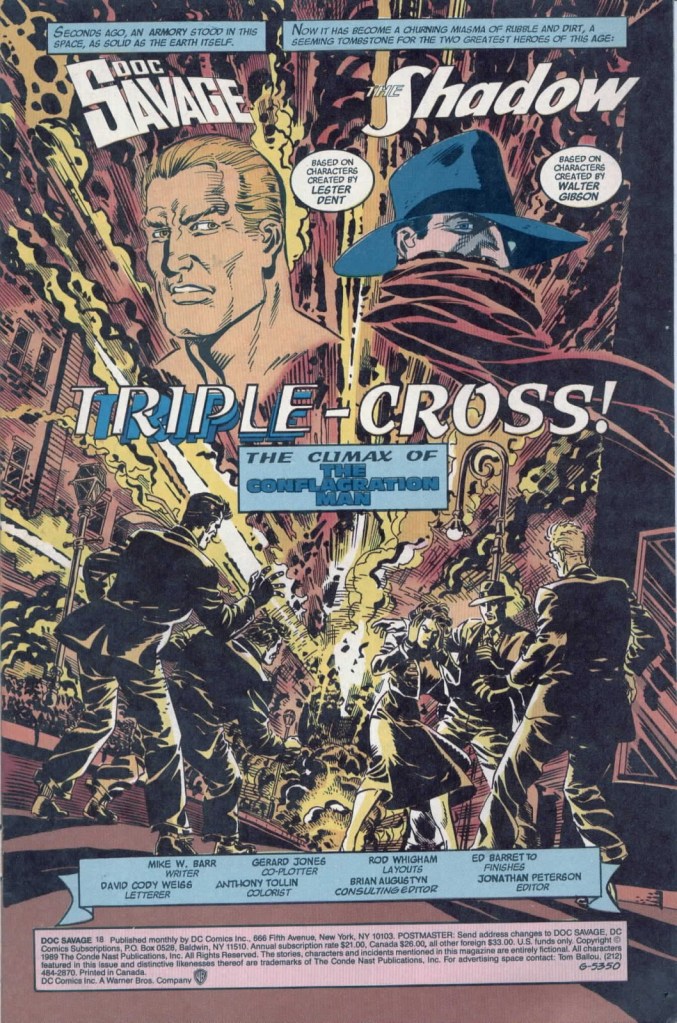
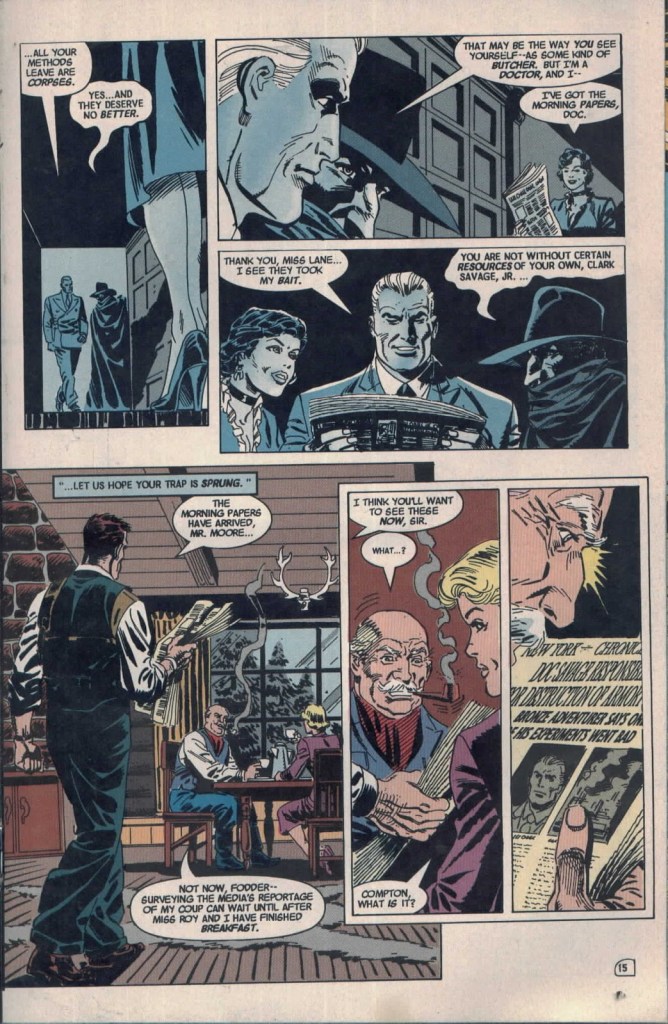
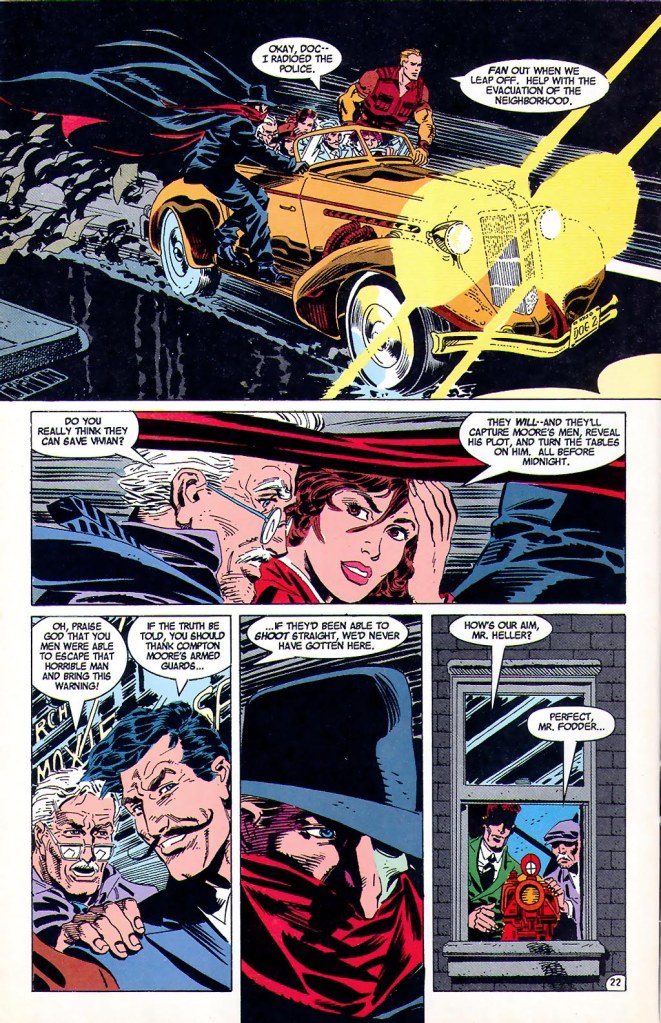
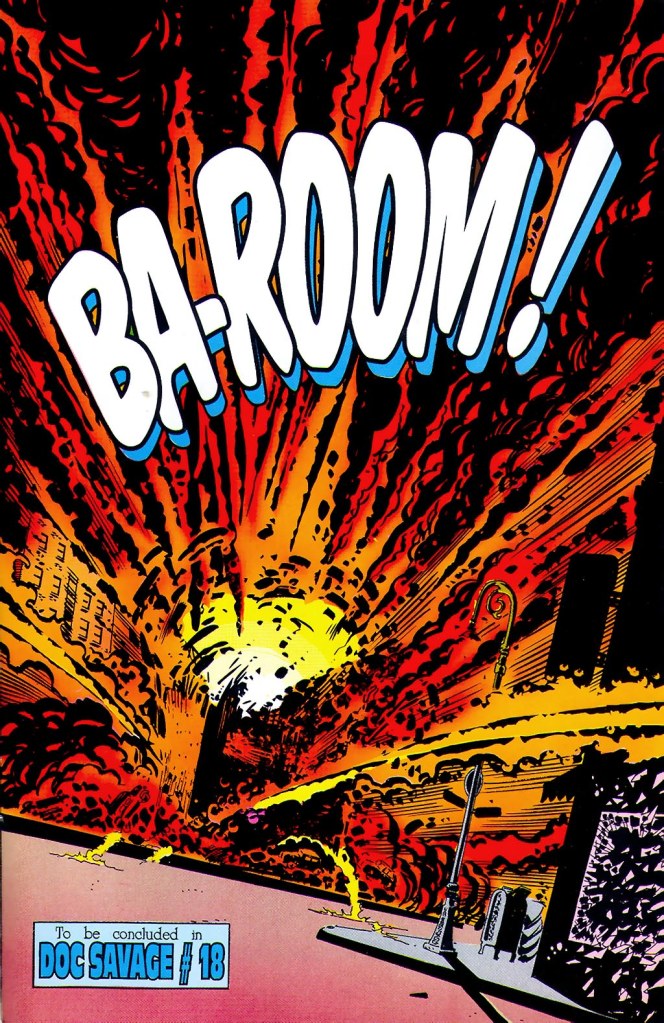
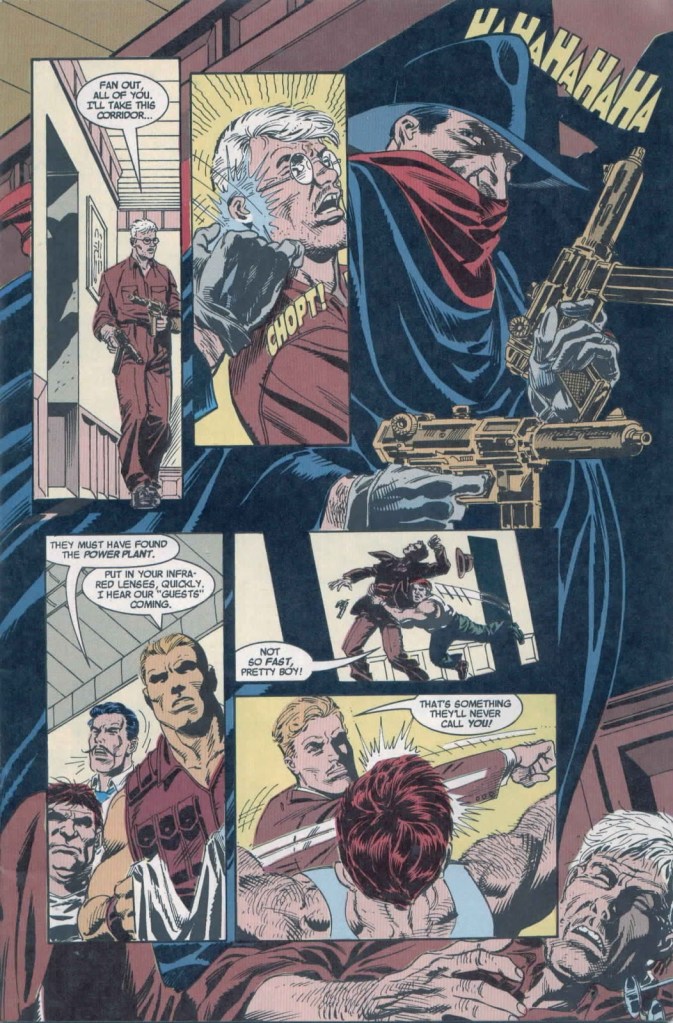
As you can see from the above opening page of Chapter 4, the previous issue finished with an explosive cliffhanger. The overall story involves an industrialist who has taken control of and weaponized an invention that causes gunpowder to detonate, and he lured Doc and The Shadow to an armory (loaded, naturally, with gunpowder) and blew the whole building to kingdom come.
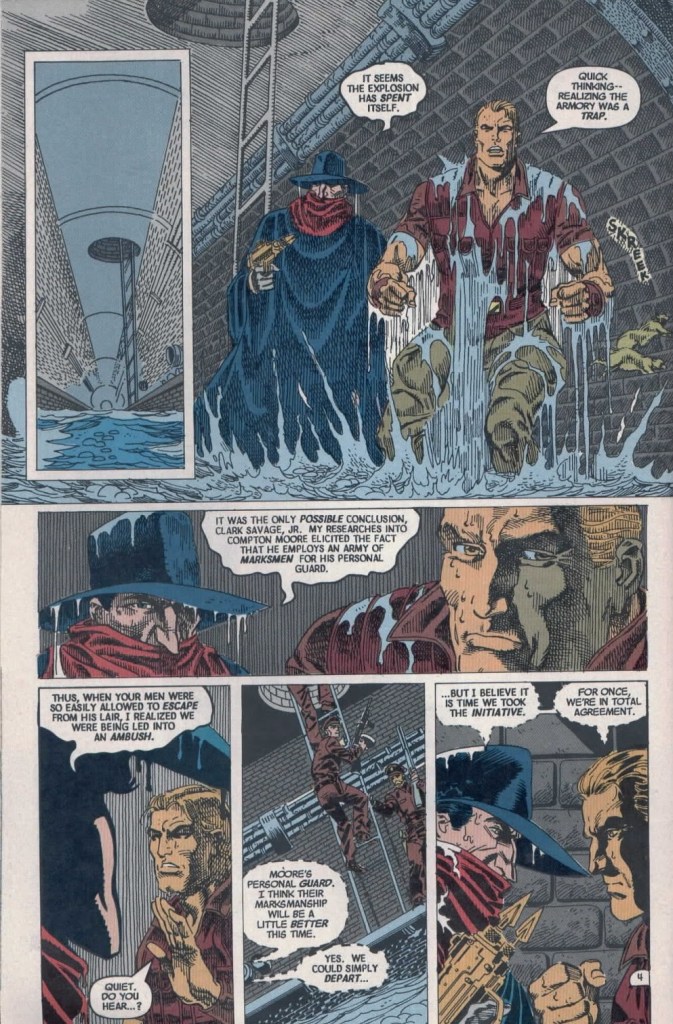
This ploy, however, was unsuccessful in its attempt to wipe out the two crimefighters. Alerted by some red flags around the ploy to get them inside the armory, Doc and The Shadow dropped down into the sewers below the building before the explosion.
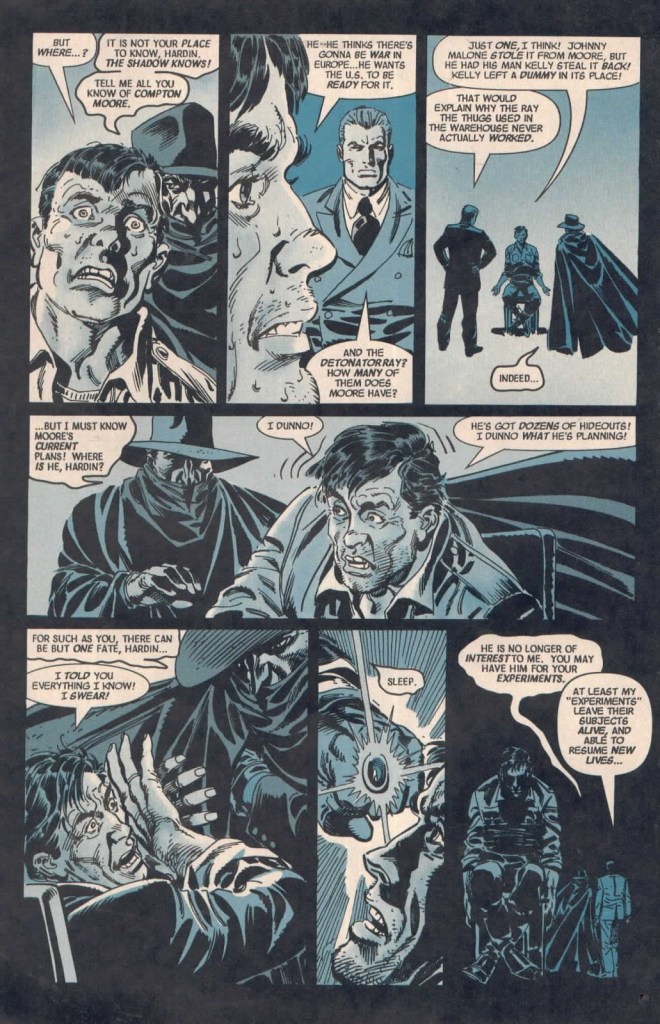
The industrialist villain figures out they have dodged the trap, and he sends members of his private army down into the sewers after them, which results in several pages of fighting. Doc and The Shadow are triumphant, and they take a prisoner to interrogate in The Shadow’s famous “blue room” (after being joyfully reunited with their agents and aides, who had thought them dead).
Not easily put off, the villain goes forward with the next part of his plan, which is to incite the world superpowers into World War (years ahead of the actual arrival of WWII). As a munitions maker, a “conflagration man”, he will naturally make untold amounts of money selling weapons to both sides.
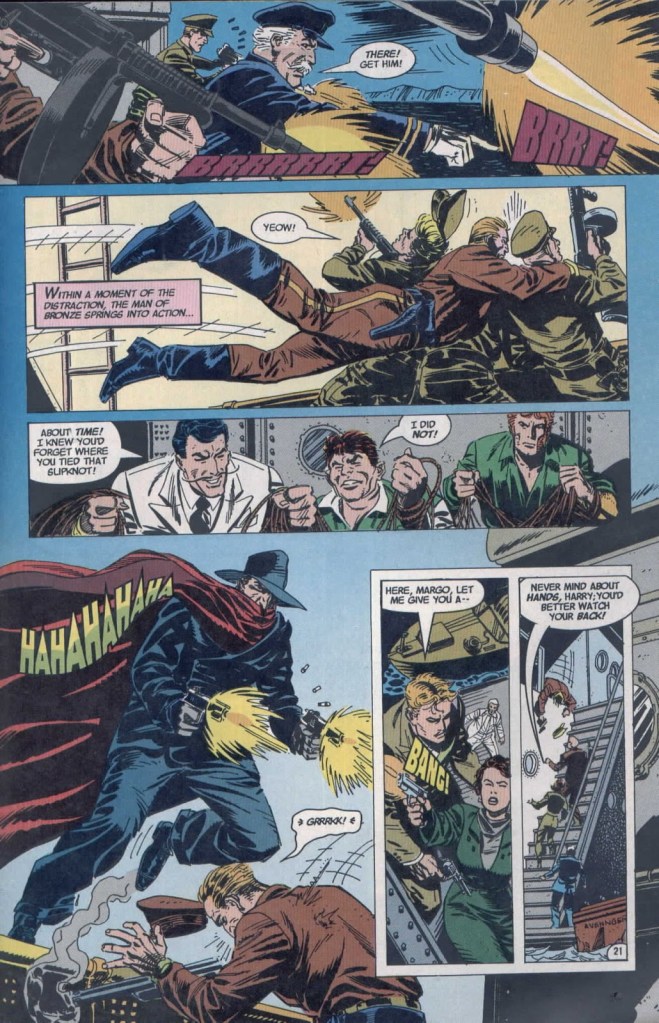
He dresses up some of his private militia as Nazis, and launches a terrorist strike against the USA. This is foiled by Doc and The Shadow, who are on the scene (Doc is disguised as a Nazi, which is why he is wearing their uniform). The climax of the story arrives as the combatants have at it on the industrialist’s yacht.
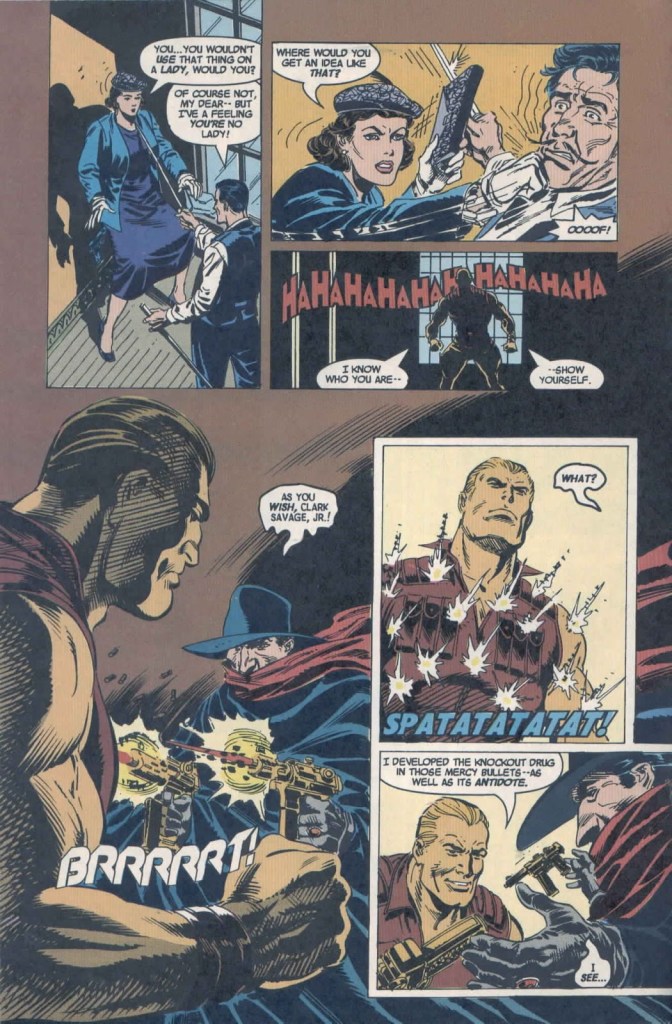
To make his getaway, the villain threatens the daughter of the scientist who had created the gunpowder-detonator gun. She was never a hostage, as her sympathies were with the villain — she liked the idea of the money and luxury the whole scheme could bring her. The unscrupulous industrialist, however, promptly uses her and then leaves her behind, much to her dismay.
Doc tries to disable the fleeing speedboat using the gunpowder-detonator, not aware that the small craft was packed with explosives…causing the craft to be blown to bits. Doc is characteristically unhappy about the death, though The Shadow, equally characteristically, is quite satisfied.
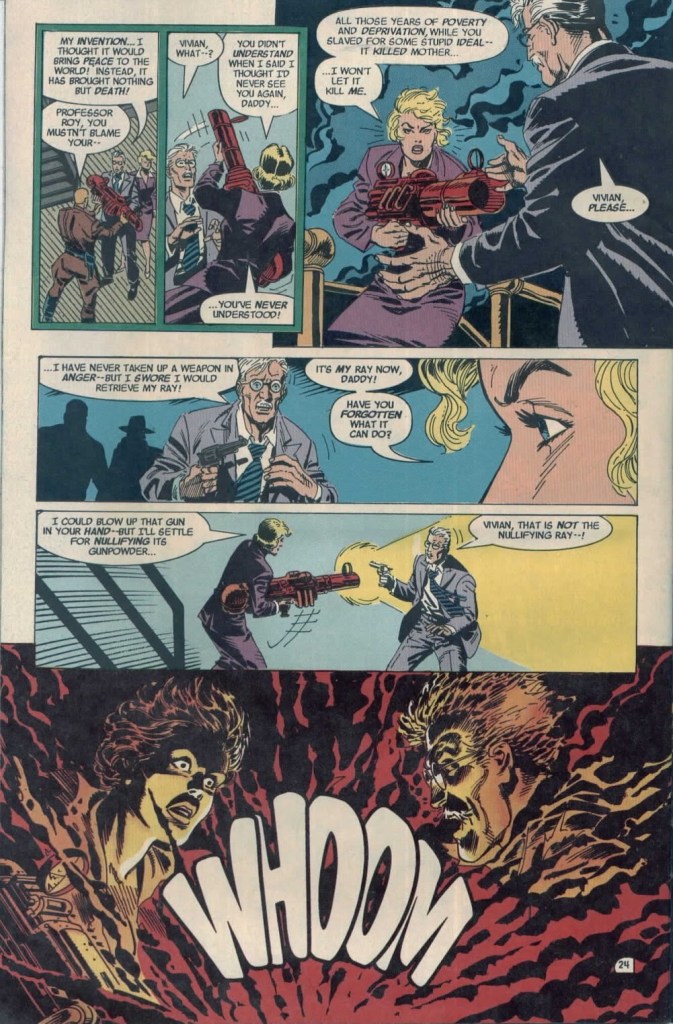
In a last twist, the greedy daughter turns on her father, and they too are killed in an explosion during their confrontation.
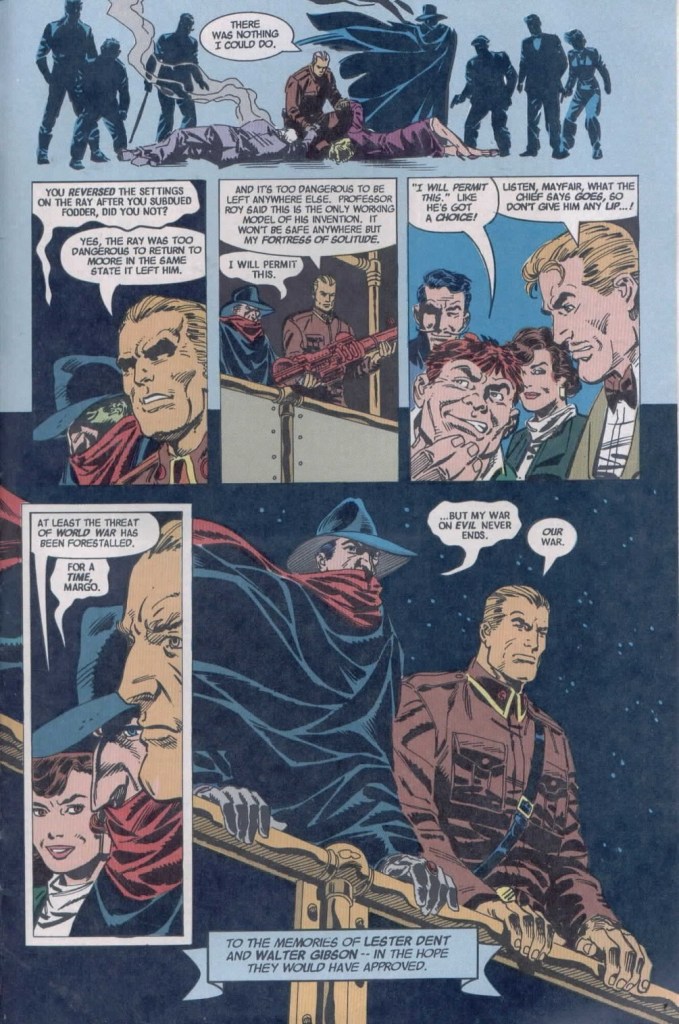
And so we come to the end, with Doc and The Shadow doing a little speechmaking to wrap things up.
Though the story suffered from some flaws in logic (and an overuse of some plot devices, particularly characters in disguise), it really was a lot of fun…and the little banner at the end of the story, dedicating it to Lester Dent and Walter Gibson “in the hope they would have approved”, was a nice touch.
It seems unlikely this story will ever be reprinted in graphic novel form, but the comics themselves are not too hard to acquire, and they will bring much pleasure to any Doc or Shadow enthusiast.
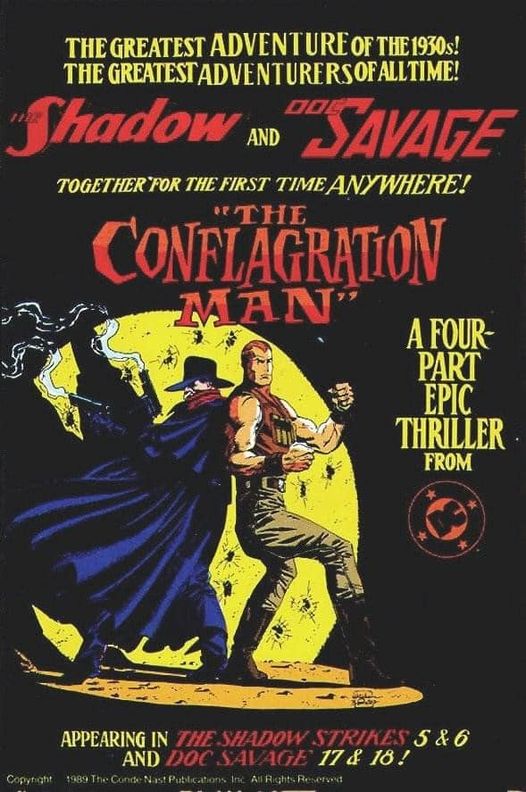
A few little extras…here is the house ad for the story, which appeared throughout the line of DC Comics just prior to the four-issue crossover:
And a little personal history as well! This is the letters page from Doc Savage 18, and among the missives printed there is one from me. Yes, back in 1990 at the know-it-all age of 32, I wrote to the Doc Savage comic (using my real name, Malcolm Deeley) praising its return to the core concepts of the character, and talking a little bit about Doc’s unique place in American literature. I was, at the time, trying to organize a fan organization and newsletter/fanzine about Doc, called “The Hidalgan Circle”, which is why that unique little title is there with my signature. The fan club did not get far, alas…that was well before the internet made connection with fellow fans much easier…but that is a tale for another time.
Part 1 and Part 2 of this article explored the unique novelty of seeing Doc Savage and The Shadow together in the 1990 DC Comics story The Conflagration Man. There were a number of clever, fun moments of mixing the story and character structures of the two great pulp heroes. Authors Mike Barr and Gerard Jones (who as solo writers guided each of the two comics for DC), had a unique arrangement in telling the story: they plotted the overall tale together, then each scripted his own book as they alternated…Barr for Doc Savage, Jones for The Shadow Strikes. It was an interesting partnership, which in some ways mirrored what might have been had Lester Dent and Walter Gibson ever joined forces on a story. Barr (like Dent) tended to favor action scenes and a headlong pace of adventure, whereas Jones brought a more tightly-plotted and subtle approach to the writing that more resembled Gibson’s writing style.
Part 3 of the crossover story shifted back to The Shadow Strikes comic, so Jones was at the writing helm.
At the end of the previous issue, Doc had arrived in the aftermath of a gang battle, finding evidence of considerable violent mayhem, and also a strange symbol scrawled on the wall. The symbol had been left by The Shadow, and was the chemical designation for cobalt. A little deduction by Doc, and he determined that The Shadow himself could be found at New York’s Cobalt Club.
That set up this fun scene, where Cobalt Club members are excited and somewhat stunned at the impending arrival at the club of a millionaire crimefighter…none other than Clark Savage, Jr.
This type of scene is where The Conflagration Man really excelled, giving fans of both pulp heroes a smile, along with pinup-worthy moments like this full page handshake shared by Doc and Lamont Cranston.
The two men confer, and begin to lay their plans for jointly dealing with the danger from a rogue weapons-manufacturer, complicated by the apparent kidnapping of the daughter of a scientist who had developed a devastating new weapon.
What both men are unaware of, is the fact that the daughter is a quite willing hostage. She is fond of the finer things in life, and detests her inventor father’s non-materialistic philosophies. She is in fact romancing the unscrupulous (and rich) villain of the story.
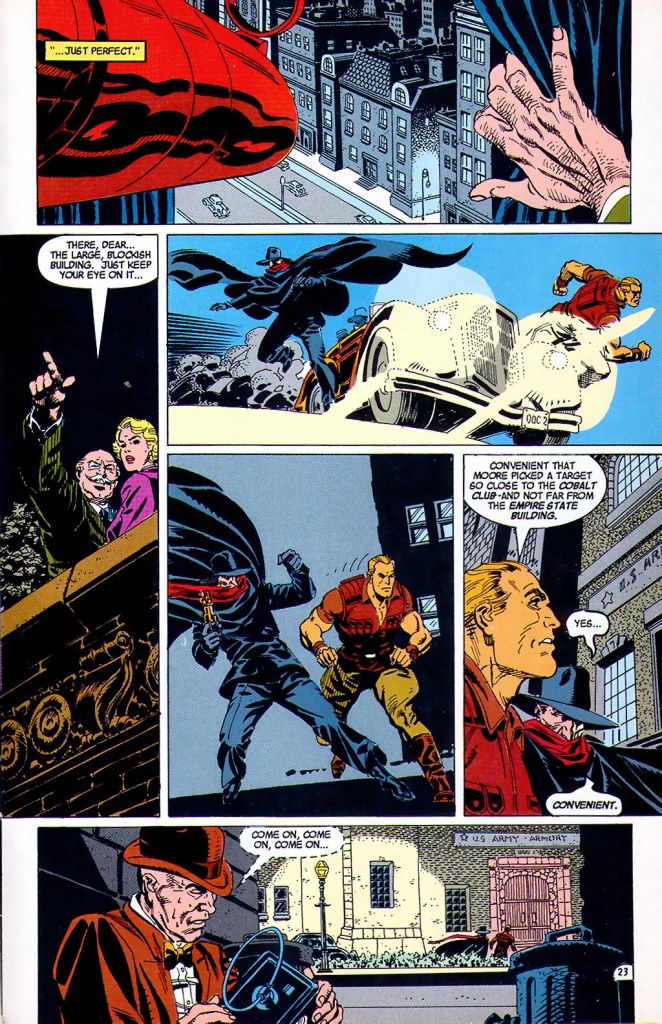
Doc and The Shadow proceed with plans to disrupt the activities of the munitions gang and to rescue the daughter (who has no desire to be rescued). There is some more bang-bang action and further deduction, which ultimately leads to the final scene of this penultimate part of The Conflagration Man. Doc and The Shadow head to an armory where they have been led to believe the case can be resolved…but it is in fact a trap.
Traveling together allows for another fun image…Doc and The Shadow both riding on the car’s running boards.
And so the two great crimefighters head straight into the trap and impending doom…
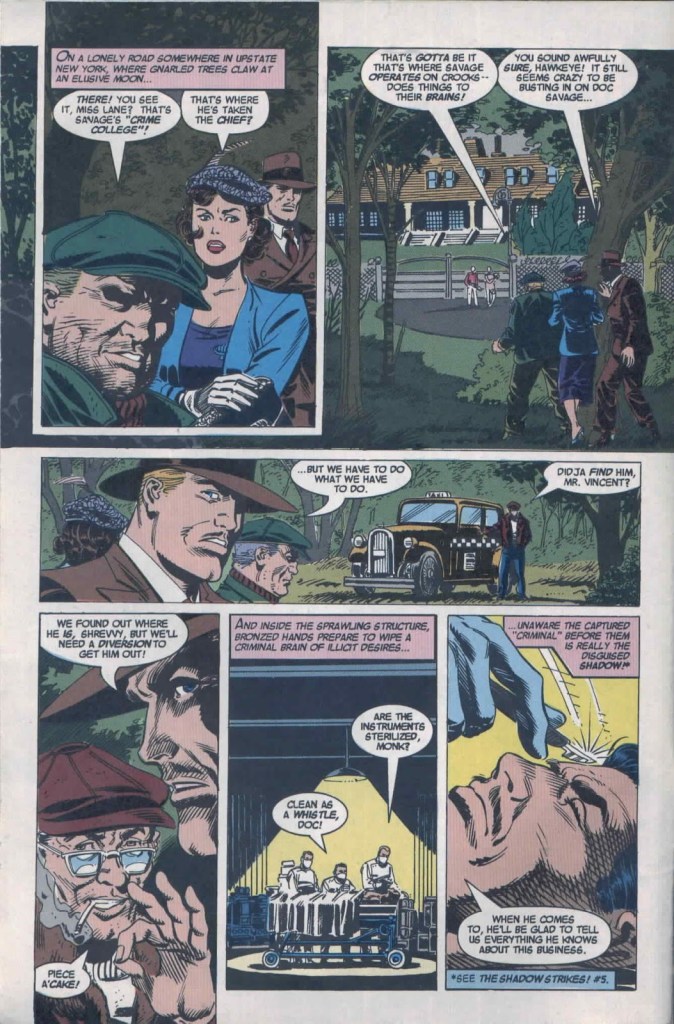
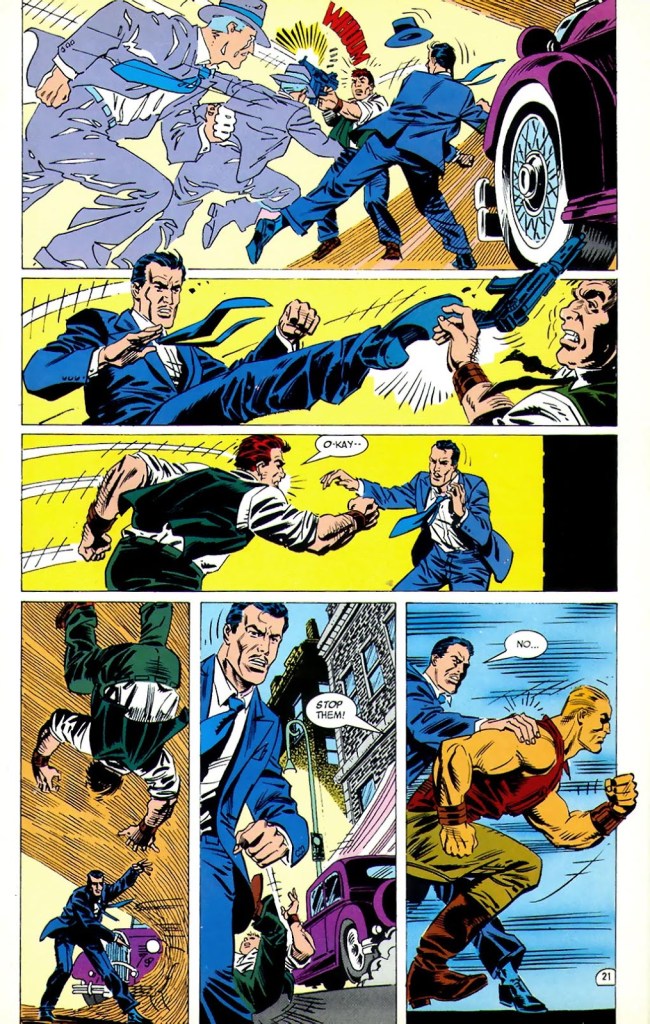
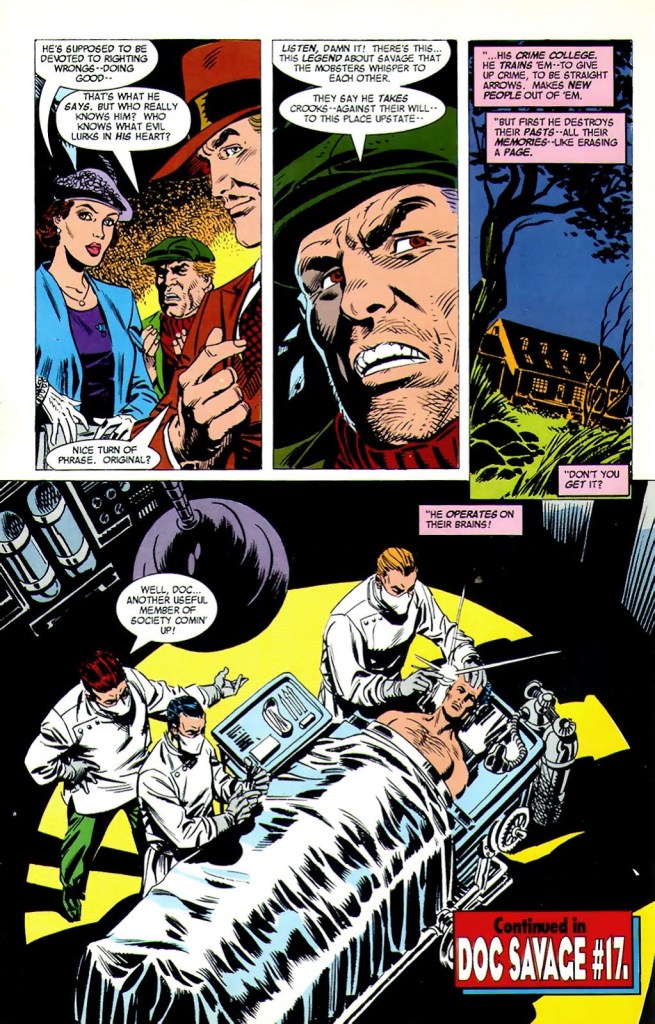
Returning to the DC Comics version of Doc Savage and The Shadow from Part 1, the cliffhanger from the previous issue was The Shadow, in disguise as a gangster, had been captured and brought to Doc’s Crime College to undergo the operation that wipes out criminal tendencies.
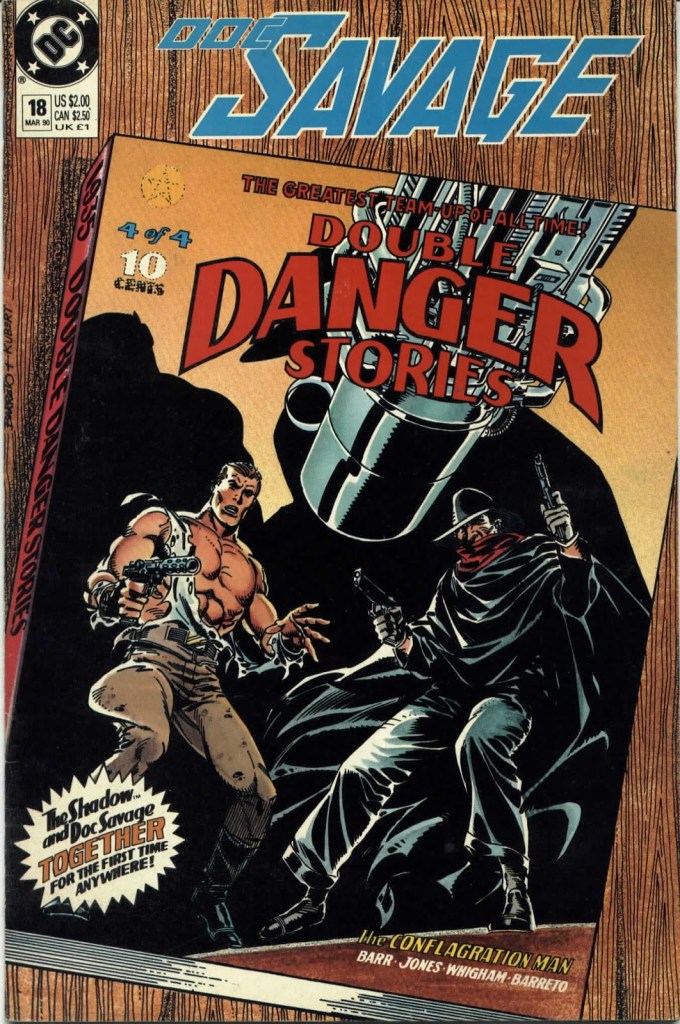
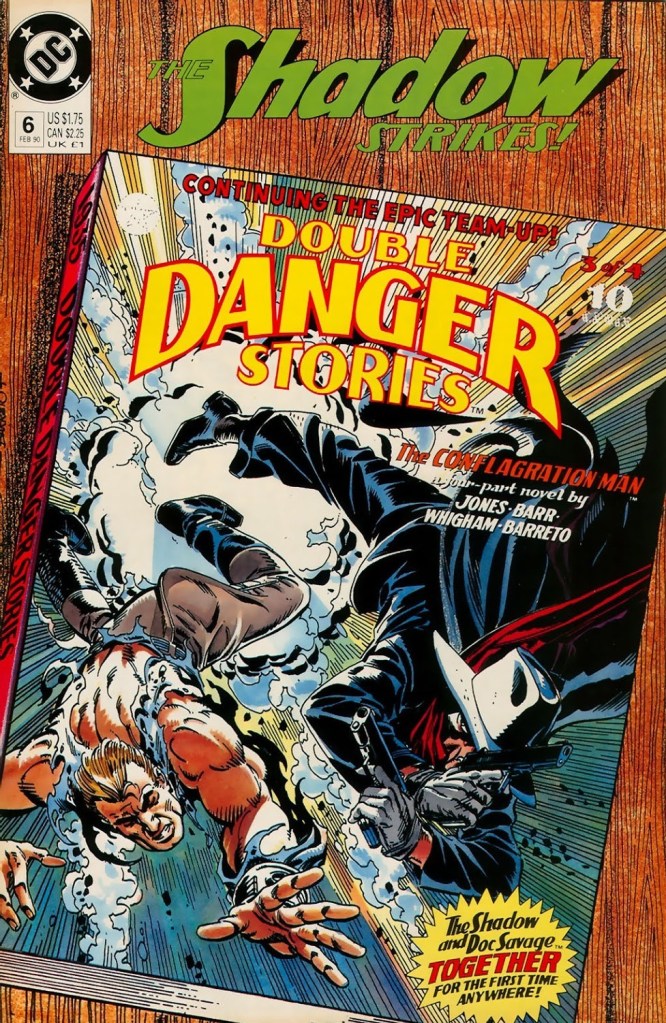
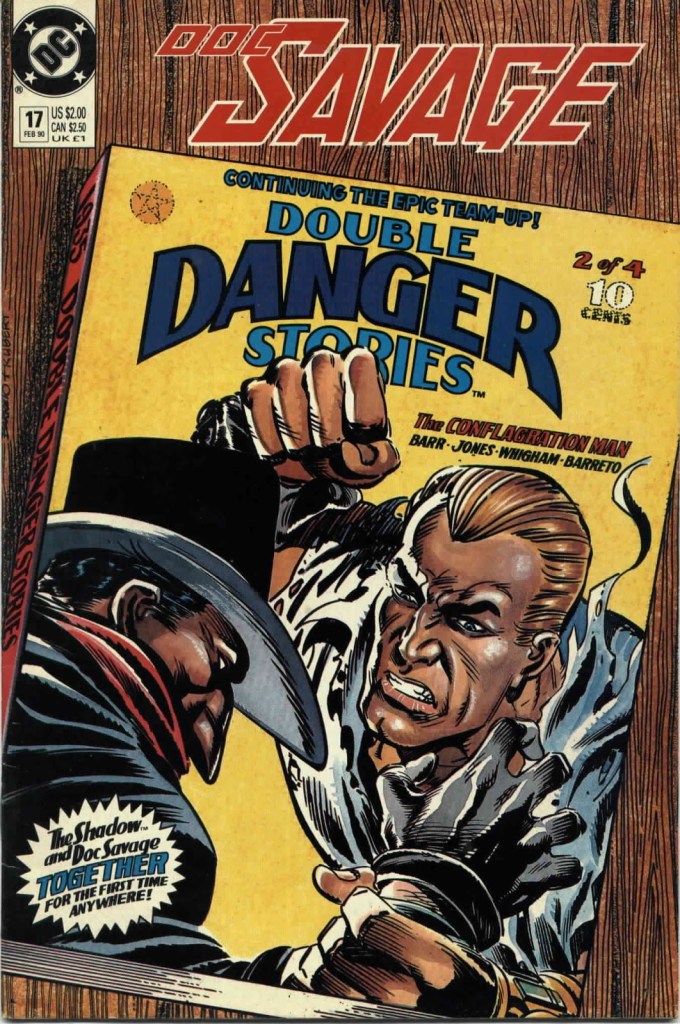
The cover of the story’s second part continues the pulp-cover Double Danger Stories theme, and the title/credits page is pretty much apin-up of the two heroes.
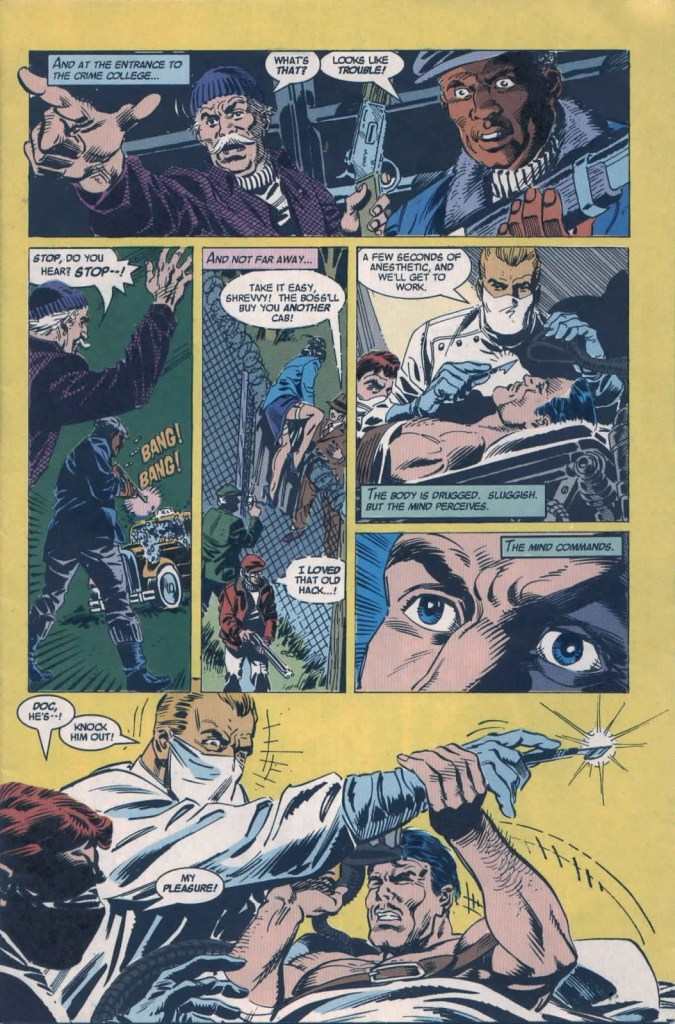
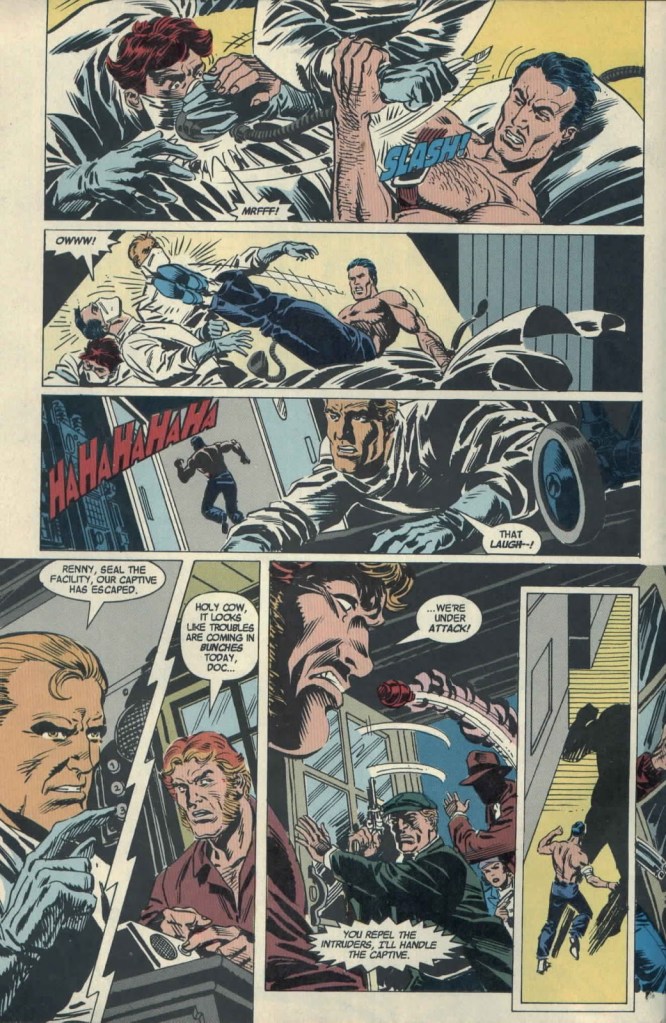
As the story swings into action, the cliffhanger (as they often do) is re-directed pretty quickly. Intriguing notion to use Doc’s criminal rehabilitation techniques on The Shadow…and fascinating to imagine the results, since The Shadow’s mind often out-criminals the enemies he faces. Nevertheless, as his agents work to free him, the disguised Shadow wakes up, and breaks out of the operating room.
At this point the story, which had been progressing pretty credibly, decides inexplicably to abandon logic. It was a little disconcerting in the previous pages to see that The Shadow’s agents had so quickly found the Crime College (which isn’t exactly a public medical facility)…and are we to believe that Doc did not detect the fact that his patient was wearing makeup, even as he leaned over to make an incision in his head? And now The Shadow, at first as Al Ombra, makes his way around loose inside the College, only to incomprehensibly find a slouch hat and cloak to slip into. Such a frankly ridiculous transition pretty much wipes out the clever twist of The Shadow picking up a pair of Doc’s mercy pistols to use as weapons.
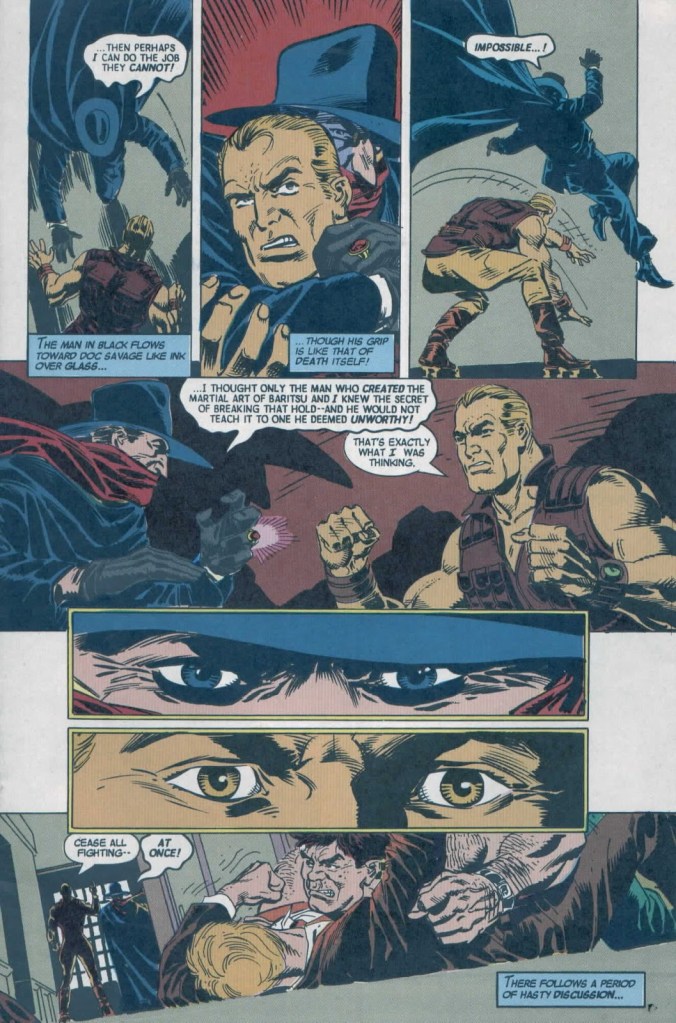
There is a bit of the comics cliche of two heroes fighting (essentially just to see them fight…as well as The Shadow’s agents fighting Doc’s aides). The confrontations are relatively clever and fun, but at least for this segment, the story had veered solidly into comics tropes, rather than pulp-style storytelling. Fortunately this is not dragged out long, as Doc and The Shadow recognize the techniques of their fighting styles as belonging to a teacher they both revere, which is enough to call for an end to the hostilities.
The storyline resumes — the two heroes and their entourages are joined, with a lot of exposition and repositioning of the good guys/bad guys dynamic rather than the somewhat-forced situation of good guys/good guys fighting each other. Frankly the story itself is somewhat labored at this point, perhaps showing some loss of cohesion due to being written by two authors in tandem. Sprinkled in with these setup scenes for the upcoming action are more novelty scenes: the agents and aides are divided in unique conjunctions between Doc and The Shadow, which leads to things like an intriguing conversation between Doc and Margo Lane, and an entertaining interlude where The Shadow becomes irritable over Monk and Ham’s perpetual quarrel.
Soon after, there is another big fight scene, which ends in a scene of carnage primarily wrought by The Shadow, and a unique clue scrawled on a wall…anyone recognize that chemical symbol?
Given that they were arguably the most popular fictional characters of their era, owned and produced by the same publisher, it’s strange that there were not more occasions when Doc Savage and The Shadow crossed paths. Certainly it is understandable in the sense that the primary writers of each, Lester Dent for Doc Savage and Walter Gibson for The Shadow, had distinctly different writing styles. Dent could be bombastic and quirky…Gibson was generally lower-key and moody.
But in more modern times, the two characters have met on several occasions. In the comics, and in novel form, in the Wild Adventures of Doc Savage.
Team-ups, which are generally done as publicity stunts, have a tendency to be less than the sum of their parts. By trying to find compatible ground between character and story styles that are unique and idiosyncratic, it can feel like the special charm of each is lost in the labor of blending them. But they can also be fun.
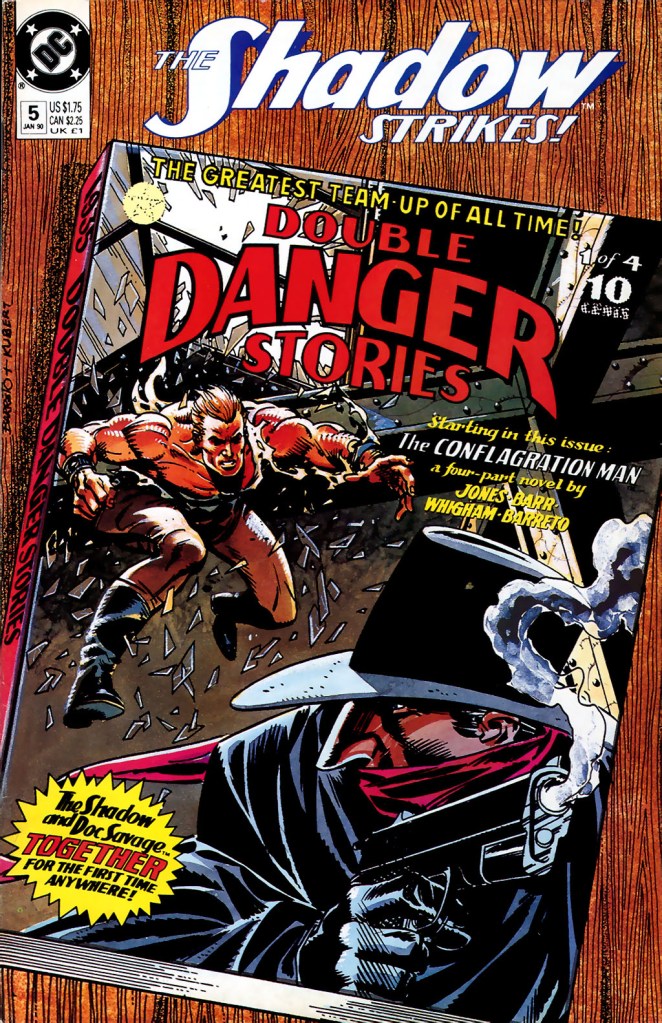
In 1990, DC Comics held the rights to both Doc Savage and The Shadow. Comics, of course, are obsessed with team-ups and crossovers, so it was no great surprise when the two great pulp heroes had a single continuous story pass back and forth between their respective titles. The story was called The Conflagration Man, and was co-written by each series author, Mike Barr and Gerard Jones. The artists, Rod Whigham and Eduardo Barreto, teamed from start to finish to give the story a cohesive look. A clever visual device was used to connect the cover presentations, with each series retaining its normal masthead, but pictured below is a pulp-styled book-within-a-book, called Double Danger Stories.
The story begins with The Shadow operating solo, working on a mystery that includes a mysterious weapon that causes guns to heat up and detonate. Given his reliance on his .45’s, his confrontation with some gangsters does not go well. He decides to come at the case obliquely, disguised as a gangster himself.
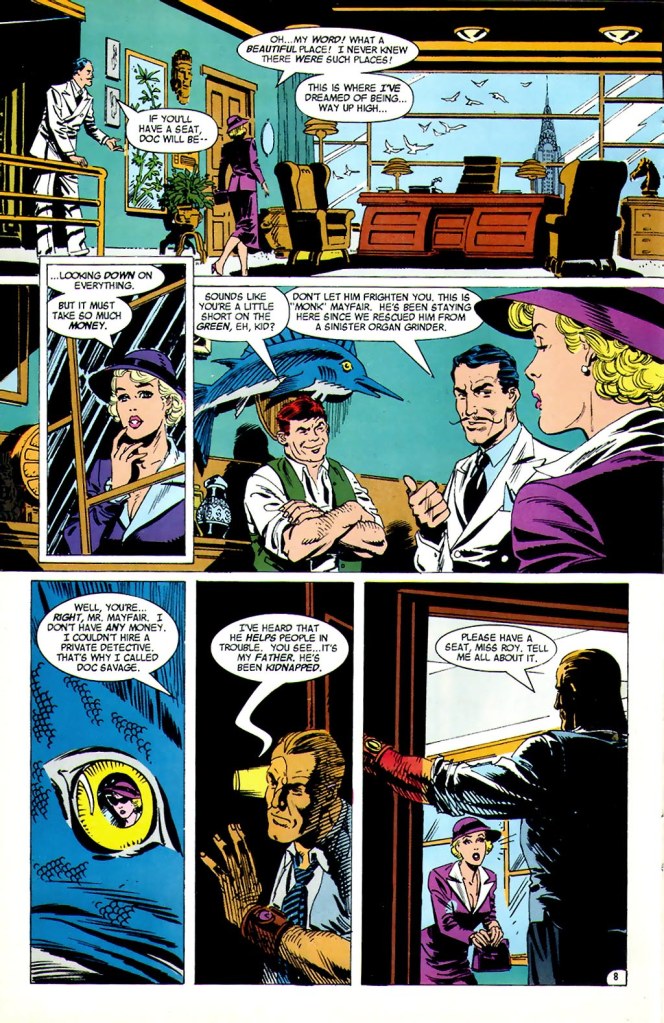
Meanwhile, a young woman arrives at a certain skyscraper headquarters…
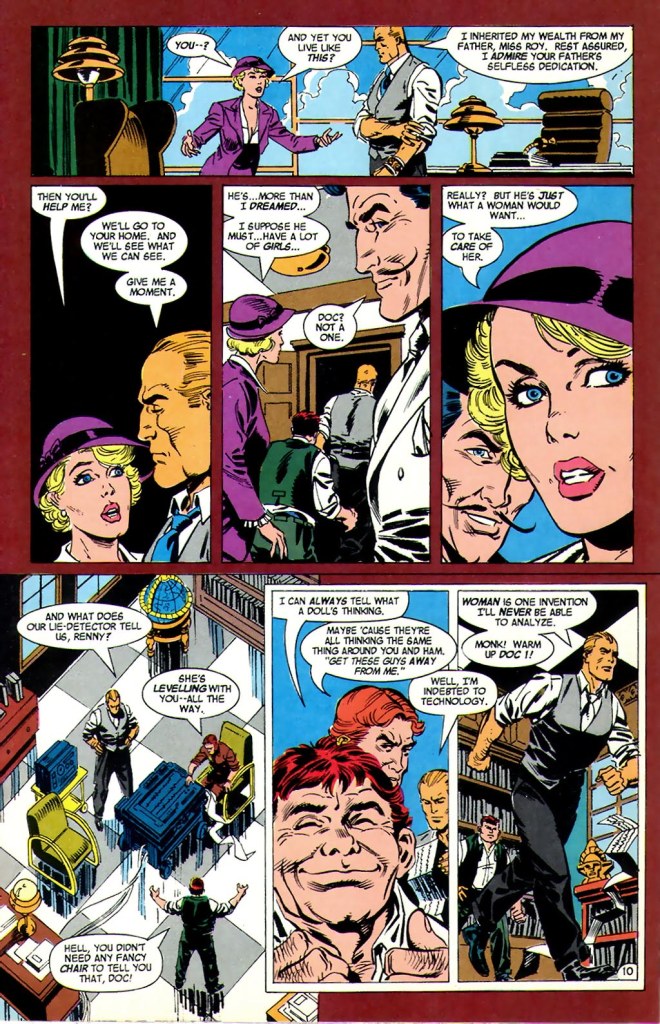
DC had begun their Doc Savage comic series with an updating of the scene to the 1980’s but they changed course after about a year and also included tales from the 1930’s. They also did a hybrid visual version of Doc himself, utilizing the basic Bama physique and an almost-widow’s peak, but dressing Doc in normal clothes unless he was in action.
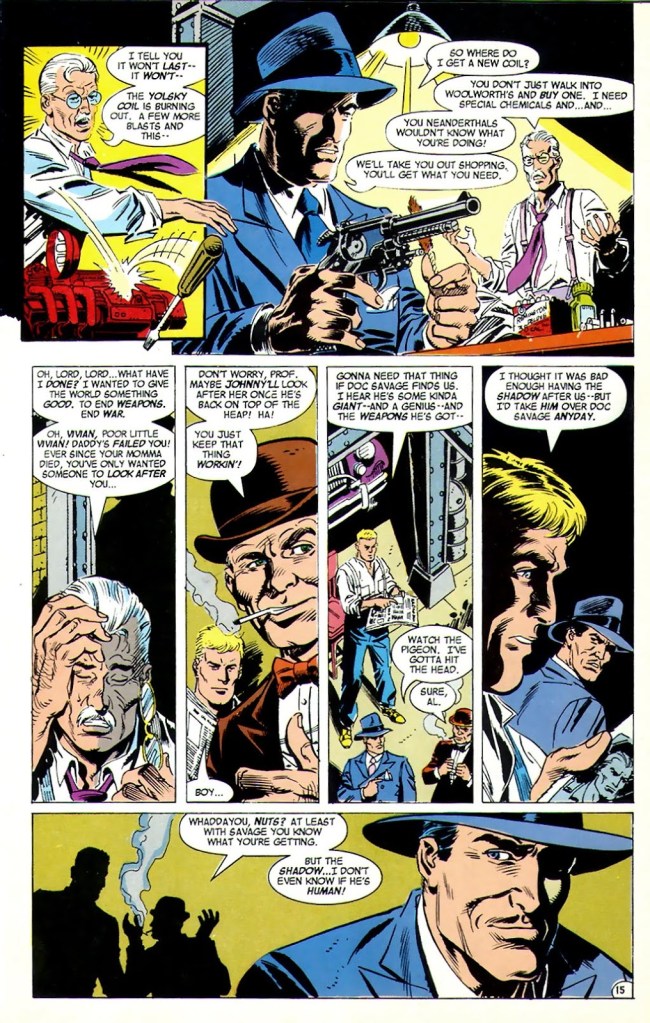
Meanwhile The Shadow, disguised as gangster Alphonse Ombra, has infiltrated the gang holding the scientist who has created the anti-weapon weapon. The conversation among the other crooks, comparing Doc and The Shadow and which they feared most, is very entertaining, given the fact that The Shadow himself is listening.
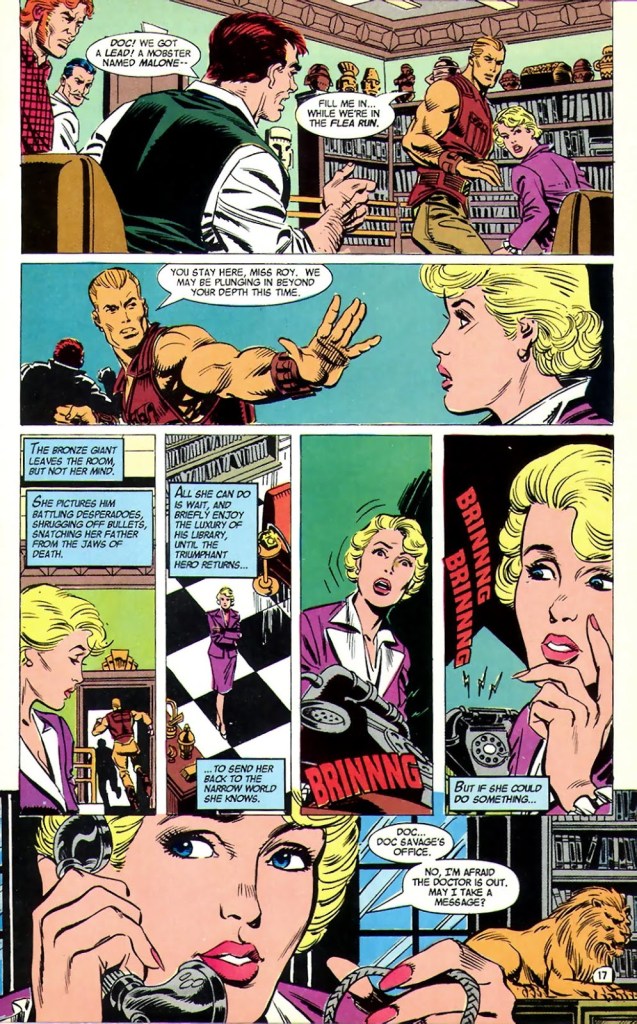
Things head for a collision course, as Doc prepares to assault the criminals directly…and soon all hell breaks loose.
The Shadow, as Al Ombra, takes on Doc directly, and attempts to hypnotize him…whether this would have worked or not is rendered moot when Ham nails Ombra with his mercy pistol. And the result is an intriguing scene indeed…The Shadow on the operating table of Doc’s Crime College, about to go under the knife!
There is a rite of passage that happens for all Doc Savage fans…the first time you were seduced by one of the series’ long, long array of spectacular covers. It might have been on a Bantam paperback, a comic book or magazine, or even an original pulp. The artist names included in that gallery of covers is legendary: Walter Baumhofer, James Bama, Jim Steranko among them.
My first happened in 1969. I was 11 years old, living in New England — a town called Framingham, Massachusetts. In that area, about 20 miles from Boston, there were many small, formerly farm-towns in the 1960’s, and Framingham, being more of a manufacturing town (the Dennison office supplies factory was located there) was a little bigger than most. It is probably hard for Millennial generations to really understand how deeply the life of a town in those days was integrated with those who lived in it. Framingham downtown had a small movie theater (which I would frequent as often as I could afford it, watching serials like Flash Gordon and The Shadow), it had a good library (being bookish, I spent a lot of time there), an ice cream parlor (where the best root beer floats in the world could be found), a department store where my grandmother worked, and a main street where they had parades on holidays.
And there was the local drug store, Dean’s Pharmacy, where I went to buy comic books. In 1969 I was a big fan of Marvel comics, and even at 12 cents each (the cover price in those days), it was hard to have enough cash to get all the issues I wanted to read.
I usually didn’t buy books. I had the library for that, and paperbacks generally cost five times the amount of a comic book. Until the day, on my way to the back wall where the comics were, I passed the Bantam Books spinner rack, and saw this:
I’d never seen anything like it before. At first I thought it was a photograph, but could there really be a man who looked like that…so powerful, with that dynamic widow’s peak? The colors were so vivid, the pose so intense…I paused, and took it off the rack to look at more closely. The back cover looked like this:
The hyperbolic story description was captivating to my 11-year old mind…and there were more of these novels listed at the bottom, a lot more! All with titles that shrieked with excitement, mystery and adventure.
The old Bantam spinner racks looked like this:
They could, of course, be spun, and you could see the titles on the spine of many books hidden by the one in front. I looked for the author’s name, Kenneth Robeson, and yes! There were more! All with visually arresting covers, which I would learn were actually painted, by an artist named Bama.
It was all too much for me to resist. 60 cents! Could I actually bring myself to spend that immense sum of money on one book? I could buy five comic books for that amount! But I had to have it. I bought Merchants of Disaster, and I carried it around with me for days, reading every moment I got the chance.
After that, I was a goner. My life no longer could be calculated in 12-cent increments. I now had to save 60 cents (later 75), to buy each new Doc book that appeared (and at that time they were monthly), as well as all of the older ones I could find. That Bantam spinner rack became my source for a treasure hunt that felt gloriously endless.
Over fifty years later I have dreams sometimes of going into Dean’s Pharmacy (which is long gone, as well as most of the icons of small-town America that I grew up with)…and finding a Doc Savage book on that rack that I have never seen before (even though I have now seen them all), and I feel the same rush of excitement I felt a half century ago.
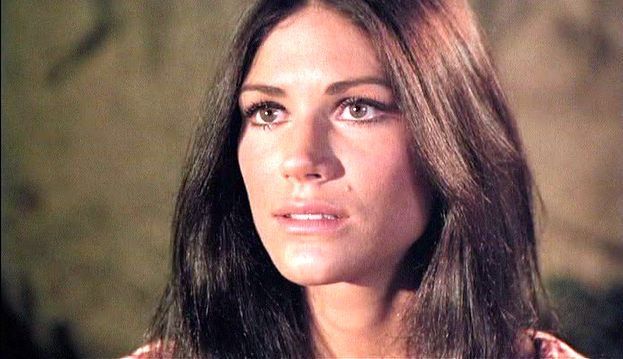
1975 was a unique year for the actress Pamela Hensley. She appeared in two motion pictures, and her roles were both strikingly different and eerily similar.
Pamela Hensley, 1975
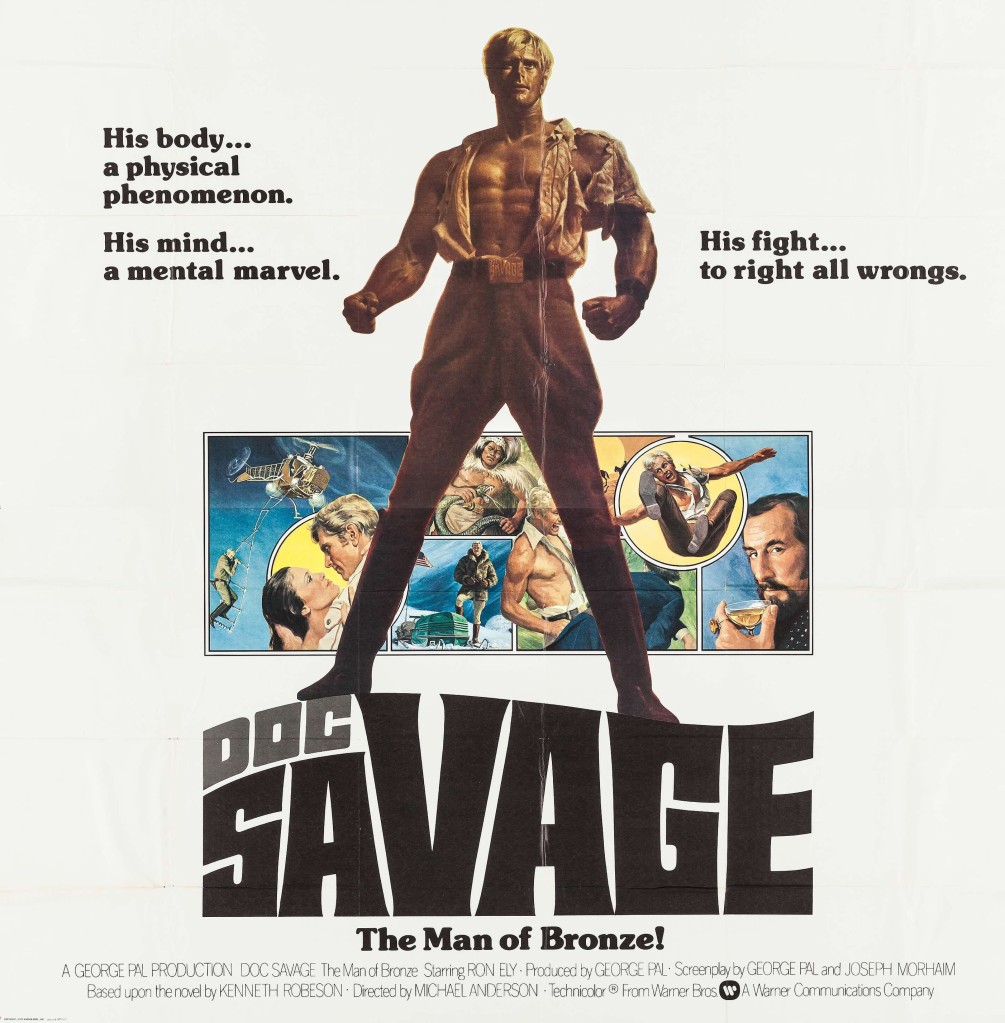
One film, Doc Savage: The Man of Bronze, was a campy adventure with aspirations to be a blockbuster. Its tone was upbeat and innocent. She plays Mona, a love interest who appears far too intelligent for her surroundings, and who is rejected by the hero (though with quirky gallantry).
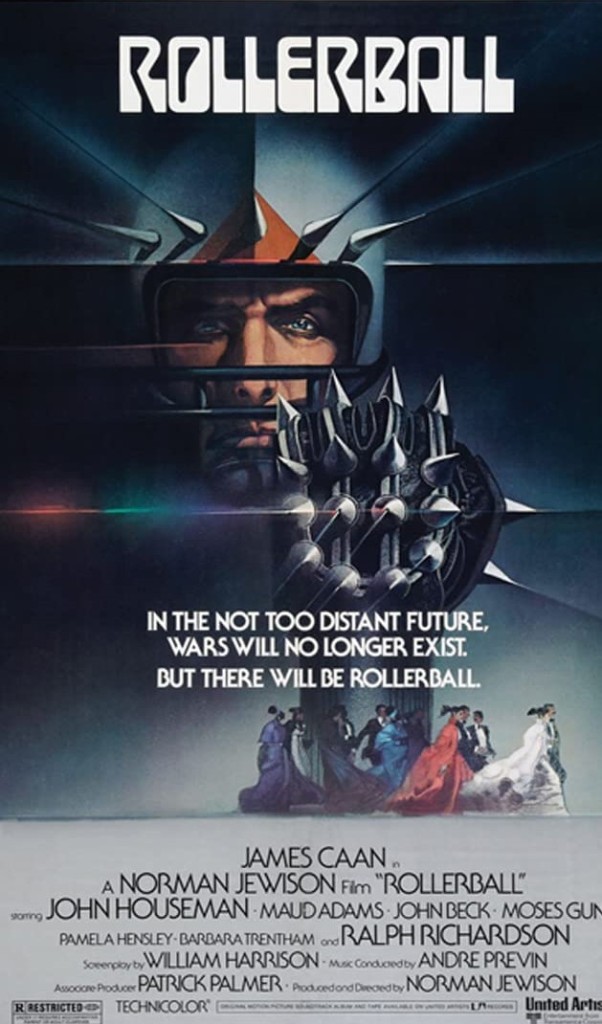
The second film, Rollerball, was a futuristic violent sport/social commentary with aspirations to be a blockbuster. Its tone was downbeat and jaded. She plays Mackie, a love interest who also appears far too intelligent for her surroundings, and is rejected by the hero (in a blunt and dismissive manner).
In Doc Savage, her role is based on Princess Monja, a Mayan aristocrat from the novel The Man of Bronze. For the movie her character is modernized, becoming Mona Flores, who helps Doc find the legendary Valley of the Vanished (which will become Doc’s source of financing his crusade against crime, using a Mayan treasure of gold).
Doc Savage: The Man of Bronze movie poster 1975
Though her role is a somewhat thankless one (she is dedicated and brave, and it could be safely said that without her assistance Doc’s quest would not have been successful), she brings considerable dignity to the character of Mona — which is noteworthy in a film loaded with so much over the top camp.
Ultimately she professes love for Doc, but he gently (if clumsily) rebuffs her — as seen in this trailer for the film. He calls her “a brick”…which was actually a somewhat complimentary term in 1933 when it was also used in the novel (meaning someone who is steady, even-tempered and dependable), but didn’t play so well in 1975.
The Doc Savage film tanked at the box office and was critically eviscerated — it was such a resounding failure that the proposed film series was cancelled.
Rollerball was something of a different story.
Rollerball movie poster, 1975
Again Hensley plays an unappreciated woman — essentially a sexual escort given to the movie’s main protagonist, Jonathan E,. the star attraction of the violent futuristic sport of the film’s title.
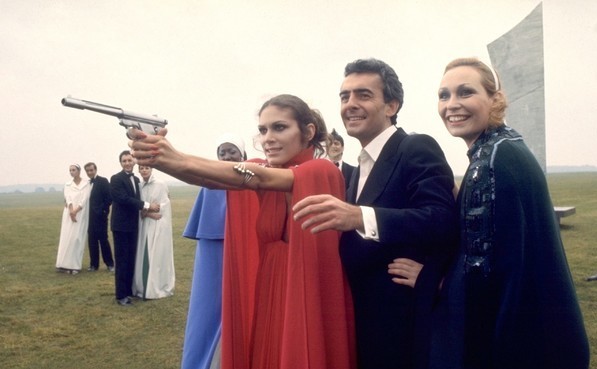
Once again, she brings considerable dignity to the role. Jonathan rejects her despite their having spent months living together. She is angry and bitter, having done nothing to merit being essentially kicked out of his life. For a while she disappears from the film, but then returns in a remarkable scene — a lavish party is being given for Jonathan, and she appears as the companion of a corporate executive. She vents some of her anger toward him, to which he seems oblivious.
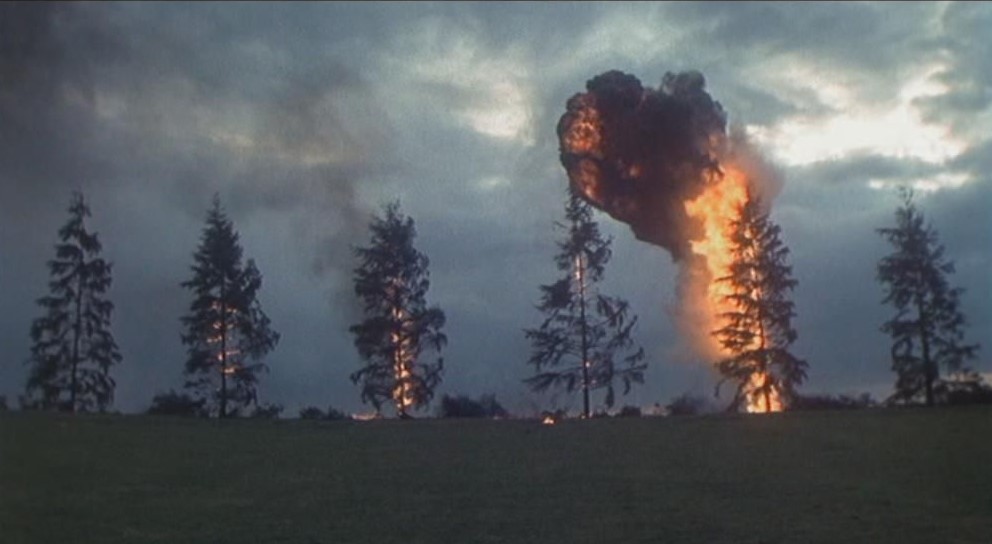
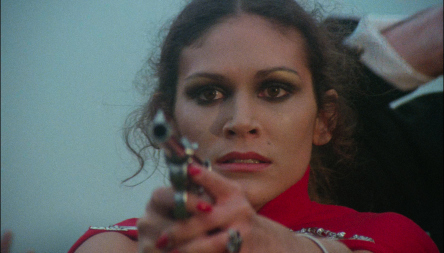
Then, as the party winds down, she and other guests wander out onto the grounds and indulge in a fit of hedonistic violence…using an incendiary pistol to set a row of trees on the property on fire.
Mackie at first seems to feel a degree of release from the fiery spectacle, but afterward appears traumatized and horrified.
It’s an intense scene, in which a viewer who has watched both films can very viscerally experience the emotional storm of frustrations felt by both characters, Doc Savage’s Mona and Rollerball’s Mackie.
Certainly a intriguing year of roles for Hensley. Rollerball was commercially successful, so her career was not sunk by Doc Savage. She would go on to appear in several TV series of the later 70’s and 80’s.
Her charisma and balance of elegance and emotion in both films from 1975 is memorable…though intended to be overshadowed by others in both films, I find when I watch them that it is Hensley who shines brightly among more highly-touted stars.
Note from Doc Talos author/contest judge R. Paul Sardanas: A fascinating piece of pastiche detective work by Joan Lee, who links the notorious stories and poems by Anais Nin, Henry Miller and George Barker, commissioned privately in the 1940’s by an individual known to them as “The Collector” (later revealed to be Oklahoma oil man Roy Johnson), to an even deeper source…none other than James Talos Jr,. using Johnson as a front. With that fascinating premise as a platform, Ms. Lee explores the perspectives of male and female passion with unique depth and vibrancy.
Comment from author Joan Lee: The writings presented as those of Anais Nin in this short piece are indeed by Nin, culled from interviews and from her commission works for authorial patron “The Collector”. Her works from that commission were collected in the book “Delta of Venus”, written in the 40’s and published in 1977. The shyness with which the character of Doc Talos approaches sexuality and the thoughts of women, as well as his own literary presence in the 1940’s, made a unique conjunction to play with in this pastiche story. I do not reveal what Doc writes at the end of the story for the simple reason that it is your own thoughts, dear reader, that I wish to have you imagine writing in his place. That is part of the mystery and glory of sex: the infinite ways that it can be articulated in our own hearts and minds.
Thank you to R. Paul Sardanas for the invitation to write this story, and for the mirror-images on the title page of Anais Nin and Ron Ely, which beautifully conjure the exchange of thought that takes place between these unique individuals.
Additional note: If you are interested in submitting fiction to the Summer 2021 contest (first prize is a Bantam Doc Savage paperback Czar of Fear first edition, signed by James Bama, and all contestants will appear in a special souvenir paperback collection of the stories) you can read the contest guidelines HERE.
At the end of Part 3 of this article, after exploring this story’s unique position as one of the final tales closing out the era of the hero pulps, as well as the narrative strangeness of the beginning and middle parts of the story itself, there was a portentous question remaining: was the Hell encountered in Up From Earth’s Center real?
At this point Lester Dent would probably chuckle, and say something on the order of “It’s a pulp yarn, kid. Stop looking at it like a sacred text.” And of course he would be right.
In his description of the story in his book The Adventures of the Man of Bronze: A Definitive Chronology”, Jeff Deischer points out that “…the original ending planned by Dent exposed the whole situation as a hoax. Editorial direction by (new) Daisy Bacon changed this to leave some room for doubt on the part of the reader. And greater hoaxes have been perpetrated in the series.”
Will Murray elaborates on this in his discussion of the story in the Sanctum reprint of Up From Earth’sCenter. He cites correspondence between Dent and Bacon about the tale:
Dent:
“Many of the pulp yarns that have seemed the most successful had an adventure background that approached the bizarre….So what about a piece about a fellow who found a natural cavern in the Earth and in exploring the meanderings deep into the lower regions made the shocking discovery that Hell is exactly where it is reputed to be — down below? Having had a peek at it through a crevice, he left hurriedly. However the brief glimpse had been noted, and Old Nick dispatched a sort of junior-grade demon to silence the chap. The yarn would concern Doc Savage, after he is called into the affair, and his difficulties with the demon, j.g. At the end, a logical explanation of the whole affair could be whipped up to take it out of the realm of phantasia, should that be advisable. It would all give room for the wildness that readers, I believe, either love or loathe.”
Bacon:
“It seems to me that the idea which approaches the bizarre adventure might not be amiss, since the last story was along pretty practical ideas. I wish I knew more about it, but time is running out and we must be getting started so I can do something about the cover and so forth. It seems to me it would be very hard to give this story a logical explanation as you suggest and I am wondering if it might not have to be left in the realm of fantasy.”
There was, understandably, the usual deadline chaos going on at Street & Smith, as well as the new editorial direction for the series, which Bacon wanted to return to its adventure-story roots, whereas Dent had more enthusiasm at this point in his career for more sophisticated storytelling. So there is a feel of the whole thing being slapped together while the series got its bearings. And of course that wouldn’t happen either — instead, Street & Smith canceled Doc Savage magazine after that issue.
Deischer, in his Definitive Chronology, offers solid explanations for all the otherworldly aspects of the tale, and Dent certainly scattered those potential explanation-points into the narrative itself. But unlike most Doc Savage stories, he did follow the “left in the realm of fantasy” direction/conjecture from Daisy Bacon, and threw so many odd features and twists into the story that readers could also adopt supernatural conclusions if they wished.
All in all, a somewhat messy creative provenance, which produced what might have been intended as little more than a stopgap issue while the team of Dent as author and Bacon as editor jelled. Had the magazine continued beyond that Summer of 1949, rather than it being the final issue, readers might not give Up From Earth’s Center any more special status in the series than they do to The Green Master and Return From Cormoral, the two adventures that preceded it.
With all that in mind, there is still the conclusion to the story itself, which has both intense and bewildering moments. The upshot of the plot machinations is that two groups descend deep into the Earth — Williams, who is revealed to also be a “devil”, and has taken Leona and Gilmore Sullivan prisoner…and Doc, Monk, Dr. Linningen, and Wail — who is kept tied with a rope-leash — pursuing them. (Ham, we learn later, had been knocked unconscious and did not descend deep into the caverns.)
Hints and realities of drugging are every which way. Doc, Monk and Linningen are all “doped” at the Maine lodge before the kidnapping, and as they go into the caverns odd smells are described, some like flower-scents, and deeper in, a more pungent, rotting scent. Doc at one point uses one of his devices to test the air, but finds nothing conclusive.
Wail slips free of the rope and flees (oddly, for a character shown to be able to disappear at will, he does not do so, but runs deeper into the cavern, the very place he has expressed no desire to go. One wonders why he didn’t go the other way…). Wail (and Williams too) display unexplained abilities to see and navigate their path in the dark. They pass through a crack in the cavern wall, and from that point on, are presumably in Hell.
Painting by Iason Ragnar Bellerophon
This is where Doc experiences either hallucinations or hellish visitations. Boulder-like shapes that can move…fungoid entities with tentacles…Monk penetrates beyond the crack and experiences encounters with the same monstrosities. Then there is a final horror that practically unhinges Doc.
Several minutes passed. He could hear the excited shouts as Monk and Wail joined Linningen and the Sullivans; he heard them continue onward. Their sounds nearly died away.
Then he heard weak, horrible sounds coming from the mass of fallen stone that had filled the crevice. He heard the sounds grow stronger, until at last they became movement, and a hideous figure began to drag itself from an aperture between the blocks of broken stone. The creature, a hideous caricature of humanity, spread itself over the broken stone, clawing, whimpering.
It began crawling toward Doc Savage, moving on all fours, stiffly and on dead limbs. “Help, help!” it wailed. “We must go back. Help us to go back.”
Clawing its way to Doc’s feet, the creature clamped its paws about his ankles. “Help!” it gasped.
Suddenly, Doc screamed, probably the first shriek of unadulterated terror he had given in his lifetime. He kicked wildly at the creature, which had buried its bony claws in his legs.
He fought madly The thing began to climb up his body, sinking clawlike fingers into his flesh, reaching upward for another handhold. Doc slugged, pitched about; with ghastly persistence, the thing clung to him getting nearer and nearer his face. Then the creature was at his throat, trying to drive small blunt teeth through the skin. Doc stumbled and fell, conscious of the thing gnawing, gnawing like a vile rat, seeking his jugular and his blood.
The tentacles of the creature that embraced him, indeed the thing’s whole body, felt spongy and slimy, and about it was the odor that Monk had noted, the sickening odor of fear. It seemed to have, except for its ability to remain fastened upon him, no real strength; he felt its teeth gnawing madly at his throat with a futile desire to eat.
He remembered then about their fear of flame. His hands were free; the creature seemed to have no desire to pin his hands. He fumbled insanely in his pockets, found his cigarette lighter and thumbed it into flame. Instantly, the repulsive thing flew away from him, covering many feet in one leap, and flattened itself against the broken stone, wailing with maniacal terror. Doc Savage sprang to his feet, more filled with fear than he had ever been, and began running. He did not look back. He had no desire to look back.
They return to the surface, and there is an epilogue in which many possible explanations are tossed off. Monk, wanting emotional relief from the whole thing, is quite ready to accept the talk of gas in the caverns and sympathetic joint hallucinations. Doc, intriguingly, takes little part in those conversations — instead he …stood at a window, frowning thoughtfully at the icicles which were forming at the eaves.
Wail is a prisoner of the authorities at this point, and Doc has a last conversation with him, in which Wail proclaims he is going to take his leave using his “devil powers”, and there is nothing that can be done to stop him. Doc leaves him in a locked room, the room’s guard peers in to make sure Wail is still there…and shortly afterward, he does indeed vanish.
The oddest thing about that (disappearances were no big deal in the course of the Doc Savage canon, they happen with distinct regularity), is Doc’s reaction to it. He actually — it appears — tells a lie. Or misleads, which is what he does when he wants to lie without technically lying. We have just seen his final interview with Wail, but flying in the face of that, is this conclusion to the novel:
The officer stepped through the door of the storeroom with a completely blank and unbelieving expression on his face. “Where the devil did he go?” he gasped.
The storeroom walls were intact, so were ceiling and floor, and there were no windows. And no Mr. Wail. Sergeant Griswold said, “When did you let him out?” “I didn’t let him out!” the policeman declared emphatically “Nobody let him out. He’s gone. Nobody went in there but Doc Savage, and he came out alone after talking to this Wail guy for a while. Isn’t that right, Mr. Savage?”
Doc Savage was wearing a thoughtful expression. “Right to some extent. You didn’t hear me talking to anyone, did you?”
“Huh?” The policeman stared. “Wasn’t he in there when you went in?”
“Did you really think he was?” Doc countered.
The officer swallowed. “My God! Why didn’t you say the room was empty? No! No, it couldn’t have been empty. I looked in after you left and saw this Wail–Oh, nuts! I was imagining–Why didn’t you tell me the room was empty, Savage?”
“I thought it might be some sort of joke,” Doc said.
Sergeant Griswold swore. “I don’t know how that Wail got away, but we’ll catch him.” The sergeant fisted his hands. “We’ll make him wish he was back in the brimstone country, where be claims he came from.”
“Want to bet on either statement?” Doc asked dryly.
And so ends both Up From Earth’s Center, and the long, remarkable pulp run of Doc Savage magazine. A strange ending indeed…one that echoes Dent’s statement from his letter to Daisy Bacon: “It would all give room for the wildness that readers, I believe, either love or loathe.”
In Part 1 and Part 2 of this article, numerous qualities about the story that have built it up into pulp-mythic status were explored — qualities which had very little to do with the story itself. The fact that it was the final issue in the iconic Doc Savage series undoubtedly gave it extra weight, as well as the fact that except for those with access to the original pulp magazine, there was no way to actually read the story — making it an object of mystery and curiosity for the more than forty years that passed between its original publication and its eventual reprint in the final volume of Bantam Books’ re-issue of the entire Doc Savage series.
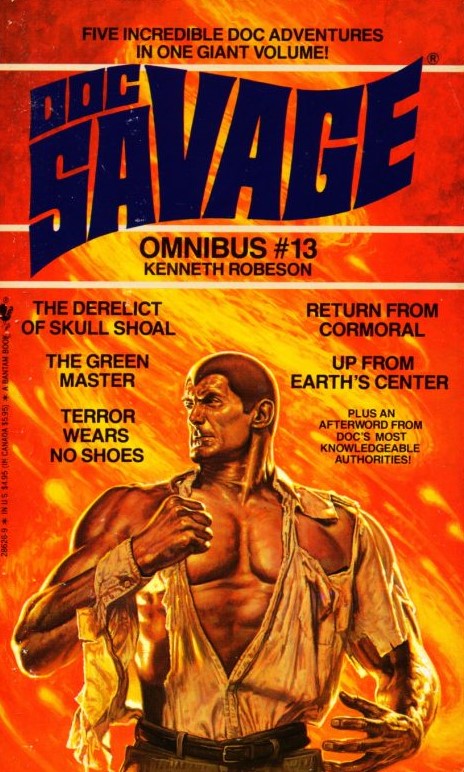
The cover of Doc Savage Omnibus #13, with art by Bob Larkin
The story itself (a sample of the beginning pages was presented in the previous article) was from the outset a strange combination of mixed cultural references, as well as confusing and disorienting behavior on the part of the supporting characters.
This would continue as the story progressed. Characters continue to do inexplicable things (for instance, one of the passengers on the boat that rescues the castaway Gilmore gets into a dinghy, throws away an oar, and sculls himself into a riptide and what would almost be certain death — he is rescued, but claims afterward he does not even remember the incident).
Doc Savage is brought into the story in a manner that relies on coincidence — one of the rescuers, a psychologist, is an acquaintance of Doc’s aide Renny Renwick, and has read that Renny is working on an engineering project in the area (Renny never actually appears in the tale). The doctor, named Linningen, presumes that Doc may be with Renny (something of a leap in logic in itself), and seeks out his rooming house in a small coastal town in Maine. On the way he is nearly run down by a car.
Hoping to get Doc’s assistance with the seeming madman they have rescued, Linningen, after some frustration, talks with the bronze man, and though the exchange is tense and irritable, Doc agrees to look into it. Linningen is relieved — he wants out of the whole strange business.
However, when Doc comes aboard Linningen’s yacht to speak with Gilmore, he finds the man has disappeared…replaced in his locked cabin by a cherubic-faced, sardonic personality named Mr. Wail.
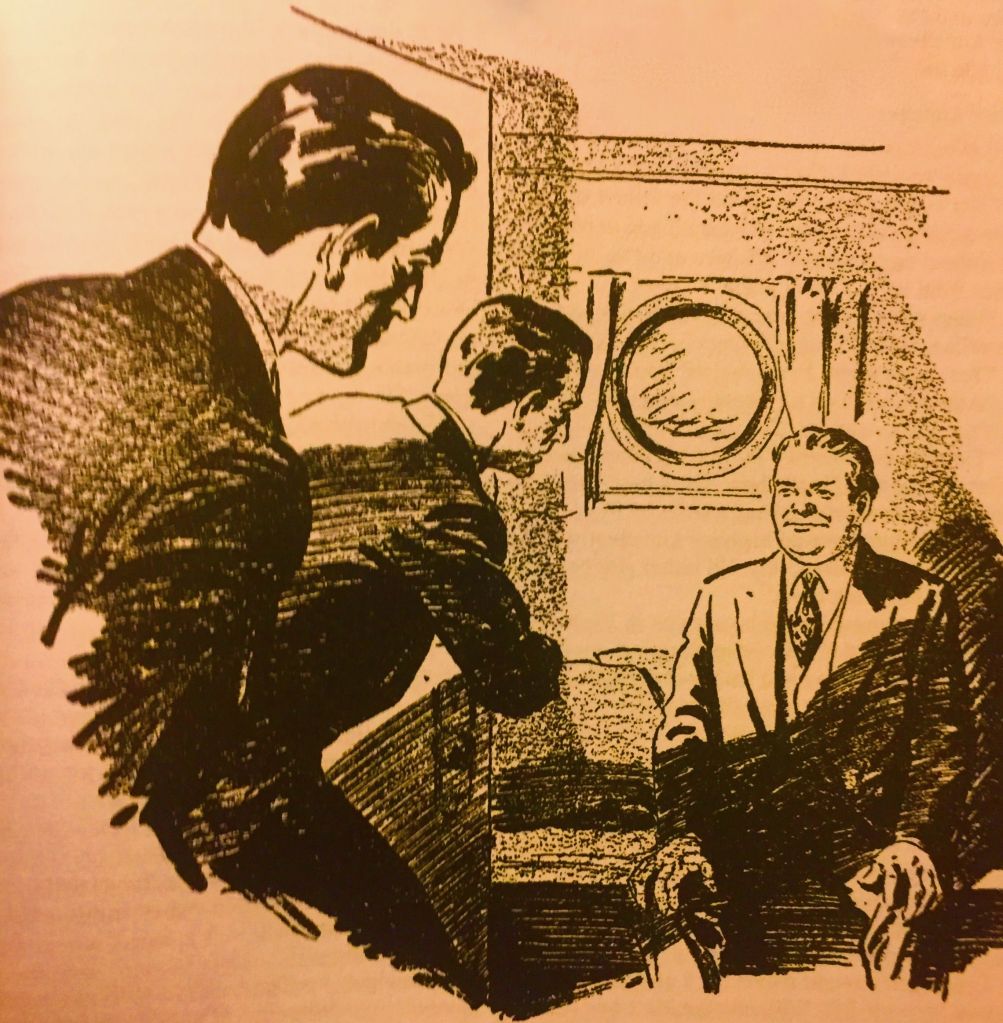
Interior Illustration from “Up From Earth’s Center”, by Paul Orban
Wail gives a very unconvincing account about how he got aboard without anyone seeing him, and basically provides contradictory information about everything. He asserts he is a private investigator hired to track down Gilmore. However, it turns out he was the one who tried to run down Linningen in the car.
After a good deal of frustrating conversation, they do learn one thing — Wail suffers from pyrophobia, a fear of fire.
The story proceeds in very haphazard fashion. Gilmore cannot be found, but Wail asserts that he may have fled to a lodge further inland run by Gilmore’s sister. Doc, Monk and Ham, along with Wail, Linningen (despite his assertion earlier that he wanted nothing more to do with the matter) and Williams (the man who almost committed unwitting suicide in the riptide), all drive to the lodge.
Not much of this, when looked at practically, makes much sense. Why did Linningen so radically change from his position of wanting to be free from the whole business? Why would Williams come along at all? Why would anyone believe Wail’s story about the sister and the lodge without even making the slightest effort to check on its veracity? How would Gilmore have gotten to the lodge at all? He was, after all, emaciated and behaving like a lunatic.
At this point, as a reader, I had decided not to try and make sense of it. Lester Dent, the author, had a long, long history of writing characters and events that sometimes careened through a tale as if he was making the events up as he went along, and would figure out how to piece it all together by the finish (to his credit, he often did exactly that). So I put my reasoning mind in check, and determined to just go along for the ride.
That ride would, in short order, go from odd, confusing and disorienting, to outright bizarre. Doc Savage stories had, for sixteen years, relied on a formula of supernatural-appearing elements being comfortably explained away in rational, scientific (or pseudo-scientific) terms. Doc generally remained calm and was many steps ahead of the game, usually having figured out the real situation well in advance. But all (or at least most) of that would go right out the window as this story hurtled through its latter chapters. Looming largest in the outcome that was soon to arrive was one question…was the Hell they would encounter real?



























 Doc Talos