Paris and Pistols: Princess Monja in the Doc Savage comics – Part 3 of 4

The first two parts of this article were in chronological order, exploring the characterization and presentation of Princess Monja in the 1972 Marvel Doc Savage comic, and the 1987 DC comics series. Monja would next appear in the 90’s, when Millennium, a smaller but very ambitious comics company, acquired the Doc Savage rights.

Millennium’s series will be the final installment of this revisit to the Princess Monja of the comics. First we will jump all the way forward to 2015, and the most recent appearance of the princess, in Dynamite Entertainment’s miniseries The Spider’s Web.

The writer/artist team for this five-issue series (specifically designed in length to be collected as a single graphic novel), was Chris Roberson and Cezar Razek. Prior to The Spider’s Web, Dynamite and author Roberson had done a much larger limited series (with impressive Bama-like covers by Alex Ross), in which the whole mythos and timeline of Doc Savage was hugely overhauled to cover the entirety of the 20th Century and beyond, to the present day. Doc’s aging (and to a lesser extent, Pat’s) has been arrested, not through the technology of space aliens as in the DC series, but through the use of silphium, the chemical that first appeared in the original pulp novel Fear Cay. This gave Roberson a huge swath of time to play with in his subsequent series.

Interesting, and certainly ambitious, but the Dynamite series seemed to try and chart a middle road between exuberant pulp adventure and the more complex plotting of modern thrillers…in the end feeling surprisingly flat.

The Spider’s Web uses the new framework to the Doc mythos to tell a story spanning much of the century. While certainly a competent tale, it is cluttered with characters that seem to serve very little purpose beyond moving the plot to the next stage. Among them, Princess Monja.

The segment of the story she appears in takes place in 1955 — an intriguing notion in and of itself, as that was beyond the 1949 end date of the pulp adventures, but far enough back in time to potentially have a unique period feel. It is presented as a flashback (Doc and his new collection of assistants are working their way through the 20th Century for clues to a modern-day mystery). The basic plot is a small mercenary group has taken over The Valley of the Vanished for nefarious reasons.

Doc, an older Monk and Ham, and Pat drive out to the Hidalgo Trading Company, doing a fair amount of talking to set the scene (a recurring problem with the Dynamite comics, contributing their often static feel).
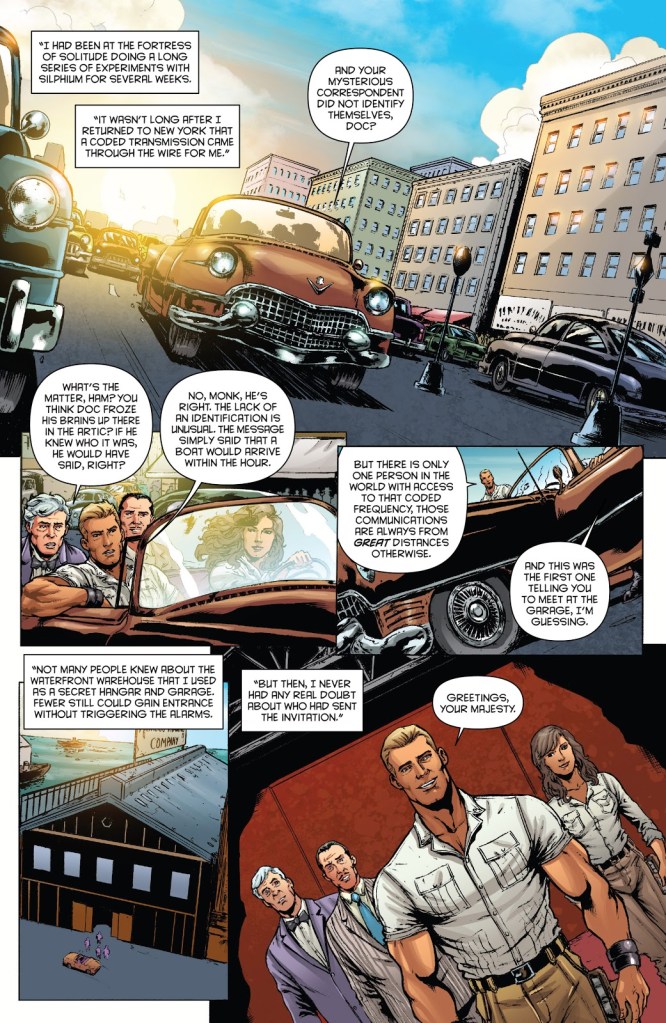
Upon arrival, they find their guest to be Monja, who is quite unlike any other incarnation of the Mayan princess.
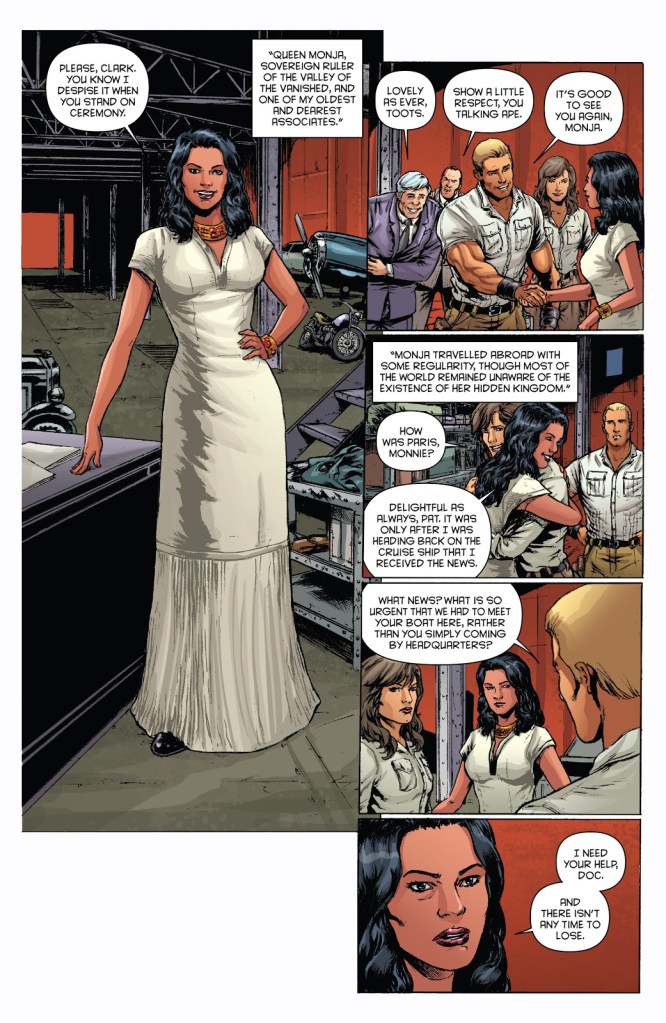
She is now Queen Monja, not princess. She’s sophisticated, modern, emotionally cool. And from the get-go it is clear that it is not merely an exterior demeanor; she and Doc have no intimacy, no spark to their relationship. He greets her by shaking her hand…even Pat is warmer, giving her a hug and calling her “Monnie”. She talks about a recent sojourn in Paris, and her other travels abroad. Then they get right down to business (more sitting and talking, again lapsing into exposition). Monja tells them about a mercenary invasion that has happened in Hidalgo, and enlists Doc’s help in freeing the Valley of the Vanished from that oppression.
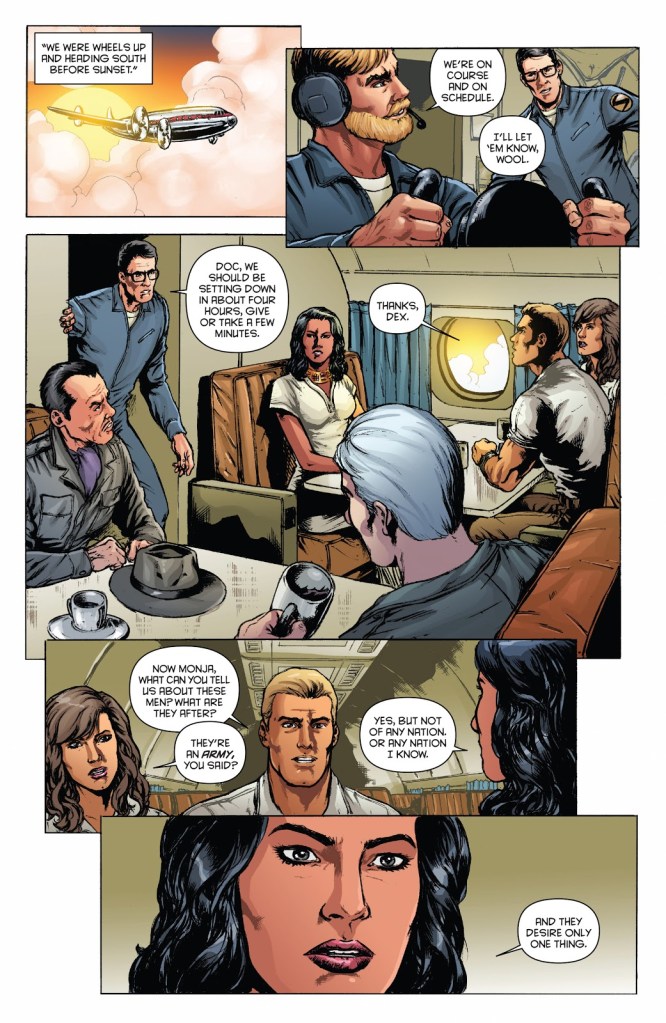
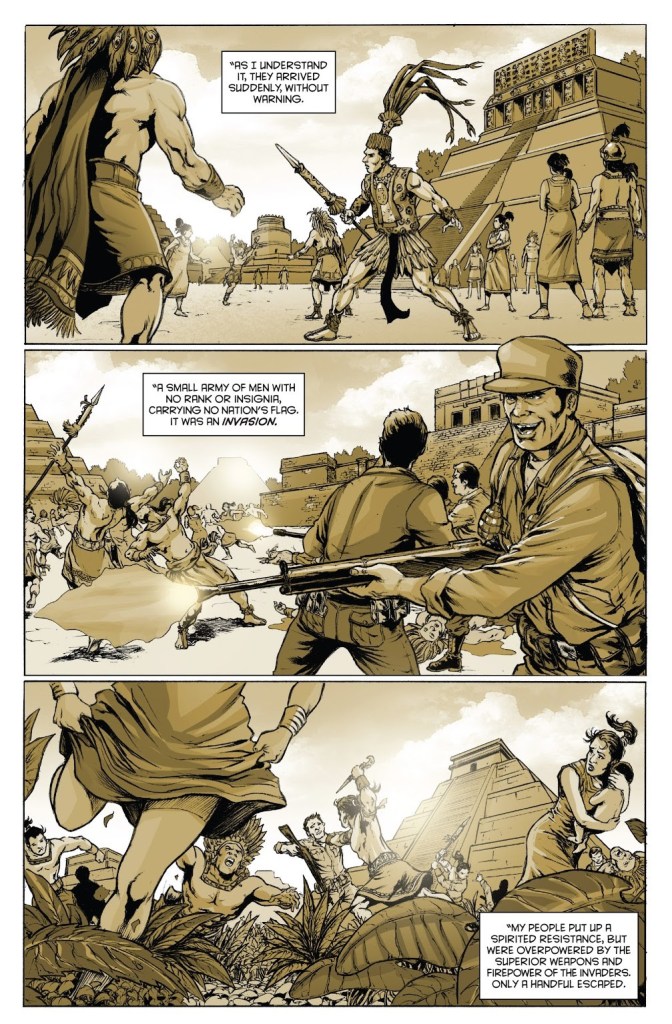
A page later they are in Hidalgo, and setting off into the jungle.
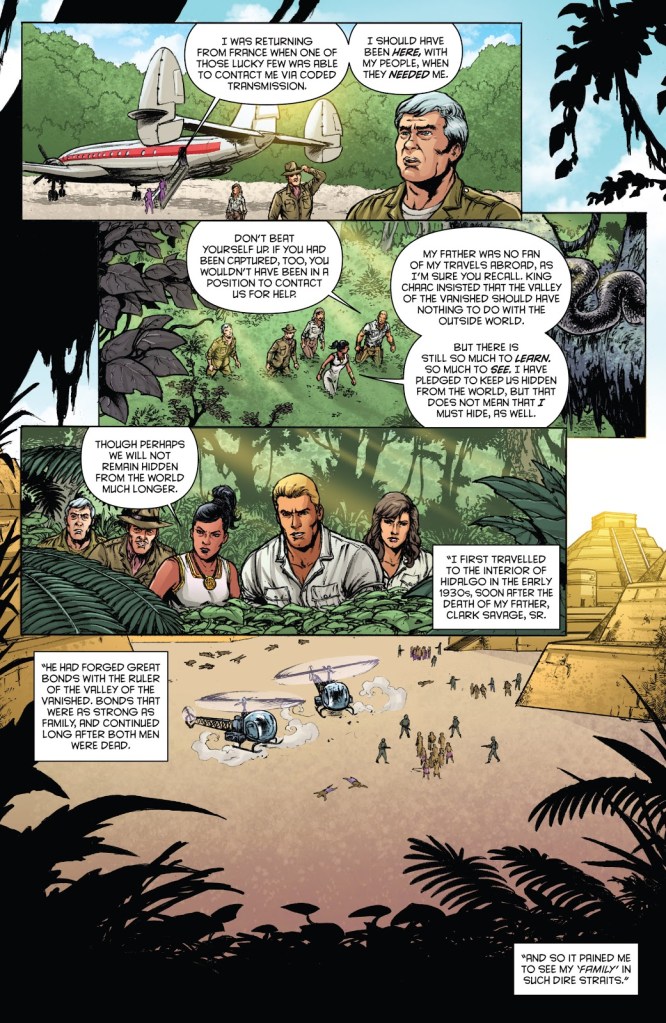
The fight that ensues is brief, decisive, and over before you know it. Monja, during the course of the battle, is strong and handles a pistol with authority — no trace of the tragic heroine, which I found enjoyable — but also, pretty devoid of personality.

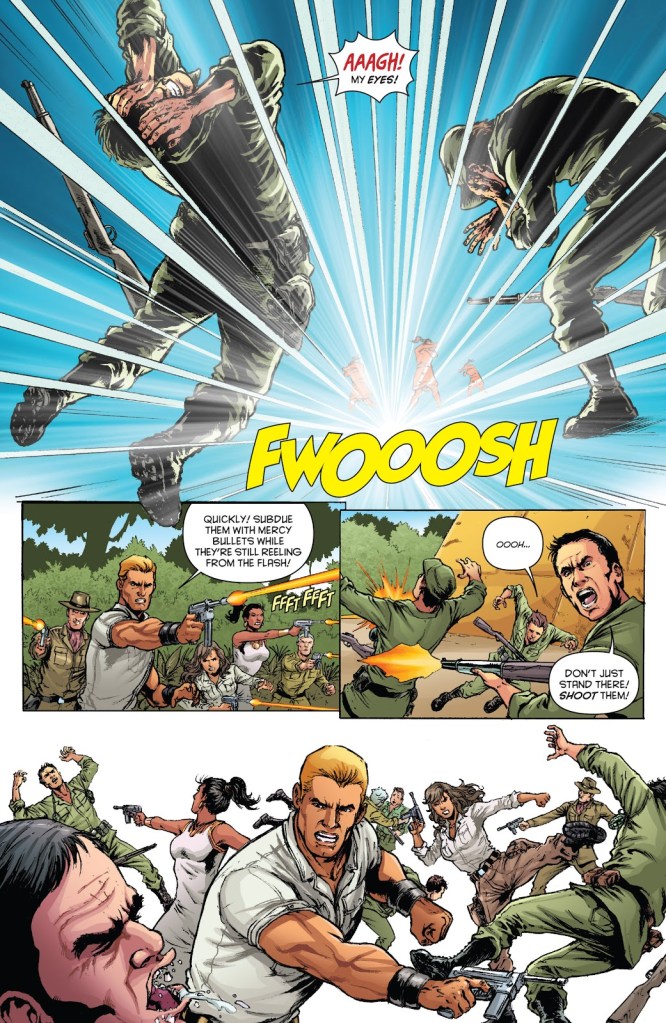
The mercenaries are routed, the plot is advanced to the next stage, and the final panel with Monja shows her standing near to Doc but apart, in a state of visual and narrative disconnection.
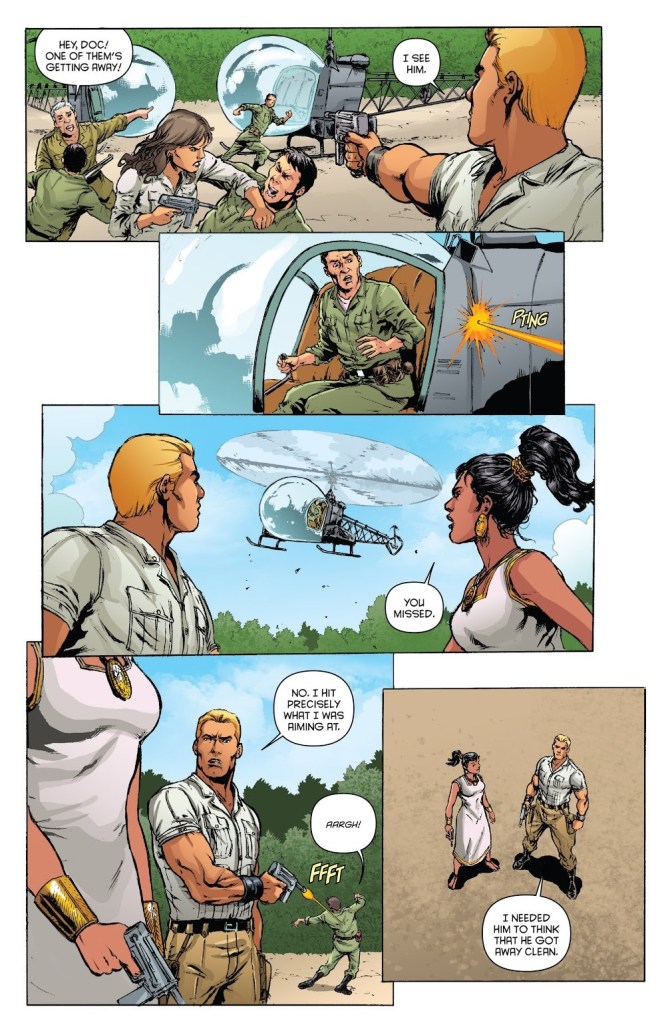
And that’s it. She does not appear in the story again. Once again, potential to explore the more human side of Doc through his connection to Monja comes to pretty much nothing, which I found sad. The story lurches on its way, and through many laborious machinations winds back to the present…all told — to use the same descriptive as above — competently, but absent of storytelling fire.

Hard to say if this will be the last time we ever see Monja in the comics…the next Dynamite miniseries didn’t include her in any way, and Dynamite does not seem in any hurry to do more Doc Savage. “Modern Monja” certainly has potential, but in what seems to be her constant fate, it may well remain unrealized.

Next…Monja’s most emotional and intense incarnation, in the Millennium story The Monarch of Armageddon.

To be continued…

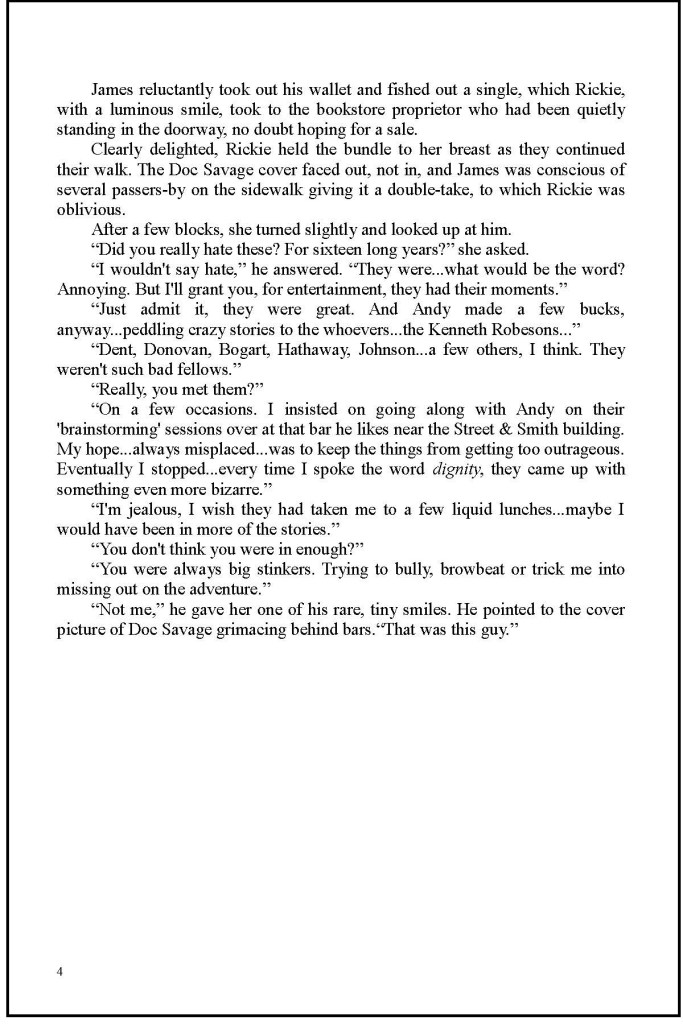
Talos Fan Fiction Contest Entry #7 – 1950

Note from Doc Talos author/contest judge R. Paul Sardanas: New Yorker Joe S. Stuart, master of the vignette, gives us a charming glance at the “Year After The Hero Pulps Died”, from the point of view of the heroes. And who among us here in 2021 wouldn’t faint dead away to see a bundle of pulps out on a bargain table, ten for a dollar?

Comment from author Joe S. Stuart: The Argosy Bookstore, featured in this little tale, is a real place, and is still alive and well today. It is, bar none, the best place in New York City. I picked The Vanisher as the pulp Rickie spots on top of the bargain bundle after I saw that great, crazy cover in the “Ten Most Lurid Doc Savage Pulp Covers” blog post here, and gave some thought to how the “real Doc” might react to having seen such things nonstop from 1933 to 1949…and then realizing that even in 1950 and beyond, he was going to keep seeing them.

Additional note: If you are interested in submitting fiction to the Summer 2021 contest (first prize is a Bantam Doc Savage paperback Czar of Fear first edition, signed by James Bama) you can read the contest guidelines HERE.

Courage and Tragedy: Princess Monja in the Doc Savage comics – Part 2 of 4

After the briefest of appearances in the Marvel comics adaptation of The Man of Bronze in 1972, Monja would not appear in the comics again until 1987. And that appearance was very odd indeed.

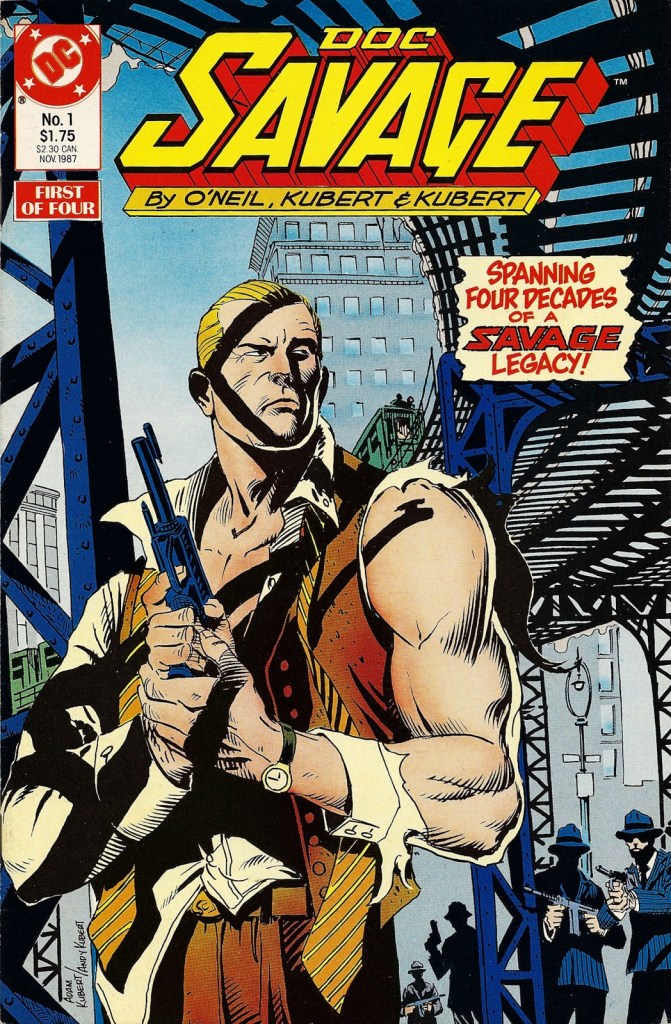
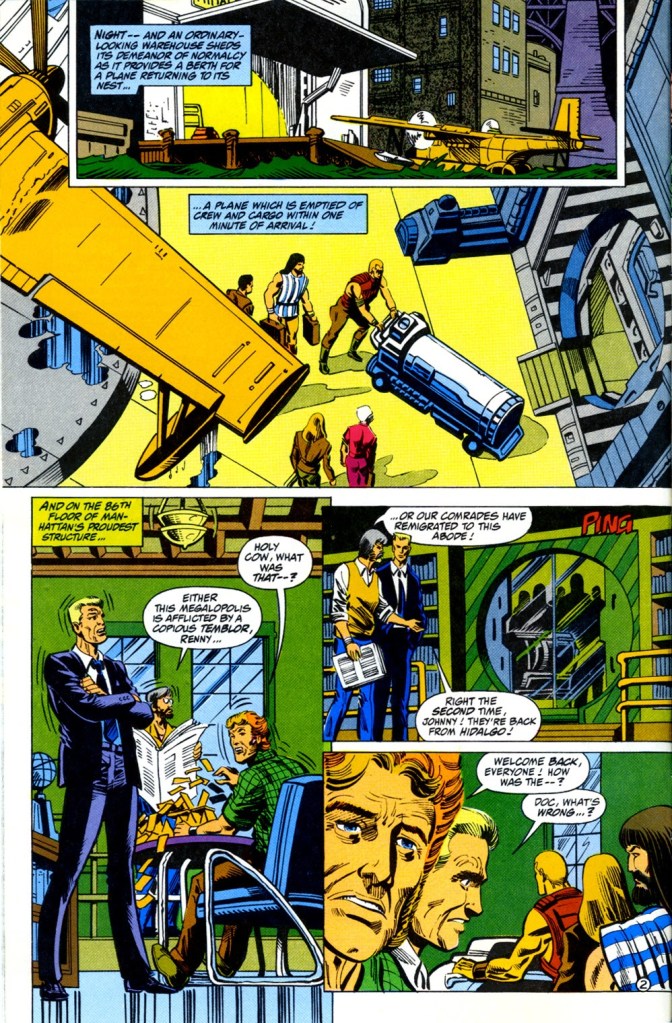
DC Comics had acquired the rights to do Doc Savage, and based on the success of Howard Chaykin’s revisionist modern The Shadow: Blood and Judgment, they clearly wanted to try something unusual. The creative team had solid credentials: Dennis O’Neil (one of DC’s more celebrated authors) doing the story, and Adam and Andy Kubert (sons of comics legend Joe Kubert) on the art.

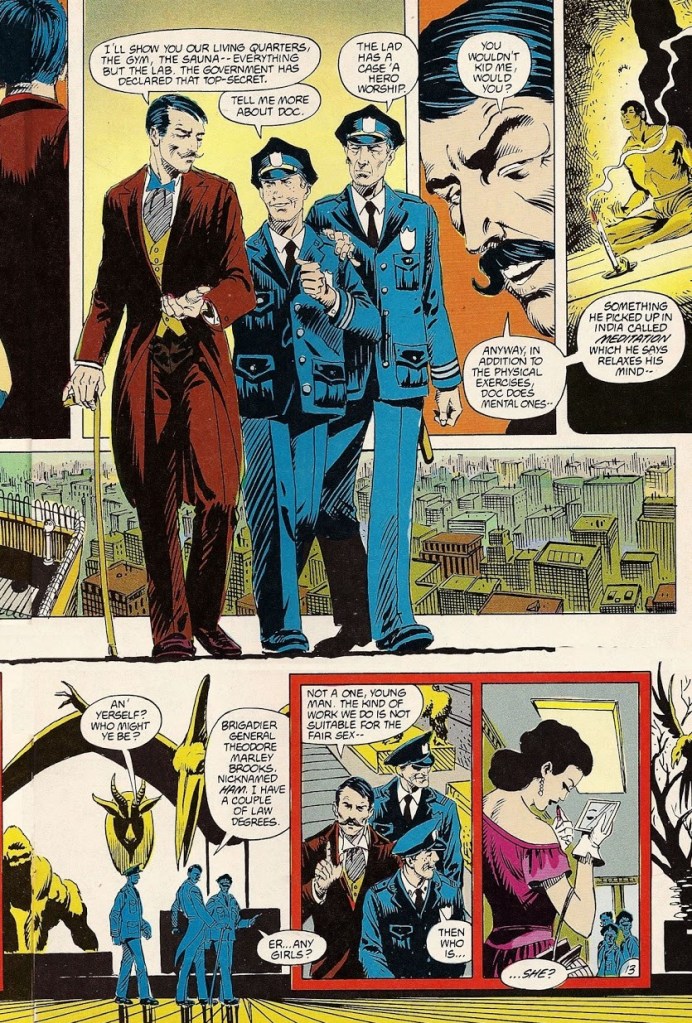
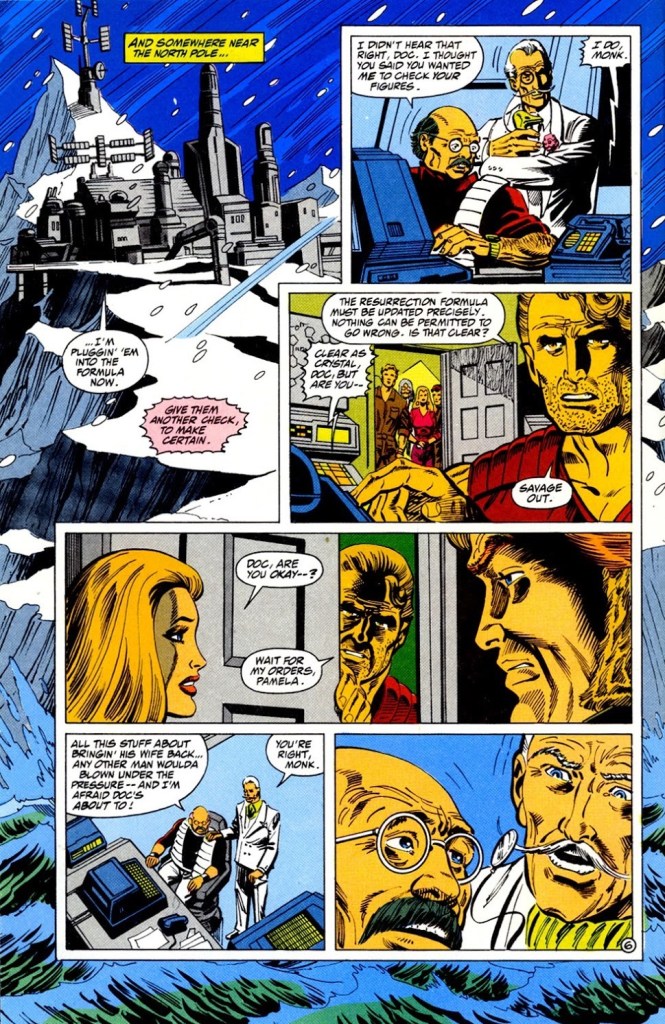
Things, however, got very weird, very fast. Doc looked pretty good (a kind of hybrid Baumhofer/Bama look, with a physically imposing Doc in normal clothing — which gets ripped, naturally) but the five aides were bizarre. Monk was runty with black hair, glasses, a droopy mustache and a sour disposition. Ham wore full tails-and/or-tophat evening attire at all times and had a handlebar mustache, making him look more like a court jester than a fashion plate. Johnny had a beard and was not particular skinny, Renny was nondescript instead of immense with huge fists, and Long Tom, instead of being puny, looked like a linebacker.

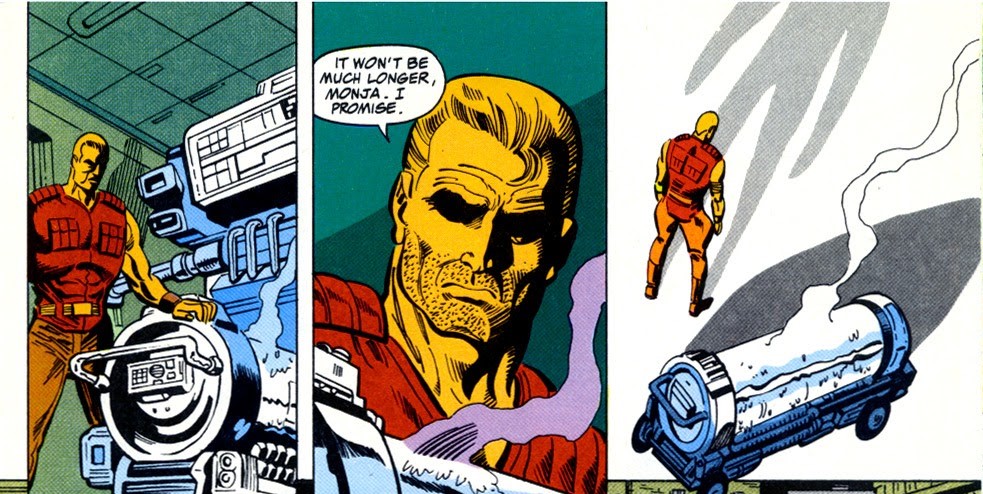
There there was Monja. In the story, set in the 1940’s, she and Doc are married — an intriguing concept — but for some inexplicable reason O’Neil does not use her proper name. He calls her F’Teena. If there is a reason for this other than an odd whim, it is never explained. Attempting to uncover an etymology for the name turned up zero (it has no Mayan derivation that I could find), other than the fact that Teena is a girl’s name derived from the latin Christina, meaning “anointed, Christian; strong, healthy”. I suspect O’Neil just liked the sound of it, and intended the character to actually be a different Mayan woman, since she would be so rapidly discarded in the narrative.

She has no part to play beyond serving to illustrate Doc’s shyness around intimacy, and to provide a bridge to the next generation. At the end of the first issue, in which Doc presumably dies, she is pictured — barely visible in the background — in the last panel after giving birth to his son. And then she vanishes from the series.

Later in the DC run of comics, O’Neil departed (after another bizarre storyline, involving aliens on the moon — not classic Dent scientific fakes, but real aliens), there came a change in direction for the series. Mike W. Barr, the new writer, seemed intent to restore all of the characters to something far closer to their pulp personas and appearances. Though still set in the present day, the Amazing Five began to look and act a bit more like themselves (though their action was reduced as DC continued to develop a new modern set of aides), Pat Savage was re-introduced, and so was Princess Monja. The series artist at this time was Rod Whigham.

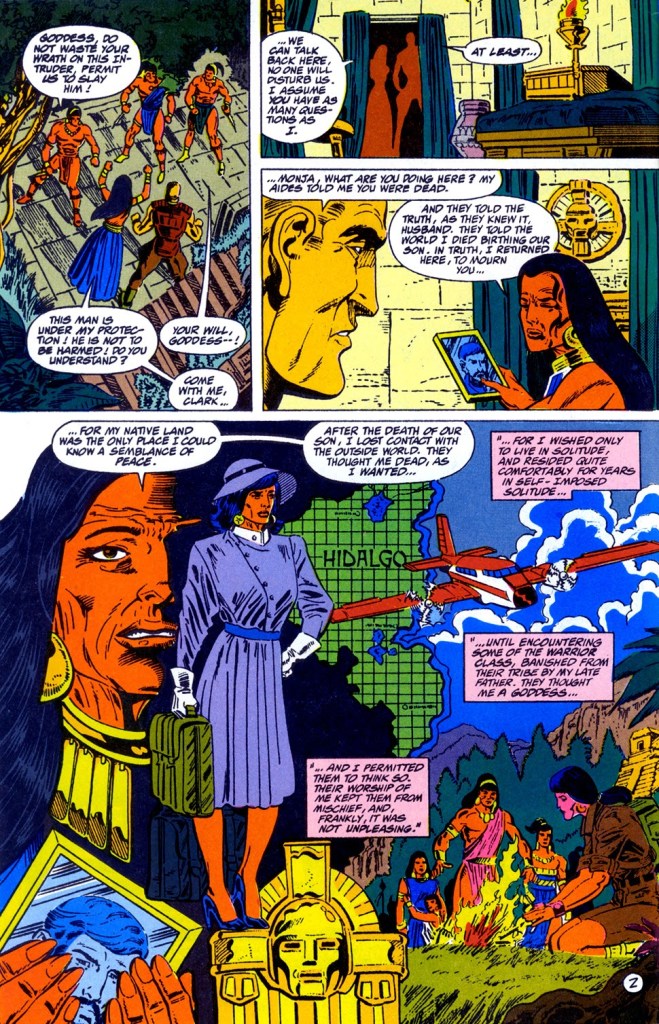
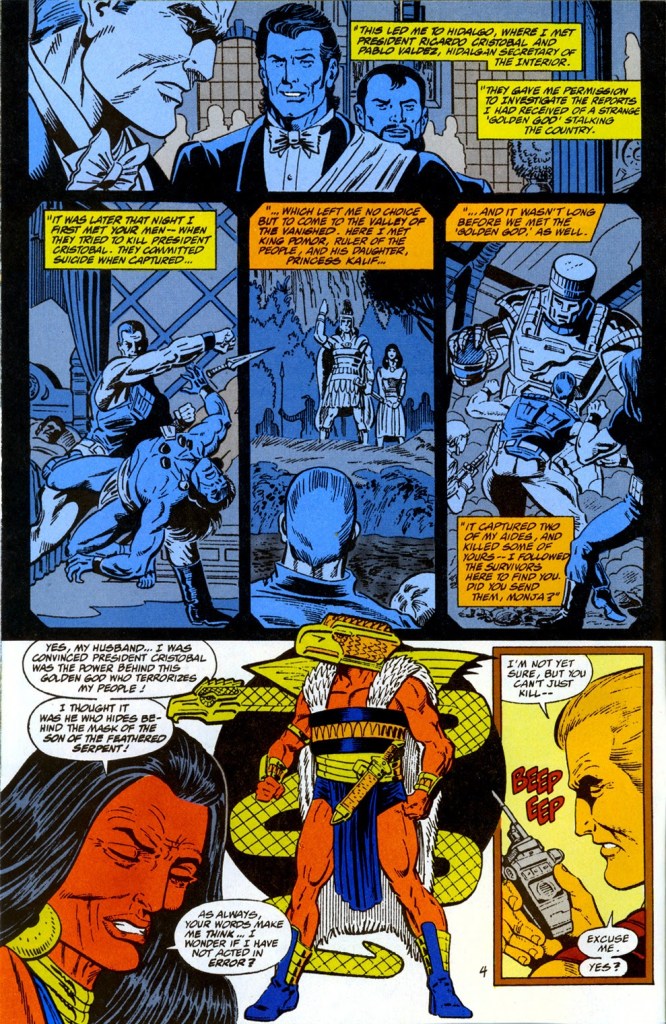
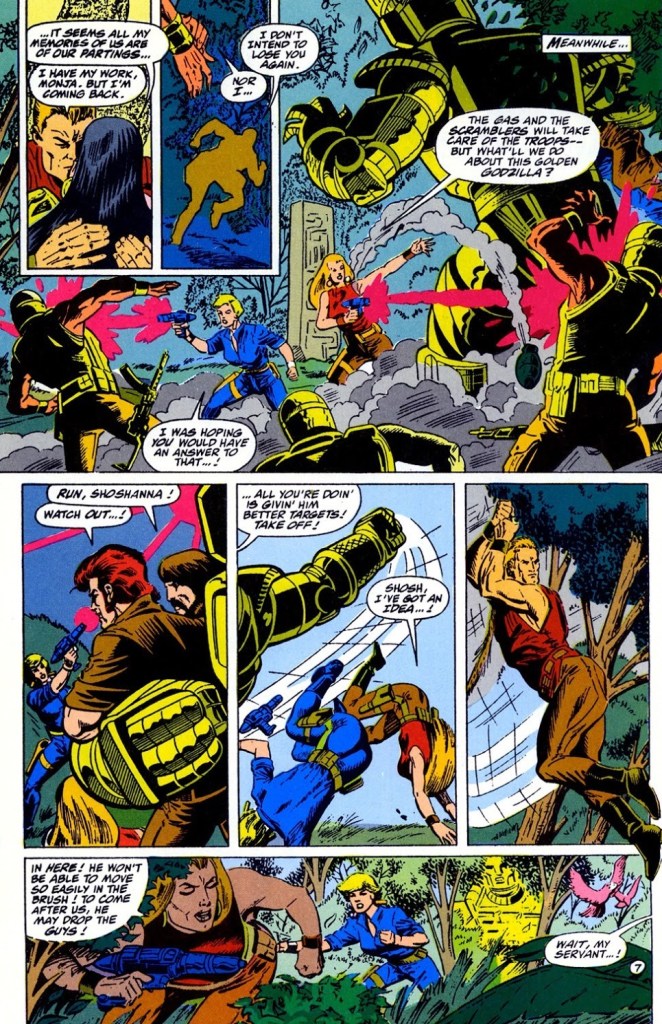
In issue #9, Doc travels to Hidalgo, which is in a crisis. And when he further goes on to the Valley of the Vanished, one of the first things Doc’s new assistants view is a golden statue of Doc and Monja. Barr simply corrected the misnaming of her character by combining the two names into Monja F’Teena, then drops the second name, calling her Monja from that point forward.

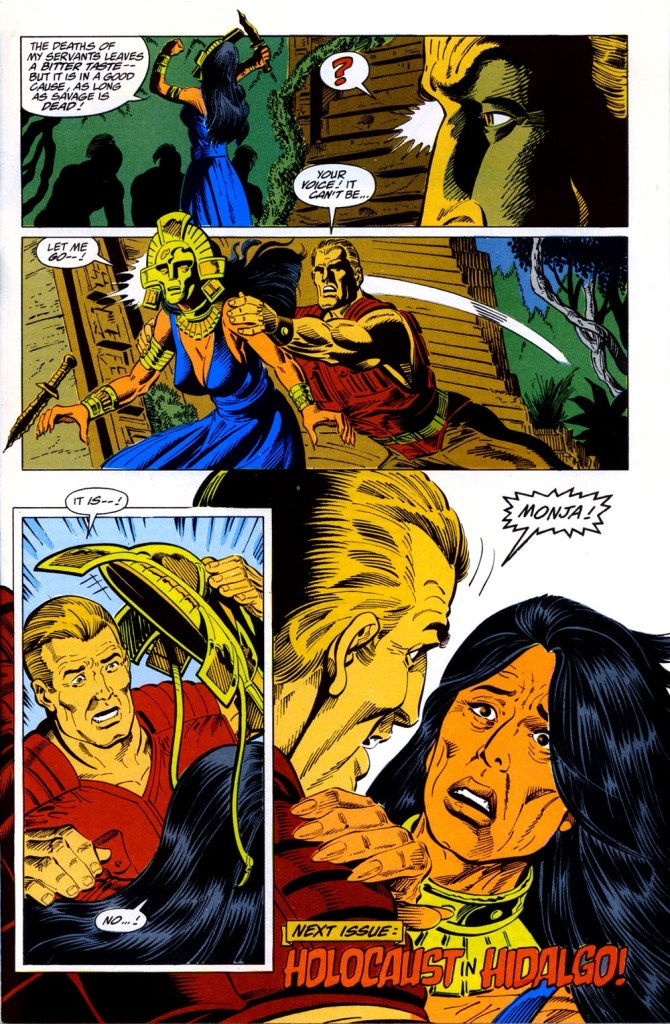
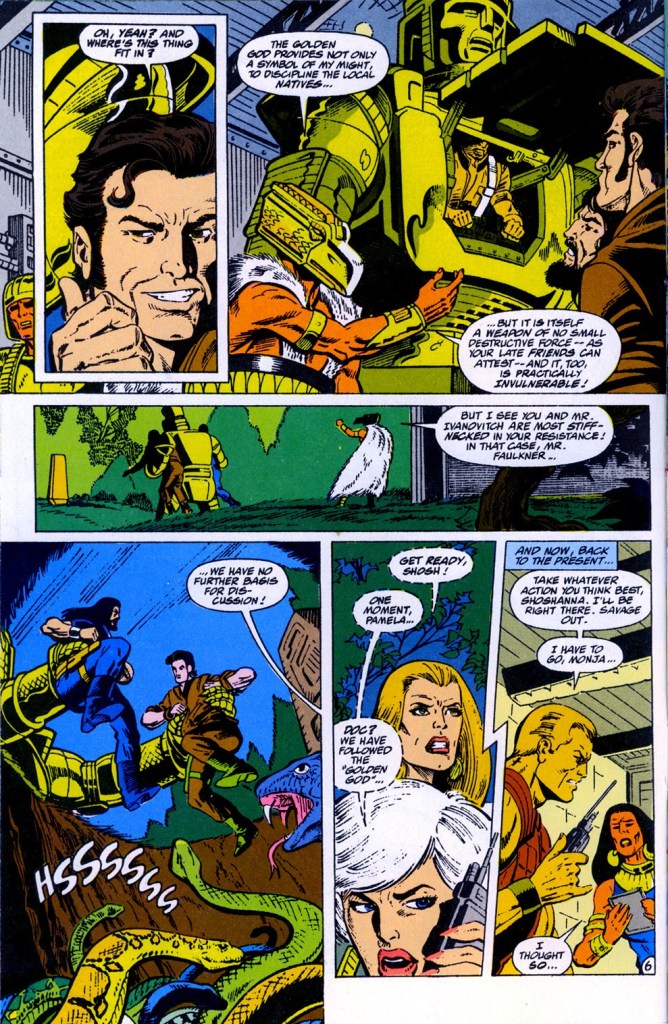
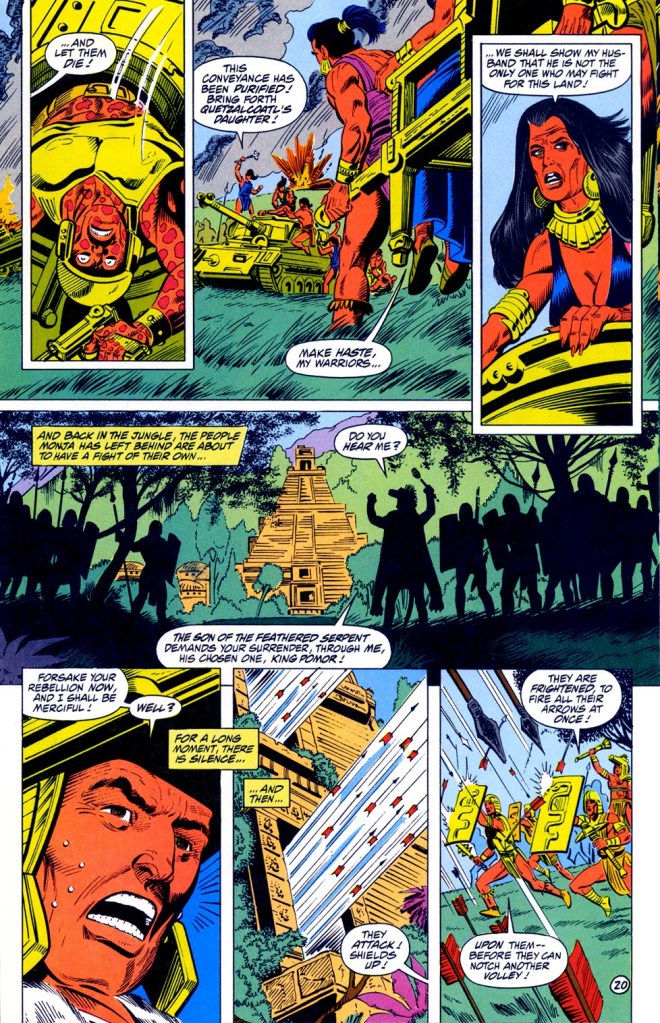
Things are still a bit odd cast-wise…there is new leadership in Hidalgo of course (this is forty years after Chaac was king there)…and among the story antagonists is a woman wearing a golden mask, calling herself the Daughter of Quetzalcoatl. Doc confronts her, and discovers it is Monja.

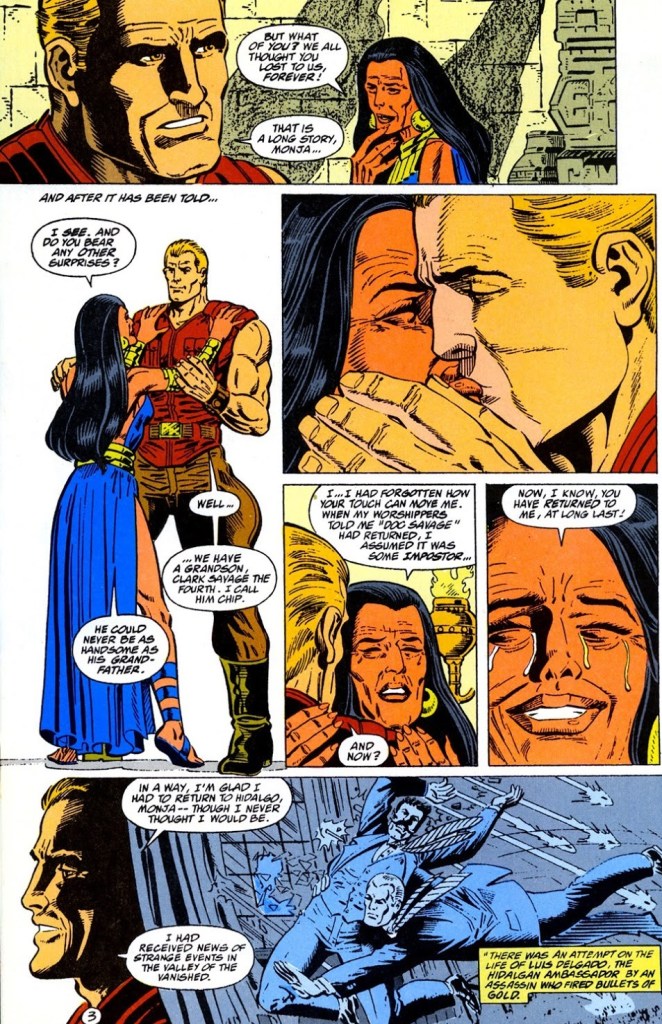
Monja has aged normally, but Doc (through the science fiction machinations of Denny O’Neil) has not. But they are still husband and wife. And rather touchingly, Doc doesn’t appear to care in the least that Monja is now greatly his senior in physical age. She tells her story (she had thought him dead, and was attacking him due to believing he was an imposter)…and they are deeply affectionate to one another.

Doc is called away to the fight, but he soon returns to Monja with his team…they are shocked and amazed to learn he is married, but pleased as well — and Doc is actually briefly playful about belatedly introducing her.

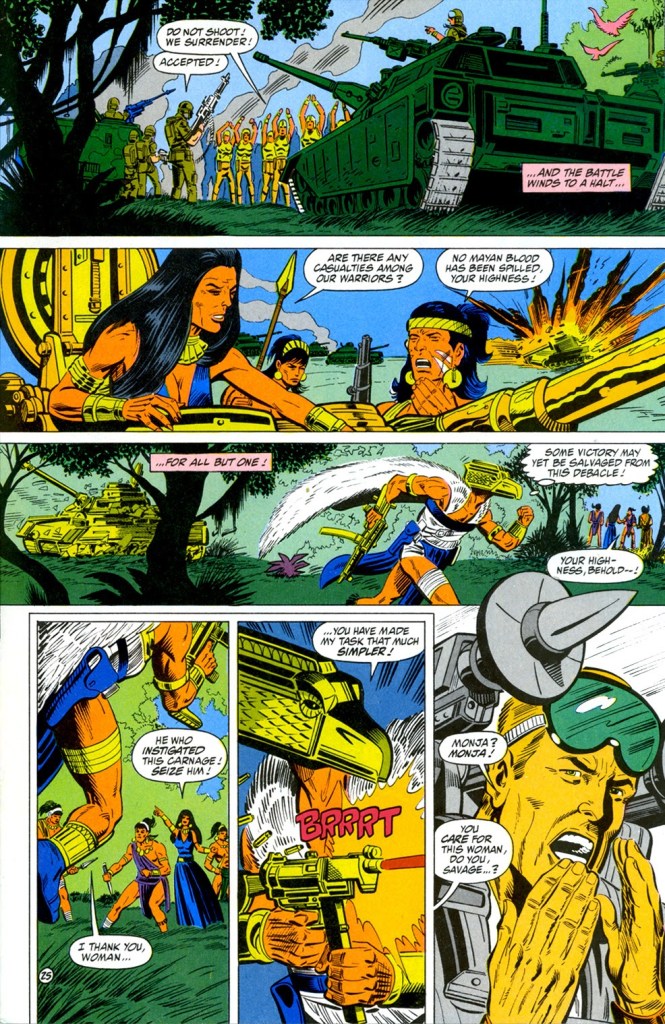
The fight in Hidalgo heats up, and everyone gets involved, including Monja. And then all of the intriguing character dynamics of the reunion with Doc are apruptly jettisoned, as Monja is killed in the waning moments of the battle.

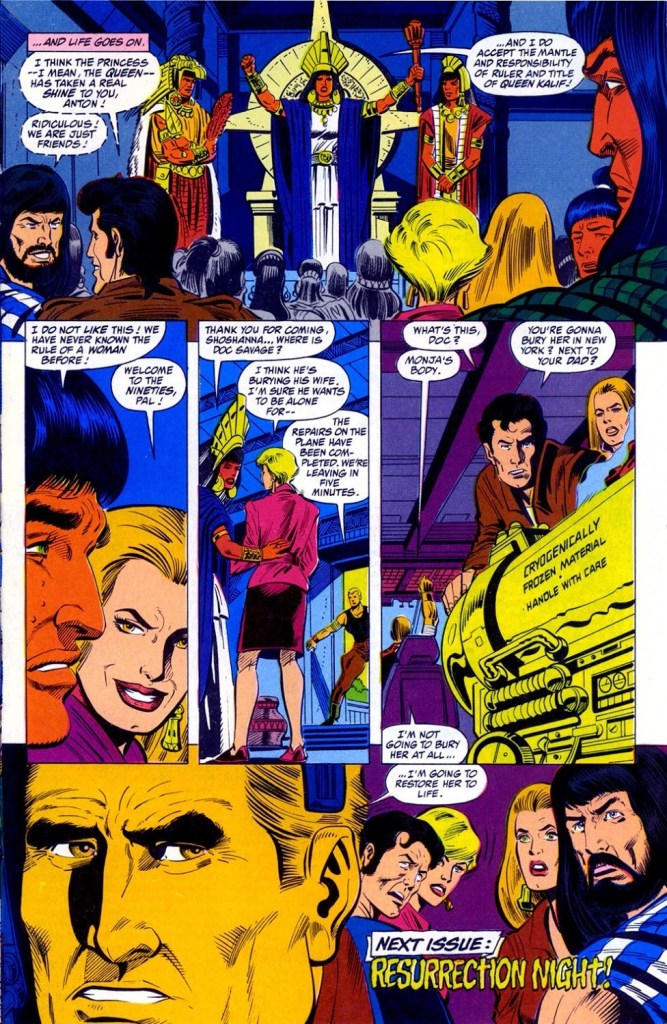
Though I found the abrupt end for Monja a shame (it would have been fascinating, I think, to finally watch them in a mature relationship together), Barr does take things through a powerful final emotional arc. Doc is devastated by Monja’s death, and actually determines to use the process he developed (in the pulp novel Resurrection Day, and the opening page of the following issue is an homage to the Bama cover of that book) for rejuvenating the dead. He intends to restore her to life.

His anguish over the loss of Monja and obsessive determination to bring her back actually provides some emotionally wrenching moments…unique for a Doc Savage tale.

Ultimately, over the course of the next four issues, everything falls apart…the resurrection formula is used, on of all people, John Sunlight…and Monja’s body is captured and used as a means to coerce Doc.

In the final scene, Doc comes ever-so-close to recovering Monja’s body, but is denied by Sunlight. Blown out into space, he barely saves himself, and Monja is gone.

The farewell to Monja is highlighted by a quote from Ecclesiastes.

And that was the end for Monja in DC’s Doc Savage comics. A strange interlude in many ways…one with intriguing concepts introduced but never really developed, and yet, more emotional impact than I had expected.

Next…Dynamite Entertainment’s brief take on a modern Monja, then Millennium’s much more involved characterization of the Mayan princess, with new commentary by series author Mark Ellis!

to be continued…
Rare Orchid: Princess Monja in the Doc Savage comics – Part 1 of 4

My first sight of Monja, the lovely (if romantically ill-fated) Mayan princess of the Valley of the Vanished, came on the cover of the 1972 comic Doc Savage #2, with art by Jim Steranko.

Doc Savage #2

Of course the woman behind Doc is not named, but who else could it be? And it was certainly a dynamic first impression as a 14 year old reader, caught up in the fervor of being a Doc Savage fan.

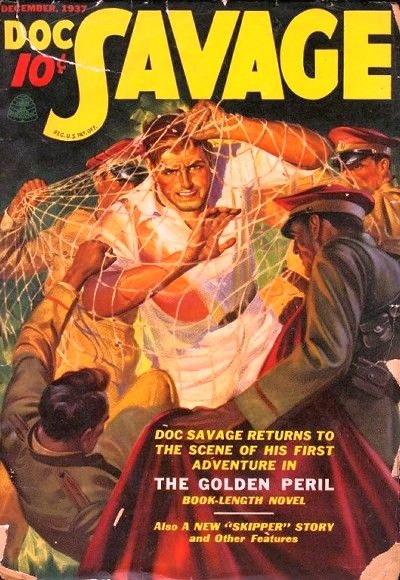
Soon after I would read The Man of Bronze novel, and in time the other two novels in which Monja appears, The Golden Peril and They Died Twice. I’ve explored Monja as one of the women in Doc’s life in an article for The Bronze Gazette, so I won’t cover exactly the same ground here, but here are the pulp covers of those issues (with Monja herself appearing finally on They Died Twice).

Doc Savage Magazine, March 1933
Doc Savage Magazine, November 1937
Doc Savage Magazine, November 1942

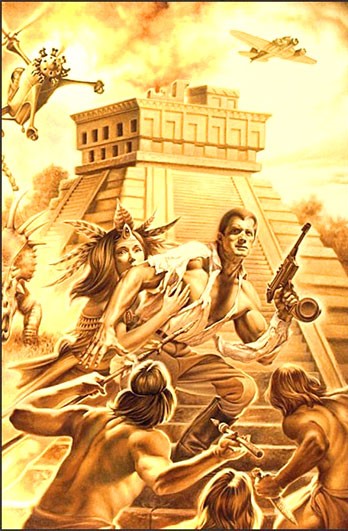
Monja would also feature prominently in the Wild Adventures of Doc Savage novel The Valley of Eternity, with cover art by Joe DeVito.

The Valley of Eternity

In the Doc Savage film from 1975, Monja is played by Pamela Hensley, not as a Mayan princess, but as a modern woman named Mona Flores.

Pamela Hensley as Mona

In the comics, Monja has appeared in series by Marvel, DC, Millennium and Dynamite Entertainment, and each version of her has differed wildly. Each author has taken her character in a unique direction. As a result there is no sense of continuity to Monja’s presence in the comics, but all of the appearances are fascinating in their own way.

Monja’s name — which is Spanish, not ancient Mayan — translates to “nun”, not a promising name for a character with a potentially romantic role. But it’s possible that in choosing it, Lester Dent may have been making reference to the Blanca Monja, or “White Nun” orchid. Interestingly, it was in 1933 at the National Conference of Flowers in Florida, that the blanca monja was suggested for the national flower of Guatemala (a center of ancient Mayan civilization). A year later it was indeed chosen as Guatemala’s national flower, symbolizing peace. Intriguing as well that the writers of the Doc Savage movie chose Flores as the surname for their version of Monja/Mona, given that its translation is “flowers”.

Or it may have come from references to the city of Chichen Itza, a Mayan ruin in the Yucatan, about which Herbert Thompson wrote a book called The People of the Serpent in 1932. It describes how, according to post-Conquest sources (Maya and Spanish), pre-Columbian Maya sacrificed objects and human beings into the cenote (ceremonial well) as a form of worship to the Maya rain god Chaac (also the name of Monja’s father). On a side note, I have wondered if the character of Hubert Robertson — described as Clark Savage Sr.’s partner in discovering the Valley of the Vanished — was based on Herbert Thompson, as the names are similar (and Thompson was in the news in the late 20’s, early 30’s when he was accused by the Mexican government of taking sacred objects from archeological sites). In a final connection to Monja, one of the oldest structures in the “lost city” of Chichen Itza was called by the Spanish the Casa de las Monjas (“House of the Nuns”).

Back to the comics, her appearance in Doc Savage #2 (written by Steve Englehart, drawn by Ross Andru) is relatively brief. In a two-issue adaptation of the novel, there was not much room for character development. But it is faithful to her role in the original novel. After Doc engages in a vigorous fight with the heavies in the story, she appears silently at the side of her father, King Chaac…and Doc does not appear to even notice her. She remains silent on the sidelines in the next page as well.

As the story progresses, Monja finally gets the opportunity to show her bravery and spirit. When Doc needs a sample of water to try and isolate the poisonous “red death”, Monja volunteers. When Doc develops the cure, she is once again in the background, offering silent support.

And that is all we will see of Monja until the end, when she expresses her desire for Doc to stay in the Valley of the Vanished, but he gently rebuffs her. When he departs, there is a tear in her eye.

Monja would not appear again in any Marvel Doc Savage production. It would be over fifteen years later, when DC comics acquired the rights to the Doc Savage character, that we would see the rare Mayan orchid in the comics again.

to be continued…

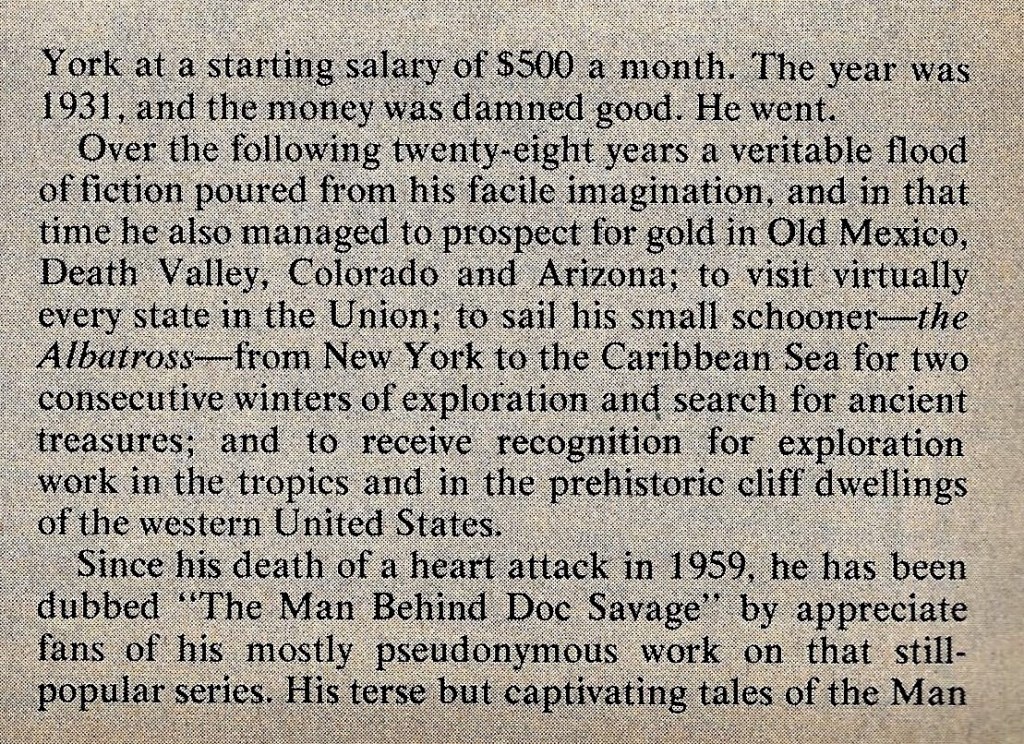
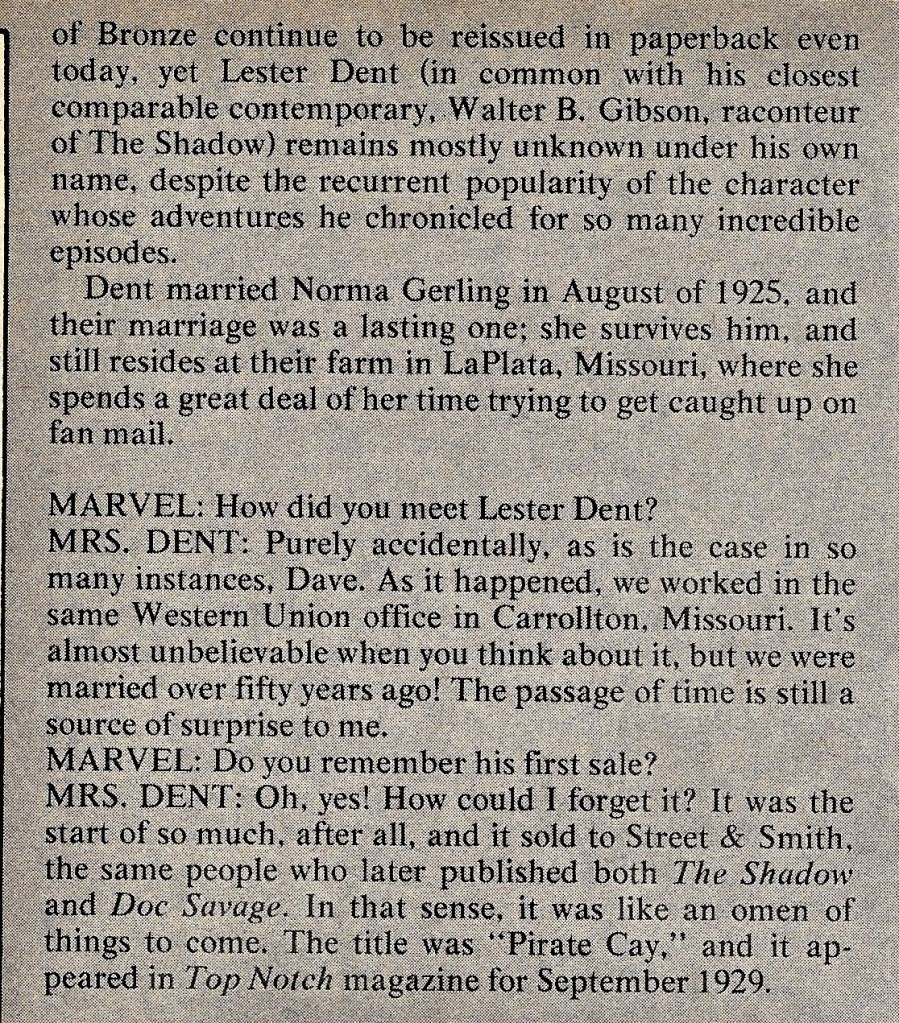
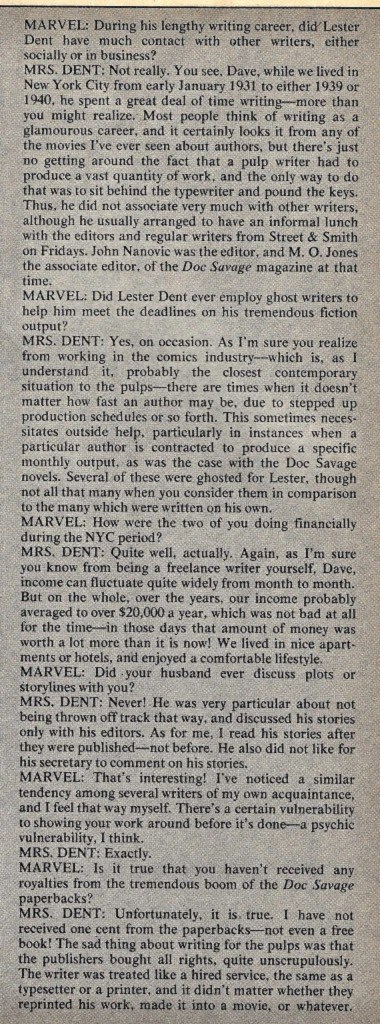
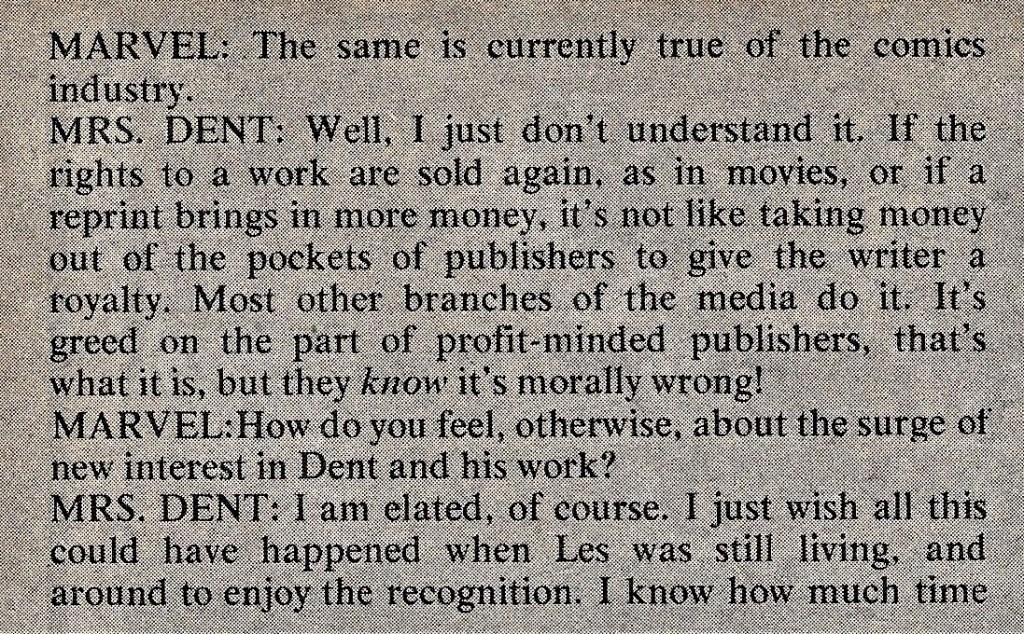
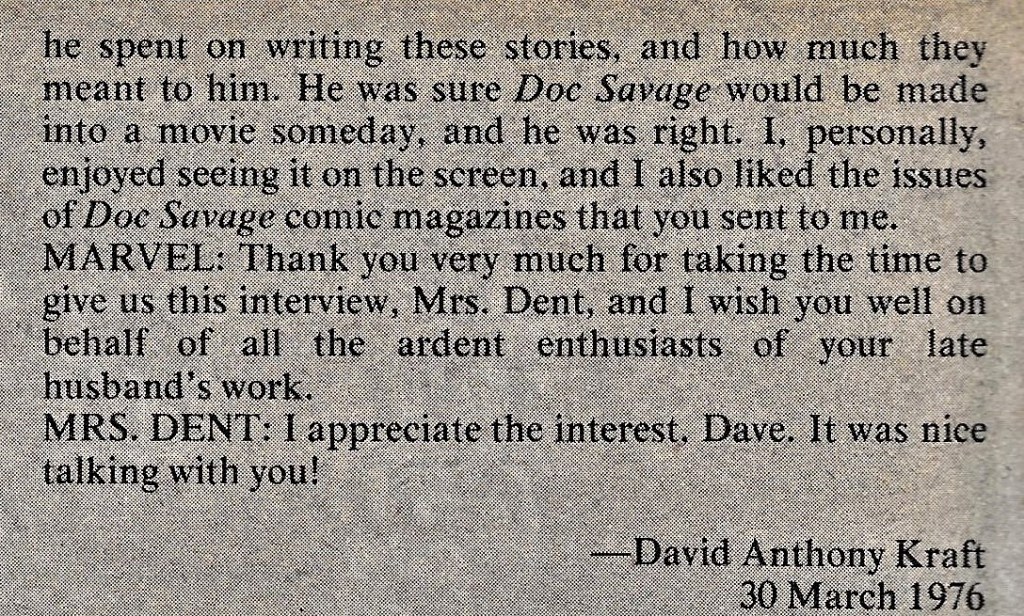
1976 Norma Dent Interview by David Anthony Kraft – and a sad farewell to DAK

Author, publisher, critic and interviewer David Anthony Kraft passed away a couple of weeks ago, on May 19, from complications of COVID-19. Probably not a household name among Doc fans, he authored numerous comics for Marvel in the 1970’s, and went on to found the periodical Comics Interview.

I didn’t have a personal relationship with David, but we had an odd link…only about five years older than me, he was a comics writer when I was a fan, and the first letter I ever had published in the letters column of a comic book was one praising a storyline of his.

Then in 1977, on my first day at my first real job, I was browsing a nearby bookstore during my lunch hour (of course I was, I lived and breathed books), and I bought a back issue of a science fiction magazine to read over lunch. In it was what I found out later had been the first story DAK had ever sold, a brief but powerful short called “Myrra”.

A couple of years later he started a small publishing house called Fictioneer Press, and he became the first publisher I ever submitted a novel to (a pulp pastiche…some things never change). He rejected the novel — which it would be generous to call a work of juvenilia — but was wonderfully encouraging to me as a “fellow writer”.

When I started the Doc Talos website last month, strange as it may seem, one of the first people I sought out for friendship here on Facebook was DAK. If he had remembered me I would have been astounded, but it seemed right, once again, to include him at a literary beginning. That was the first week of May.

He didn’t respond to the friendship request, and I felt a vague sadness, but certainly understood…we were essentially strangers who had crossed paths, from his perspective, for the blink of an eye in the 1970’s.

A little over a week later, I was reading his obituary. Only 68 years old, gone from COVID-19.

So there will be no more firsts to share with DAK. To his family and friends, who do not know me, I want to tell you that he was a touchstone to moments of aspiration and inspiration in my life, and I’m grateful.

David was on the editorial staff of the Marvel Doc Savage magazine (presaging his career later as a premier interviewer), and he did the following interview in issue #5 with that great lady of the Doc Savage world, Norma Dent. She answers his questions with warmth, wit, conviction and charm.

Farewell, Dave.

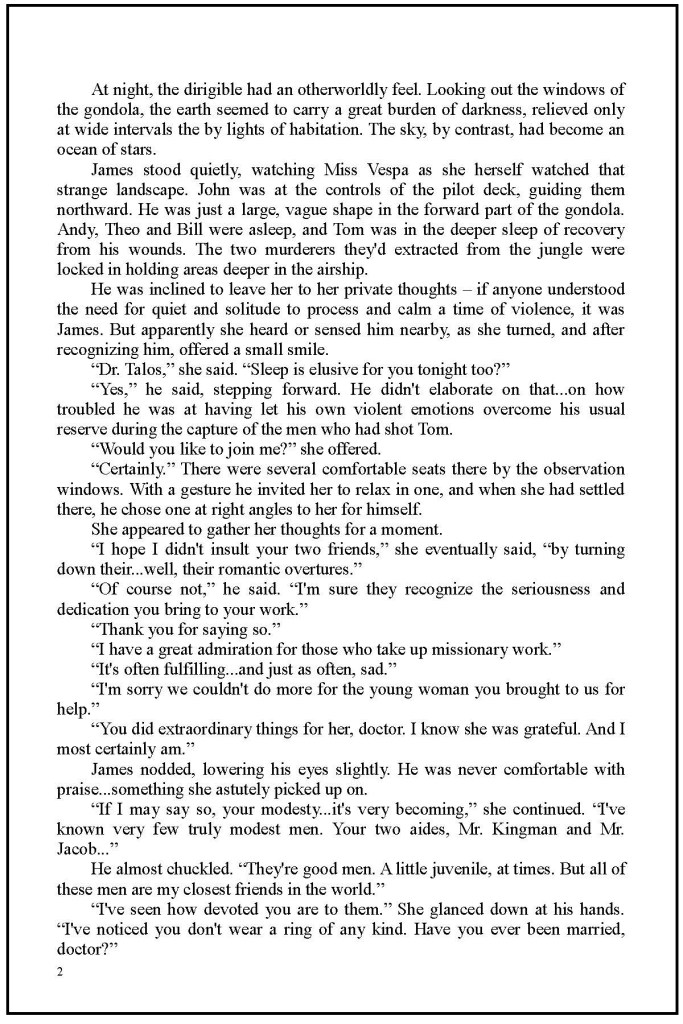
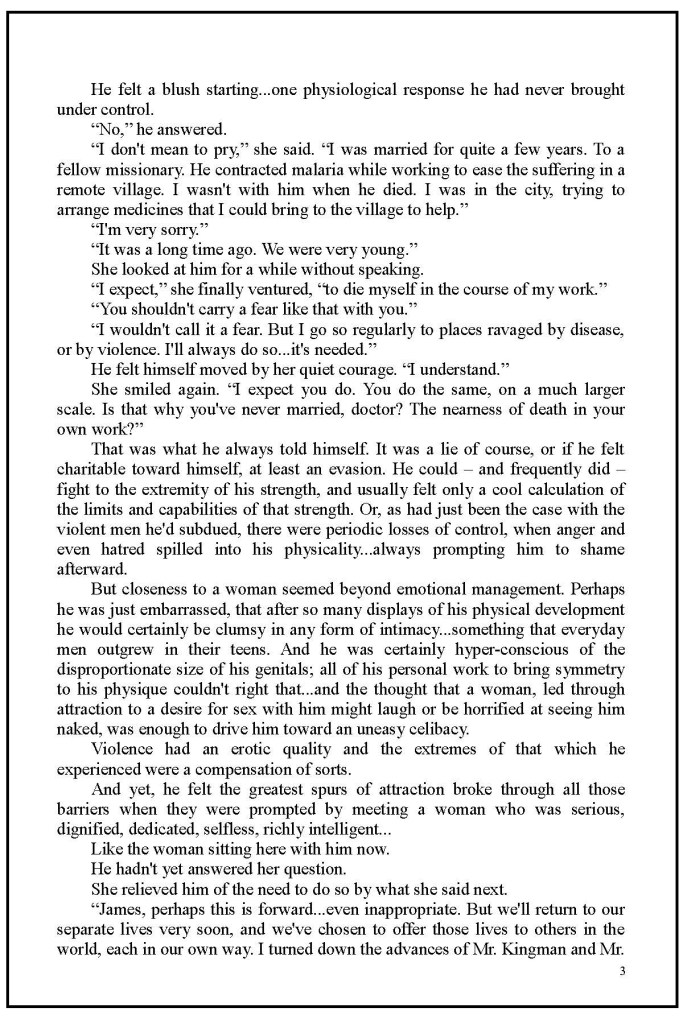
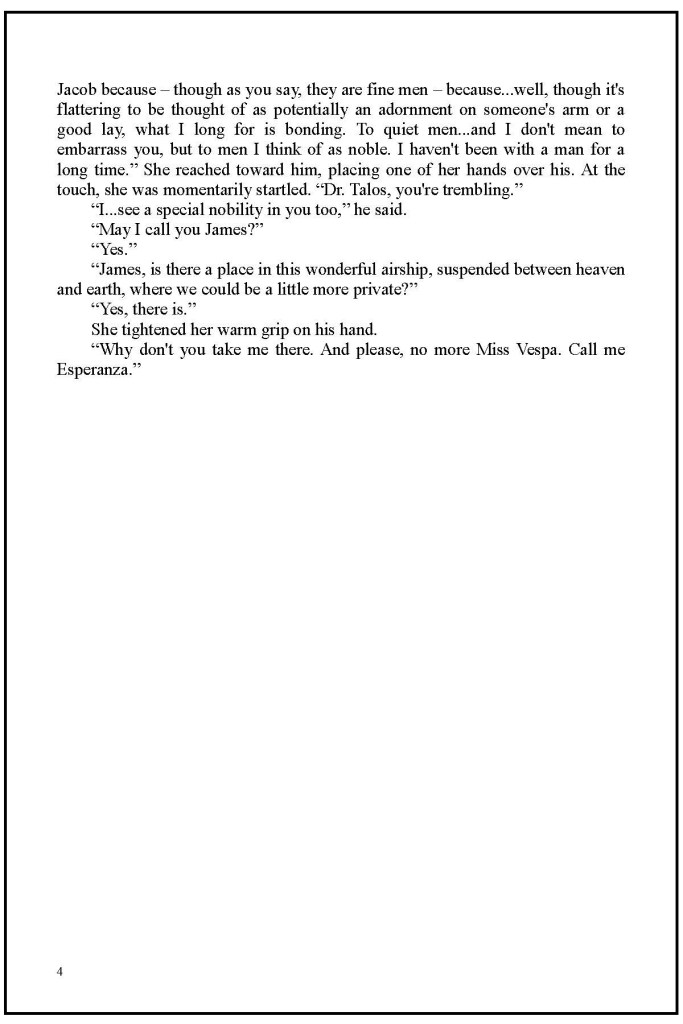
Talos Fan Fiction Contest Entry #6 – Esperanza

Note from Doc Talos author/contest judge R. Paul Sardanas: Grace Ximenez is something of a celebrity in adventurous corners of the internet — she has, for the past ten years or so, run a highly successful adult fantasy/peril forum, which is filled not only with roleplayers, but writers, artists, and filmmakers. She has authored independent screenplays, short stories, and has been depicted in portraits by some of the greats of comic book art, including Esteban Maroto, Frank Brunner, Gene Colan, and Richard Sala. She is the inspiration for one of the key characters in the Talos Saga. She has an encyclopedic knowledge of the comics and pulp literature in general, bolstered by an immense personal library of periodicals, paperbacks, and original art. Her story for this contest is brief, moving, and like her character, Esperanza Vespa, clearly comes from a deep place of the heart.

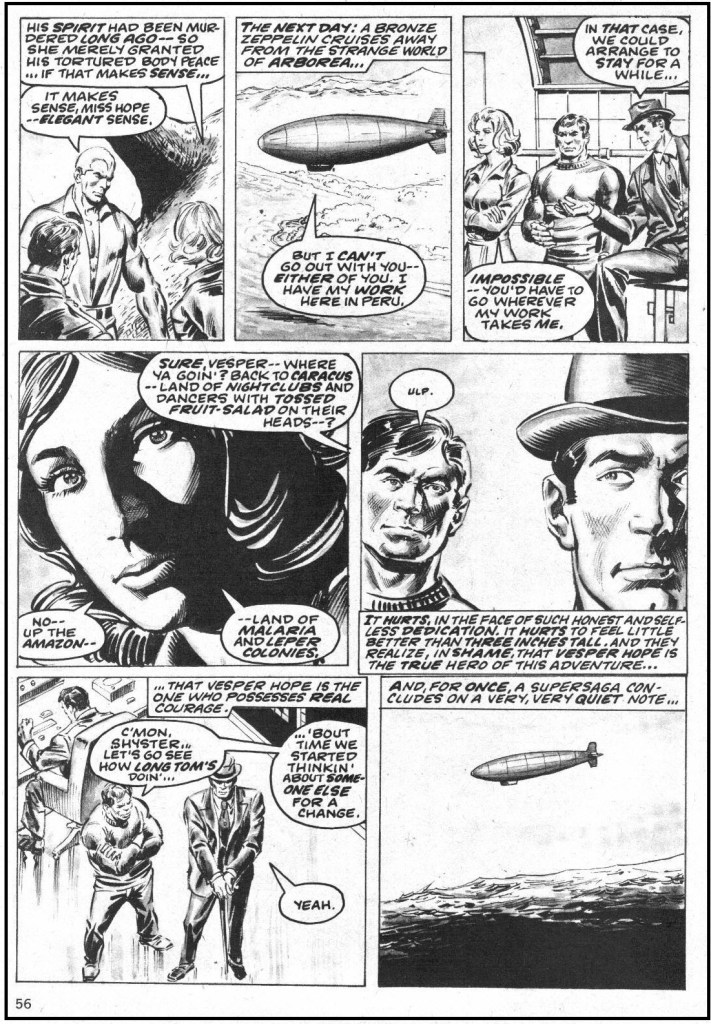
Comment from author Grace Ximenez: While deciding on a story to tell, inspiration was all around me. The splendid authors already showcased in this contest have pulled the foundations of their tales from both pulp and classical literature of all kinds…and that place of creativity is the world I love best. I have one page from a Doc Savage magazine in my collection of original comic art: the final page from Marvel’s Doc Savage #7, a story called “The Mayan Mutations”. The artwork, by Val Mayerik and Tony DeZuniga, has no lettering on the original — the captions and dialogue are on a tissue-thin overlay sheet. Lifting that overlay allows me to see how truly talented both artists are. In it is a beautiful missionary named Vesper Hope…and I always thought that she epitomized the kind of woman Doc would be attracted to.

There was no romance in the story, but I kind of wished there was…one night between two very serious, very dedicated — even noble — people. I would have loved to make it a steamy erotic scene (and behind the scenes in my thoughts it is)! But it seemed right for these characters to make it quiet…a kind of dignified and thoughtful passion. I hope you enjoy it.

Additional note: If you are interested in submitting fiction to the Summer 2021 contest (first prize is a Bantam Doc Savage paperback Czar of Fear first edition, signed by James Bama) you can read the contest guidelines HERE.

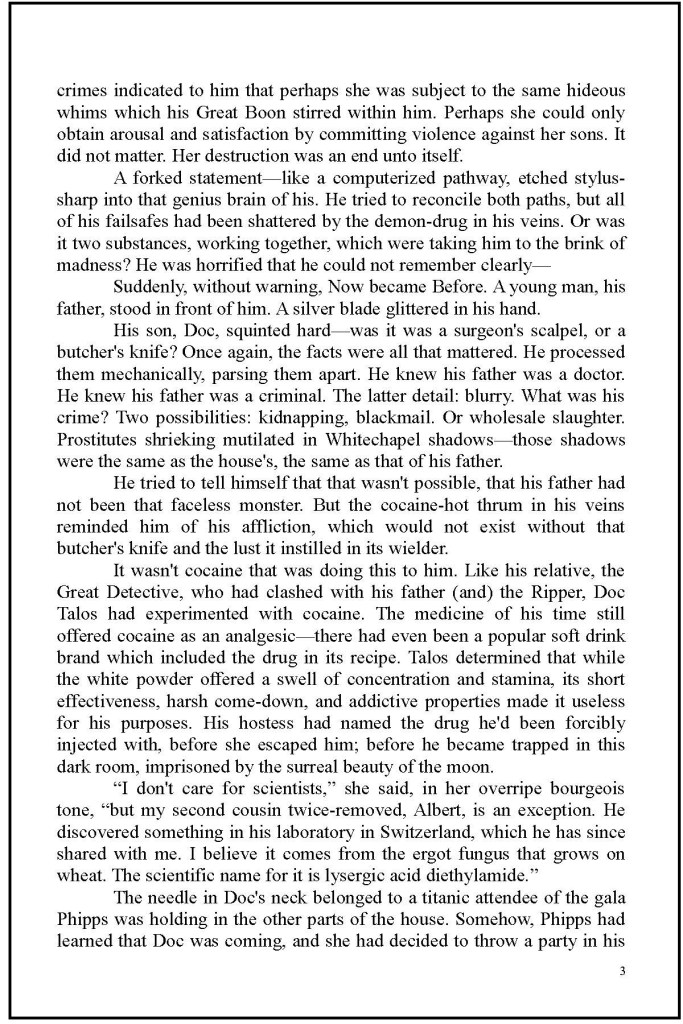
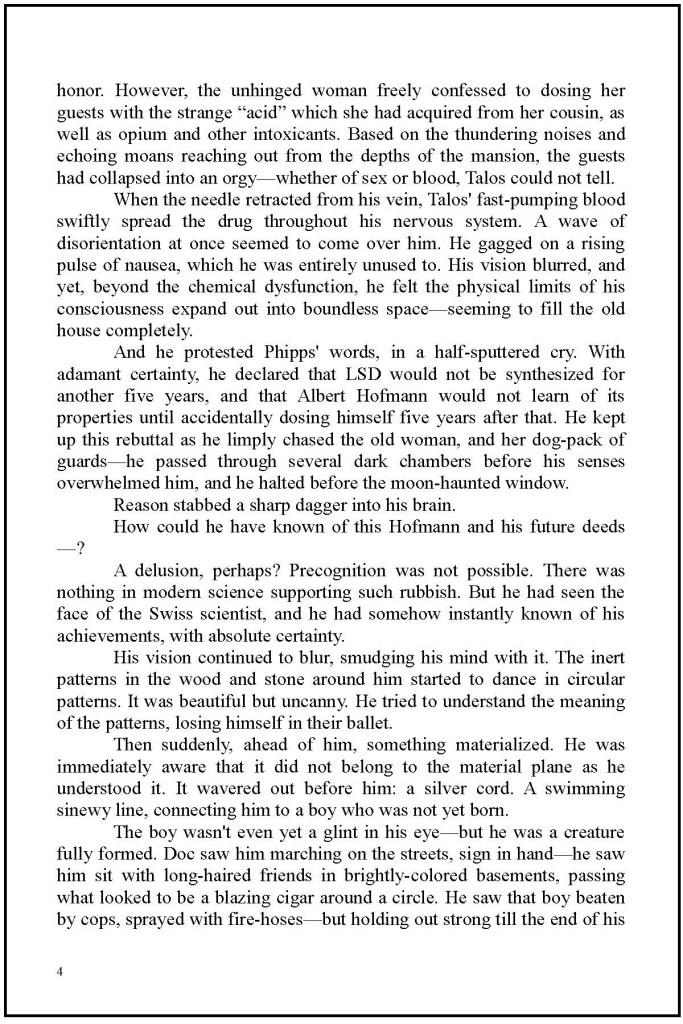
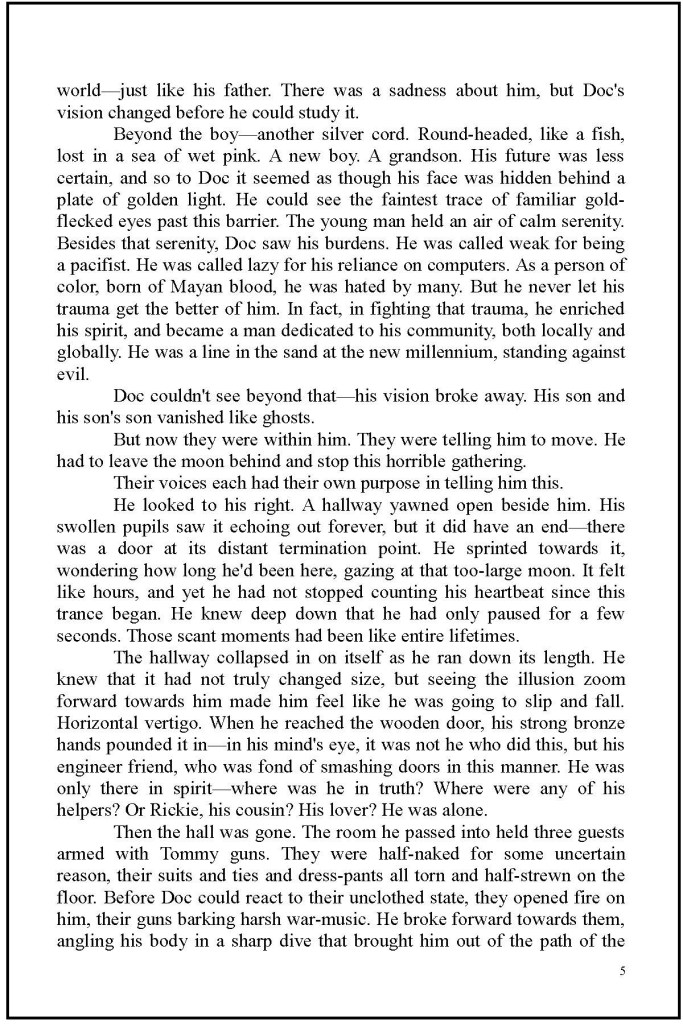
Talos Fan Fiction Contest Entry #5 – Silver Legacy

Note from Doc Talos author/contest judge R. Paul Sardanas: Atom Mudman Bezecny’s story is an ambitious weaving of elements from across a spectrum of Doc Savage works. She blends the pulp and comic worlds, and infuses them with a powerful explicit tone of eros/thanatos in the style of A Feast Unknown. The result is a skillful, visceral, intensely psychological tale.

Comment from author Atom Mudman Bezecny: Silver Legacy is an experimental story drawing from a variety of sources, including the original Doc Savage pulps, A Feast Unknown, the ’80s Doc comic books by DC Comics (which depicted Doc’s descendants), and the drama film The Silver Cord, which came out in the same year as the first Doc Savage story. I hope you enjoy, and thank you for reading.

Additional note: Title page artwork by Adam and Andy Kubert, from DC Comics 1980’s Doc Savage comic. If you are interested in submitting fiction to the Summer 2021 contest (first prize is a Bantam Doc Savage paperback Czar of Fear first edition, signed by James Bama) you can read the contest guidelines HERE.

Transformations from the world of “A Feast Unknown”, Part 1

The Doc Talos books are in many ways a pastiche of a pastiche. To explore facets of pulp heroism and adventure that would never be allowed in canonical or mainstream works featuring Doc Savage or Tarzan, author Philip José Farmer, for his 1969 novel A Feast Unknown, shifted to doppelgangers of those iconic characters, Doc Caliban and Lord Grandrith. That way he could freely explore themes that fit with his commission to write a novel for the adult publishing firm Essex House, with explicit pornographic elements.

That novel, over fifty years later, has led to the Caliban/Grandrith stories becoming canonical in and of themselves. Reprinted numerous times in multiple languages, through a whole series of editions (from both adult publishers like Playboy Press to presses with a more mainstream feel — the “forbidden” aspects of the works being far more widely accepted in the world of 2021).

My hope, during Farmer’s lifetime, had been that at some point he would return to edgy, primal, challenging sexual themes of the original novel. He never did, instead steering the series first to a more mainstream place, and then more into the realm of his “mashup” Wold Newton concepts, in which numerous literary characters, styles and canons are cross-connected.

Having to accept, reluctantly, that the rogue, visceral world of intelligent and literate pulp pornography — the world of “A Feast Unknown” if not its sequels — was not going to happen, I felt the kind of disappointment that I would guess explorers must feel when they see a mountaintop that has to be turned back from to survive. That mountaintop still beckoned. Farmer’s take on adventure pornography had not compromised his style or vision — in fact it had elevated an often-derided genre.

Having met Farmer and received permission to work on an immense visual multimedia project adapting A Feast Unknown, the artist/auter Iason Ragnar Bellerophon had presented those works on stage in 2005 (an article describing that project can be read HERE). In the years since, he had been slowly working on another massive project: a wordless graphic novel depicting the whole of Feast.

When Iason and I began working together, we realized we had a mutual desire to return to the fiercely explicit tone of the original novel. To do so, he set aside his literal Feast adaptation and we used Farmer’s own technique of literary pastiche to open up a broader landscape to work within. As he had transformed Doc Savage and Lord Greystoke into Doc Caliban and Lord Grandrith, so we made another transformation, creating Doc Talos and Lord Grersoun. The “Talos” reference is to the Greek bronze automaton of myth, and at first in our new novels was used as a disparaging nickname for one of the foundational characters of the Talos saga, Doc’s father. The Grersoun name is the older form of the Scottish Grierson — our version of the character is a Scottish lord, not an English one.

But many other transformations needed to be charted out as well. Though a devoted lover of A Feast Unknown, I found its antagonists, the Nine, to have been portrayed in broad strokes that I wished very much to deepen. To that end Iason and I placed them in a framework of Gnostic belief, and changed the nature of the characters themselves.

A central character undergoing that transformation is Anana in Feast, who is depicted as being extraordinarily ancient — a fearsome figure — but very little of her personal motivation and history is explored at all. Here is a portrait of Anana by Iason.

Anana by Iason Ragnar Bellerophon

Wanting the leader of the secret cult of immortality to have a much more complex nature — including the indulgence of becoming a film star in the Thirties and beyond — as well as a richer epistemological basis for her beliefs and actions, we transformed her to the Gnostic dark Archon Ruha…a very powerful, sexual, and ruthless character, but with many perplexing shades including an intense devotion to those she loves, and a wicked sense of humor. Here is how Iason re-imagined the character, turning her into Ruha.

Ruha by Iason Ragnar Bellerophon

Her “everyday” name is Damaris Emem (the Greek/Latin first name meaning, ironically, “gentle”, and the last name being of African origin, and again mocking her violently sexual nature, meaning “peace”).

And this was just the beginning, as we pursued what has to this point been a six-year obsession with redefining and elevating explicit pulp storytelling.

to be continued…
The Thousand-Headed Man (almost) on film

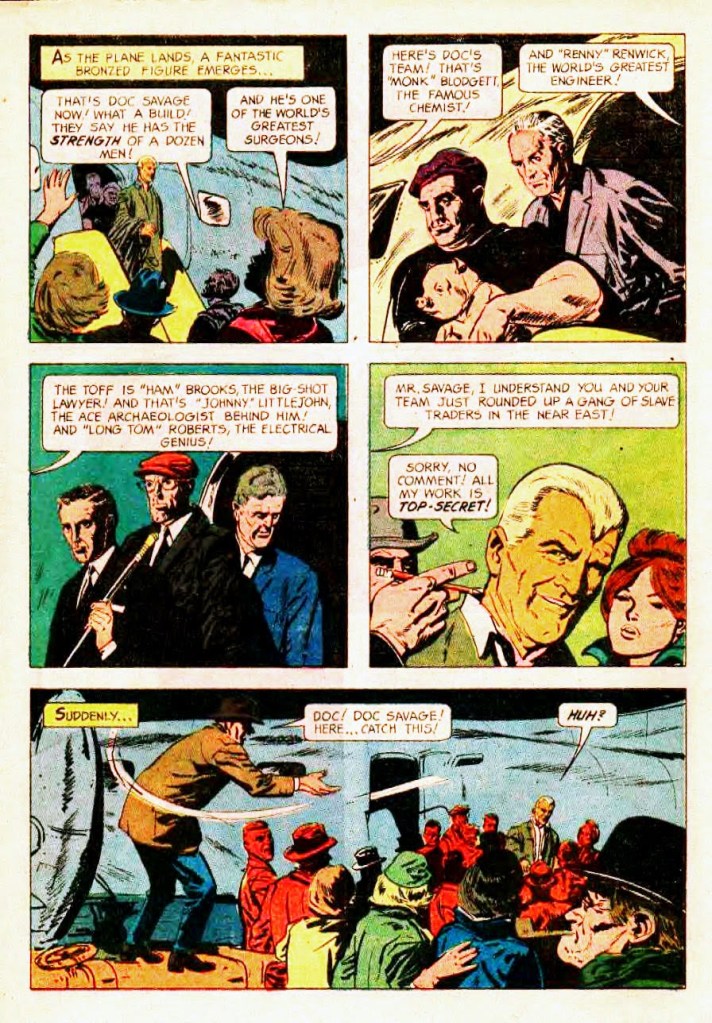
Much has certainly been written about the Doc Savage film that never was. In brief, the story was that producers Mark Goodson & Bill Todman, interested in capitalizing on the success of the James Bond films, acquired the rights to Doc Savage from Conde Nast in 1966, and went into pre-production on a film, to be based on Lester Dent’s novel The Thousand-Headed Man. Then rising star (TV’s Rifleman) Chuck Connors was chosen for Doc, and other publicity items, like a comic-book adaptation of the film, were done.

Doc Savage, Gold Key, 1966

Rare to see a comic book with a James Bama cover! But of course the art was simply lifted from the painting done for the Bantam Books novel, zoomed in on the figure of Doc fighting the snake.

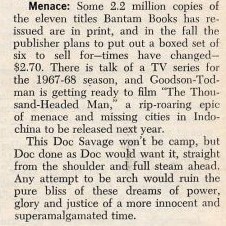
An article in Newsweek examines the Doc Savage paperback phenomenon (the tone of the article is anything but reverential…at one point it describes Lester Dent’s writing style like so: His style read as if he had a stopwatch in one hand and a thesaurus in the other!) But at the end of the article it discusses the upcoming film, which — despite the craze for camp at the time — would not be camp in tone! An odd reference to “missing cities”, I presume should have read lost cities.

Clipping from Newsweek article, 1966

The film of course was never made. Goodson-Todman discovered that they did not have the film rights after all…Conde Nast owned only the book publication rights. Lester Dent has retained control of any film to be done using Doc, and those rights had passed to his wife Norma after his death. She was apparently not averse to doing a deal, but instead the project was dropped (I can imagine the chaos between movie execs, Conde Nast execs, lawyers for both sides…)

A further legend about the film is that since the whole cast had been signed, they simply transferred the entire cast to another property that they did have the film rights to, a Western called Ride Beyond Vengeance.

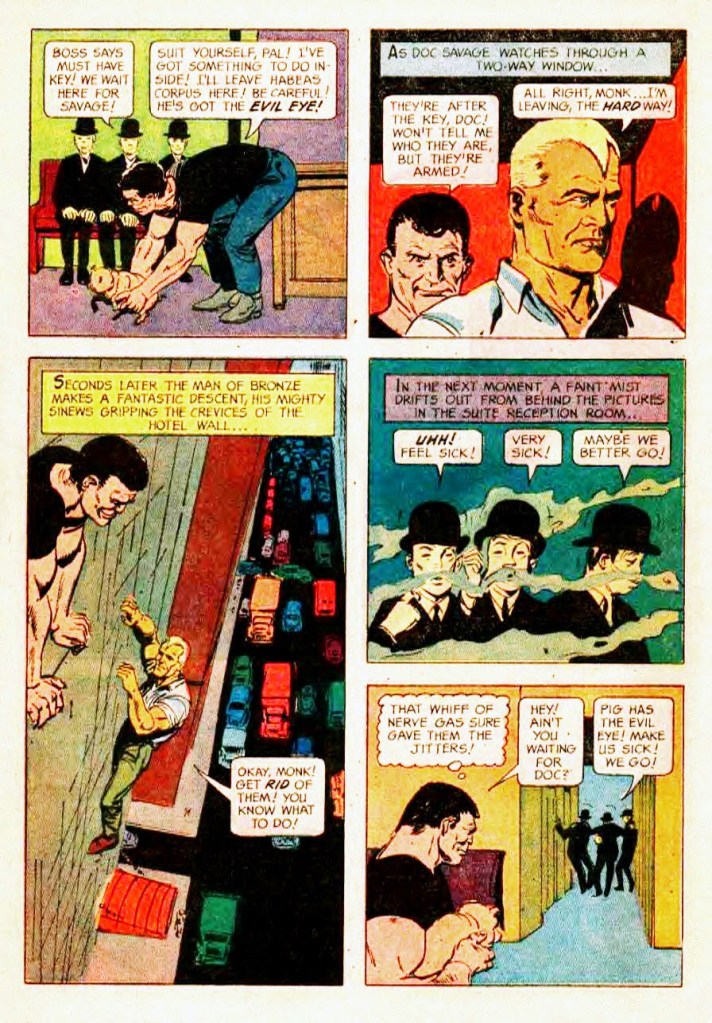
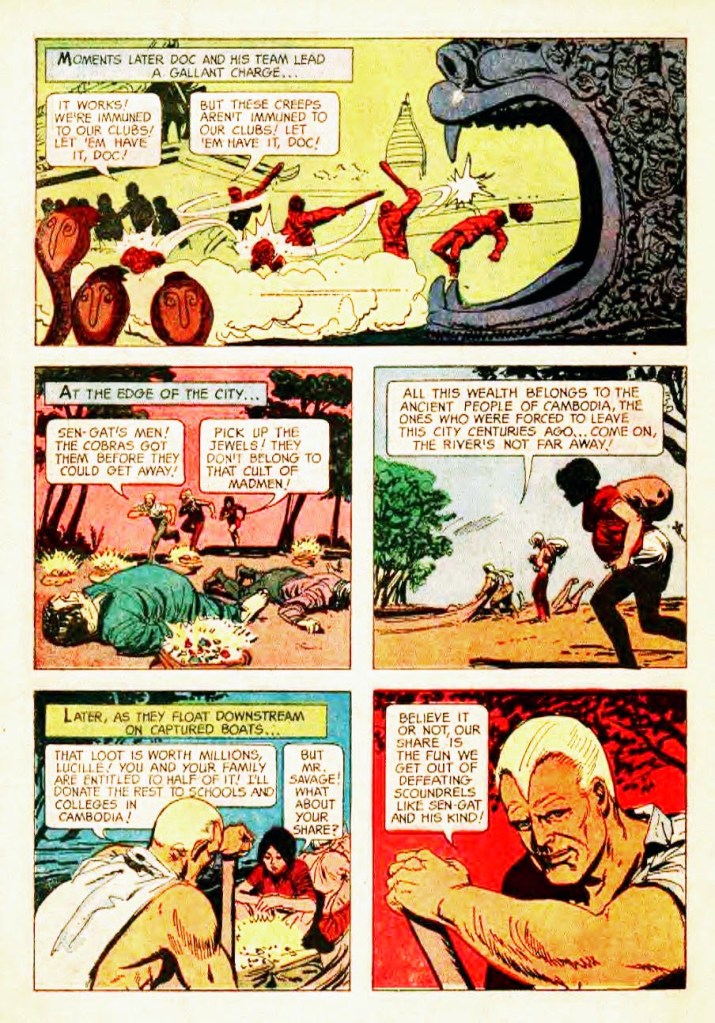
How much of this is true and how much is Hollywood hearsay, I certainly don’t know. But the comic book is an intriguing artifact of that project. Written by Leo Dorman and drawn by Jack Sparling, it was actually a pretty skillful adaptation of the novel, managing in one issue to condense the novel without it feeling completely rushed (a problem with later Marvel novel adaptations). Sparling certainly was basing his visuals entirely on the James Bama depiction of Doc and his aides.

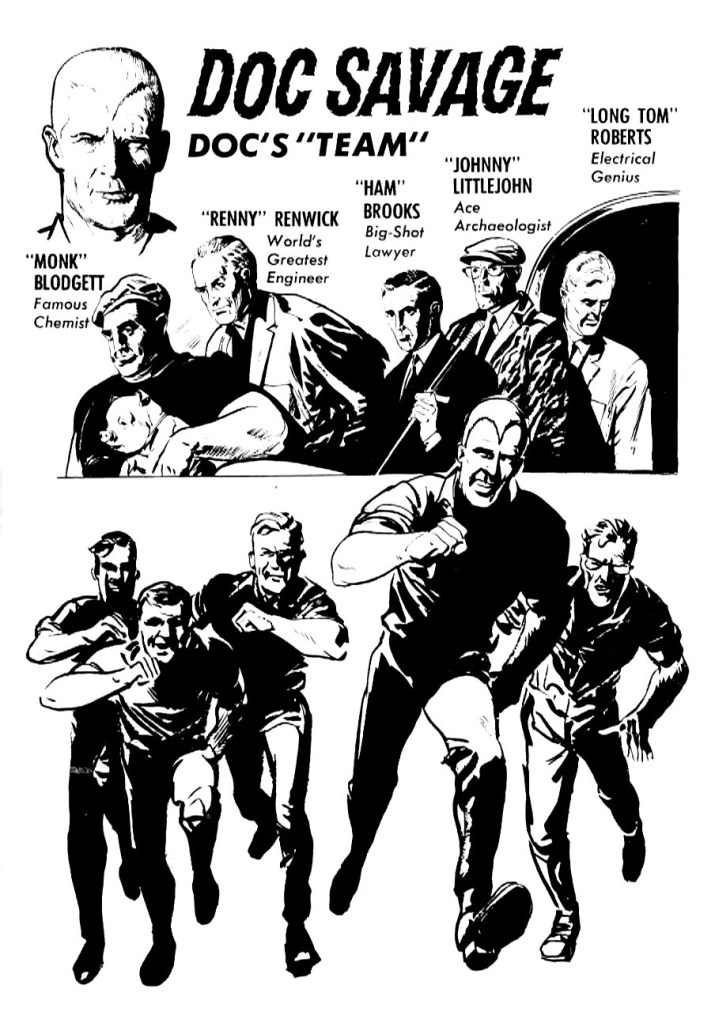
Despite getting Monk’s name wrong (calling him Blodgett, instead of Blodgett Mayfair), it was interesting to see the characters so utterly Bama-styled. Well, not entirely Bama-ized. Doc wears a normal business suit (as he does in the pulp magazines), and a white shirt with rolled up sleeves when in action scenes. Not a jodhpur to be seen. Doc’s hair was so light, apparently, due to limitations around Gold Key’s printing process. This was also responsible for the skin tone of the oriental characters. Monk’s hair should be red of course…a misinterpretation of the Bama black-and-white depiction of the aides on the back of the paperbacks. The setting had modern updates (jet planes, for instance), though when one looks down into the street below Doc on the page where he is clinging to the wall, the traffic does not appear to definitively be 60’s vehicles.

I have never read if Dorman was working from a film treatment provided by Goodson & Todman, or from the novel, in crafting his script. Dorman had quite a bit of experience doing film/TV-to-comics adaptations (like The Twilight Zone and Outer Limits).

A clever (if improbable) shift from the novel was to make the “black sticks” of the novel into mysterious black keys (best not to wonder too much how explorer Calvin Copeland had a key-shaped mold available…).

Inside front cover, Doc Savage, Gold Key 1966

The inset picture of Doc holding the keys is practically a line for line swipe of the back cover head portrait of Doc on all of the Bama paperbacks.

The comic, as promised by the Newsweek article, is done completely straight…no camp. So there is certainly a strong likelihood that the film would have been done in the same style. Here is the last page of the comic.

Doc Savage, Gold Key, 1966

And the inside of the back cover was also printed, with a seeming invitation to follow more exciting adventures to come.

It would be a while before Doc returned to comics, with the eight-issue Marvel run beginning in 1972. And Doc made it to the big screen in 1975. But it is fun to think of what might have been!

The strange days of Doc Savage, Science Detective

For a brief period before Doc Savage magazine ended its run in 1949 (and the hero pulps as a genre essentially disappeared), the magazine changed its title, adding “Science Detective” after Doc’s name. That decision was reversed just before the end, with an attempted return to style and appearance of the 1930’s pulps, but it was a unique interlude in the long history of the series.

I won’t go into a long presentation of the editorial changes, publisher mandates, dates, names, and personalities involved in those last years of Doc Savage magazine — others have done that, with far more accuracy than I could hope to achieve. But I’d like to explore the zeitgeist of the times, and how the evolution of the stories felt to a reader of the second wave of Doc fandom, after the revival by Bantam books.

Bantam, despite the changes in postwar storytelling from the original run, did not change its style of cover art. Following their successful formula to the end of the reprints, every cover featured a dynamically-posed single figure of Doc in the James Bama style. The last paperback, issued in the 90’s, had very much the same cover approach as the first one, in 1964.

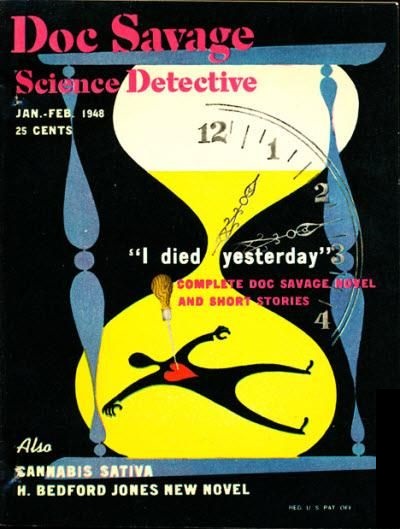
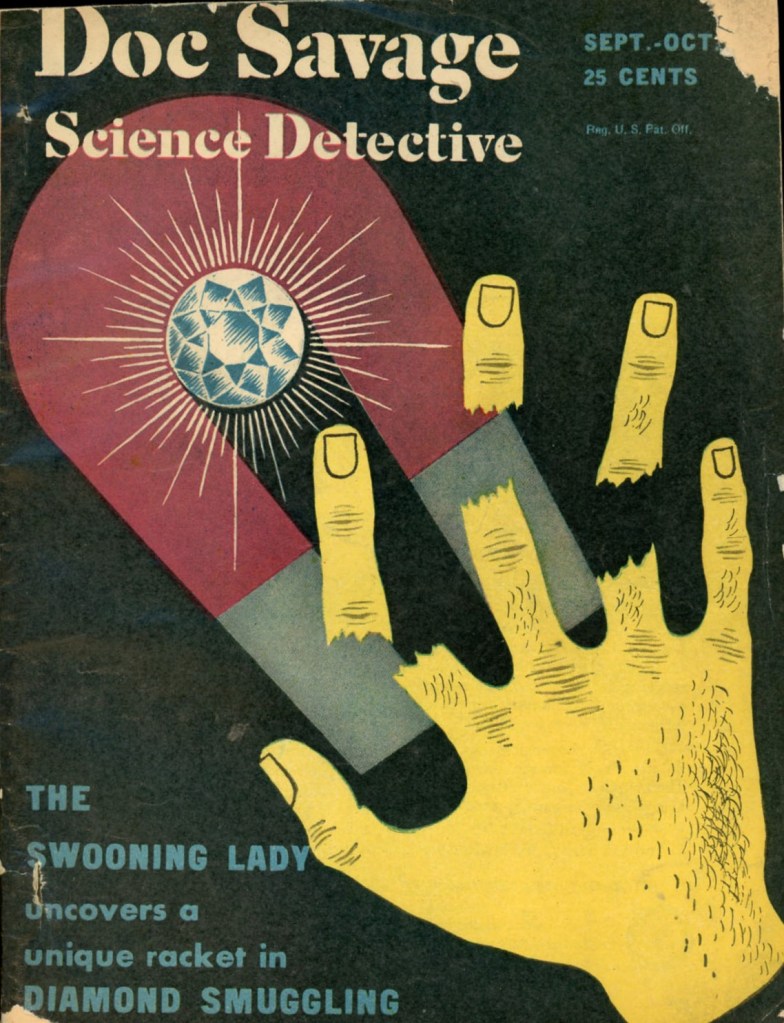
The covers during the period of Doc Savage, Science Detective were very strange indeed. They were abstracts, suggestive of the story but not really specific to its action.

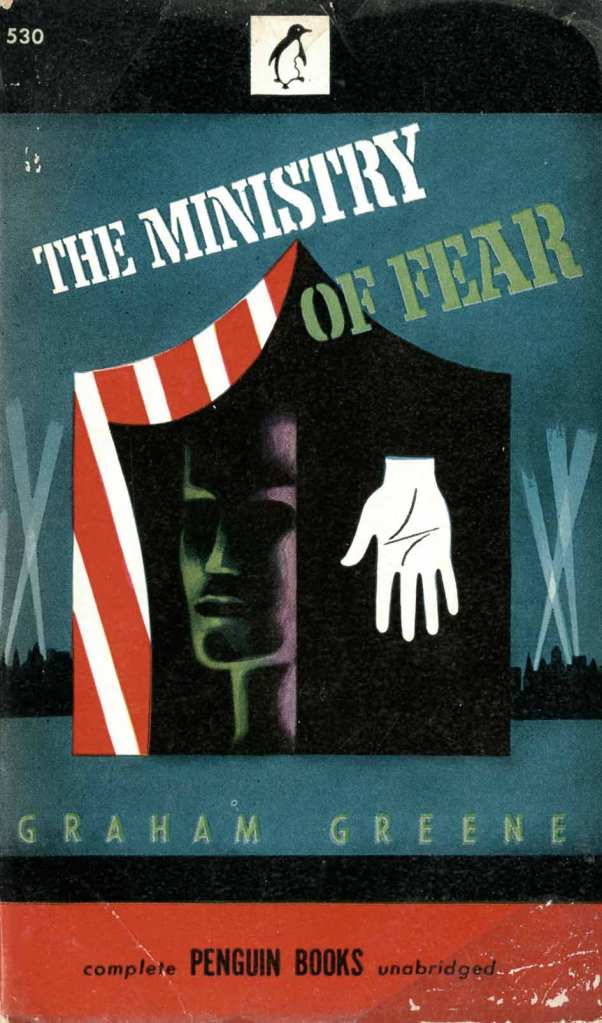
Jarring as they are to someone who visualized a Doc Savage magazine in the light of a Walter Baumhofer or James Bama, they were not just a mad editorial whim…book and magazine covers in postwar America had undergone a great change since the debut of Doc Savage magazine in 1933. Penguin Books in the 1940’s launched a successful line (sometimes new novels, sometimes re-packaging old ones) that used similar abstract techniques, pioneered by artist Robert Jonas.

Robert Jonas cover for Graham Greene’s “The Ministry of Fear”

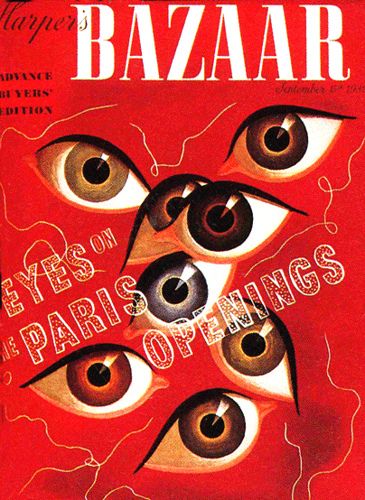
They were considered stylish and sophisticated. And there were even pre-war examples of the trend in the “slick” magazines, like this 1939 cover of Harper’s Bazaar (note the similarity in the eye motif to the Doc Savage issue Terror Wears No Shoes).

Alexey Brodovich cover for Harper’s Bazaar, 1939

The stories themselves in the “Science Detective” era were generally of smaller scope than the grand adventures of the Thirties. They had tight, relatively narrow plots, and spent a good deal of time on characterization and mood. This style was the standard of “fine writing” at the time. The de-emphasis of the hero in literature was a distinct tone of the times (notice that the cover of the March/April 1948 issue of Doc Savage, Science Detective does not even mention the Doc novel inside).

World War II had changed the way adventure entertainment was perceived. Though I am from the next generation (born in 1958), I can well understand how, having passed through an unprecedented time of war and devastation, the reading public was less interested in world-threatening gadgets and larger-than-life villains.

Also, there is a generational quality to the readership of long-running series. Doc Savage had been designed and marketed to a mid- to late-teen male audience, and those readers had aged, while a new wave of younger readers had been seduced away from the pulps by the emergence of comic books. So Doc Savage magazine was in an unusual void. Its choice to attempt to hold onto their older, existing readers through a change in story content and packaging is not so unusual (even if it was not ultimately successful).

For me, reading these stories with a traditional Bantam Doc cover was unsettling. My mindset was still in the Thirties, and I was not immediately comfortable with the changes in the stories and characters themselves. Some of the stories felt so lightweight as to be trifles. But when I got past that culture shock, I actually found some of them to be quite compelling in their own right.

They were, after all, still being written by Lester Dent…and he seemed invigorated through being able to embrace a somewhat more adult style of writing. This was a direction, as I understand it, that he wished to take his writing career anyway…taut detective fiction for the slicks, and for the larger houses publishing novels at the time.

In time I came to appreciate this period in the Doc Savage saga more and more. I still cherish the Thirties adventures, which are so emblematic of the series as a whole. But for a slightly more adult Doc, with some richer shadings of personality and stories that don’t crowd out that characterization, they can be illuminating and enjoyable.

Doc Savage grew up a little, as the whole world did after the wrenching realities of war and its aftermath. As a reader, I grew as well from the teenager who fell in love with Doc. Both sides of my personality are still going strong all these years later, and in the whole of its run, Doc Savage embraces both those selves.

(Thank you to Ralph Grasso of Fans of Bronze for suggesting this article.)