Doc Brazen in Net Prophet

In Jeff Deischer’s recent guest blog post here at Forbidden Pulp, he introduced Doc Brazen, his unique pastiche series based on the adventures of classic pulp hero Doc Savage. I was also honored to write the Introduction to the newest edition of the first book in the Doc Brazen series, Millennium Bug.

The exciting news is that Doc Brazen is back! The new Brazen novel, Net Prophet, is now available.

Here is the book’s description, and a look at the front and back cover:

WHO IS DOC BRAZEN?

The world’s most famous crimefighter, scientist, and adventurer from the Thirties and Forties comes out of retirement after fifty years. Aided by a new group of aides, Oz and Noble, two young Aztec men; Robert Lafitte, a semi-reformed cat burglar; Thunderbird Crale, a female stunt pilot; and Henry Prevost, a computer scientist, Ulysses Brazen, Jr. returns to his career of righting wrongs and punishing evildoers.

When Oz and Noble come across the corpse of a young starlet in unusual circumstances, they feel compelled to investigate the murder. Who killer her and more importantly, why? What secrets do the Eleusinian Ministries hide, and what does the internet guru Jazz Phoenix have to do with EM’s Los Angeles Parthenon?

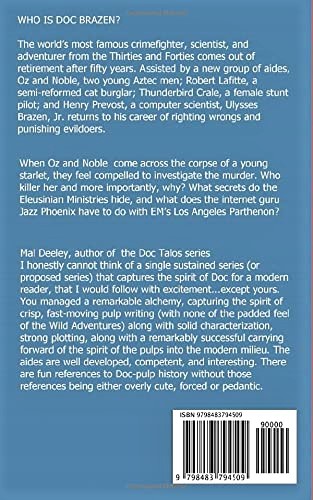
There on the back cover are my enthusiastic thoughts about what Jeff has achieved with the Doc Brazen series. I’ve been a Doc Savage fan for over fifty years, and have seen adaptations, pastiches, updates…but as I say on the back of Net Prophet, this series is head and shoulders above any previous effort to bring the pure pulp spirit of the original canon forward into a modern setting.

In more depth, here is what I said in the Introduction to the first Brazen book:

Ulysses Brazen Lives!

It takes a certain audacity to create a pastiche of an iconic literary character, and the world of authors does not lack for audacity. But in the cold light of critical assessment, combined with the loyalty (and stubbornness) of the original character’s readership, most fall far short. Why, after all, should a reader be attracted to a pastiche, when a wealth of the original character’s stories are available? Mostly, I think, out of a desire to experience the seductive joy that was felt in the reading of those original stories, but through the freshness of a current author’s perspective. Authors and readers come together in a unique symbiosis…and there is an excitement that comes when an old literary love is taken up by a contemporary writer who clearly shares that love.

But the road ahead from there, unfortunately, has seen that special form of audacity crash and burn far more often than it soars.

The source here is the character Doc Savage, arguably one of the most popular characters of the 20th century, and certainly in the era of the pulp magazines of the Great Depression, a giant of popular culture. The Doc Savage magazine ran for 181 issues, from 1933 to 1949, and inspired countless imitators, but it embodied a unique set of qualities that was beyond imitation. It took the qualities of its time – largely the privations of the Depression – and responded with storytelling that included agency (Doc kept many businesses afloat by investing in silent partnerships) and compassion (he was always ready to assist the common man, accepting no fees for his services). Into the mix went the escape of high adventure and globe-trotting exoticism. Never was a character more perfectly suited for his milieu.

Amazingly, those qualities resonated with a mass audience again in the 1960’s, when Bantam Books began its long series of paperback reprints. A phenomenon once again, Doc became a cherished hero for a whole new generation.

Since then, publishers and authors have attempted to recapture that lightning in a bottle. Through licensing of new novels, through comic books, through film. Some have been disasters, others have been earnest – and modest – successes. And then there has been pastiche. Characters (many of them named Doc), instantly recognizable as doppelgangers of the original Man of Bronze, have appeared over and over again. Some have been interesting, others workmanlike, but to my mind none captured the special alchemy of their source.

Until Doc Brazen.

The weakness of most of these pastiches, to my mind, has been rooted in a failure to grasp the complexity of the original’s appeal. They have seized on a single aspect of the character that seemed a key to success. Nostalgia (setting the pastiche character in the 30’s and drenching the storytelling in a kind of backward-looking glow), or adventure (keying on the somewhat sanitized violence of the pulps, often a strange mix of visceral danger and innocence), or simply repetition (attempting to copy the writing and plotting of Lester Dent or the other Kenneth Robeson ghosts and simply changing all the character names).

Such efforts, at their best, could be fun, but were hitting on only one cylinder of an engine designed for an immensely more powerful performance.

Even before discovering Jeff Deischer’s Doc Brazen stories, I was aware of his unique fascination with Doc Savage. His book, The Adventures of the Man of Bronze: A Definitive Chronology, had been on my bookshelf since 2012, and I had read it with great pleasure. The book’s dedication, “For Lester Dent, one of the great storytellers”, spoke eloquently of where he perceived the greatest strengths of the long history of the Doc Savage pulp magazine to be. So I was more than casually interested when I discovered, in 2018, that he had created his own pastiche of Doc. Upon seeking it out, it became immediately apparent to me that this was a unique take on breathing new life into a whole pulp mythos.

Visual design has always been a significant part of the Doc Savage mystique, and modern creators have stood on the shoulders of images by talents like Walter Baumhofer (pulp cover artist) and James Bama (paperback cover artist) for decades. But Jeff’s Doc Brazen #1: Millennium Bug took an innovative approach, tapping into the zeitgeist of 21st century symbolism, which uses simple, clean imagery and bold colors to carry its message.

Beyond that dynamic packaging, the book’s blurb described Doc Brazen as “the world’s most famous crimefighter, scientist and adventurer from the Thirties and Forties, coming out of his fifty-year retirement”. So this was not going to be another in the crowded field of stories mimicking 1930’s style and shoehorned into a canon already filled with a huge existing continuity of novels and novellas. This was a continuation into the present era, orchestrated by one of the character’s most accomplished researcher/chronologists.

Others have tried this (most persistently in comic book adaptations), and have immediately gone astray, primarily due to lack of a coherent vision. Doc stories brought forward into the latter part of the 20th century or into the 21st have felt like an uneasy graft of the past onto the present. Without exception, those efforts were short-lived. I had pretty much come to the conclusion, as a reader, that it couldn’t be done.

Nevertheless, I could not resist trying Deischer’s Doc Brazen. And as I read that first novel, I came to realize that it could be done…because it was happening right before my eyes.

Where other pastiches had been halting, limited in scope – or simply exercises in imitation – Jeff’s vision for a present-day Doc was richly layered, balancing with remarkable poise between respect for the original stories and the fresh energy of a present-day setting. Doc himself was plausibly brought forward in time, aging (his white hair actually providing him with a new level of dignity), but in such a way that he was hale and vigorous. His retirement after 1949 (to the small Central American country of Coronado) was explained, not through laborious exposition, but skillfully woven into a fast-paced action narrative. New, younger aides were introduced, with connections to the past that helped them feel familiar, but also refreshingly characterized with unique qualities of their own.

The story brought in elements of Doc canon – again, always in a plausible manner – which expanded, rather than repeated iconic concepts.

And most of all, hearkening back to the dedication to his Definitive Chronology, the storytelling captured the best of Lester Dent’s style while deftly transitioning it – removing anachronistic qualities, incorporating aspects of Dent’s quirkiness without ever descending into parody, and pacing the story in such a way that it remained exciting from cover to cover. It was superb craftsmanship melded to the intangibles that made pulp-reading so much fun.

For the first time outside of the canonical pulp stories, I felt completely caught up in the magic that had prompted me to fall in love with Doc’s stories over fifty years ago. Doc was alive again.

The question that remained was: could Jeff do it again? One of the great allures of the original pulps is the fact they comprise a continuing story. You are not done with one novel…there is another, and another, and cumulatively a whole world emerges that you can immerse yourself in. A kind of joy (well understood by the passionate readers of the world) enters your life when you have thoroughly enjoyed a book, and you can envision a line of them on your bookshelf that will continue the journey. Millennium Bug had a short blurb in bold text at the end, which read: Doc Brazen will return…

When the return happened, I absolutely intended to be there.

But time passed. 2019, 2020, and Doc Brazen did not return. There is a surface part of me that is a man in his sixties, who understands that the world – particularly the literary world – can be a place where dreams do not come true. But alive and well in me is the teenager who followed splendid continuing stories as if my life depended on it.

Time and circumstance, in this instance, was kind. Net Prophet is here, and much more is to come.

Reading the Brazen books has brought me back to days when I would await each Doc Savage paperback. My pulse would race when I spotted the new dynamic cover, and I could barely wait to get each one home and start reading.

So I am grateful. Jeff Deischer rekindled a joy that was sparked in me as a reader a half century ago. Doc Brazen is indeed alive, and in the best pulp tradition cast as a new vision for today, the world is better for it.

Check out these links to further explore the exciting world of the Doc Brazen series:

Millennium Bug

Net Prophet

Five first-person encounters with a man of bronze: I Died Yesterday

A few months back, I did a review of the story I Died Yesterday, but in essence it was more a discussion of my long literary love for the character Pat Savage, and how it reached one of its peaks in my reading of this short novel, which is narrated by her. In the context of the final — and ultimate — Forties first-person story narration in the Doc Savage pulp magazine, it is well worth a second look.

For the third straight story, author Lester Dent uses a female narrator. In Let’s Kill Ames it was Travice Ames, con-artist. In Once Over Lightly it was Mary Olga Trunnels, sort-of detective. Both of those women had a degree of toughness, were smart and strong, and possessed a unique (sometimes mordant, sometimes a little arrogant, sometimes self-deprecating) sense of humor, which colored their views of people and the world. As it turned out, their resemblance to one another, and what would follow in I Died Yesterday, presents the impression that they were practice. Practice for Dent to adeptly display the Doc Savage canon’s most vital and dynamic female character: Patricia Savage.

Pat has all of those characteristics too…and far, far more. She debuted in the series fourteen years earlier, in 1934, and this would be her last appearance before the end of the pulp run in 1949. Brief glimpses into her thoughts had been presented over the years, but never in this depth. From the 1934 late-teen Canadian tomboy we met in Brand of the Werewolf

…to the fierce seeker after adventure throughout the rest of the Thirties…

…to the postwar businesswoman of 1948, she has evolved into a fascinating woman.

By the time of this story in 1948, Pat is still strong, impulsive, determined…but she has also become more introspective, and even a little world-weary. When I Died Yesterday begins, she is in her office at the Manhattan salon/gymnasium that she owns, but is not particularly looking for adventure. When her assistant comes to her with a problem (an oddly-behaving man who has come to the salon and won’t leave), she seems as if she would really prefer to just let her employees take care of it.

To her surprise, her assistant, Miss Colfax, shows less deference than usual, and actually talks back, expressing the opinion that the staff would like to see how Pat, the famous hellraiser, would deal with something as prosaic as a problem customer…in fact, some of them were frankly dubious about her reputation as an adventuress.

Troubled by this, worried that she may have lost her edge, Pat goes to throw the intruder out. The result, of course, is violence and chaos enough to make her salon staff (including Miss Colfax) wide-eyed with awe.

The actual plot of the story is not particularly memorable. The formula for what was now Doc Savage, Science Detective was vastly different from the globe-trotting, sprawling grandeur of the Thirties…the world had grown much smaller, and plots were usually either tight crime or espionage narratives, or character-driven tales. I Died Yesterday definitely falls into the latter category. The danger/mystery of the story involves what would today be called eco-terrorism, but it is not greatly compelling. What it does do is provide the framework for a number of scenes that are made intense and gripping simply because they are seen through Pat’s eyes. Those include a scene where Doc is ambushed by thugs, featuring some of the most harrowing descriptions of violent action that Dent ever wrote…and a scene where Pat is captured (a stock device in earlier stories, usually signalling a rescue on the way from the Man of Bronze). Pat gets out of it herself, using her natural reckless audacity (as well as some gadgets she had collected since Doc abandoned using them).

During these scenes and others strongly spotlighting Pat, the story soars. When it returns to the machinations of the plot, it labors.

As noted throughout this series of articles exploring the five first-person Doc Savage stories, perhaps the most interesting opportunity they offered was to see Doc himself through the eyes of other characters. Across the years, observation about Doc, his lifestyle, his appearance, his behavior…all had come through third-person narration. Dent and the other Robesons had sometimes been fast and loose with narrative conventions, and at times Doc’s thoughts and feelings had been described, or the opinions of characters concerning him at least obliquely presented. But not with quite the intimacy that first-person narration could achieve.

The first four stories in this sequence looked at Doc through the eyes of strangers. But in I Died Yesterday, we see him from the perspective of perhaps the closest person to him in the world. Pat is never reverential…she often teases her cousin, and is even frequently prompted to anger by his over-protective behavior (which was often accompanied by Doc doing his poker-faced equivalent of teasing back). Over the course of this tale, we also see the admiration she feels toward him, and the warmth. Her distress when he is in trouble is intense, and she displays protectiveness of her own. She is constantly plagued by Doc and his aides saying she is nothing but trouble…they intend to “disown” her…they wish she would stick to prettifying New York society ladies in her salon. But despite all that on the surface, there is an undercurrent of love, which is actually quite touching amid all the pulp violence and mayhem.

With those qualities, I Died Yesterday is one of the most important stories in the long pulp canon of the the Man of Bronze. Had it been narrated by another stranger, the story on its own merits would have been a trifle. But Dent brought Pat to life as never before, and it was none too soon, as by 1949 Doc Savage magazine would be done.

As noted above, Pat would not appear again in a Doc pulp. So reading this story is bittersweet. She even expresses some hesitation about wanting to get involved with dangerous adventure again. Her last words contain even more bittersweet feelings, as in many ways, this is goodbye:

I turned and walked away, wondering if the miracle that Doc had been working for had happened, and I was cured of my liking for adventure, or whether it was just that I was still scared. I didn’t feel scared, which was what worried me.

By the next issue the first-person narrative experiment was over. The rest of the series to its final issue were done in traditional third-person. The five stories were quite a wild ride, running the gamut from solid pulp entertainment (No Light to Die By, Let’s Kill Ames) to uninspired storytelling (The Monkey Suit) to a semi-screwball comedy train wreck of a tale (Once Over Lightly)…to a final adventure with a cherished heroine (I Died Yesterday).

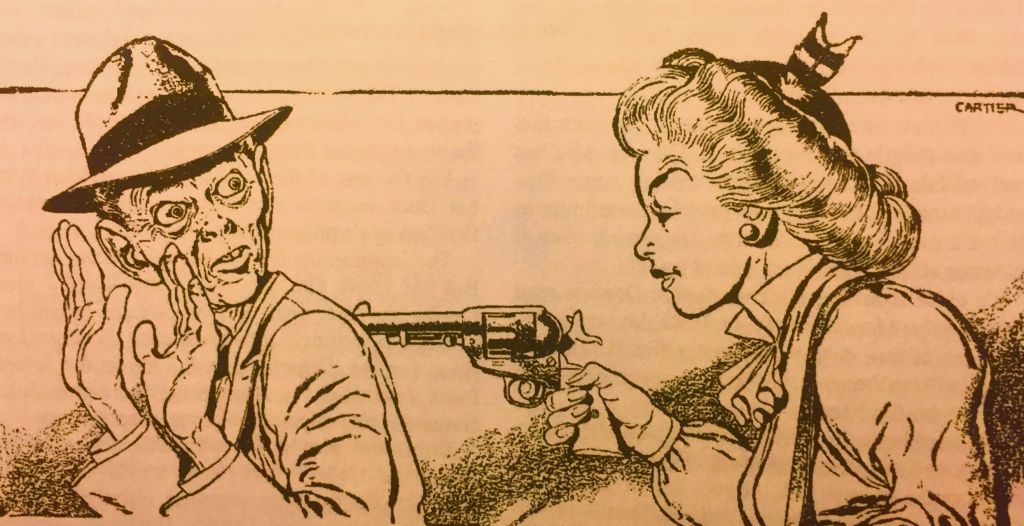
It was perhaps the widest disparity of stories in any five-issue span of the Doc Savage pulp. It ended well, with a tinge of melancholy…but also with bursts of fierce energy (Pat with her six-shooter is a sight to behold)…and plenty of heart.

“I Died Yesterday” interior illustration by Edd Cartier

Five first-person encounters with a man of bronze: Once Over Lightly

The fourth of five consecutive first-person narratives in the Doc Savage pulp magazine took place in the Nov./Dec 1947 issue. The previous issue had debuted the new title of the series, Doc Savage Science Detective, and this (though it would be short-lived), continued as well. The three first-person point of view stories to this point had been a mixed bag: No Light to Die By had been clever and engaging; The Monkey Suit, with its plot-that-went-nowhere, less so. Let’s Kill Ames had showcased a female narrator for the first time in the canonical pulp run, and it was a successful, taut thriller.

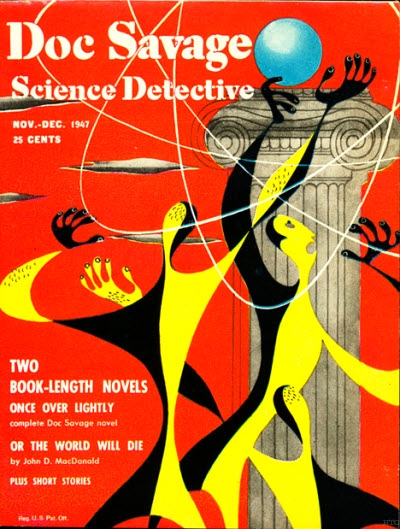
However, this latest story, Once Over Lightly, was something of a train wreck. To begin with, the pulp cover bore no resemblance to anything in the story. It took the abstract approach from this era of the magazine up a notch…its Cubist figures appear to be playing some intense kind of ball game with a blue sphere, in the vicinity of a classical architectural column. Sharp-pointed clouds (or perhaps spaceships?) in the background complete the design. I presume it illustrates the John D. MacDonald novel Or the World Will Die, which I have not read, but which has been summarized as a futuristic novella about nuclear proliferation. The white lines around the blue sphere seem to suggest an atomic symbol, which might (or might not) further connect it to MacDonald’s story. In any case, it was pretty weird.

The title of the Doc Savage novel is odd as well. By definition, “once over lightly” means “a hasty or superficial treatment, look, examination, etc.” Basically to give something a cursory glance before moving on. How this applies to the actual story is a question not easily answered, nor is it an enticing invitation to an adventure/mystery.

Any hope that the novel itself is going to redeem all of this bizarre framing, is swiftly lost upon reading.

Once again author Lester Dent gives the story a female narrator. This time it is Mary Olga Trunnels, who prefers the nickname “Mote”. The M.O.T. is of course her initials, but again, resorting to the dictionary, we find the definition of mote to be “a small particle or speck, especially of dust”. Why anyone would embrace this nickname is beyond me.

To make matters worse, Mote is something of a pale copy of the previous novel’s heroine and narrator, Travice Ames. Miss Ames had pretended to be a private detective, and Mote works for a P.I. Agency…they both have a wisecracking style. This repetitive characterization immediately drains some of the interest from the storytelling, as one of the main allures of the first-person approach was to give unique, differing perspectives on the character of Doc Savage as seen through a fresh character’s eyes.

The plot of the novel as it unfolds is, frankly, a convoluted mess. A girlfriend of Mote’s named Glacia (another unlikely name, suggesting a cold, slow-moving personality, whereas Glacia proves to be noisy and high-strung) tells her to quit her job and come out west, where a much better job awaits. No details about this plum job are provided, and yet Mote immediately embarrasses one of her employers to get herself fired (ostensibly to avoid having to give two weeks notice), and heads west with vague prospects.

A fake Indian named Coming Going meets her and brings her to where Glacia is staying — in an inexplicably bizarre hotel that appears, for the most part, to be isolated from civilization (and loaded with strange features like animal totems instead of room numbers). Glacia still refuses to tell Mote what her new job is, but assures her she’ll get paid. It will later turn out that the only reason Glacia summoned Mote is as a sort-of bodyguard (a role Mote seems not at all suited for), since Glacia trusts no one at the hotel and is vaguely frightened.

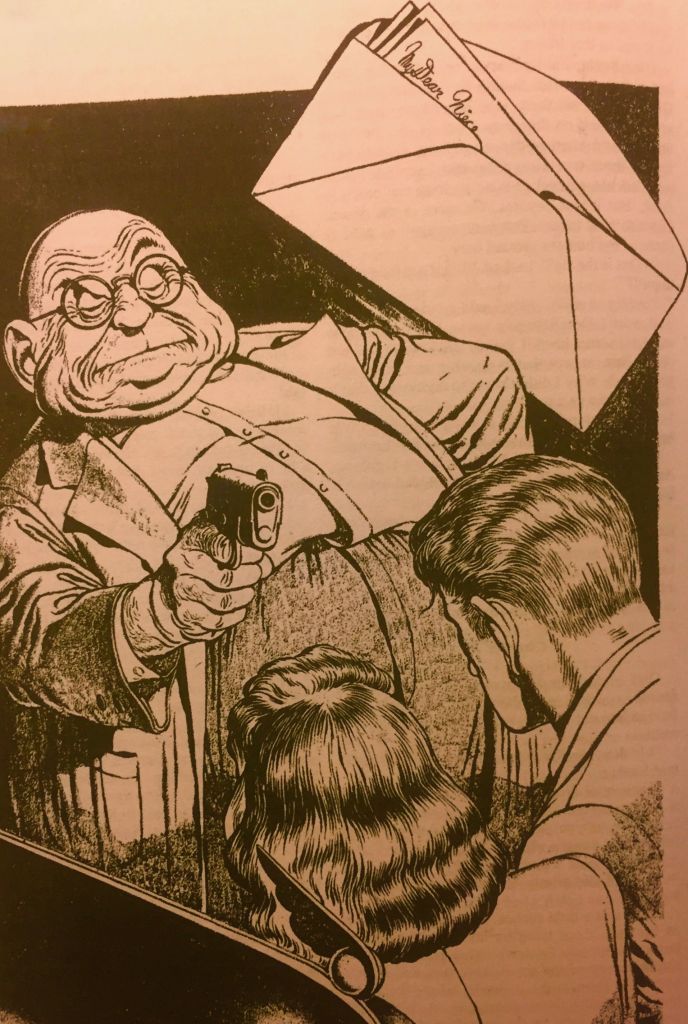
In short order, everything but the kitchen sink is tossed haphazardly into the plot. An eccentric uncle (who is murdered), an inheritance that nobody comprehends, a couple of villains whose chief characteristics are being fat and bad tempered (one of them is displayed in a cartoony interior illustration by Edd Cartier)…

…a few other characters with quirks and attitudes are thrown into the mix seemingly for the hell of it…Doc Savage appears on the scene, supposedly there for a vacation (of course no one could possibly believe he has come to such a strange place for real vacation, so it is obvious to everyone that he is investigating the same dark doings that have sucked in Mote)…and everybody essentially runs in circles accomplishing very little.

The plot is shown to involve a sunken ship with uranium aboard (this is explained about three quarters through the novel, rather than as a mystery-reveal at the end)…though why everyone has gathered in the desert southwest to chase this atomic-era trove when the ship sank on the way to England is once again anyone’s guess.

The whole mishmash comes to an end with a final fight that appears half-serious, half-camp (for instance, one of the villains, trying to get away, tries to jump through a window, not realizing it is boarded up on the outside. He knocks himself cold).

The intent of this story would, by any logical measure, be an experiment by Dent to expand on his often quirky humor, pushing it over the boundary into a kind of adventure/mystery/screwball comedy hybrid. Perhaps not the best time to attempt such an experiment, when editorially the magazine was attempting a rebrand into the “science detective” storytelling mode. In any event, it was not (thankfully) repeated. Before the end of the magazine in 1949, there would be strong, dramatic stories to come.

But as for Once Over Lightly, perhaps it is wise to take its title in the form of advice…give it a glance, and quickly move on.

Next: The final first-person narrative, told by Pat Savage herself!

Five first-person encounters with a man of bronze: Let’s Kill Ames

The third of five consecutive first-person narratives in the Doc Savage pulp magazine took place in the Sept/Oct 1947 issue. The first two had involved a look at the Doc Savage world through the eyes of a tough-talking, hard-edged “regular guy”, and then what would normally have been a background character: a rather unlikable two-bit scientist.

In the third narrative, Let’s Kill Ames, author Lester Dent tries something never before attempted in the long run of the magazine: a story told by a female protagonist.

Women in the canon of original Doc Savage stories, with the exception of his dynamic cousin Pat Savage and to a lesser extent the Mayan Princess Monja, rarely achieved much depth. Some were little more than window-dressing for stories, some were feisty, occasionally a few were villainesses, some were more noble…others were classic, pretty (but vapid) “good girls”. The authors who wrote under the house name of Kenneth Robeson were tightly restrained by Street & Smith policies, which have been described as including what was essentially a dictum not to explore any female character below the neck or above the knees.

So it was interesting indeed to finally get inside a female character’s full persona.

The cover of the Sept/Oct issue was another in the line of abstract late-Forties artistic compositions, but it does obliquely match the story of Let’s Kill Ames, which involves the infecting of extortion victims with a radioactive substance. The victims have to pay enormous amounts for a cure, or suffer a slow death. This was also the first issue to carry the masthead title Doc Savage Science Detective.

The “Ames” of the title is in fact the woman narrator, whose full name is Miss Travice Ames. We meet her in the moment her nice car is being repossessed, and she will soon learn that she has also been locked out of her hotel room by the management, for non-payment of her bill.

Miss Ames, it turns out, is a con-artist — a grifter who uses her looks and wits to fleece various victims out of as much cash as she can manage, after which she moves on to a new city and does it all again. She’s been going through a tight stretch, with the lack of incoming con-game cash catching up to her expensive lifestyle of good hotels and fancy cars. She doesn’t want to just skip town, as all of her clothes and possessions are in the locked hotel room, and they won’t let her in unless she ponies up about four hundred bucks in room fees (a lot of money in 1947).

With few options available, she decides to try and get the money from a chemist named Pulaski who has a crush on her. He’s not much to look at, but she’s been pretty much able to wrap him around her little finger, and she figures he’ll be good for enough to get her room unlocked, so she can grab her stuff and move on.

At dinner, she plays him like a fiddle, taking periodic shots at his manhood to get him to show off (when he has had enough of that, she intends to get him to prove he is a big man by giving her some money). Instead, he is goaded into trying to impress her with a whopper of a story…he is soon going to be rich, as he has developed a technique for slow radioactive poisoning, which is going to be used on wealthy men, with a payoff coming by selling the victims a cure.

Miss Ames is somewhat astonished, and though impressed, she is frustrated about learning more when the semi-drunk Pulaski suddenly realizes he has talked too much, and clams up. She is still not sure if it is all bunk, until she decides to try a scam herself on Pulaski’s targets (men which he unwisely revealed the names of). Soon after that, an attempt is made on Miss Ames’ life, and when, after barely escaping, she rushes to confront Pulaski…she finds him dead.

(interior illustration by Edd Cartier)

Through all of this, author Lester Dent has shown a pretty skillful touch for writing a mystery/adventure from a female’s point of view. Like many Dent characters, Miss Ames (her first name is almost never used) is jaded with a clever and sometimes dark sense of humor…she is smart, knows a lot about manipulating men, and gets shaky when things become violent, but is calculating and brave enough to get herself both in and out of trouble.

This trouble, however, is more than she can handle. So she hits on the idea of calling in the famous troubleshooter Doc Savage, who she will unleash on the bad guys. And maybe, if the Bronze Man is like most men and a sucker for a pretty face, she’ll maneuver herself into getting a little money out of him too, or at least some portion of the scheme’s ill-gotten goods, before vanishing herself.

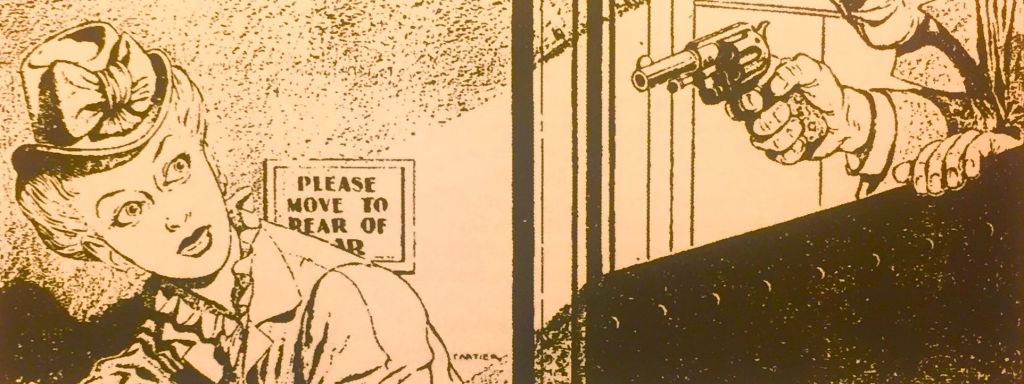
The story launches into a tight series of chapters where Doc arrives, clues are explored, and the peril escalates. One particularly intense sequence involves Miss Ames being trapped in an elevator stuck between floors with the crook who killed Pulaski, and her desperate struggle to avoid being shot (clever touch by interior artist Edd Cartier to add the “please move to rear of car” sign inside the elevator…Miss Ames looks like she heartily agrees).

“Let’s Kill Ames” interior illustration by Edd Cartier

One of the highlights of these first-person stories is the chance it affords for the main characters to share their impressions of Doc Savage. Miss Ames’ thoughts on this are very interesting — she is impressed by such a handsome, competent man, but is wary about him discovering that she is a petty crook herself. In one passage she muses about that, and offers an interesting opinion about Doc’s well-documented discomfort around women.

(Doc Savage) said, “You’re a very stable person, aren’t you, Miss Ames? Death and terror and men lying themselves blue in the face all around you, and you’re not too much affected.”

“I’m affected all right,” I said. “With a little more of this encouragement, I think I could shake up a first-rate case of hysterics.”

Don’t,” he said. “It might not look well on you.”

I had heard somewhere that he was afraid of women, that he didn’t understand them; that, as a matter of fact, he had a phobia about the point, and never allowed himself to form any attachments of that sort. Just because he couldn’t figure a woman out. It would be nice if that wasn’t the hooey I was beginning to think it was.

Doc, it appeared, had grown up a bit by 1947 in his ability to deal with women. It should be emphasized, however, that there is not a trace of romance in Let’s Kill Ames…not between any of the characters. Pulaski is a dupe and fall guy, a character named Futch who appears interested in Miss Ames — who might, in more traditional pulp fashion, have ended up romantically connected to her — actually supplies a different twist to the tale. Miss Ames herself seems to consider Doc to be something like a tiger she has invited a little too close, who might at any point decide to put an end to her career as a con artist. The lack of even a whisper of romantic involvement was actually quite refreshing for a pulp story narrated by a woman. By contrast, a couple of decades later another notable adventure writer, Ian Fleming, would also produce a female-narrated novel (his James Bond story The Spy Who Loved Me), which felt strained and maudlin with romantic undercurrents at times.

The story keeps up its brisk pacing throughout, and Miss Ames is engaging from start to finish. Developments include Miss Ames doing a bit of extortion herself (to the tune of two thousand dollars, which will feature in the story’s ending), then discovering she has also been poisoned by the radioactive compound…a tense standoff with the villains…a few familiar Dent-isms like a red herring character that turns out to be one of Doc’s aides (in this case, Ham Brooks), and the unmasking of the mastermind behind the whole thing.

Fortunately for Miss Ames, the poisoning cure is not a fake, so she gets out of it alive. In the end, she learns that Doc is aware of her own criminal tendencies, but he nevertheless lets her go. Here are Miss Ames’ thoughts on it all at the end of the story.

So I had been pretty smart, I was the one who was going to use Doc Savage to rake the chestnuts out of the fire, then I was going to grab the chestnuts and leave him with a foolish expression. Sure, I had been smart, the way a cat is when it sticks its head into a milk bottle then discovers that the head that went in easy won’t come out.

I remembered that I had left my purse in the car. I went and got it and took a look inside. The two thousand wasn’t there, but it wasn’t much of a surprise. I had a pretty good idea that I wouldn’t say anything about my vanished profit.

And I didn’t; and a couple of weeks later, I got an awfully nice letter from a cancer research fund, thanking me for the fine donation of two thousand dollars. So I didn’t feel too foolish.

All in all, Let’s Kill Ames was fun, clever, exciting, and even, at times, insightful. One of the best of the first-person Doc adventures.

Next: Once Over Lightly

Five first-person encounters with a man of bronze: The Monkey Suit

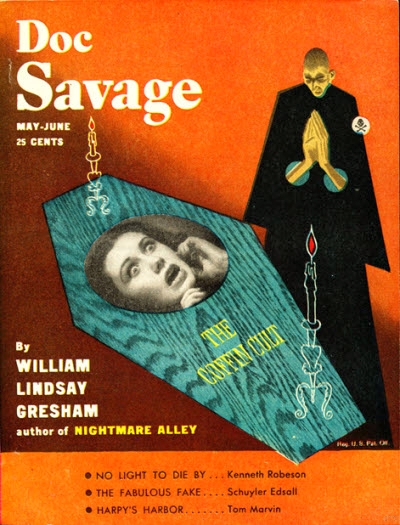
The second of five first-person narratives in the latter part of the Doc Savage pulp run was in July-August 1947. The story was called The Monkey Suit. The cover art, unlike the May-June issue, actually depicted the main Doc Savage novel, though it was once again a composition in the late-Forties abstract style.

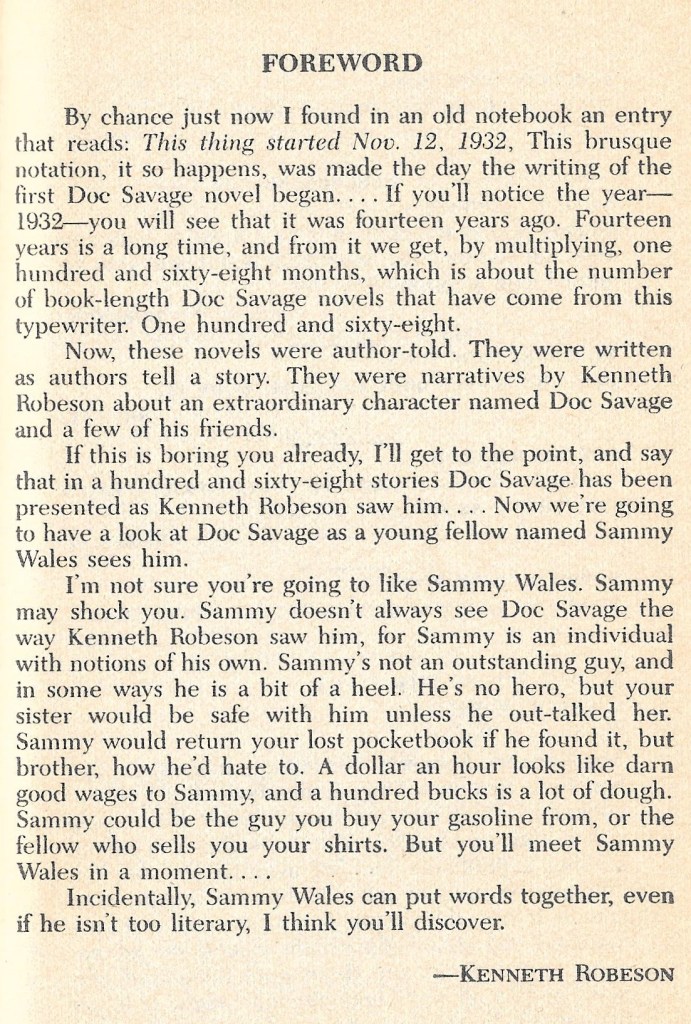
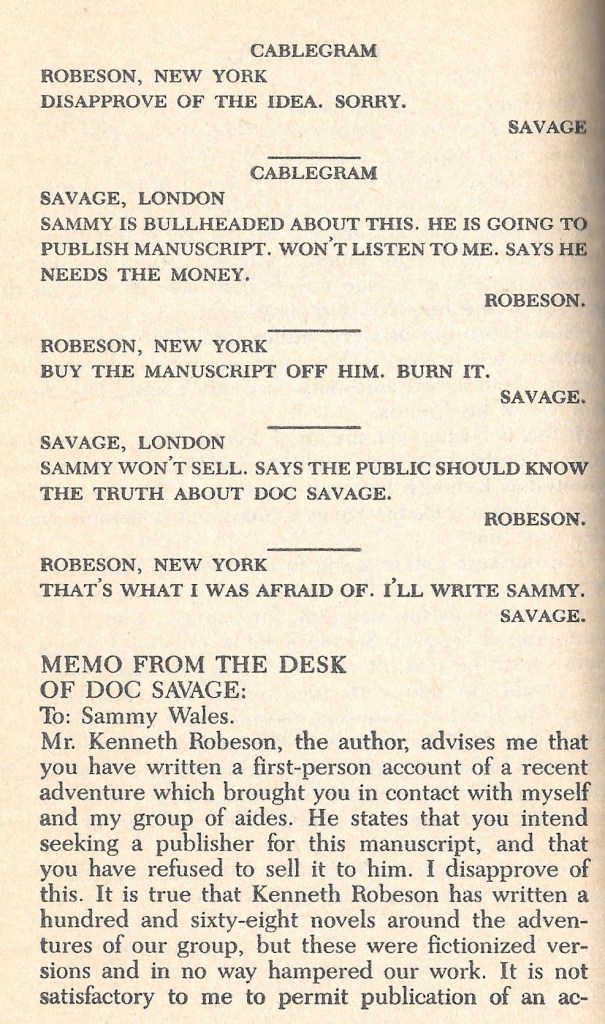
Author Lester Dent had prefaced the previous issue’s story, No Light to Die By, with a really astonishing sequence of introductory pieces, including an author foreword, a whole series of cablegrams purportedly showing efforts to kill publication of Sammy Wales’ first-person account of his adventure with Doc Savage, and finally a statement/disclaimer by Doc himself. For this second experiment with the new narrative style, that was trimmed back to just another author foreword by “Kenneth Robeson”.

It’s relatively short, and basically informs the reader that this time the narrator is someone distinctly unlikable. In fact (Robeson claims) most readers are likely to feel an urge to take that narrator, Henry Jones, and “kick him in the slats”.

I had felt, in reading these five stories, that the greatest challenge Dent faced with them was to clearly differentiate his narrators, so that each successive story didn’t end up feeling like Lester Dent himself under various names. I needn’t have worried…the narration provided by Henry Jones is distinctly different from that of Sammy Wales.

Jones is a scientist, but definitely a lower-tier one, though he has a very high opinion of himself. He has his own modest lab, but his researches are not noble endeavors for the betterment of mankind; his primary motivation is to get himself a product that he can market for a decent amount of cash. To that end, Jones has discovered than an eminent chemist (no less than Andrew Blodgett Mayfair), has perfected a process that will enhance his own product, and he is desirous of acquiring use-rights to that process. Being a bit of a skinflint, Jones hopes that he can get the rights for an affordable fee, since Mayfair is reported to be perpetually broke, and might be willing to cut him an attractive deal.

He sets up an appointment with Mayfair, but an hour or so before they are scheduled to meet, one of Jones’ old acquaintances — a man he distinctly dislikes — contacts him because he wants a favor.

Jones fumes over this…and we get a clear picture of his personality. He is fussy, prissy and easily irritated. He thinks of himself as a gentleman, and has a sneering disdain for anyone who doesn’t fit that standard (needless to say, it is going to get interesting when he meets Monk Mayfair).

The old acquaintance comes over to his lab and promptly launches into a fast-talking spree of “old buddy, old pal” talk. Jones really wants to get rid of him, but the man is an old-school leech, and not only won’t go away, he won’t shut up. Jones is appalled and jealous to discover the man has a corporate position better than his skill level, and the jealousy is stoked further when he meets the man’s girlfriend, who is a looker.

But things get very strange, very fast. It seems the favor that the boorish friend is angling for is for Jones to collect a package from a public locker and hold onto it. He is given the locker key, but before any kind of rational explanation can be made, there are sudden attempts on Jones’ life.

The loudmouthed friend hastily makes his exit, but Jones follows him (to a cocktail lounge, where he finds the man in the midst of a string of more outrageous lies, this time to his pretty girlfriend). When he leaves, Jones nerves himself up and approaches the woman, basically to expose and discredit her boyfriend’s lies.

Remembering his appointment with Monk Mayfair, he calls his lab to let his assistant know he has been delayed, and finds out that Monk is already there. Intrigued to hear Jones is in a bar, Monk impulsively comes to join him.

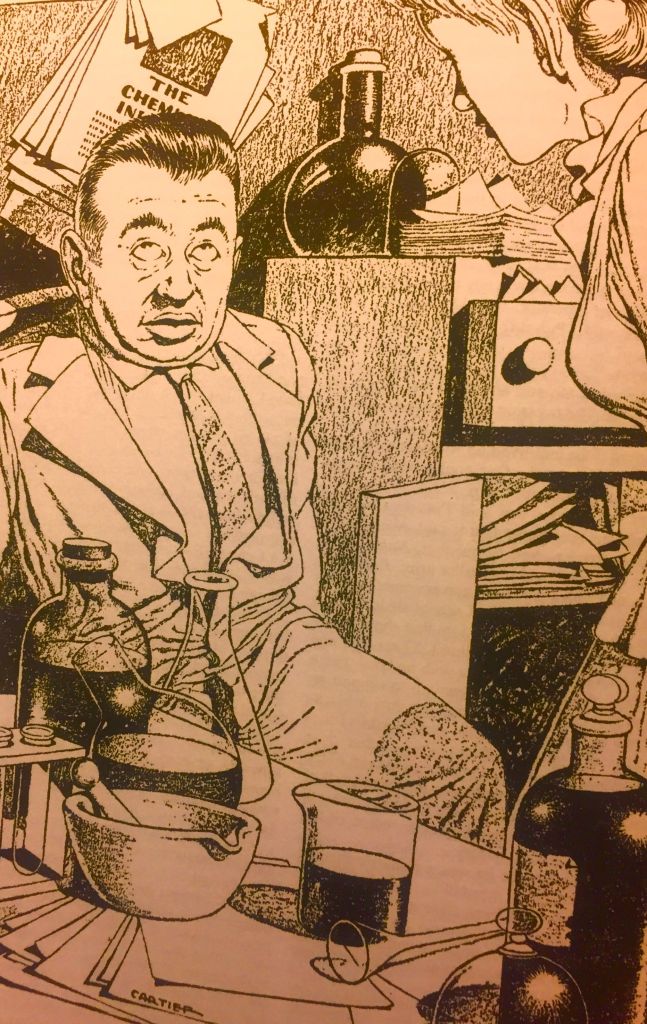
For a while, the narrative that follows is pretty crazy, and a lot of fun. Monk is in fine form, immediately playing up to the girlfriend, Lila (which infuriates Jones, who is smitten with her). More danger arrives, in the form of two gunmen who burst in and appear to be holding up the cocktail lounge (they are in fact intending to murder Jones). The interior illustration is by Edd Cartier, whose more cartoon-like style had replaced the long-term classic artistry of Paul Orban.

While Jones behaves in a pretty cowardly manner, Monk (who loves a good scrap) tears into the gunmen, and mayhem ensues. After a wild fight the gunmen flee, with Monk in pursuit. Jones finds the whole episode barbaric, and is further disgusted to see that Lila clearly thinks Monk is a better man than Jones.

This section of the story is filled with Dent’s snappy dialogue and quirky mix of danger and humor. Doc Savage is brought into the mystery, and here the first-person narration actually felt like an improvement over the third-person approach; for the mid to latter part of the Forties, Doc had been portrayed as more fallible, which sometimes led to very awkward scenes describing his emotions. With him being observed by Jones in this tale, he is portrayed as competent, modest, strong, and remarkably diplomatic with the abrasive Jones. It provided a nice balance between the old “superman” presentation of Doc, and the more humanized characterization of the later pulps. Jones, displaying more petty jealousy, keeps telling himself that Doc’s reputation must be completely exaggerated, considering the bronze man to be a “fourflusher”…an opinion that keeps getting punctured by Doc’s efficiency, accomplishments and sterling character.

Unfortunately, the character interplay can’t carry the whole story, and as the plot (such as it is) unfolds, the tale bogs down in efforts to explain all of its absurdities. The mysterious package is recovered, and proves to contain a cheap gorilla-suit from a costume shop. The reasons for this, when finally revealed, are pretty underwhelming. The whole story pivots on a mass of hoaxes, ridiculous logic, and a lack of any real menace.

The Monkey Suit, in essence, felt like a lark…and a very enjoyable one at times. Monk and Doc are the only regular series characters to appear, and Dent clearly enjoyed having the space to play with them (Monk particularly benefits from having no space taken up by his perpetual quarrel with Ham, who is absent).

In the end, Jones, still “jonesing” for the pretty Lila, is essentially brushed off by her (no boy-gets-girl ending here!), and the bittersweet final lines hint that Jones may actually be catching on that he is a pretty disappointing human being.

_______________________________________

Next…Lester Dent writes from a female character’s point of view, in Let’s Kill Ames.

Five first-person encounters with a man of bronze: No Light to Die By

Toward the end of the long run of the Doc Savage pulp magazine, author Lester Dent changed things up a bit. The stories from 1933 up to May-June 1947 were all told in third-person narrative. With that issue however, and across the following four installments of the magazine, the stories were told from a first-person perspective.

This was a strange time in the history of the magazine. With sales declining (Doc Savage would come to the end of its original run in 1949), there was a good deal of experimentation going on…including a number of abstract covers, which sometimes did not even illustrate the Doc Savage novella inside. The Doc story in the May-June 1947 issue, listed below the headliner atop two other backup stories, almost seems an afterthought.

Nevertheless, first-person writing was an intriguing approach toward getting a fresh look at Doc’s world. However, it also posed a unique challenge for Dent. He had a distinctive writing style, and the strength in first-person story narration comes largely from establishing the “I” character voice in a convincing way. Would all five of the sequential narrators simply sound like slightly altered versions of Dent himself?

In the first of the five novellas, No Light to Die By, this is exactly what appeared to happen. The narrator of the story is a young man named Sammy Wales. He has a somewhat quirky, occasionally mordant sense of humor…he is pretty tough, has a wayward streak, but has a penchant for coming around and trying to do the right thing (sometimes despite himself). He has plenty of attitude, but is also self-deprecating at times. All very much in the style of Dent’s omniscient third-person writing.

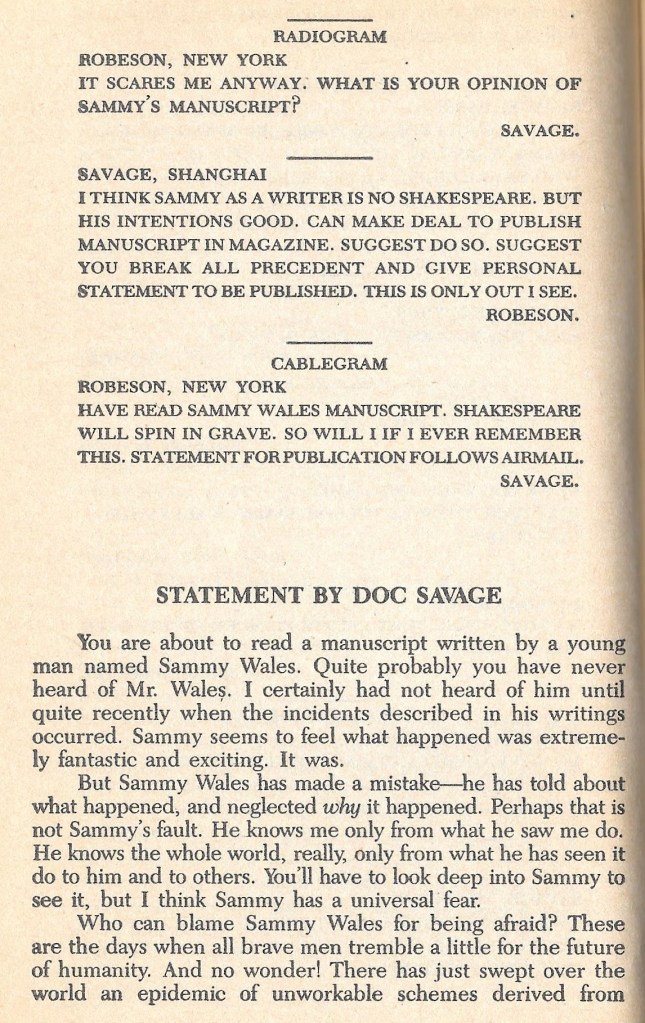
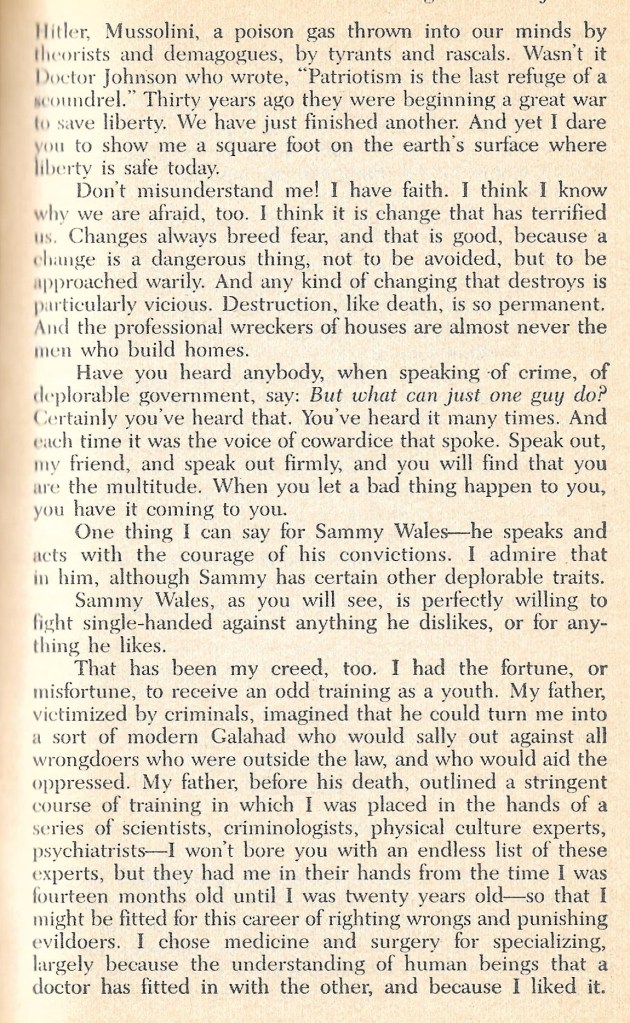
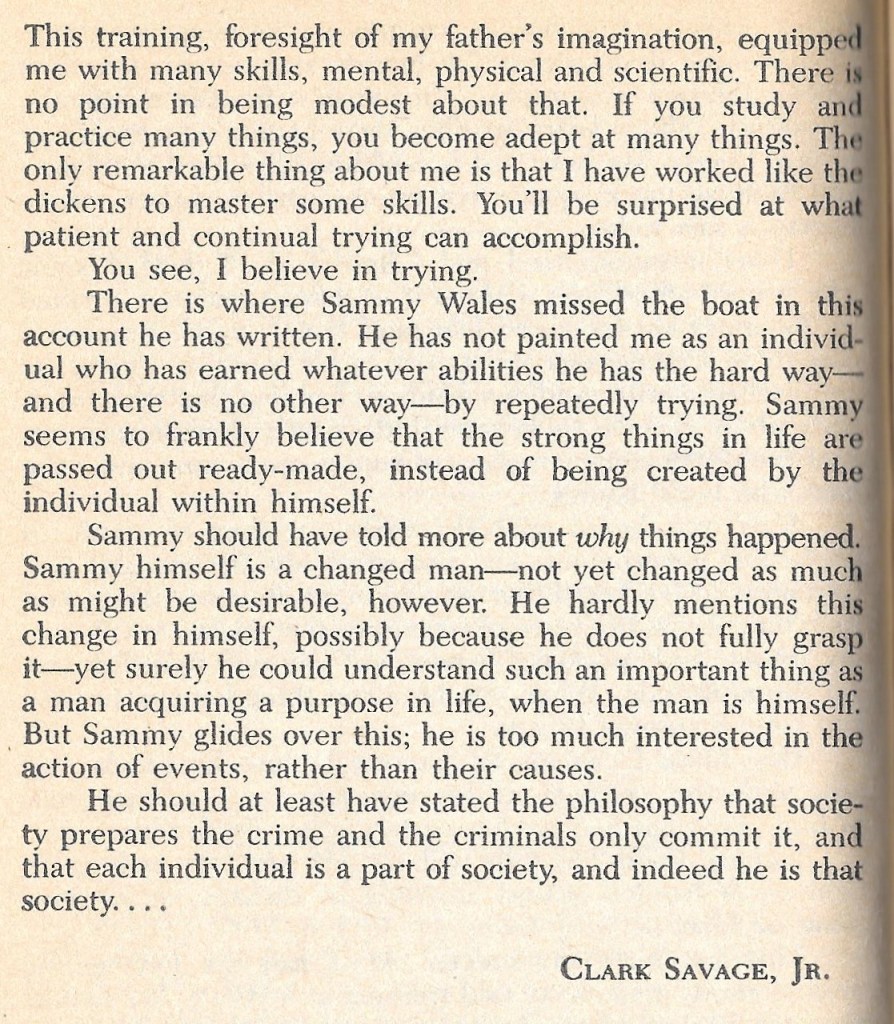
The narrative change prompted an extraordinary burst of introductory pieces to No Light to Die By, all to set the scene. They included a Foreword by Kenneth Robeson, a series of cablegrams documenting Doc’s effort to shut down the story (while simultaneously in transit to various exotic world locales), and finally a statement/disclaimer by Clark Savage Jr., himself. They would, in later years, become a gold mine for fans and literary biographers who enjoy musings on “Doc Savage as a real person”…and even taken as pulp playfulness, they are pretty remarkable.

After all that, the story actually gets underway, narrated by Sammy.

Dent-isms abound, including a case of mistaken identity, an eccentric group of mixed potential villains and possibly innocent dupes, a bizarre effect in the night sky that Doc identifies as a highly-sophisticated (and dangerous) form of energy emission that looks like moonlight gone berserk, and a big black moving void that can kill by inflicting dozens of small punctures in its victims. There is a pretty girl, whose voice is alluring enough to bring Sammy into the business in the first place, and who prompts amusing exchanges between skirt-chaser Monk and smitten Sammy. The story is fine pulp entertainment.

Most interesting, of course, are Sammy’s impressions and observations concerning Doc, Monk, Ham, and the whole concept of “righting wrongs and punishing evildoers”. Throughout, Sammy is a mix of tough-guy jaded and reluctantly impressed. Sammy is a WWII vet, and at one point he and Doc have a pointed exchange about Sammy’s attitude that having been shot at repeatedly for Democracy and Uncle Sam, he is owed some good things in his life, without having to work like a dog to get them. Doc points out that tens of thousands of Americans were in the war right alongside Sammy Wales, and they are willing to keep working hard. Sammy doesn’t take kindly to the criticism, until in a quiet corner of Doc’s headquarters he discovers a modest display case that includes no less than four purple hearts — after which he is quieter about being owed a living after being shot at.

This type of interplay is actually quite effective — Sammy’s lack of reverence (and frequent wiseguy backtalk every time he opens his mouth), gives weight to the moments when he is impressed and even occasionally awed throughout his adventure with the Man of Bronze.

What is achieved, at least to some extent, is a heightened feeling of being a part of the adventure rather than an observer. Sammy, as a “regular guy”, gives the story a grounded perspective. This heightens tension in moments when he is afraid, prompts curiosity when he is puzzled within the complexities of the plot, and when mysteries are revealed, the “ah ha!” moment has more impact. So to me, the experiment felt successful.

There is a bit of a cliched feeling to what in most respects is a happy ending (mysteries are solved, and there is even a guy-gets-girl moment — a relatively rare ingredient to Doc Savage stories), and it is kept from being too neatly wrapped up when you circle back to the beginning and realize that after “the end”, Sammy doesn’t just disappear into the sunset, but will stir up a last bit of trouble when he decides to write and publish his story…which of course ends up printed in the Doc Savage pulp.

Even if it had been a one-shot experiment, it would have been a notable tale within the Doc Savage canon. But the experiment was just beginning, with four more first-person narratives to go.

Next: July/August 1947 – The Monkey Suit

Millennial Doc Savage – Part 8

In the previous article, the exploration of efforts to update the iconic 1930’s/1940’s pulp character Doc Savage into the 21st century focused on the penultimate chapter of Dynamite Entertainment’s 2013 story Doc Savage: The Man of Bronze. Written by Chris Roberson and drawn by Bilquis Evely, the first seven issues were an ambitious effort to move the entire structure of the Doc Savage continuity forward past the conclusion of Doc’s pulp run in 1949.

A positive aspect of this effort was the sincerity Roberson brought to the storytelling. Clearly he loved the character, and not a hint of parody ever entered the narrative. Doc was portrayed as a man deeply dedicated to improving society, and this was explored by the placement of Doc into subsequent decades after the mid-20th century, theorizing on how his mission to “right wrongs” might have manifested and evolved as the world itself evolved beyond the Depression and World War II eras of his original adventures.

On the downside, this approach gave the series a somewhat documentary-style feel, draining some of the tension and excitement from scenes designed to be emotionally intense. The artwork, while consistent from issue to issue and filled with sometimes clever detail, also had a static feel, giving the visuals a staged, overly-posed look.

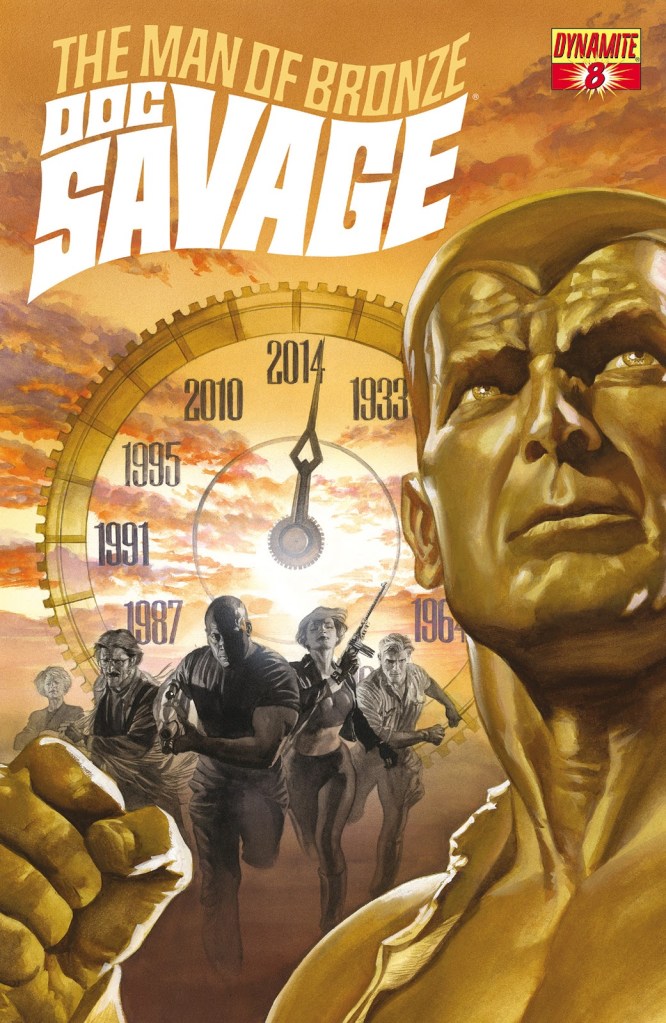
Each of the eight issues had a stunning cover by artist Alex Ross, and the final issue, #8, was no exception. It strongly captured the sensibility of famed Bantam paperback cover artist James Bama, and summed up the Dynamite series’ approach of a journey forward in time, by a clock showing years instead of minutes.

The story had left off in 2014, with a terrible global threat emerging through the hack of cell phones by a virus that unleashes uncontrollable violent impulses in people. All around the globe people start slaughtering one another. The technology for this actually circled back to the beginning of the series, when a similar weapon had been utilized by a villain in the 1930’s. So Doc travels to his Fortress of Solitude to acquire the artifacts of that earlier adventure, hoping to adapt his solution from the Thirties into the technological infrastructure of the millennial world.

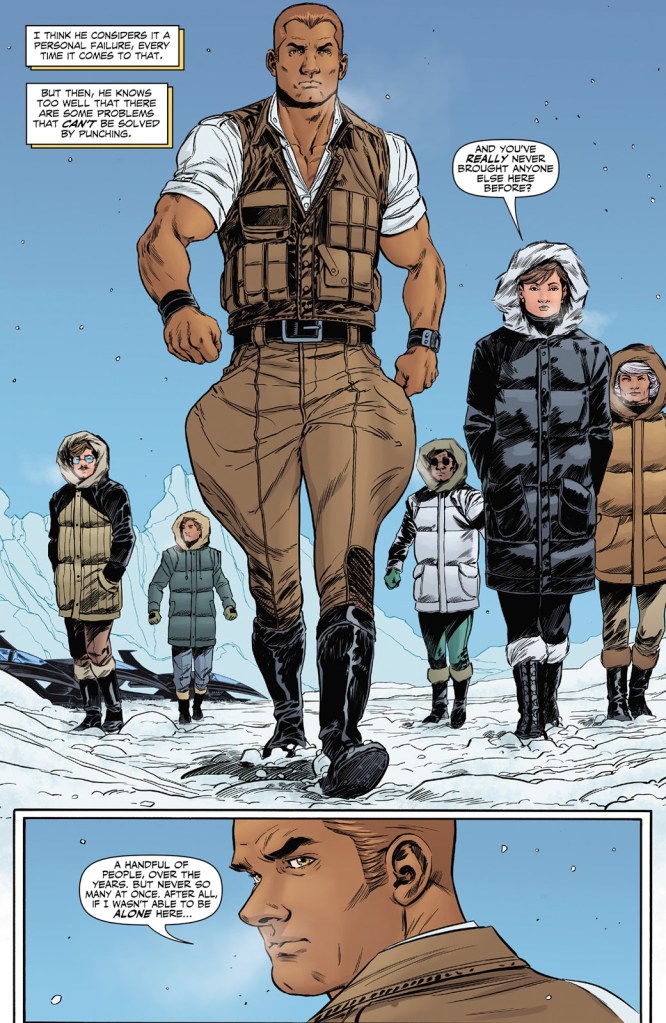
Some of the visual presentation at this point in the plot seemed off-kilter to me. Doc, for instance, wears short sleeves, his equipment vest, and jodhpurs to the arctic. And the appearance of the Fortress is clearly meant to evoke the “strange blue dome” of 1930’s adventures, though the design of the arctic retreat had been modified even in later pulp adventures. To me it felt (and not for the first time in this series) that Roberson and Evely were hedging their bets, trying to straddle the fence of attempting to please readers who had a fixed concept of Doc Savage in their minds that was based on extremely successful older imagery, while still trying to advance things to a modern time. The result was an uneasy marriage.

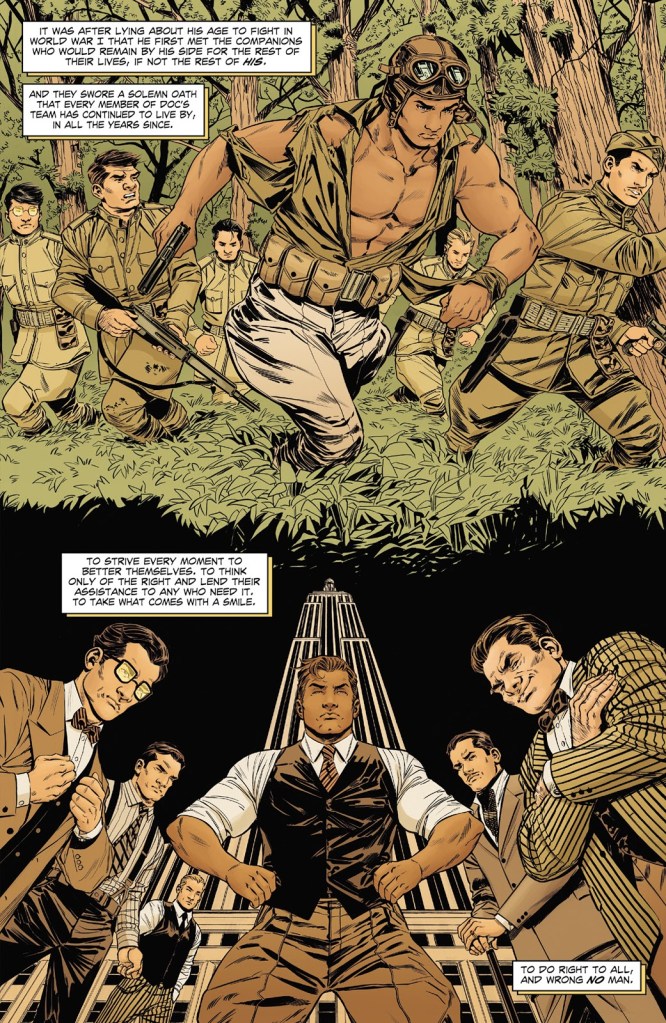
Continuing with the documentary-style of storytelling, a few pages are expended looking back at Doc’s long career. Once again, though interesting, this digression from the crisis unfolding in the main storyline contributed to a degree of disconnection from the immediacy of the present.

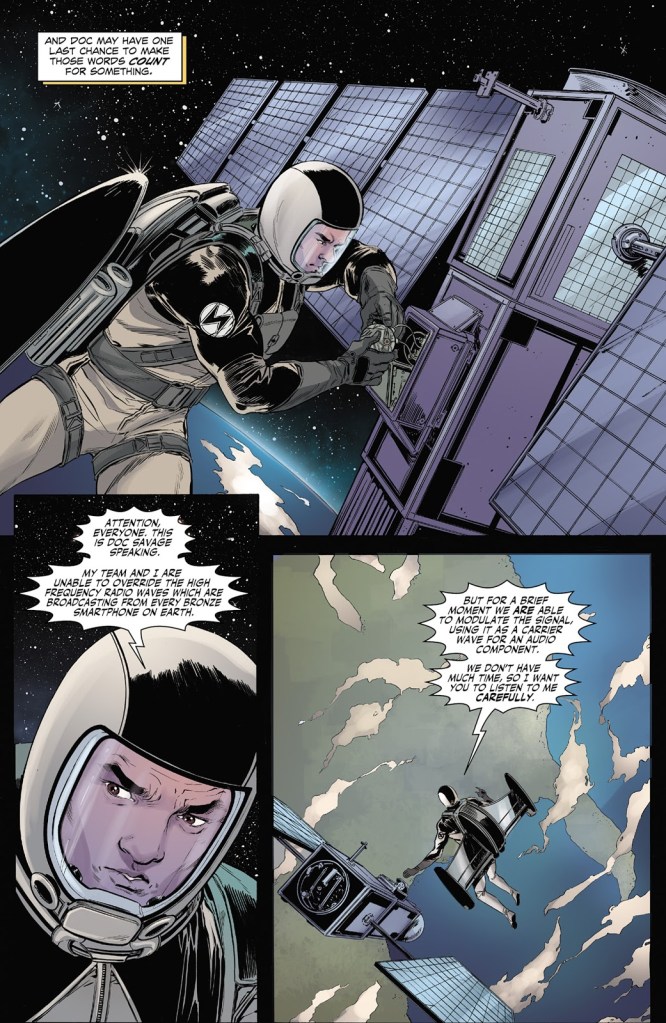
The story does eventually return to the crisis at hand, with Doc using orbital tech to try and counter the waves of violent behavior washing over the globe.

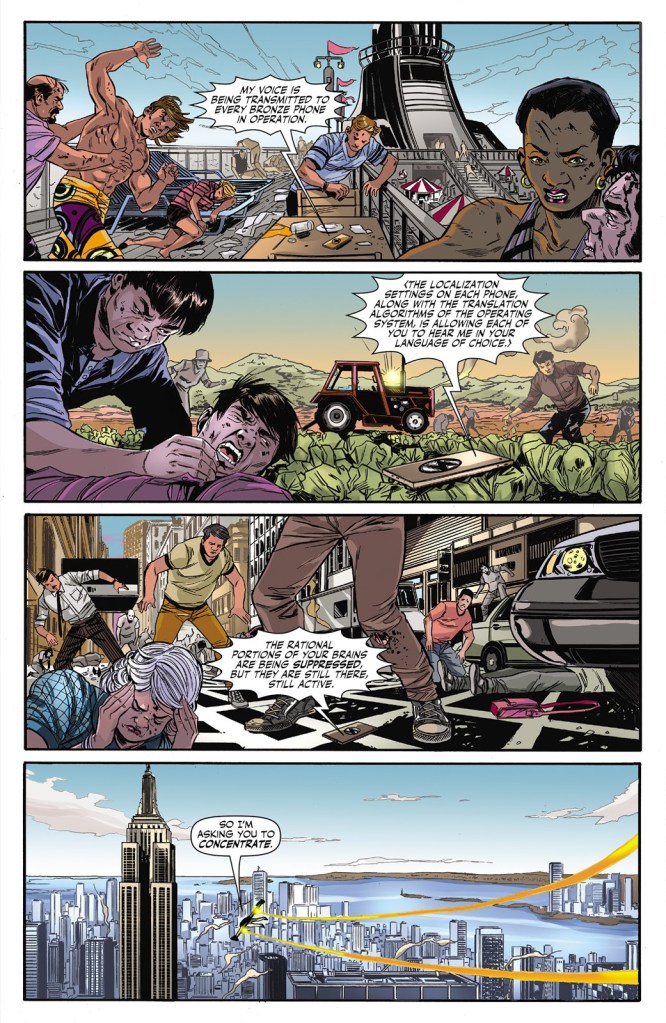
At this point, the story taps more strongly into its foundational theme, which is that Doc Savage is less a figure of crimefighting adventure, and more an embodiment of human aspiration and hope. His counter-weapon is a simple appeal to reason and caring…qualities that have always made Doc a deeply appealing character beyond the ongoing pulp mayhem. As he speaks, the rampant violence begins to diminish.

The crisis eases, not just from Doc’s appeal, but from the simple expedient of the battery charge for the infected cell phones eventually running out, rendering them inert. It was an odd resolution to the climax, mixing philosophy with practicality, and producing, at least in me, a sense of quiet, rather than the usual burst of elation that generally accompanies the denouement of an adventure narrative. Not necessarily a bad thing, aside from a sense of the climactic moment never really quite arriving.

A short epilogue closes out the series, with Doc addressing some of the other societal issues explored in the series, followed by a somewhat artificial-feeling new crisis, which Doc and his team rush off to avert.

Overall, this story of Millennial Doc had a feeling of noble goals not quite matched by the storytelling, which at times felt pedestrian. It had bold ideas, but pulled back from delivering them with visceral power. Perhaps in a way this is actually emblematic of the 21st century as we have experienced it thus far: a time of great contention, but one in which the role of heroes is not quite so clear-cut as it was in the time of the pulps.

Millennial Doc Savage – Part 7

Continuing the look at the literary efforts to update the iconic pulp magazine hero Doc Savage into the Millennial world of today, we come to the climax of Dynamite Entertainment’s 2013 comic book series Doc Savage: The Man of Bronze. The story unfolded over eight issues, all written by Chris Roberson and drawn by Bilquis Evely, with covers by Alex Ross.

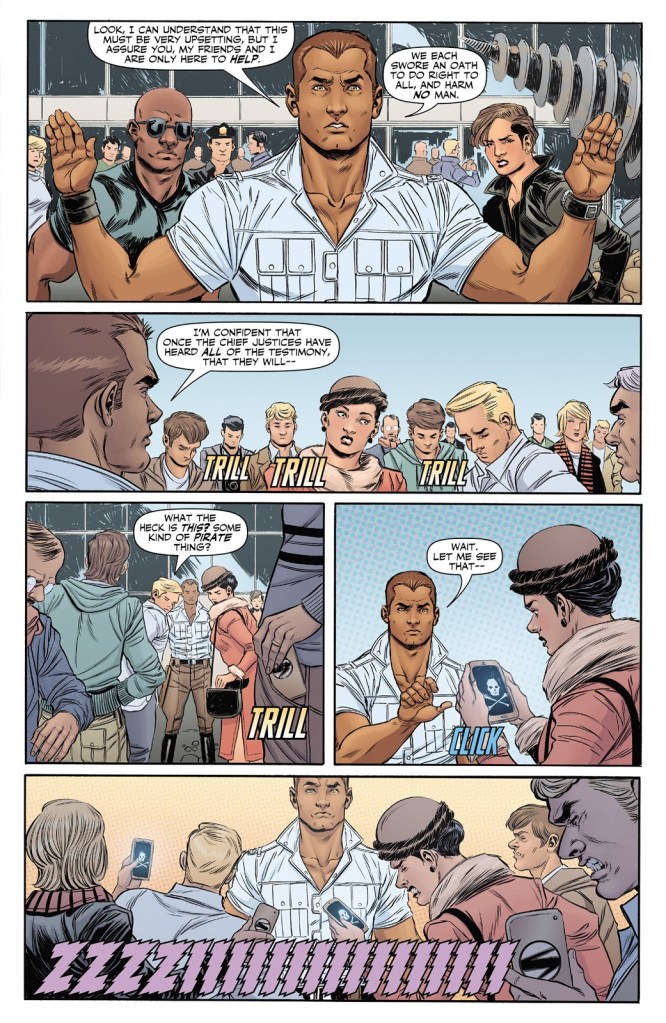
The penultimate issue of the series had a particularly chilling cover by Ross, displaying in vivid fashion some of the difference between the world of the Great Depression and the world of the present. In it, a mob, carrying cell phones, swarms violently over the figure of Doc Savage, with one of the assailants (in what has become typical post-2000 behavior), capturing the moment on his cell phone camera.

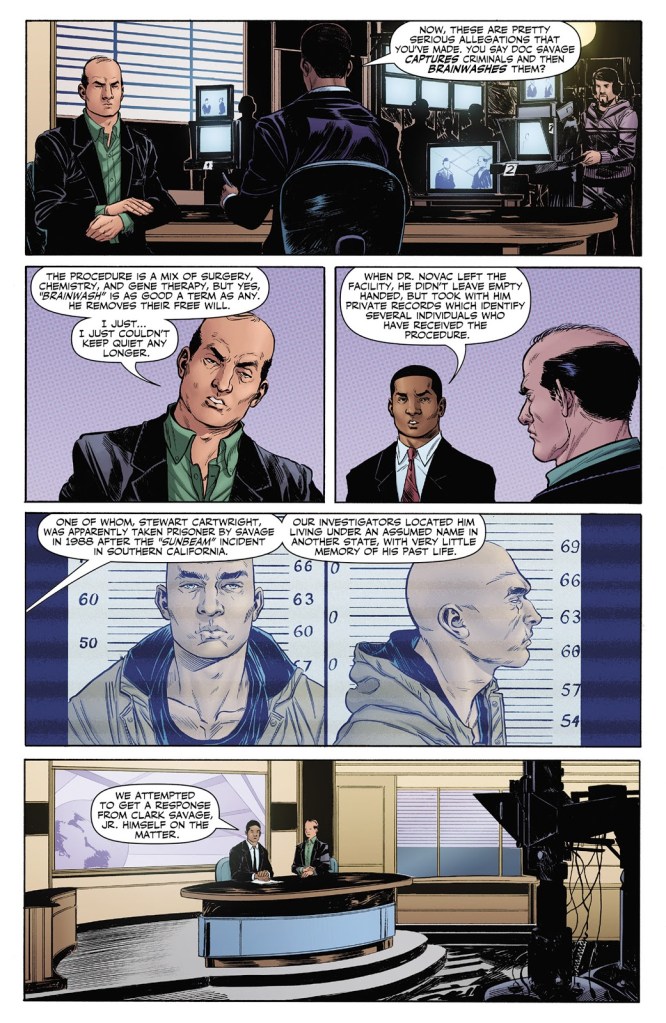
The story itself begins on an equally unsettling note. One of the foundational concepts of the Doc Savage series in the pulp magazines of the 1930’s was Doc’s “Crime College”. Unlike his pulp contemporary The Shadow, whose method for criminal deterrence was essentially to fill crooks with lead from his 45’s, Doc was deeply invested in rehabilitation. He had a secret medical facility where operations were performed on the brains of criminals encountered in his career of “righting wrongs”.

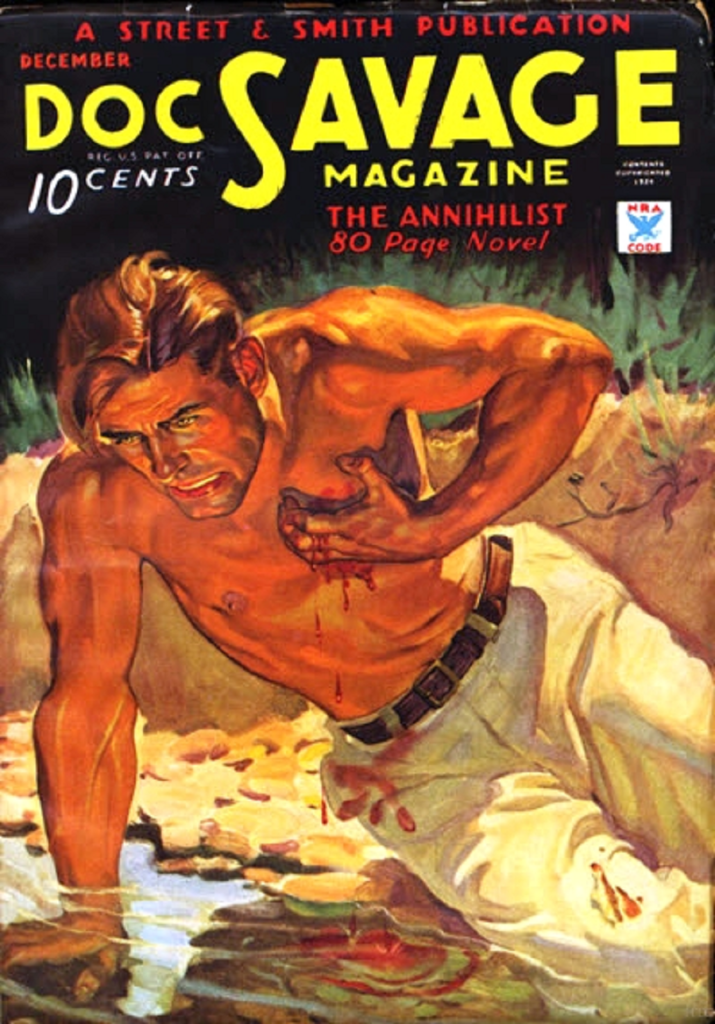
Essentially all memory of the criminal’s former life is erased, and those receiving the operation are then taught a trade and conditioned to hate all forms of crime, before being returned to society. In the 1934 pulp novel The Annihilist the procedure was described as dealing with something called the “crime gland”…a somewhat simplistic concept that was revised later in the series.

Needless to say, this approach to criminal rehabilitation would run into some serious issues in today’s world.

The Dynamite Entertainment series tackles those issues…first with an interview that exposes Doc’s activities to the world at large.

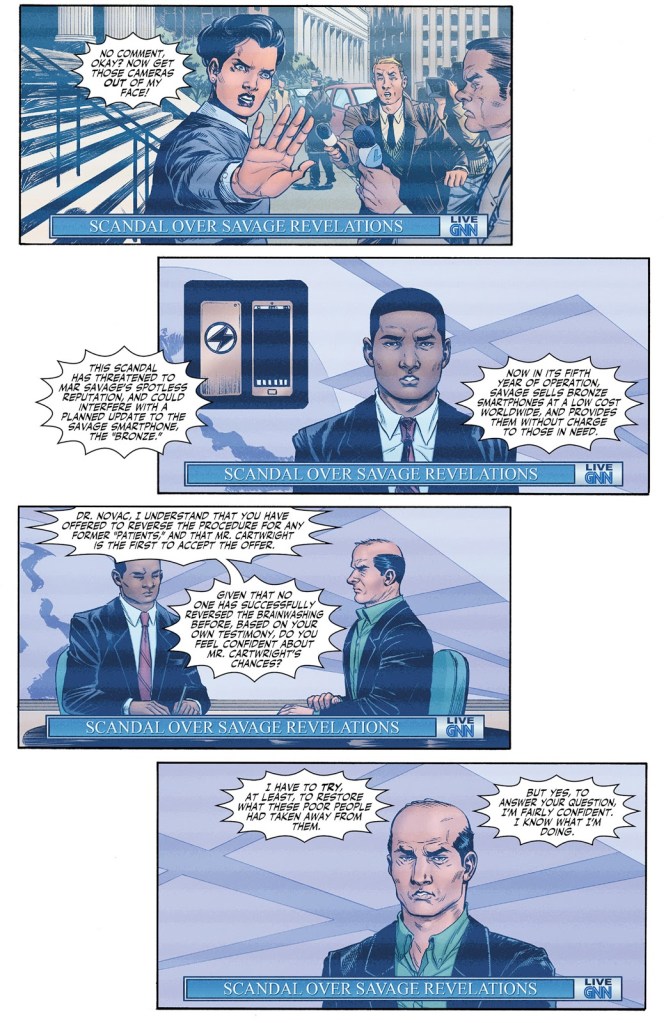
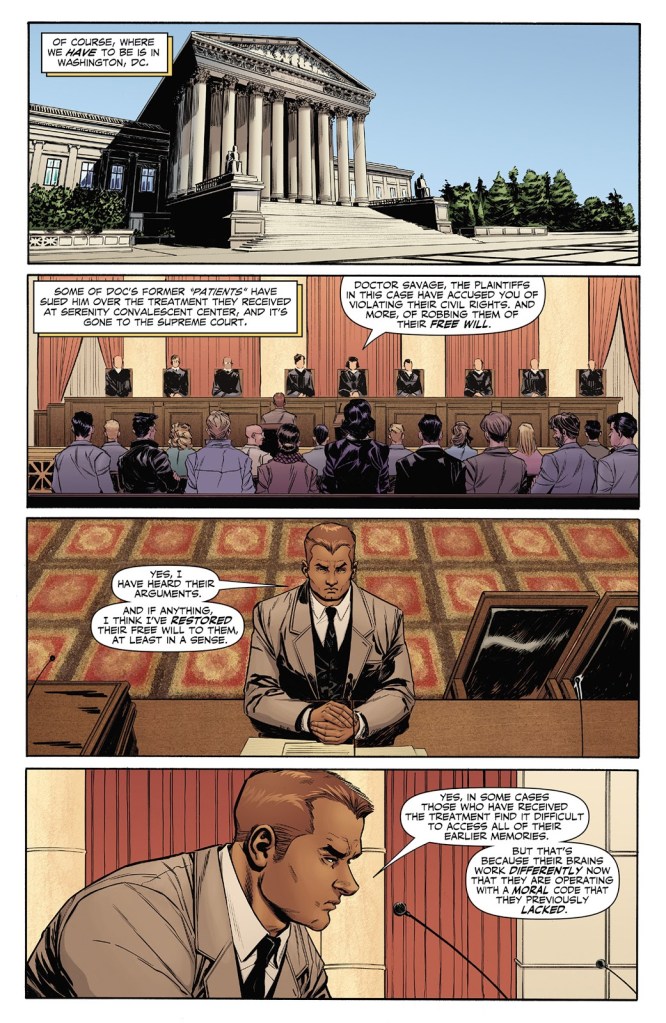
The scandal over the “Crime College” (referred to in this story as the “Serenity Convalescent Center”) snowballs, until Doc himself is brought before the Supreme court to explain himself.

It’s interesting to see the practical and moral issues raised by the concept of surgical intervention to prevent criminal behavior explored openly in the story. Arguments from both sides are presented with a degree of eloquence, providing much food for thought. Doc is not whitewashed of culpability for his actions, but things do become thematically skewed in the narrative as efforts to “restore” the individuals who have undergone the treatment somewhat predictably results in a return to criminal behavior. The most extreme example of this comes in the form of a horrific hack done to one of Doc’s primary 21st century tools, a cell phone called “The Bronze”, which has come into near-universal use all around the world.

A clever sidelight to the bronze phone is its ringtone…as you will see in the pages presented below, it trills.

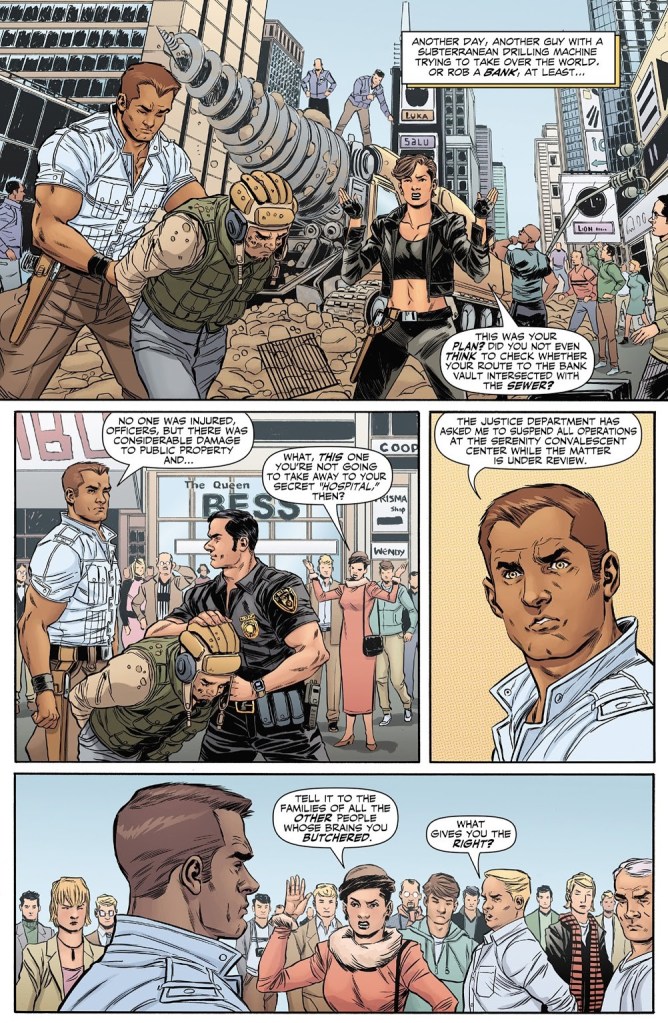
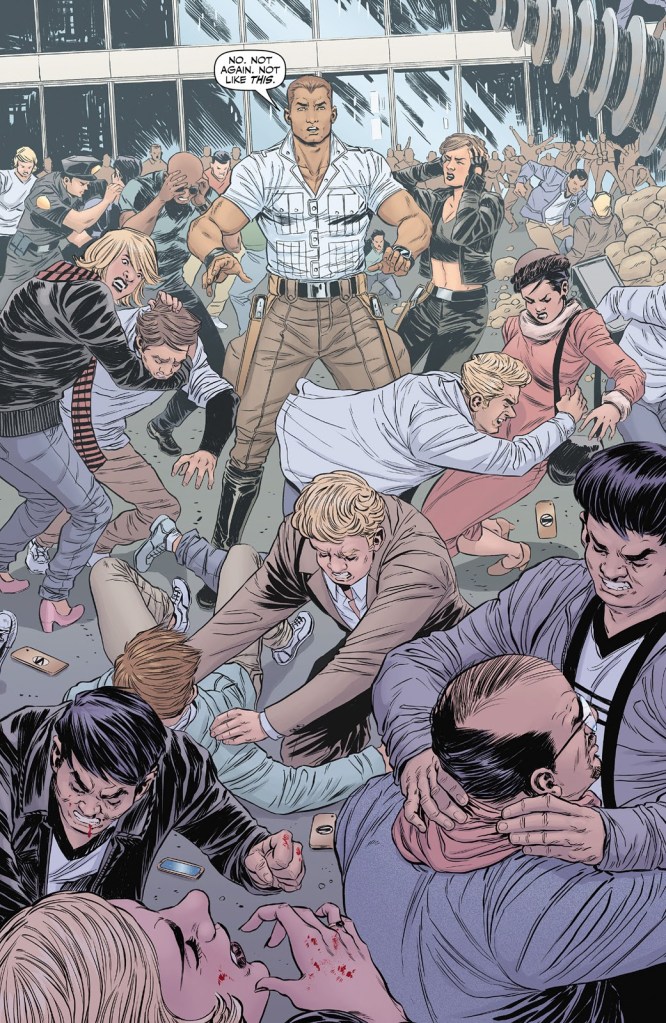
Far more seriously, as Doc continues his crimefighting activities while the Supreme Court deliberates, he is confronted by everyday people who are angry about the “brainwashing” allegations. Despite that, almost all of them carry a bronze phone, all of which (after trilling alarmingly), display a skull and crossbones, and an effect is unleashed that plunges everyone into a state of extreme, violent aggression.

Essentially, just about everyone in the world is overcome by insanely violent impulses…it looks like Armageddon has arrived, via cell phone.

“Millennial Doc Savage” to be concluded in the next article…

Talos Fan Fiction Contest Entry #16 – Manuscript found at -85.517813, 97.356019

Note from Doc Talos author/contest judge R. Paul Sardanas: The author of this piece respectfully declined the opportunity to post an author comment or biography, preferring the work to stand on its own. So it is presented here as authored by “Anon”. A uniquely hard-edged look at a possible envisioned end to Doc’s career.
Additional note: If you are interested in submitting fiction to the Summer 2021 contest (first prize is a Bantam Doc Savage paperback Czar of Fear first edition, signed by James Bama, and all contestants will appear in a special souvenir paperback collection of the stories) you can read the contest guidelines HERE.

Millennial Doc Savage – Part 6

With issue #6 of Dynamite Entertainment’s Doc Savage: The Man of Bronze, the story’s timeline (which had begun in the 1930’s) crossed over the boundary of the year 2000, bringing Doc into the Millennium.

Cover art for Dynamite Entertainment’s Doc Savage #6, by Alex Ross

Writer Chris Roberson had used a plot device to carry Doc through the years essentially unaged, but by 2000 all of the original characters from the pulp adventures were gone, with the exception of his cousin Pat (who was aging, but at a slow rate).

The time period after 1949 (when the original pulps had come to an end) was virgin literary territory to explore, and for the most part Roberson told interesting stories, capturing the feel of the decades from the 1950’s through the 1990’s pretty well. The antagonists of the stories were less the supervillain type and more reflections of the troubles of the times, with Doc pitting his endless qualities of optimism and inventiveness against terrorism, cult inculcation, industrial greed and recklessness in the advances of technology.

This approach had really come to provide the heart within the long story arc, and though — as I pointed out in the last part of this article exploring the Dynamite Entertainment Doc — the story had at times a static, documentary-style feel, it was relentless in its message that hope and personal responsibility were qualities that shaped and brought true advancement to the world. A very positive message that was enormously appealing.

The earnestness of that message was clearly communicated in a scene taking place in 1979 in an earlier issue…a young woman named Tamsin, cynical, angry and despairing about the future, is swayed by Doc’s belief that the present and future can be changed for the better (even though she refers to him as a “corny old sod”). She would become one of the new aides on Doc’s team (with a personality a bit more memorable than most of the new characters). Doc himself, after experiencing something of a “dark night of the soul”, emerges from the story re-energized in his vision and mission.

One aspect of Bilquis Evely’s visual depiction of Doc is a degree of adolescence, even boyishness in his manner. I found that a little hard to get used to while reading these stories, but ultimately found it endearing.

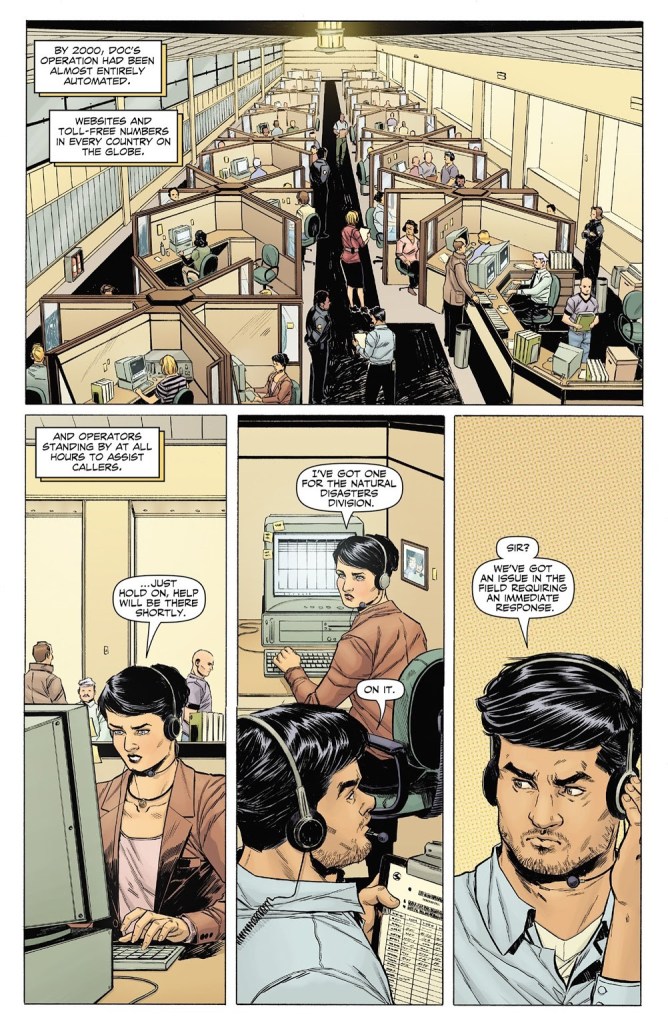
By the year 2000, an interesting infrastructure for Doc’s activities has emerged. During the Great Depression, Doc did a huge amount behind the scenes to support the overall workings of society. He was a silent partner in many businesses that he essentially kept from collapse, in addition to his globe-spanning adventures. In this story, his endeavors are far more open. He has built an immense organization that has integrated itself directly into all levels from the everyday life of the common man, to world events.

Doc himself still takes direct action in dangerous situations, like this one, where a despotic regime has brainwashed children into becoming soldier/slaves.

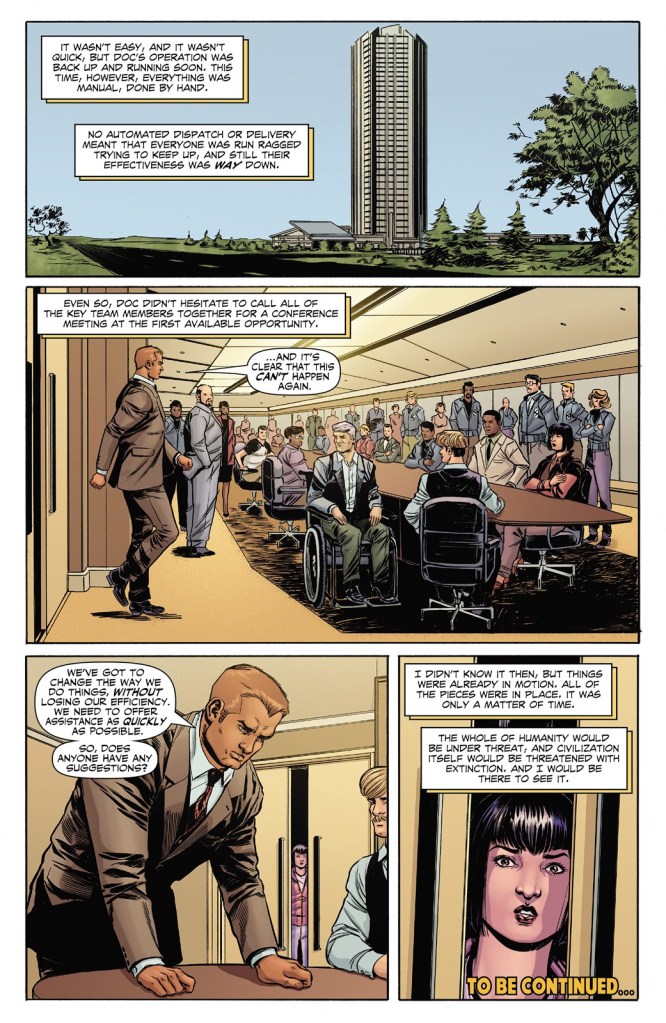
A crisis arises where worldwide computer systems are hacked, and Doc’s organization, which was hugely dependent on computer automation, essentially crashes, causing significant chaos. It was an intriguing play on one of the frightening issues of the time, the so-called Y2K event (in which there was great worry that a flaw in the way computers were structured would cause massive worldwide breakdowns as internal computer timeclocks switched over from 20th century time calculation to the year 2000). The catastrophe some predicted never materialized, but this story provided an intriguing extrapolation into what that social/economical/technical disaster might have looked like.

After restoring a semblance of order, Doc (practical as ever), returns manual safeguards to the system, and works on new ways to bring efficiency back to previous levels.

This basic theme (the potential unraveling of society through a mixture of error and malicious intent by dangerous individuals) would continue as the series progressed. An interesting exploration of the “one man changing the world” tone of the Depression-era tales evolving into a “one man working in partnership with the world” philosophy for the new millennium.

to be continued…