R. Paul Sardanas and Iason Ragnar Bellerophon are putting the finishing touches on a special short story/mini graphic novel featuring the incomparable Rickie Talos (pastiche of Pat Savage). It’s a wild tale of 90-year old pulp colliding with modern virtual reality, for an intense story-and-art experience. Here’s the Foreword for the upcoming special book release of “The Hills of the Unconsoled Dead”.
Foreword
Rickie Talos and Pat Savage share the same birthday, naturally enough: August 13, 1915. When thinking about her teenage years for the anthology book Rickie, I wondered what might have been her preferred reading material…her favorite authors? Given her wayward and headstrong nature and her intense love of adventure, the answer about her absolute favorite author seemed obvious: Robert E. Howard. So for the opening story of the anthology, set in 1930 when she was fifteen, I had her reading (and fantasizing fiercely about) a Howard tale of Solomon Kane, The Moon of Skulls.
A year later, Doc Talos co-creator and illustrator Iason Ragnar Bellerophon and I were having one of our always-wild brainstorming sessions about all things Talos, and he came up with the idea of resurrecting a character from our novel Savages – Miles Harmon. Miles was a pastiche of Philip José Farmer’s Tchaka Wilfred, described thus in Chapter 14 of A Feast Unknown:
Tchaka Wilfred was born in Cleveland, Ohio. He had been a professional football player until he had been caught after holding up a bank to finance a militant black organization. He escaped from prison and joined another organization in Harlem. There he had run afoul of Doctor Caliban, who had taken Wilfred prisoner but had not turned him over to the police. Instead he had sent Wilfred to the private sanitorium, where Caliban rehabilitated his criminals. By surgery.
Wilfred has a relatively small but memorable part…his personal history, behavior and speech pattern were a bit stereotyped in the mold of late Sixties “blaxploitation” books and films, but that was a quantum leap from the blatantly racist stereotypes of the 1930’s pulps. Wilfred dies fairly early in Feast, and that is mirrored by Harmon in Savages. So he was certainly a character left largely undeveloped.
The idea at first was to have Doc Talos use a serum similar to that which Doc Savage developed in the pulp story Resurrection Day to bring Harmon back, so he could have an African adventure alongside Rickie. Incredibly tantalizing notion…but as I tried to work it out plot-wise, I kept running into continuity issues with the timing and methods used by Talos in the later novel Madonnas, which also carries a resurrection theme.
But the answer was straightforward. Rickie has been shown in many later Talos tales to be enthralled by Virtual Reality tech – and given her literary love of Robert E. Howard, it would be perfectly natural for one of her earliest forays into VR play to have a Howardian theme. She would be a little embarrassed at playing out her pulp-style fantasies with Doc (who, throughout the Talos saga, has often expressed exasperation with the pulp stories of his literary doppelganger, Doc Savage). She had liked Miles – a rough-edged, tough-talking individual not unlike herself – so why not choose to include him in her VR fantasy?
Iason, with a burst of his characteristic artistry, had created a number of AI images of pulp-feverish scenes featuring Rickie and Miles, which were both thrilling and inspiring. In some of them, menacing figures with an undead-like aspect could be seen lurking in the background. Lights of course, went off in my head at the sight of these, when considering the Rickie/Robert E. Howard connection. Another Solomon Kane story, 1930’s The Hills of the Dead, would certainly also have been devoured in that year by pulp adventure enthusiast Rickie.
Young Rickie, I imagine, would have happily cast herself in the role of Kane (as I did myself when first reading the story in the 1968 Donald Grant hardcover collection Red Shadows – cover art by Jeffrey Catherine Jones; and a little later in a splendid Marvel Comics adaptation by Roy Thomas and Neal Adams). So the pieces were suddenly in place for a rousing tale of violence and passion. Just the way Rickie likes it.
But as is often the case with Talos tales, a layer of very sophisticated 20th Century literature has worked its way into the narrative…in the form of Kazuo Ishiguro’s deeply bemusing, strangely moving book The Unconsoled. I consider it one of the most difficult books to follow that I’ve ever encountered (almost on a par with Joyce’s Finnegan’s Wake), as it takes the form of scenes that change and shift with a sense of being unmoored from reality, while simultaneously being deeply immersed in it. At times you have to look very hard…to focus, in order to not become cut adrift. At other times, if you let yourself go, anything feels possible.
Pulp fiction can feel that way too, taking us to places where the dead can walk side by side with the living, where bodies can be interchanged…where souls are lost but can, almost beyond hope, be regained.
As this detailed look at the 1970’s Marvel/Curtis black and white Doc Savage magazine continues, we have reached the climax of the second issue, and its tale “Hell-Reapers at the Heart of Paradise”, by author Doug Moench and artist Tony DeZuniga.
The story centers around a favorite theme of the original pulp canon: the “lost world”. In this instance it is a hidden cavern in the frozen north, which has attracted greedy interest from the villains of the story first through what ultimately proved to be a red herring — gold from a sunken treasure ship — which becomes a more modern treasure trove, as the cavern contains a hugely rich deposit of uranium.
Doc, his aides, and a woman named Sandy Taine have come to the cavern for a more humanitarian reason…to find Sandy’s father, who was lost in a previous expedition. The early part of the story included kidnappings of other old expedition members, and a somewhat over-the-top villain called “The Mad Viking”. When we left off, Doc’s expedition has found most of the kidnap victims, and is being threatened by “reptilians” that live in the cavern.
As the reptilians close in, Doc & Co. prepare to repel an attack.
As the situation deteriorates, the kidnap victims show their true colors.
Doc shows an unusual degree of emotion here…incensed at the killing. This was a trait that author Moench displayed more than once in this series, portraying Doc in more of a middle ground between the highly self-controlled persona of the classic run of 1930’s pulps, and the more emotional Doc of later pulp years. To me as a reader I found Doc’s occasional outbursts in the series to be a bit jarring, but it’s not really a wildly uncharacteristic portrayal (in the first few pulps Doc was much more violent), and in the 1970’s storytelling milieu there was often an effort to imbue heroes with more nuanced character traits than the old pulps were wont to do.
In any case, the good guys and bad guys in this tale are finally delineated.
We now see Sandy’s missing father, who has in fact joined the reptilian denizens of the cavern. And remember the glimpse of the window broken in the wrong direction earlier in the story? Here it is revealed as the clue which informed Doc of the real state of things. A trope of the pulps is invoked here in interesting fashion…Doc’s habit of withholding information from his aides during the course of an adventure. In this case the habit goes wrong, leading to his companions being in the dark at a critical moment…another shading of 1930’s storytelling into more gray areas prevalent in tales penned in the ’70’s.
The exposition here to present the reptilian society is a bit labored…everything from the costumes to the setup of the village to the transformation of the humans into reptile forms really doesn’t hold up logically, which is one of the weak points of the story. But in terms of comics storytelling even just the effort to make it plausible is more sophisticated than much of the comics landscape of the ’70’s, which was littered with cardboard characters in completely implausible situations. In that context I was quite prepared as a teenage reader to let most of the absurdities slide, and the story was compelling enough to keep me rolling along with it.
Now the pieces begin to move toward the peak of action, with Doc setting out to rescue Long Tom (a somewhat unfortunate holdover from pulp cliche is the constant capturing of one or more of the aides, requiring the save from Doc). Monk in these scenes is shown in a thankfully competent light, making the harrowing descent by plane into the cavern with style…while Long Tom is close to making his own escape by the time Doc arrives.
The fight scene and the plane’s descent are spliced together through dual points of view, which was deftly done. Fight scenes in the comics (or in pulp narratives) are challenging to frame with a feeling of real tension (the good guys generally prevail), but the two tense situations layered in this way upped the reader sensations of conflict and peril in the tale.
After apparent victory and success, things take an abrupt turn for the worst. One repeating theme of the Marvel/Curtis Doc stories is the “unhinged villain” (there was also a similar round-the-bend take on the bad guy in the first issue)…and Rutter, recovering from Doc’s haymaker, promptly loses it completely.
The blasts destabilize the whole cavern, which begins to flood with alarming speed. Doc tries to get as many as possible into the plane, though his offer to take the reptilians out is implausible…the plane hardly seemed large enough for a full exodus. In any event, Sandy’s father refuses, and she is stricken with grief and sadness to realize he is also insane.
The story wraps quickly, with escape barely achieved. It ends on a poignant note, as the mask worn by Sandy’s father is washed up from the flooded cavern into the light of day, before freezing.
It was, of course, unusual for the old pulps to incorporate elements of pathos into their storytelling. But that was very much a part of the tone of 1970’s comics, and I found it fit well with the Doc Savage style of adventure, adding some emotional weight to the tales. Moench certainly incorporated it into much of his writing in that era, and we will see it numerous times as this series continues.
After the first two issues of the new Doc Savage magazine, I was thrilled. The stories had their flaws, but they were exciting, and it felt to me that Doc’s literary legacy was being honored and enhanced.
Guest blogger Atom Mudman Bezecny wraps up her look at the 1930’s Columbia Pictures movie series featuring the magnificent Pat Savage. The films that never were…but should have been.
__________
PAT SAVAGE, GIRL GANGBUSTER (1938)
Saving the best for last: the poster for the third Pat movie captures the glamour and giddiness the series embodied.
Saving the best for last: the poster for the third Pat movie captures the glamour and giddiness the series embodied.
Pat Savage, Girl Gangbuster (or Gang-Buster, to use the poster’s parlance) marked the first Pat movie in which Rita Cansino was credited as Rita Hayworth. Hayworth’s rising fame may have partially influenced the series ending on this entry, but it’s more likely that falling box office returns were to blame. This is entirely too bad, as Girl Gangbuster shows that the series was in many ways just getting started.
Girl Gangbuster is based on Dent’s Doc Savage novel Death in Silver (1934), and it starts off with a bang—literally. Our villains are the Death’s Head Moths (loosely based on the Silver Death’s Heads from the pulp), a gang of masked criminals who are blowing up building in New York for seemingly no reason! The stock market is going crazy, and theories as to the crooks’ identities and motives abound, from foreign spies to a cult of sun-worshippers. When her girls at Park Avenue Beautician give her news about the United Bank blowing up, Pat is as jumpy as she can be. She’s been ready to take a crack at this case for weeks now, and she’s finally managed to clear her schedule. Her secretary tries to force more clients on her, as her personal services are in high demand, but Pat blows her off and heads to the streets. Her girls wonder if they should unionize.
Pat rushes to the ruins of the United Bank, where a variety of discussions are taking place. Bankers are fretting about all the money that was destroyed, while others celebrate the fact that selfish millionaire Taylor West, a slumlord who abuses his tenants, lost all his money in the blast. Pat wonders if maybe the Death’s Head Moths were setting their sights on West. Talking to the police, she learns that nearly every attack the Moths have committed has involved a millionaire in some way. Pat wonders why this pattern has never been commented on before, but the cops explain that the city’s rich folk are paying the papers to hide it.
Pat presses the officers on their phrasing “nearly every attack.” They spill that one of the bombings targeted the house of a working class man, John Withers. Withers (Marc Lawrence) and his wife Lorna (Lynne Roberts) survived the attack, and at once, Pat suspects they know something. She tracks them down to Lorna’s sister’s house, and interviews them.
John Withers is unsure why he and his wife were attacked, but during the conversation, Pat observes that Lorna is nervous. She finds time to talk to Lorna alone, and the terrorized young wife explains that she was approached romantically by her employer, Hugo Burgess, who owns the company she works for, Silver Spoon Industries. Lorna rejected Burgess’ advances instantly, but is scared of telling her husband, fearing that she’ll think she’s a liar. Pat, who is understanding, asks Lorna for information on Burgess, but Lorna doesn’t want to talk in the house. Pat asks her to write a letter to her at Park Avenue Beautician. As she says this, we transition to the parlor, where an imposing-looking man (Skelton Knaggs) approaches the front desk, and dryly requests an appointment.
The secretary is shocked, but pulls herself together and explains that this is normally a place for women. The man wants a manicure—he demonstrates his nails in a way that highlights his long fingers. The secretary remains hesitant until the man gives her a big wad of cash. She agrees to book him with the manicurist immediately. When she asks his name, he replies: Hugo Burgess.
(All throughout the movie, Burgess’ long fingers will be highlighted throughout the movie, along with Burgess’ tendency to dress all in one color. This will be discussed below.)
Pat returns to her parlor unawares. Her secretary greets her, concerned, and explains the situation with their strange guest. Upon hearing the name Burgess, Pat tenses up, but quickly produces one of her trademarks from the pulps—her six-shooter. After two movies worth of trouble, Pat is ready this time. She strides confidently into the back parlor and levels the gun at Hugo Burgess’ head. His sinister face splits open in a grisly smile as he lets forth a rare, brief rattle of a laugh.
Burgess explains that he heard of Pat’s legendary services, and praises her manicurist on the job she did on his nails. Pat tells him to stop being coy and explain why he’s here. He explains calmly that her visit to the Withers house was spied on. He always has someone watching that house, with a radio set on hand. He doesn’t like anyone messing with “his” Lorna, male or female; he always gets what he wants, and he wants Lorna.
Pat wonders if he wants more than her. Maybe he wants whatever a man could get from being leader of the Death’s Head Moths.
To her surprise, Burgess immediately confesses to being the leader of the Moths. He challenges her to bring him down. The cops won’t help her, as she has no evidence. She’ll need to find some to gain any ground against him, but meanwhile he’ll be working against her. “It’s war, then,” Pat says simply. “Oh, yes, I’m afraid so,” Burgess replies.
And war it is. From the moment that Burgess steps out of Park Avenue Beautician, with his splendidly-done nails, he and Pat fight spectacularly. Their clashes are of a scale usually only attained by chapter serials. The Pat Savage movies have always had a resemblance to the serials, starting all the way back with Karl Lobo’s status as a hooded mystery villain, but here the intensity and relentless of the action resembles the most brutal serials of the time, such as The Spider’s Web (1938). In rapid succession, we see Pat foil several attempts by the Moths to blow up her beauty shop, only to be confronted with some of her girls being kidnapped. As she rampages across the city to rescue them, Burgess sends men to attack the Withers house. To Lorna’s horror, the Moths murder her husband, and take her prisoner—Pat valiantly saves her from death.
So much of this action is better seen than described in a review, so I’ll refrain from describing the other subplots of the movie’s middle act. At the end of it, Lorna has revealed that John was working on a secret government project to develop a new kind of submarine. Burgess was interested in working with him to develop these subs, but John, perhaps sensing Burgess’ attentions towards his wife, snubbed him on the contract. Pat begins to get an idea about where the Moths retreat to once they’re done blowing something up. With Lorna’s help, Pat gets in touch with government officials who have developed John’s blueprints into a working prototype. Pat explains that she believes that a spy in the department copied the blueprints, and that the Death’s Head Moths have built a sub of their own first. The department worker she’s meeting with, Crawford (Roy Barcroft), disagrees with that theory. Pat decides to check Crawford out, hiding in the government base after-hours to spy on him.
When she goes back to Crawford’s quarters, she finds him communicating to Burgess on a radio, saying that Pat is onto him. She breaks into his office and demands that he take her to the sub. He explains calmly that she’ll be arrested and convicted for espionage for what she’s doing. She counters he could be subject to the same thing. He tries to attack her, but she disables him with a punch to the face. Someone outside the room hears the commotion and starts knocking, but instead of fleeing she searches the room. Eventually she finds a copy of the sub blueprints hidden in Crawford’s desk, proving he was a spy. However, Pat isn’t ready to turn over the evidence yet. She breaks back out of the office and speeds to the base’s dock. Here she finds the submarine prototype, and climbs inside. She intends to use the blueprints to steer it.
Now Pat’s managed to piss off the Army. Soldiers try to break their way into the sub, but she locks them out. Working quickly, she pulls away from the dock and heads out into the cold waters of the Atlantic. If her theory is correct, then the Moths’ base can’t be far away. If she’s wrong, she’ll go to prison for life.
Sure enough, however, she finds another submarine, one far larger that the one the government developed. Part of the sub opens and she is able to guide her ship inside. Upon stepping out of her vessel, Pat finds herself surrounded by Burgess’ gunmen. Burgess compliments her, saying she’s nearly as deadly as her cousin.
Pat says that she’s owed an explanation, and Burgess agrees. He confesses that he doesn’t really care overly much for Lorna Withers—he desired her because he wanted her husband’s plans, and because stealing her would hurt a man who snubbed him. As for the other millionaires he’s hurt or killed, he’s done so either to eliminated rivals or to use his company’s resources to seize their assets. Once he kills Pat, nothing will stop him from continuing with his industrial takeover. Maybe at some point, he suggests, he’ll go into politics, and impose his own sense of order on the world.
This time, Pat doesn’t wait for her lawful pursuers to catch up with her. She still has her six-shooter, and she’s going to blast her way out. She explains calmly that she’s seen the blueprints for this submarine—Burgess has modified it, but it’s general design is the same, and it still needs special air-compression chambers to submerge. Some of those chambers are kept in this very room. One of her bullets blows a nearby tank open and sends Burgess’ men flying. The gang charges at her, but she drives them back with her gun, resorting to her fists when she runs out of bullets. It’s a fantastic battle sequence, wherein Pat’s stolen submarine is damaged, falling free from its restraints and sinking. One by one the goons fall, until at last the fight ends with Pat chasing Burgess to the head of the ship. The damage she inflicted earlier is causing the submarine to flood. At the head of the ship is a smaller sub which Burgess intends to use to escape. Pat knocks him out and drags him into the pod, using it to escape herself. Burgess’ ship goes down, and Pat takes its captain back to the government base—where a small army of soldiers awaits them.
Pat explains Burgess’ scheme to an Army General (Onslow Stevens), who agrees to pardon Pat of the theft of the sub and take Burgess into custody. It is not to be, however—Burgess breaks free from captivity, and tries to run back to the sub to escape. The soldiers are forced to shoot him when he gets his hands on a gun. And so ends Pat Savage’s last cinematic adventure.
The sheer wildness of the action in Pat Savage, Girl Gangbuster can’t be understated. This is an earth-shaking movie, where Pat gets in a literal street war with a supervillain and sinks a submarine with a six-chamber revolver. These reviews have probably made the Pat Savage of these movies seem like a bitter hardass, but that exciting humor that Hayworth is so adept at prevents Pat from becoming a vicious figure. She’s always fun to follow, from the first frame to the last, whether she’s gossiping with her girls at her beauty parlor or throwing herself clear of bomb-blasts. This is a particularly strong entry for Park Avenue Beautician, with its able team of girls getting a good amount of the spotlight this time around. One gets the impression that Pat teaches these girls to fight even as she shows them hot new makeup tricks.
There are some interesting elements of political satire in this script, which may well be accidental. The film is never particularly sympathetic to the millionaire the Moths blow up, and those of them we see are shown to be quite awful people. The police have been shown to be inefficient all throughout this series, but now both government bureaucrats and the U.S. Army are skewered as well. It’s an enjoyably cynical touch which gives the movie a sort of covert progressive nature. It’s a movie where the working class are the heroes—though one wonders if Pat, in her opulent salon, fully counts as working class.
There’s also an elephant in the room, which I’ve been trying to save discussing up until now. Hugo Burgess is clearly based on the most popular Doc Savage villain of all time, John Sunlight. Sunlight first appeared in October, 1938’s Fortress of Solitude, two months before the release of Girl Gangbuster. This movie was in production in October, and it is doubtless that the writers decided to borrow Sunlight for their film, despite their contract not allowing them access to him. (Pat Savage doesn’t appear in Fortress of Solitude.) Hugo Burgess derives his name from Bedford Burgess Gardner, the villain of Death in Silver, whose real name is Hugh McCoy. But his monochromatic style of dress and long fingers makes his connection to Sunlight clear. Skelton Knaggs is thus the only actor in history to have played John Sunlight in a movie (that I’m aware of). He does a fantastic job, conveying Sunlight’s quiet creepiness with great subtlety.
I think the writers knew that this would be their last hurrah, so they decided to pit Pat against someone they saw was a truly formidable villain. They decided to go all-out with the production in general—and I believe they did so because they fell in love with Pat, as so many writers and pulp fans have before. They wanted to celebrate her before the grim reality of capitalism took her away from them. They succeeded in their goal of making a worthy capstone to her series, which has been a blast to revisit. I can’t recommend these movies enough—and of them, Pat Savage, Girl Gangbuster is undoubtedly the best.
OTHER ESCAPADES
There were other attempts to bring Pat Savage to the screen after the end of the 1930s series. Pat’s famous cousin would finally get his own studio film with 1975’s Doc Savage: The Man of Bronze, but Pat didn’t appear in that movie. Previously Doc had appeared in the ’60s fan film adaptation of Fear Cay, and had nearly starred in an adaptation of The Thousand-Headed Man in 1966, a film whose resources would be reshuffled into the Western movie Ride Beyond Vengeance. But Pat’s own turn in the movies back in the ’30s sparked interest in putting her, specifically, back in films.
In 1952 Edgar Ulmer, the director of such classic films as The Black Cat (1934) and Detour (1945), expressed interest in making a continuation of the Pat Savage films for United Artists. Ulmer wanted to cast Irish-Welsh actress Peggy Cummins, star of the unforgettable film noir Gun Crazy (1950), to play the titular character in The Daughter of Pat Savage. Story details are vague, but the story centers around Sally Savage, Pat’s daughter by an unspecified father. Unfortunately, legalities would stand in the way of this film’s productions. At the time, there was some ambiguity regarding the film rights to Pat Savage, with neither Lester Dent nor Columbia certain as to who owned the rights. So this film never made it off the ground. Ulmer’s screenplay, said to be complete, has never been found.
Pat reappeared in an unconventional form in the late ’60s, as part of an apparent attempt to cash in on the recent Bantam re-releases of the Doc Savage series. 1967 saw sexploitation director Barry Mahon release a quartet of movies based on John Cleland’s 18th Century erotic novel Fanny Hill—these were Fanny Hill Meets Lady Chatterly, Fanny Hill Meets the Red Baron, Fanny Hill Meets Dr. Erotico, and finally, Fanny Hill Meets Pat Savage. Pat in this crossover film was played by actress Cleo O’Hara, perhaps most famous for her turn as the psychotic Sister Sarah Jane in the 1972 horror film Evil Come, Evil Go. O’Hara’s sapphic interactions with Susan Evans’ Fanny are quite sensuous, but Pat doesn’t really get to do much besides roll around on a bed. The overall quality of Mahon’s Fanny series ultimately pales in comparison to Nouvelle Gauche Studios’ evocative 1971 epic, The Ghost of Che Guevara Meets Fanny Hill. (The chronology of all of these films suggest that either Fanny Hill is a time-traveler, or has many descendants, presumably through her daughter Kissey from the 1966 film The Notorious Daughter of Fanny Hill.)
At the end of the day, we will always have the Rita Hayworth Pat Savage movies. They are true gems, honoring their majestic protagonist with the kind of excitement she deserves. Though unjustly obscure today, like Tim McCoy’s 1943 turn as the Avenger, these movies are a fine distillation of all the fun these old B-movies can provide. It’s easy to see why Doc Savage fans have held these movies close to their hearts for decades.
Tim McCoy’s versatility as cowboy master of disguise Lightning Bill Carson led to his casting as Richard Henry Benson. But that is another story for another day.
Guest blogger Atom Mudman Bezecny continues her tour-de-force 1930’s cinematic history of Pat Savage by Columbia Pictures…
________
PAT SAVAGE – LADY LANCELOT (1937)
A jail guard flinches at the eerie look in Pat’s eyes in this lobby card for the second Pat Savage movie. Is that a hint of a Mona Lisa smile on Pat’s face?
A jail guard flinches at the eerie look in Pat’s eyes in this lobby card for the second Pat Savage movie. Is that a hint of a Mona Lisa smile on Pat’s face?
Following on from Pat Savage, Bronze Knockout, which was based on Brand of the Werewolf, Pat Savage – Lady Lancelot derives itself partially from Lester Dent’s iconic Doc novel Fear Cay (1934). But despite the mention of this tale in the opening credits, fans of the original pulp story will likely be disappointed, as this movie bears little in common with its pulp predecessor.
The movie’s opening, at least, has commonalities with that of Fear Cay. We fade in to Pat in a department store sampling different perfumes. With an employee’s help she picks out a new brand called “Fountain of Youth,” which causes a man in the background to regard her suspiciously. Pat and the employee gossip a bit about recently silver thefts which have struck the city—as an amateur detective, Pat is intrigued, but is no closer to solving the mystery than the police. After buying the perfume, she sees a man drop a wallet on the sidewalk. She runs up to it and picks it up, only for a plume of gas to come out of it. She passes out and a pair of men come by and scoop her up, taking her into a nearby car.
The men drive the unconscious Pat to an empty warehouse, where suddenly she awakes and begins attacking the pair. They surrender, and ask her how she overcame the gas so quickly—she explains that she suspected the wallet was a ruse, and simply held her breath. She wants to know why they kidnapped her. While hesitant to talk, the men say that their boss, Santorini (Cesar Romero), wants to know why the gal who sent Karl Lobo to the chair is interested in Fountain of Youth perfume. (By the way, R.I.P. Karl Lobo.) Pat is completely confused, saying that she just wanted a new scent. They don’t buy it, knowing that her cousin is a famous lawman. Suddenly, one of the men throws a piece of debris at the lightbulb overhead, plunging the warehouse into darkness. Pat tries to stop the men from escaping but fails.
Now she’s been tipped off that something’s up with the perfume she just bought, Pat decides to investigate. She goes back to her beauty parlor, Park Avenue Beautician, and this is the first time we get to see it since she acquired her fortune in the previous film. The parlor’s rich splendor matches the description of the pulps to a T, and the film also has Pat employ a legion of women nearly as beautiful as herself as her staff. Pat operates by upcharging her clients stupendously, just as she does in the pulps. Her back office is spacious and comfy; here is where Pat comes to rest after a hard adventure.
By inspecting the perfume bottle, she sees that the fragrance is manufactured by a company called Fountain of Youth Inc. Their headquarters is nearby so she goes to visit. While receiving a tour of the plant, she overhears one of the employees mentioning a Mr. Santorini and a Mr. Franklin, the latter having been hurt on the job somehow. Pat recognizes the name Santorini, but plays it cool. She asks her guide (Byron Foulger) about Mr. Franklin, and the guide becomes noticeably anxious. Here’s where Pat turns on the charm: through her sweetness, Pat learns that Franklin was sent to Pancini’s Health Clinic to recover. She darts out before the poor man gets a chance to kiss her.
At Pancini’s Clinic, Pat talks to Pancini (Hans Schumm), who remembers a guy named Franklin coming in. Pancini is a rather unfortunate looking fellow, so Pat doesn’t try to get sweet on him. Instead, she pretends to be an insurance agent working for Franklin, and with this ruse she acquires the address of the hotel Franklin is staying at. She goes to meet Franklin (Noel Madison) who is suffering from a lung ailment. The doctor says he’ll probably have trouble breathing for the rest of his life—the fault of a carbon-based compound used in the perfume at Fountain of Youth Inc. In the interest of bringing the company down, he tells her that Santorini is the owner of Fountain of Youth, and that he knows that the perfume is frequently sent to a ship called the Harpoon for some unknown purpose. At that moment, a shot rings out, and Franklin cries out in pain before keeling over dead. Pat, in what is easily the series’ weakest moment, screams and runs into the hallway, seeking out a man to help. She finds the hotel manager, who is horrified to learn of the murder. “We have a reputation here,” he says, “and not the kind I like to write home to my mother about!”
Pat runs away, returning exhausted to Park Avenue Beautician. Here she rests, before going out in search of the Harpoon. She finds the ship docked in the New York Harbor, and quickly notices that the men who kidnapped her earlier are aboard. She decides to sneak aboard at night, eluding the guards keenly. Inside the ship, she witnesses something incredible: the Fountain of Youth perfume is being used as part of a serum that makes synthetic diamonds. The other ingredient in the serum is silver—meaning Santorini is behind the silver robberies. Santorini will be a rich man if he can get those diamonds to market. Bad luck causes Pat to slip out of hiding, but instead of killing her, Santorini orders her turned over to the police. She has, after all, trespassed on private property, as Santorini owns the Harpoon. Pat protests, saying that she has a famous “brother” (!) who won’t stand for this. (More on this later.) Santorini snorts that she should tell it to the cops, and soon Pat is in the local jail, with everyone laughing at her story about perfume that can be turned into diamonds.
Pat refuses to give up, however, and manages to secure her escape by stealing a guard’s gun. She becomes a fugitive from justice, with not even her beauty parlor being a safe haven. In the end, Pat manipulates her fugitive status cleverly. She waits near the Harpoon until the next shipment of silver arrives, and then charges headlong towards it. A nearby cop spots her just as she “blunders” into the case of silver. The officer rushes in to arrest her, but spots the stolen metal. Santorini’s men shoot the officer, and Pat runs away to the officer’s car. Here, she calls for help, and the police race in to stop Santorini’s gang. They find the perfume and the diamonds, and realize that explains the abnormal surge in diamond sales lately is Santorini’s fault. Pat is thanked and the gangsters are sent to jail.
Overall, Pat Savage – Lady Lancelot suffers from an inherently weak premise. Having Pat start her investigation into Fountain of Youth because one of Santorini’s men is needlessly suspicious of her is pretty dumb, and there are a few instances of lazy or contrived writing throughout. It’s never explained how Santorini discovered that perfume plus silver equals diamonds, and the synthetic diamonds plot is a fairly common one in B-movies, making its marginal sci-fi elements not particularly interesting. As my synopsis implies, the actual content of the story is fairly shallow, despite it being an undeniably busy script. Pat runs all over New York City and back again in her quest for justice, but none of the locations she stops at are particularly fleshed out, making all the adventuring rather dizzying in a bad way.
There’s also the issue that Pat is somewhat neutered in this movie. That scene where she runs away screaming from a murder is a real doozy. It’s not at all consistent with the rest of the series, and the fact that she specifically seeks out a man to help her is not flattering. The filmmakers seem to have second-guessed themselves by removing Inspector Fielding from the story—with nary a man supporting Pat in the course of this story, they had to strip her of some of her power to make her acceptable to the censors at the time. It’s sad.
That’s not to say that this movie isn’t still a fun ride. Pat breaks out of jail and goes on the lam, which is impressive to witness. Her brief time in jail is different from other jail scenes seen in B-movies of the time, being more prescient of the women-in-prison genre of exploitation movies—Pat gets in cat-fights with her fellow girls, and they call her some (censor-friendly) nasty names. All throughout, Pat is her delightfully spunky self, and Rita Hayworth doesn’t miss a beat, except for that weird moment where she says “brother” when she should say “cousin.”
Every actor makes mistakes, and in spite of my earlier praise of William Beaudine, every director makes mistakes too. But I found it unlikely that both Hayworth and Beaudine would allow a blooper where Pat calls Doc her brother instead of her cousin to make it to the final cut. I did some digging, and to my great surprise, there exists an earlier draft of Pat Savage, Bronze Knockout in which Pat refers to her famous adventurer relative as her brother. It seems that, in a needlessly defensive attempt to separate the Pat Savage movies from the Doc Savage pulps, Columbia considered changing Pat’s cousin into her sibling. The scene where Hayworth seemingly messes up the line could well represent a cut of the film that used an alternative script. It’s fascinating to consider that the series was considering modifying Doc’s link to Pat so late in the game.
(It’s possible, of course, that the “Pat Savage” we’re seeing onscreen is not actually “Pat Savage,” in the sense that we commonly understand it. It’s possible, in whatever universe these films are set in, that Pat Savage is in fact Doc Savage’s cousin, but Doc also has a sister who has been fictionalized in the movies as “Pat Savage.” But that is outside the perview of this article.)
Speaking of Doc, this movie is the only one in the series to include elements from more than one Doc Savage novel. (Though as we will see, the third film arguably nods to two different stories.) Pat’s visit to the health center is based on a similar sequence in Dent’s The Annihilist (1934), while the Harpoon is based on the ship of the same name from Spook Hole (1935). These nods do help make up for the fact that the movie jettisons most of the exciting parts of Fear Cay in adapting it. (Those seeking a more accurate adaptation of Fear Cay should check out the 1967 fan film of the same name—which has the honor of being the first movie to directly feature Doc Savage. Pat also appears onscreen for the first time since 1938, as played by Kathy Sedoff.)
There is one additional historical detail that I found interesting. The hotel where Franklin is murdered bears some resemblance to the infamous Cecil Hotel in Los Angeles (currently known as the Stay on Main). Since 1927, the Cecil has been the site of a disturbing number of suicides and violent murders. Though the Pat Savage movies are set in New York, the idea of this hotel having a “reputation” is an eerie mirror of the unfortunate real-life hotel. If deliberate, I have to wonder if this is the first reference to the Cecil Hotel in the movies.
To be concluded with…Pat Savage, Girl Gangbuster (1938)
Many thanks to guest blogger Atom Mudman Bezecny, who takes us deep into the movie career of Pat Savage…that never was. But oh, if it only had been…
_____________
In the early days of cinema, movie theaters operated rather differently than they do today. Instead of offering a single A-tier feature for the price of a ticket, theaters would run showings that would typically consist of a cartoon or short, a serial chapter, an hour-long B-movie, and then finally the feature presentation. The origins of these programs involve the long, complicated history of the Hollywood studio system and the practice of “block booking,” wherein theaters would effectively be forced to buy inexpensively-produced movies alongside the desirable A-movies, which would ensure that the studio would make on a profit on what were often lower-quality productions. In spite of their lower budgets, however, a great many of the B-movies produced during this period are just as entertaining as their blockbuster counterparts, and part of this is due to their willingness to adapt “lowbrow” media to the screen. When studios in the 1930s and 1940s needed B-movies for their revues, it was only natural that they’d turn to popular media that had proven to be successful in its original format—and so began the Golden Age of Pulp Movies. Dozens of characters from pulp magazines and pulp-like fiction began appearing in movie form, from The Shadow and Bulldog Drummond to The Spider and Tarzan. Legions of detectives, monsters, sci-fi heroes, jungle explorers and more flooded the screen, entertaining viewers of all ages.
But one of the most famous pulp characters of this era was conspicuously absent from the world of movies: Doc Savage. Though Doc Savage’s home magazine ran from the dawn of the ’30s to the end of the ’40s, and sold millions of copies, Doc and his fabulous team of aides were apparently never even considered for movie options during this time. That’s not to say that Doc’s world, sans Doc, didn’t make it onto the screen, however. In 1937, Columbia paid Street & Smith Publications for the rights to make a series of B-pictures about Doc’s adventurous female cousin Pat Savage. For the role of Pat, they chose one of their up-and-coming players: a lovely young woman named Rita Cansino, who would very soon become more famous under the name Rita Hayworth.
The casting of Rita Hayworth as Pat Savage more than makes up for the lack of Golden Age movies starring Pat’s cousin. It is an almost unbelievable casting, one only made possible by Hayworth’s inauspicious start in B-movies. Pat is a cult favorite among the pulp fandom, and to have such a talented and gorgeous actress as Hayworth in the role is superb. Hayworth infused Pat with the sort of fiery energy which not only reflected the original pulp character, but also gave a rare sort of raw feminist energy to this era of cinema. The only character comparable to Pat in these movies is Torchy Blane, played variously by Glenda Farrell, Lola Lane, and Jane Wyman in a series of nine movies made between 1937 and 1939—the brilliant, bold journalistic adventures Torchy embarked on were a huge inspiration on Jerry Siegel and Joe Shuster’s creation of Lois Lane. Pat has a youthful, spritely energy that contrasts and complements the moody passions of Hayworth’s later roles, such as her turns in the seminal films noir Gilda (1946) and The Lady from Shanghai (1947).
The Pat Savage movies were still B-movies, in spite of a young Hayworth’s presence, and that meant there were some stipulations on what the writers were allowed to do. First of all, the rights secured by Columbia only covered Pat herself. While the films were allowed to mention that Pat had a famous adventurer cousin, they could never name or show Doc Savage. They were also forbidden from featuring or mentioning Doc’s five aides and any of the villains from the pulps, and locations such as Hidalgo, the Fortress of Solitude, and the 86th floor headquarters were off-limits as well. Pat’s beauty parlor could appear, and would indeed be her “home base” during the films, but that was it. There were some allowances, however—in the interest of keeping a connection between the films and the pulps, Street & Smith permitted the filmmakers to use the storylines of novels in which Pat appeared to build their own stories. At the time of signing, this gave Columbia ten Doc novels to use, within the limits of their other guidelines (the contract included Red Snow, in which Pat only appears via phone call).
Because minimal expense was the goal of any B-picture production, studios employed directors who were able to work quickly. One director who was consistently reliable in this regard was William Beaudine, who commonly provided quality material in short time. Contrary to the rumor spread by Michael and Harry Medved, who called the director “One-Shot Beaudine” in their 1978 book The 50 Worst Films of All Time, Beaudine did not neglect to do retakes of flubbed scenes. Comparing his B-movies to others of the period, especially his crime and horror entries, shows that he was an above-average director with very few obvious blunders onscreen. In fact, Beaudine had been A-class director in the silent era, and he worked on and off at Columbia until 1931 when a bad encounter with producer Sam Briskin left him shut out of higher-end productions. Briskin left Columbia in 1935 to work at RKO, and only returned in May 1938, when the final Pat Savage movie was already scheduled for production—in Briskin’s absence, Columbia held no ill will towards Beaudine, giving him one of the more lucrative jobs of this period of his life. And this is to the series’ great benefit, as Beaudine helps infuse the Pat films with his typical energy and humor.
With all of that history in mind, I’d like to take a look at the three Pat Savage movies and give my thoughts on what makes them some of the most entertaining pulp B-movies of the ’30s.
1. PAT SAVAGE, BRONZE KNOCKOUT (1937)
Columbia adopted a “simple but stylish” approach for the poster of the first film of the Pat Savage franchise. The “Bronze” in the title refers exclusively to Pat’s hair; she is far paler in the films than her bronze-skinned pulp counterpart, probably so that the filmmakers could avoid having to darken Hayworth’s skin.
Columbia adopted a “simple but stylish” approach for the poster of the first film of the Pat Savage franchise.
The “Bronze” in the title refers exclusively to Pat’s hair; she is far paler in the films than her bronze-skinned pulp counterpart, probably so that the filmmakers could avoid having to darken Hayworth’s skin.
The first film in the series is very loosely based on the first Doc Savage novel in which Pat appears: Lester Dent’s Brand of the Werewolf (1934). That story sees Doc Savage and his team travel to Canada, where a criminal called the Werewolf has murdered Doc’s uncle Alex, Pat’s father. Pat joins Doc and his team as they battle the Werewolf over an ivory cube that contains a map to a cache of pirate treasure. For the most part, the film adopts the same general premise, but in addition to filling Doc’s role in the story with Pat, the story splits off in many ways from the original pulp. In spite of these deviations, this is a fantastic first entry for a movie series.
The movie opens as the novel does, on a train. Unlike in Brand of the Werewolf, however, where the train carries Doc Savage from the U.S. to Canada, here the train is bringing Pat Savage from Canada to New York. The first emergent oddity coming from Pat taking Doc’s place is that Alex Savage has been changed to being Pat’s uncle as well. The identity of Pat’s father in the movies is never specified, but aside from a transplant to the States, the role of Alex Savage is the same for Pat in this movie as it is for Doc in the original pulp. Pat has received a request from her uncle Alex to come see him right away, on apparently urgent family business. The wealthy Alex (who will be played by Oscar O’Shea when we see him) has long considered Pat to be the daughter he never had (ironic, given their pulp relationship) and, suspecting that he wishes to discuss his will, Pat fears her uncle is dying. She meets a fellow passenger, Inspector Fielding (Jonathan Hale) of the NYPD, who is returning from a vacation in Canada. As she is explaining the situation to Fielding, Pat is suddenly accosted by an eccentric elderly woman who speaks to her of a “plague” in New York named “Lobo.” After Fielding shoos the old lady away, Pat’s curiosity is piqued, and Fielding says that he received a telegram a week ago about a crime lord named Karl Lobo who has been ransacking seemingly random homes in Long Island. As her uncle Alex lives in Long Island, Pat is understandably concerned, but also fascinated. She’s never been in the same city as a real live crime lord before.
We get our first allusion to Doc Savage in this scene when Pat mentions that her cousin is “a real famous science-detective,” of whom she is “green with envy.” She longs for an adventurous lifestyle such as his, and sort of always has. Fielding is clearly skeptical of a pretty girl getting into the crime-fighting business, but he entertains her excitement, largely because he enjoys scoping out her legs.
Upon meeting up with Alex, Pat’s worst fears (and perhaps greatest hopes) are confirmed: her uncle has been receiving threatening notes from Karl Lobo, demanding that he give him “it.” Alex is a collector of rare objects, but he has no idea what Lobo wants specifically. Pat asks him if anything weird has been happening around the house, but he hasn’t seen anything. Later that night, Pat is retiring to bed when she overhears her uncle arguing with a man outside. Suddenly, Alex seems much more certain of what object from his collection Lobo is after. Pat watches as Alex goes to one of the back rooms of the house, and inspects a chest. When he crosses her path coming back to his bedroom, she feigns a trip to the kitchen, which fails to fool him. He warns her not to meddle in his affairs, suddenly taking a gruff demeanor with her—but she’s not intimidated. Instead, she stays awake until her uncle finally falls asleep, and then creeps back downstairs. Opening the chest, she finds a strange white cube inside. As this happens, a gunshot goes off, and Alex cries out—when Pat runs to find him, it’s too late, and her uncle is dead. Shocked, she calls the police.
When the cops arrive, they are led by Inspector Fielding, who is pleased to see the pretty young lady from the train again. Pat immediately realizes that the much older Inspector has developed a crush on her, and slyly manipulates this to avoid being arrested as a suspect in her uncle’s murder—something advocated by the other officers, given that Pat was the sole heir in Alex’s will as well as seemingly the only one in the house at the time of the murder. Thanks to Fielding’s interference, Pat is given a slap on the wrist and told not to skip town, leading her to shoot back: “If you think I’m gonna run away from the craziest thing to ever happen to me…you’re nuttier than Karl Lobo!” With that, she launches into an investigation of her own.
At first, Pat decides to take the white cube to a historian she knows named Smith (played by Charles Quigley). While on the way to Smith’s antique shop, she is attacked by a thug who demands that she hand over the cube. Pat defends herself, and she does with an astonishing level of viciousness for a woman in a late ’30s film. Movies have never been averse to women slapping male aggressors, even in eras of high censorship, but the punches and judo throws that Pat gives out allow her to easily surpass any male combatant in films of the same era. There is no comedy surrounding Pat’s efficiency either; it is played entirely straight, for the sole purpose of promoting how awesome the character is. For 1937, this is an astonishingly forward-thinking move, and Smith, when he emerges from his shop to watch Pat dust her hands off, praises her instead of undercutting her. (Smith may also be coded as gay, but that’s just my own perception.) Pat mentions offhandedly to Smith that her skills are something her cousin taught her. This incarnation of Pat has evidently met her version of Doc before the events of her first story—sadly, their first adventure together was never explored.
Upon inspecting the cube inside the shop, Smith ascertains that it is a puzzle-box left behind by the pirate Henry Morgan. His sources indicate that cube contains is a map to the pirate captain’s treasure. He has no idea how it’s meant to open, but according to an old Indian legend, “the howl of the wind spirit” will unlock it. Pat leaves the cube in Smith’s safekeeping while she goes to research the Indian legend—warning him that people may come for it. Smith says he doubts that Lobo’s men will know he has it.
Unfortunately, he is wrong. Later that night, while studying an old book from his library, Smith is attacked by a hooded figure, who clubs him over the head and steals the cube. As Smith slumps to the ground, he takes his book with him, and ensures that it falls a certain way.
In the morning, Pat heads back to the shop to investigate, but finds Fielding and his men already there. Smith has been taken to the hospital—he’s in a coma, and might not make it, so he won’t be able to say if he saw anything. Pat asks to inspect the crime scene, and when Fielding refuses, she flutters her eyelashes at him and lectures him on how giving a lady what she wants can lead to splendid rewards. Fielding’s heart races, and when he rushes in to take Pat in his arms, she ducks past him and runs into the house.
Here, she finds the overturned book, and before Fielding rushes in to arrest her, she catches a glimpse of what Smith was studying: Rock Grotto Cave. The Inspector, furious at having been tricked, throws Pat into the back of his cop car to bring her downtown, now being more than willing to process her as a suspect not only in the case of her uncle Alex, but that of Smith as well.
On their way to the station, however, a car runs a red light and T-bones Fielding’s car. The Inspector is knocked unconscious and two men rush out and kidnap Pat, gagging and blindfolding her and dragging her into their own car. Once in the backseat they tie her up and take her to an old house outside of town. Though blindfolded, Pat listens to the bumps in the road, biding her time. At the house, the men take her inside and tie her to a chair, and a voice behind a curtain calls out that he is Karl Lobo. He has tried for the last several hours to open the ivory cube, and suspects that Pat knows something that he doesn’t. He intends to have his men interrogate her, by whatever means necessary, to learn how to obtain the treasure map inside.
Pat is still blindfolded, which the gangsters try to take advantage of. One of the men takes a cigarette lighter and runs it over her feet, claiming it’s a red-hot poker. Pat flinches from the heat. The men chuckle, as they take a sharpened piece of ice and jab it against the heel of her foot. She cries out, and then laughs. “That’s an old sorority trick,” she muses. “Don’t try any more—I invented half of them.” Karl Lobo growls at his men to torture her for real—she won’t fall for any psychological stuff. One of the men takes out a knife and begins pressing it against Pat’s skin. She pales, realizing that this is real trouble. Just as Lobo commands his man to start cutting her, Pat runs her fingers over the man’s sides and tickles him. As he giggles, he drops the knife, severing the rope that holds Pat’s feet. In an instant, she kicks the man away from her, sending him reeling.
What follows then is one of the most thrilling sequences in the series, as Pat, still bound at the arms and blindfolded, battles the gangsters with just her footwork. The goons rush her again and again, each time falling victim to her strong kicks, while she struggles to break the ropes binding her to the chair. From behind the curtain, Karl Lobo rather ineffectually calls to his men: “Get her! Get her!” Pat breaks one of the ropes by grinding it into the edge of the chair’s arm. She quickly frees her other arm and removes her blindfold. At that moment, Lobo runs out from behind the curtain, his face hidden under a hood (he is the one who attacked Smith). He has a gun, and fires rapidly at Pat. She manages to evade his shots, and runs for a nearby window. Diving through the glass, she sprints off into the wilderness. Men stream out of the house in pursuit of her, heading for the nearby woods. As they enter the forest, however, we see Pat dart out from hiding behind a tree—she runs back to the house. She finds another window, this time taking the time to open it the right way. She enters into a large parlor room, where she begins searching for the cube. She is forced to hide when Karl Lobo enters into the room. The fast-paced action sequence becomes one of steady suspense.
While we don’t yet see Lobo’s face, Pat does, reacting when he lowers his hood off-camera. Pat accidentally creaks a floorboard, and Lobo swiftly throws his hood back on. He searches for her, but fails to locate her—he decides to continue on his way. When at last he does leave the room, Pat continues searching, until she finds a box with the cube inside. She takes it and heads back out through the window, where she once more runs into the wilderness.
As she runs, we see flashbacks of her listening to the bumps in the car. She knows where she is, and as such knows how to get to Rock Grotto Cave. After a long run, she heads into the cave, where she finds a passage at the end that opens up into an underground river. An odd-sounding wind blows through this part of the cave, formed by a face-shaped hole in the rock resembling a demon. When Pat holds the cube up to this hole, the sound causes it to vibrate. To her delight, the lid pops open, and inside is a folded manuscript—the preserved treasure-map of Henry Morgan.
Pat turns to leave, and finds herself standing face-to-face with a man named Gunter (played by Dwight Frye). He is one of Lobo’s heavies; he has a gun, and he’s come for the map. He explains that his boss saw her in the parlor, and allowed her escape with the cube. Now that she’s opened it she’s saved them all a whole lot of trouble. Left with no other choice, Pat hands over the map—she tries to sneak a peek at it, but fails thanks to Gunter’s keen eyes.
Inspector Fielding arrives shortly after Gunter flees, and when Pat asks the Inspector how he found her, he explains that he noticed the same thing she did—that Smith was researching Rock Grotto Cave when he was attacked. He came down here on a hunch, and Pat’s glad he was right. She explains that Lobo now has the map, and Fielding frets that with the treasure, he could hire more men than ever, and sweep over the city in a massive crime wave. Pat then reveals that while she wasn’t able to look at the map, she snagged a tiny strip of it on her fingernail, and pressed it under her nail to avoid Gunter finding it. The fragment doesn’t show much more than a small piece of coastline, but Fielding believes that Morgan’s treasure is somewhere in New York, narrowing down the possibilities.
At the police station, Pat and Fielding pour over a dozen maps of New York, passing long into the night. When the Inspector goes to get more coffee, Pat finds that the map fragment matches a stretch of coast near to a tiny village called Fata Morgana. Realizing the connection between the town’s name and Captain Morgan, Pat exits the police station before Fielding returns, and tells a young officer that the Inspector is allowing her to borrow a police car. The officer doesn’t believe her, but she speaks confidently enough that eventually he lets her pass, giving her the keys, too. She speeds off in the cop car, running the sirens the whole time. “For the first time in this caper, everyone’s getting out of my way!” she cries triumphantly.
In the town of Fata Morgana, Lobo’s gang is working their way down to the beachfront, where they plan to excavate the pirate treasure. In a small beach cave, they find a small symbol made from stacked rocks which Lobo (still hooded) names as Morgan’s family crest. They start digging, but Pat pulls onto the beach outside in the police car. She pops open the glove compartment, and finds a service pistol inside. “They should be careful who they give these things,” she mutters. Then, she heads off towards the cave.
She comes up behind two of Lobo’s men, and orders them to stick ’em up. The men drop their guns, but there are two others who still have their rods. Lobo mocks Pat, saying her coming here will only get her killed. She returns that the cops probably won’t let someone who stole a police car get very far. True to her word, a small fleet of cop cars swoop onto the beach, intent on getting Pat for her theft. The officers rush into the cave and Lobo tries to take Pat hostage. She replies by putting him ahead of what W.C. Fields might call a kitten stocking—a sock on the puss. The cops disarm Lobo’s men, and unmask Lobo as a mean-looking tough. Inspector Fielding is about to arrest the man for the murder of Alex Savage, the attempted murder of Carson Smith, and the burglaries, when Pat interrupts. She points out that the man named Gunter is in fact the real Karl Lobo. She saw his face when he took his mask off. No doubt by posing as one of his lesser thugs, Lobo was hoping to serve a lighter sentence, and reorganize his operations more quickly. She wondered why “Gunter” didn’t just kill her in the cave and get it over with, but this “switcheroo” explains it: he wanted to avoid a direct murder rap. But now, he’ll face the full consequences of his crimes.
Pat’s uncle wanted to keep the treasure a secret from her because he intended to leave its wealth to her in his will. That was why he had tried to act gruff around her. She speculates that if he had just told her the truth, maybe she could have done something—but now it’s too late. Fielding mentions that on the plus side, Smith has recovered splendidly in the hospital. He then asks if Pat is going to stay in New York now that she’s a wealthy woman. She replies that she intends use her uncle’s money to open a beauty parlor. The old man immediately asks her out on a date, and she agrees, writing him her phone number before leaving. An officer comes up behind the lovelorn Inspector, and bursts his bubble by pointing out that Pat gave him the non-emergency number for the police station.
For anyone who feels that the series might be bogged down by Pat being chased around by a much older man, don’t worry—Inspector Fielding never appears after this first movie. And so much the better. Pat didn’t need a male sidekick for these films—she easily carries them all by herself.
This movie is a feast of wild, anarchic pulp-fiction energy. Pat fights Lobo’s men like a hell-born wildcat, and her stunts build on each other until that last climatic rush when she steals the police car. She’s always two steps ahead of nearly every other characters, and runs circles around them with ease—though she’s not invincible. Modern viewers may find her a touch sociopathic for the aplomb and excitement she demonstrates after the murder of her beloved uncle, but the tone is never so dark that this affects the viewing experience. In fact, Hayworth’s performance is so fine that it suggests that Pat copes with grief by throwing herself into the fray. Movies made later in the century, more serious ones, would have built on the horror of Alex Savage’s death, but like many other pulp B-movies, this film is effectively a live-action cartoon. There’s not gonna be much deep emotional weight. People cry their tears and then the action picks up again.
There are some definite faults to be found in Bronze Knockout—the “old Indian legend” is a pretty cheap story element for resolving the riddle of unlocking Morgan’s cube. This bit is a relic of the Native American elements in Brand of the Werewolf. But reducing these elements of the story to something so minor is probably for the best when one considers the racism of the original pulp tale—many a Doc Savage fan still cringes at the depiction of the Native character “Boat Face.” Karl Lobo is in many ways a weaker villain than the Werewolf, but there are still some elements about him—mostly his hooded appearance, and his portrayal by Frye—that make him stand out.
Frye really is one of this movie’s best stars, helping to support a low-key spookiness that haunts the entire procession. This movie is rife with plenty of enjoyable minor horror moments, from Lobo’s hooded face to the demon-visage in Rock Grotto Cave to the creepy abandoned house where Lobo and his men interrogate Pat. It gives the movie an eerie feeling that the Doc Savage pulps, including Brand of the Werewolf, relished in.
Overall, Pat Savage, Bronze Knockout is cinematic gold, one of the most enjoyable action-adventure B-movies of the period—to say nothing of being a great start for Pat’s movie career. Unfortunately, the sequel would go on to miss the mark a little bit—showing that this was a tough act to follow.
To be continued…next: Pat Savage, Lady Lancelot (1937)
Gromagon Press is proud to announce the release of Atom Mudman Bezecny’s powerful tale Leon Shatters the Easter Eggs.
This is a prestige hardcover, with wraparound Gustav Klimt cover, and illustrated within by classic century-old Decadent and Symbolist paintings and drawings.
To set the mood for this remarkable story, here is the Introduction, by Doc Talos author R. Paul Sardanas:
And here is a sample from the narrative…the story’s Preface:
Atom Bezecny is one of the most powerful and innovative authors in the landscape of independent storytelling today. Don’t miss this beautiful presentation of one of her most mind-bending, consciousness-expanding tales!
Leon Shatters the Easter Eggs
by Atom Mudman Bezecny — prestige hardcover, 59 pages, with full color artwork
$19.95 plus shipping
To inquire about or purchase this book, please email admin@gromagonpress.com, and GP customer service will process your order.
As writers and readers of pulp fiction, I think sometimes we feel a detachment in our work and entertainment from some of the realities of society around us. It’s all just pulp adventure and escapism, right?
The answer can be yes, and that said without judgment. That is a large part of the allure of pulp fiction — it’s fun, it’s wild…it plays with the trashy and exploitative alongside an innocence that can be very comforting and comfortable.
But make no mistake, creations of this sort can and do have an effect on people’s perspectives, even if, during the escape into a fun, thrilling read, we might not be fully cognizant of it.
In the Sixties, when I began reading pulp stories and my lifelong love of the genre was kindled, I was nonetheless troubled by sometimes appalling racism and sexism in the texts. I needn’t go into the details…just pick up any adventure or mystery pulp from the 1930’s and you will find those things woven into the subtext…sometimes in the background, sometimes in the forefront. Homophobia was certainly present as well, though perhaps less frequently spotlighted, as pulp writers of the era often avoided going near the issue at all.
In some ways the world of 2023 is vastly more enlightened and humanistic than 1933…but there are times, reading in the news about hate crimes, intolerance and dismissal toward fellow human beings, I feel as if very little has changed.
As an author, I made a conscious decision long ago to actively oppose and reverse the attitudes toward race, gender, sexual identity and more that I had seen in the pulp genre I so loved. When I undertook the vast project of creating a modern pastiche of the heroic fiction world through the Doc Talos tales, I wanted very much to take the sometimes subtle, sometimes blatant attitudes of intolerance and make a very different statement: none of us — readers or the characters we channel in stories — are stereotypes. We all deserve dignity…we all deserve acceptance and respect.
The above image, of the character Rickie Talos (avatar of Pat Savage) in a suit and sporting a You got a problem with me, pal? expression — an alternate cover/ultimately interior illustration for the 2022 Rickie anthology — would have been inconceivable as a cover painting for a 1930’s pulp magazine. Sexual roles were expected to be conformed to…and that was the tip of a conformity iceberg.
To write about human beings, infinitely complex as they are, is a responsibility I feel even pulp writers must embrace. And so I have striven to portray that complexity in every corner of the stories told in the Doc Talos world. A few examples include the fact that in addition to being dynamic, intelligent, a shrewd businesswoman and a skilled aviator, Rickie is bisexual. There are familiar characters within the pastiche who are gay. No bias is laid at their feet whether they are hetero or otherwise. The primary power-character threaded through the tales is a woman of color. One of the Seven (analogous to Phil Farmer’s Nine) is a transwoman. LGBTQ+ characters take important roles right alongside white, hetero males.
And the point is not just to give the diversity of people a place and strong, nuanced voices, but to involve those characters in the tales as a perfectly normal part of the storytelling. There are laudable, notable, fascinating qualities within every character. The diversity spectrum includes heroic characters, villainous ones, supporting characters.
I present everyone in the tales as imperfect…but (I truly hope) none are two-dimensional; their human qualities impossible to sum up with a pre-judged, cardboard façade.
No doubt I make mistakes, and errors of judgment in the writing. But I hope, ninety years from now (as we are, in 2023, nine decades down the line from the Depression-era pulps) that if the stories survive that long, they reflect a society that is certainly still grappling with enlightenment, but following that long moral arc of justice that sees people through a societal lens of respect.
May more and more of the stories we create and enjoy take us along that road.
What follows is a review/discussion by three diverse authors…all enthusiastic creators and readers of pulp adventure. The three of us met in 2021 and immediately enjoyed one another’s company and writings to the degree that we joined in the tradition of author circles like the 1930’s Kalem Club (a literary group whose last names all began with K, L or M, and included H.P. Lovecraft) and the Inklings, the Oxford circle made up of J.R.R. Tolkien, C.S. Lewis and Charles Williams.
A brief introduction: Atom Mudman Bezecny is both an author and publisher, and created the Hero Saga, which has brought to life unique pastiches of classic — and some wonderfully obscure — pulp characters. R. Paul Sardanas is the co-creator (with artist Iason Ragnar Bellerophon) of the Doc Savage adult pastiche Talos Chronicle, and André Vathier is a French Canadian author who has written stories in both the Hero and Talos “universes”. Together we comprise the Conseil du Mal (or Council of Evil)…dedicated to wicked literary pleasures of all kinds!
SARDANAS:
Hi Atom, Hi André!
So we are gathered to discuss and dig deep into the new James Patterson/Brian Sitts novel The Perfect Assassin, which is the long-awaited (with a predictable mix of excitement and horror expressed by fans) update and restart of the iconic Doc Savage series by its copyright holder, Conde Nast.
Here is the blurb, widely circulated by CN and the James Patterson website, for the book:
Prof. Brandt Savage—grandson of the legendary action hero—is forced into a top-secret training program where he discovers his true calling…as the perfect assassin.
Dr. Brandt Savage is on sabbatical from the University of Chicago. Instead of doing solo fieldwork in anthropology, the gawky, bespectacled PhD finds himself enrolled in a school where he is the sole pupil. His professor, “Meed,” is demanding. She’s also his captor.
Savage emerges from their intensive training sessions physically and mentally transformed, but with no idea why he’s been chosen, and how he’ll use his fearsome abilities. Then his first mission with Meed takes them back to her own training ground, where Savage learns how deeply entwined their two lives have been. To prevent a new class of killers from escaping this harsh place where their ancestors first fought to make a better world, they must pledge anew : Do right to all, and wrong to no one.
So unlike the Will Murray Doc Savage books which had been published for the past few decades, this is not a traditional Doc story. Instead it focuses on Brandt, grandson of the great adventurer (I believe in the actual book that is great-grandson).
As alluded to above, many Doc fans loathed the idea from the outset, and equally loathed the concept of it being written by Patterson, one of the world’s bestselling authors, but a writer with no clear affinity or connection to the world of pulps. Of course that too is another object of contention, as Patterson writes using a “factory-style” format, with presumably most of the heavy lifting done by his co-author, Brian Sitts.
Needless to say, this all caused quite a tumult in the world of Doc Savage fandom. Personally I tried to approach it with an open mind…much as I love the original pulp tales and enjoyed Murray’s time as “Kenneth Robeson” (the old Street & Smith house name used by Lester Dent and other original-pulp authors…which, by the way, has been jettisoned by Conde Nast — Patterson’s name is plastered everywhere on the new endeavor, even to the point of dwarfing the title of the book on the spine), I think there is a point where trying to recapture the magic of the pulps by essentially copying their formula ad infinitum becomes stagnant, and a new approach might well attract modern readers to a beloved series.
Does The Perfect Assassin achieve that goal? Well…in the eyes of Conde Nast the answer is probably yes, as the book seems to be selling well, and in that sense may revive a profitable product for them. In the eyes of Doc fans, I am seeing mostly lukewarm reviews, which in a way is surprising, given the vehemence of its pre-publication detractors, and the general dislike afforded to Patterson’s previous pulp-resurrection, The Shadow. Among the Conseil du Mal — all three of us far more than casual Doc Savage fans — I’m really looking forward to a great discussion of the whole “new Doc Savage”.
To readers of this roundtable talk, please be aware that we will likely be talking about details that would be considered spoilers. Personally I don’t read books like this particularly interested in its twists and surprises (at this point plot surprises are unlikely to really surprise most followers of Doc Savage)…but we realize that element of reading is important to many folks out there interested in the book. So if you want your experience of The Perfect Assassin to be a clean slate, perhaps read the book first, then return here to check out our discussion.
BEZECNY:
I don’t think I’ve ever seen such a strongly negative reaction to a book before its release, save for those written by literal Nazis. The intensity was rather incredible to behold at times. I guess it goes to show what love for a property can do – though, sometimes speculative fiction fans forget that this stuff isn’t really that bad. Nothing can erase what has come before, and the future is still full of possibilities. Patterson does represent authentically bad and exclusive practices in the modern mainstream writing industry, but these are broader issues with late stage capitalism itself…an issue that affects all forms of art and human expression. Moving our society away from kleptomaniacal profit-driven corporate rule would probably improve the chances of certain forms of artistic expression being allowed to exist, on top of actually making our planet habitable for the majority of our species. But we of capitalist nations are trained to attack individuals instead of institutions. We’re taught to do so to unconsciously maintain the status quo. It’s natural and normal to lay the blame at Patterson and Sitts’ feet, and I’m not going to blame anyone who attacked them preemptively when the book was announced. Even beyond that, it’s okay to like things, and it’s okay to not like things. There were professional reasons to dislike this book as well, which I am hugely sympathetic to! I gotcha, guys.
With all that being said, this book is…fine. It’s no different than any other Patterson factory book in that it’s clearly meant to be an easily consumable bit of action-excitement that you forget about later. But, imagine how boring life would be if we reserved critical lenses for high art. I am of the belief that the more disposable a piece of media is, the more that can be learned from it, especially regarding the nature of privilege. Disposable media, as we so often term it, is often created in a hurried and, if I can be frank, somewhat thoughtless manner. There is often a desire in such media to appeal to as many people as possible, and therefore their general mood represents what might be considered an average worldview, or rather a worldview averaged across the various lenses of privilege. This is a book aimed at a primarily cishet audience; there are no queer people here. The cast is pretty much entirely composed of white people. The sort of thriller that Patterson writes is usually meant for white cishet men middle-aged or older.
And so, what we end up with is a book that is about 50-60% fighting and training montages. Effectively, the first half of this book is dedicated to the assassin training of Brandt Savage and flashbacks to the training of his mentor, Meed. We find that Meed was essentially abused from birth, being subjected to overly harsh conditions constantly after being kidnapped and taken to an assassin school as a baby. Brandt, who is the narrator in the modern day chapters of the book, complains of being tortured, but really he gets off easy compared to Meed, his worst experiences being that he had to drink a nauseating volume of protein shakes. To actually connect this to Doc Savage, what Meed went through is probably similar to what Doc is meant to have gone through in his specialized training, pre-pulp days. And yet, Brandt is somehow supposed to be the special one, the successor to Doc Savage. The book hints, by way of the training and her copper-colored hair, that Meed is also a descendant of Doc Savage, possibly Brandt’s cousin or sister. Meed had a twin who died as a baby, but maybe that kid actually lived and grew up in America. (This book opens with baby murder by the way, which is…a choice.) But no…these hints that Meed is a Savage pan out to nothing. It’s like Meed was meant to be the main character, and then they just replaced her with a man. The possibility that Meed and Brandt are related becomes…weird, later, as I’m sure we’ll get to. But for now I just have to say the sexism becomes more and more visible as time goes on.
I’m just gonna say it up front: my thesis for this discussion is going to have something to do with the undeniable fact that Brandt Savage is a colossal loser and I spent a ton of my reading time laughing at him.
The action scenes are well-written though – impressively so. Somehow, this first half wasn’t repetitive, perhaps because of those nuggets of weirdness I mentioned. I liked this book in certain parts, both honestly and in a so-bad-its-good way.
VATHIER :
The pre-release anger and vitriol towards the book were indeed incredible to behold at times Atom. It did feel exaggerated. However, with the previous release of The Shadow some folks felt they were in the right to feel as they did.
I did not like The Shadow. Even if the characters were replaced and every Shadow reference removed, you would still end up with a below average young adult fiction novel. This is not a critique of young adult fiction. Many good books are YA (YA shorthand for Young Adult fiction). The Shadow unfortunately is not one of them. Having read some of the Patterson factory books in the past, I knew what I was going into. In addition, I welcomed the new changes. As you said R. Paul, a new approach prevents things from getting stagnant.
The book itself is average. If I have to make a comparison, it reminds me of the Fast and Furious movie franchise or the Michael Bay Transformer movies. Intense well-made action sequences but at the end of the day somewhat forgettable. Not boring by any means just average.
The opening chapter of The Perfect Assassin removes any ambiguity. This will not be a YA book. As Atom said, the book opens with baby murder. This was shocking to me. I did not expect this in a Doc Savage book. Give me a machine that makes men turn into puffs of smoke or a device that makes people’s heads explode…but baby murder by assassins is where I draw the line. After that chapter, we meet our titular hero. Late twenties to early thirties Doctor Brandt Savage. Great Grandson of Doc Clark Savage Jr. He is a professor for some unnamed university. What does he teach? I cannot recall, we know he is filling in for a colleague of his who is an anthropologist. As Atom said, he does come off as a jackass. Meed is the superior character but I will give Patterson and Brian Sitts benefit of the doubt here. I do not think they intentionally wrote to him as an asshole (at least I hope so). We saw it before in other stories. Boring awkward man accepts the call to adventure and transforms into the man he’s destined to be. Nevertheless, boredom and awkwardness are in the eye of the beholder. The way he interacts with his students and the passing judgments he makes, causes Brandt to comes off as an unpleasant person. Later during the training phase, Meed plays a video of him on a loop. The video in question was his daily routine. Waking up, getting his Starbucks coffee , teaching, having dinner alone, reading and going to bed. I know this is supposed to represent, “Look at you Brandt…you are not fulfilling your destiny! Follow your bliss as Joseph Campbell says!” Speaking of Joseph Campbell the book does follow the hero’s journey which makes sense. If you want to reach the widest possible audience in eyes of a mega corporation, the hero’s journey is a safe bet.
Because we saw him judge his students in a negative light, it makes sense that he is a loner. If only we had shown him being well liked by his students and peers. Also due the fast paced nature of the novel we do not really get to know Brandt. There are little to no character moments and the ones we have relate to Meed.
Meed is the quintessential trained woman assassin that is popular now. You know the one. Movies like Anna (2019) , Red Sparrow (2018) and the recent MCU movie Black Widow (2021). If you have watched any of these movies recently then you know exactly who Meed is. This paint by the number storytelling is not bad it is just predictable. For better or worse you can remove any mention of Doc Savage lore from the story and it would still work.
The story itself is divided into two parts. Part 1 is the Meed origin story with Brandt Savage training arc and Part 2 is the assault on the assassin school. Part 2 contains lots of twists and turns.
Poster for “The Perfect Assassin” with its somewhat ironic tagline
SARDANAS:
I was also appalled at the callous nature of the baby murder that opens the book — the men who perform the act are hideously, casually amoral about it — which was, I suppose, intended to spotlight the cruel nature of the “assassin school” that they are child-snatching for. Of course a hallmark of pulp fiction is violent action, but I do not recall a single incident in the long, long run of the Doc Savage pulp which displayed anywhere near this level of violence toward children.
Moving beyond that, the opening chapters were the first evidence as well of what I would find to be at times an astonishing level of carelessness in plotting and structure in this book. The “village” where the child abduction takes place is apparently within walking distance of the assassin school. And no one seems to have a clue that it exists. I tried to give the authors (who are, after all, highly-touted professionals and bestsellers) a pass at first, but as the book progresses, this form of what really seems authorial laziness will only get worse. More on that later.
However, before going too much into what may seem a landslide of negatives, I’ll say that in the balance, I enjoyed the book, and will give its already-announced sequel a try when it appears. The tools are there to craft what I feel could be a worthy continuation of the Street & Smith/Conde Nast Doc Savage. The original Doc tales were also very much factory products, so I don’t hold that against the new series per se. But there is a lot — and I do mean a lot — for the authors to improve on, if they care to do so.
The question that raises is…do they care? I got no inkling from the book that either Patterson or Sitts are trying to do anything more here than rack up sales. Again, that in itself is not a series-killer. Lester Dent, author of most of the original pulp stories, sometimes expressed frustration about writing what he considered trashy, semi-mindless literature. But part of the Doc Savage “formula”, beyond mechanical and formulaic plotting and writing, was an intangible: there was an undercurrent of joy in it…even if it was simply from storytelling-abandon and a gunslinging wildness across the whole sixteen year arc of original stories. If Patterson and Sitts are content to simply mail in the “new Doc Savage” and ride the marketable Patterson brand to a cash-trove for themselves and Conde Nast…well, that may be what businessmen and mercenaries do, but it won’t hold my interest for very long.
Okay, on to more good and bad. Atom, your observation was right on that it seemed almost to be Meed who was designed to be the “new Savage”, but the powers-that-be chickened out and grafted in Brandt to fill that role instead. медь in Russian means “copper”, and refers to her hair, which is that color. And her story is far more fully-realized than Brandt’s. You are right Andre, the whole scenario around Meed’s situation owes a great deal to the stories you mention (the James Matthews novel Red Sparrow being, I thought, superior to The Perfect Assassin in its presentation of the premise). And as you both mention, Meed is far more engaging and powerful a character. Brandt does very little more than perpetually whine, which is very off-putting. His difficulties and challenges after being himself kidnapped and forcibly trained absolutely pale when compared to what Meed goes through…and where he bitches and moans endlessly, she in those worse straights displayed determination, courage, emotional depth, and even considerable compassion. Honestly, I would have vastly preferred the book if Brandt had been removed completely, with the whole “new Doc” being the story of Kira (her real name).
An oddity of the book is that Kira’s chapters are told in third person, and Brandt’s in first person. That structural choice, by its very nature, would seem designed to present a deeper look into the thoughts and emotions of Brandt. But he was so vapid (and frankly, annoying) that I wish I had been spared.
BEZECNY:
I am something of a believer in the principle of “give them enough rope” – capitalism can only go so far before it breaks. Of course, the challenge is hoping that humanity as a species doesn’t break first, what with the active destruction of the planet and worldwide civil rights in progress and all. But I believe that as the arts (and many other aspects of society) become more and more corporatized, the more people will break away from such offerings to seek out things that actually fulfill them. As technology advances, the tools available to independent creators become more varied, and that gives us more chances to create things that will please those who are sick of things like this book. Perhaps through those means, our voices can help change society for the better. It’s not a wholly positive situation – but there’s never really been a time in history where artists have had the sort of social placement that we’ve wanted. There will probably always be unique challenges for creators, at least as long as we live in an unequal society. It’s important to always battle against these oppressive forces, because inevitably, capitalism must be destroyed for the sake of humanity’s survival. And balance can only be found through action. But also, often, the enemy’s actions blow up in their faces, even after the point where, financially and politically speaking, we’ve been rendered helpless.
And similarly, there’s nothing wrong with quick, disposable books – as I said before, I believe they serve a purpose as lenses into certain aspects of our society. And a lot of them are just fun to read. I’ve been beating this book up a lot, but as rough as it was at times it was still a fun read. I blame this on Meed, who we may as well reveal to be Kira Sunlight – great-granddaughter of Doc Savage’s greatest foe.
John Sunlight in this book is presented quite similar to Shiwan Khan in the Patterson/Sitts Shadow book – a fairly generic villain, with no inherently solid connections to the original pulp character. He exists merely to be the source of all evil in this universe, though there is also the matter of Doc Savage’s evil twin brother Calvin, which is a sequence of words I just wrote. Kira is set up as a prospective villain but steadily turns to be more of a tortured anti-hero. And unlike a lot of tortured anti-heroes, I had a lot of sympathy for her. She went through some truly horrible things, much worse than anything Brandt faced, as we’ve said. She is definitely a clone of a lot of other fictional women who have appeared in recent pop culture. But, being a devotee of Philip Jose Farmer’s Wold Newton Universe gave me a unique perspective on this book. According to the Wold Newton works of Win Scott Eckert and Christopher Paul Carey, John Sunlight was Doc Savage’s son. This would make Brandt and Kira cousins…and so this means that Kira is effectively a dark version of Doc Savage’s cousin Pat.
Pat Savage is often the savior of troubled Doc Savage media. There’s really nothing her presence can’t improve, though depressingly, neither she nor any of Doc’s aides are ever mentioned in this book. But she continues to haunt the narrative through Kira – a gorgeous, copper-haired woman who is more competent in many ways than our male protagonist…or at the very least, more adventurous. And certainly more interesting. No offense to Doc, but to me Pat is the star of all of “his” stories that she appears in. At least Doc is a character you’d actually want to follow for 181+ stories. Brandt…I’ll follow him for maybe like two more books, tops, if he doesn’t fundamentally change in some way. And that’s mostly for the sake of completion.
The book does seem to hint that Brandt and Kira are related in some way – almost as if the authors were vaguely aware of the Sunlight-as-Doc’s-son theory. (Some reviewers claim that there are nods to the works of Philip Jose Farmer in this book, but I didn’t see any.) At the same time, Patterson and Sitts couldn’t be considering John Sunlight Doc’s son because…Brandt and Kira get together at the end. If this is a story set in the Wold Newton Universe, their relationship is incestuous. Now, we’ve seen variants of Doc Savage – Doc Caliban and Doc Talos predominantly – commit incest with their versions of Pat. And in this case, I believe the characters in question would be something like second cousins once removed, unlike Doc and Pat, who are closer relations. But still, Brandt is not Albert Einstein and it’s not the 1930s. Brandt and Kira are not, as fun as that might be, servants of the Nine or the Seven. This time around this just feels weird.
MOSTLY BECAUSE KIRA COULD DO SO MUCH BETTER.
But I digress. Kira is really fun and cool, and her presence allows for the climax to tease one of the neatest Doc Savage concepts that’s come out in a while: a Savage-Sunlight team. If you’re going to read this book, do it just for that reason – to see an alliance between the descendants of two titanic figures who were the most of bitter foes. I’d love for there to be a Doc Savage story where he and Sunlight are forced by outside circumstances to work together, but this is honestly nearly as good. Even if the Savage that we have kind of sucks.
Oh, also, as tempting as it may be, don’t base a drinking game around how many times the phrase “copper-colored curls” is used when Kira is being described. You will be dead before the halfway mark.
VATHIER:
Truth be told I’m having trouble talking about this book. Not because there is anything bad with it. It’s just so damn forgettable! Being fans of Doc Savage, we are no strangers to bad stories. But I think the worst one is the forgettable one. I mean do we really remember the plot of The Submarine Mystery? No, we remember Se-Pah-Poo and Fortress of Solitude. If not for this discussion, I would have read The Perfect Assassin once and then forgot about it. Let me remind you that this is not a bad book. I have read worse. Nevertheless, it feels like a corporate product. They had a list and checked boxes.
Established IP: Check
Best Selling author that can dwarf the title: Check
Standard action adventure story with popular and safe tropes: Check
Winks and nods to please the Doc Savage fandom: Check
R. Paul I agree with you – I do not think they care the way previous Kenneth Robesons (living and dead) cared. Atom, it is depressing that we have no mention or hint of Monk, Ham, Renny, Long Tom, Johnny and Pat. I presume they are dead like the original Doc. However, what is depressing is the idea that in the story they might as well have never existed. Instead we get Calvin! I never got the impression that Calvin is evil. Just a normal man who was manipulated.
I was certain that Brandt Savage is the great-grandson of not Clark Savage Jr but Calvin Savage. In my mind, it would have explained the attitude of Brandt. Brandt is not a well-written character. I share your opinion Paul. It seems that Kira was the main character but they did chicken out.
But I maintain that it was not authorial laziness but a genuine mistake from Brian Sitts and James Patterson. They wanted to write a boring man who’s forced into the intense world of Kira Sunlight. You know, kind of as a reader avatar. That way we could relate to Brandt. Instead, they wrote an asshole.
Can we talk about the superpower? At the end Brandt has super strength, invulnerability and he hints that he has some healing powers (like Wolverine from the X-Men). This comes out of nowhere. Sure in the original pulp Doc’s strength, stamina and endurance bordered on the superhuman. I cannot recall ever going to the extent of Brandt’s abilities. When he gets shot in the chest, I was half-expecting Brandt to reveal a secret bulletproof vest from the fortress that matched his skin color. No, he is genuinely bulletproof. I conjecture that the protein shake that Meed force fed to Brandt contained a little extra pep. This decision to give Brandt superpowers feels like it was done to cater to the superhero cultural craze we witnessing right now in popular culture. The entire book does feel cinematic or prestige television. I could see it as an streaming service exclusive series. It ticks all the right boxes what I assume a studio executive would look for.
“MOSTLY BECAUSE KIRA COULD DO SO MUCH BETTER…”
Now Atom do not be too harsh we all have dated someone we regret and in retrospective think, we could have done better.
SARDANAS:
Before we move too far from the cultural implications you both raise about this book and corporate management of creative output in our society, I want to echo your statement, Atom, about what I have often thought of as capitalism’s war on independent creativity. You’re right, technology is more and more putting the tools for independent publishing into the hands of mavericks, but simultaneously those creations are actively marginalized by mega-sellers…the result being a book like The Perfect Assassin outsells all the Will Murray Docs combined, and as you have pointed out Andre, works its way even into the reading and commenting habits of people who openly recognize it as an inherently mediocre (and in fact, as you illustrated with your checklist, a coldly reader-manipulative) product.
It’s not a new phenomenon…among the bestsellers in 1969, the year A Feast Unknown was published, were authors like Sidney Sheldon and Irwin Shaw, who in their time were very Patterson-like massive corporate-style juggernauts. My point being, though as a fan of Doc Savage I wanted to read this new authorized continuation of the series, I felt guilty and unhappy buying the book when I could have spent that money on something from Meteor House or another independent press. I hesitate to even put it on my bookshelf (which is distinctly devoid of “bestseller” products). I could, of course, have waited for it to be available at the library or the remainder bin, but fan-madness got the better of me. I plan to read the sequel only when it ultimately hits my local library…and I will make amends for purchasing the first book by continuing to relentlessly buy independent.
Fortunately, in my literary world-view, I believe the mavericks and outlaws of writing will always resist being squashed, and will continue to challenge tropes, push boundaries, empower the marginalized, and make statements (even in — perhaps most importantly in — works that you characterize, not disparagingly, as disposable literature, Atom). Those are the wicked corners of reading and writing that are exciting to hang out in…and those are the creators whose works I will always seek out, no matter how far they have been shunted into obscure societal corners.
Returning to our discussion of The Perfect Assassin, I did find many of the action scenes to be engaging — some exhilarating, some harrowing — but the inclusion of super-powers that you talk about Andre was to my mind an incredibly bad idea, effectively destroying any suspension of disbelief the book had achieved earlier. Before Brandt demonstrates that he is indeed bulletproof, Kira had mocked the idea, advising him not to push his luck. Good advice…unheeded by Patterson and Sitts. It is one of book’s stupidities…how did Kira’s training and (presumably) drug manipulation of Brandt achieve this effect? It is certainly not part of the “Doc Savage regimen”, or from some experiment conducted at the assassin school, or all the students there would have equal superpowers. If a change of this nature was within Kira’s capabilities and part of her program, why didn’t she use the technique on herself?
Logic really does go out the window throughout the second part of the book, leaping from impossibility to absurdity so wantonly I got the feeling the authors had no interest in presenting a coherent story at all. I tried to embrace it…looney action can be fun…but there were way too many “Wait…what?” moments for even this fan of pulp nonsense/excess. For example, stuff like this happens: Kira and Brandt at one point steal a jet from an airport — and no one pursues them (this in the post 9-11 world). Except the bad guys, who possess no plausible way to follow them…but do anyway. Their jet is shot down over the water — right on top of the original Doc’s Fortress of Solitude, which had apparently gone undiscovered across the decades until this incredible bit of coincidence. What Kira and Brandt intended to do at the assassin school is devoid of logic…particularly when their whole assault on it is rendered void by Brandt sending a distress call to Interpol, which brings an international force down on the school. It was that easy? Why didn’t Kira call Interpol to start with a decade ago, and skip the whole Brandt thing entirely? I can tolerate dumb plotting for the sake of fun, but this (and many more examples pile on as the book heads to its climax) is bordering on writing incompetence.
BEZECNY:
I agree with you, Andre–while I was struck by the story the first time I read it, which was only a few weeks ago, I’ve already forgotten a lot of the fine details, and despite my praise, I’m not hugely tempted to go back and reread the book to fill in the gaps. That’s a consequence of a book being a product first and a story second. As we have this discussion, the Internet is presently turning its back on AI-generated art because most if not all of the companies behind such software have violated the copyrights of artists to make their products. Regarding this, my boyfriend showed me a video by author John Green, where he talks about how the copyright issues with AI art are actually just part of a larger issue: that someday, humans may be viewed simply as meat hardware, literal parts of a machine, to be used by corporate rulers as they will with no regards to the needs of those “parts.” While I’m skeptical of most future-speculations of that kind, I think that Green has something there. Corporations already push narratives that marginalize human emotion and expression. They do treat us as machines, workers and consumers alike.
Someday, though, I do think that the owners of such corporations may find themselves facing the same situation as the nobles of France in the late 18th Century.
And on that note…the Marvel movies are still selling big, despite ending their main storyline like three years ago. That’s probably why Brandt has superpowers – pulp heroes are out, superheroes are in. Which is quite silly because any superhero creator worth their salt knows the bond that superheroes share with pulp heroes. At least some of the movies Marvel makes are willing to acknowledge that they came from that world. Here, Patterson and Sitts seem about as embarrassed to be writing a non-superpowered character as superhero movies are to give people codenames and costumes which were designed in the ’60s. (Seriously, if you’re making a superhero movie and you want to get on my nerves, have the characters talk about how stupid it is to dress up in colorful costumes and call yourself “Something Man.” Then don’t make the movie, hon.) Maybe the superpower sequences are actually Brandt’s dying hallucinations as he bleeds out from getting shot. Or, as someone on a Doc Savage Facebook group suggested, maybe Brandt is descended from Calvin Savage, who was really named Kal-El and was the real dweller of the Fortress of Solitude. Or maybe, when he was looking through the Fortress of Solitude, Brandt found Doc’s magic ruby from the ’40s comics, aka the one time Doc Savage actually had superpowers. It’s just lazy writing, ultimately – a desperate attempt to make a boring character interesting.
Of all of the dumb things in this book, the one I actually came close to hating was the twins thing. For some reason the book makes a big deal about how everyone is a twin. Kira had a twin sister who died and contributed nothing to the plot. Kira’s dad had a twin brother whose reveal as her uncle contributed nothing to the plot. And, Doc Savage has a twin brother, Calvin, who ostensibly contributes to the plot but could have easily been cut with no problems. In this iteration of the Doc Savage mythos, Clark Savage Sr. made what I consider to be a major error in judgment and wrote down all of the training protocols used to make Doc who he was. Never mind the fact that Doc was trained by many different teachers around the world, some of whom probably wouldn’t consent to having their secret methods written down. Calvin’s role in the plot is to steal this book and give it to John Sunlight, who uses it to found the assassin school. Then, Calvin is never seen or heard from again. I agree with you, Andre, that Calvin was likely not “evil,” but the invocation of what I’ll call the Evil Twin trope made me laugh for probably five straight minutes. I kind of wished that Calvin had been hunchbacked with fangs, to drive home the fact that Doc was the Good Twin. Having Clark Sr. use Calvin as the control for his experiments on Doc is an interesting idea, but because we never actually meet Calvin, we never get to explore the emotional depths of such a plot thread. They could have just had Sunlight launch an attack on the place where the training manual was located and steal it that way. Doc and Co. never stopped him from founding the assassin school with the manual because…look, writers are supposed to be creative, I’m sure they could’ve come up with something. Maybe Calvin will play a role in the sequels, but I’m not exactly gonna hold my breath.
Oh, and a big deal is also made about how twins “run in the family,” despite the fact that Doc and Calvin are supposedly not related to the Sunlights. That was a huge point of confusion for a lot of readers, I observed, and it doesn’t help the fact that it feels like Brandt and Kira are committing incest.
VATHIER:
The training manual being stolen was the plot of the DC comics Doc Savage annual from June 1989. I feel they wrote it better in the comic.
“look, writers are supposed to be creative”
You hit the nail on the head Atom. The book does not feel creative. It does not go all in. It always read as if they are holding back. You want Brandt to have superpowers GO FOR IT don’t hold back. Use it! Have him crash through walls…survive a firing squad…take a grenade in the face with a smile. Lift up fallen debris on his back while the water is rising. Jump one eighth of a mile.
That is where I think the pulps of old and the Will Murray stories differ from The Perfect Assassin. They were creative with lost cities, super weapons, under water world , hollow earth, blind violinist with a map tattooed on his back that can only be seen with X-ray machines.
Some of the stories were trash. Nevertheless, the creativity is what stood the test of time. In a way they had to be creative. I mean if you write monthly stories you need to come up with something different every time or else folks will just stop reading.
I hope our words do not come off as those snobs that Phillip Jose Farmer talks about in Doc Savage: His Apocalyptic Life. I am frustrated because The Perfect Assassin is just an okay book with safe tropes and safe storytelling. It looks like they are taking creative risk with the Doc Savage world but if you look closely it’s very safe and does not rock the boat too much. They are tropes that are already established popular tropes. Assassin schools are popular now in fiction. Evil twin tropes are a solid established trope. Twin motif, etc.
They introduce interesting ideas. Calvin Savage as the control now that is something I feel other writer could have done something with. How would Pat and Doc react to a normal happy man who’s content with the life he’s got? How would the other members of Doc crew react? Seeing what an average version of their leader would look like.
In a way, Calvin could have had a wife and kids. He’s not shackled by the adventure life.
I hope they do something else in the next book. I feel they exhausted all the safe tropes in the first book.
My point about creativity can be summed up with Flint Golden. A pastiche of Chip Savage. You do things that are outlandish but because you stuck to your guns and went all in Atom it never feels out of place.
Again I do not dislike the book. I just wish it was a better book.
SARDANAS:
Like you Andre, I hope that we don’t come off as snobs. For heaven’s sake, we all love the Doc Savage pulps, which are rife with wooden characterization, cliche, deus ex machina, absurd turns of plot…all comments we have made regarding The Perfect Assassin. Heroic fiction, even when off-the-rails crazy, gives us all a lot of joy.
Atom, you have put forth the single most brilliant way to retroactively reader-edit the whole superpowers thing. That it was all fantasized by Brandt after being shot (and the bullet not bouncing off). Had Patterson and Sitts actually done that, I would have been applauding.
In any case, I also did not dislike the book. It lacked commitment and passion (as we all have pointed out), and sometimes fell below what I consider professional standards of storytelling — the original pulp writers often did better, despite having sometimes only weeks to churn out a novel, where Patterson and Sitts had (seemingly…it was a long wait for the book) all the time in the world.
Here are some of the things I did like in the book.
Kira Sunlight was an interesting and nuanced character. Extrapolating her from the original pulp John Sunlight was, to my mind, a brilliant move, as was (per your earlier comment, Atom), the unique excitement of making a Savage and a Sunlight into a team.
I am a sucker for an emotional or poignant moment, and the book did have a few of those. The death of Kira’s piano teacher was both stark and touching. The scene where Kira returns a stolen baby to its mother had emotional impact as well, even though it was set up in a calculated fashion…the mother was spotlighted in a few earlier chapters, which seemed weird at the time, as she was not utilized in the plot at all…but when the scene of the baby being restored to her came along, I could see that the mom’s earlier chapters had been included for no other reason than to give weight to that restoration. Nevertheless, even though manipulated, I was touched.
The book tries at times to give a more realistic vibe to its scenes and dialogue. This is somewhat spoiled by some of the goofy story choices that we’ve discussed, but I appreciated that at least in part, the story was not aimed at fourteen year-olds. I hope future books in the series continue that — and commit to it, instead of waffling between at least semi-adult, and outright juvenile.
As we noted earlier, many of the action scenes are well choreographed and some are quite exciting. Some action-based stories have difficulty by making such scenes confusing and opaque, but those in The Perfect Assassin were sharp and clearly-realized.
Doc Savage, to my mind, has been loved for the better part of a century in large part due to the inherent idealism that grounds the series, and this new iteration of Doc holds on (at times tenuously) to an underpinning of idealism as well. I hope that continues too.
BEZECNY:
I enjoyed that 1989 story you cite, Andre, and it indeed does a much better job of dealing with the idea of Doc Savage’s training being corrupted and used for evil. It helps that it incorporates one of Doc’s mentors, giving us a direct connection to Doc as he was when he was young and vulnerable – a vulnerability that the story’s villain exploits. There is no distancing effect between the story and the Doc Savage mythos there as there is here. Here, the Doc Savage story is part of a murky past, rather than a truly living part of the tale. Here’s to hoping that the text’s assertions that Doc is dead and gone are incorrect.
I think that it’s easy for certain condemnations to come across as snobby because of how capitalism has shaped the narrative of our countries. We want stories that take risks and challenge the status quo rather than simply rehashing what’s come before, and I don’t think it’s unreasonable for us to ask for such things. The simple fact is that texts with a touch of rebellion to them burn brighter to people like us, and speaking for myself at least, I believe such works are fundamental to human survival. For what this book was, it was fine. There is still a need for quick, entertaining reads, and as we’ve said, this is basically a modern pulp in most respects.
Kira and most of her story was my favorite part. She represents the greatest potential of the text, and if the team is smart, they’ll focus more on her and not on Brandt – unfortunately, male privilege seem to trump all these days. A revolutionary spirit would let the writers capitalize on some of the odder emergent aspects of the text, but that’s not the game they’re playing. But I’m still curious to see what comes out. If nothing else, this could help with a broader Doc Savage revival, as we and many others have commented – whether that’s official or fan-led, we’ll have to see.
VATHIER:
I wish I had more things to say about the book. In the end I wish it was a better book instead of average. They left enough loose ends to have me interested in the sequel.
SARDANAS:
I always try to look at the literary and film subjects of our Conseil du Mal discussions as opportunities to learn — from you both, and from the story we are discussing. Pulp-style creativity in this early part of the 21st Century is at quite a crossroads. With the older generations who followed the pulps in the 30’s and those (like myself) following their characters and histories in the 60’s and beyond beginning to fade (I have long faced the fact that I’m getting old)…the driving forces of escapism and nostalgia don’t have the power they once did. Today’s pulp writers have a unique opportunity to re-characterize the genre.
In that light, what can be learned from The Perfect Assassin? It is a product of formula and marketing rather than inspiration or any clear love for pulp storytelling — which I find a little sad. Its financial success will certainly power more sequels, but it remains to be seen if they will strive to energize the pulp market, or merely generate cash until something more profitable comes along. There isn’t much for authors to glean from this story — it breaks no new ground, takes few chances, and even the level of writing expertise was inconsistent at best. If the message is that grafting an iconic hero together with a massively bestselling author’s name is how to build new interest in pulp storytelling, it’s a pretty cynical approach.
I hope that the authors, having achieved financial goals, will feel relaxed and liberated enough to try and craft a continuation of the Doc Savage mythos with a degree of passion and commitment to the subject. As I mentioned above, I’ll be watching, but no longer buying — my financial support as a reader will be going to more idealistic independents.
FORTRESS, by R. Paul Sardanas and Iason Ragnar Bellerophon
— review by Grace Ximenez
This book is going to be enormously challenging to review. And this is far from my first rodeo…I’ve been reviewing books and films for over two decades, and have even reviewed works in the Talos universe (having done a review of the splendid anthology Rickie in 2022).
Fortress, however, is literally beyond assessment or criticism of a pulp yarn. It is brilliant, mystifying, moving…it is either an utter anomaly to the world of pulp fiction, or a blueprint (albeit an impossible blueprint to re-create) of what pulp fiction can be in the 21st Century.
God, where do I begin?
The Doc Talos stories — now something like a dozen books and still going strong — have from the beginning been…well, something never seen before. I love pulp fiction…it can be so exciting and fun, it can be trashy in the best definition of the word, it can take you on adventures, put you in a state of tingling peril from the safety of your easy chair. The sixteen year run from 1933-1949 of the Doc Savage pulp was a blast.
That is not the Doc Talos experience.
I can only refer to the Doc Talos mythos as a pastiche because the English language lacks for an adequate descriptive. We ain’t in Kansas anymore Toto…we’re not even hanging out for simple, glorious fun on the 86th floor of one of Manhattan’s most famous skyscrapers.
The Talos stories feel like astonishingly erudite mainstream fiction whose topic is a lurid subterranean world. Yes, they are for mature audiences. There is explicit sex and sometimes shocking violence. But they are truly mature because you need to use your brain in reading them. All of your brain. Your intellect, your perceptive qualities, your human insight. These tales are not going to let you off easy.
Case in point: Fortress.
On the surface, this is a pastiche re-telling of arguably the second-most famous (after The Man of Bronze) Doc Savage pulp story, Fortress of Solitude.
The original is one of the wildest rides in the mad world of Thirties pulp storytelling. It reveals the secrets of Doc’s titular fortress (shamelessly appropriated as a concept by Superman comics)…it introduces John Sunlight, who became one of the most iconic villains of the pulp age…it has a diesel-engine rush of action…it has goofy, quirky elements like two spies who are immensely strong women with a weirdo, princess-bitch of a sister named Fifi. It is a Lester Dent tour-de-force.
Forget all that when reading Fortress. Yes, the basic elements are there. Doc’s mysterious, remote sanctuary…the Sunlight character (renamed Sergei Morosov and known as “Illumus”)…
It chronicles the penetration of Doc Talos’ sanctuary by Illumus, and the momentous experiences thus triggered.
But holy shit, this becomes Doc Savage written by some ungodly-brilliant savant. My head began to spin literally on Page 1 (wherein Illumus is being interrogated while imprisoned in a Russian Siberian gulag).
There is no pulp bad-guys-plot-to-take-over-the-world stuff. The content is a brutally sophisticated discussion about idealism, despotism…the terrors and despair of totalitarian imprisonment…it’s about hope and dreams and what can either preserve or crush them.
And there will be no let-up for the entirety of this story. James Talos — Doc — never physically appears. He is presented (and grippingly illuminated) through streams of thought layered over the books he reads when in solitude (which include Thomas Aquinas, Sun Tzu, and much much more).
Explicit sex, yeah…but so psychologically complex and compelling I didn’t feel a single molecule of prurience. Both Doc and Illumus are driven by undercurrents of erotic obsession as well as their intense idealism, and that is all laid bare for us to see.
History is meticulously channeled…from the gulag to 1930’s Russia…I felt as if I was looking behind the scenes at the hidden shaping of the 20th Century world.
The personalities of the story — from Doc and Sergei, to the interrogator, on down through a clutch of purged Russian scientists, to figures out of the shadowy corners of history — are all so finely drawn I felt like I personally knew them all. And the climax, when it comes, is devoid of pulp extremes or melodrama.
The artwork (some of which decorates this review — the book contains dozens of full color paintings by fine artist Iason Ragnar Bellerophon) somehow manages to be visceral and visionary all in the same stroke.
I put down this book (which I read in a single, nonstop rush), literally stunned by it.
Do not enter Fortress looking for a pulp romp. Do not look for adolescent thrills. But be prepared to think as you have not thought in a long time, and prepare to be changed by characters and creators who have not settled for anything less than a harrowing — and ultimately inspiring — trip into the heights and depths of being human.
(Grace Ximenez hosted a noir/story/roleplay/film site for almost a decade, and headlined three pulp-peril short-story collections called The Grace X Anthologies. She is the author of the Doc Talos fan fiction story “Esperanza”, and was the primary inspiration for the character “Grace X” in The Talos Chronicle.)
This detailed look at the stories of the 1970’s Doc Savage black and white magazine continues with the next section of issue #2, which featured the story “Hell-Reapers at the Heart of Paradise”, by author Doug Moench and artist Tony DeZuniga. To this point we have been introduced to a bizarre villain called the Mad Viking, a tale of a lost galleon in the far north, followed by a modern expedition to find its treasures…the tragic end of that expedition, and a daughter’s plea to Doc to help her find her father. To that end, Doc and his aides prepare to set out to the far north.
First stop, the Hidalgo Trading Company…
Moench invented a number of impressive vehicles to fill Doc’s warehouse/hanger (among them the dirigible Amberjack — used in issue #1 — and the tanklike Juggernaut, which would come into play in a later story). The hydroglider was an intriguing design, looking fierce with its many sharp angles and edges. In the pulps, Doc often used a trimotor plane to make the “long flight” which took place in almost every tale, but those airships were almost always wrecked during their adventures…apparently Moench wanted a plane that would actually survive a mission.
Monk’s penchant for bragging (which he cannot resist any time he is in the presence of a pretty girl), is cut short by Doc, a little more sternly than he was wont to do in the pulps, but it highlighted his serious, modest, and no-nonsense nature.
In any case, off they go, and in short order arrive in the icy north.
Using more gadgetry, the group moves much faster and more efficiently than the original expedition to find the lost galleon, and sure enough they are right on top of it.
The galleon, it turns out, is not an answer in and of itself, but a gateway to deeper mystery.
The discovery of lost worlds was a staple of the 1930’s adventure pulps, and even by the 1970’s when this story was written, the finding of secret worlds and lost civilizations was a thrilling moment. The “strange blue world” that Doc and the others now enter was a pretty enthralling sight.
In short order, the survivors of the lost expedition — and the kidnap victims, also appear.
At this point the story veers a little more into 70’s Marvel comics style than 30’s pulp. For all the bizarre elements abounding in the original pulp tales, they were most often fakes or concepts grounded in at least a tenuous sense of reality. The “reptilians” which are about to appear take that premise just a little too far in my mind…though an effort will be made to explain them in at least pseudo-scientific terms.
The expedition members implicate Sandy’s missing father as the villain of the piece, but something doesn’t seem right about that…all of which will have to wait, as one hell of a fight is about to break out.

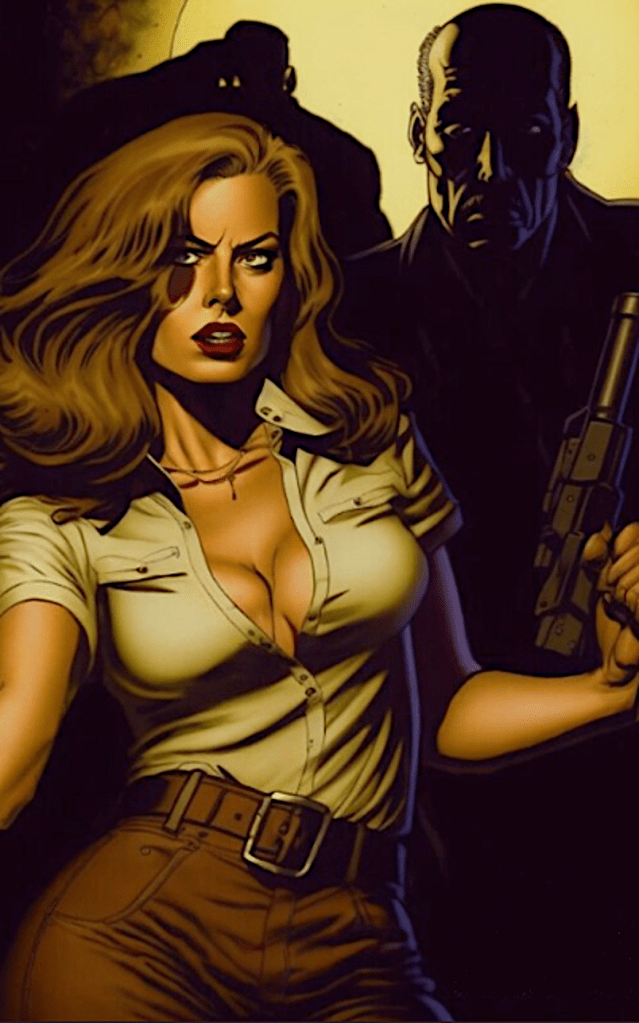
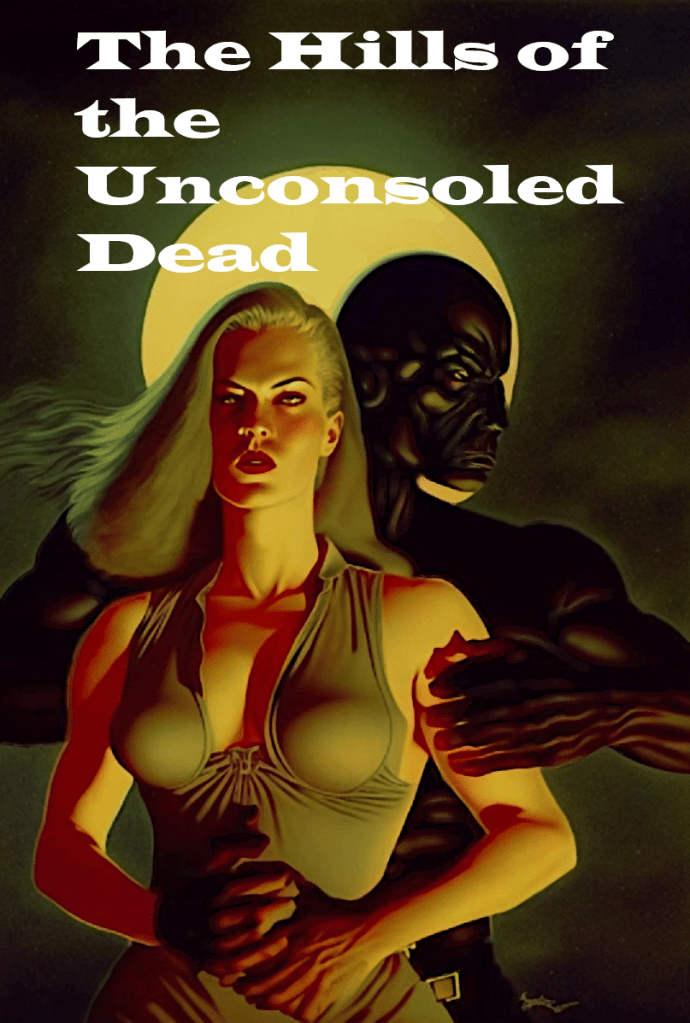
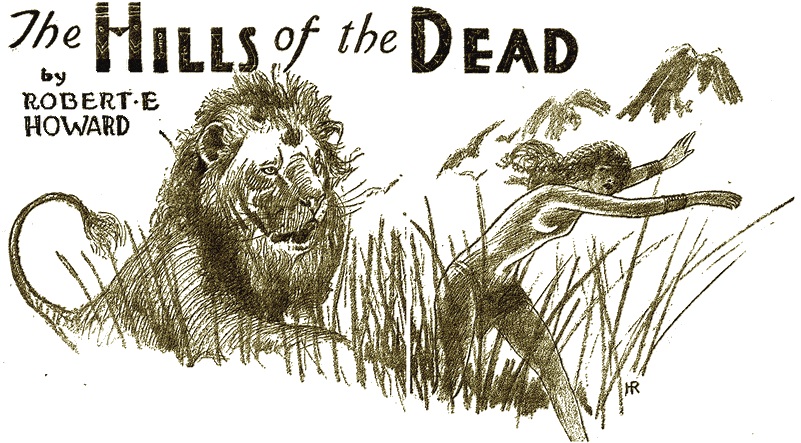


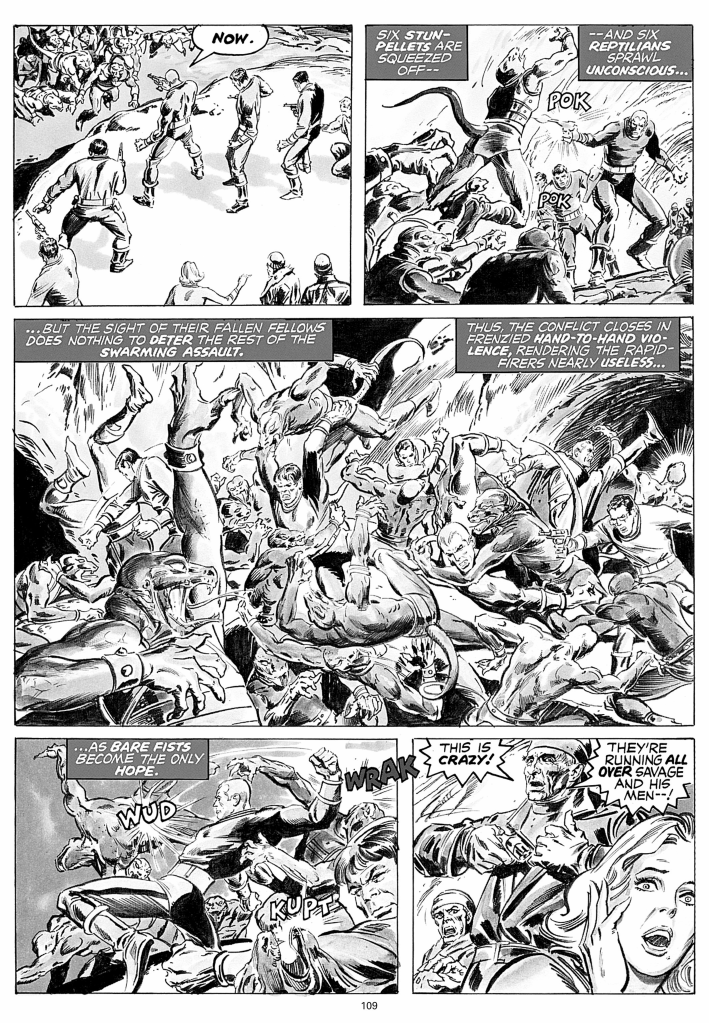
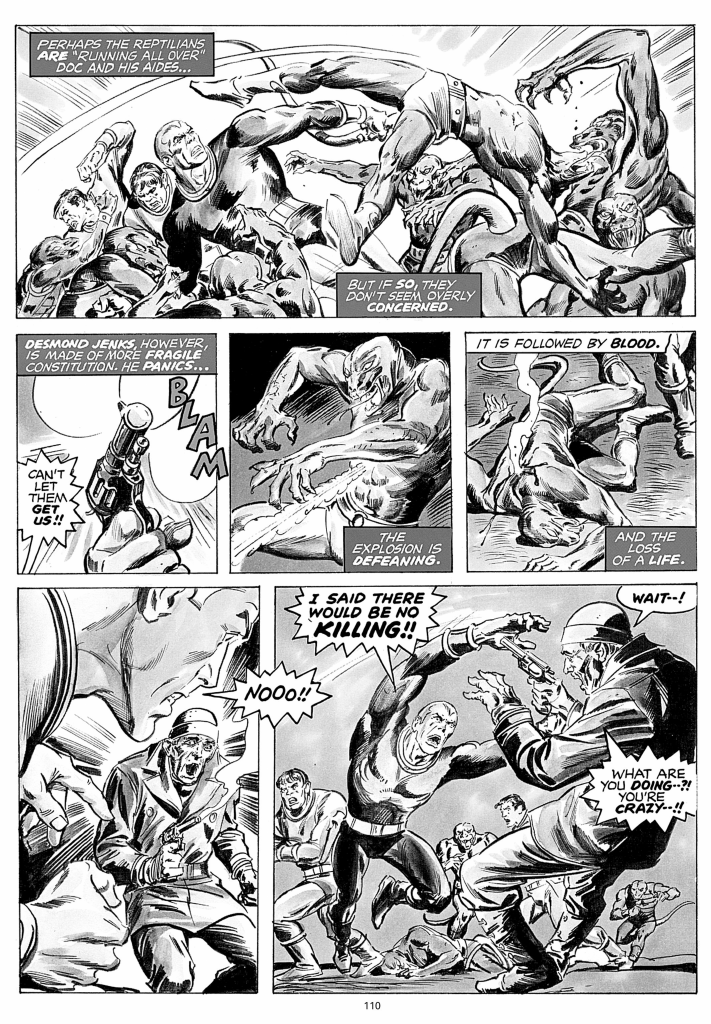
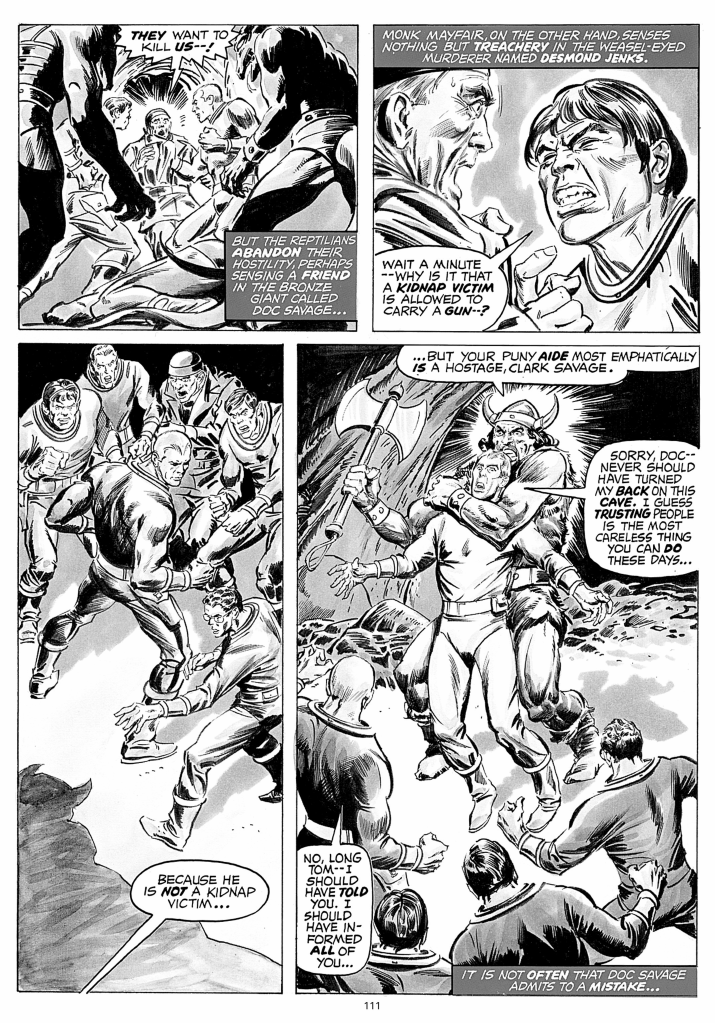
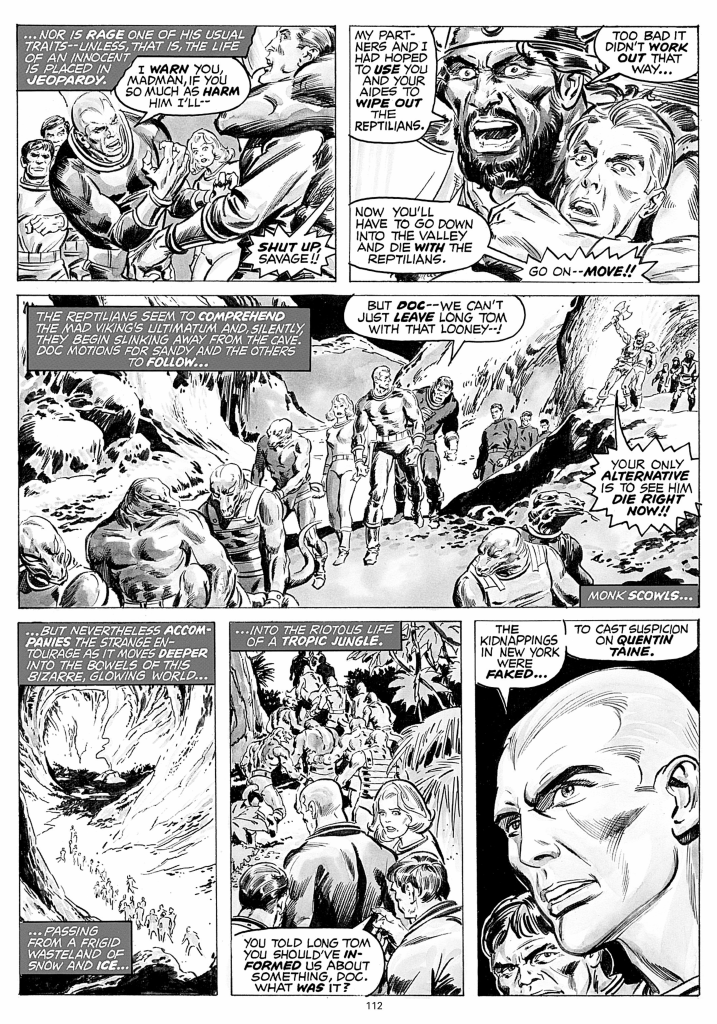
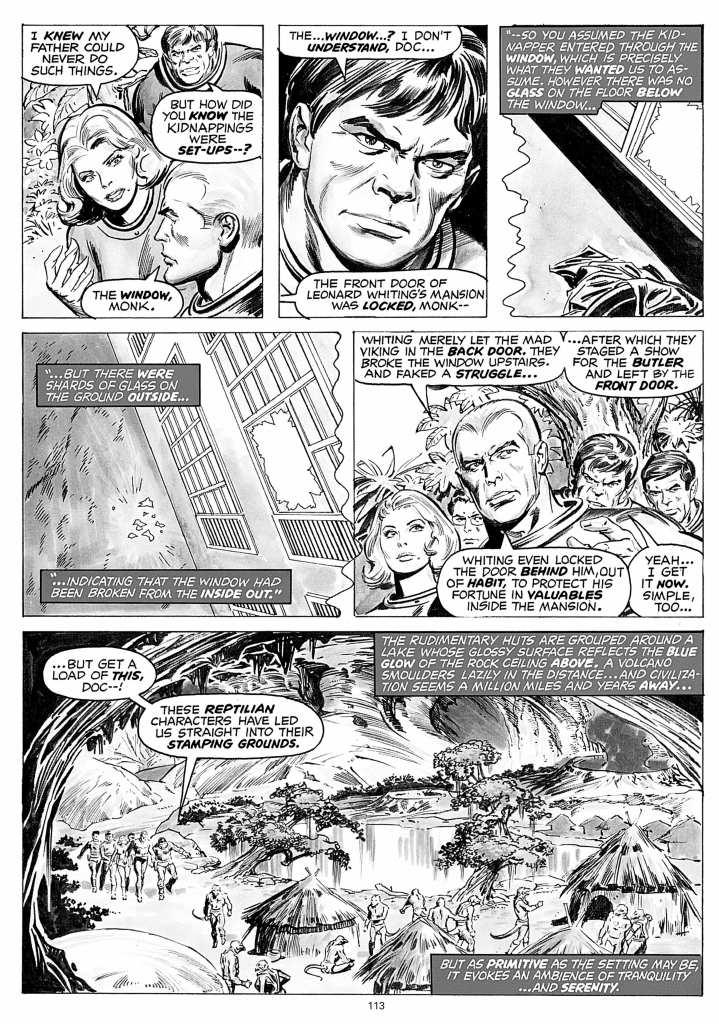
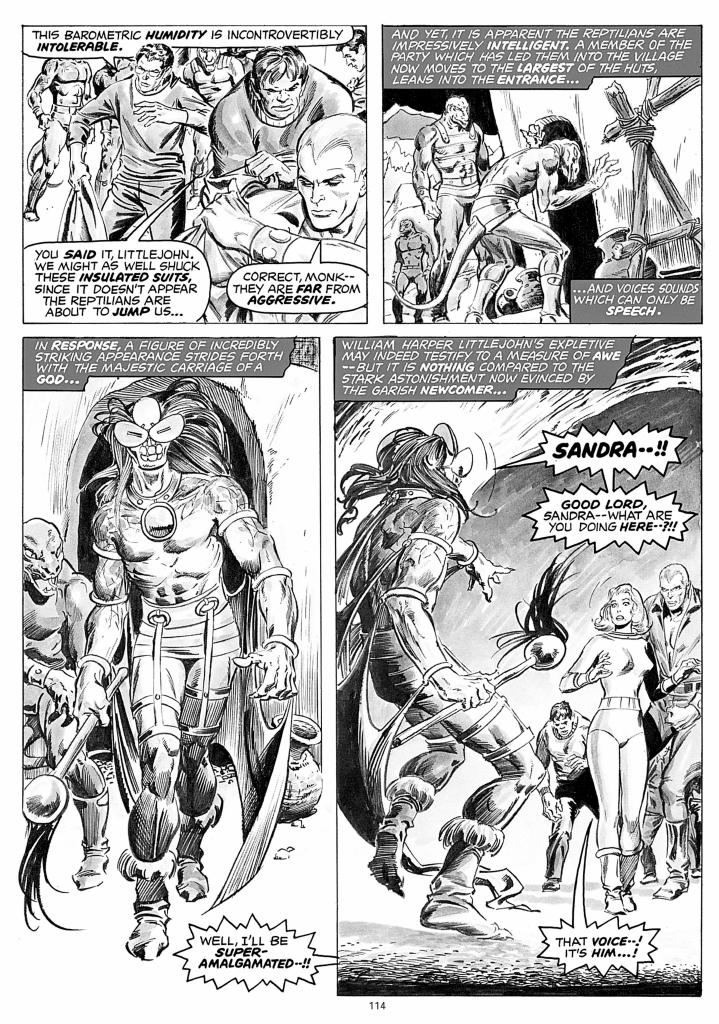

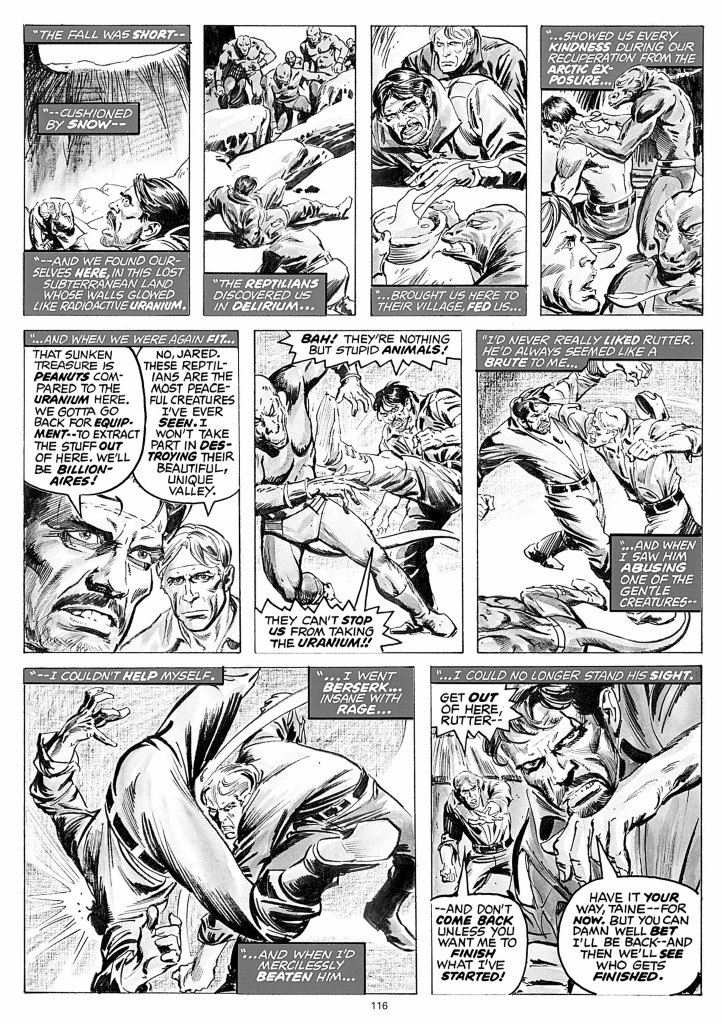
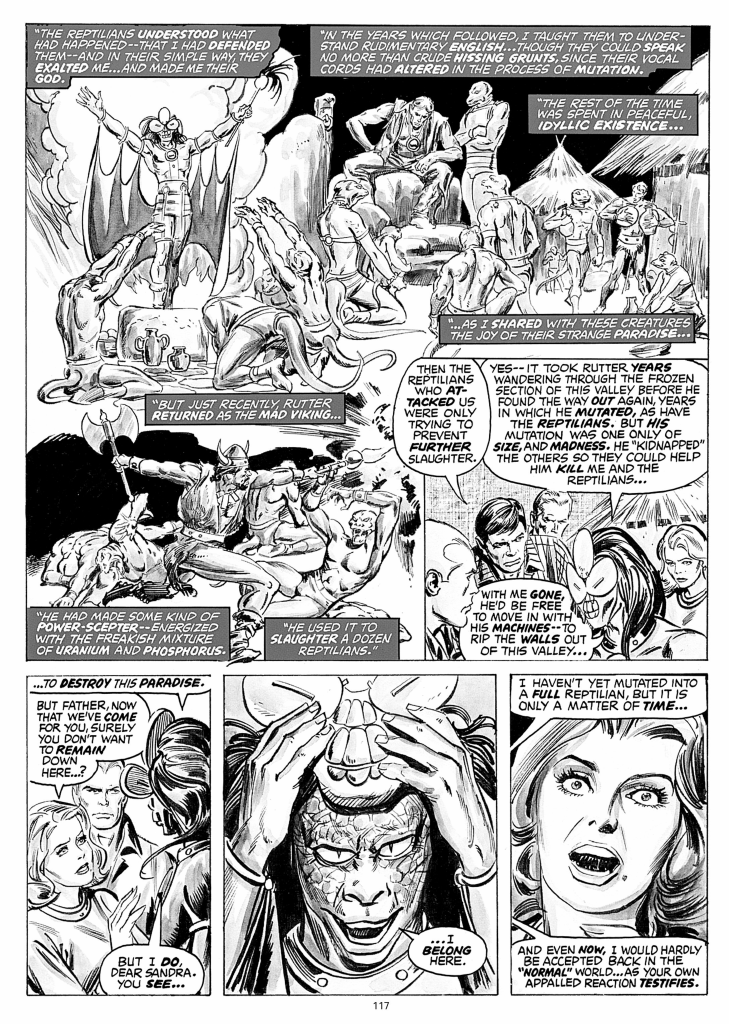


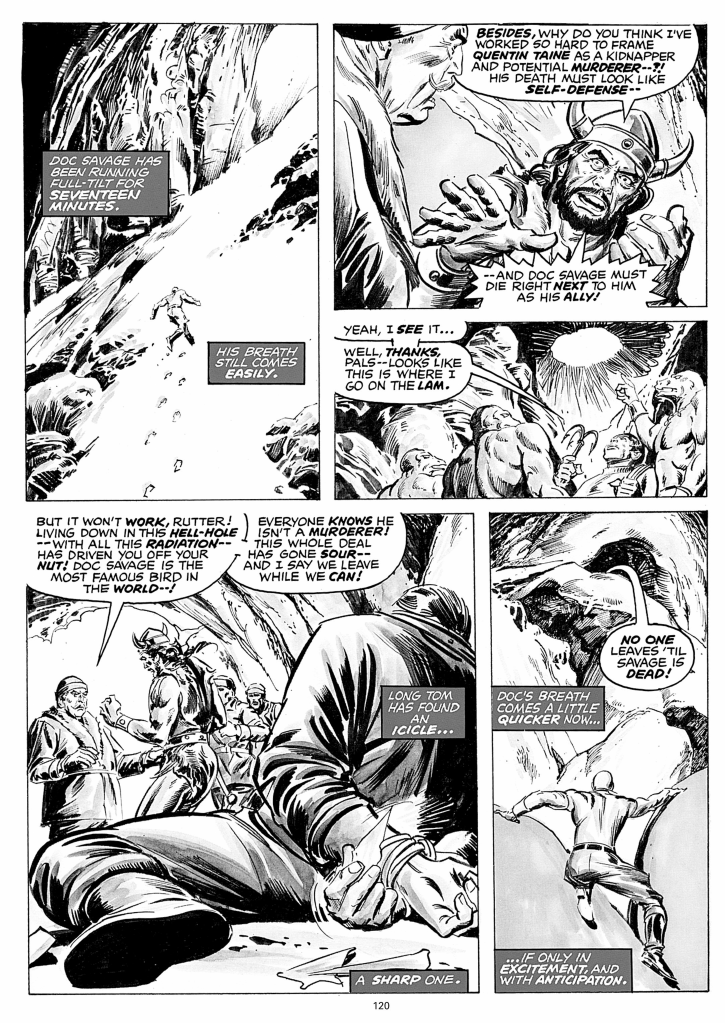
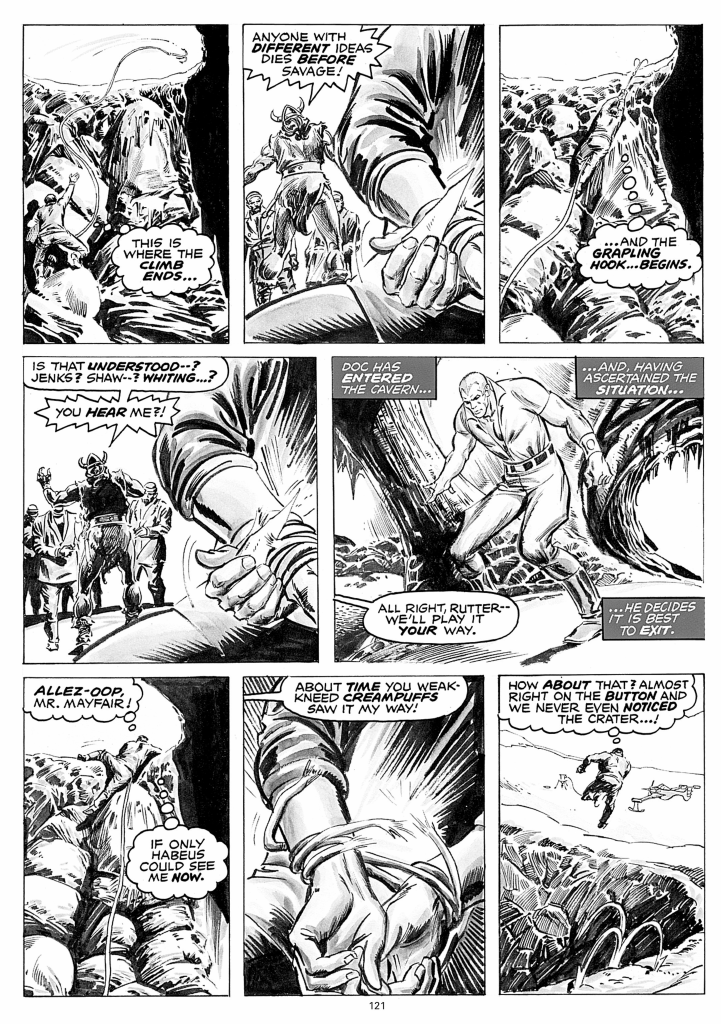
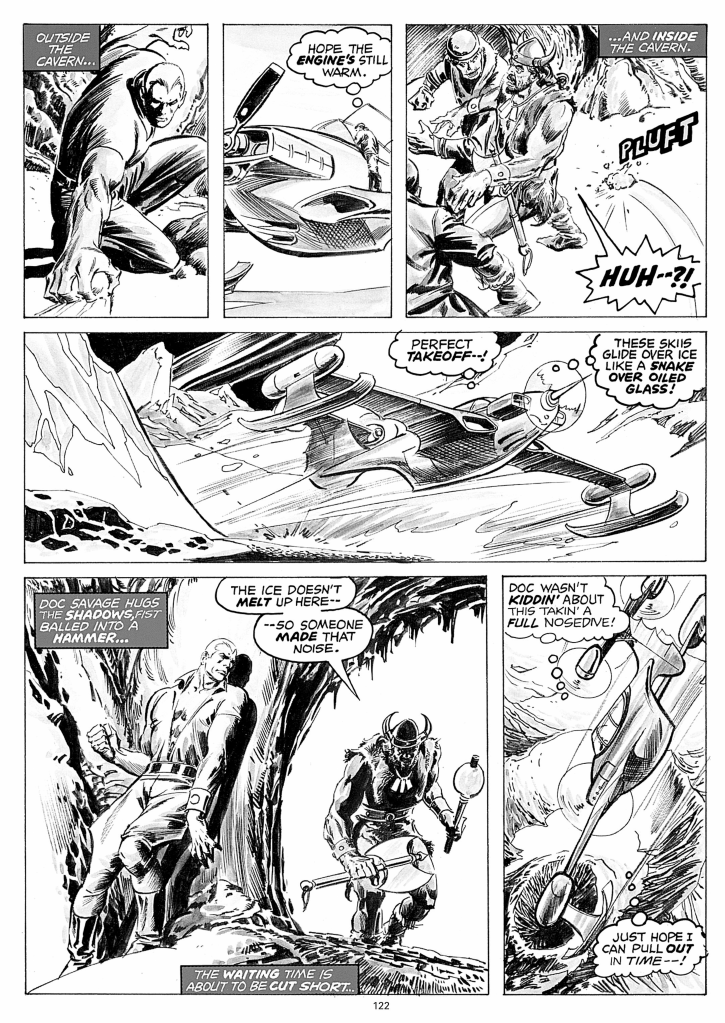

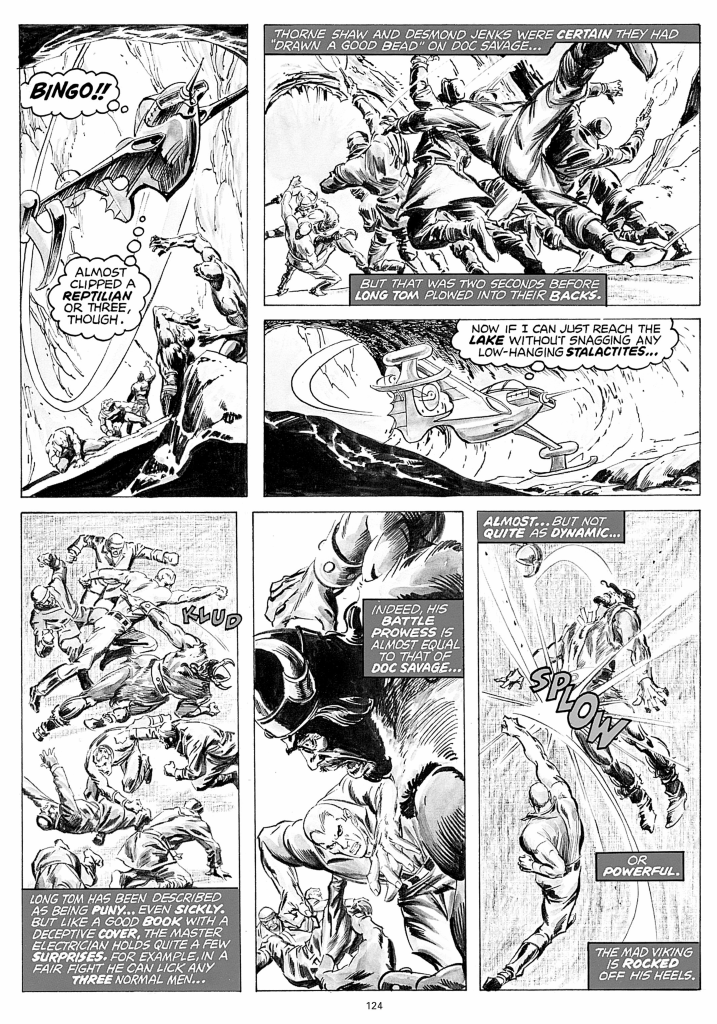
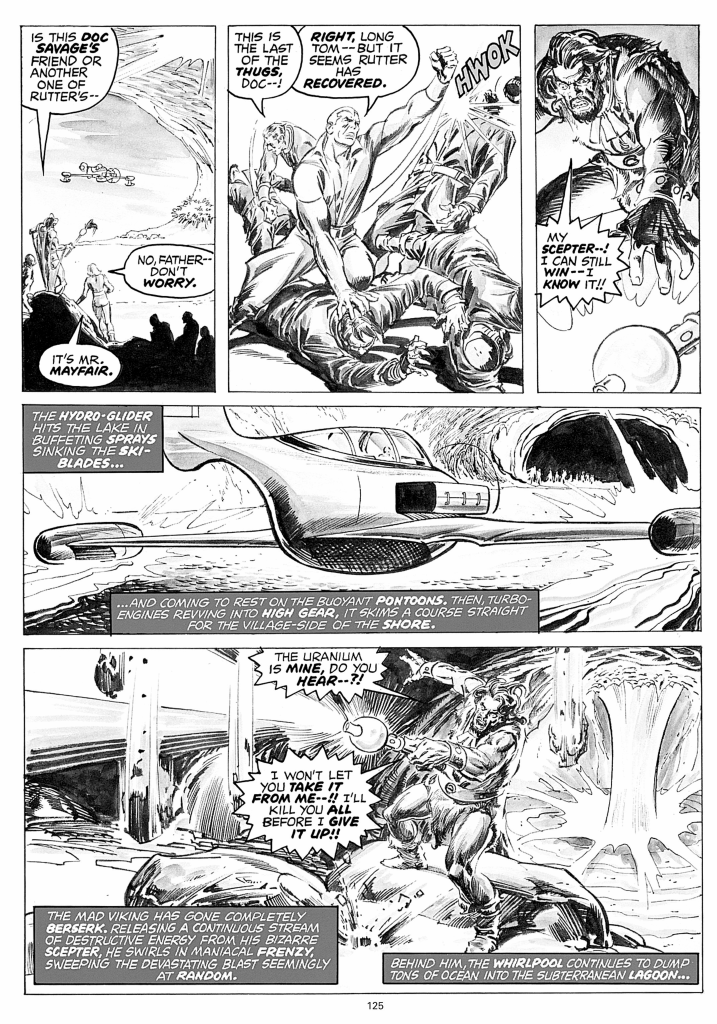
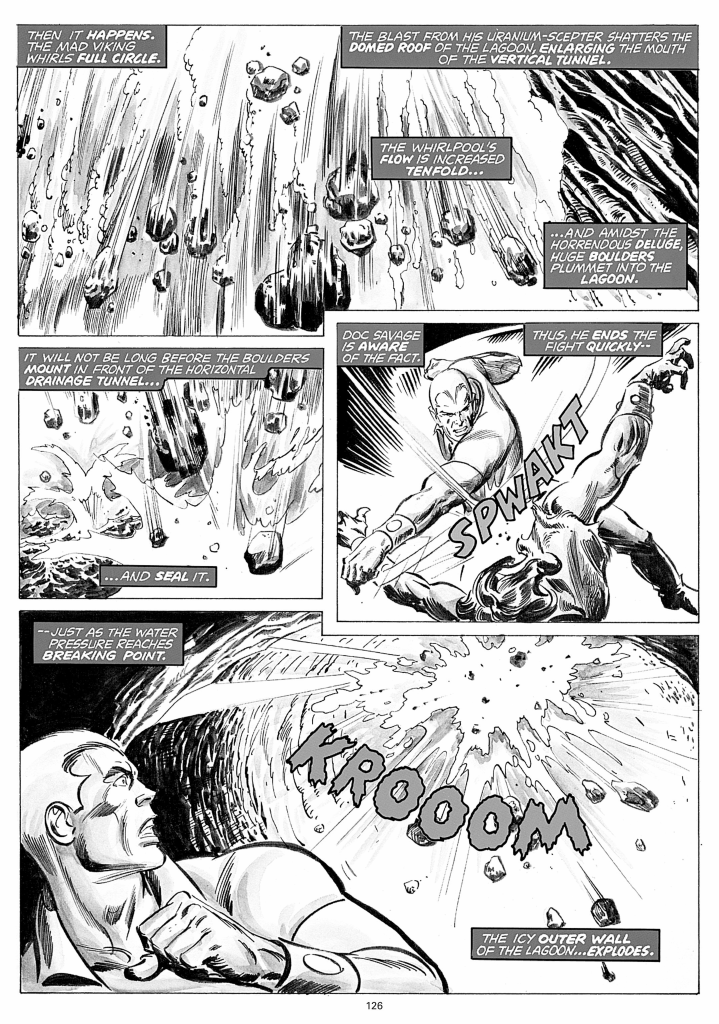
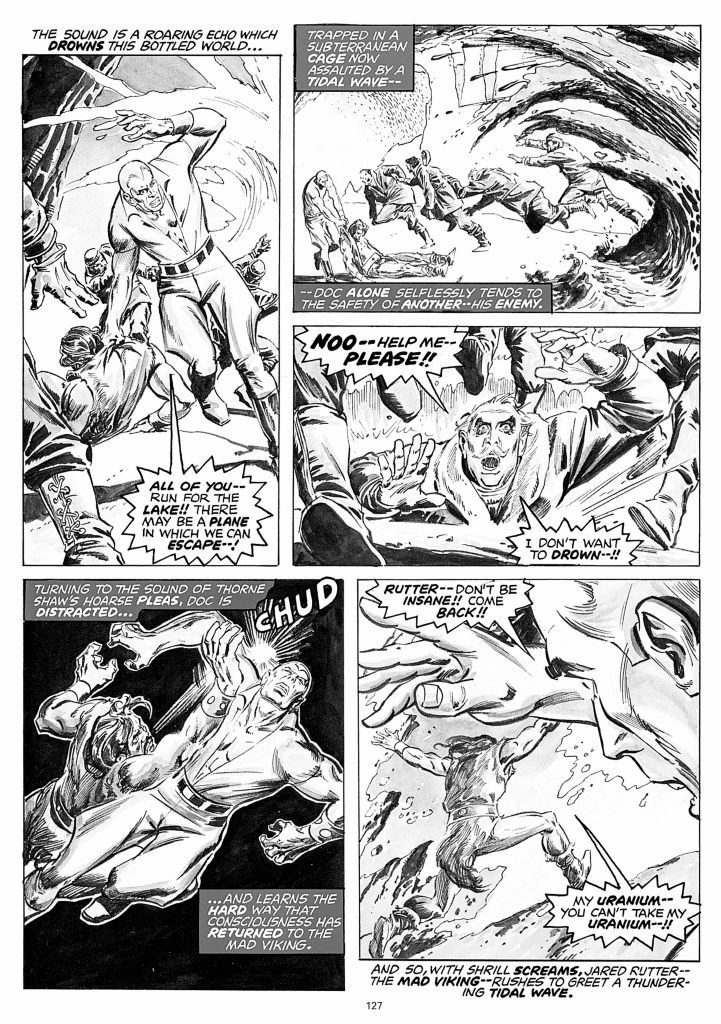
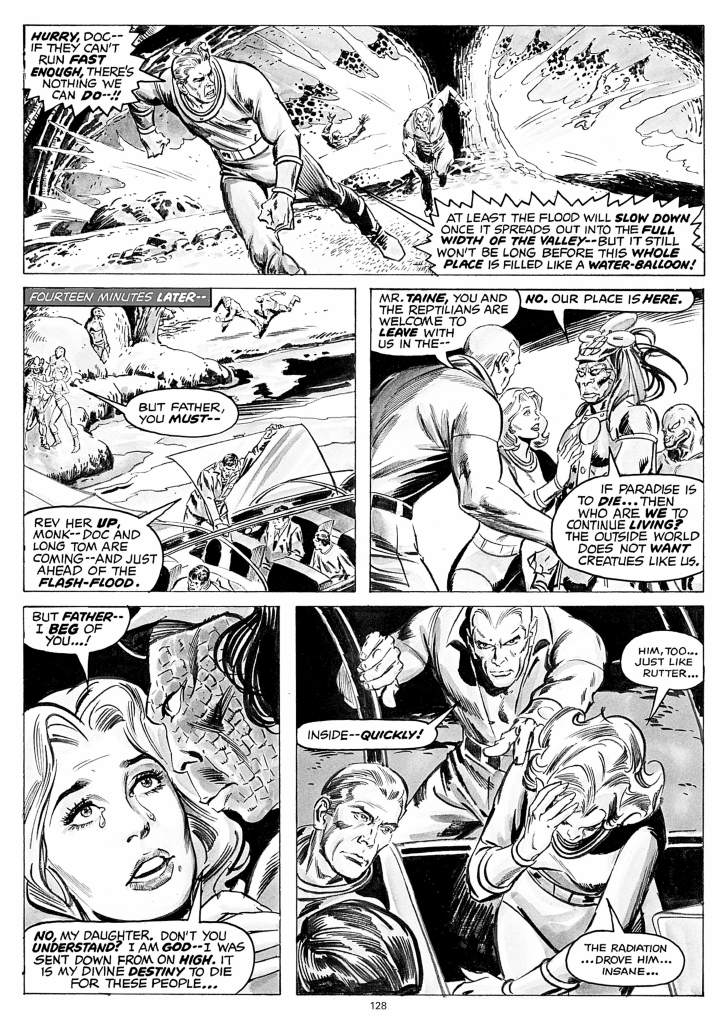
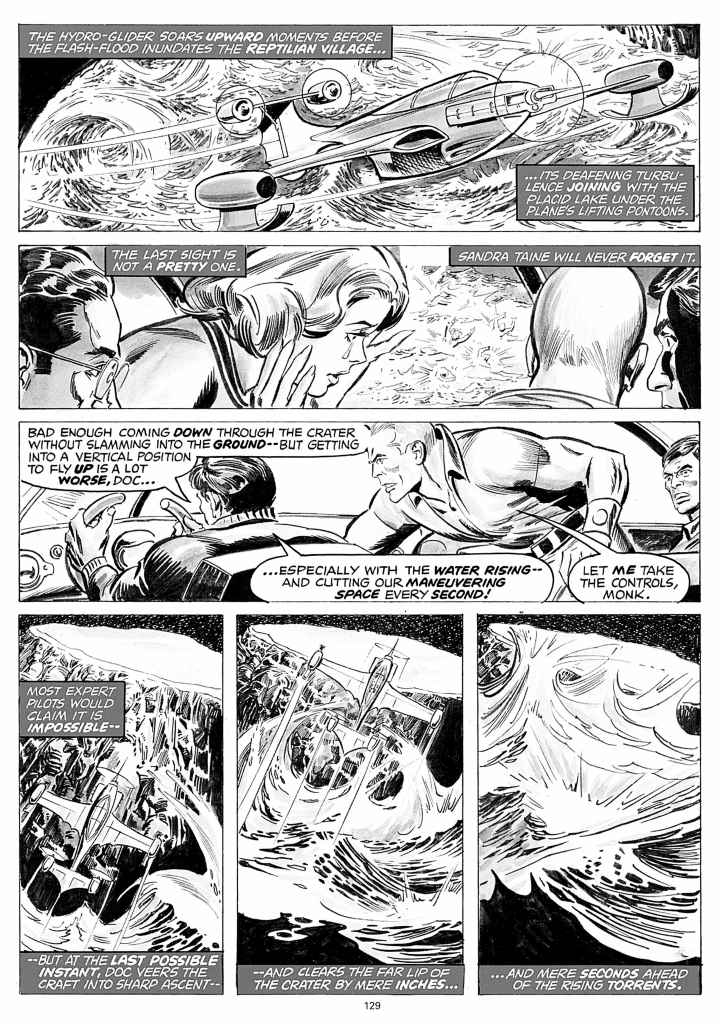
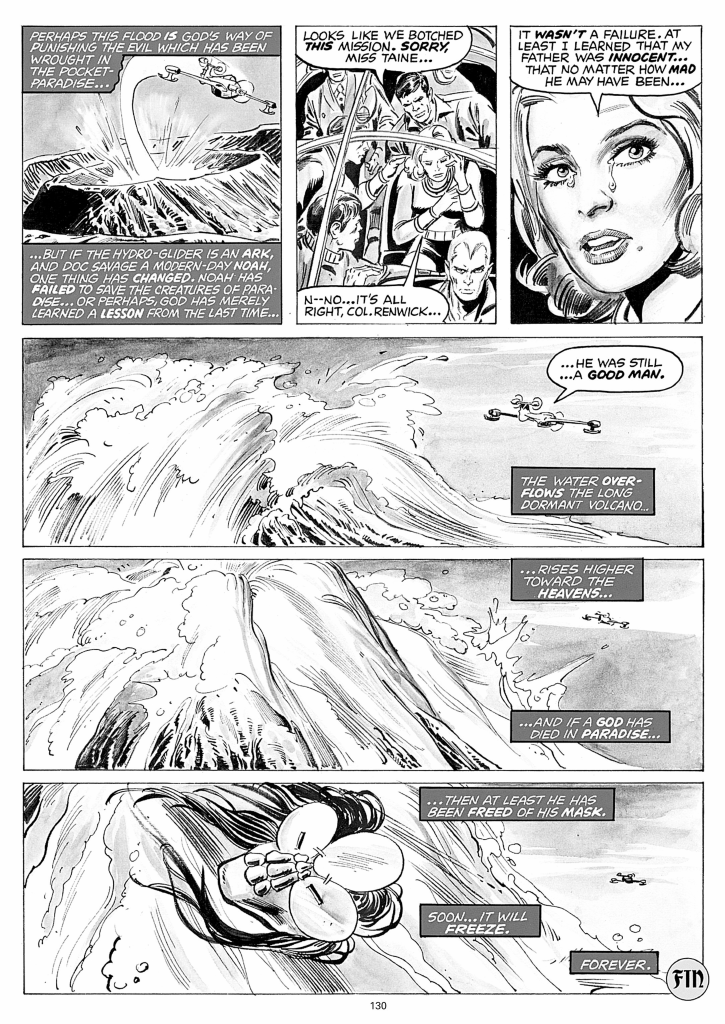
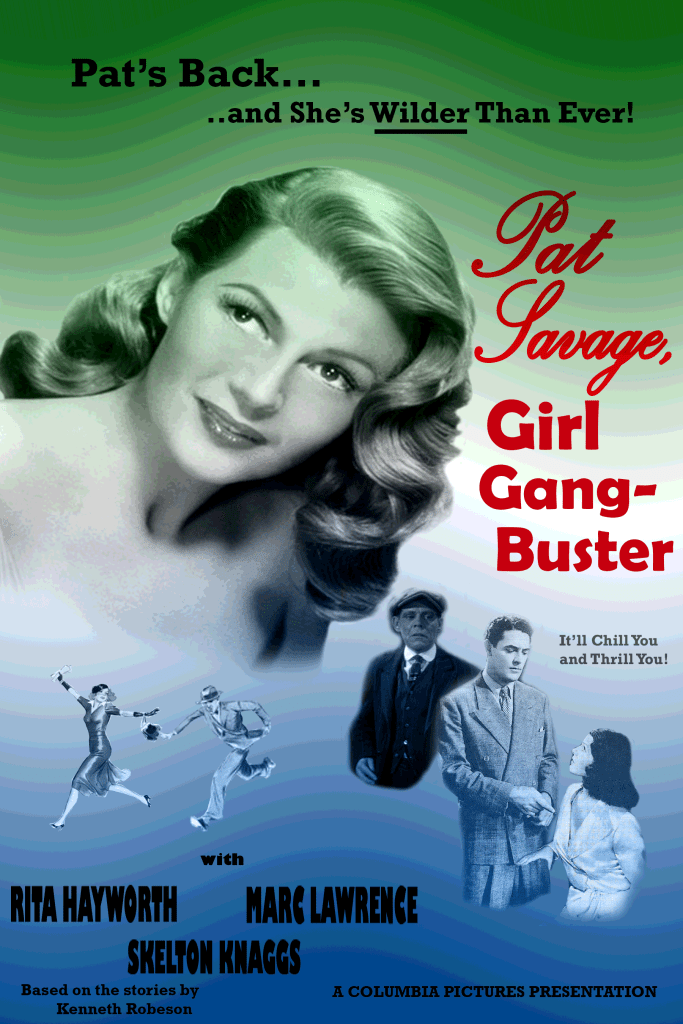
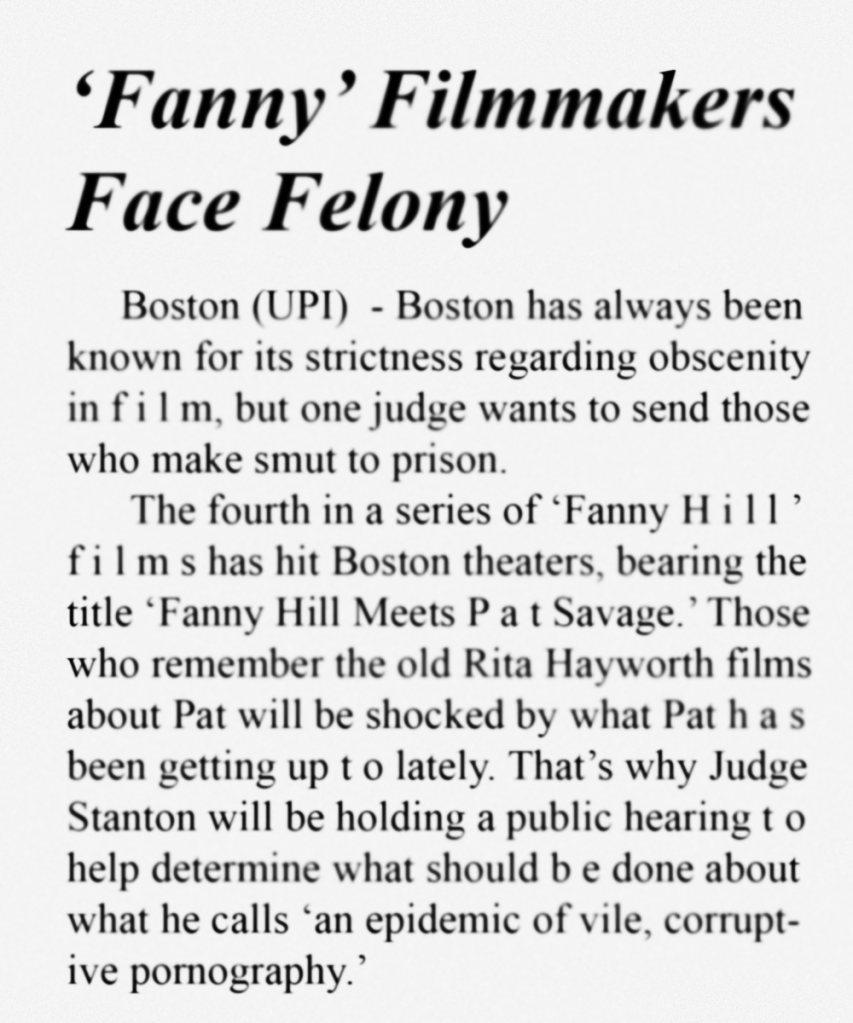
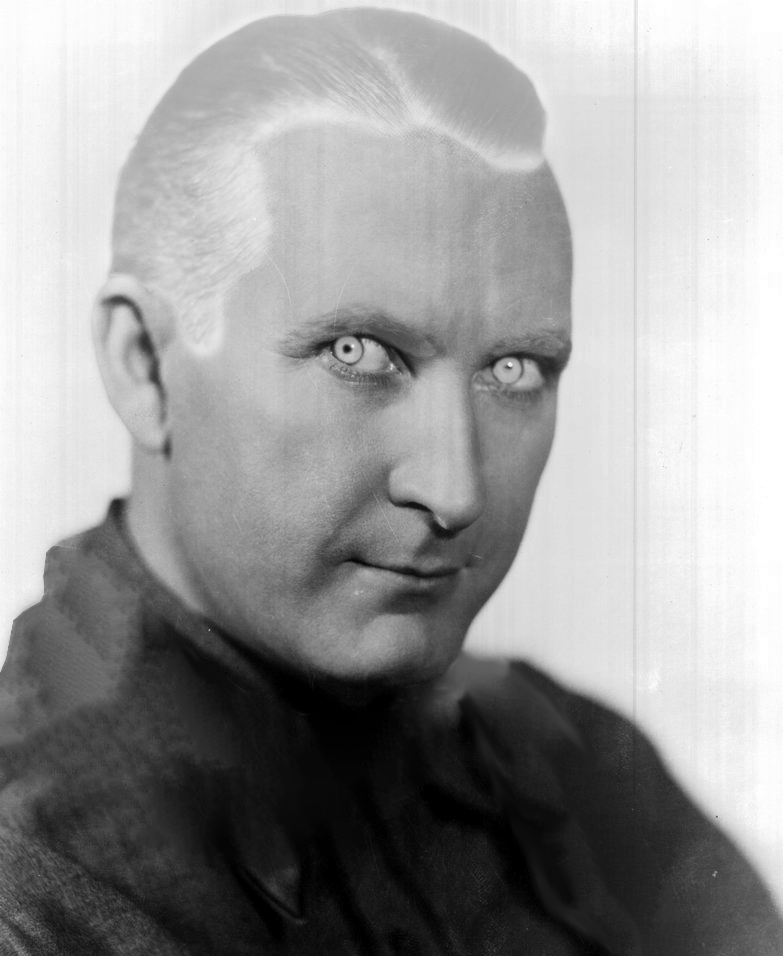

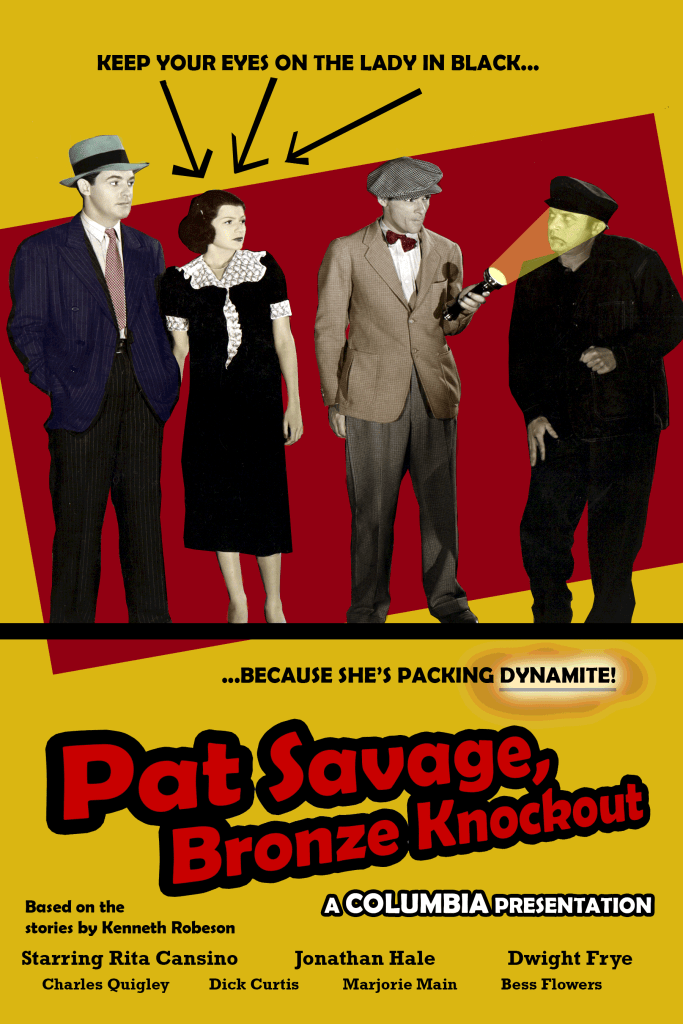
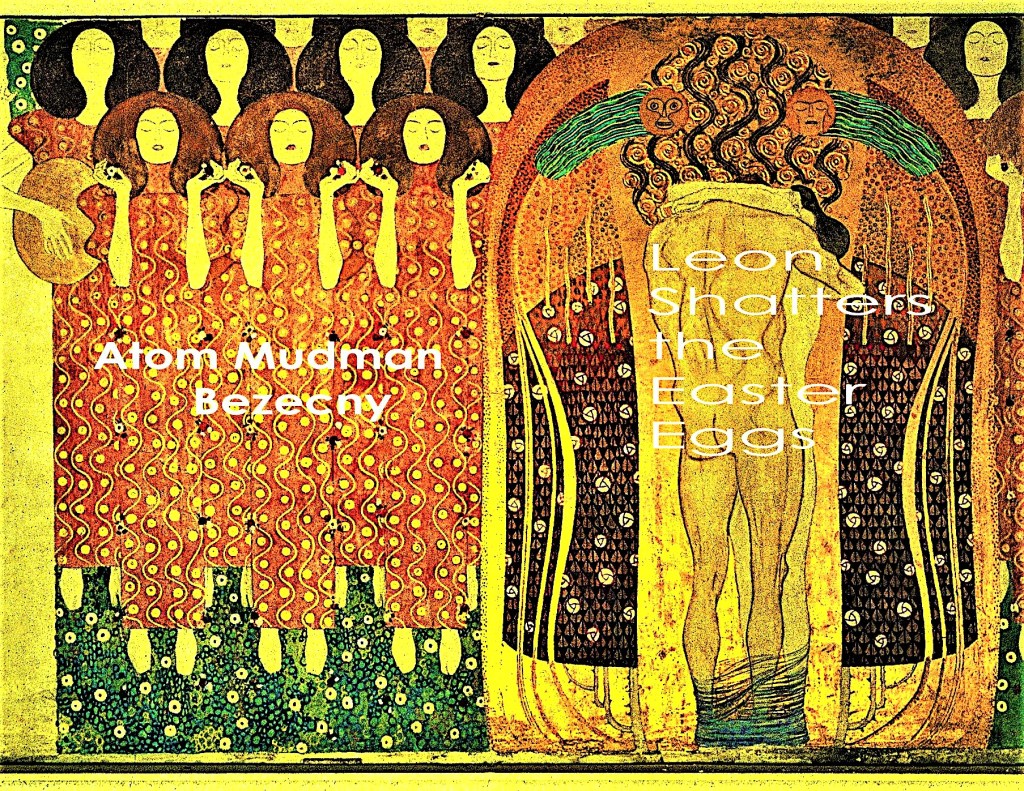
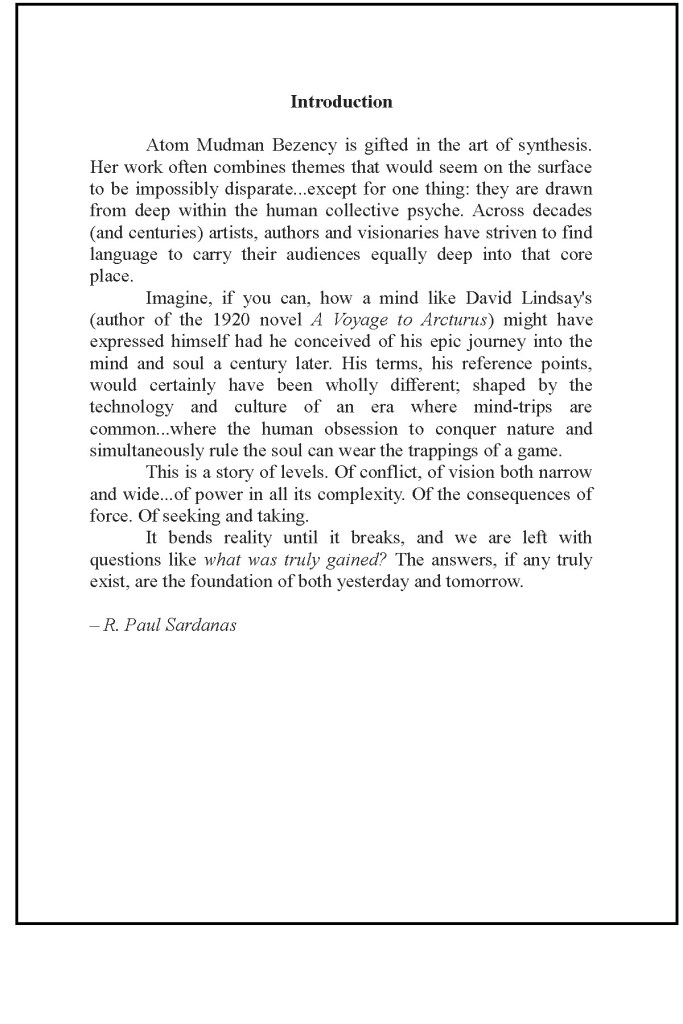

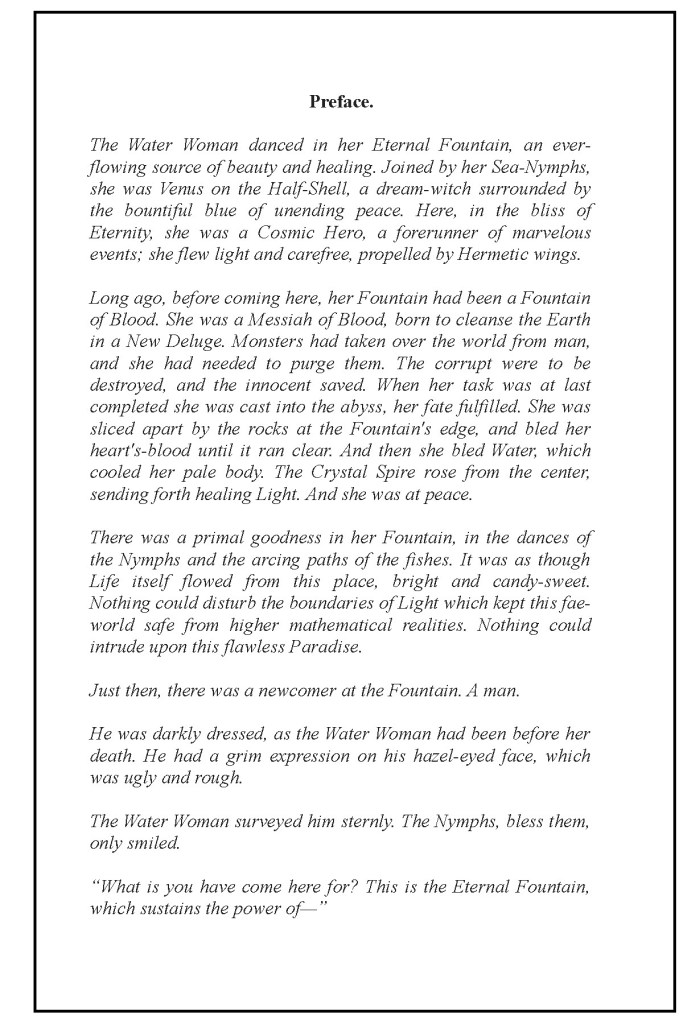
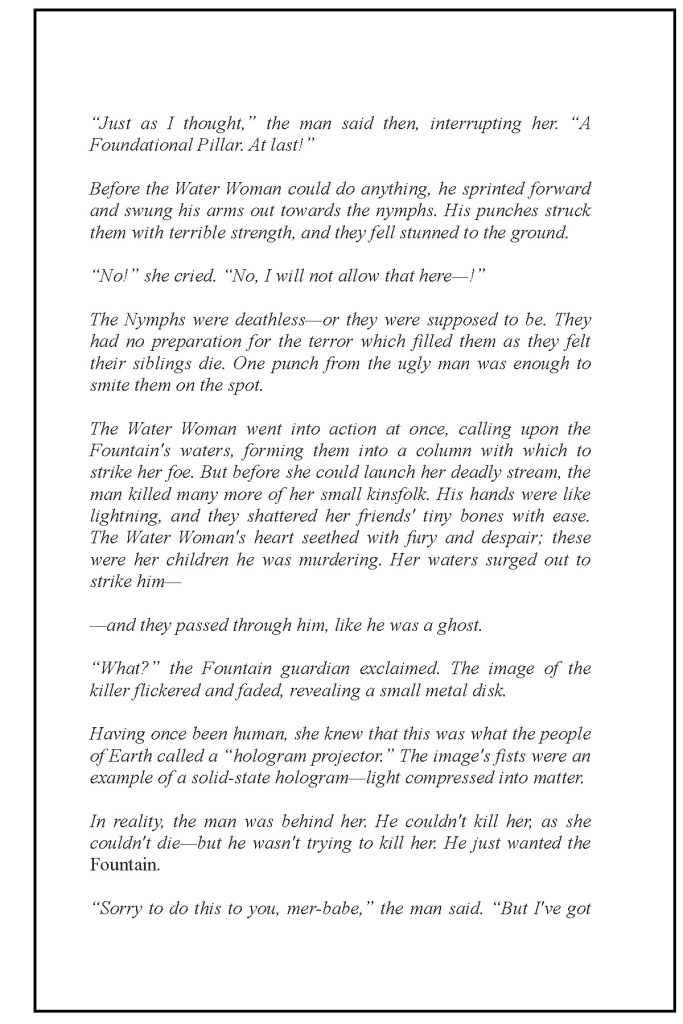
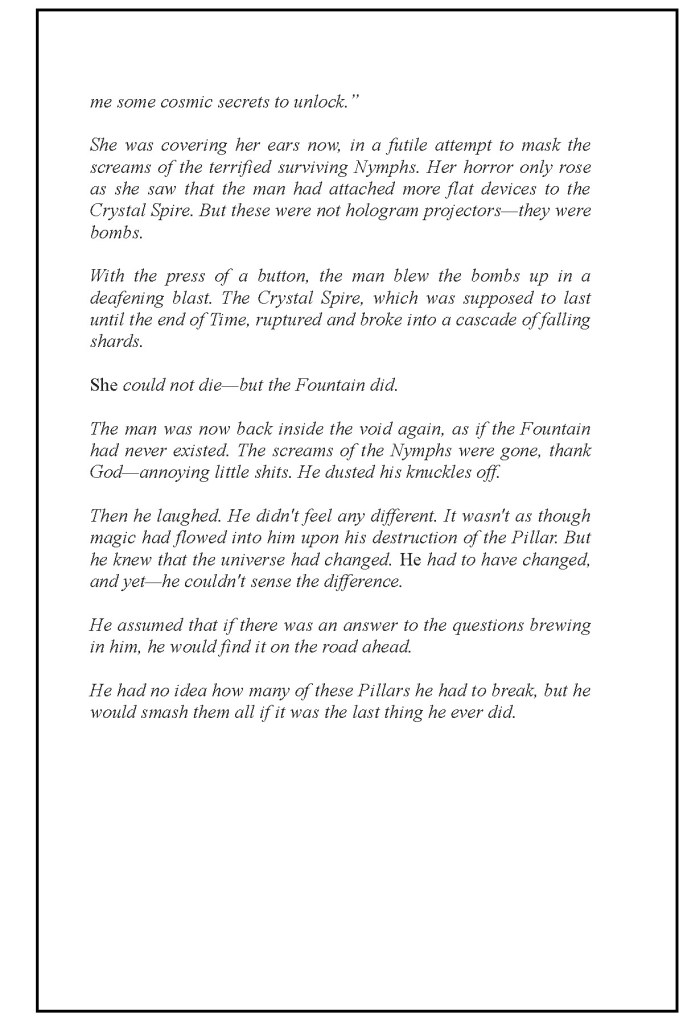
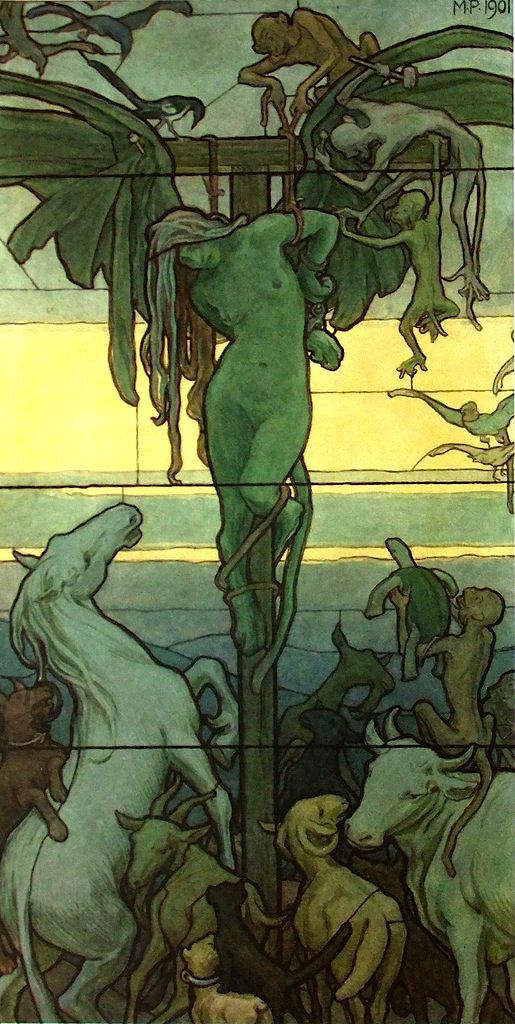


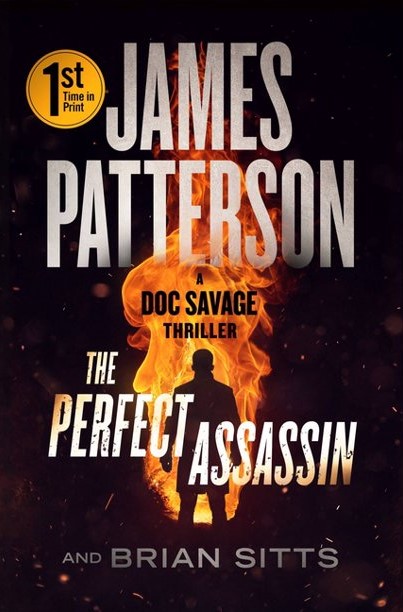


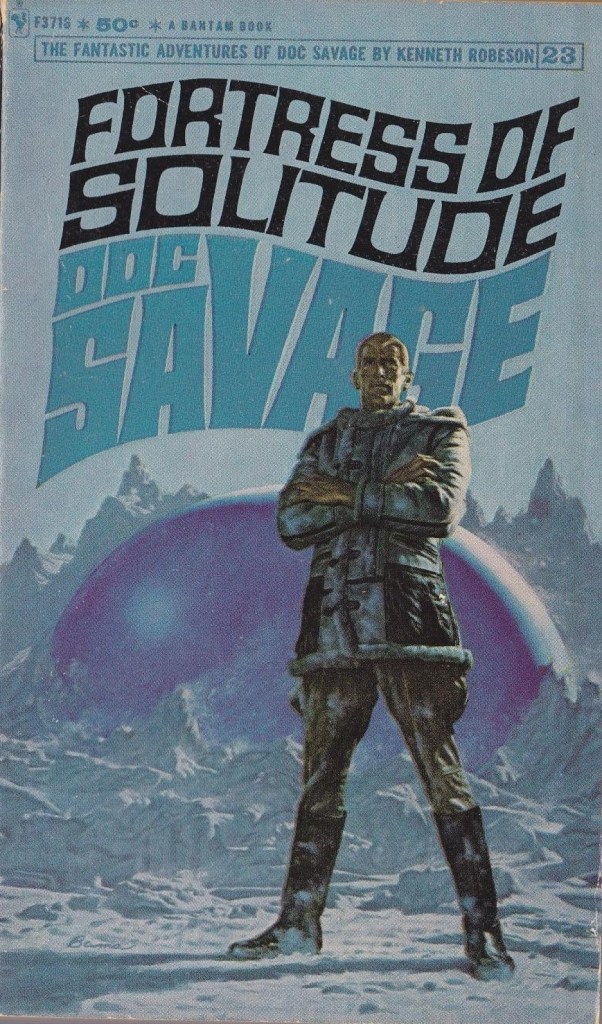

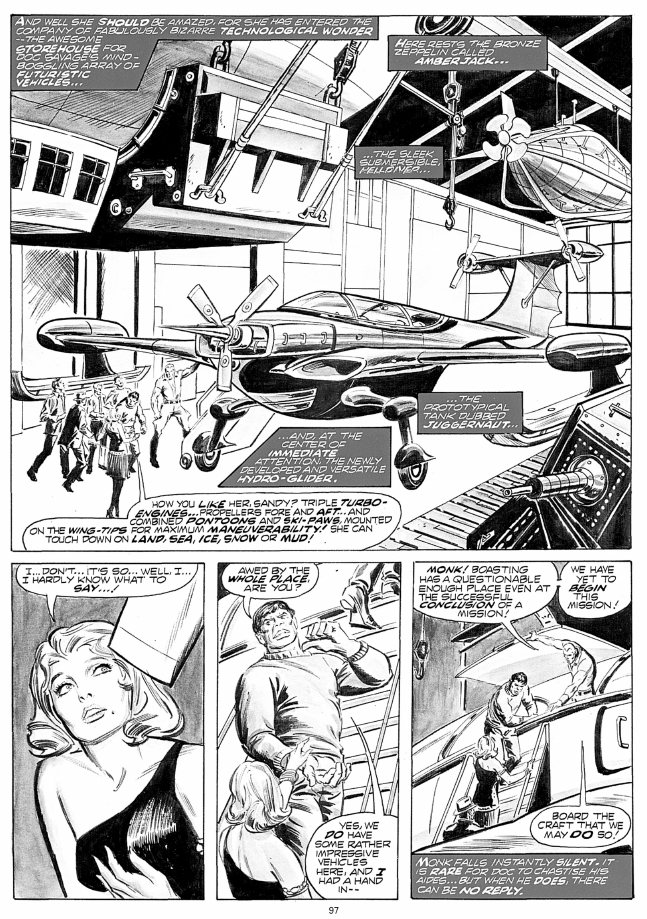


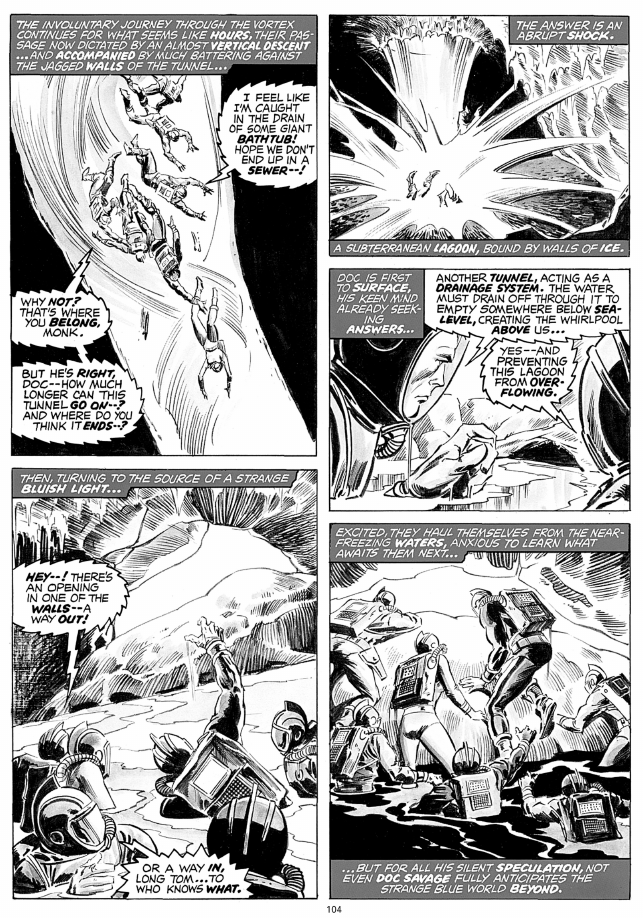
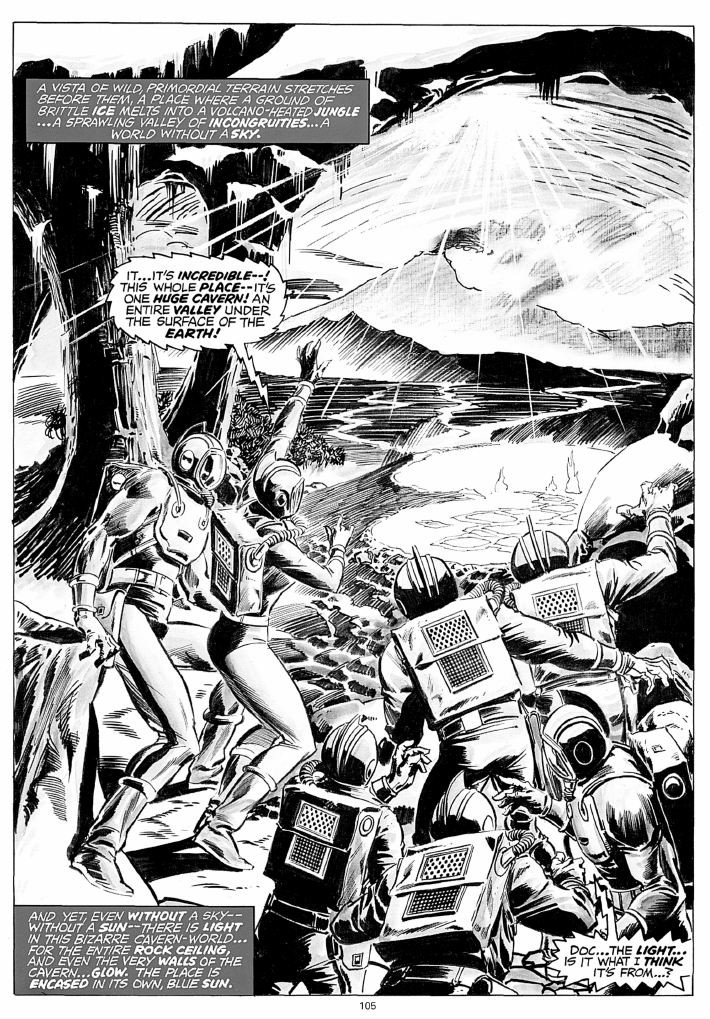
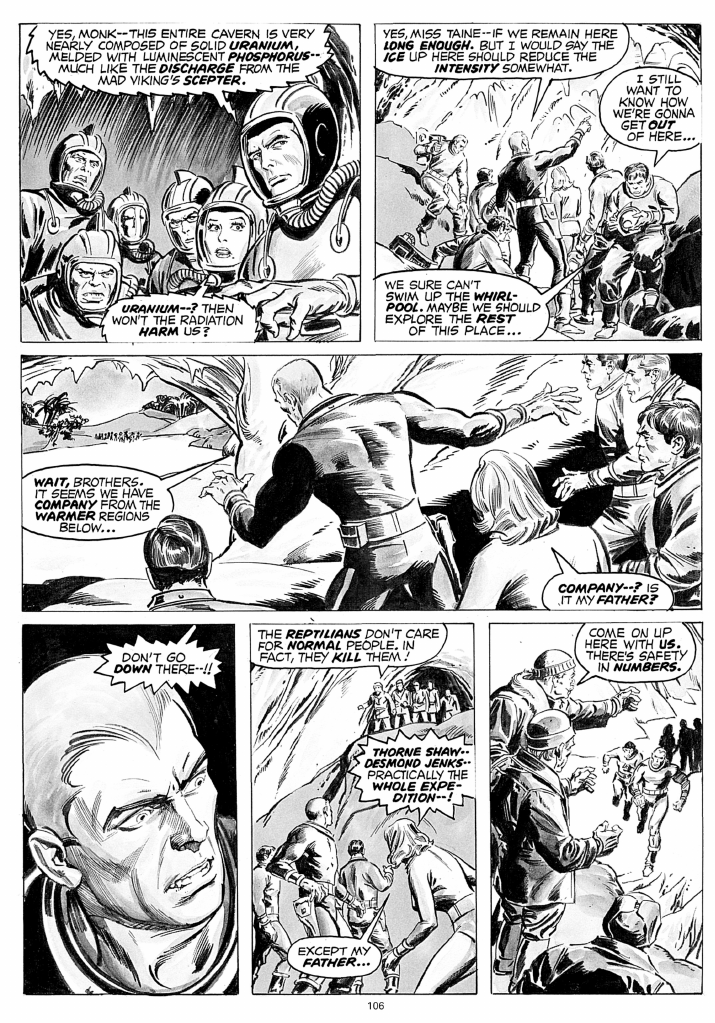


 Doc Talos