In the first part of this article, a few paragraphs from the Foreword of Philip José Farmer’s novel A Feast Unknown were presented, describing how the narrator, Lord Grandrith, was certain that his biological father was Jack the Ripper. That father would also go on to sire James “Doc” Caliban, Farmer’s pastiche of Doc Savage.
Here is more from the Foreword:
That part of the diary which I had forbidden other to read describes how my mother happened to be with her husband in Whitechapel on that fog-smothered night. She had insisted on going with him to look for his brother, who had escaped from the cell in the castle in the Cumberland County. Private detectives had quietly tracked John Cloamby (author’s note: AKA James Wilder, ultimately to become the senior Caliban) to the Whitechapel district of London. His brother, James Cloamby, Viscount Grandrith, had joined this hunt. My mother, Alexandra Applethwaite, related to the noble family of Bedford, had insisted on accompanying him.
My uncle objected to bringing his wife along for several reasons. The strangest was that his brother had attempted to rape her after breaking out of his cell by bending several of the bars and uprooting them from their stone sockets. Only her screams and the prompt appearance of two manservants armed with pistols had saved her.
Farmer displays his love of family-tree play here, as well as suggestion — the description of the dangerous brother shows him escaping due to a strength characteristic of his later son, Doc Savage. The Foreword of A Feast Unknown goes on to show the hunt in Whitechapel, which does indeed result in Alexandra’s rape. Afterward, it goes on to describe the sexual estrangement of Viscount Grandrith to his wife after the assault, their trip to Africa just as Jack the Ripper began his rampage of death in that same Whitechapel, and the birth in Africa of the Grandrith child, who would become Farmer’s avatar of Tarzan.
Later, the ancient head of the Nine, Anana, lays it all out for Grandrith and Caliban.
“Your father has a son in America.”
“All exceedingly strong men with tendencies to madnesses. All were doctors too, as if the knife were your totem, your desire, your bliss. All lovers of violence.”
So this, in Farmer’s narrative, is the pastiche equivalent of Clark Savage, Sr. With a history of unspeakable violence, then of changing his life-path after recovering from madness, becoming a doctor in America, and going on to train his son to “fight evil”. Psychologically, very compelling.
James Talos Sr, AKA Doc Caliban Sr, AKA Clark Savage Sr, by Iason Ragnar Bellerophon
It all set down roots to provide an explanation for the elder Savage’s fanaticism toward the life-mission of his son, shaped out of the dark world at the end of the 19th century, aimed at bringing light and honor and positive change to the early 20th.
“Lovers of violence,” as Anana had stated, perhaps. Doc is also surrounded by rampant violence throughout his adventures. Interestingly, the first few Doc Savage novels show a Doc who uses a good deal of brutal violence himself, before exercising personal control and implementing his more humanitarian philosophies. Like father, like son.
Doc Savage’s father is mentioned in many of the pulp novels, but only in the context of his strange obsession to turn his son into a superman, trained and equipped to fight the evils of the world. Why would he do such a thing? The concept is intensely extreme…and yet what drove the elder Savage to do this is never explained.
Painting of Clark Savage Sr., from the film “Doc Savage: The Man of Bronze”
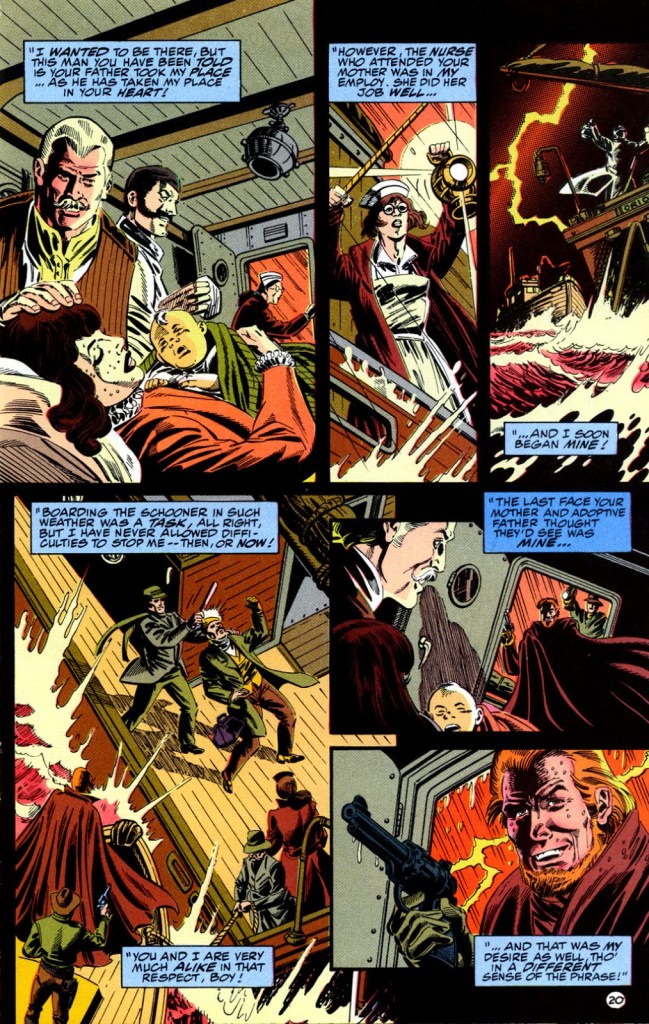
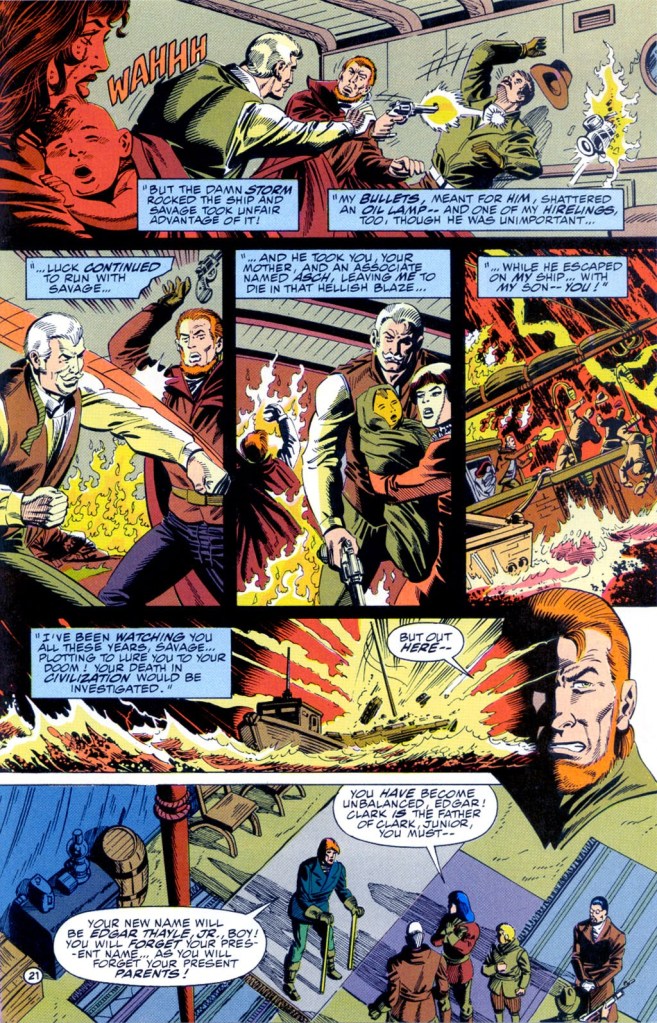
Retroactively, various creators doing “authorized” (meaning rights have been granted by the copyright owner, Conde Nast) versions of Doc Savage stories have delved a little more into the mystery of Doc’s father. Will Murray did so in his Wild Adventures of Doc Savage novel Skull Island, and several comic book takes on Doc have also centered around the senior Savage. All are vastly different, and thus none of them have a feeling of canon to me. Still, they are interesting. In the Millennium comics story Devil’s Thoughts, Savage Sr. is depicted as a borderline (and sometimes over the line) criminal. In the final story of DC Comics’ late 1980’s/early 1990’s take on Doc, his father is presented as a very hard man, not averse to dealing out cruel justice, as in this version of the night of Doc’s birth aboard the schooner Orion.
But perhaps the most compelling theory of the obsessions of Doc’s father came through the pastiche character Doc Caliban, written by Philip José Farmer. The family history presented in Farmer’s novel A Feast Unknown is lurid and intense. Farmer linked the identity of Doc’s father to a character in Sir Arthur Conan Doyle’s The Adventure of the Priory School, James Wilder. And beyond that, he identified Wilder as Jack the Ripper.
Certainly that would provide a motivation for such extreme life-philosophies and behavior. Tormented by his own acts as one of the most grisly killers of the 19th century, Wilder (changing his name to Caliban) might well swing to the other extreme in order to find atonement.
Farmer lays out this premise in the Foreword of A Feast Unknown, but does not pursue it in depth. Nevertheless, a great puzzle of the soul had been set out — to my mind, crying out to be assembled. Farmer presented Doc’s father as something of a madman in his brief visit to the Victorian roots of the character, but it has always felt to me as if deeper and more complex psychologies must be at play within such a character.
Countless novels, movies, “true crime” theories, and other speculation has run rampant about Jack the Ripper. Many are fascinating, many are illuminating. But England at the end of the 19th century is a compelling study in and of itself. The Victorian Era was one which proudly wore a veneer of great order and control…a “civilized” place and time. But it seethed with subcultures of mysticism and sexuality, all of which might come to bear in shaping a character like Doc’s father. It was a society filled with many hypocrisies, many temptations, many conflicts…which could potentially tear even the most idealistic individuals in two.
It was also a time when the world was opening up through exploration and European domination/exploitation of unexplored areas of the world map, feeding, in the pulp years of the 20th century to follow, a fascination with the concept of “lost worlds” and “secret societies”.
This would have been the world of Doc’s father…one which would inevitably lead to the strange extremes of the son’s life to come.
Note from Doc Talos author and contest judge R. Paul Sardanas: There was always something special about Doc’s small humanitarian gestures. The globe-spanning adventures were breathtaking, but he would also never fail to take the time for simple acts of caring. The recipient in Don Murphy’s tale of a very different Maximus the World’s Fair Goblin is an unexpected one, but all the more touching for that.
Comment from author Don Murphy: With realism part of the literary tone in Doc Talos stories, I wondered what it would look like if I grounded the characters from the original World’s Fair Goblin in more of a hardscrabble Depression viewpoint. Max Booker is based on a gentleman I actually knew, who suffered, not from gigantism, but muscular dystrophy. He liked to pretend he was a tough guy, but his true toughness was in a stoic cheerfulness and quiet personal courage.
Additional Note: If you are interested in submitting fiction to the Summer 2021 contest (first prize is a Bantam Doc Savage paperback Czar of Fear first edition, signed by James Bama) you can read the contest guidelines HERE.
Decades before the 10-cent extravaganzas that were the pulp magazines, the Victorians had Penny Dreadfuls, filled with intense and lurid tales. And it was also a uniquely rich time for novelists and short story tellers like Poe, Stevenson and Stoker, who explored crime and the dark side of human imagination. In real life, Jack the Ripper terrorized Whitechapel.
It was also a time when social mores were outwardly very straightlaced — but under that veneer, a seething underground flourished. Though never explored in the Doc Savage canon of pulps beyond vague and brief references, that would have been the world inhabited by Doc’s immediate forebears.
These are the opening paragraphs of Philip José Farmer’s Foreword to his novel A Feast Unknown:
I was conceived and born in 1888.
Jack the Ripper was my father.
I am certain of this, though I have no evidence that would stand up in court. I have only the diary of my legal father. He was, in fact, my uncle, though he was married to my mother.
My legal father kept a diary almost up to the moment of his death. Shortly after he had locked it inside a desk, he was killed. His last written words recorded his despair because his wife had just died and I, only a year old, was wailing for milk. And there were no human beings within hundreds of miles, as far as he knew.
The person making that statement is Lord Grandrith, Farmer’s pastiche of Tarzan. For the next eight pages of the book, he introduces the harrowing, nightmarish reality in his life that his real father (and, we are to learn, the father of Farmer’s Doc Savage pastiche, Doc Caliban) was the most hideous criminal of the 19th century.
Jack the Ripper, by Iason Ragnar Bellerophon
After that extraordinary beginning, Farmer (and Grandrith) move quickly forward in time, to what was then the present day, 1969. He would never return in depth again (making reference to it in his extensive fictional family trees, but not in any further narrative patches) to the place and time which, in such fascinating fashion, spawned a monster that would in turn spawn two heroes.
In extrapolating on that concept for the Talos stories, it wasn’t enough just to scratch that surface. Much of the era of pulps was shaped either in settings or by creators who were born in or greatly influenced by their historical closeness or immersion in the Victorian Era (1837-1901): Edgar Rice Burroughs (b. 1875); the luminaries of Weird Tales, H.P. Lovecraft (b. 1890), Clark Ashton Smith (b. 1893), Robert E. Howard (b. 1906), Arthur Machen (b. 1863), Arthur Conan Doyle (b. 1859), Walter Gibson (b. 1894), Lester Dent (b. 1904). To understand the concepts born in that time, it was an enthralling exercise to dig deep into those Victorian conceptual roots of 20th century pulp fiction.
Not just a passing glimpse, as Farmer had given with his powerful (and explicit) peek into that world. To go all the way down into what was, in many ways, a culture of order on its surface, underpinned by a hidden subculture that would, a generation after the passing of Queen Victoria, heavily influence the themes of “the bloody pulps”.
The art deco plaque in the lobby of the Empire State Building
In Issue #85 of the Bronze Gazette, Chuck wrote in his Editor’s Column about the enduring strength of Doc Savage fandom. The emotions stirred in him were very much shared by me. A faith in the camaraderie we all share together, balanced against the publishing forces that have time and again made an effort to capture the lightning of unique popularity that has, more than once across the decades, vaulted Doc Savage powerfully into the public consciousness. Like Chuck, I wonder what lies ahead.
In the 1930’s the Doc Savage pulp magazine was a phenomenon. It’s no exaggeration to say that through the Depression, very few characters kindled the fire of devoted readership that Doc did. Some elements of that phenomenon were unique to the time. In those Depression years, Doc was a melded embodiment of escape literature (traveling the globe, exploring lost worlds), the burgeoning concept of science-as-miracle (the supernatural elements of the stories were all presented as advances in scientific ability), and hope. Hope that human ingenuity wedded to idealism could contribute ultimately to a world where the brutal conditions of the Great Depression could be fought, could be healed.
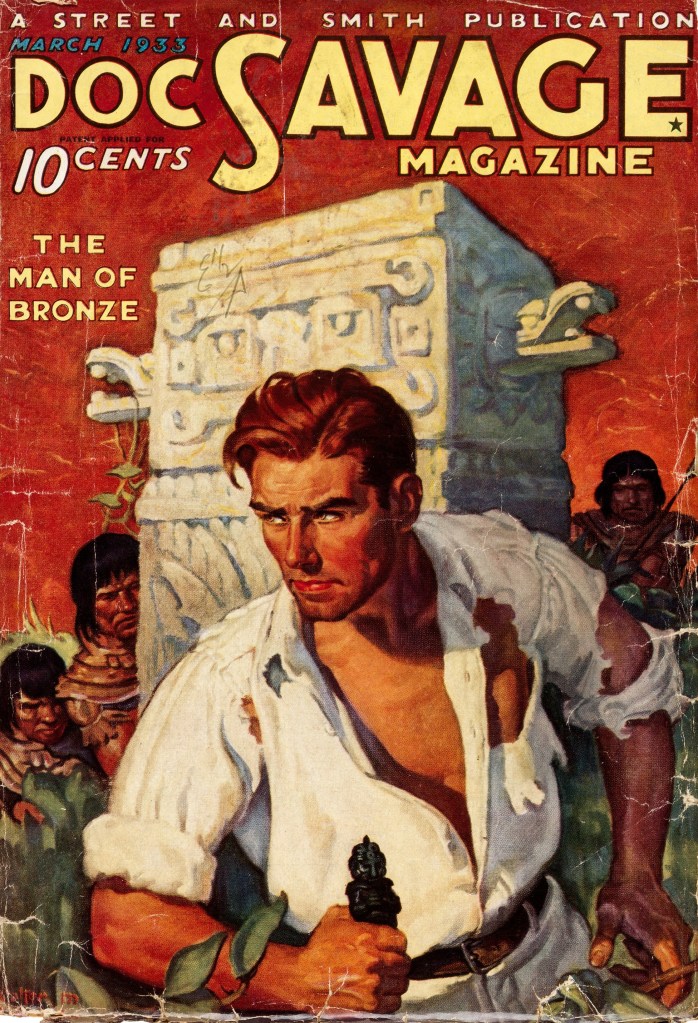
Doc Savage #1, Street and Smith, 1933
Then came a change. World War II altered the paradigm of national zeitgeist, and though many marvelous stories passed through the Doc Savage magazine across those years, Doc himself grew into more of an awkward fit – the transition from world-shaping and world-saving to an often grim and grueling struggle between nations and beliefs about humanity, shifted the approach of the series. Doc became more human in many ways; the bronze light he had cast through the Depression becoming harder, more flawed, more nuanced.
In the postwar years, that evolution continued. The magazine tried to adapt to a new cultural consciousness, becoming “Doc Savage: Science Detective”. Again, the sophistication of the stories increased, but the attention of the reading world was fading. By 1949, the original run of stories was done.
As Chuck observed, for many characters that might have been the end.
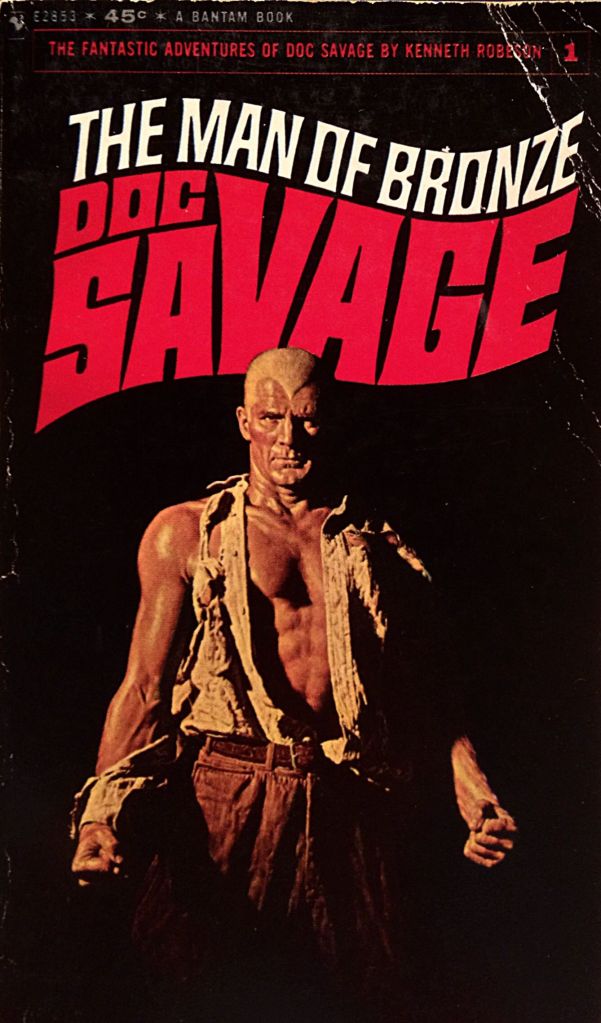
In the 1960’s the Bantam Books reprints began, and amazingly, Doc became more popular than ever. Part of that was a brilliant stroke of marketing, headlining the books with vibrant, ultimately iconic covers by James Bama. Sales of the paperbacks were in the millions.
Doc Savage #1, Bantam Books, 1964
Why? Nostalgia was a part of it certainly, but time and again I have read comments from older Doc followers, who grew up with Doc in the 1930’s (authors like Phil Farmer and Harlan Ellison spring to mind) stating that they disliked the departure from the “Baumhofer Doc”. Based on marketing from Bantam, which appears in many of the paperbacks, they aimed the series more squarely toward a teenager to college-age audience, and with immense success. But my interest, again, is less in the marketing, and more in the “soul” of what captured the fascination of a new generation (my own generation, as it turns out).
The prospect of visiting what felt to 60’s youth like a more innocent time may have been part of it. As antiheroes began to proliferate in entertainment of all kinds, Doc was a counterpoint – a man who did many undeniably badass things with a good heart, a strong dedication to the little guy, and a willingness to challenge the boundaries of law in the name of obvious human good. Doc’s 1960’s popularity is strange in that regard, and yet not so strange. There is a powerful connection – different from that of readers in the 1930’s, but no less compelling – to ideals of the hippie generation. Basically a sense of being empowered to change things for the better. In that light, Doc shone very bright indeed.
As the 70’s went on, the fervor of both the youth movement and that of readership for the Doc paperbacks began to lose steam. The series was, by the well-researched accounts presented across the years here in the Bronze Gazette and other places, at the brink of cancellation on several occasions. It held on, and even continued into new stories and story ideas discovered in Dent’s papers – adapted and presented by Will Murray as the latest Kenneth Robeson.
I enjoyed all of those. But I think it’s safe to say that a third wave of mass popularity never materialized. In those days movies could spark great interest in an old character, but the 1975 Doc Savage film (again, as noted sagely by Chuck) came closer to killing widespread interest in the character. The choice to adopt a camp tone for the film was (to my mind at the time), disastrous. In the decades since 1975 my feelings about the film have evolved (as have those of the general critical public). Throughout the 80’s and 90’s reviewers who gave starred ratings to films appearing on TV routinely gave “Doc Savage: The Man of Bronze”, a single sad star. That has changed – look at the ratings on Amazon, for instance, and you’ll see them hovering steadily at a much higher level of appreciation. I feel much the same. After being massively disappointed as a 17 year old in 1975, I’ve come to truly enjoy the relentless optimism of the film.
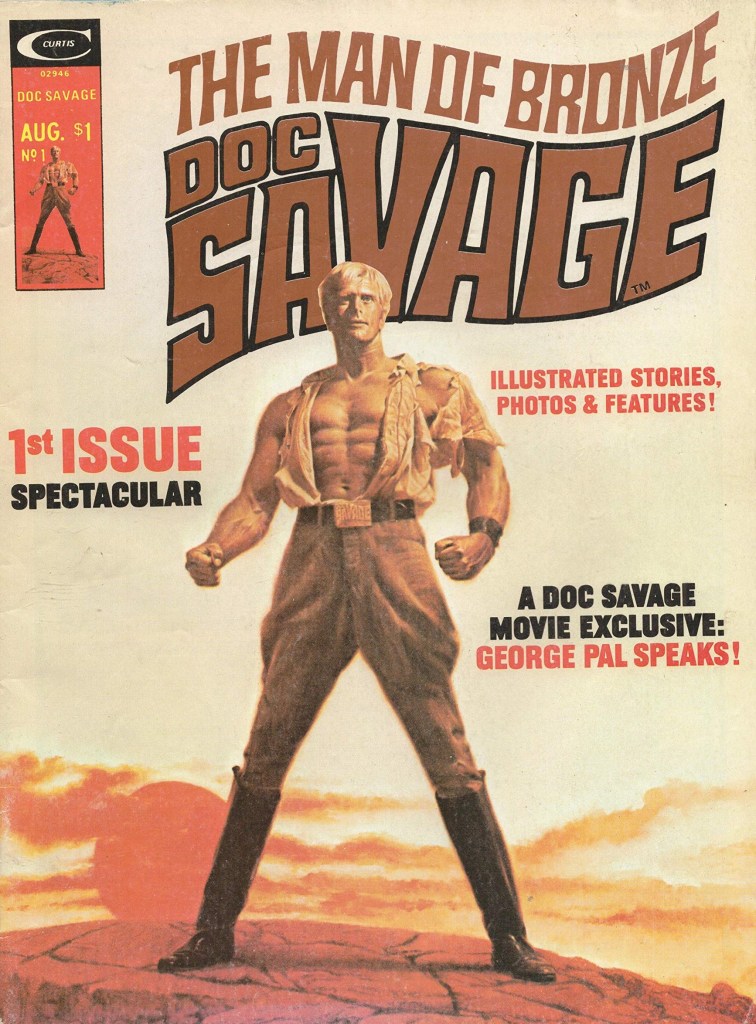
But at the time, Doc seemed done. The paperback reprints were faltering – a fine black and white comics series from Marvel lasted only eight issues, and the proposed second Doc movie (I’ve read one of the script versions of it – written by Farmer – which scaled back on the camp considerably), was never made.
Doc Savage #1, Marvel Comics, 1975
As noted above, Doc refused to die. Through the 80′, 90’s and 2000’s, a number of interesting Doc properties have come and gone. Numerous (short-lived) comics adaptations of varying approach and quality make for a fascinating study of how-to (or how not-to) promote new interest in an old character. They have ranged from straight-up nostalgia to some intriguing attempts toward updating Doc…some with laudable ambition. But nothing really stuck, and those periodic bursts of Doc Comics have begun to feel somewhat strained. None of the great auters of the comics world (innovative writer/artists) have tackled a revival…they have been, to my mind, mostly labored, journeyman efforts. I’ve followed them all (check out the letters page of one of the 1980’s DC Comics Doc Savage/Shadow crossover issues, and you will see a missive from me). Some have been fun, some have been intriguing, while others have been wildly uneven and disappointing.
In the book world, Will Murray has continued his thoroughly enjoyable stewardship of the “Wild Adventures of Doc Savage”…I’ve read them all. They are mostly revisitings of Dent concepts expanded into a much longer many-hundreds-of-pages format, and clearly give great pleasure to Doc purists (of which I am one, though I improbably straddle the fence between love of “pure old Doc” and desire to see powerful modern techniques of writing applied to the character). Those books seem to be winding down now as well. There’s a similar feel in the air to what I imagine was the reader-expectation back in 1949. Are we done?
I don’t expect a new movie (if it ever happens) or TV series (recently floated after the movie stalled) to do anything like explode into public interest and consciousness. It would probably please some fans and tick off others…gain a few new converts, and alienate some older followers.
So what is left? As Chuck’s column asserted, there are the fans. Doc has inspired a unique level of love and dedication in readers, which has kept the character alive (if sometimes on life-support) for nearly a century now. The Gazette itself is a splendid testament by and for those fans. There are several possibilities…it may become, as it has with characters like Sherlock Holmes, a divided landscape of “canon” (essentially the original pulp magazine run) and “non-canon” (stories that try in various ways to capture the thrill and pleasure of those original tales through revise/reboot approaches). As the white-hairs of the Second Wave (hey, wait a minute, I’m one of those hippie-era converts to Doc, how did I end up a “white hair”?) age and pass into the sunset, who will be reading Doc Savage?
As I have throughout these musings, I’ll rest my hope for the future on the soul of the character and stories. The chief reason, to my mind, that Doc is approaching 100 years, is the hope and idealism at the core deep inside the foundations of Doc Savage storytelling. Those are universal qualities, which might wax and wane through trends in the entertainment world, but which never die. They are part and parcel of the human spirit. My hope is that as new “Doc” works eventually emerge, they will be built less from tinkering with the surface qualities of Doc Savage mythos, re-arranging parts, playing with mashups and crossovers, and more from a deep sense of connection to the inspiring elements of hope, courage, adventure and humanity so inherent to both the first and second waves of Savage fandom.
Shining outward from a foundation like that, Doc might indeed be a Man for the Century…and not just the 20th.
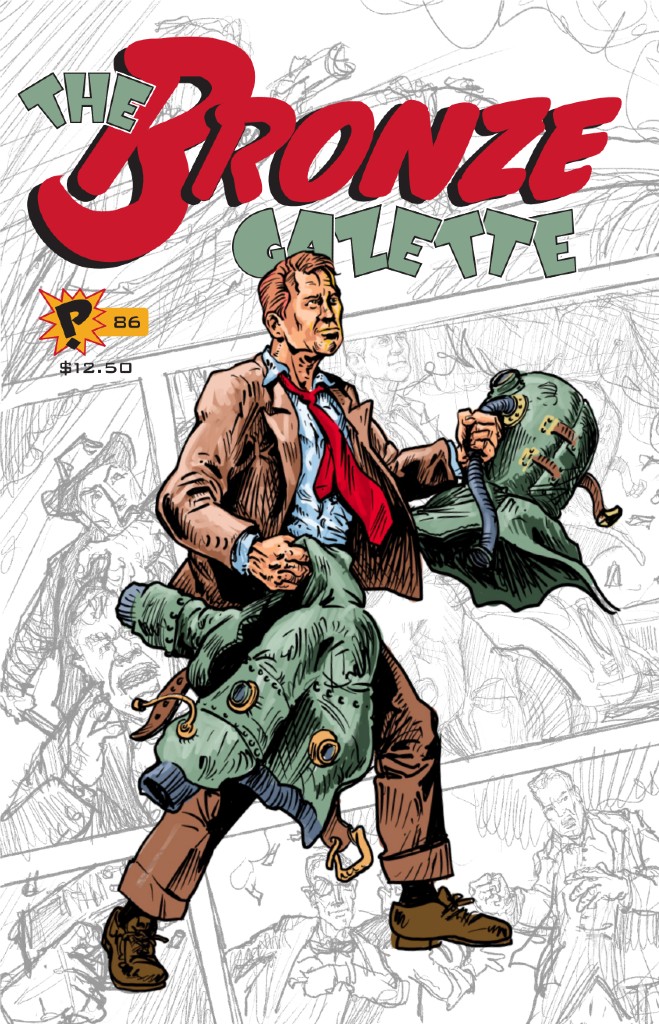
Note: This article appeared in The Bronze Gazette #86 — that issue can be acquired, and other excellent issues of the magazine viewed, HERE.
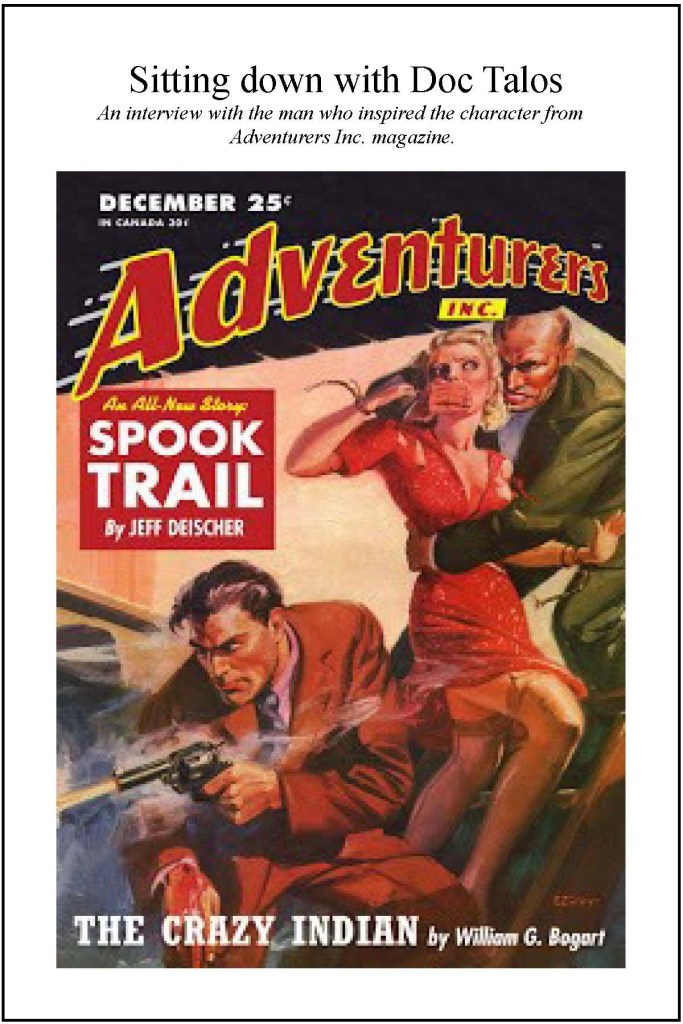
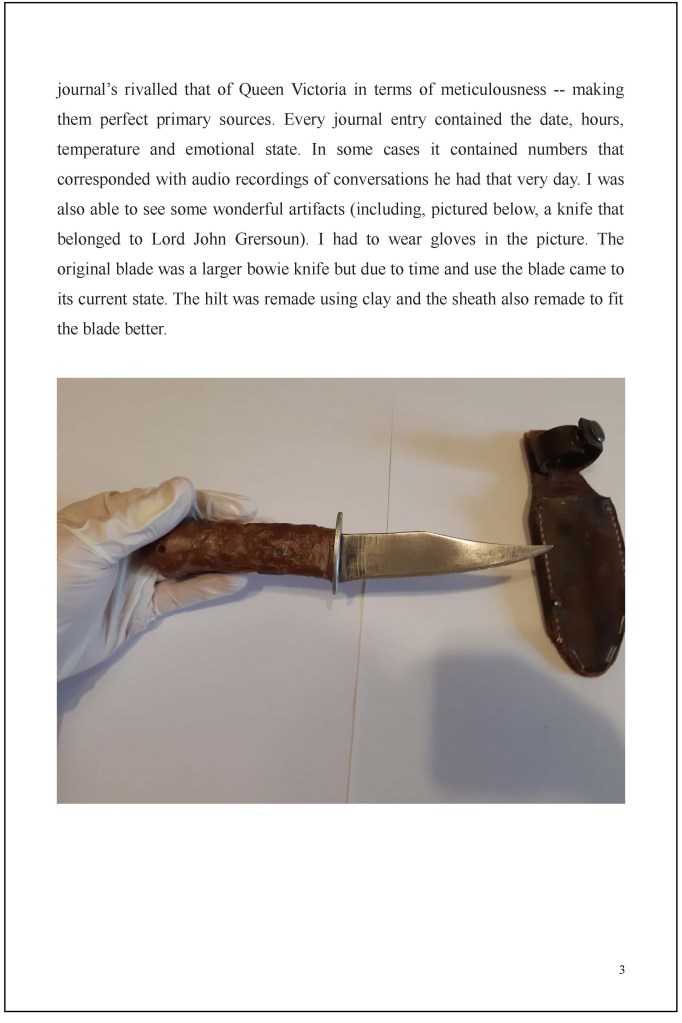
Note from Doc Talos author and contest judge R. Paul Sardanas: Alexandre LeVasseur, a discerning reader of the Doc Talos stories, took an intriguing tack with his contest entry, adopting the personas of both myself and James Talos to craft an installment of a biography/interview. Adding an additional layer even to that ambitious premise, he linked Doc Talos to a pulp character other than Doc Savage, and even threw in some photos of a unique artifact from the saga.
Comment from author Alexandre LeVasseur: My obsession with Adventurers Inc. inspired me to write this bit. Product of a literal hack-job for money by William G. Bogart they are one-off characters with so much unused potential. They represent what is quintessential about the genre and everything bad with it. Meanwhile the Talos Saga elevated the genre like Phillip Jose Farmer did with A Feast Unknown back in 1969. I wanted to combine the two and see what happened.
Additional Note: The Adventurers Inc. artwork used to decorate the title page below was a real publication, but is no longer in print in that edition — however, anyone interested in Jeff Deischer’s Adventurers Inc. sequel to the old pulp story by William Bogart can find it here: LINK TO SPOOK TRAIL (Thank you Jeff Deischer for the link!)
Intimacy, in the lives of most thoughtful adults, is not just sex. It is a vast and complex landscape that includes affection, bonding, friendship, admiration…a whole host of ways that as human beings, we experience the joys (and sometimes sadness) of touching and being touched.
In heroic literature, there are few figures who have a more baffling place within that landscape than Doc Savage. An accomplished, consummately intelligent, handsome man who cares deeply about people, who over the course of the almost staggering amount of novels that comprise the original pulp canon, has almost no intimate moments.
Regarding the sexual side of intimacy, certainly its absence in Doc’s life across the run of pulp novels was influenced (more like rigidly controlled) by the strongly puritanical strictures of Street & Smith management. But even within that framework, allusion is made to the intimate lives of other recurring characters. Monk and Ham are outright “skirt chasers”…and even Doc’s cousin Pat is depicted as attending a party now and then (“The Black Spot”), or having dinner with a member of the opposite sex (“Poison Island”).
Doc, as portrayed in the pulps, is constantly under the admiring gaze of women. But he avoids even the gentlest forms of intimacy. Why?
Certainly a framework of reasons is provided. He apparently never knew his mother, had very little direct life-guidance from his father, and was placed very early into the hands of what appear to have been exclusively male tutors. Shyness is understandably the result…but there are also ample aspects within his history to have mitigated that shyness. Military service at a young age (and Philip José Farmer explored this a little with a sexual encounter for Doc in his World War I novel Escape From Loki)…a doctorate certainly acquired in a collegiate atmosphere…and of course the countless adventures (he is, after all, over thirty years old at the time of The Man of Bronze) in which he encounters women of all types and personalities, many of them stunningly beautiful and clearly attracted to him.
The stock response to this absence in his life in the novels is that his life is too dangerous to have a romantic relationship. Okay…but as noted, Monk and Ham had no such compunctions, and they were in on virtually every dangerous escapade. Was Doc gay, and in the closet? A not unreasonable conjecture, given his male-centric upbringing and male companionship in adult life. But not even the slightest hint is given of this. Was he, like another character with a long canon of stories — Sherlock Holmes — apparently uninterested in sex and intimacy altogether? He doesn’t give that impression…no indication of simply having low libido or philosophical tendencies toward celibacy.
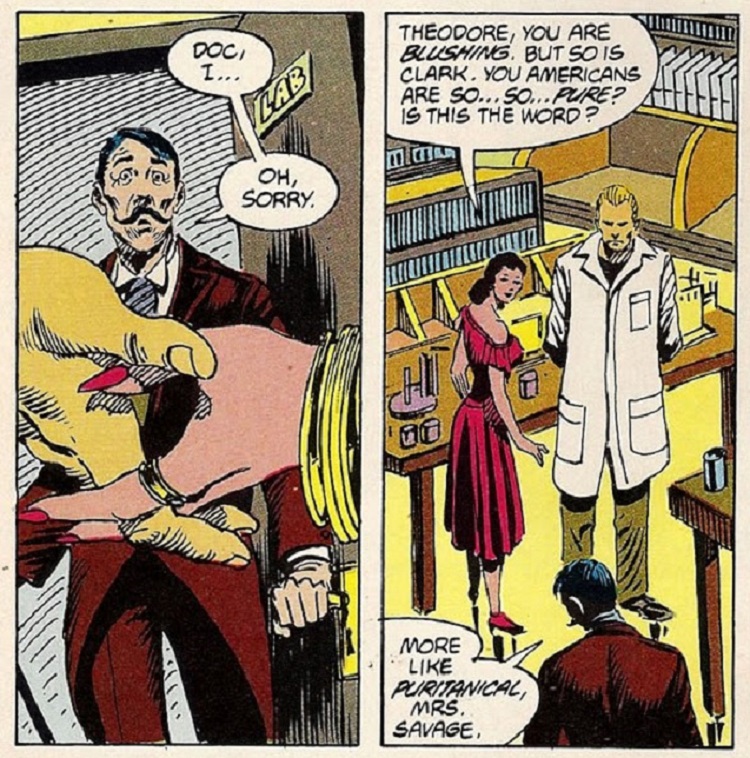
More likely, he was simply very private. This sequence from the DC comics Doc Savage miniseries The Silver Pyramid perhaps captures this as well as anyone has…keep in mind this comic appeared in the late 1980’s, around the same time Doc’s pulp contemporary The Shadow was being unflinchingly portrayed in another DC miniseries (Blood and Judgment, by Howard Chaykin) as openly and graphically sexual.
DC Comics, Doc Savage, “The Silver Pyramid”
In the above scene, Doc is married (to Monja, though in the story she is inexplicably given another name), and Ham Brooks accidentally interrupts them holding hands. Ham’s reaction is rather like what one might expect from someone walking in and unexpectedly seeing Mom and Dad having sex. Everybody blushes, except Monja, who seems to find it charming, but also a little amusing.
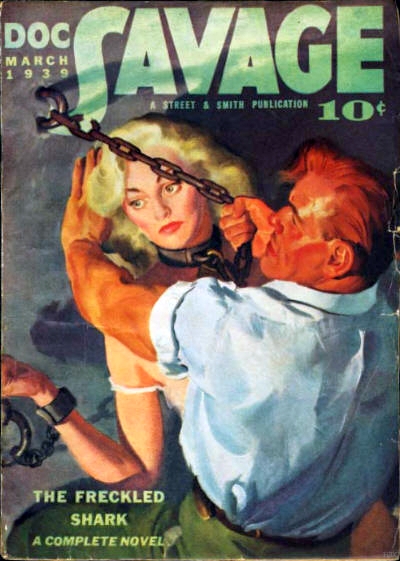
More blatant comedic approaches to Doc’s hesitant intimate life are also present in both canonical pulps and later works…in the novel The Freckled Shark, a good portion of the book takes place with Doc in disguise as a loud, openly and bombastically romantic rogue named Henry Peace, who enthusiastically woos the story’s heroine, Rhoda Haven. Later, as himself, he distances himself from her in frantic haste (the fact that the cover of the pulp chose a scene of Doc breaking chains I leave to armchair psychologists).
The Freckled Shark, March 1939
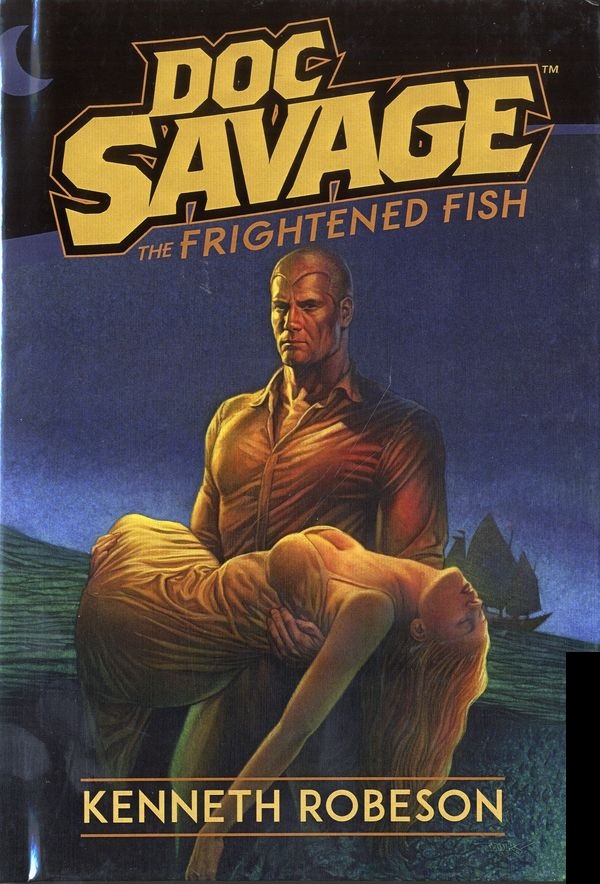
Much more recently, Will Murray’s Wild Adventures of Doc Savage story The Valley of Eternity explores the idea of Doc getting married, but the tone is adolescent and comedic, which to me, seemed a shame. A period piece showing a more mature and nuanced approach to romance in Doc’s life is something I would have greatly enjoyed. Murray did also write a unique take on a romantic connection in Doc’s life — the “madonna-like” Russian woman Seryi Mitroff, who also appeared in The Red Spider — in the novel The Frightened Fish, which I found much more interesting and poignant, as it was played straight.
The Frightened Fish, Moonstone edition
In some ways, Doc’s shyness around women was very relatable to what was undoubtedly the largest percentage of Doc Savage magazine readers…adolescent young men. As a painfully shy youngster myself, I actually found a little comfort in my literary hero, Doc Savage, having the same issue. But I did outgrow that, and somehow I don’t doubt that Doc would have as well.
To be balanced in the assessment of Doc’s intimate life in the original pulps, in later adventures in the 1940’s he no longer seemed to regard women as if they were a mysterious and troubling alien species. One could imagine the Doc of say, 1948 or ’49, actually going out to dinner with a lady and enjoying himself.
I’m glad. Because under it all, Doc really is a good guy, and as deserving of warmth, companionship and passion as each and every one of us is.
Note from Doc Talos author/contest judge Paul Sardanas: Maxine Vega is an old friend from my days of writing dark poetry that appeared all over the odder corners of the web and in obscure SF anthologies…to my mind, her own poetic talent far eclipses mine. When I told her I was running a fan fiction contest for the Doc Talos saga, to my surprise, she said she wanted in. Seriously? A devotee of the SF/Horror side of the genre, Maxine knew very little about Doc Savage and his literary pastiches (including mine). She said to send her the most terrifying Doc Savage novel I could think of, and she would write a Talos poem based on it. Without hesitation, I sent her the final novel of the original pulps, an electronic scan of Up From Earth’s Center. Her passionate, emotional/psychological take on it, transferred from the Savage into the Doc Talos world, is undoubtedly one of the most unique — and powerful — creations this contest will produce.
Comment from poet Maxine Vega: A strange and fascinating story, it set off a whole chain of disturbing emotions in me…to wit, about how broken even the most outwardly-together among us may be beneath the veneer, and what Hell might look like to someone who struggles with intimacy. That the original story references the Rubáiyát of Omar Khayyám also got my immediate attention, and led me straight onward (or downward, toward the infernal regions) into Dante. I picked the photo image R. Paul used to decorate the poem, a Rodin. Maybe, in a way, we are all locked in stone and yearning to be free from some form of Hell.
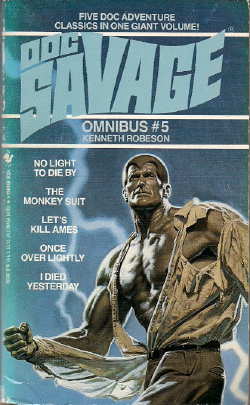
Since I first heard of it in 1973 (it got a lot of attention in Philip José Farmer’s Doc Savage: His Apocalyptic Life, which I acquired in that year) to 1988, when Doc Savage Omnibus #5 was released, the novel “I Died Yesterday” was one of my Doc holy grails. The mention by Farmer that it was narrated by Pat Savage (in her final appearance in the series), and that it featured her own in-depth perspectives on her life and those of the others in the Doc Savage circle, was incredibly tantalizing. I had been a fan of Pat since I first encountered her in the Marvel Comics adaptation of Death in Silver.
In his long chapter about Pat in ApocalypticLife, Farmer spends three pages discussing the novel (the other novels featuring Pat get a couple of paragraphs at most), and it sounded fascinating. Not so much the plot — which is marginal — but the opportunity to see her with a depth never before approached in the series.
So I did indeed search for the story for fifteen long years. Until the Omnibus reprinting the only edition I knew of was the original pulp, and in those days, before ebay and online fan circles and other modern resources, finding the January/February 1948 issue of Doc Savage, Science Detective magazine was all but impossible.
That original pulp, near the end of the long Doc Savage run, was in the era of that “science detective” title tag — digest-size magazines with odd, impressionistic covers. Some of the covers at that time didn’t even depict the Doc lead story. I Died Yesterday was indeed the cover feature, and surreal though it was, the cover image did actually match the story in its quirky way.
Jan-Feb 1948 issue of Doc Savage Magazine
With no chance in hell of finding it, I had no recourse but to wait for Bantam to reprint it. At various points when the Bantam reprints seemed in trouble and faced discontinuing, my emotional response was always the same: “Please, don’t cancel the paperbacks until you’ve printed I Died Yesterday!”
Finally the day came. A wintry day in early 1988, and on the shelf of my most-frequented book haunt of the 80’s, the huge Waldenbooks in Harvard Square in Cambridge, I spotted the gorgeous Bob Larkin cover of the Omnibus.
Doc Savage Omnibus #5, February 1988
I grabbed it, rushed with it to the checkout counter, and barreled out of there to catch the train home. That weekend, my nose did not come out of that book.
As I mentioned, the story itself is pretty lightweight, a bit of eco-crime with forgettable supporting characters and a ho-hum plot. But none of that matters. Because the story, “By Patricia Savage as told to Kenneth Robeson” is a first-person narrative that unfolds through Pat’s eyes.
And that experience is everything Farmer promised. She is her usual headstrong, dynamic, independent self, but with some of the early-pulp gloss of her appearances throughout the Thirties worn down, giving her the feel of more a real person.
When a man appears at her salon, acts very strangely, and sets off the story’s chain of events, Pat feels that maybe she has been coasting on her reputation as a hellcat. When her receptionist Miss Colfax comes to her with the problem (they do not yet know that the man has been severely wounded, with a broken-off ice pick in his back), Pat and Colfax have this exchange:
Colfax lowered her eyes to her hands and examined one of her best ten-dollar manicures. “I think they’re looking forward to watching you throw him out.”
“Who is?”
“The hired help.”
“Oh, they are, are they? And what is behind that kind of anticipation?”
Colfax lifted her head at my tone and said, “You’ve got me wrong…it’s just that they’ve heard about you.”
“What,” I asked, “have they heard about me?”
“Things. About excitement.”
“I see.”
“I’m afraid you haven’t been living up to your reputation,” said Colfax quietly.
I told her that some others hadn’t been living up to their reputation around here, one of them being Miss Colfax, who was supposed to brush off pests. I said I would brush this pest off personally, then we would go into the other matter, the one about maintaining reputations.
“Yes, Miss Savage,” Colfax said.
She wasn’t very impressed, and I thought about that for a minute. Colfax was supposed to be awed by me, even if she wasn’t spellbound by anyone else. Hitherto she had been. She wasn’t now. She was even giving me, her employer, a little of the sass that our prestige-minded customers paid money for. There was just one answer — Colfax was right, and I hadn’t been keeping up my reputation as a hair-raising adventuress, and I was losing standing.
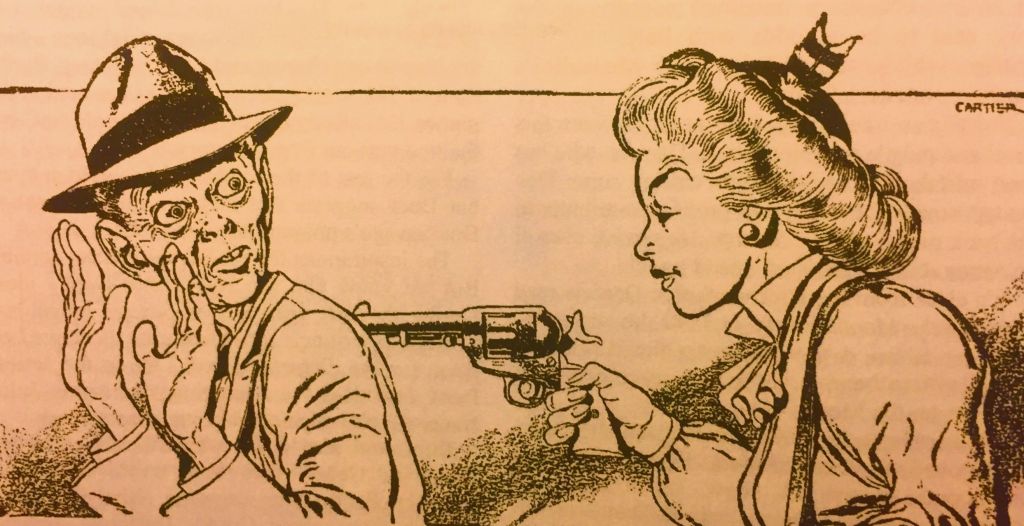
Pat bestirs herself to go deal with the problem, and in short order her hired help get to observe the hair-raising adventuress, as things quickly go from bad to worse and Pat ends up confronting bad guys with her iconic six-shooter.
I Died Yesterday illustration by Edd Cartier
She gets banged up, roughed up, and gives out mayhem as well as she takes it. The criminals end up getting away, and when she returns to her salon her staff — including Colfax — are wide-eyed.
The story progresses crisply — Pat brings in Doc to assist medically with the wounded man, and he tries to shunt her safely off to one side of the developing adventure, as he has dozens of times before in previous adventures. Good luck with that, Doc.
Doc has pretty much given up his famous gadgets, but Pat has collected a virtual museum of them, and loads herself down with the means to inflict untold damage. When she is kidnapped (so she thinks) soon after, she escapes by blowing a hole with some of Doc’s explosives in the side of the truck where she’s been confined.
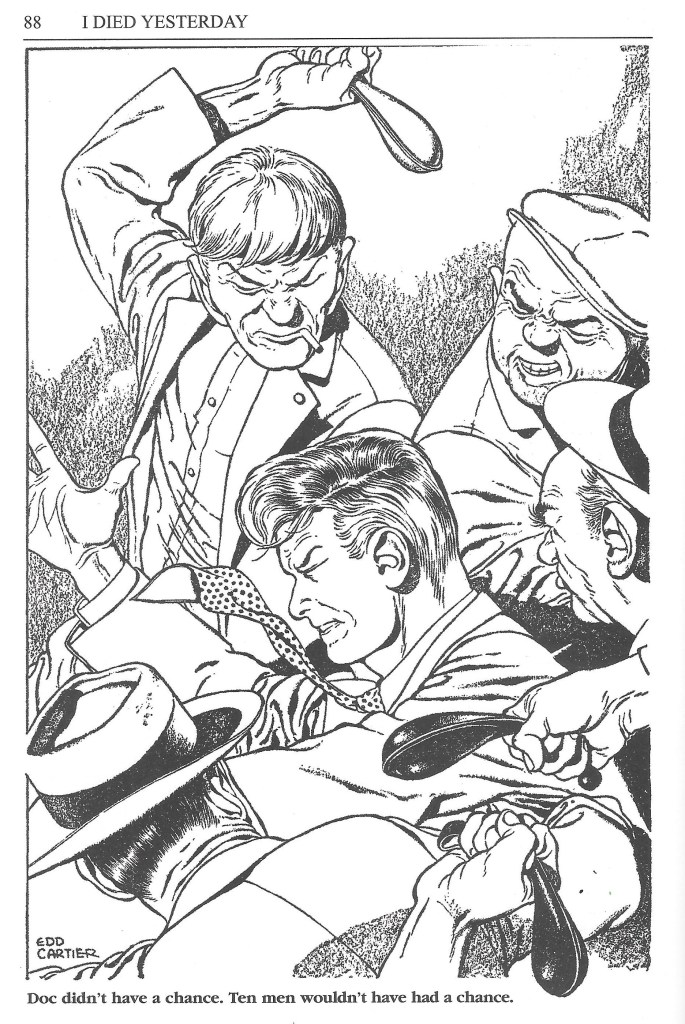
Soon Doc is also attacked, and the scene at the end of Chapter 6 of I Died Yesterday is, to my mind, one of the most intense and compelling I have ever read from the pen of Lester Dent, including the unforgettable line:
The color red was on my hand, and if the color red can get into a scream, it was in mine.
I Died Yesterday, illustration by Edd Cartier
The plot of the story, as I mentioned, isn’t spectacularly gripping…but who cares? Pat comes alive in this novel as never before (Monk is also particularly well depicted…his tough-guy-with-a-soft-heart self immensely endearing…a far cry from the days of “Blazes” and “Howling Calamities”).
Often when you wait a long, long time for something (and as said, I waited a decade and a half to read I Died Yesterday), the actual experience is something of a letdown. Not this time. I still return to this novel and re-read it regularly, delighted to once again experience one of my favorite literary characters, the incomparable Pat Savage, in all her glory.
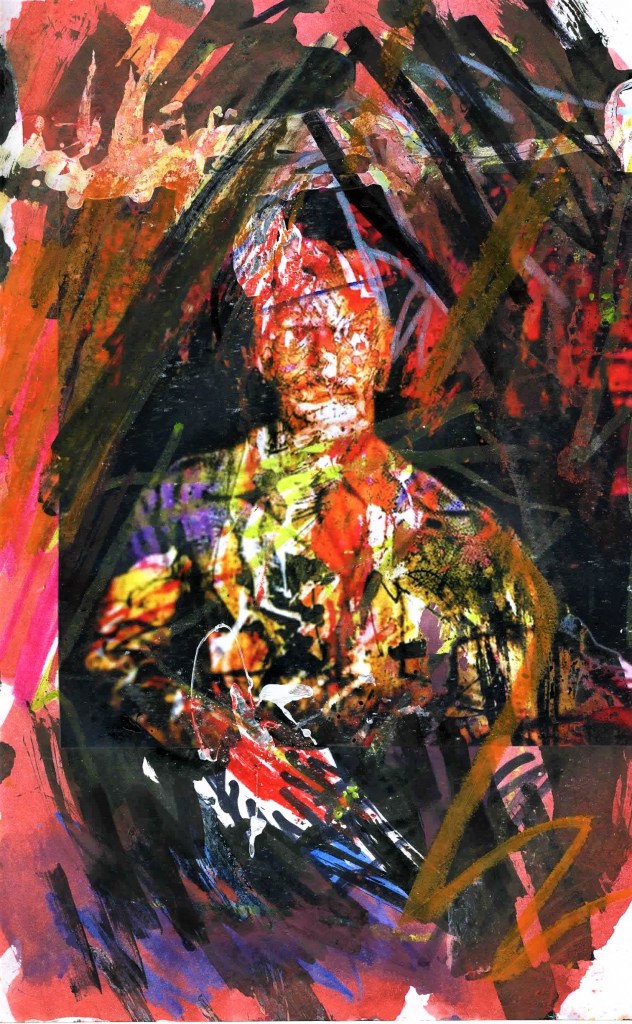
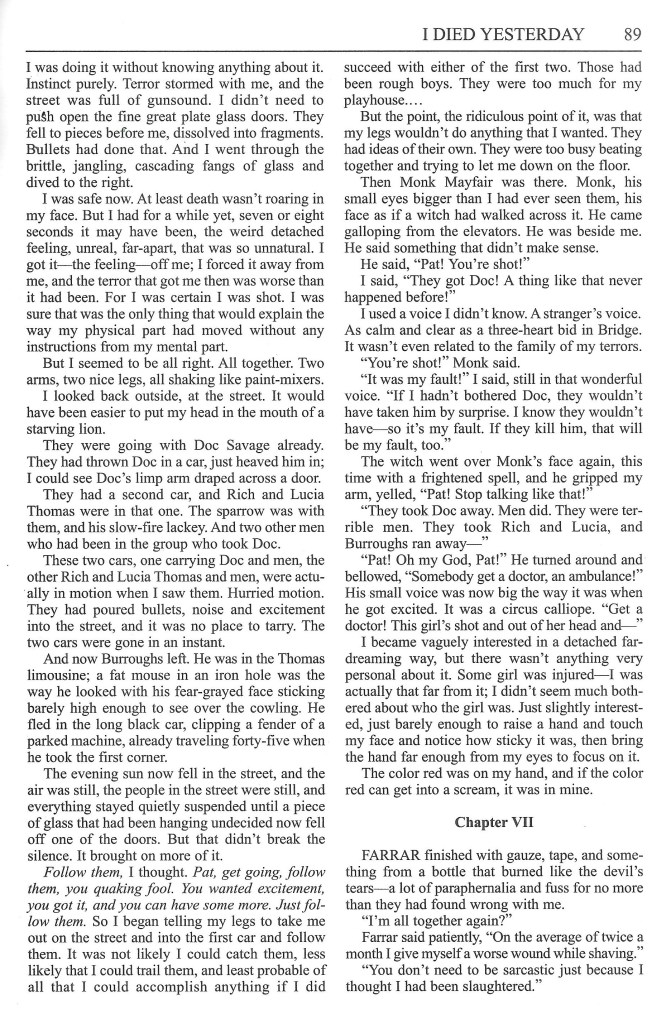
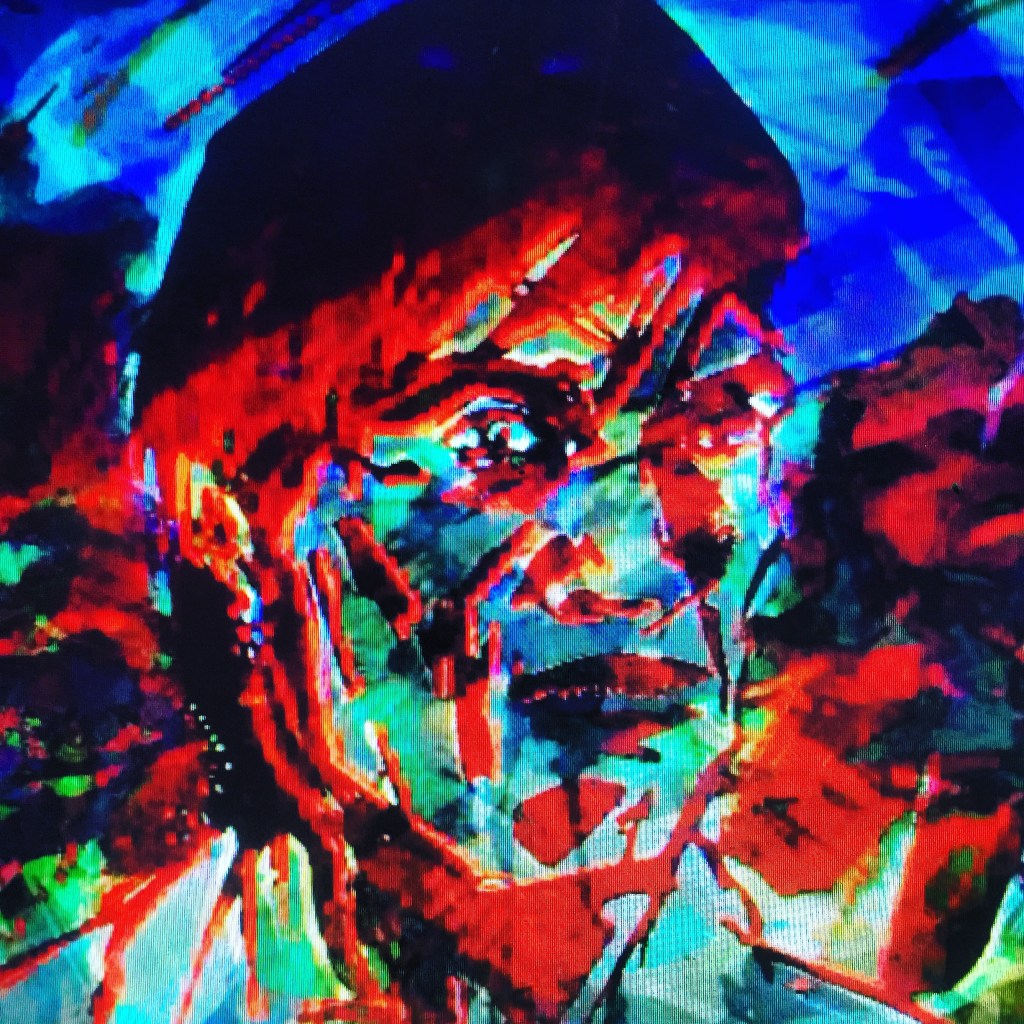
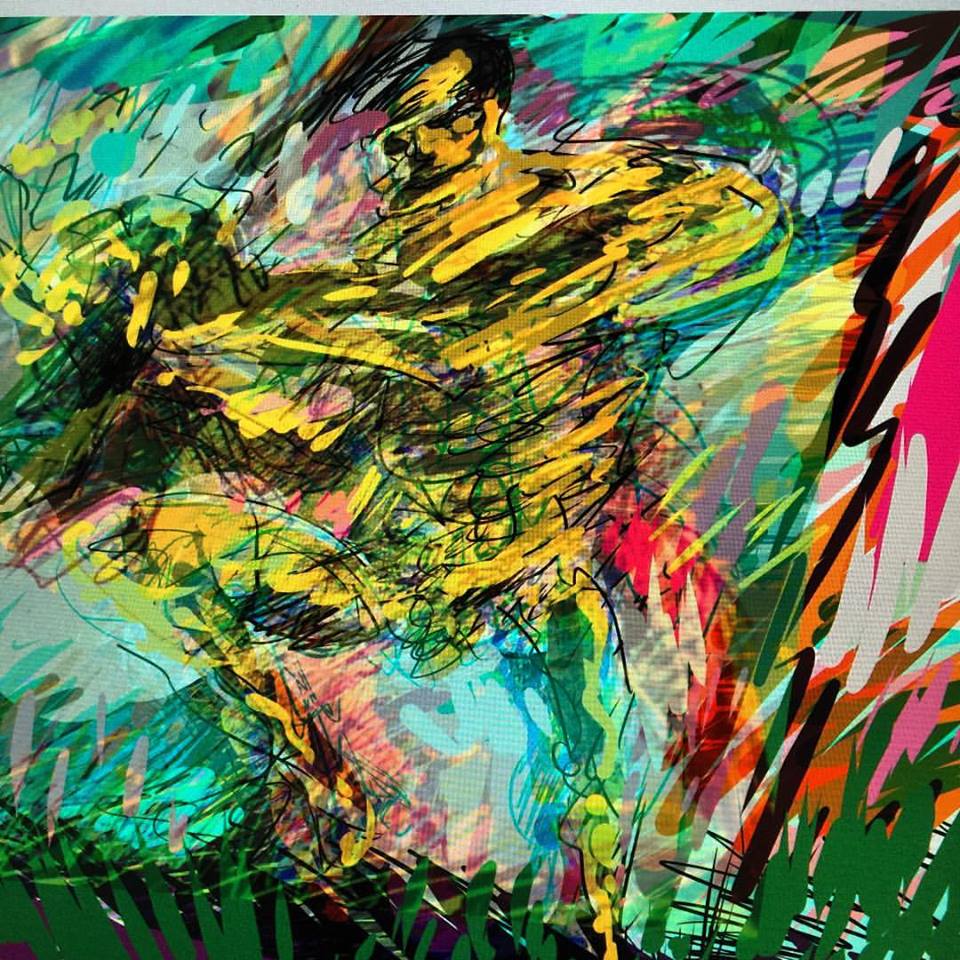
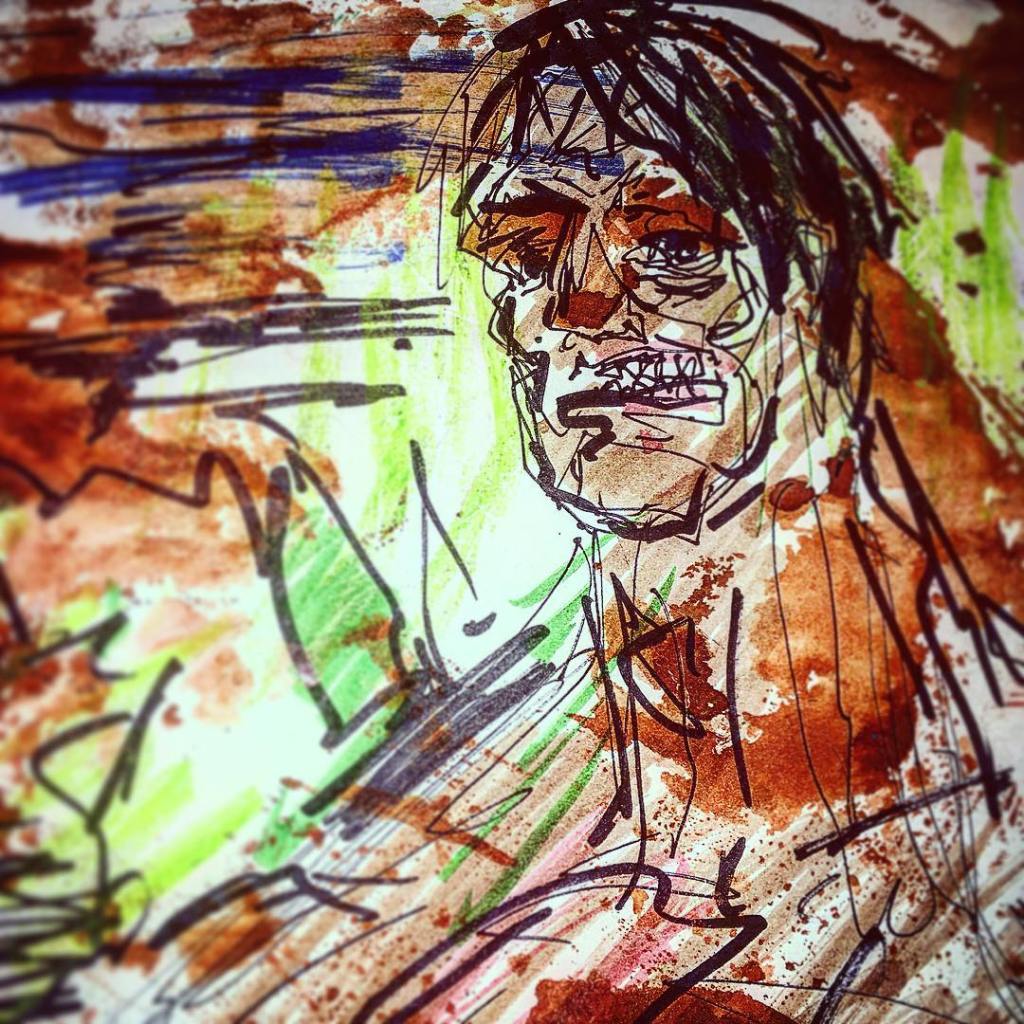
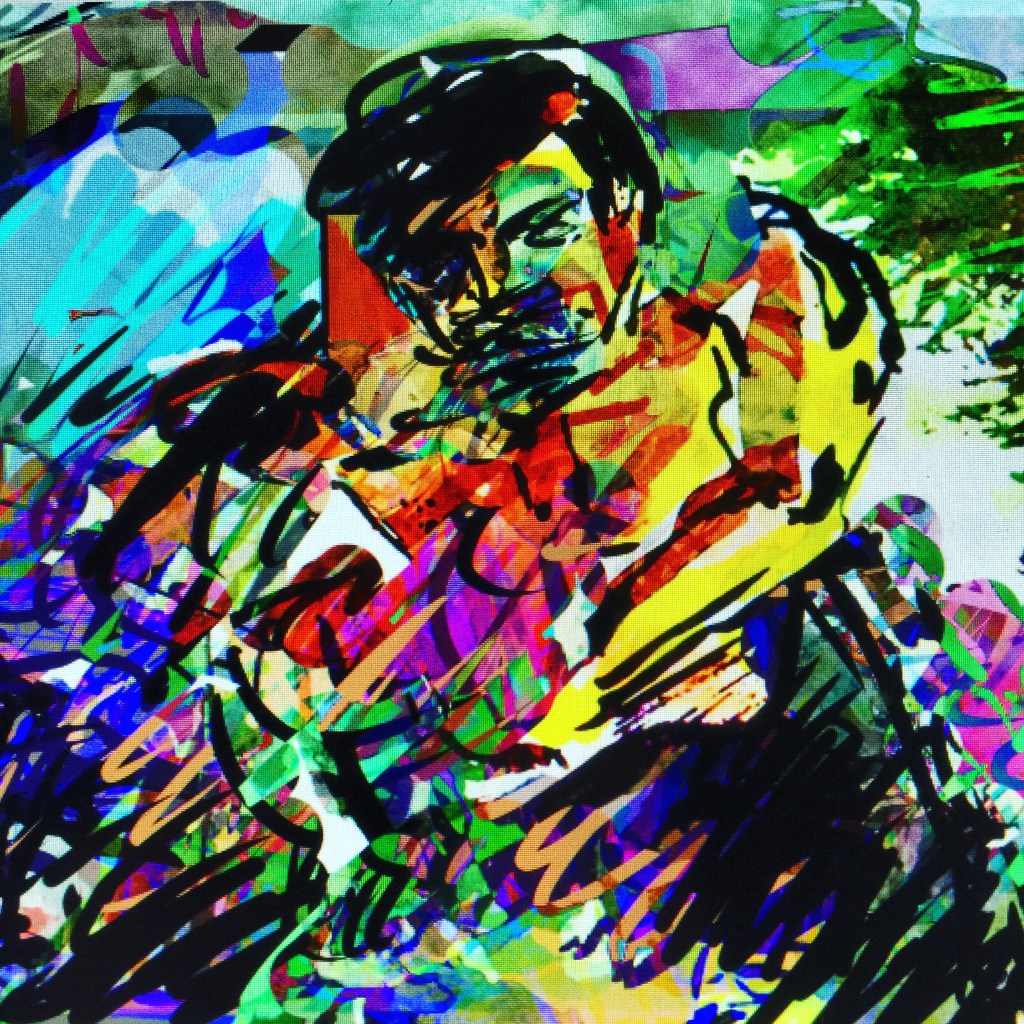
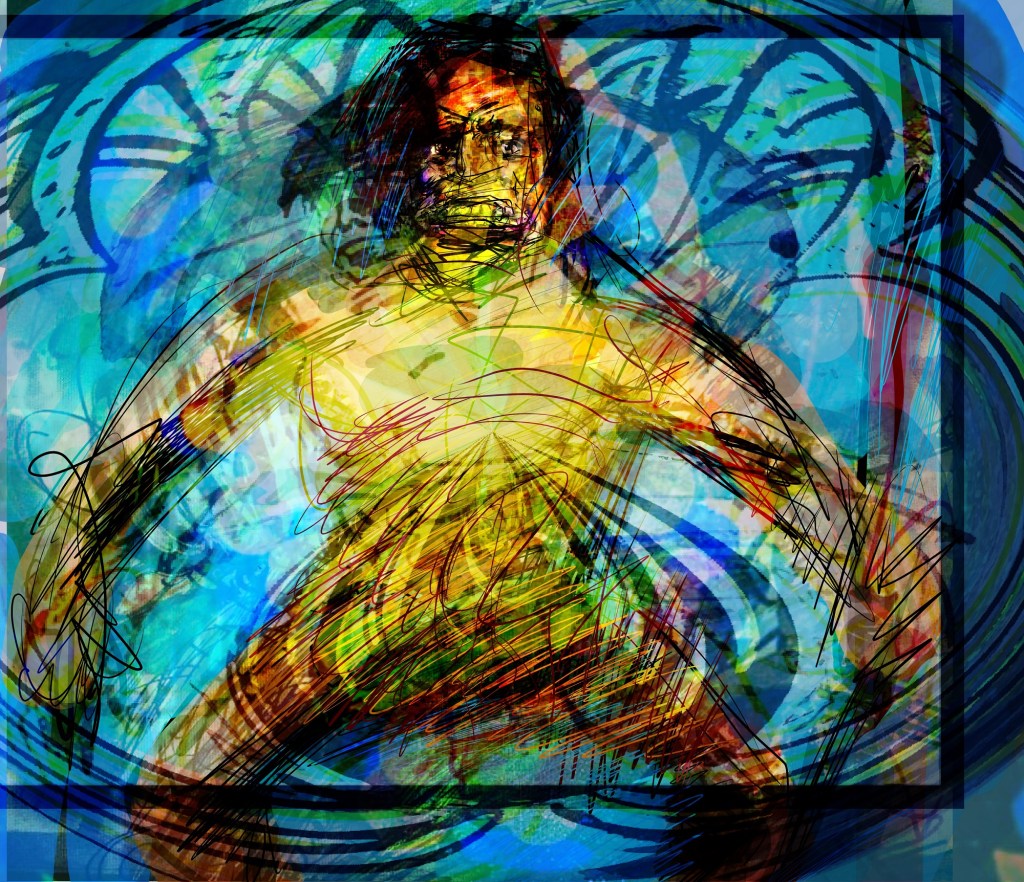
An explosive gallery of art from Iason Ragnar Bellerophon’s sketchbook for the novel Savages. All depict the novel’s Tarzan pastiche, Lord John Grersoun. Abstracts, kinetic figure drawings and portraits…you have never seen the Jungle Lord quite like this.















 Doc Talos