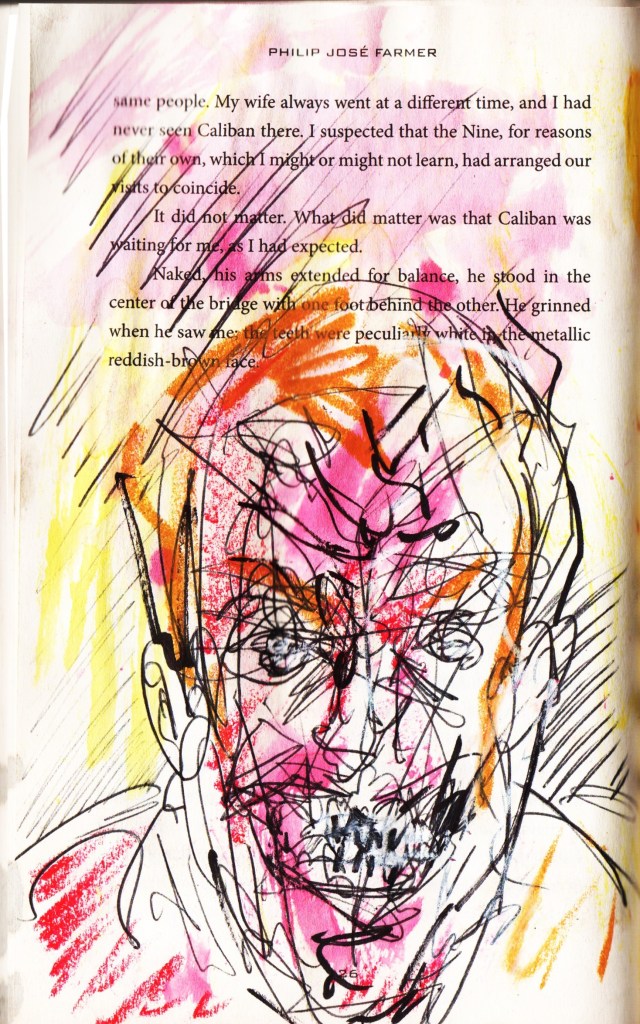
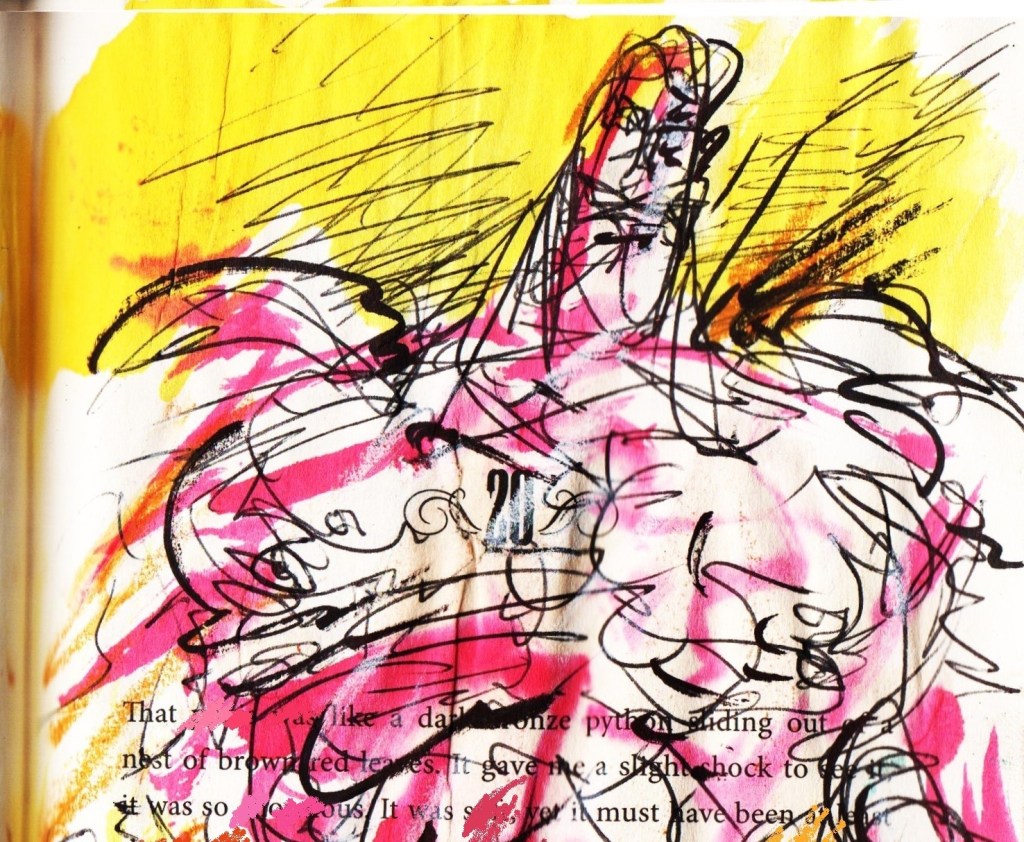
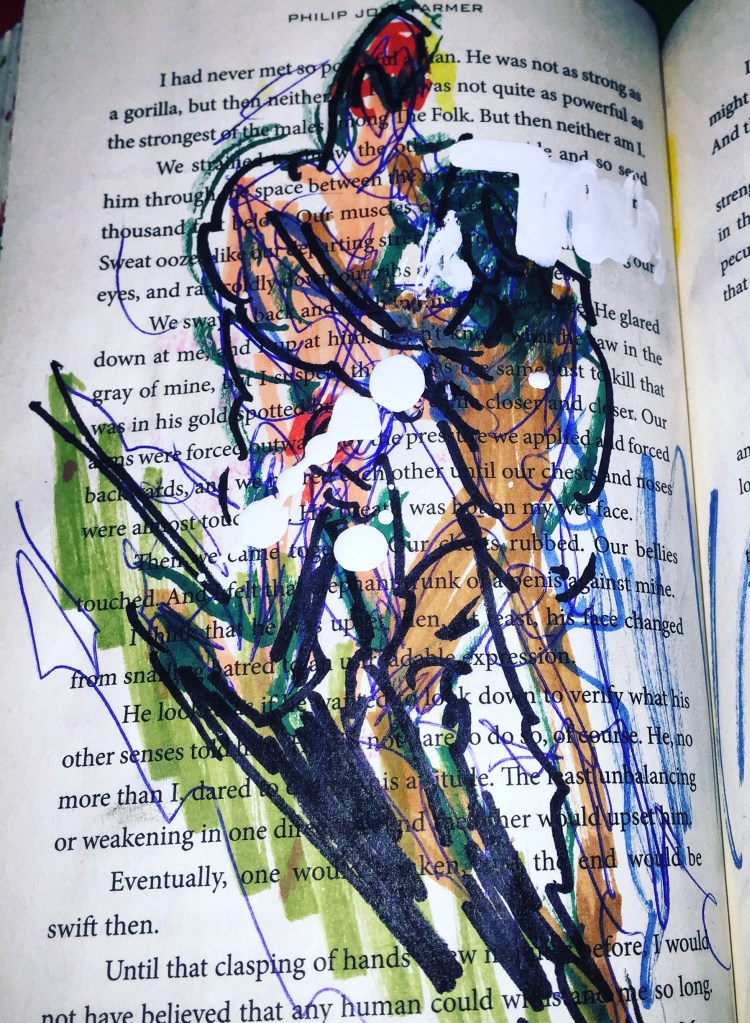
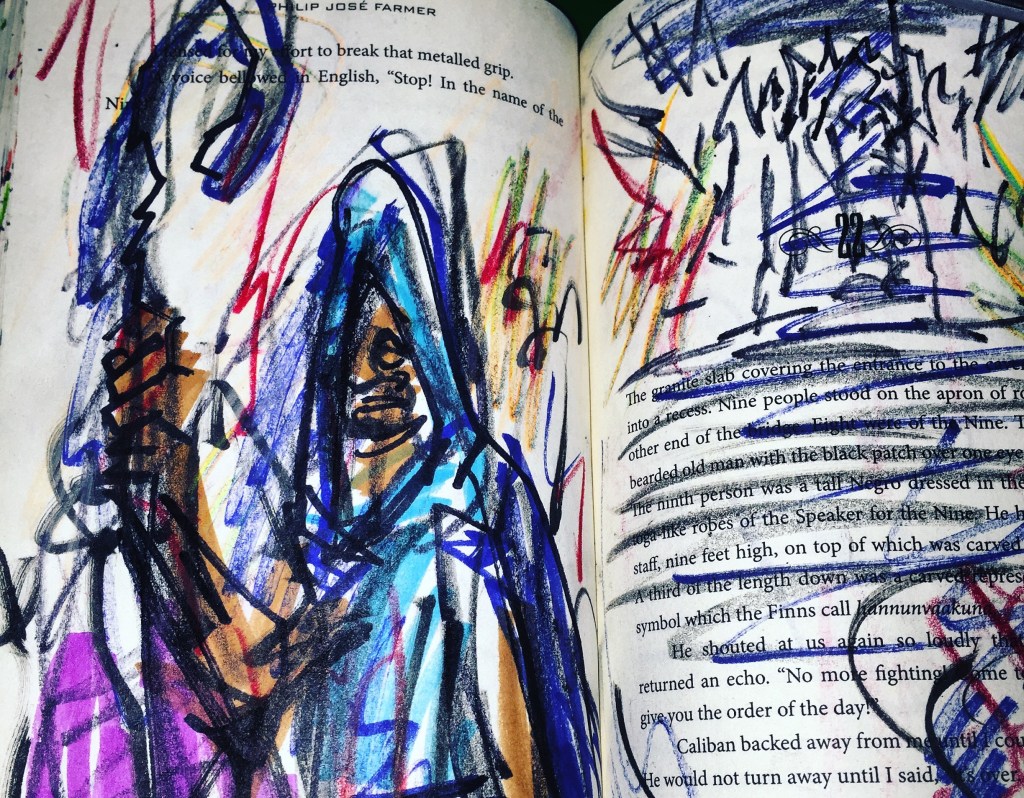
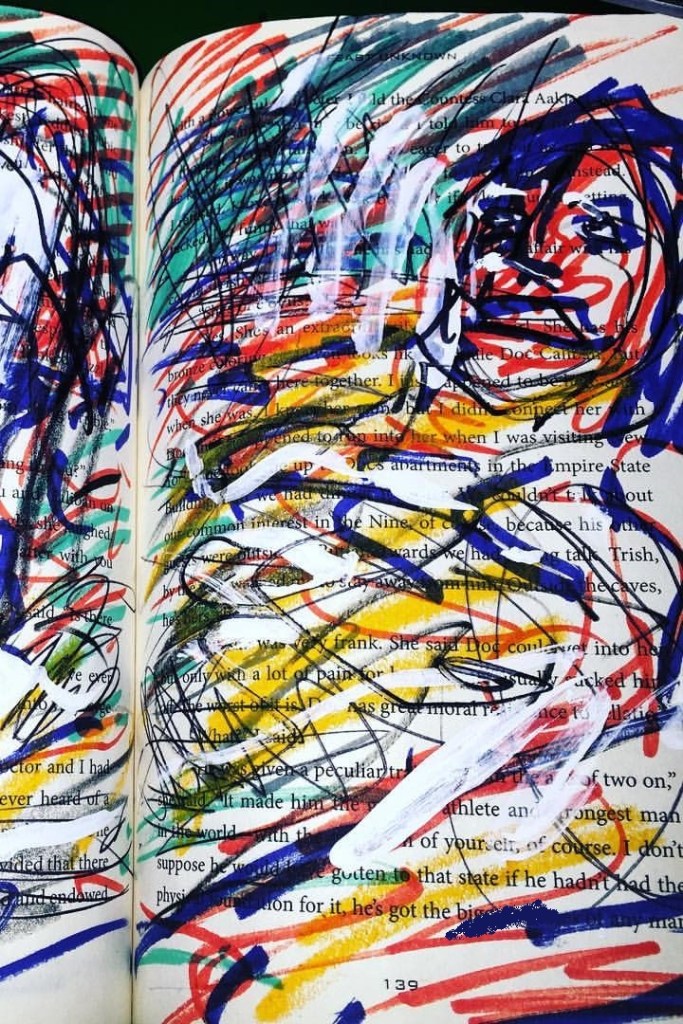
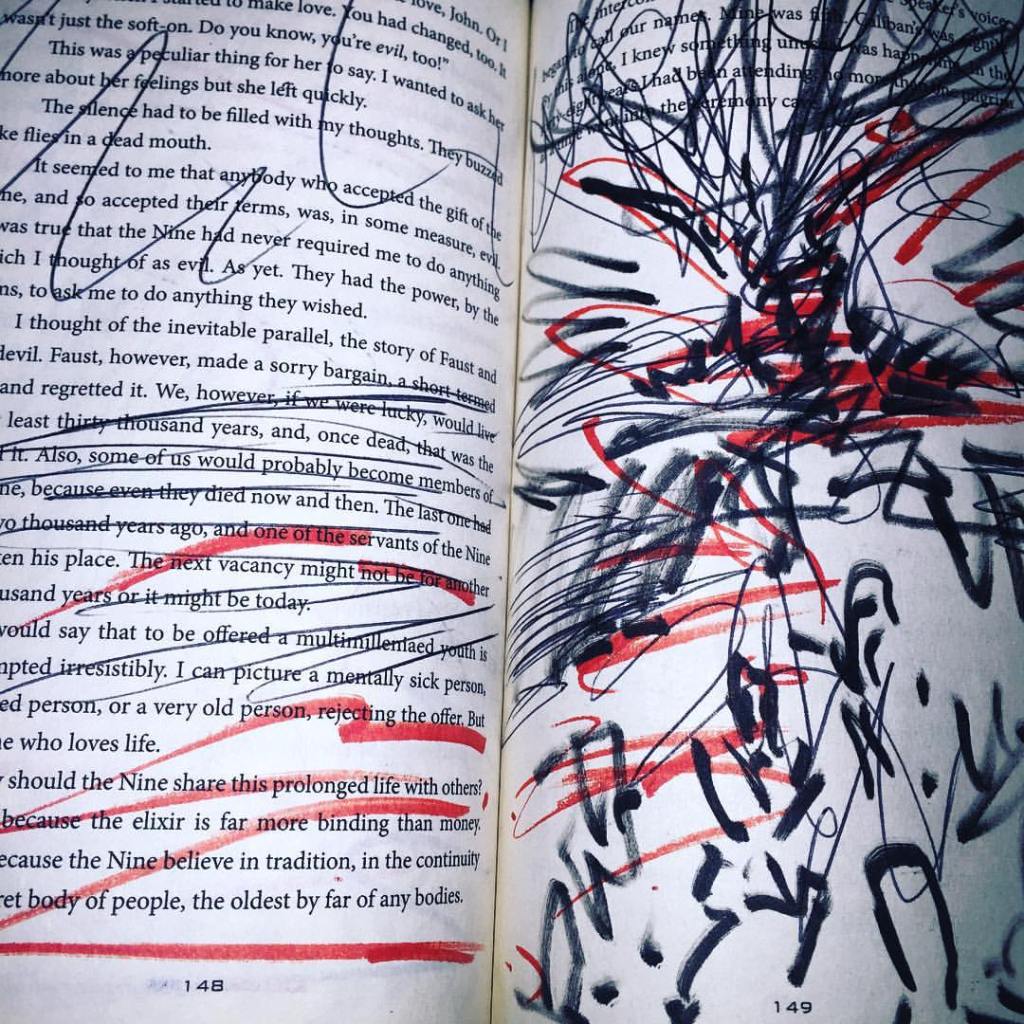
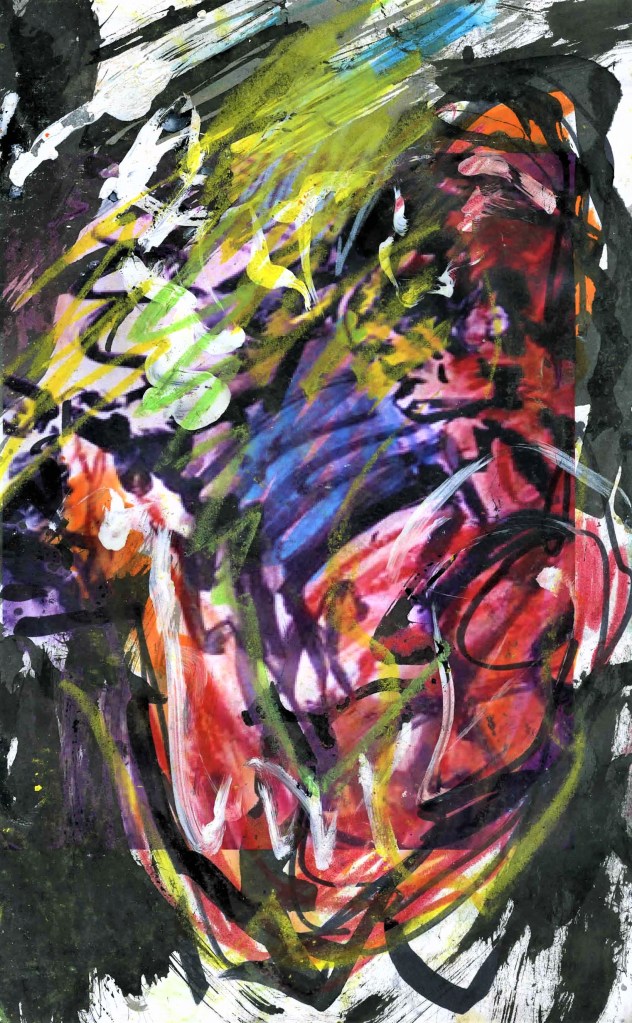
In this month’s earlier blog post, Painting Into Books: The Creation of Readable Art, there are dynamic visual samples of Iason Ragnar Bellerophon’s method of painting directly onto the pages of books. That technique did not begin with the painted books of the Talos Saga. Years before undertaking that epic project, Iason was drawing onto the pages of his personal copies of Philip José Farmer’s adult pulp classic A Feast Unknown. Character sketches, scene depictions…they are hints of the visionary magnum opus that was to come, and are mesmerizing in their own right. Farmer’s pastiches of Doc Savage and Tarzan, Caliban and Grandrith, literally burst off the pages.
Enjoy this unique look into the intense, visceral world of A Feast unknown.
Note from Doc Talos author/contest judge R. Paul Sardanas: A great way to kick off our presentation of the entries in our Doc Talos Fan Fiction Contest! D. B. Brodie’s story captures the ambience of the Talos stories splendidly, and is terrific fun to boot.
Comment from story author D. B. Brodie: I was a big fan of the old Doc Savage comics, and there was this scene in one of them where Pat Savage gives Monk the business by brushing him off to go on a date with a shy and nervous milquetoast character from the story. I always wondered what that date might have looked like. So now with the names changed and style made a little more adult to fit the Doc Talos universe, it was fun to finally play it out.The title is an homage to PJ Farmer’s chapter about Pat in his book Doc Savage: His Apocalyptic Life.
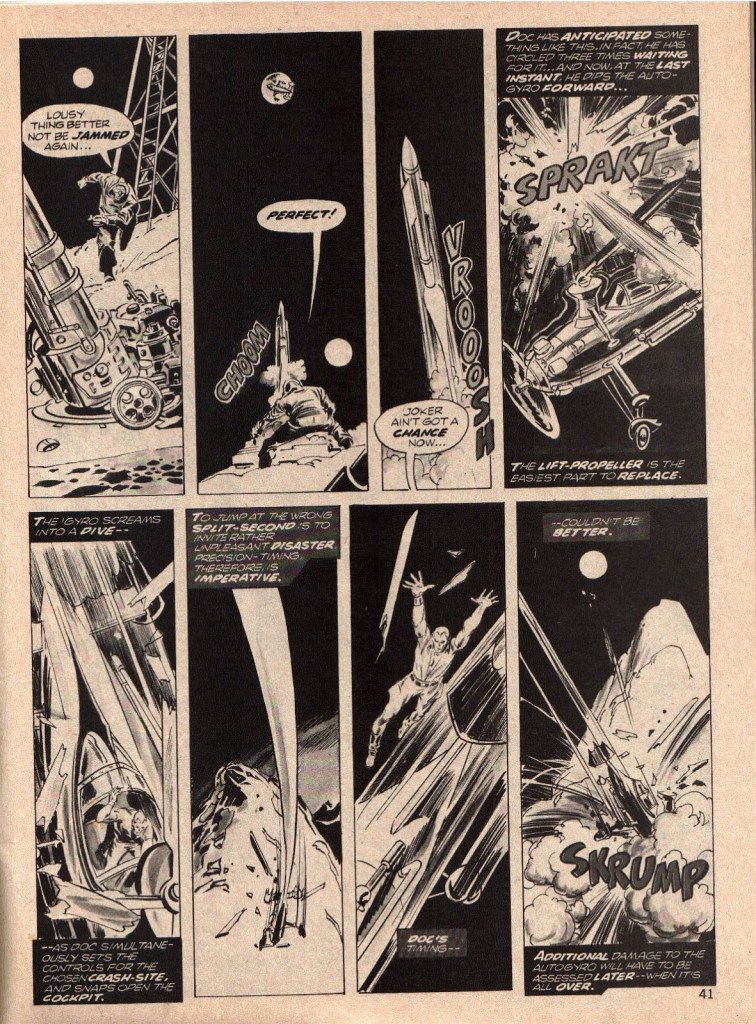
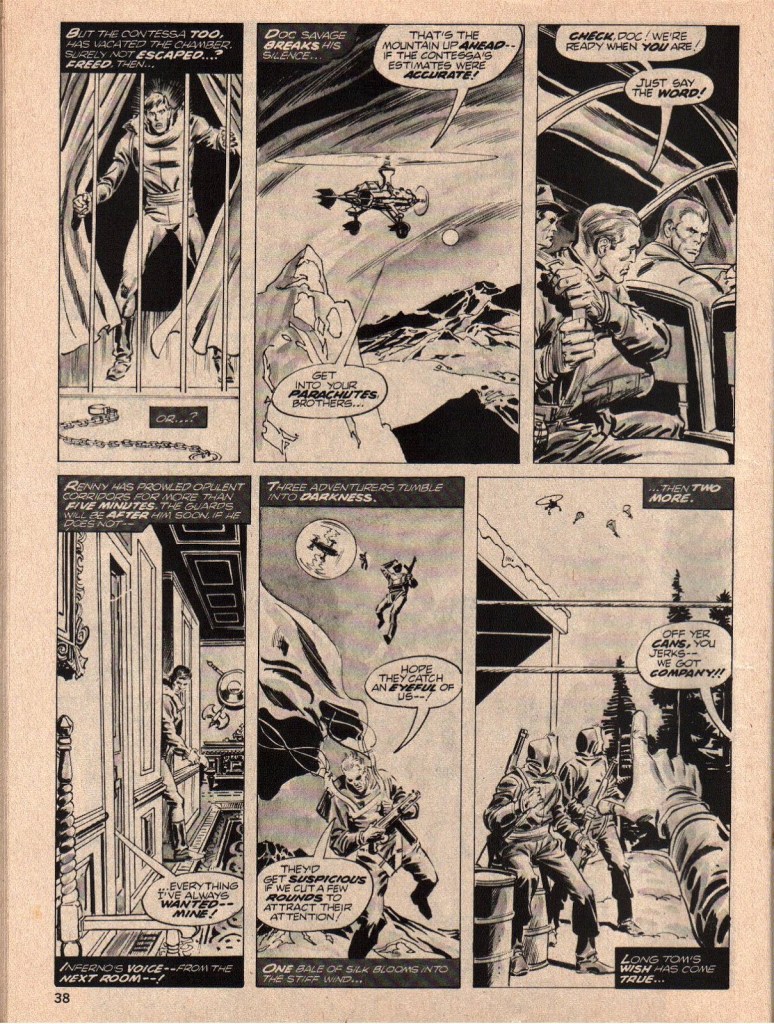
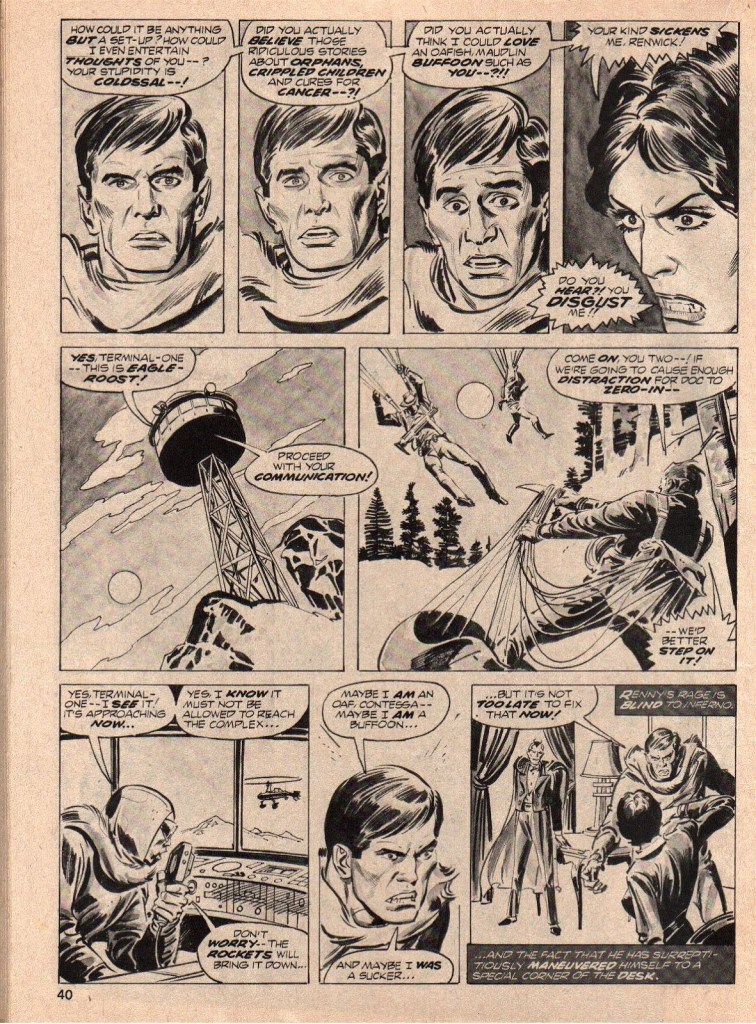
After a masterful buildup, The Inferno Scheme, which appeared in the Marvel magazine Doc Savage #3 (1976) began to unfold its climax. Doc, in the Autogyro, actually wants the mercenaries in the fortress to shoot him down. He has even been circling to make sure they get a clear shot. This (and the clearly-observed parachute drop of Ham, Long Tom and Johnny that preceded it), is meant to precipitate a chaotic fight that will unnerve and panic their enemies. Another nice realistic touch by writer Doug Moench — as the missile is about to strike, Doc tips the Autogyro so the impact will be on the rotor blade…the easiest part of the airship to replace. For the seasoned reader of Doc Savage novels, it’s also a sly in-joke aimed toward the ever-repeating motif in the pulps of Doc’s vehicles being constantly destroyed.
Meanwhile, the three aides begin their assault on the base of the fortress.
From this point on, the action will cross-cut at an intense pace. In the fortress, the Contessa has backed away from the angry Renny, and Inferno opens a trap door under him. Doc’s attempt to crash the gyro with minimal damage has gone wrong, as it has caught fire, both rendering it a total loss and illuminating his position. He goes back for one of his gadgets, a set of skis that will facilitate what turns out to be one of his wildest stunts ever.
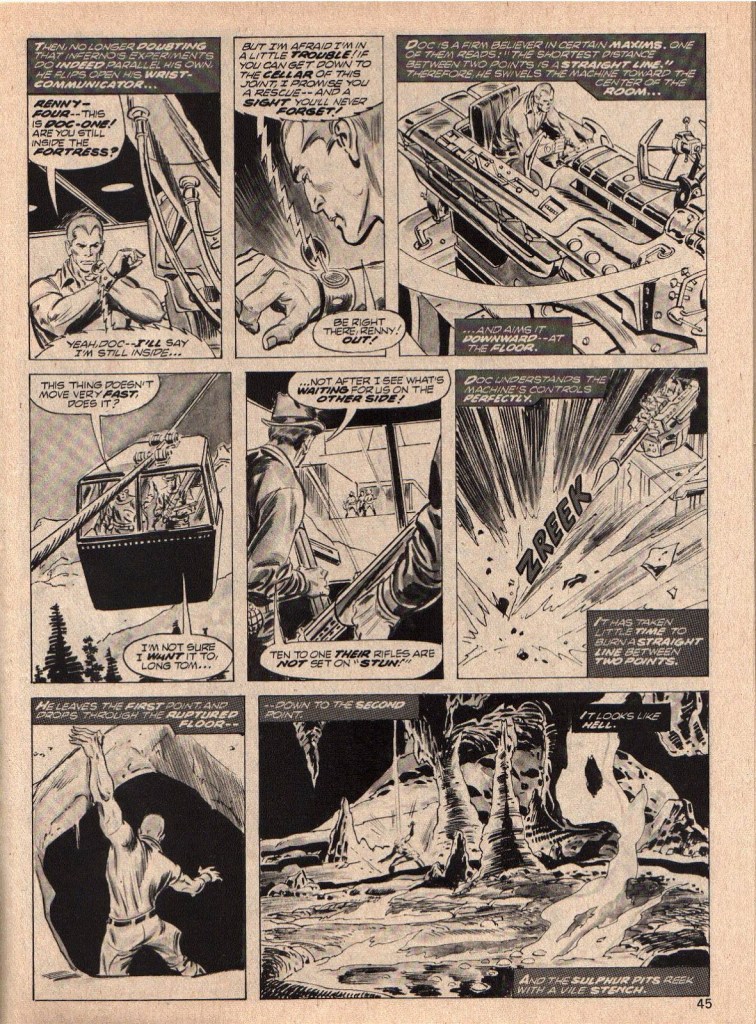
While Doc calmly locates Renny, the cable car with the three aides is going up right into the teeth of the mercenary resistance. Doc, on establishing that Renny is below him, is ever-practical, and uses the Inferno Machine to cut himself a direct path downward.
The fight continues at a fever pitch on both fronts.
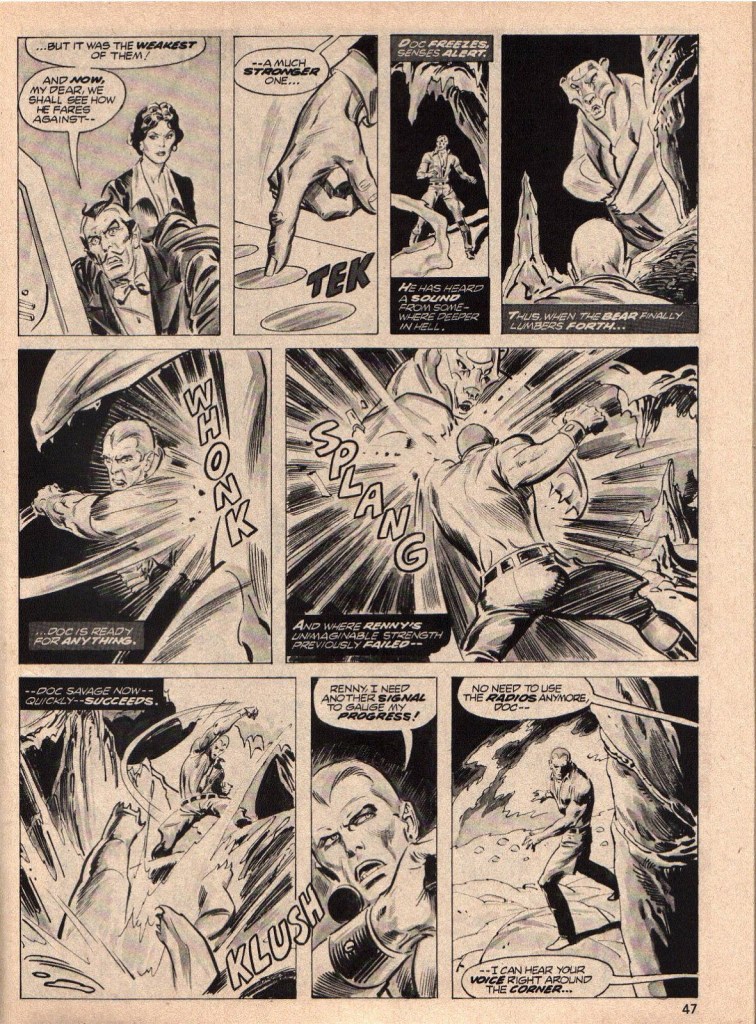
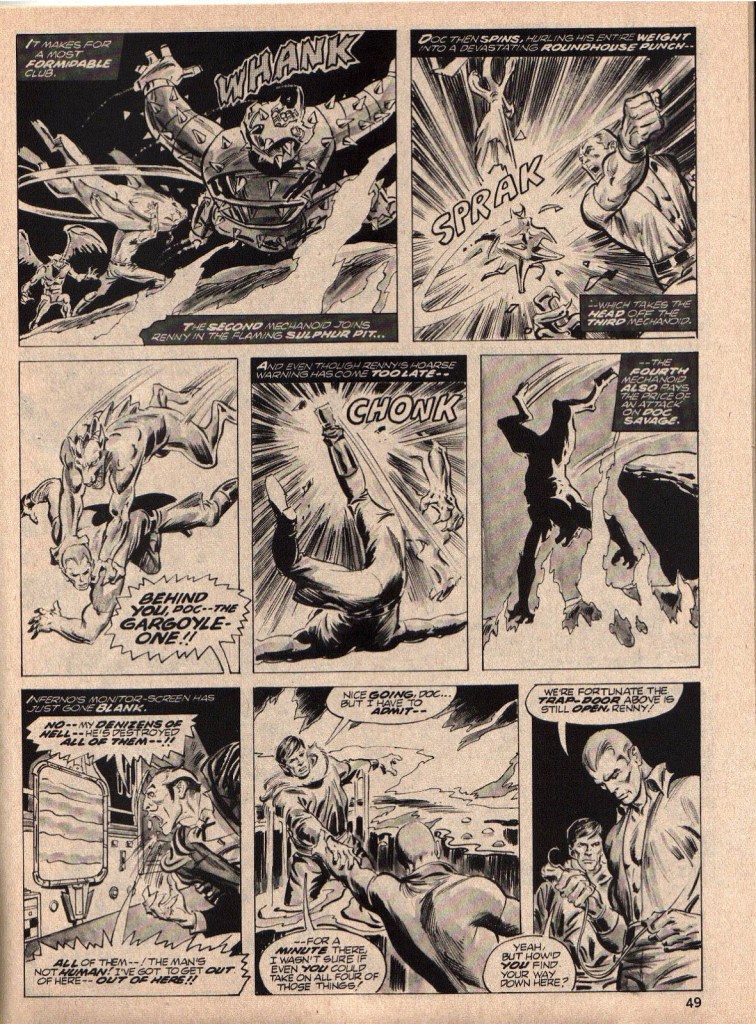
Doc dispatches the automatons, and Inferno, seeing his cinematic vision of hell rather easily managed and dismissed, loses his composure. But it’s not all smooth sailing to defeat the bad guy…Renny reveals that he rigged the Inferno Machine to short out and destroy itself after prolonged use. Doc, unknowingly, came close to blowing himself and everything else to smithereens when he cut the hole down to “hell”. Another realistic touch to the action, tempering Doc’s display of fighting virtuosity by knowledge that he is quite capable of making mistakes.
Inferno, totally panicking, blunders right into Doc and Renny, and he goes down for the count. However the really dangerous villain is the Contessa. She wastes no time in putting the Inferno Machine into action. Interestingly, Renny does not say a word about her betrayal, but urges Doc to help him save her.
The Contessa, wildly destructive and vindictive, refuses to listen even when Renny shouts that he has shorted out the machine and she is in terrible danger. This is actually another sly touch…in the pulp novels it was another repeating story motif that criminals end up destroyed and killed by their own terrible machines. Doc often tries to warn them, but is, of course, ignored. Here it is Doc recognizing the impending consequence of Renny having used the same tactic, and he prevents Renny from sacrificing himself in his frenzied effort to save the Contessa.
All of this elevated a familiar plot device to an unprecedented level of emotion for a Doc adventure.
The final actions scenes are intense and chaotic. Even knowing what is going to happen, it feels like there is tragedy in it, and sense of peril for everyone to the very last.
And the final page hammers home both the final details of the clever “Inferno Scheme”…and its emotional consequences. The narrative hook that introduced the story (which on my first reading, I had almost forgotten amid the mayhem), now closes it…along with a poignant final shot of the usually-stoic Renny shedding a tear.
A unique and engaging adventure, notable for both excellence in its craftsmanship and powerful in its humanizing of characters that had sometimes become caricatures in the pulps…45 years later, this story — and the overall eight-issue run of the Marvel Doc Savage magazine — are still high-water marks of adventure storytelling.
The first and second parts of The Inferno Scheme from Marvel’s 1976 Doc Savage magazine #3, displayed a superb blend of pulp adventure grounded in realistic touches, and unexpected character development. Sophisticated storytelling techniques blended with straightforward actions scenes seamlessly. But would the creative team of Doug Moench, John Buscema and Tony DeZuniga continue to successfully walk that tightrope of excellence? As a follower of many Marvel productions in the 1970’s, I had noted a tendency for ambitious storytelling to begin to unravel as stories progressed. The deadline pressure to produce the comic and magazine line was relentless, and it often took its toll on stories that had started with immense promise. As a reader, a part of me braced for The Inferno Scheme to begin to fray around the edges. But. to my delight…it kept the bar high indeed.
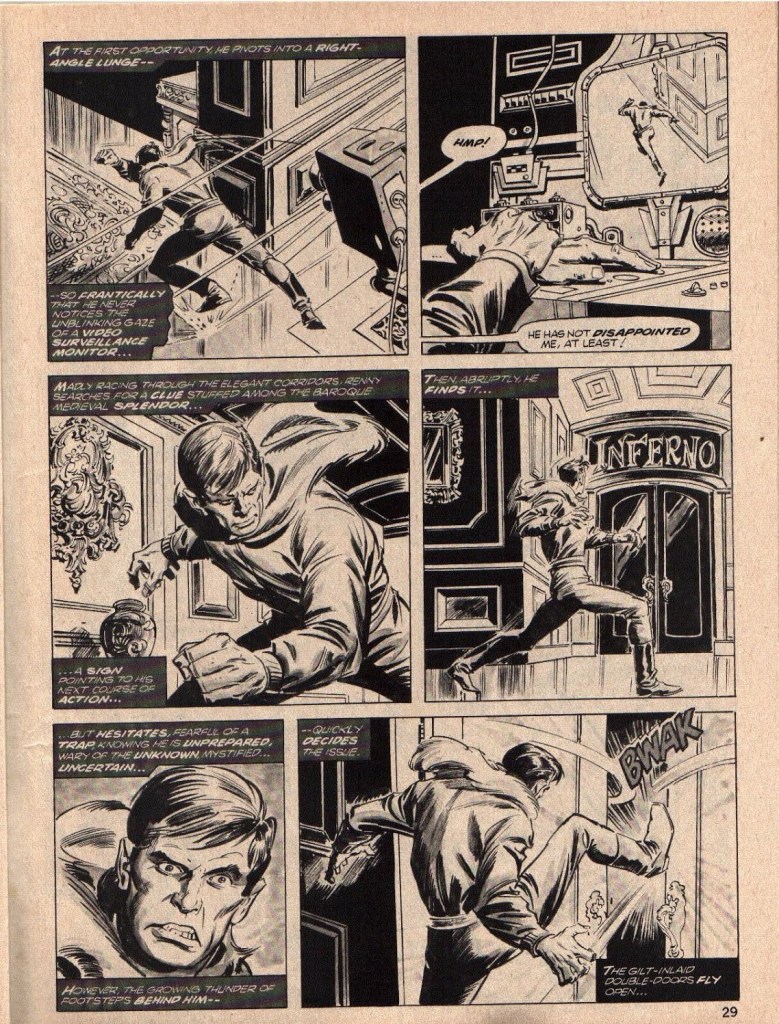
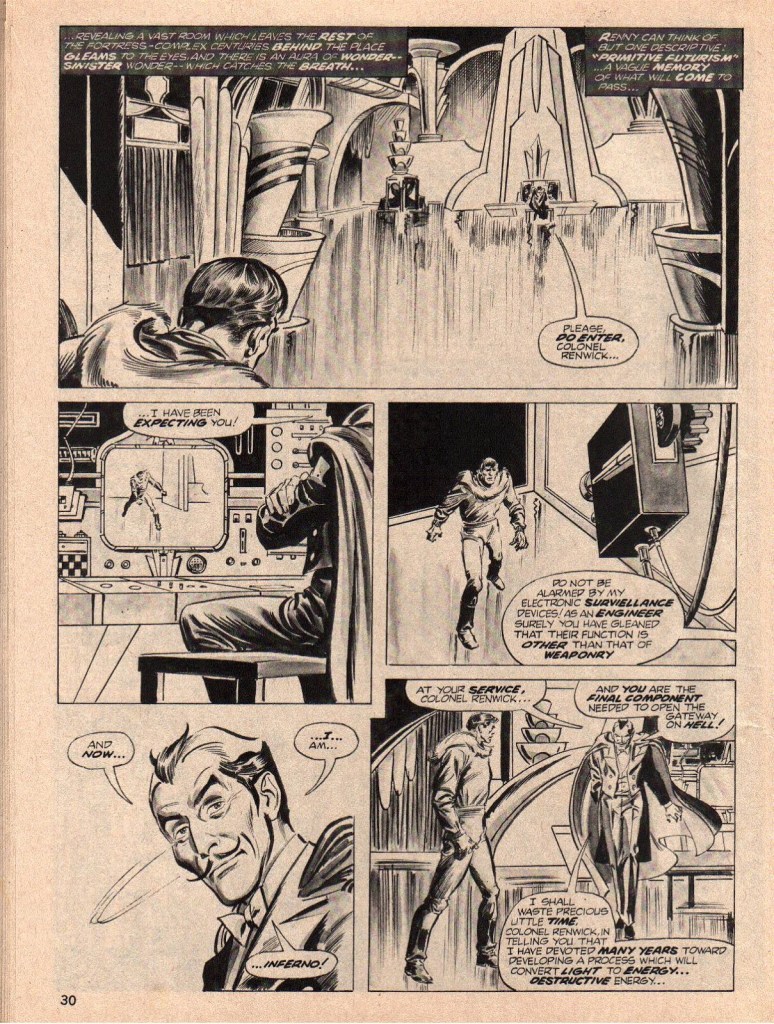
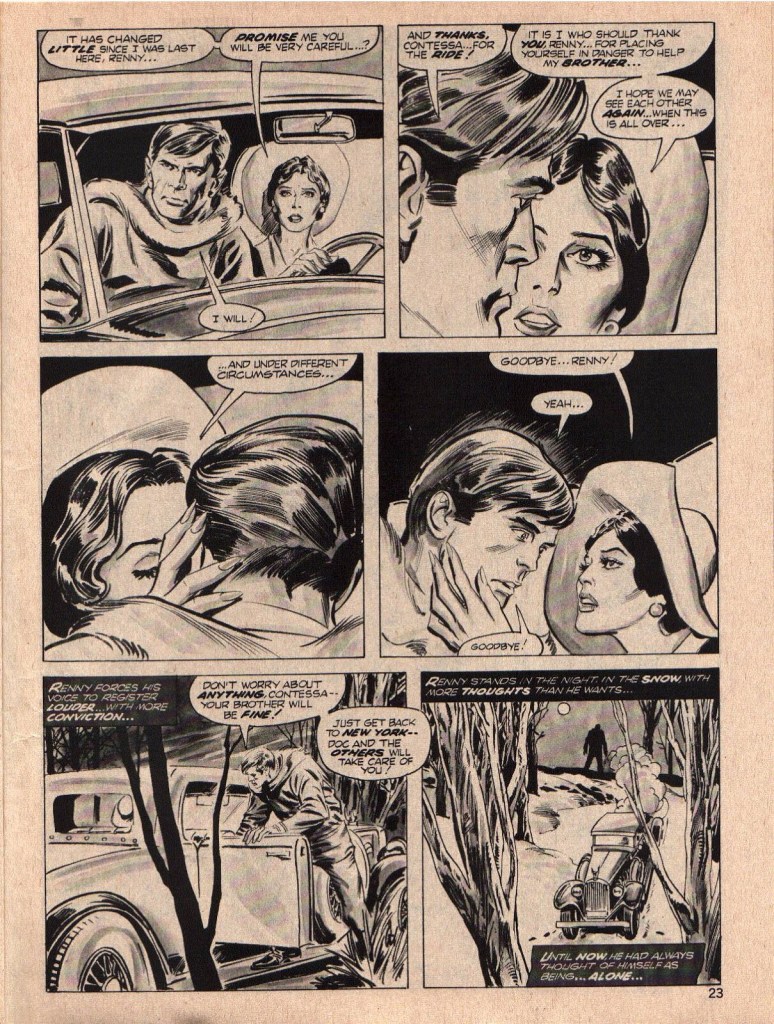
John Buscema, then at the height of his powers in sequential panel layout, puts on a master class with this page. Note that every panel makes an abrupt shift in direction and perspective, long-shot to closeup, POV panel, action starting and stopping to ramp up the dramatic impact. And the panel where Renny, his mind working rapidly to pick up clues to the direction he should take to find the villain, runs right into a huge sign pointing to Inferno’s inner sanctum, is just brilliant. In one stroke, we see the villain’s vanity and hubris on display, and no time is wasted in transitioning a hyperkinetic scene to one that promises some form of awesome vista behind the doors.
And awesome it is. Inferno’s inner chamber looks like an opulent setting from a 1930’s Hollywood epic. The man himself makes every move a dramatic gesture, right down to prefacing the saying of his name with a head turn, a smirk, and not one, but two pauses in speaking his line.
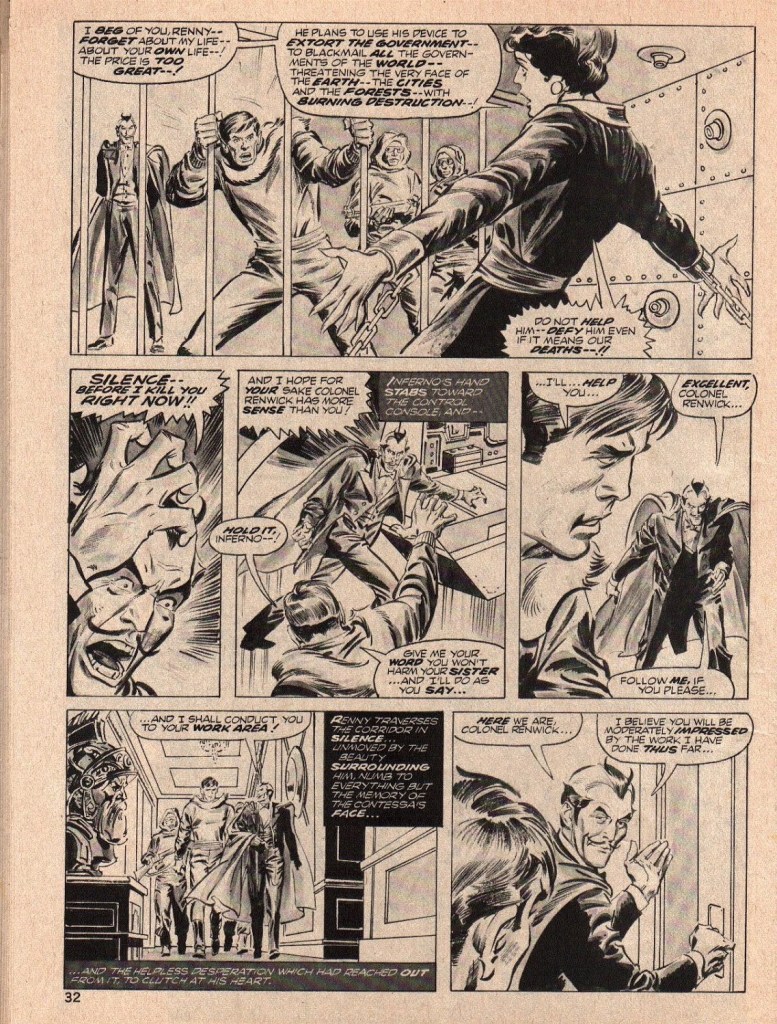
Renny gets threatened, and seems unimpressed, but then he gets an emotional jolt as Inferno unveils (in another dramatically cinematic gesture, with parting curtains), his unexpected hostage. This type of scene can be quite cliched, but I found the sight of the Contessa, chained and surrounded by mechanized guns, to be quite intense. The warmth of her brief but poignant bond with Renny is still fresh in the reader’s mind, and she looks traumatized and vulnerable.
She becomes emotional, pleads with Renny not to give in, expresses willingness to sacrifice herself. His anguish over the scene is writ large on his face, and of course he acquiesces, agreeing to assist Inferno in completing his project.
And so we see the Big Ray Gun…another potential cliche, but it is overshadowed by Renny’s emotion of hatred toward the villain, which at this point the reader certainly shares.
Perfect dramatic point for a scene shift, ushered in with style by looking up the dramatic length of the Empire State Building. The interplay between the aides has a unique feel without Monk present…they are champing at the bit for action. Doc is calm, his every move measured…and off they go in the iconic Autogyro.
More seamless panel-to-panel scene shifts, and Renny once again breaks free, showing competence and agency rather than a “wait for Doc” helplessness that so often shadowed the actions of the aides in the pulps.
The action begins to dovetail, as all the players in the story are on the verge of coming together. There is palpable anticipation here…
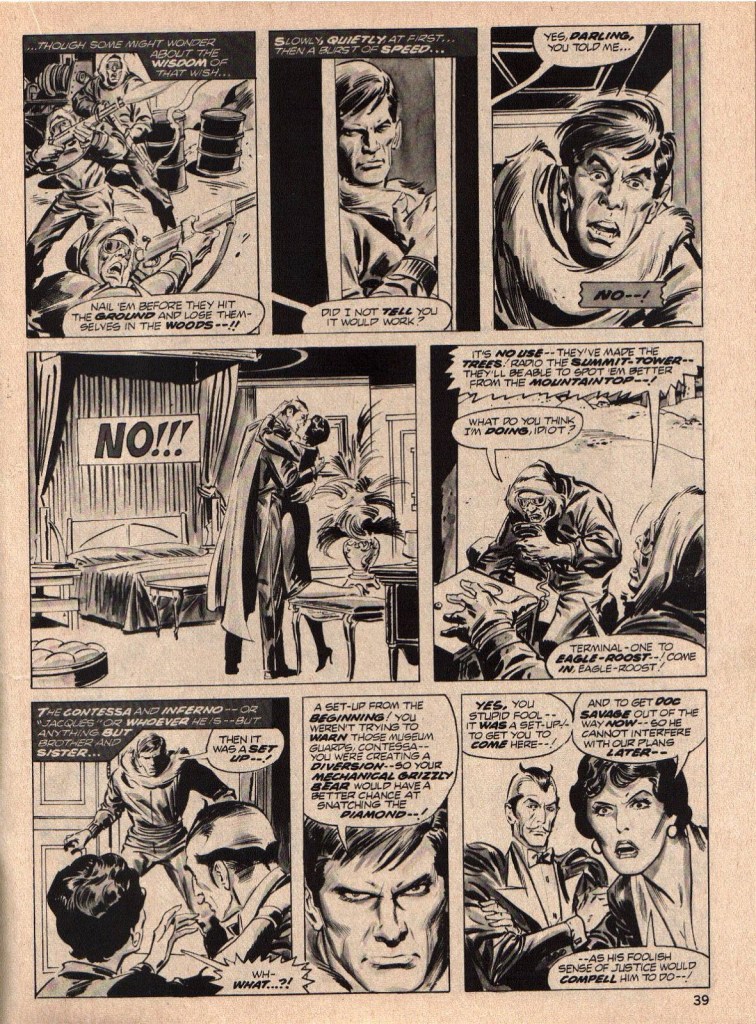
And the revelation of the Contessa’s duplicity hits with unexpected emotional power. Veteran reader of dozens and dozens of Doc novels, I had been conditioned to expect that women were hardly ever villains in them. Marvel comics were also somewhat addicted to “noble, tragic heroine” plots, and that was what I had anticipated here.
The intensity of her venom toward Renny is almost shocking. Renny is pushed right out of his normal stoicism, ready to explode with anger himself. And the scene outside the mountain stronghold is also ready to burst.
Hang on, reader…the climax has built like a wave, and is about to break.
Doc Talos drinking coffee by Iason Ragnar Bellerophon
Fan fiction (as evidenced by the countless fan stories penned by followers of the Talos character-inspiration, Doc Savage) has always been an exciting and fun way to connect with a pulp character and his myth. Amateur (and even professional) authors have a rich enthusiasm for characters they enjoy, and fans are often iconoclastic, thinking outside of the box to create uniquely inspired tales.
This is a call to authors who might enjoy plunging into the Doc Talos world. One does not have to be thoroughly versed in Talos canon to be able to take part…the characters are pastiches of classic Doc Savage figures, and familiarity with those is enough to serve as a story springboard. Did you ever have a story about those characters that you would love seeing, but know would never happen? Those are the types of stories you can create here.
There’s a great grand prize up for grabs — the best story submitted (to be chosen by Doc Talos author R. Paul Sardanas) will win its author a copy of the 1968 first edition paperback of “The Czar of Fear”, signed by cover artist James Bama! (images are of the actual book and signature)
Here is a list of characters from the Talos saga that should be quite familiar:
Doctor James Talos, Jr. (born 1901) – Surgeon, scientist, adventurer
Doctor James Talos, Sr. (Formerly James Wilder, 1848-1932) – Victorian era medical man, explorer
Andy “Kong” Kingman (1888-1968) – Ape-like chemist
Theo Jacob (1885-1968) – Fashionable lawyer
John Renner (1890-1964) – Big-fisted engineer
William “Bill” Johnson (1886-1966) – Erudite geologist/archeologist
Thomas J. White (1890-1967) – Scrawny electrical researcher
Patricia “Rickie” Talos (born 1914) – Cousin of Doc Talos, with the same exotic skin and hair color, and also a love of getting into trouble
Story guidelines are very open. Anything from a short vignette to a more involved short story is welcome. Story ideas can come from many sources, including Doc Savage stories (extrapolations into the Talos world only…all copyrights must be respected, make sure all names are changed…and classic scenarios, if used, are just for inspiration), historical events and figures, or, as mentioned, scenes with these basic characters that you have always wanted to see, but know you never will unless you write them yourself.
By submitting, you give permission for your story to be posted here on the Doc Talos website. There will also be a privately-printed paperback collection of the stories which will be given as a souvenir to all participants (every person submitting to the contest will receive one as a personal collector’s item — they will not be sold to the public).
The tone of the Doc Talos saga is adult, sophisticated fiction. Characters are portrayed realistically, they have sex lives, careers, and emotional scope and depth. Explicit content to the stories is fully permissible if you enjoy writing adventure erotica. Simple slice-of-life stories about the characters (more realistic than pulp adventure) are welcome. Experimental writing styles are also acceptable. Don’t feel you have to write something that is “Talos canonical”…these stories are meant to be fun for writer and reader, so they can veer into any unique or interesting storyline or characterization you would like.
Here is a sample to give you an idea of thematic tone of Doc Talos short stories/vignettes: a tale of Rickie Talos screen testing for the role of Pat Savage in the 1970’s Doc Savage film sequel that never happened:
Here’s another sample from the series…a short scene where Andy, Theo and Rickie hang out together for a late dinner the night before the 1939 World’s Fair opens:
Another sample is at the bottom of this page…an excerpt from Talos, in which Doc and his “wife” Mona discuss life and love. (This excerpt was also printed in The Bronze Gazette #85)
Other guides to feel your way into the Talos world can be found by reading the synopses in our Bookstore and Downloads sections, as well as the origin story for the series in the About section here on the site. No purchase or fee of any kind is required to enter the contest.
If you still feel a little at sea and would like to float a story concept to series author/contest judge R. Paul Sardanas, you may feel free to drop him an email at: admin@gromagonpress to chat about your idea before you write it.
The contest will run through the summer of 2021, with a winner announced on September 1 of this year. The contest prize will be shipped at no cost to the winner at that time.
Submissions may be made in Word format or pasted into the body of an email to admin@gromagonpress.com. Please put the words DOC TALOS FAN FICTION SUBMISSION (or INQUIRY, if you have a question) in the title of your email.
Good luck to all!
Doc Talos by Iason Ragnar Bellerophon
SAMPLEEXCERPT FROM “TALOS” Conversation between Doc and Mona at Point Nord, Greenland (AKA The Fortress of Solitude). Doc is working on a “resurrection project”; a concept based on the 1936 novel “Resurrection Day”. Doc and Mona are husband and wife, but not really…she is a Virtual Reality construct that he has created. Nevertheless, she is as real in many ways as the woman he once loved, and they discuss life and death together…
She leaned down and kissed me on the cheek, her loose black hair brushing my shoulders.
“Thank you for making my tea, love.”
“You’re welcome. I heard you stirring.”
Mona moved to the side of the table and settled there, extending one hand toward me while she lifted her virtual teacup and took a sip. I placed my hand over hers, and she curled it under, encouraging our fingers to intertwine.
“Ahh,” she said, “that’s good. You are up early this morning, darling.”
I looked into her still-sleepy brown eyes. She had on her warm, red wool robe. When Mona had been with me in New York, she’d always disliked the cold. Despite the comfortable environment inside the domes, I often saw her respond with a brief shiver when she looked out of a window at Point Nord’s frigid landscape.
For an instant as I looked at her, my eyes blurred, causing her to appear doubled.
More eyes…it seemed that they hovered about her. I blinked, and her normal appearance returned.
“I had some ideas that I wanted to pursue.”
“And you can never sleep when in their grip, I know,” she smiled. “Do you want to tell me about them?”
“Complicated subject for before breakfast.”
She lightly laughed. “How many times have we unraveled the weave of the world over our coffee and tea?”
I smiled in return. What was Mona’s secret, to unlock my perpetual poker face with such ease?
“I vacillate, as you know, between absolute conviction that the fundamental structures of life are concrete and quantifiable, meaning they can be understood…guided…”
“Or not. I know. So you are once again pursuing your personal white whale.”
She squeezed my hand, and as always in such moments, a part of my heart ached, on the edge of a pain that I was, perhaps, an idiot to constantly subject myself to.
She released my hand, leaned back, and took another sip of her tea. “I’m not the best choice for a research partner.”
“But you are. I want…well, I want science to stop being something that’s cold.”
“And so here we are, in the Arctic?” She mock-clutched the robe tighter around her.
“It needs art…it needs faith.”
“You’re such a puzzle. I wish we’d gotten married when we were twenty. I’d at least have had a head start in figuring you out.”
“I would have liked that.”
“The shy boy and girl, eh?” She reached forward again to pat my hand. “Did you look at the eagle this morning?”
“I look at it every morning.”
I could see that the simple statement moved her. Her gaze clouded, very briefly, with a mixed pleasure and a subdued but deep-reaching joy. A look that I would call love, in the subtle promise it held of our ability to touch one another.
“You asked me to make it in malachite.”
“Yes.”
“When you choose spiritual things, I admit I don’t know what to make of it. It’s a beautiful stone in and of itself, but that’s not why.”
“Yes…the Egyptian paradise was called ‘The Field of Malachite’…it has death and resurrection in its layers.”
“Green is for the Holy Ghost…life eternal, and hope.”
“A rare interpretation with agreement among Catholics and polytheistic nature worshipers.”
“Rarer still for an atheist to commune with. I always assumed you went along with our Catholic wedding to indulge me.”
“Honestly, I did.”
The corners of her lips turned up slightly. “Making your primitive girlfriend your primitive wife?”
“I don’t think belief is primitive. There’s beauty in it…and power too, that’s difficult to understand.”
“Father Rodriguez would say it’s not meant to be understood. Reason not being always conducive to the soul’s experiences.”
“But they can find harmony.”
“As we do, darling? Yes, I believe they can.”
“Somewhere in that harmony, is a key, or keys.”
“Remember twenty years ago, the theory that Bill had? That with electrical and chemical science you could potentially raise the dead?”
Twenty years ago. Of course for Mona, it was still the 1950’s.
“His theory was really very sound in some of its foundations. Of course it was equal parts science and wish-fulfillment. Bill would have loved to apply such a procedure to mummified bodies, with an archaeologist’s fantasy of conversing with the giants of antiquity. Of course even a perfectly mummified pharaoh wouldn’t have worked. You can’t put viscera back in after they’ve been stored in canopic jars. He posited Solomon as I recall…at the time his researches were very much engaged with identifying the preserved bodies of the very dim past, and there was an intriguing story – never substantiated – that some Biblical figures, purportedly touched by God, did not decay, but were sealed in secret tombs with guardians that crossed the centuries.”
“So lacking those, who would you raise, dearest James? The tragic dead, restored to their families? The brilliant thinkers, the artists, the dreamers?”
“Yes, possibly.”
“It’s a lovely fancy.”
“Or parted lovers.”
“Even lovelier.”
“But the spark of their minds, their emotions…would that be present simply through the restoration of a body?”
“Or would Bill’s pharaoh have to cross back over the river of the dead, or Papa come back from Heaven?”
“It sounds so absurd.”
“No…no, it doesn’t. I think there would be sadness in it, and joy too.”
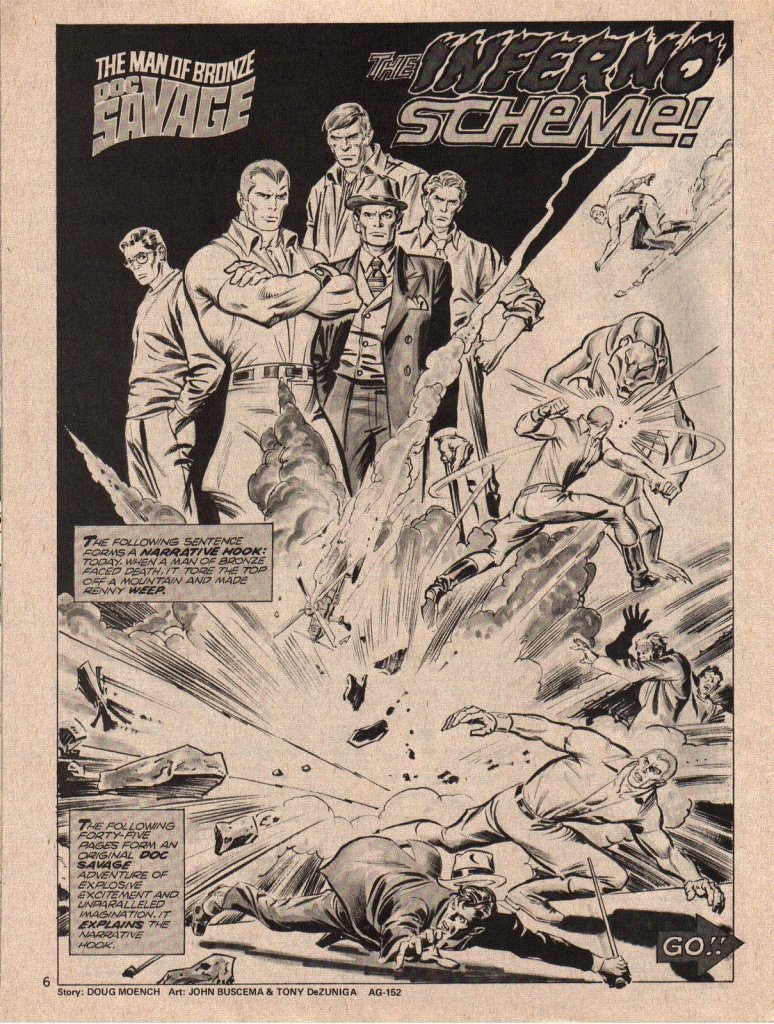
The opening scenes from Marvel’s Doc Savage magazine #3 (1976) not only were loaded with action, they displayed some writing virtuosity. The act of the author breaking the fourth wall (speaking directly to the audience) had been a technique used by Marvel since the Sixties — Stan Lee often used it just as Doug Moench did on the title page of The Inferno Scheme: to preview the action and essentially invite the audience in to enjoy the story.
Moench however used a compositional technique called the “narrative hook” (and goes so far as to describe what that is). It’s a statement or picture that reveals the end of the story without actually spoiling it for the reader. What you reveal there at the beginning should tantalize, and vault the reader forward, but carry enough mystery or artistry to make the conclusion feel emotionally satisfying or moving when you finally arrive there.
That’s actually not easy to do well. You are banking on your skill as an author to keep the reader’s attention to the very last words of the story, even though they know, in some form, what is coming.
The narrative hook from The Inferno Scheme is “Today, when a Man of Bronze faced death, it tore the top off a mountain, and made Renny weep.”
Interesting…a promise of apocalyptic action, along with some form of emotional consequence. And a consequence to of all people, Renny…who for all intents and purposes spent the entire run of Doc Savage pulps breaking doors with his huge fists, saying “Holy Cow”, and looking gloomy when he was happy over and over again.
The aides at the beginning of the pulp run were very competent men. But as time went on they became, in many ways, marginalized by their idiosyncratic behaviors (aside from Renny, two perpetually squabbling, one using big words, one a physical weakling who could like five times his weight in wildcats — entertaining, signature characters, but constrained to repeat their same behaviors ad infinitum).
Moench’s narrative hook signaled a change, and one toward more sophisticated character development.
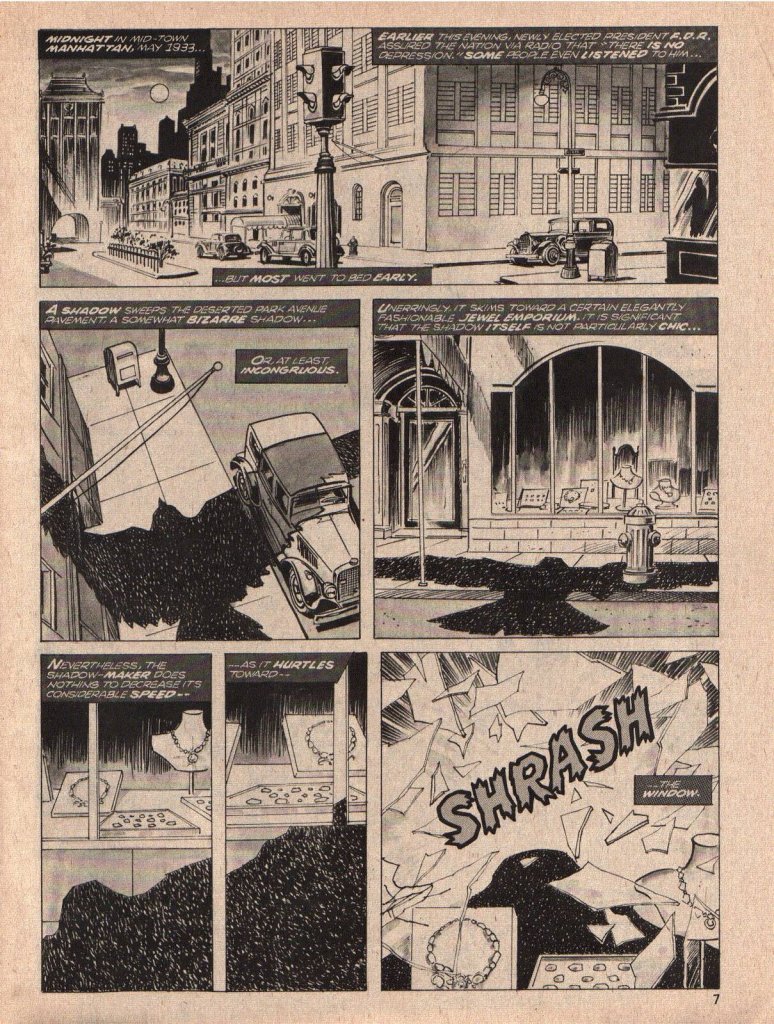
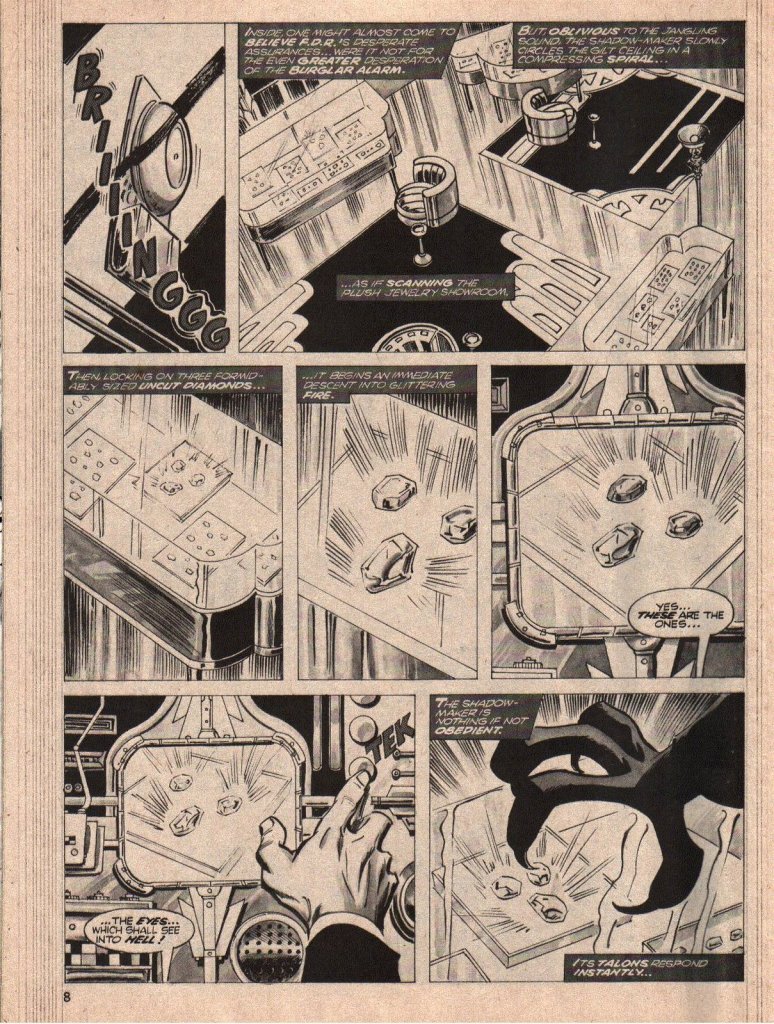
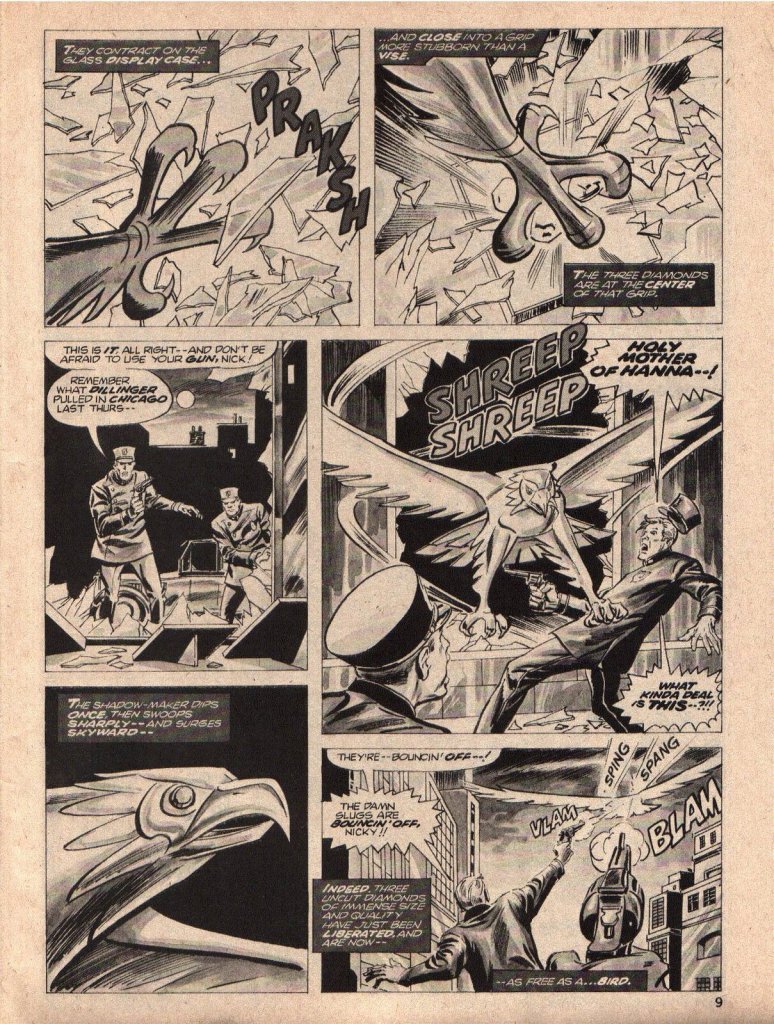
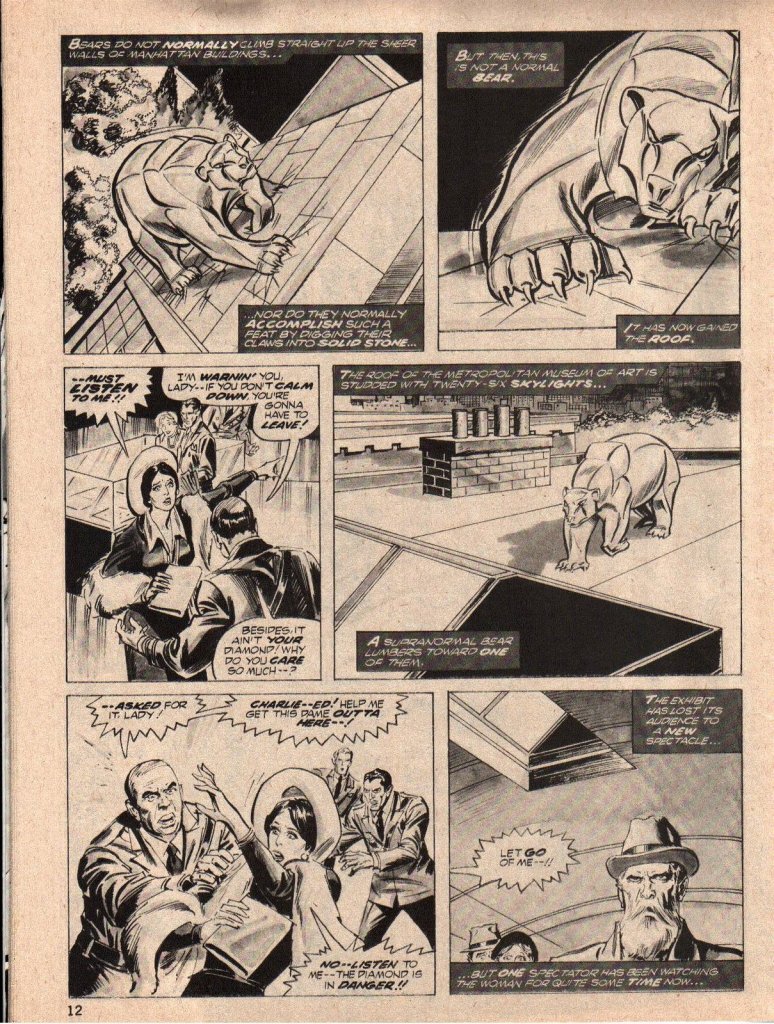
The opening of the story does indeed focus on the setup of the plot (using several other sophisticated techniques: the omniscient narrator who has no specific character but a distinctive voice…and POV shots that insert the reader into the action from unusual angles), and Renny. There is distinct and skillful effort to set the milieu of 1930’s New York both visually and through naturalistic dialogue from many background characters. The diamond thefts, made by animalistic metal automatons, have the quirky oddness that was a Lester Dent signature, but they also behave believably (the bear automaton falling through the skylight to get down into the museum showroom).
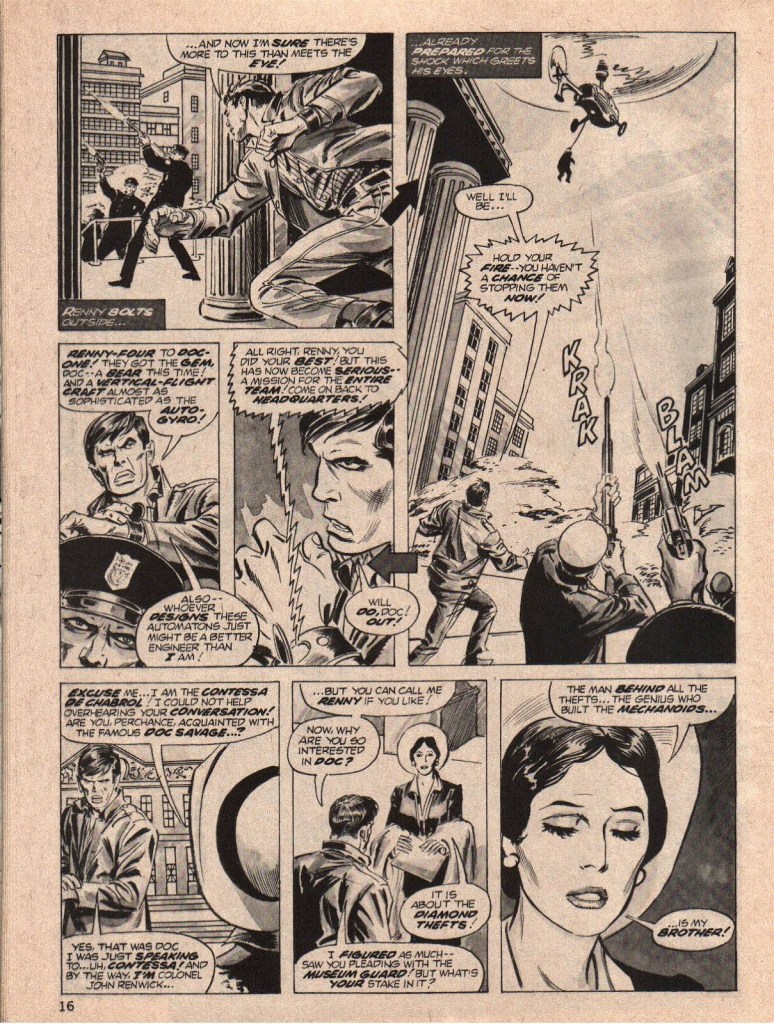
The character of the Contessa, through mannered speech and the intelligence she projects, is immediately interesting and sympathetic. Renny’s fight with the automaton ends up with him being trounced, but he takes that with competent stoicism. These may seem like little things, but it’s a competency in storytelling technique and character development often missing from comic book/adventure pulp stories. Only then does Doc appear in the story, and that only through his voice as Renny contacts him to report.
The presence of these storytelling techniques feels seamless, effectively producing reader immersion into the story, without weighing down the action narrative. Skilled story-artisans are at work here.
The next section of The Inferno Scheme continues to both deepen the characterizations, and build toward the promise of that opening narrative hook.
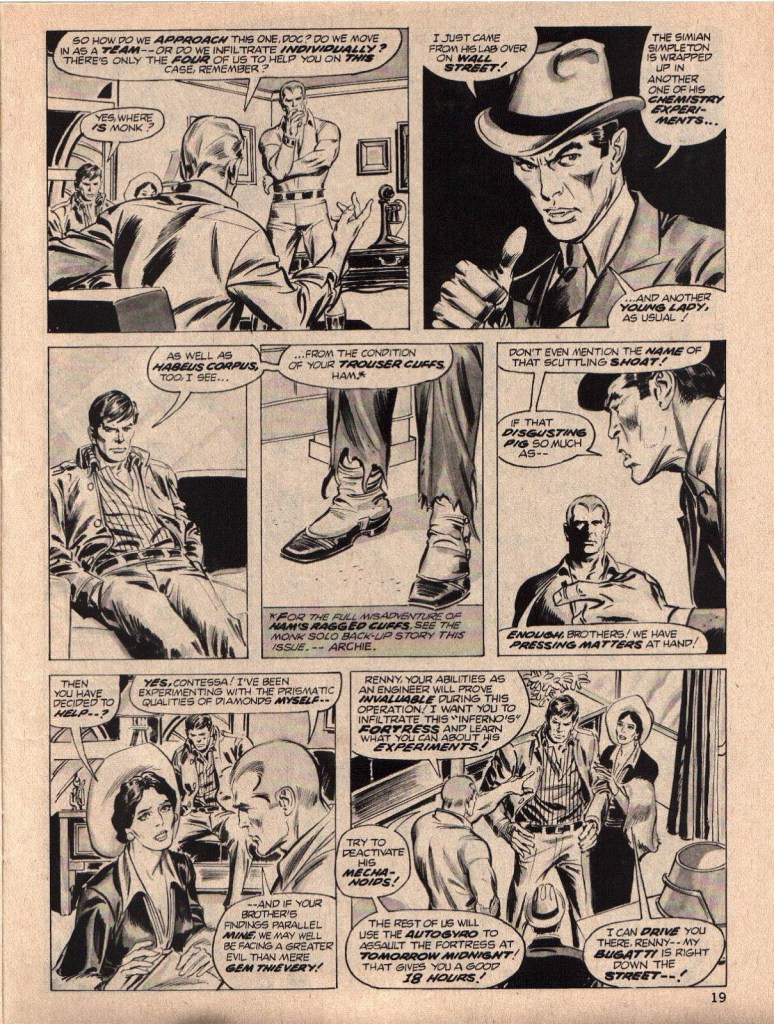
The technique of having a character describe the details of the “case” was one mastered by Sir Arthur Conan Doyle in his Sherlock Holmes stories. But it too has potential pitfalls. There can be too much exposition and not enough characterization…you can reveal too much and spoil or telegraph surprises to come…but all of that is handled deftly here. Doc and his men are portrayed as strong, capable and confident — Renny even gives a naturalistic description of Doc’s trilling to the Contessa. And Monk is not there! (the perennial scene-stealer had his own solo adventure later in the magazine).
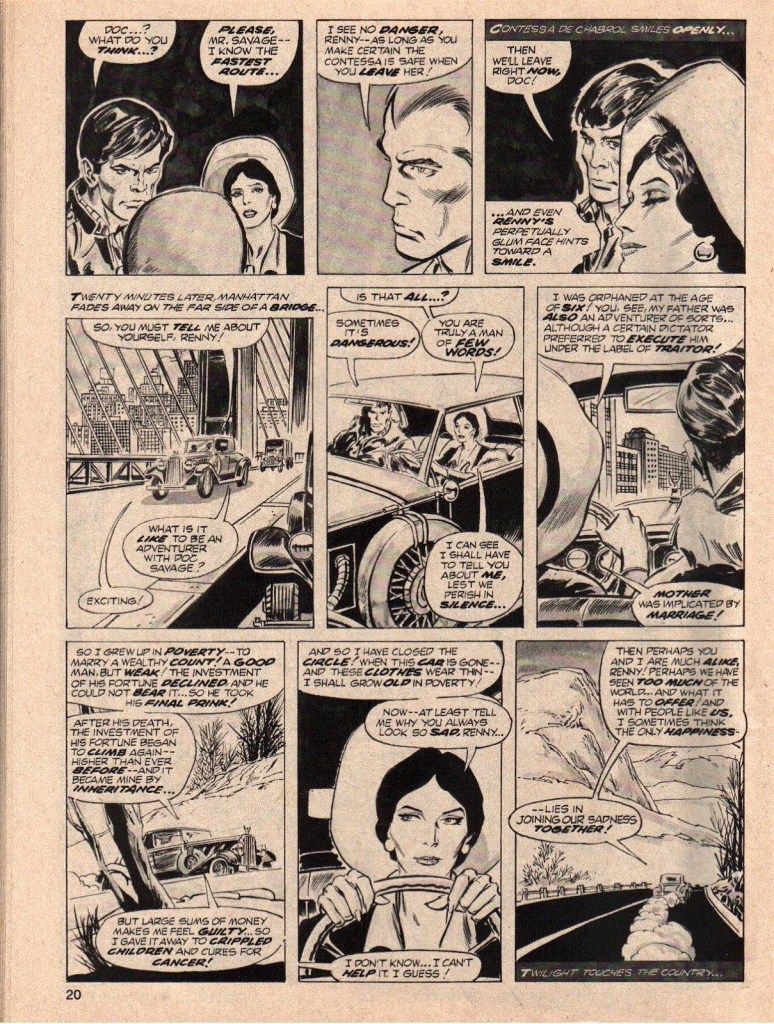
The conversation between Renny and the Contessa here is really something remarkable. She recognizes Renny’s signature traits, and displays warmth and connection to the way he thinks and perceives his place in the world. He is endearingly awkward in return, replying in simple lines that imply he tries not to think too much about his own emotional connections to his lifestyle. She is dignified, doesn’t vamp him (the earlier kiss felt like impulsive and endearing warmth, rather than seduction) , but clearly is getting to him.
The parting scenes with the Contessa are beguilingly touching. Renny continues to be awkward (in ways that young-adult readers of the story can unquestionably identify with). He shows his bravery and resolve, but with a subtle emotional depth.
A repeating motif of the pulp stories was the aides, when in action on their own, invariably get captured and require rescuing by Doc. Renny promptly gets captured himself, but also gets out of the situation himself. At last, one of Doc’s aides acting with real agency! (Moench also had a good touch with portraying bit-players in the story, like bystanders and thugs. They behave, by and large, realistically, continuing to ground the story).
The action continues to heat up, with dynamic visual pacing by Buscema and DeZuniga. Another very difficult thing to do in adventure fiction is generate a tense environment of peril (since the reader knows the character is not going to die, action can sometimes feel pointless and hollow). But in these scenes, there is taut dynamism propelling the reader forward.
There is an alchemy to strive for in bringing the pleasures of pulp adventure into the 21st century. Part of the pleasure for older readers (of which I am one) in revisiting pulp storytelling is nostalgia. A few are left who fondly remember where they were and what they were doing at a point they read a pulp magazine in the period of time from 1933-1949 (the original pulp run of Doc Savage). Many more of us link the fondness of nostalgia to the second run, from 1964-1990, when Bantam books re-issued the series in paperback.
But there comes a point in the cultural arc of an iconic character where more and more generations pile up between original stories and current experience. Nostalgia begins to lose steam as a driving force of interest in a character’s continuance. Here in the year 2021, the 20th century is falling away behind us. Efforts to extend the original tropes of 1930’s pulp characters have begun to feel, to me, more strained, less in touch with new readers of today.
There was evolution even in the original run of Doc Savage Magazine. As a generalization, it could be said that the early years were immensely fun, but displayed very little writing sophistication. In the later pulps the level of authorial quality (with a few stumbles along the way) went up, but the fun, wonder and excitement diminished. Had the Hero Pulp survived beyond 1949, it’s interesting to conjecture where the evolution would have gone.
One answer might be found about halfway along the journey from 1933 to 2021. Around the time of the Doc Savage movie in 1975, Marvel Comics retooled their take on the character (a few years previously it had run eight issues of adaptations from the original novels, with varying quality). Marvel’s black and white magazine line, free from the restrictions of the Comics Code Authority, was pushing out the boundaries of graphic storytelling. And to me at that time, it felt like the stories in the Doc Savage magazine hit on a remarkable mix of more sophisticated writing and pulp-style adventure.
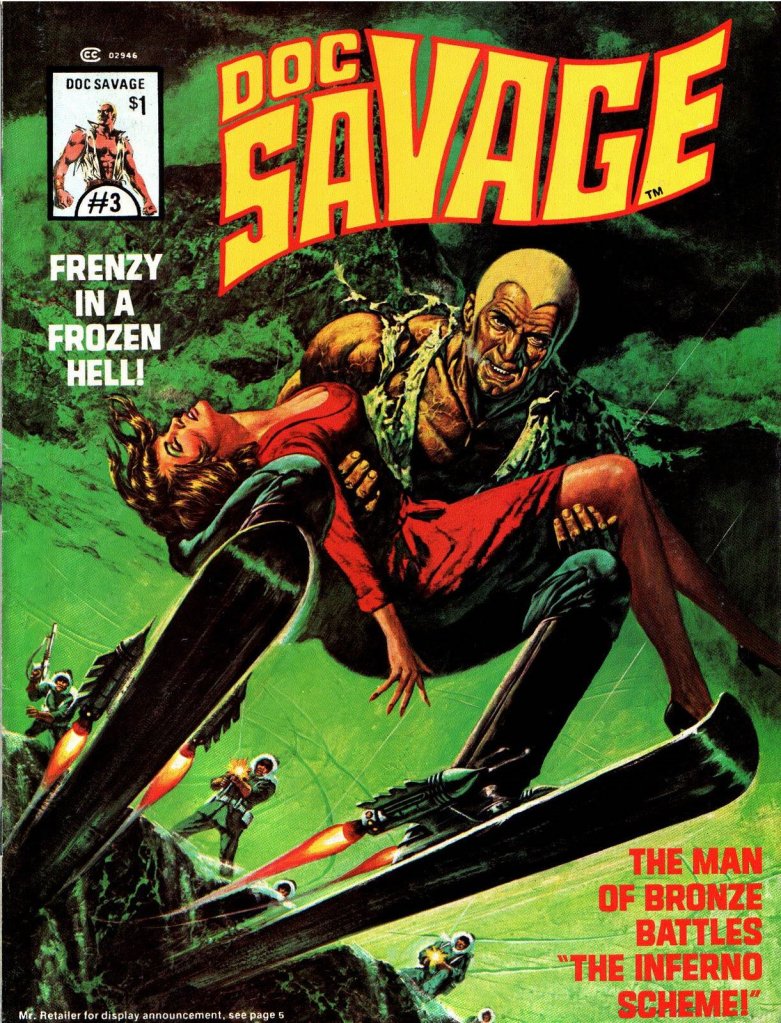
So let’s take a look at one of those stories…1976’s “The Inferno Scheme”. In this first of a four-part retrospective, we’ll look at subtle ways that writer Doug Moench, and artists John Buscema and Tony DeZuniga adjusted and advanced the techniques of pulp storytelling in general, and Doc Savage in particular.
Here is the cover and the first eleven pages. In our next installment, we’ll explore what we’ve seen, and then continue on.
Doc Savage was a straight arrow, and pretty much the whole run of James Bama, Fred Pfeiffer, Boris Vallejo, Bob Larkin and Joe DeVito paperback covers poses him in a very stalwart fashion. But on the pulp covers, things sometimes edged a little bit more toward the forbidden.
A list of this sort is highly subjective of course…no doubt you have others you think should have made the cut. But it’s all for fun…so let the debate begin.
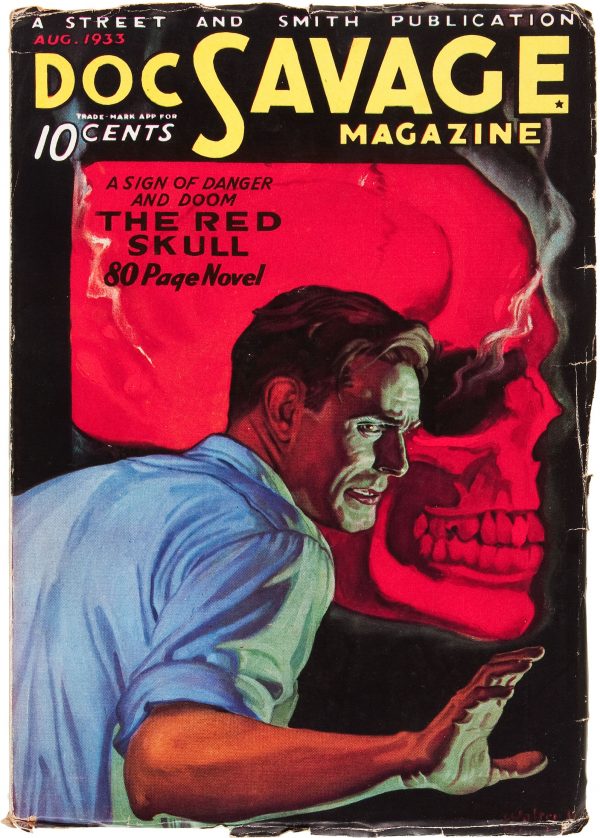
#10
No smoking in here! Everything from colors to pose to expression in this painting is malevolent.
The Red Skull, Walter Baumhofer
9.
This one, in which Pat Savage runs afoul of a trip-rope, certainly has a bit of leg-fetishist in it.
Death is a Round Black Spot
8.
Watch out, the skeleton has a gun! And Doc, dressed uncharacteristically in black, makes him look a little more outlaw than hero.
The Land of Fear, Robert G. Harris
7.
There are many wild melees portrayed on Doc pulps, but this one has an over the top feel, with a bloody Doc roughing up his opponents pretty well, and the heroine of the tale wielding a mean shoe.
The Gold Ogre, Emery Clarke
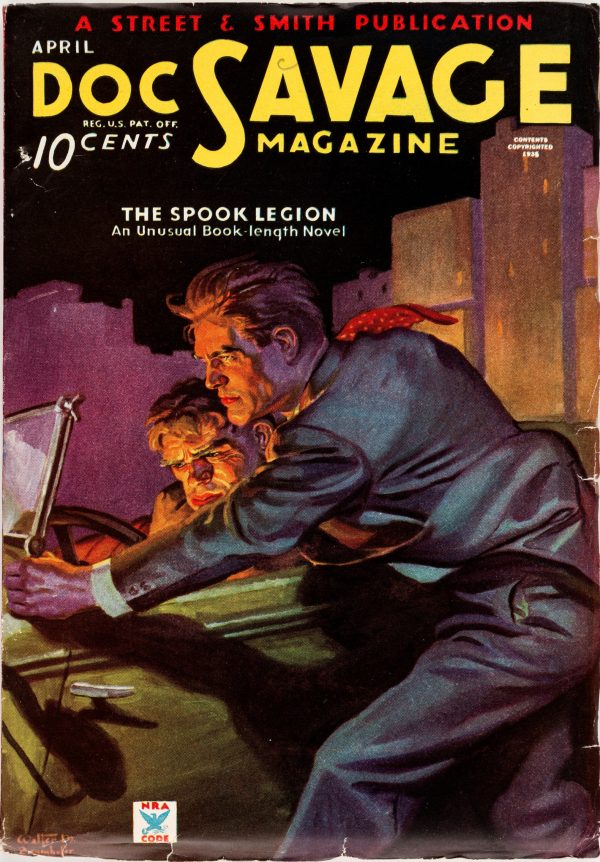
6.
A favorite of Philip José Farmer (chosen as the cover for the first hardcover edition of Doc Savage: His Apocalyptic Life)…driven by the brutish Monk, Doc, perched on the running board, might appear to be making a getaway to the average observer…
The Spook Legion, Walter Baumhofer
5.
Another of Farmer’s favorites (as I understand it, the runner-up choice for Apocalyptic Life). Doc looks pretty fierce, but it’s Pat that makes this one, with her excitedly happy expression while in peril…that girl was made for trouble.
Fear Cay, Walter Baumhofer
4.
Well, thank heaven for some air bubbles and a well-placed strand of kelp (or Sargassum Weed)…
The Sargasso Ogre, Walter Baumhofer
3.
Doc in classic black and white jail stripes!
The Vanisher, Robert G. Harris
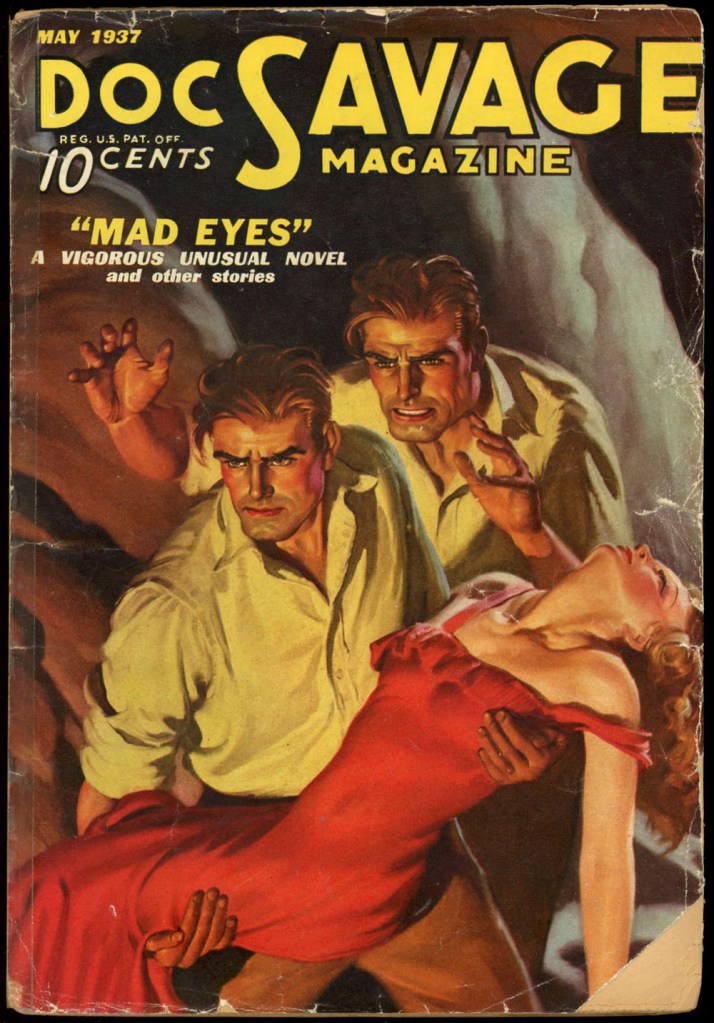
2.
Good Doc, bad Doc…both look pretty badass actually, and what are they planning to do with that poor girl? (Actually, she is no saint herself…)
Mad Eyes, Emery Clarke
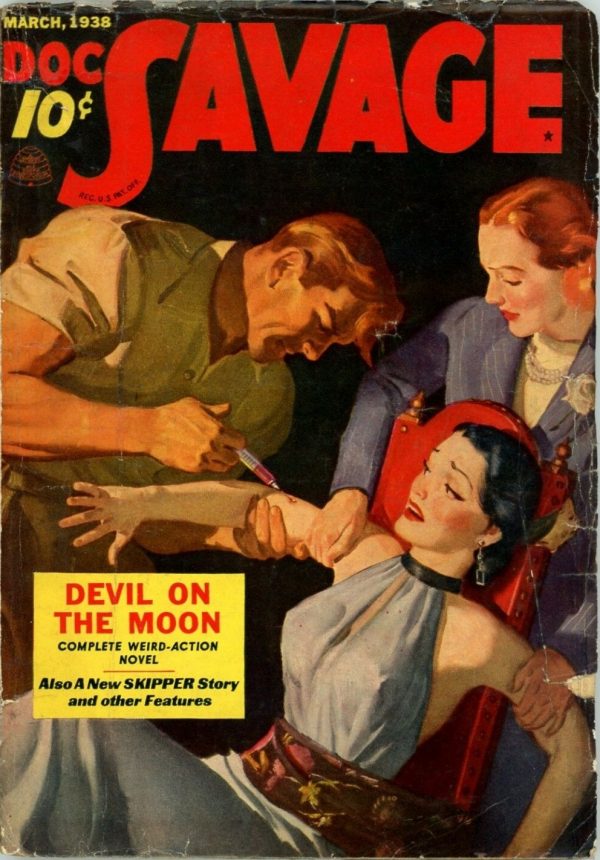
1.
And my Number One most lurid cover…in which Doc and Pat seem to be the ones up to no good.
Nobody moved. They could not accept what they had seen. And when their senses thawed, they began to realize what they faced.
That line from A Feast Unknown could well summarize the experience of reading the novel. It was, in essence, one hammer-blow after another, leaving the reader stunned. This was not just because of the intense, explicit content of the story. I believe it was because the novel achieved that rarest of literary accomplishments: it was about something.
What, exactly? I’m sure the question would raise lively debate even a half century later.
What was A Feast Unknown? Essex House wanted to add a prestigious name to their author list, and they wanted a speculative pornographic novel of the highest quality. Certainly they got it. Farmer, from his statement in the interview back in Part 2 of this essay, wanted to explore the sexual component that had been essentially ignored in the canons of Doc Savage and Tarzan. He wanted to satirize pornography. Certainly he achieved that. But what happened ultimately was more. The story did not merely satirize and entertain, it elevated the much maligned and dismissed genre of erotically explicit creativity. It took icons of the 20th century and unleashed in them — in greatly exaggerated form — some of the most primal behaviors in the human condition: sexual need and violent expressions of power. It linked the two, in a narrative of unrelenting intensity.
In 1981, the critic John Simon wrote (not in reference to Feast, but to all literature), “There is no point in saying less than your predecessors said.” These are words I passionately believe. All literature is linked to a huge tree that we are just the most recent branch of. As creators, we have a unique opportunity (and responsibility) to go fearlessly as far out on a limb as we can. Farmer did that, using sheer literary muscle and audacity to dig deep, and in a bloody welter, rip secrets of the human soul out for us to see and feel.
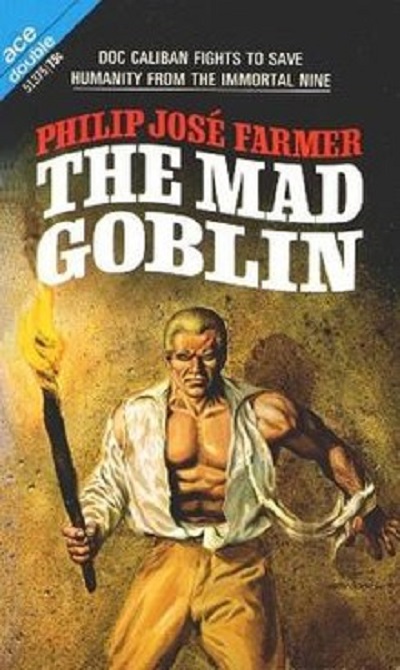
What happened after that? Well, Farmer throttled back. The two books that followed, The Mad Goblin and Lord of the Trees, were a very different experience.
The Mad Goblin, Ace Double book, 1970, cover art by Gray Morrow
In his essay on Farmer in the 2013 Sanctum Books reprinting of the Doc Savage novels Murder Mirage and The Other World, Will Murray states (referring to the Ace Double first printing of The Mad Goblin/Lord of the Trees) that “…editor Don Wollheim had censored all frank sexual content.” And that was true. The two stories were engaging adventure fiction, a little rougher than standard Doc Savage/Tarzan fare, but in film terms, the NC-17 content had been dropped to PG-13.
In so doing, the mesmerizing look at human sexuality through a bold lens of the extreme was gone.
Had Farmer even wanted to go back to that fierce, exacting place through his writings? Possibly not. Even if Wollheim, managing the mainstream Ace Books, would not have allowed it, Farmer’s own description of his plans for Caliban and Grandrith seem to indicate neither wish nor intent to return to laying bare raw essences of violence and nobility in the human soul…it would instead finish as a tough and clever adventure series, eventually even veering into Lovecraftian psuedo-science/supernatural themes.
Well and good in its own right, and here in 2021 Win Scott Eckert has finally completed that last intended novel in the series, The Monster on Hold. I always enjoy reading Goblin/Trees, and I have no doubt I will enjoy the final posthumous collaboration.
But to my mind that direction was a loss of something truly remarkable. In an interesting parallel, 1969 (the year Feast was published) was also the year Midnight Cowboy, then an X-rated film, won the Academy Award for Best Picture. It has since been deemed “culturally, historically or aesthetically significant” by the Library of Congress and selected for preservation in the United States National Film Registry. It too elevated sexual themes out of the critical wasteland of the label “pornographic”, giving the weight of intelligence, emotion, and countless nuances of troubled, messy humanity. Think of that film being followed by a PG-13 sequel tailored to fit a 1970 TV Movie of the Week.
That does not dismiss the aftermath of A Feast Unknown. I love adventure fiction, am a devoted reader of the original Doc Savage canon, which I think is deserving of far more literary recognition than it receives. I take great pleasure in the works of those talented people who have explored the more playful of Farmer’s concepts, like his literate mashups and cross-connections. But to quote another author/critic, Harlan Ellison (again, not talking specifically about Feast, but about the phenomenon of human creativity)…”There was only one Machiavelli, only one Shaka Zulu, only one Alexander of Macedon. Name the highest and brightest and most accomplished until you get to Fellini or Billie Holiday or George Bernard Shaw and compare; and recognize how much higher thereafter is the high water mark. Suddenly, there is more sunlight in the world.”
A Feast Unknown went to a pinnacle…it burns, and pounds, and stuns you even all these decades later. And only when our senses thaw, can we begin to realize what we face.
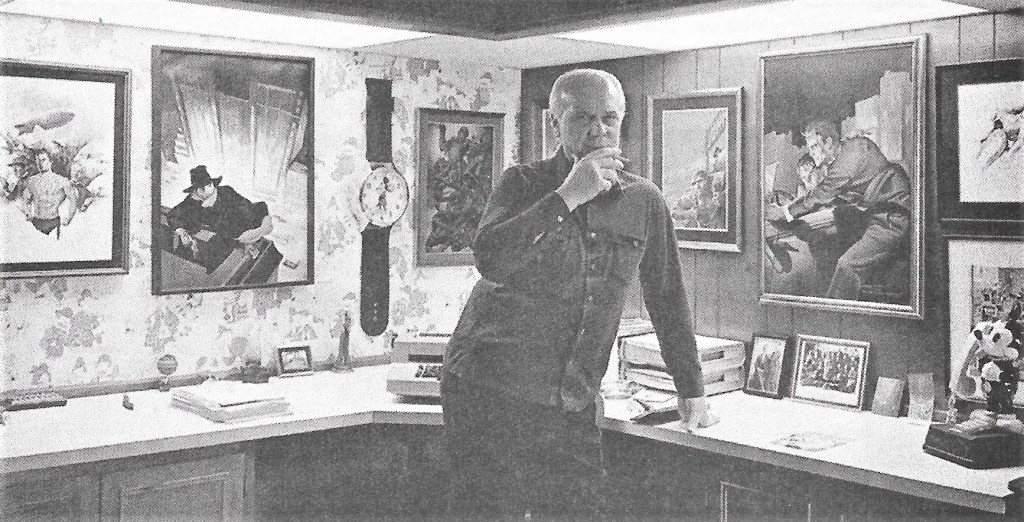
Phil Farmer – over his right shoulder, a painting by Richard Corben of Doc Caliban
The French title for A Feast Unknown is La Jungle Nue, “The Naked Jungle”…in Italy it is Festa di Morte, “The Feast of Dead Men”. But it seemed they missed the subtlety in Farmer’s title. Not all editions have it, but most show this stanza from the poem Evolution before the story begins.
Stanza that introduces A Feast Unknown
The poet, May Swenson, though not widely known today, was in fact a very influential creator in her day. The eminent critic Harold Bloom considered her one of the most important and original poets of the 20th century. Born in 1913, she was a contemporary of Farmer – he might well have witnessed the whole of her literary career.
on this ball half dark half light i walk Upright i lie Prone within the night
beautiful each Shape to see wonderful each Thing to name here a stone there a tree here a river there a Flame
marvelous to Stroke the patient beasts within their yoke
how i Yearn for the lion in his den though he spurn the touch of men
the longing that i know is the Stone also it must be
the same that rises in the Tree the longing in the Lion’s call speaks for all
o to Endure like the stone sufficient to itself alone
or Reincarnate like the tree be born each spring to greenery
or like the lion without law to roam the Wild on velvet paw
but if walking i meet a Creature like me on the street two-legged with human face to recognize is to embrace
wonders pale beauties dim during my delight with Him
an Evolution strange two tongues Touch exchange a Feast unknown to stone or tree or beast
Fascinating to consider the poem’s themes of all things, even the inanimate, yearning for life. Its metaphors include the lion (and Grandrith would, notably, wrestle and kill a lion in the narrative), and stones hungering to speak (bringing to mind intense images from the final Doc Savage novel, Up From Earth’s Center). The question of what any creature might be willing to do in order to achieve life (or extended life, in the narrative of A Feast Unknown), also echoes strongly through the book.
All in all, a more subtle title-choice from Farmer than when taken at first glance.
The cover art above gives a strong impression of the story that is to follow. The violence is intense and unrelenting in A Feast Unknown. Upping the stakes even further, the two main characters, Doc Caliban and Lord Grandrith, are in the grip of a condition which makes them impotent unless strongly contemplating or initiating violence themselves. They have become living engines of sex and violence, and the theme is literally “full-frontal” in the story, with every act graphically depicted and described.
Certainly a compelling concept to explore in our time, where the linking of those two words in fiction and entertainment has been ubiquitous, but rarely with a goal that includes understanding violent and erotic human drives. Farmer himself, a vigorous explorer of sexual themes throughout his career, framed the eros/thanatos equation in the context of it being a byproduct of an elixir the Nine and their followers (the antagonists of the story) take in order to extend their lives. They do so willingly, but at a great price to their humanity. The spiritual puzzle being one that Grandrith himself ponders on: I was forced to dwell a little on that which I had pushed away because it was too painful. Had I, by becoming a god, become less of a man?
Interesting conjecture, when you apply it to the extremes human beings will go to in order to perpetuate personal power and life.
By layering deep seams of philosophical content under the action narrative, Farmer invests the story with a powerful, primal heartbeat.
Farmer, in interviews about the book, also stressed its black humor and elements of satire. Here is a excerpt from his interview about Feast presented in Bakka magazine. He recalls his thoughts when Brian Kirby of Essex House asked him to write some novels of science fiction erotica.
Farmer: “Well, I had never read a pornographic book up to that time. So I became kinda interested. I thought…well now, here’s a chance to write a satire on my heroes Doc Savage and Tarzan, because Edgar Rice Burroughs and Lester Dent totally ignored the sexual content. I had done some thinking, extrapolating, if there was a real Tarzan, what would he actually be like? Well, all right, I wanted to write an erotic satire of these two gentlemen, also at the same time I was satirizing pornography. I had my tongue in my cheek, and I had a hell of a lot of fun doing it.”
Pornography is a strange thing…by definition, something that is created expressly for the purpose of stimulating sexual arousal (this is a bad thing?). By society’s usage, the word is generally utilized to describe something erotic that the criticizer of that particular form of eros doesn’t like. So porn is cheap, exploitative, degrading. Why should that be so? It’s rather like trashing a chef for succeeding in making something that stimulates an anticipatory, excited desire to eat, and to have that eating become a feast for all the senses.
One interesting point to consider is that very little of the sex in Feast is presented as pleasurable. Mostly it seems a form of agony. This perhaps, reflects the deep and diverse fear and discomfort many people feel about sexuality.
The cover art of the French edition above, in the light of these thoughts, becomes more than a slasher-scene. The knife Farmer wields to cut into intense, often shunned human themes causes splatters of hot blood to go everywhere. Through the experiences of heroes like Caliban and Grandrith — who are so often equated with a nobility of action and spirit — we can viscerally feel our own blood pumping with primal power.




























 Doc Talos