December 7th was Pearl Harbor day, and though a peacenik, there is a fair amount of military history in my family (Grandfather, Navy WWI — Father, Air Force Korea — brother, Army Special Forces). In the pulp world during WWII, the creative and management people of Street & Smith made the choice to keep Doc Savage out of direct military service, which even though volubly explained in the pulp stories (one of the few times Doc expressed anger was when denied active service, and the government position — that he could do more for the country acting to take down spies, plots, fifth columnists, etc.) — still somehow didn’t sit right for me. So it is one of the instances where Doc Savage and Doc Talos lore diverge. Talos joined the Army after Pearl Harbor, and served in the Pacific. I’m in the process of writing a short story from that time in his life…a very humanistic tale in which he treats a wounded Japanese soldier, who is deeply philosophical and holds a hatred for war, but is torn by the demands of honor.
Portrait of James Talos, US Army by R. Paul Sardanas. Image modeled in pre-AI vintage 1999 Poser, with finishes in Photoshop, Adobe Illustrator, and hand painting.
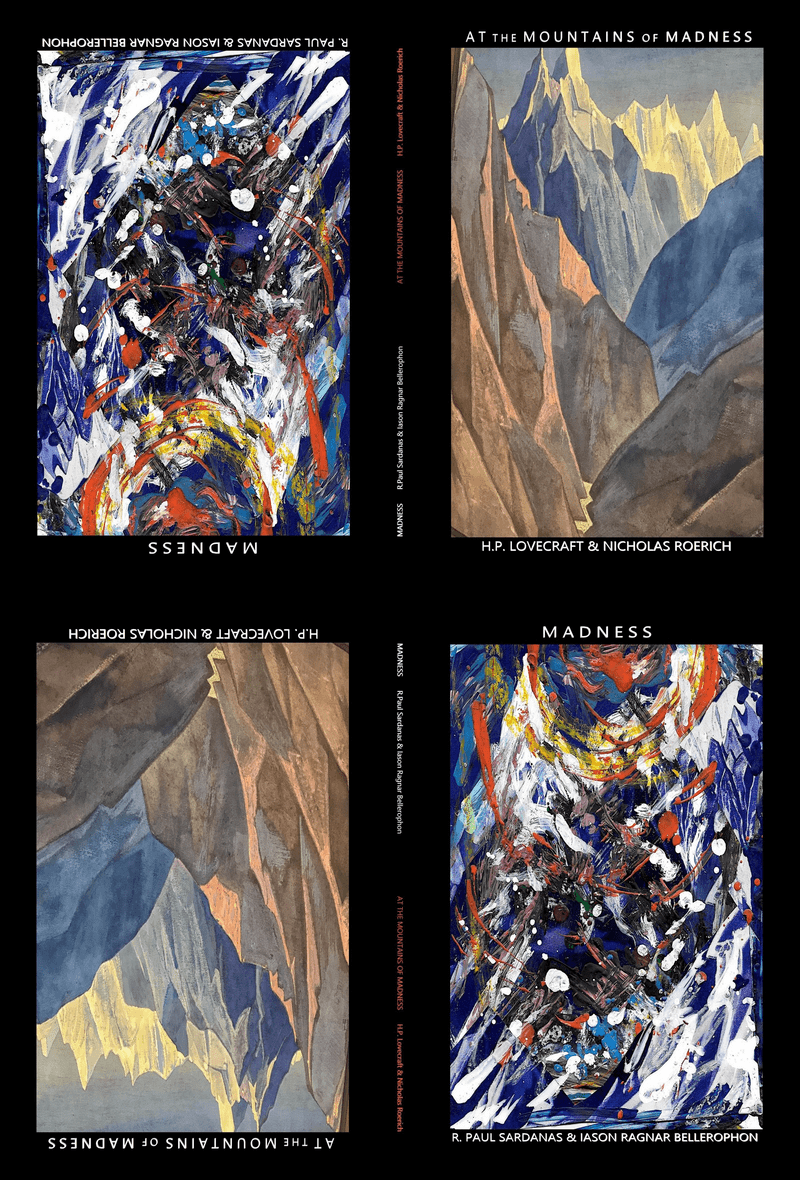
After its four-issue serialization in Doc Talos Magazine, the R. Paul Sardanas/Iason Ragnar Bellerophon story Madness has been combined into a single narrative, and is joined in the popular Doc Talos Double flip book format with the original public domain Lovecraft tale At the Mountains of Madness.
Here’s a sneak peek at the book’s Foreword:
_____
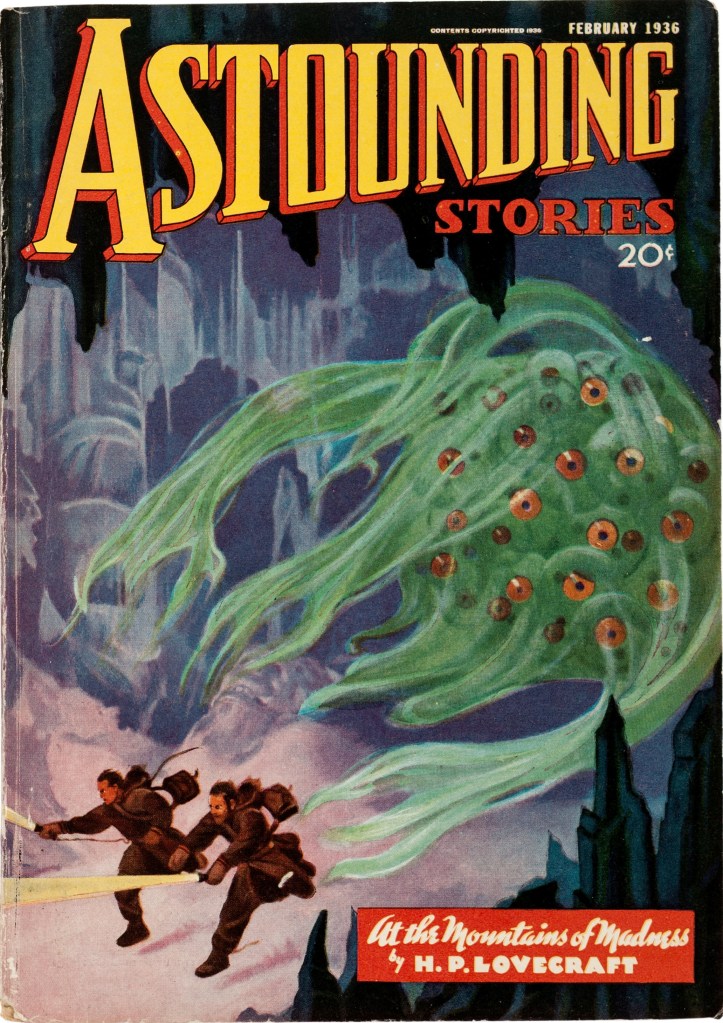
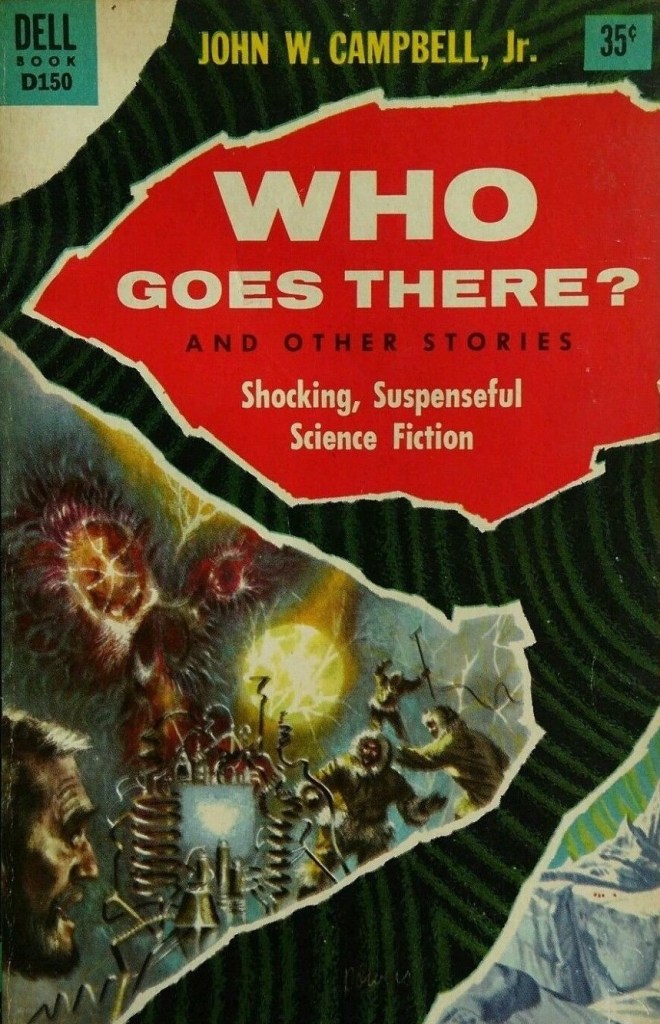
Pulp fiction archivist/theorists, a mixture of playful and remarkably serious, have loved, over the decades, to find secret connections among the tales in those wonderful old magazines. Some are tremendous fun…and at the same time, deeply intriguing. Among them is a persistent placement of two members of the Doc Savage cast in seminal works of the time, both with polar settings: Doc himself, embodied as the character McReady in John W. Campbell’s 1938 Who Goes There?, and Johnny – William Harper Littlejohn – quietly hiding out within the persona of geologist Professor William Dyer in H.P. Lovecraft’s At the Mountains of Madness, which was written in 1931 and published in 1936.
I was fascinated in my teens with both tales. I acquired a copy of the Arkham House hardcover edition of Mountains of Madness back in 1971 (I got it and an Arkham hardcover of Dagon for Christmas that year)…and my first exposure to Campbell’s story was not the book, but the 1951 film The Thing From Another World, which I watched on a TV late-late show right around the same time.
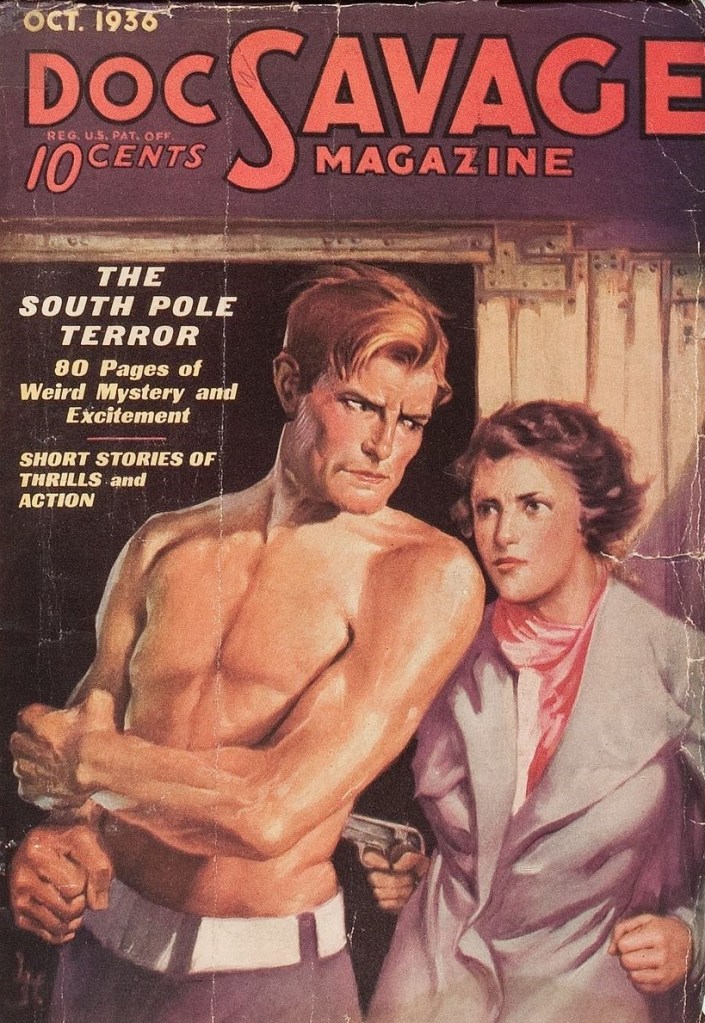
Though a fan of the Doc Savage stories since ’69, no light bulbs went off in my head connecting these fiction-streams. This despite the fact that Doc’s lone Antarctic adventure, The South Pole Terror, also appeared in 1936.
Those conjectures came later, with the lightbulb-moments not my own, but concepts posited by the likes of Philip José Farmer, subsequent Wold Newtonists, and others. For myself, creative expression around these stories took shape in a desire (explored at length elsewhere and resulting ultimately in the Doc Talos stories) to do a more sophisticated, adult version of Doc…and, relatively early on in my authorial career, an ambition to write a sequel to At the Mountains of Madness. Events and developments in the story all but seemed to beg for one, with the late-story madness-inducing vision of a vaster and even more terrifying locale beyond the titular mountains, seen via a mirage by Professor Dyer’s younger protege Danforth. And the story itself was an oblique sequel of sorts, to Edgar Allan Poe’s 1838 The Testament of Arthur Gordon Pym of Nantucket.
I planned the tale, which I called Kadath in the Cold Waste, and began it in earnest several times. I never finished it. I was, across those early writing years, working hard to purge my writing of a distinct tendency to turn purple – as a habit of verbosity was one of the chief characteristics of Lovecraft’s authorial style, writing a direct sequel in that style was literally putting myself in the position of getting into bed with stylistic demons I wanted to kick out of my brain.
But I was always a little sorry I never wrote Kadath…and of course such things linger (perpetually) in a writer’s undermind.
In intervening years, I developed a fascination with the real history of polar exploration; the very idea of it more than a little mad, given its long narrative of privation, tragedy and death. That interest was further developed by reading texts like Alfred Lansing’s Endurance – a recounting of Ernest Shackleton’s journey to the frozen south, which Shackleton advertised at its outset with this notice: “Men Wanted: For hazardous journey. Small wages, bitter cold, long months of complete darkness, constant danger, safe return doubtful. Honour and recognition in case of success.” I was also entranced watching the 1969 film The Red Tent…which though dealing with the north polar regions, included a rich psychological landscape of the figures of that era (it is the story of the disastrous 1928 dirigible flight over the North Pole) including Roald Amundsen, who died in an attempted rescue of the expedition’s stranded men.
To at last focus a Talos tale through the prism of Bill Johnson’s thoughts is a special pleasure. I always loved Johnny in the original Doc Savage stories. His erudite nature, coupled with a somewhat pixie-ish side in his playful use of jaw-breakingly big words makes a deeper journey inside his mind endlessly appealing. Bill has appeared in several previous Doc Talos works: escorting Rickie Talos to a Harlem nightclub in the short story The King and the Angel, and appearing as part of the full ensemble cast in the novel Fear – and his passing was marked in the short story Testament, which showed that his choice of final resting place was actually Antarctica. Not as a result of the events depicted in Madness, but displaying how deeply the experiences of 1930-31 had ingrained themselves into his memory and feelings.
Not much of Johnny Littlejohn’s personal life was chronicled across the 181 original pulp yarns. Farmer posited that he had served in military Intelligence during World War I – he occasionally evinced at least a passing interest in some of the parade of attractive women who appeared in the stories, but there was not the slightest hint that he was ever anything but a lifelong bachelor. In musing upon what his life outside of the adventures and scholarly pursuits might have been, I envisioned Bill being attracted to a fellow learned soul…thus the presence of Harvard botanist Elizabeth Thomaston in his life, who in this tale frames his antarctic experience in a humanistic light. I lived in Cambridge, Massachusetts for much of the 1990’s, and can easily picture Bill and Elizabeth feeling at home there.
The occult subtexts of the overall Talos Chronicle aside, the more realistic tone of Talos stories precludes the presence of Old Ones, a vast ancient megalopolis amid the tallest peaks on Earth, or the Shoggoths of Mountains of Madness. The same goes for the identity-stealing aliens of Campbell’s tale. Those things can be evoked however…echoed in the mind, and in the landscape of one of the most alien-seeming places in the world.
Regarding the artwork in this story, this passage appeared in Lovecraft’s At the Mountains of Madness:
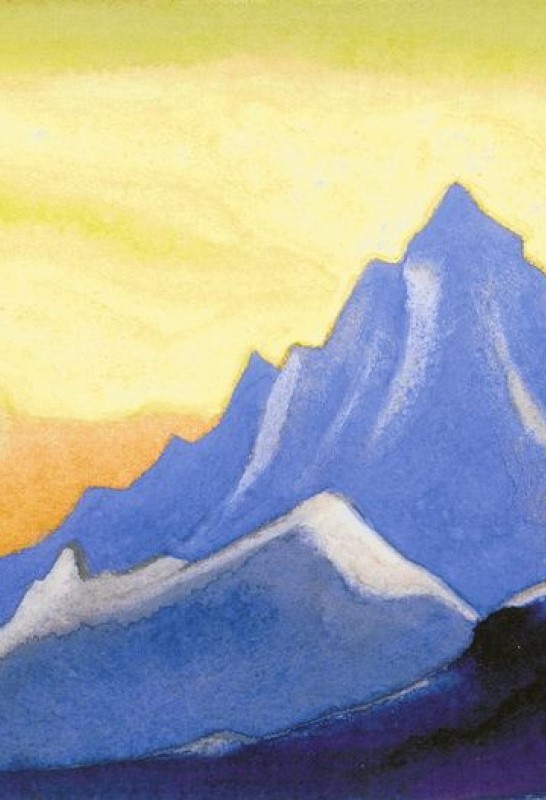
The last lap of the voyage was vivid and fancy-stirring, great barren peaks of mystery looming up constantly against the west as the low northern sun of noon or the still-lower mountain-grazing southern sun of midnight poured its hazy reddish rays over the white snow, bluish ice and water lanes, and black bits of exposed granite slope. Through the desolate summits swept raging intermittent gusts of the terrible antarctic wind; whose cadences sometimes held vague suggestions of a wild and half-sentient musical piping, with notes extending over a wide range, and which for some unconscious mnemonic reason seemed to me disquieting and even dimly terrible. Something about the scene reminded me of the strange and disturbing Asian paintings of Nicholas Roerich…
The 1997 Annotated H.P. Lovecraft book actually has as its cover image one of Roerich’s Himalayan paintings…and they moved me in a way similar to how his story protagonist Professor Dyer describes above; though to me, capturing in equal measure the Antarctica that will inspire awe and wonder in both James Talos and Bill Johnson.
_____
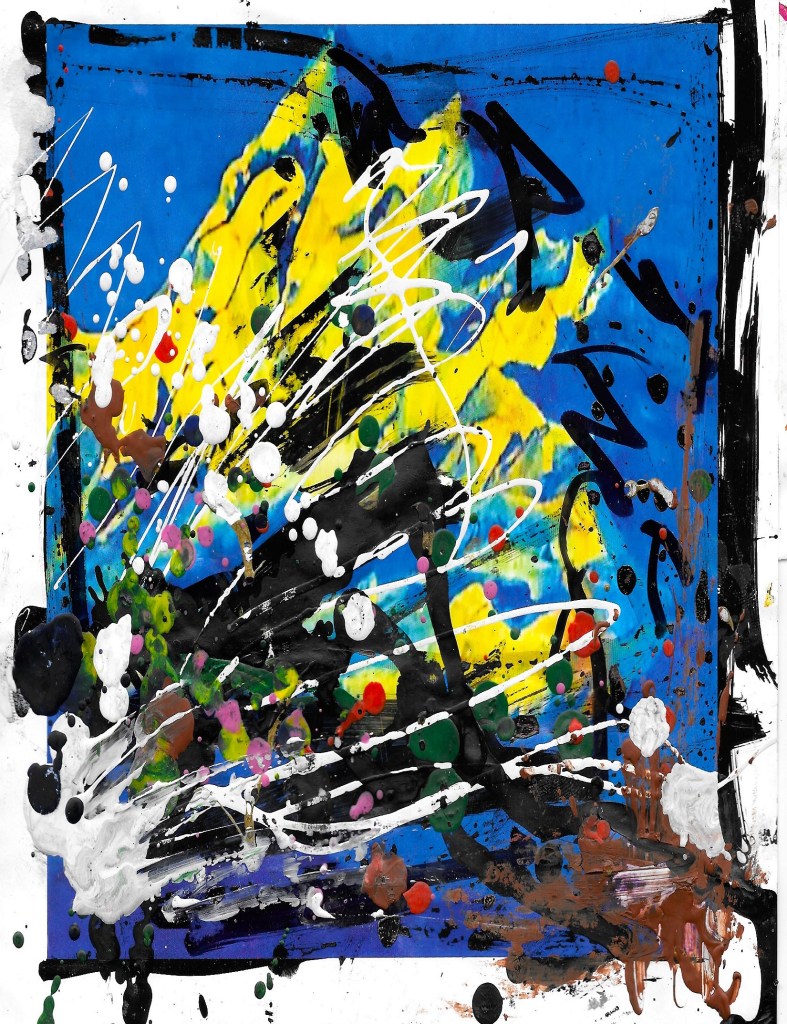
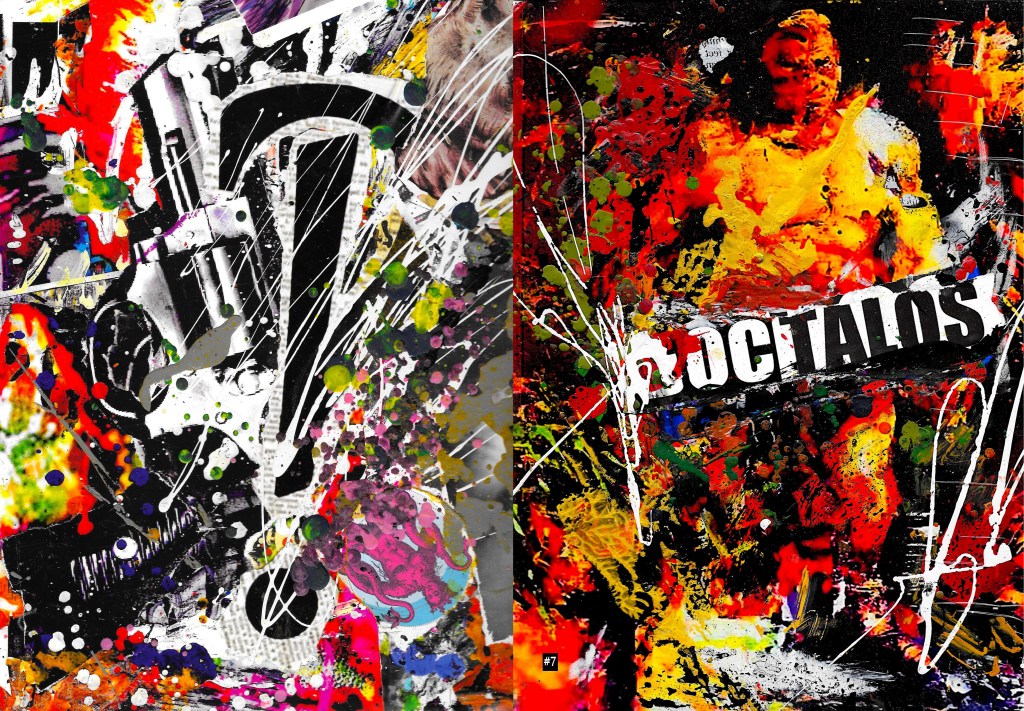
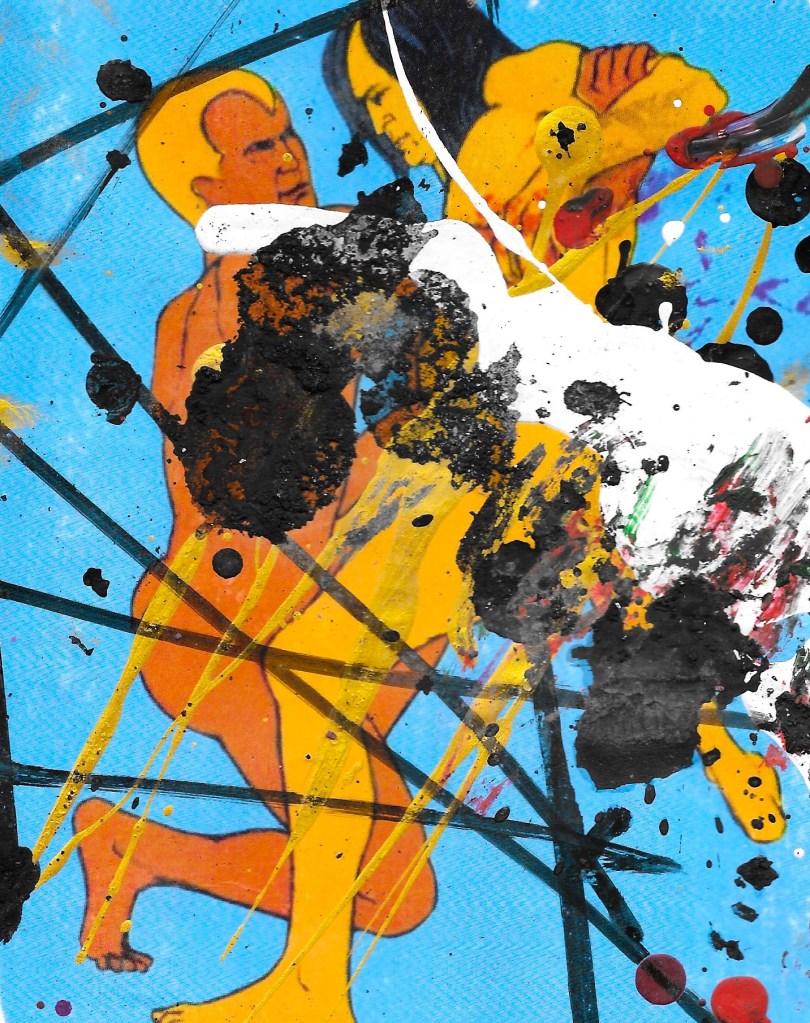
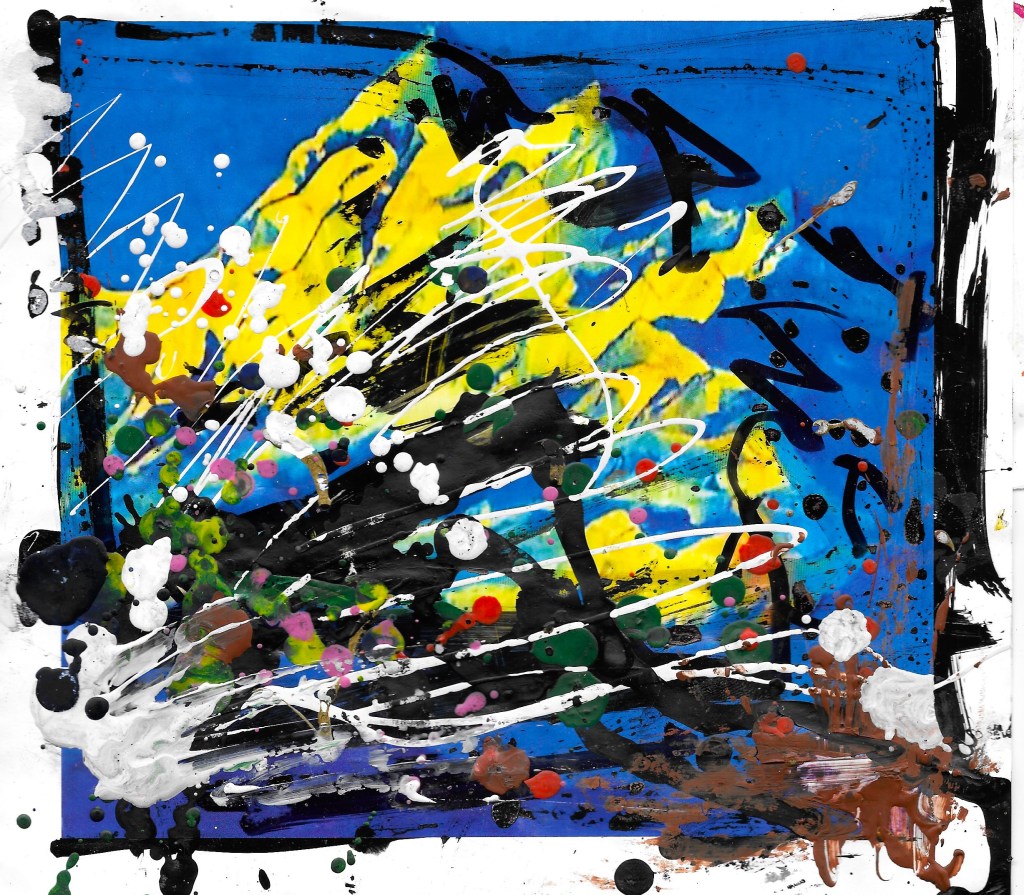
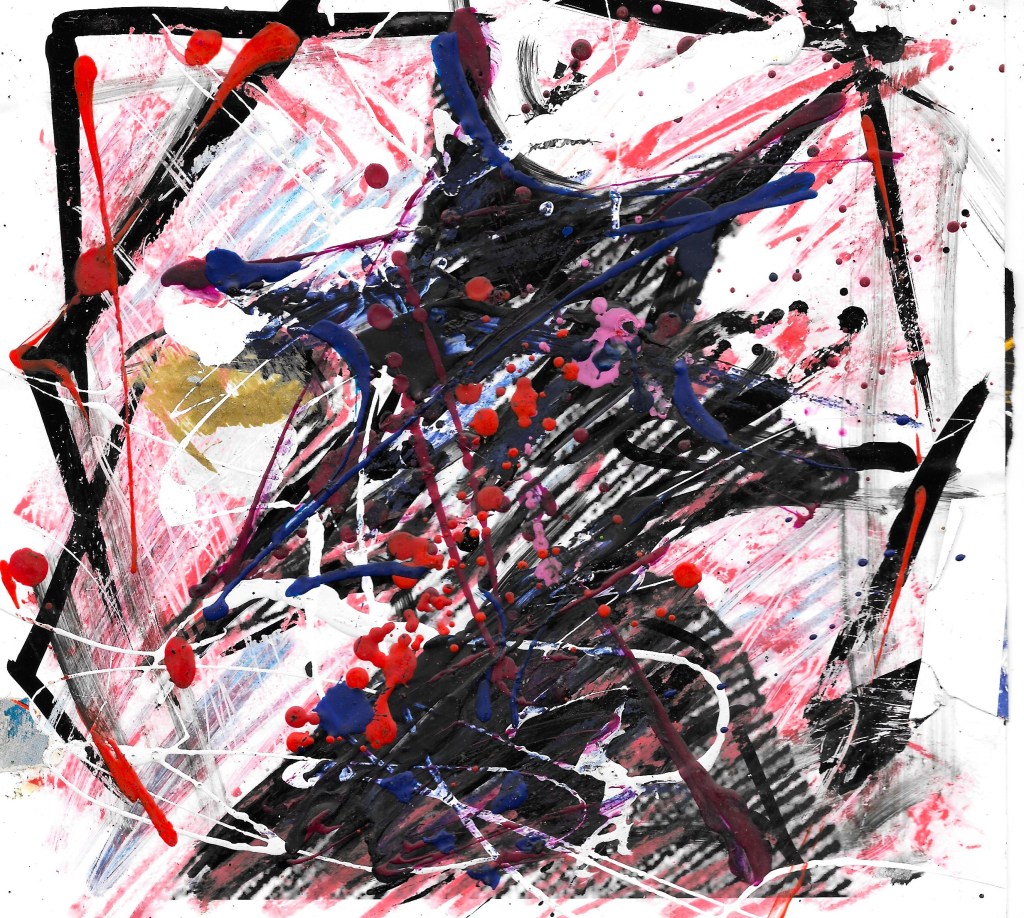
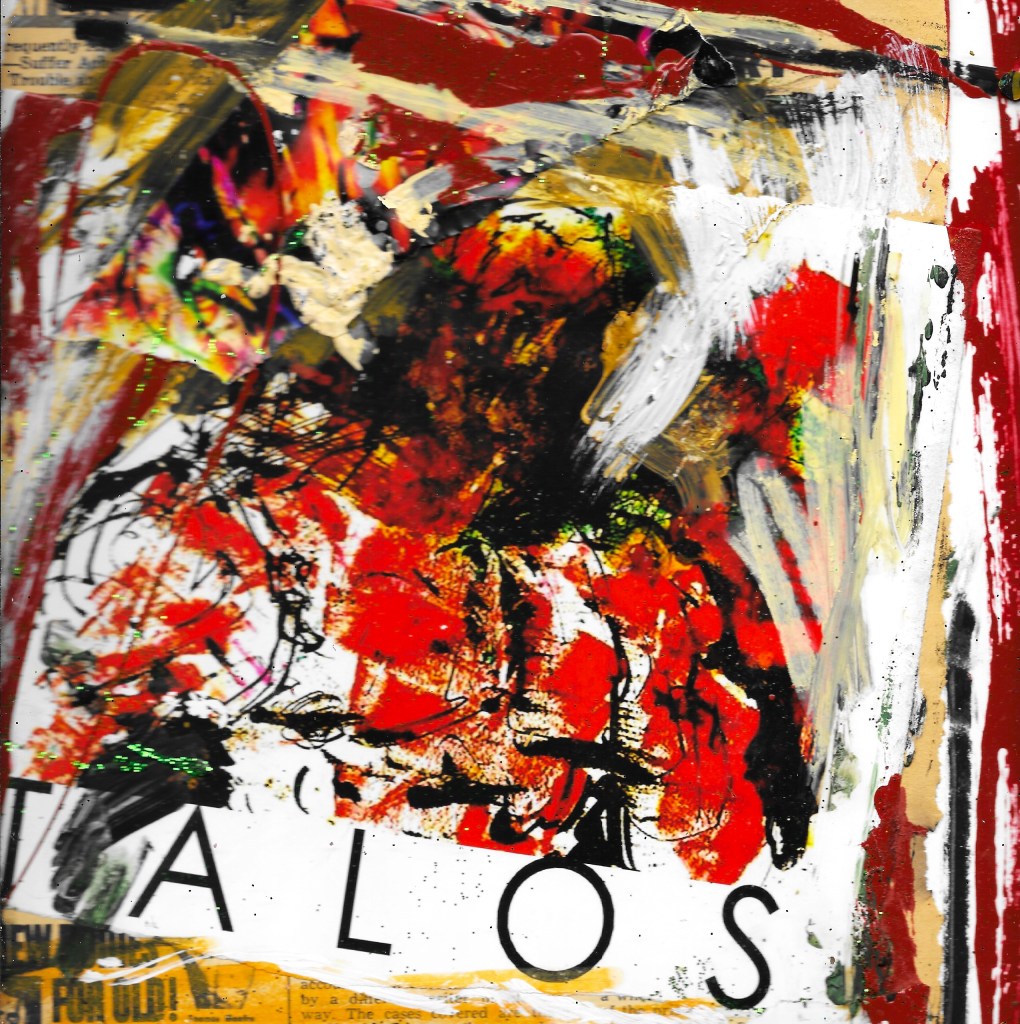
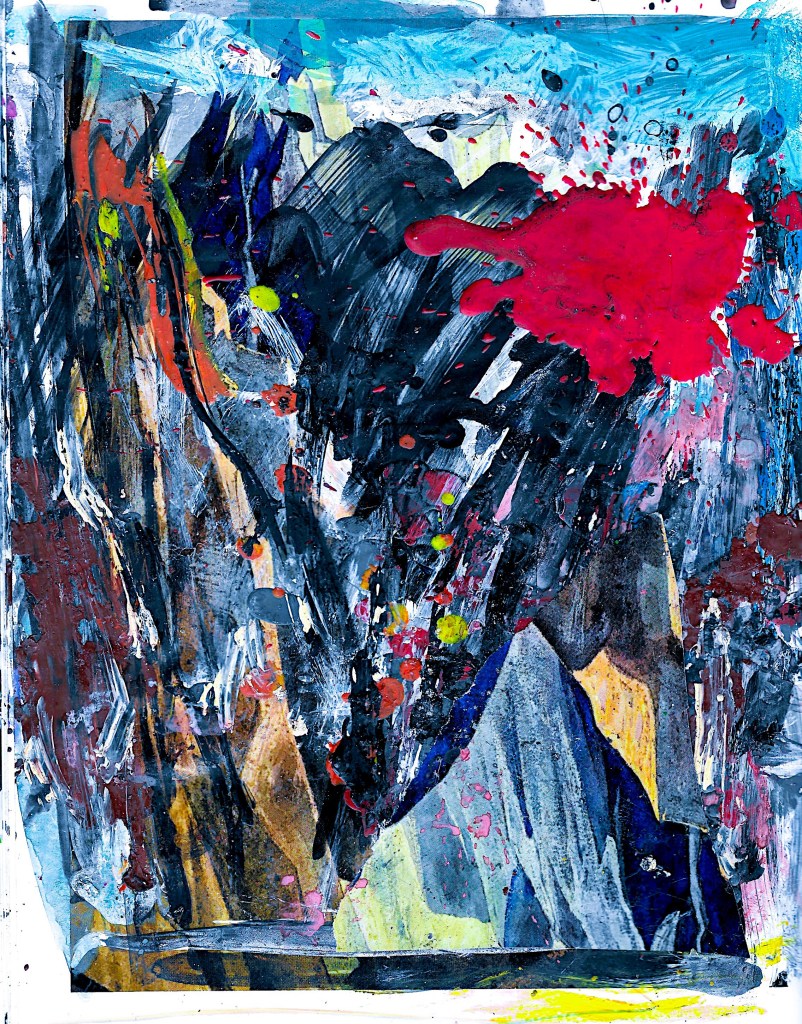
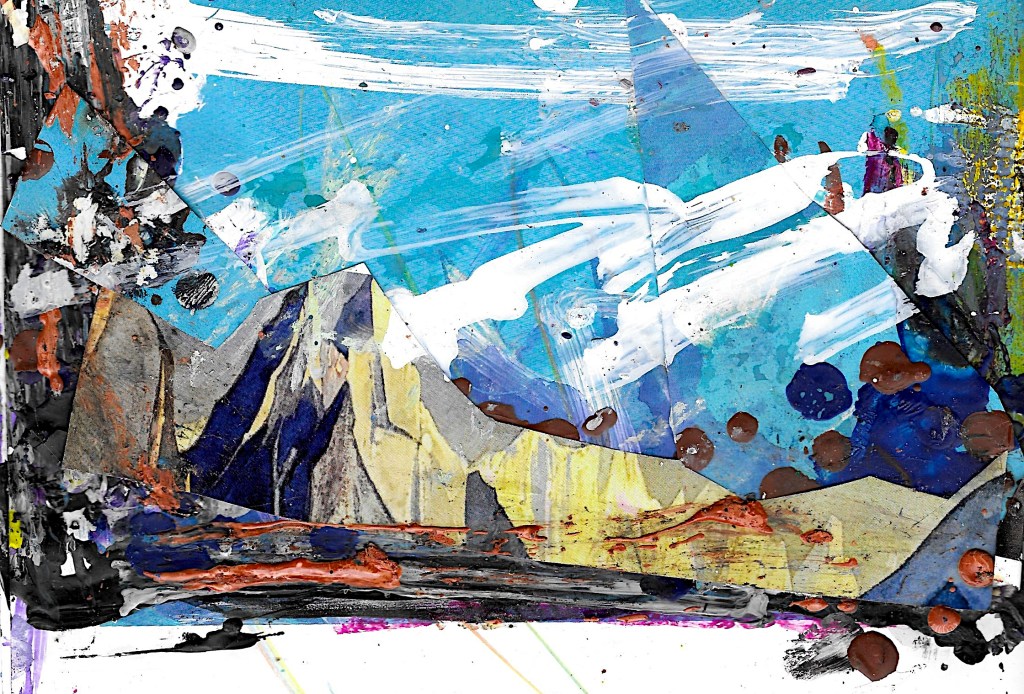
As with all Doc Talos Doubles, the book is physically flipped over to start the second story from the other side. Madness is illustrated by powerful semi-abstract painting/collages created by Iason Ragnar Bellerophon, some of which have as their foundation the above-mentioned paintings of Roerich. The flip side Lovecraft original is decorated by artwork of Roerich himself.
The stories are a study of stark contrasts…Lovecraft, of course, was devoted to the building of mood, often to the exclusion of characterization, and Sardanas shifts the focus with equal devotion to the characters. Roerich painted in a dreamlike, elegant style, and Bellerophon is fierce and dynamically experimental. The result is two stories that take a single concept to wildly divergent ends: from cosmological weight to the immediacy of the human mind and heart.
Madness/At the Mountains of Madness will retail for $21 plus postage when released on December 1, 2024, but if preordered before that date, the cost is $16 plus postage. To place your advance order, please send an email to: taloschronicle@gmail.com, and we’ll provide all details and options for your purchase.
MADNESS/AT THE MOUNTAINS OF MADNESS
A Doc Talos Double flip book
6 x 9 paperback, 164 pages with full color painted illustrations
from Gromagon Press in partnership with Tetragrammatron Press
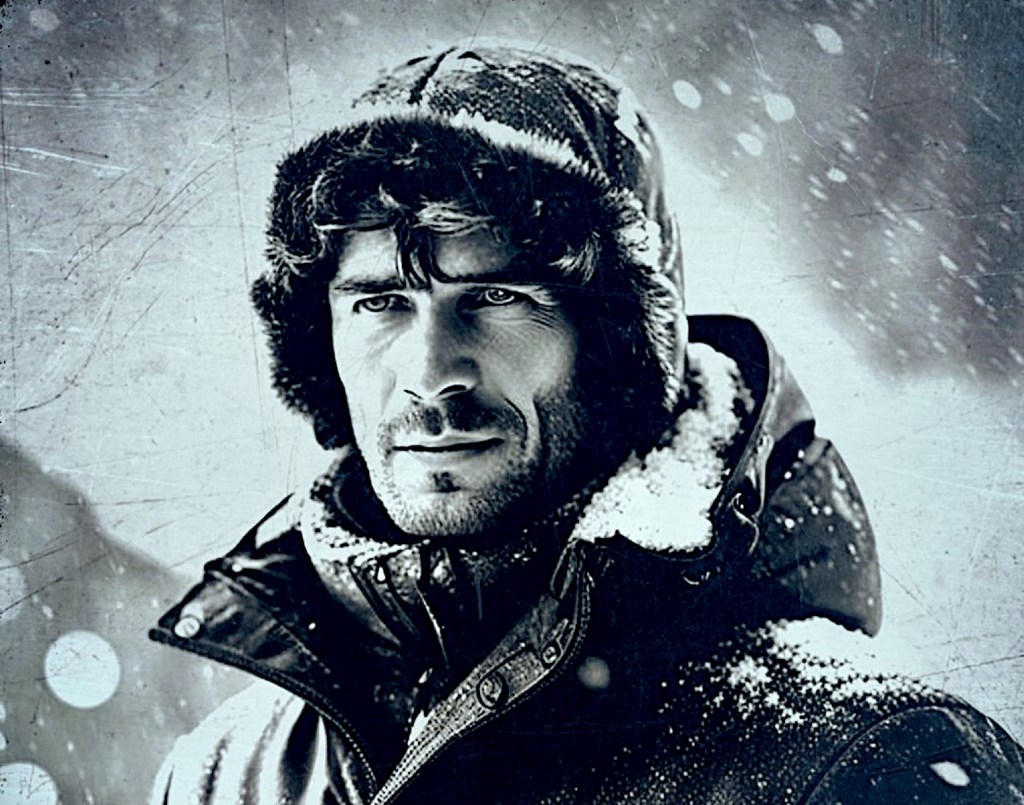
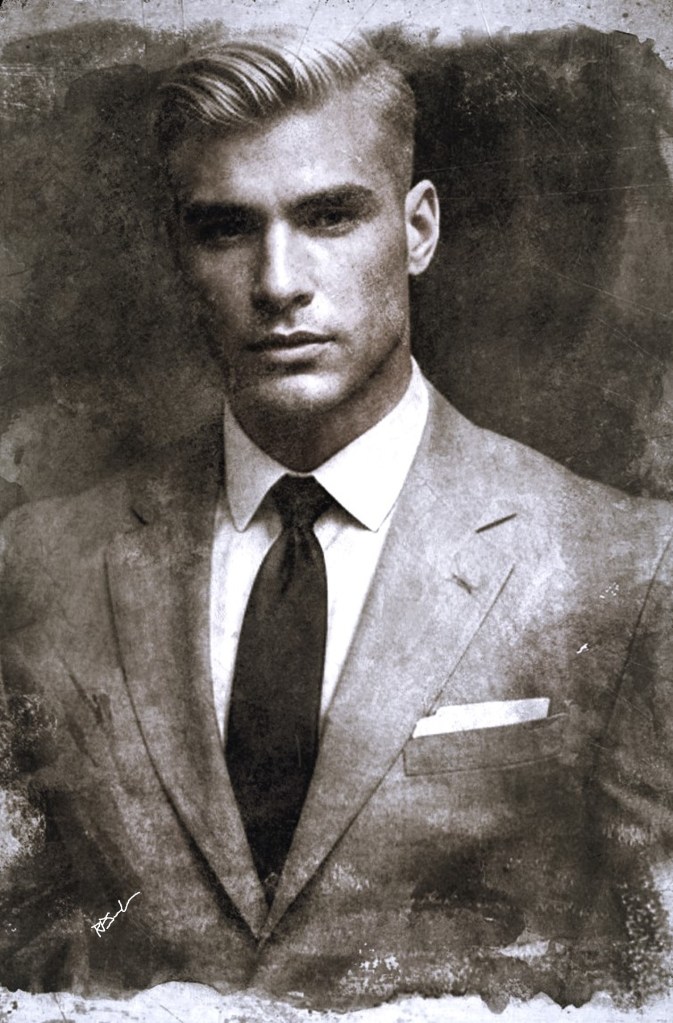
Farewell with so much admiration and gratitude to Ron Ely. As Ely was the only actor to play both Doc and Tarzan, I offer this small tribute of him in yet a third role…that of Doc Talos, in his thirties, circa 1933.
I confess I’ve been surprised a little at how deeply the passing of Ely has affected me. I never knew or met him in person (though from all accounts — including the wonderfully heartfelt farewell posted by his daughter — he was a great guy). He starred in a film that, though I have warmed to it over the years, was a massive disappointment in so many ways, with its disastrous descent into camp.
But somehow, even as the centerpiece of that film, he carried a dignity and charm — even a kind of nobility — that was warm and accessible, almost miraculously channeling the best humanistic qualities of the pulp Doc Savage.
For long decades fans of Doc have hoped for a new movie that would supersede the camp trainwreck of 1975, but I find my thoughts straying to the hope that doesn’t happen in my lifetime. Ron is my living embodiment of Doc, and there’s a strangely remarkable comfort in that.
For the days since his death was announced I’ve been obsessively doing Doc Talos portraits that incorporate some of Ron’s features into a depiction of Doc pastiche James Talos…not slavishly trying to “cast him” in the role by a perfect reproduction of his face, but trying to catch a little of that warmth he brought to Doc, which allows me to picture him offering a small but genuine smile for all of us (his family of fans) on his otherwise perpetual poker-face.
Editorialby R. Paul Sardanas – Exploring the poetic voice of A Feast Unknown.
Italian Ices and Earth Wreckersby D. B. Brodie with visual excerpts from Doc Savage Magazine #5 – In 1976, Rickie Talos and Harry Kingman (son of the Talos pastiche of Monk Mayfair) spend a day at the beach on Coney Island and pick up the latest copy of the Marvel Doc Savage magazine to read.
Madness, Part 4by R. Paul Sardanas / artwork by Iason Ragnar Bellerophon – The concluding chapter of the Talos pastiche re-imagining of H.P. Lovecraft’s At the Mountains of Madness.
I am James, I am Patriciaby RPS / artwork by IRB – Poetry and art portraying how fictional characters can become passionately merged with their readers.
The Scripture of Ghost and Lionby R. Paul Sardanas / artwork by Iason Ragnar Bellerophon – A powerful, sweeping blend of poetry, philosophy and Talos history spanning life and death in the Talos family from the 18th to the 19th centuries.
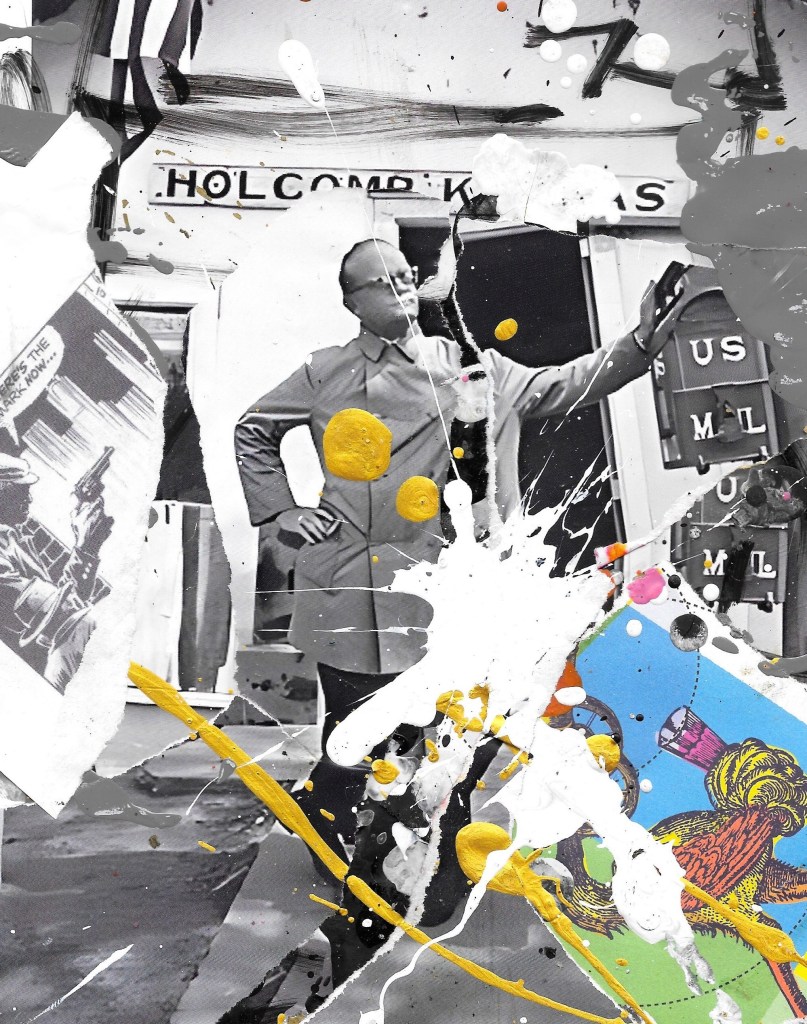
In Cold Bloodby Richard Lawrence / artwork by Iason Ragnar Bellerophon – In Truman Capote’s harrowing classic of murder and its consequences, Capote cites Doc Savage’s “Crime College”. In this tale, Capote and Doc Talos meet and discuss both the horrors and hoped-for redemptions for those who succumb to crime.
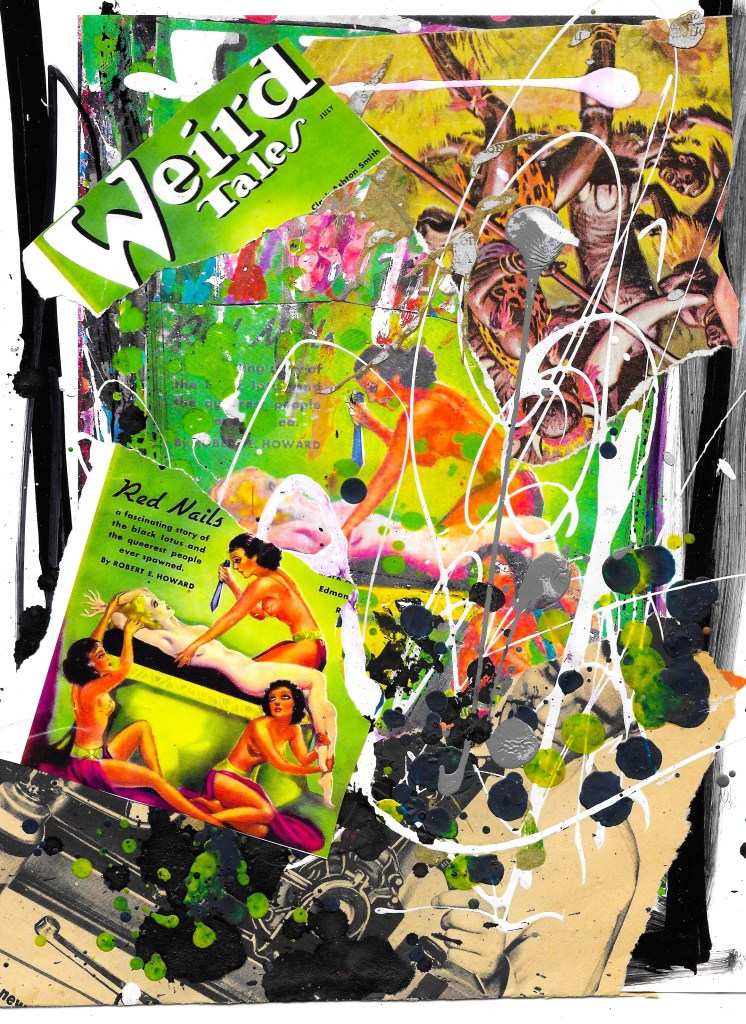
Nails, Part 1by RPS / artwork by IRB – A major story in the Doc Talos canon begins in serialized form, as Rickie Talos is kidnapped in Africa by a false “Tarzan”, then imprisoned in the Archon Sanctuary, where she is subjected to a nightmare of indoctrination by the cult’s leader, Ruha.
The Observation Deck – creators from this issue discuss their process and inspirations.
Pulp Community Bookstore – special section showcasing creations from around the pulp community.
The second Doc Talos Double flip book* is a stylish revisit of classic pulp storytelling, dovetailed into the ongoing Talos Chronicle mythos.
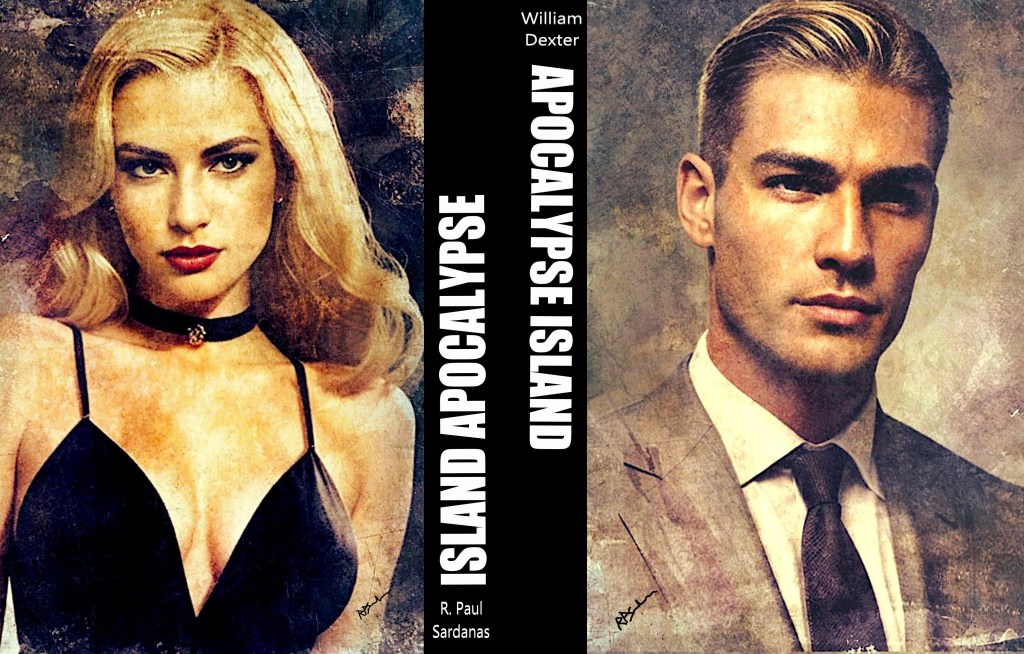
Setting up the tales on each side of the book, we find none other than Rickie Talos (the “real-life” inspiration for Pat Savage in the pulps) in the year 1950…one year after the death of the hero pulps. Paperbacks are now all the rage, and a new publisher hoping to jump into the void left behind when the pulps were cancelled has approached Rickie to see if he can involve her in the launching of a new line of books. She meets two ghostwriters in a New York City diner, and they brainstorm together. The authors, William Dexter and R. Paul Sardanas, both love the pulps, and along with RIckie, they come up with two very different stories. William will channel classic 1930’s pulp in a novella echoing some of the best of the “good guy” Doc Savage tales, and R. Paul will round out the double book with a short story channeling the more racy, violent “bad girl” stories coming into vogue at the beginning of the ’50’s.
The first side of the book is Apocalypse Island, by William Dexter.
“Apocalypse Island” frontispiece portrait of Doc Talos by R. Paul Sardanas
This novella goes right to the heart of 1930’s pulp adventure, taking inspiration from the 1933 Doc Savage story The Land of Terror. One of Doc’s mentors is murdered in horrifying fashion, by a weapon that evaporates organic matter. And this is just the beginning of a tale that plunges into fabulous mysteries, including an island in the Bermuda Triangle where time has gone mad.
Inspiration for “Apocalypse Island”
One the flip side, is R. Paul Sardanas’ Island Apocalypse.
“Island Apocalypse” frontispiece portrait of Rickie Talos by R. Paul Sardanas
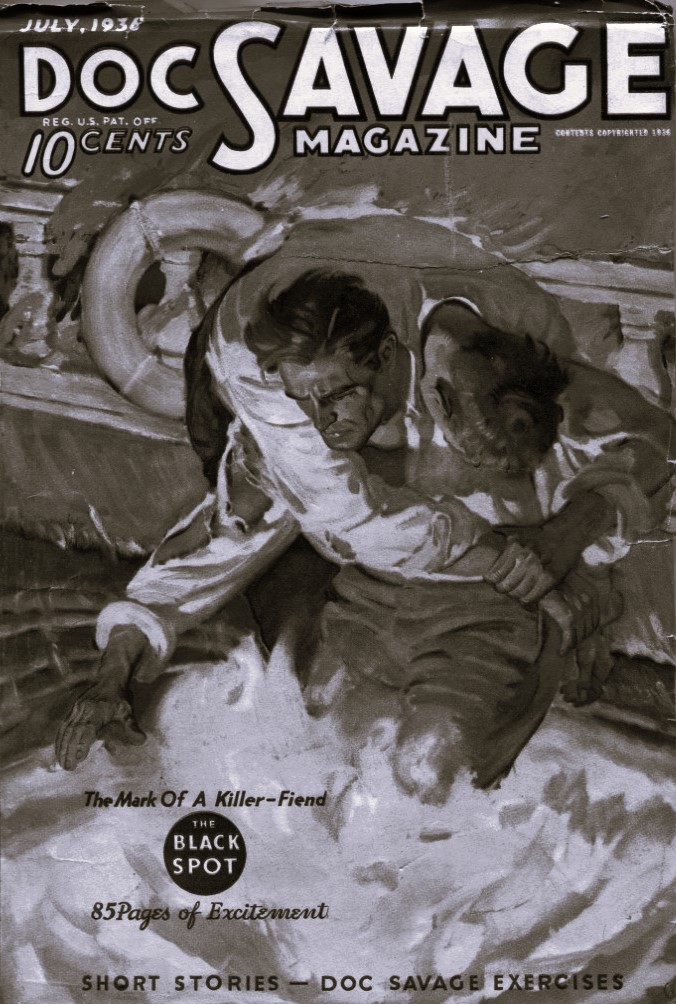
Imagine a scenario riffing from the opening scenes of the 1936 Doc Savage novel The Black Spot…a gangster/moll themed party thrown by an eccentric millionaire. In attendance at Long Island Sound’s Rat Island we find Rickie Talos herself. Everyone is expecting a good, slightly wicked time. No one is expecting the party to become a killing frenzy as all the guests are poisoned by a vengeful femme fatale, who promises an antidote only to the last man or woman standing.
Inspiration for “Island Apocalypse”
This book is being done as a charitable benefit. Both authors have agreed to donate proceeds from Apocalypse Island/Island Apocalypse to The Animal League, an organization that rescues and rehomes abandoned pets, often saving them from being euthanized. For animal lovers (like Dexter and Sardanas) it is heartbreaking to think of abused, neglected or abandoned animals, and we want to do our part to help these loving creatures back to health and a forever home. Even if you decide the benefit book is not for you, we hope you’ll consider a donation of your own to The Animal League.
We are keeping the cost of the book low to encourage folks to take part in the benefit. Apocalypse Island/Island Apocalypse is a 6 x 9 paperback, 130 pages, and can be acquired for $10 plus shipping. A PDF version is available for $5. The physical book is set up in a fun rightside up/upside down flip style (you actually flip the book over to start on the other side for the second story)…the PDF version is all facing in the same direction (much less fun to have to flip a PDF on your screen and read backwards).
To get your copy, please drop an email to taloschronicle@gmail.com. We’ll get your address information, and offer several options for payment, including PayPal, check or money order.
We hope you find the book enjoyable and exciting, and thank you for helping to support this charitable cause.
*The first Doc Talos Double flip book was “Montage”, available in our bookstore
Reflecting on the past today, I was struck, as I so often am, by the importance, in our creative community, of lifting one another up. And I thought about people who have done that for me in my own life. Unfortunately, my own dad was not a very laudable person — a brilliant man who nonetheless was dishonest and narcissistic…a con man who was constantly in trouble with the law, and, to my personal sadness, had very little interest in me as either his son, or simply as a person with dreams and aspirations.
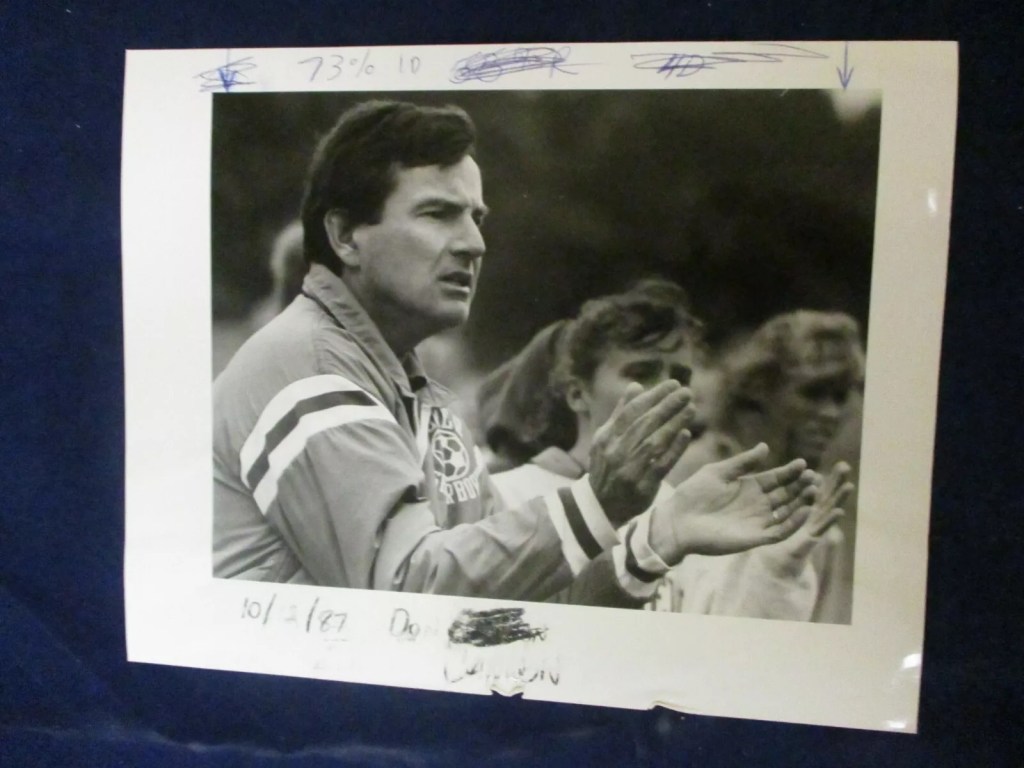
But one man who did express a wonderful and lasting interest, was my eighth grade English teacher, a man named Don Cannon. That final year of Junior High was my last in public school…my father, again in trouble with the law, basically took my whole family into hiding off the grid. But Mr. Cannon had come into my life at exactly the right time, and encouraged me like no other in my love of writing.
That year, 1971, I was thirteen, and somewhat astonishingly, was writing a novel. When Mr. Cannon learned this he asked to read what I’d written, and afterward came to me and said he didn’t want me to follow the normal English curriculum…he wanted me to use my time in his class to write the book. I was amazed, and I can still remember how my heart soared. By not following school rules, Mr. Cannon was also putting himself into potential trouble with his school superiors, who were, to be blunt, both strict and narrow minded.
But he didn’t care about that…his priority as a teacher was to nurture, support and encourage. He did exactly that, reading my work as the weeks of that school year passed, offering thoughtful feedback that helped me grow in my chosen craft, with clear caring and excitement that strengthened my young ego.
I have never forgotten him. I did indeed write my first novel in his classroom…and though I didn’t take a single official test or follow a single element of the curriculum, he nominated me for Outstanding English Student of 1971…an honor I won, just before my school days came to such a strange end.
I returned years later as a published author in the 1980’s and found him still teaching English (and acting as soccer coach too…his players adored him) and told him how much I owed to him for his caring, insight and enthusiasm. He just smiled, said he was proud of me, and that he never had a single doubt that I was meant to live a life filled with the joys of writing.
Thanks Mr. Cannon. I try, to this day, to pay forward the gifts you gave me.
Editorialby R. Paul Sardanas – Creating the appearance of Doc Talos from iconic past depictions of Doc Savage.
Tales of the Big Building: The Girl From Missouriby Glen Held / artwork by Iason Ragnar Bellerophon – The touching tale of a young fan whose last wish is to meet Doc Talos.
There is Sorrow Enoughby Don Murphy / artwork by RPS and IRB – In 1931, James Talos says farewell to the beloved dog he saved from death a decade before.
The Foundation of Beautyby R. Paul Sardanas / artwork by RPS and IRB – John Grersoun is railroaded by Damaris Emem (AKA Ruha) into doing a violently erotic film for her own mysterious purposes.
Tobacco and Other Consumable Ash Residue…written and illustrated by Iason Ragnar Bellerophon – Examination of a bizarre book unlocks esoteric secrets.
Madness, Part 3by R. Paul Sardanas / artwork by Iason Ragnar Bellerophon – The penultimate chapter of the Talos pastiche re-imagining of H.P. Lovecraft’s At the Mountains of Madness.
Smiling, to the Deathby RPS / artwork by John Gallagher – Rickie Talos takes part in an Archon erotic death tournament.
The Observation Deck – creators from this issue discuss their process and inspirations.
Pulp Community Bookstore – special section showcasing creations from around the pulp community.
I’m delighted to announce that a special Doc Talos project is in the works for release later in 2024. I’ve teamed with author William Dexter to create a very unique book: which will ultimately be the second Doc Talos Double (a flip book, like the old Ace Doubles). We’ll be doing it as a charitable benefit…both William and I are serious animal lover/activists, and we’ve agreed to donate all profits from the book to an animal care organization.
The book will be text only, so it will be very affordable. The concept is a fun one: imagine what it would be like if after the “death of the pulps” in 1949, a fledgling paperback company had approached none other than Rickie Talos (pastiche of Pat Savage) to storm the paperback adventure genre by writing pure pulp Doc Talos tales. Rickie, who always loved the pulps, agrees with enthusiasm, and pens two books embodying the fierce storytelling of that era. First, “Apocalypse Island”, a story that rivals a classic Lester Dent pulp yarn. That book (as told to William Dexter) is told on one side of the Double. Second, on the flip side, an intense hardcase crime tale (as told to R. Paul Sardanas), called “Island Apocalypse”.
So keep your eyes open as 2024 rolls on for announcements about “Two Apocalypses”, the benefit Doc Talos Double flip book!
Here’s an advance peek at my contribution to the pinups in the upcoming issue of Doc Talos Magazine.
The Doc Talos stories take a more realistic approach to the classic Doc Savage characters, but interestingly, it is only post-pulp that Pat began to be depicted in the Bama-esque “Doc Savage costume”, so when creating images of Rickie I have plenty of period inspiration from the pulp covers, where she was a stylish, beautiful, but not super-hero-ish character. I love portraying her in what are now of course, vintage 1940-or-so fashions…ah, that was an era of style!
She is described in the pulps as having bronze skin, like her cousin, with hair slightly darker in color. One of my favorite Lester Dent descriptions of her (from the 1946 issue “Death is a Round Black Spot”), is as a “bronzey-blonde”. Her eyes are described in varying ways (which, as I recall, prompted Phil Farmer to muse that she perhaps wears colored contacts)…but most often with the Savage gold flecks. Pure gold eyes look more than a little spooky, so I’ve made Rickie’s a bit more brown, with some gold tones in her always-arresting gaze.
Images created using pre-AI Poser 3D, Photoshop, Adobe Illustrator and hand painting.
Rickie’s special issue of the magazine, coming this month, has no less than FOUR pinup sections, with artwork by Iason Ragnar Bellerophon, R. Paul Sardanas, Steff Murschetz, and a sketch gallery of stellar artists.
I wrapped up the writing today on “Madness”, the Doc Talos re-imagine of H.P. Lovecraft’s “At the Mountains of Madness”. A moment for letting out a deep breath…I usually write stories at a breakneck pace, but this one, literally, took decades to write.
I was writing it back in 1977, as a sequel to Mts of Madness called “Kadath in the Cold Waste”, telling it as the story of the Starkweather-Moore expedition that was preparing to follow the Miskatonic University one that so memorably uncovered a frozen megalopolis amid the tallest mountains in the world. Over and over I worked on it, in a Lovecraftian style (exquisitely slow, with ornate language).
But it just wasn’t right. I wanted to do more than strive to skillfully mimic Lovecraft. My writing interests (characterization, psychological veracity, human relatability), were — and are — in many ways the polar opposite (pun intended) of HPL’s style. “Kadath”, each and every time I returned to wrestle with it, felt hollow.
With the final decision to shift the story into the Doc Talos world, it was suddenly alive, with the character-depth of the Talos avatars of Johnny Littlejohn, and Doc himself. Instead of horror-pulp monsters (which I enjoy in their own right, but are, creatively, not really my thing), the journey became one of strange wonders (which the real Antarctica possesses in plenty) and the obsessions, frailties and strengths of people who undertake the task of penetrating the most hostile places on Earth.
All these years later, it is finally done, and is presented in four installments (Doc Talos Magazine 3, 4, 6 and 7).
Artwork by Iason Ragnar Bellerophon after Nicholas Roerich, and from archival photographs.
“There are many reasons which send men to the Poles, and the Intellectual Force uses them all. But the desire for knowledge for its own sake is the one which really counts and there is no field for the collection of knowledge which at the present time can be compared to the Antarctic. Exploration is the physical expression of the Intellectual Passion. And I tell you, if you have the desire for knowledge and the power to give it physical expression, go out and explore. Some will tell you that you are mad.” –Apsley Cherry-Garrard




















 Doc Talos