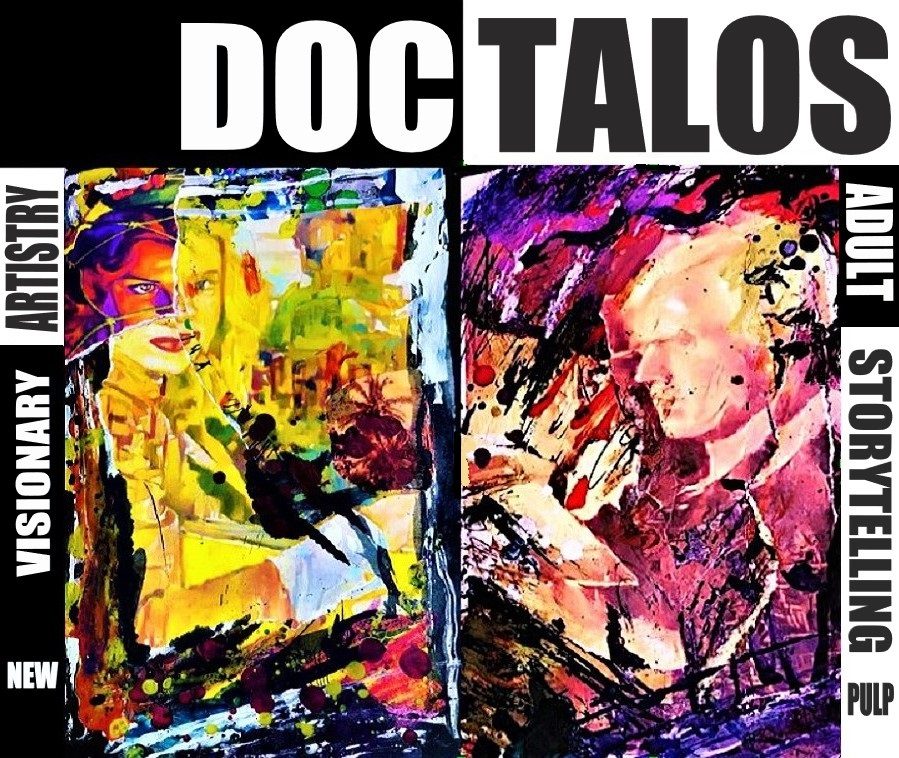
The Doc Talos stories have always been steeped in the history of literature, and we celebrate that front and center in Doc Talos Magazine #10. One might not think of the huge tapestry of world literature when contemplating the glory that is pulp storytelling…but in the Doc Talos world they are always deeply intertwined.
Across its content of stories, vignettes and serials, this issue’s readers will encounter inspiration from Shakespeare, the Japanese haiku poets Basho, Issa and Buson, novelist William S. Burroughs, John Milton, essayist/philosopher Harold Bloom, and pulp authors Lester Dent and Robert E. Howard.
There is no pretentious division between “high” and “low” lit in these stories. They all blend into tales of the Doc Talos canon with equal weight. If there is a message in that, it’s a simple one: all literature brings joy to the readers of the world.
The key to libraries is juxtaposition. Despite all efforts to impose order by cataloguing, they still retain the marvelous chaos of thought and feeling that make up the human experience. Homer and Virgil down the aisle from Mickey Spillane and Dr. Seuss. On the shelves, they are, perhaps, not literally mixing. But they inform one another…enrich one another.
Usually the process goes in one direction. Something in a book echoes something in another, and like stanzas in a poem, things that don’t make linear sense somehow take on duality in your psyche. That process, in a reader’s life, is repeated…essentially endlessly. But memory being what it is, the connections blur. And stories are nothing if not the blurred essences of mystery given shape.
Art comes into the equation as well. Sometimes consciously, as when a scene or character from a book is depicted visually. Other, more esoteric times, when a theme is explored in words, and then in visuals…or vice versa. It’s all really quite magical.
Sometimes, of course, juxtaposition is window-dressing. I remember quite a few episodes of TV shows, or Marvel comics or pulps with titles right out of literature and history. The Conscience of the King or By Any Other Name (Star Trek/Hamlet, Romeo and Juliet) …A House Divided (Fantastic Four/Abraham Lincoln)…Up From Earth’s Center (Doc Savage/Omar Khayyam) In a sci-fi horror film, a spaceship gets named Nostromo (Alien/Joseph Conrad). Often as a younger reader or watcher I had no clue about what was being referenced, or even that any other work was being referenced at all. But damn, they sounded cool. One of my favorite stories in the Doc Savage pulp canon took a reverse route to that formula: intended for publication in 1949 (a schedule undone by the collapse of the hero pulps in that year), it was unearthed and finally published in 1979 as The Red Spider. Its original title? In Hell, Madonna.
Good Madonna, why mournest thou?
Good Fool, for my brother’s death.
I think his soul is in hell, Madonna.
I know his soul is in heaven, Fool.
The more fool, Madonna, to mourn for your brother’s soul being in heaven.
– Twelfth Night
As a voracious consumer of pop culture, references like these felt like invitations, which I followed (usually via library books) back to their sources. Despite being, in multiple instances, essentially a gimmick to add gravitas to some form of pulp, nevertheless the bleed-through from one realm of expression to another left its mark on my thinking.
What if not just a phrase or stanza or title but the deeper spirit of a work could be bled into a genre often derided as shallow? If attempted as more than an impressive marquee, the storytelling couldn’t help but be transformed. If the opposing camps of readers dug in their heels of course, the effort might be considered making fun, unpretentious pulp more boring…or making sophisticated classical creativity cheap.
But for those who love to wander the library, not disdaining the frankly loud and gaudy or walking right past the antique and sedate, the hope is there that the mystique and allure of both will shine brighter together.
“Evening in the Library” (bronze pulp goddess Rickie Talos — avatar of Pat Savage — in 1940) by R. Paul Sardanas.

 Doc Talos