
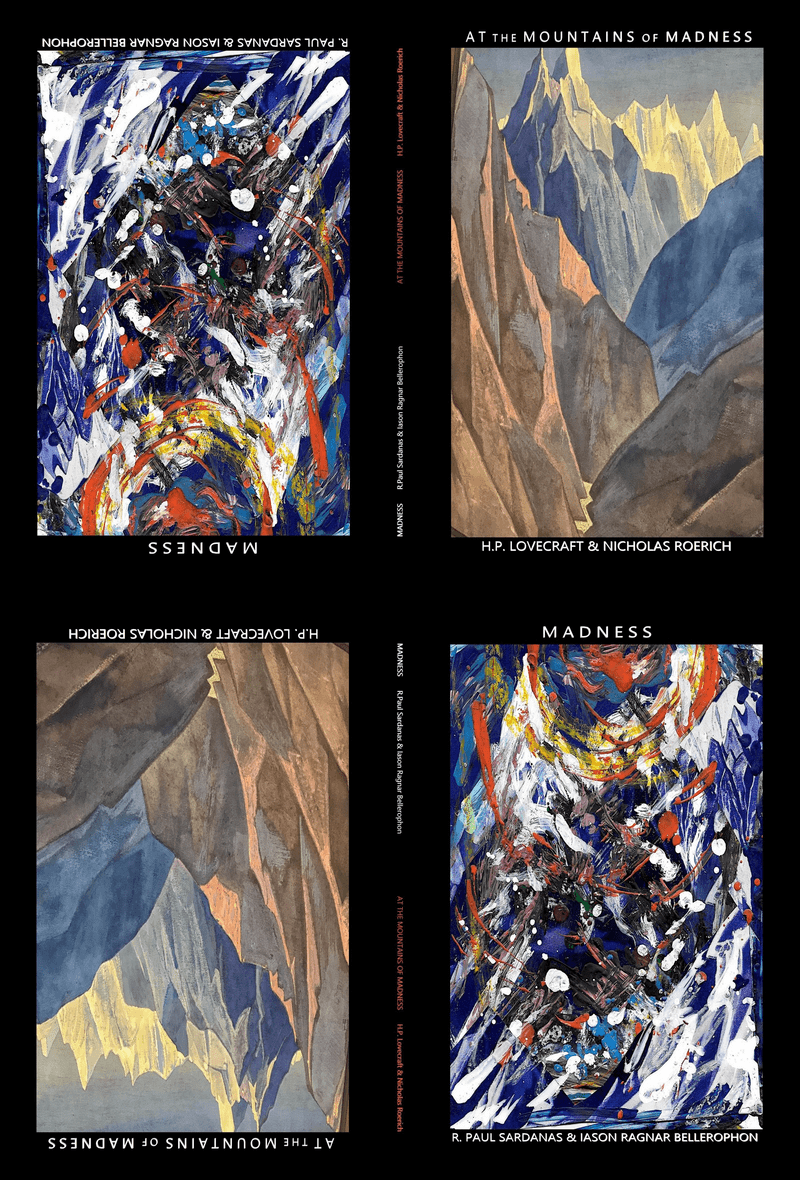
After its four-issue serialization in Doc Talos Magazine, the R. Paul Sardanas/Iason Ragnar Bellerophon story Madness has been combined into a single narrative, and is joined in the popular Doc Talos Double flip book format with the original public domain Lovecraft tale At the Mountains of Madness.
Here’s a sneak peek at the book’s Foreword:
_____
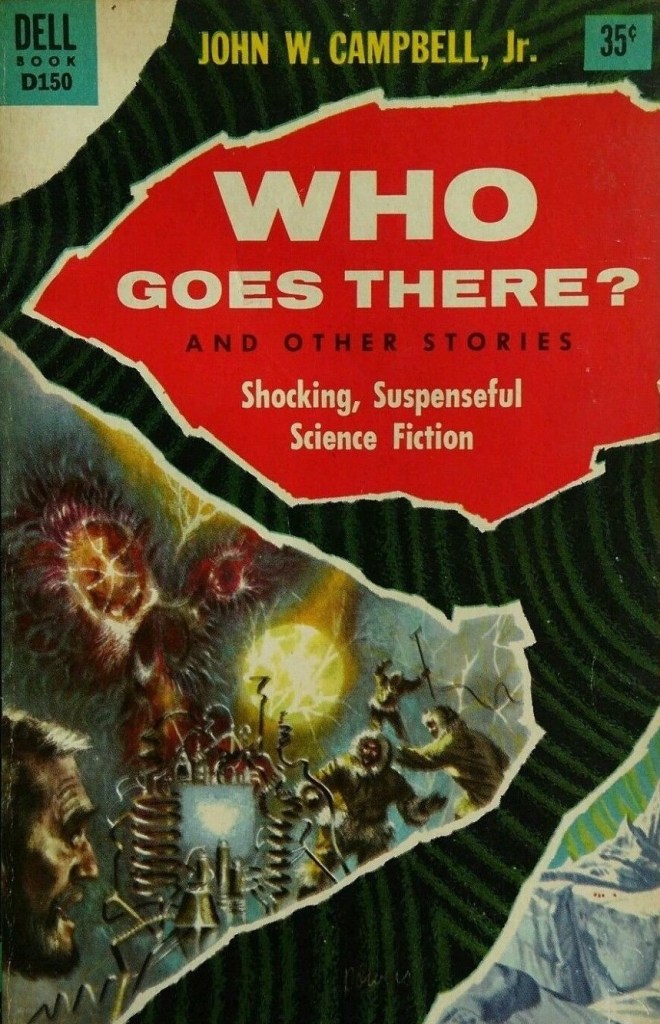
Pulp fiction archivist/theorists, a mixture of playful and remarkably serious, have loved, over the decades, to find secret connections among the tales in those wonderful old magazines. Some are tremendous fun…and at the same time, deeply intriguing. Among them is a persistent placement of two members of the Doc Savage cast in seminal works of the time, both with polar settings: Doc himself, embodied as the character McReady in John W. Campbell’s 1938 Who Goes There?, and Johnny – William Harper Littlejohn – quietly hiding out within the persona of geologist Professor William Dyer in H.P. Lovecraft’s At the Mountains of Madness, which was written in 1931 and published in 1936.
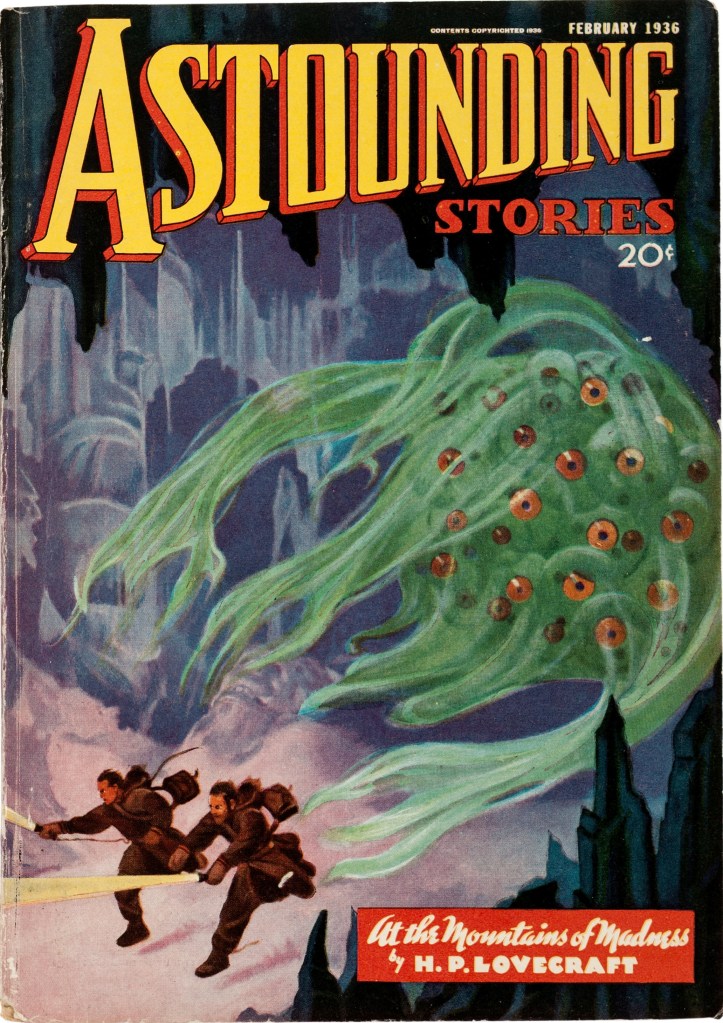
I was fascinated in my teens with both tales. I acquired a copy of the Arkham House hardcover edition of Mountains of Madness back in 1971 (I got it and an Arkham hardcover of Dagon for Christmas that year)…and my first exposure to Campbell’s story was not the book, but the 1951 film The Thing From Another World, which I watched on a TV late-late show right around the same time.
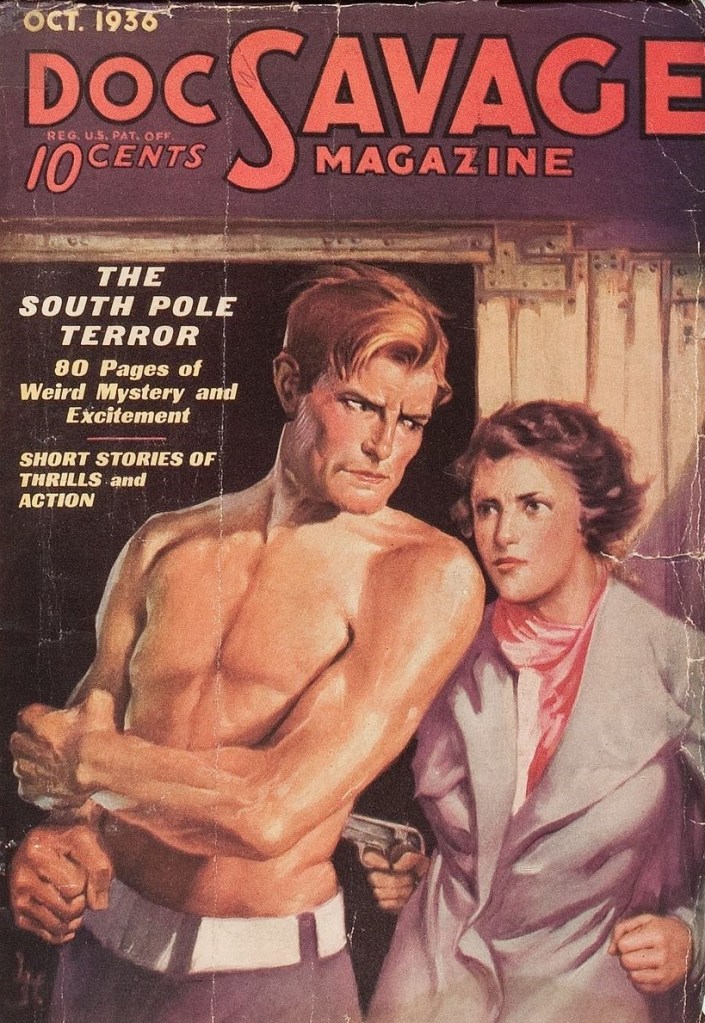
Though a fan of the Doc Savage stories since ’69, no light bulbs went off in my head connecting these fiction-streams. This despite the fact that Doc’s lone Antarctic adventure, The South Pole Terror, also appeared in 1936.
Those conjectures came later, with the lightbulb-moments not my own, but concepts posited by the likes of Philip José Farmer, subsequent Wold Newtonists, and others. For myself, creative expression around these stories took shape in a desire (explored at length elsewhere and resulting ultimately in the Doc Talos stories) to do a more sophisticated, adult version of Doc…and, relatively early on in my authorial career, an ambition to write a sequel to At the Mountains of Madness. Events and developments in the story all but seemed to beg for one, with the late-story madness-inducing vision of a vaster and even more terrifying locale beyond the titular mountains, seen via a mirage by Professor Dyer’s younger protege Danforth. And the story itself was an oblique sequel of sorts, to Edgar Allan Poe’s 1838 The Testament of Arthur Gordon Pym of Nantucket.
I planned the tale, which I called Kadath in the Cold Waste, and began it in earnest several times. I never finished it. I was, across those early writing years, working hard to purge my writing of a distinct tendency to turn purple – as a habit of verbosity was one of the chief characteristics of Lovecraft’s authorial style, writing a direct sequel in that style was literally putting myself in the position of getting into bed with stylistic demons I wanted to kick out of my brain.
But I was always a little sorry I never wrote Kadath…and of course such things linger (perpetually) in a writer’s undermind.
In intervening years, I developed a fascination with the real history of polar exploration; the very idea of it more than a little mad, given its long narrative of privation, tragedy and death. That interest was further developed by reading texts like Alfred Lansing’s Endurance – a recounting of Ernest Shackleton’s journey to the frozen south, which Shackleton advertised at its outset with this notice: “Men Wanted: For hazardous journey. Small wages, bitter cold, long months of complete darkness, constant danger, safe return doubtful. Honour and recognition in case of success.” I was also entranced watching the 1969 film The Red Tent…which though dealing with the north polar regions, included a rich psychological landscape of the figures of that era (it is the story of the disastrous 1928 dirigible flight over the North Pole) including Roald Amundsen, who died in an attempted rescue of the expedition’s stranded men.
To at last focus a Talos tale through the prism of Bill Johnson’s thoughts is a special pleasure. I always loved Johnny in the original Doc Savage stories. His erudite nature, coupled with a somewhat pixie-ish side in his playful use of jaw-breakingly big words makes a deeper journey inside his mind endlessly appealing. Bill has appeared in several previous Doc Talos works: escorting Rickie Talos to a Harlem nightclub in the short story The King and the Angel, and appearing as part of the full ensemble cast in the novel Fear – and his passing was marked in the short story Testament, which showed that his choice of final resting place was actually Antarctica. Not as a result of the events depicted in Madness, but displaying how deeply the experiences of 1930-31 had ingrained themselves into his memory and feelings.
Not much of Johnny Littlejohn’s personal life was chronicled across the 181 original pulp yarns. Farmer posited that he had served in military Intelligence during World War I – he occasionally evinced at least a passing interest in some of the parade of attractive women who appeared in the stories, but there was not the slightest hint that he was ever anything but a lifelong bachelor. In musing upon what his life outside of the adventures and scholarly pursuits might have been, I envisioned Bill being attracted to a fellow learned soul…thus the presence of Harvard botanist Elizabeth Thomaston in his life, who in this tale frames his antarctic experience in a humanistic light. I lived in Cambridge, Massachusetts for much of the 1990’s, and can easily picture Bill and Elizabeth feeling at home there.

The occult subtexts of the overall Talos Chronicle aside, the more realistic tone of Talos stories precludes the presence of Old Ones, a vast ancient megalopolis amid the tallest peaks on Earth, or the Shoggoths of Mountains of Madness. The same goes for the identity-stealing aliens of Campbell’s tale. Those things can be evoked however…echoed in the mind, and in the landscape of one of the most alien-seeming places in the world.
Regarding the artwork in this story, this passage appeared in Lovecraft’s At the Mountains of Madness:
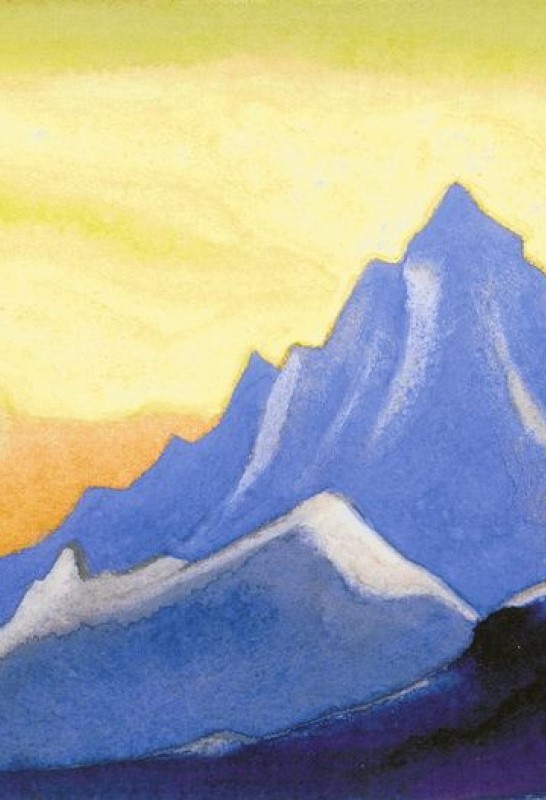
The last lap of the voyage was vivid and fancy-stirring, great barren peaks of mystery looming up constantly against the west as the low northern sun of noon or the still-lower mountain-grazing southern sun of midnight poured its hazy reddish rays over the white snow, bluish ice and water lanes, and black bits of exposed granite slope. Through the desolate summits swept raging intermittent gusts of the terrible antarctic wind; whose cadences sometimes held vague suggestions of a wild and half-sentient musical piping, with notes extending over a wide range, and which for some unconscious mnemonic reason seemed to me disquieting and even dimly terrible. Something about the scene reminded me of the strange and disturbing Asian paintings of Nicholas Roerich…
The 1997 Annotated H.P. Lovecraft book actually has as its cover image one of Roerich’s Himalayan paintings…and they moved me in a way similar to how his story protagonist Professor Dyer describes above; though to me, capturing in equal measure the Antarctica that will inspire awe and wonder in both James Talos and Bill Johnson.

_____
As with all Doc Talos Doubles, the book is physically flipped over to start the second story from the other side. Madness is illustrated by powerful semi-abstract painting/collages created by Iason Ragnar Bellerophon, some of which have as their foundation the above-mentioned paintings of Roerich. The flip side Lovecraft original is decorated by artwork of Roerich himself.

The stories are a study of stark contrasts…Lovecraft, of course, was devoted to the building of mood, often to the exclusion of characterization, and Sardanas shifts the focus with equal devotion to the characters. Roerich painted in a dreamlike, elegant style, and Bellerophon is fierce and dynamically experimental. The result is two stories that take a single concept to wildly divergent ends: from cosmological weight to the immediacy of the human mind and heart.
Madness/At the Mountains of Madness will retail for $21 plus postage when released on December 1, 2024, but if preordered before that date, the cost is $16 plus postage. To place your advance order, please send an email to: taloschronicle@gmail.com, and we’ll provide all details and options for your purchase.
MADNESS/AT THE MOUNTAINS OF MADNESS
A Doc Talos Double flip book
6 x 9 paperback, 164 pages with full color painted illustrations
from Gromagon Press in partnership with Tetragrammatron Press
 Doc Talos
In discussing Antarctica in genre fiction in one of my essay collections, I suggested that the Thing might have been a Shoggoth, its guessed-at origins incorrect.
LikeLike
It’s a suggestion that makes perfect sense, and i wonder if that concept might have been lurking in Campbell’s mind when he created the shape-shifting, amorphous Thing. For the Doc Talos version of the story the SF/horror elements have been greatly muted to present a more humanistic version of the concepts in ATMOM and WGT, but it is endlessly fascinating to conjecture about the creations (and creative origins and intentions) of classic authors like Lovecraft and Campbell.
LikeLike