
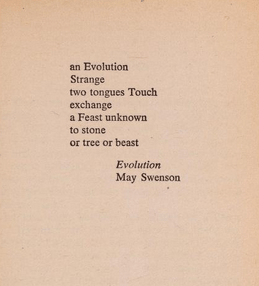
Poetry is probably not the first word that springs to mind for most people when considering Philip José Farmer’s powerful, enduring novel A Feast Unknown. And yet, the title itself is from a poem. Not all editions have it, but most show this stanza from the poem Evolution before the story begins (the following passage and analysis revisited from an earlier Forbidden Pulp blog entry).
The poet, May Swenson, though not widely known today, was in fact a very influential creator in her day. The eminent critic Harold Bloom considered her one of the most important and original poets of the 20th century. Born in 1913, she was a contemporary of Farmer – he might well have witnessed the whole of her literary career.
Here is the full text of the poem:
Evolution
by May Swenson
the stone
would like to be
Alive like me
the rooted tree
longs to be Free
the mute beast
envies my fate
Articulate
on this ball
half dark
half light
i walk Upright
i lie Prone
within the night
beautiful each Shape
to see
wonderful each Thing
to name
here a stone
there a tree
here a river
there a Flame
marvelous to Stroke
the patient beasts
within their yoke
how i Yearn
for the lion
in his den
though he spurn
the touch of men
the longing
that i know
is the Stone also
it must be
the same that rises
in the Tree
the longing
in the Lion’s call
speaks for all
o to Endure
like the stone
sufficient
to itself alone
or Reincarnate
like the tree
be born each spring
to greenery
or like the lion
without law
to roam the Wild
on velvet paw
but if walking i meet
a Creature like me
on the street
two-legged
with human face
to recognize
is to embrace
wonders pale
beauties dim
during my delight
with Him
an Evolution
strange
two tongues Touch
exchange
a Feast unknown
to stone
or tree or beast
Fascinating to consider the poem’s themes of all things, even the inanimate, yearning for life. Its metaphors include the lion (and Grandrith would, notably, wrestle and kill a lion in the narrative), and stones hungering to speak (bringing to mind intense images from the final Doc Savage novel, Up From Earth’s Center). The question of what any creature might be willing to do in order to achieve life (or extended life, in the narrative of A Feast Unknown), also echoes strongly through the book.
But it’s not just the title and its provenance that echoes with poetry in the book. I’ve long considered Farmer, either consciously or by unconscious inspiration utilizes poetic language in a powerful way. Poetry often stirs emotion, and even a spiritual response, not directly, but with oblique imagery, which prompts a reader to a strong reaction though a sometimes unexpected, even mysterious beauty. Much adventure fiction is devoid of this kind of deeper layer within its narrative, but A Feast Unknown is filled with it.
Consider this passage from the beginning of the novel — the prelude to an exceedingly violent military attack on Grandrith. One theme of A Feast Unknown, at the time considered a frankly pornographic novel (it is, but it is also much more) is an exploration of qualities of violence within the passions of the human sexual drive. This passage utilizes a mixture of explicit description, stream of consciousness thought, and metaphor, creating a uniquely visceral reading experience.
The sun was no longer an old lion. It was the red eye of Death, the drunken always-dry sot who had thirsted for me for almost 80 years.
Now the red eye was bisected by my penis, which reared with a piss hard-on. I was lying on my back, naked, and the scarlet ball climbed up the shaft and was on its way to being balanced atop it.
From some distance, there was a click.
The sky ripped as if it were rotten old cloth.
The sun was on top of the head of my penis, seeming almost to spurt out.
I knew what the ripping sound was the moment I heard it, and I knew what the click had been.
As if it were red seed, the sun burst open from my penis. It disappeared in smoke. The walls flew apart as if they had become a flock of cranes disturbed by an eagle. The smoke poured into me and filled me to the backs of my eyeballs. The noise was squeezed out of me.
I was turned inside out like a glove. I was a tuning fork trying to find the correct resonance.
A remarkable evocation of the male climax, using nature imagery, spiritual life/death allusions, wrapped in a hard-edged adventure narrative. Erotic writing (much less the more derogatory and dismissive term pornography) had never quite looked or felt like this before. Even the short sentence breaks used by Farmer evoke stanzas of a poem.
This type of style suffuses the novel, raising it to a dynamic artistic level. Later in the book, an erotic scene between Grandrith and Trish Wilde (a pastiche of Pat Savage) presents a much more ecstatic bonding:
I came several minutes after entry. Instead of withdrawing, I remained on top of her and left the semi-hard cock in her. She began to squeeze on it with her sphincter, which was powerful, and seemingly, tireless. It was like a weak but loving fist sending telegraphic messages. My peter swelled up again, and I began going back and forth with her legs over my shoulders and my hands around her hips and under her thighs so that the tips of my fingers caressed the edges of her labia. The second orgasm did not arrive until quite a few minutes later. I almost passed out from the intensity; I saw great red flowers shooting up from green stalks, exploding in scarlet, and collapsing.
Another poetic technique is being used here…notice that instead of the stanza-like breaks of the previous passage, a continuous unbroken narrative is presented. This begins with prosaic (even clinical) language, which in the end suddenly pivots into fierce, even hallucinatory imagery. This is an adept use of the methodology of blank verse, which often grounds the reader firmly and then abruptly tips or propels them into intense sensation.

A Feast Unknown is often cited as a landmark in shifting heroic literature from highly sanitized narratives to a place where storytelling can include powerful human drives, needs and obsessions. But as a work of sensual literature, it also provides a superb example of how poetry can enhance and elevate an entire genre.
 Doc Talos